Showing posts with label astrobiology. Show all posts

Tuesday, September 23, 2025

planet aqua

It's strange that we are calling our planet "Earth" as there isn't all that much earth around here. There's a metal core, some rocky stuff around it, and just a very thin layer of earth covering less than a third of the surface. So, looking at it from the outside, it makes sense to call it Planet Aqua instead, and to write a book about how the history of civilisations is really about managing the flow of all that water, and how due to the climate catastrophe which we have caused, we are now losing that control over the hydrosphere. Which Jeremy Rifkin has done:

Planet Aqua: Rethinking our home in the Universe
by Jeremy Rifkin
Polity Press 2024
My long essay review of the book is now out in the September issue of C&I:

Go with the flow

Chemistry & Industry Volume 89, Issue 9, September 2025, Page 34

access via:

Wiley Online Library (paywalled PDF of the whole review section)

SCI (premium content, ie members only)

As always, I can send a PDF on request.

Monday, January 06, 2025

tiny survivors

Tardigrades (water bears) have often appeared in my writing as an example of remarkable resilience under extreme conditions. Our shared history goes back to the German edition of Life on the Edge, which came out in 1997, and from there they spread into the pages of Astrobiology. I just noticed I even created a tag for them back in the 00s when they took up space travel. Since then, they even landed on the Moon.

Surprisingly, however, I haven't had a full feature dedicated to them. As there have been several new developments in the field of tardigrade evolution, ecology and resilience accumulating in the last few months, and as I often use the first feature of the new year to describe "fantastic species", I felt the time had come to put the spotlight on tardigrades. In the process, I learned that apart from individual specimens surviving the most horrendous physical conditions one can imagine, their lineage has also survived the last three of the five big mass extinctions. Hence it isn't even a an exaggeration to call the feature:

Ultimate survivors

Current Biology Volume 35, Issue 1, 6 January 2025, Pages R1-R3

FREE access to full text and PDF download
(will become open access one year after publication)

See also my Mastodon thread where I highlighted all CB features of 2025.

The thread for 2024 is here .

Much about the distribution, ecology and physiology of tardigrades remains to be explored. (Photo: Frank Fox/Wikimedia Commons (CC BY-SA 3.0 DE).)

Update 7.4.2025: A tardigrade has just been voted Invertebrate of the Year!

Monday, January 29, 2024

imagining extraterrestrial life

For somebody writing about astrobiology, I haven't read much science fiction, even though there are obvious parallels and connections. Thus the book

The possibility of life

by Jaime Green

came in handy to fill me in on some of the relevant books that I should have read. As in astrobiology, the author ponders the deep questions of how to find, recognise and deal with extraterrestrial life, but mostly from the perspective of the imaginary encounters of the sci-fi world.

More about it in my long essay review now out:

Imaginary aliens

Chemistry & Industry Volume 88, Issue 1, January 2024, Page 34

access via:

Wiley Online Library (paywalled PDF of the whole review section)

SCI (premium content, ie members only)

As always, I'm happy to send a PDF on request.

Blackwells

Monday, May 22, 2023

weird relatives

I've been writing about archaea on and off since the 1990s - there were quite a few of them kicking around at Regensburg biology department when I was there. Until very recently, this field was mainly of interest (especially to me) for its sheer weirdness. Which is why archaea star in some of my weird books, from Life on the Edge onwards.

Now, however, we know for certain that some of our ancestors were archaea. Specifically the Asgard group of archaea, which are extremely difficult to culture, have been shown to include the root out of which all eukaryotes evolved.

I hadn't followed this development all that closely in the last few years, but the recent report of the second Asgard species to be grown in culture has reminded me that I really should, so my latest feature on our ancestors among archaea is out now:

Archaic ancestors

Current Biology Volume 33, Issue 10, 22. May 2023, Pages R377-R379

FREE access to full text and PDF download

See also my Mastodon thread where I highlighted all CB features of 2023.

I'm not on Instagram myself, but I believe if you follow CurrentBiology there, you'll find my features highlighted there as well.

Imaging work with Candidatus Lokiarchaeum ossiferum reveals that actin provides the cell with a complex cytoskeleton reminiscent of eukaryotes. (Image: Margot Riggi, The Animation Lab, University of Utah.)

Tuesday, April 25, 2023

strange new worlds

Some thoughts on

Planetary systems: a very short introduction

Raymond T. Pierrehumbert

Oxford University Press 2021

The astrobiology book I co-authored with Kevin Plaxco grew out of its “brief introduction” subtitle with the third edition, but for all who want a much smaller book, there are several options in the very short introductions from OUP. I never got round to reading the one on astrobiology, but the one on planetary systems (which came out just two months after our third edition) is authored by my musical friend Ray so we did a book swap and I actually read it.

Ray’s background is in atmospheric physics (he was a PI on one of the IPCC reports on climate change, but then switched to the less depressing task of studying atmospheres of other planets). So he has a different angle on things compared to us mere biochemists and although there is a lot of overlap with our book, there were a few insightful remarks that made me perk up as we hadn’t thought of that.

For instance, the title is interesting, as it reflects how much the field has changed in only 25 years. Before the confirmed discovery of exoplanets, there would have been no sense in writing about planetary systems, as we only knew about one, our own. Now we know many, and in astonishing detail. And some of them are messing up our beautiful theories about how planetary systems originate, which were based on just one example.

With all the brevity required by the format, there is always a bit of space for a witty aside or cultural cross-reference. For instance, I enjoyed the remarks on the habitability of the planetoids imagined by Antoine de Saint-Exupéry in Le petit prince.

Now that the James Watt Space Telescope is in operation and first results are being published, our knowledge of planetary systems and their atmospheres in particular will again expand dramatically, so you may want to read this little introduction now, before a much bigger one is needed.

Blackwells

Wednesday, November 16, 2022

bees and astrobiology reviewed

When I talk about book reviews, I have separate tags for books I review and for my books being reviewed, but this may be the first time I have to use them in the same entry, because the November issue of C&I contains both a review of my book Astrobiology (3rd ed.), and my review of the absolutely brilliant book

The mind of a bee
by Lars Chittka
Princeton University Press:

All the buzz about bees

Chemistry & Industry Volume 86, Issue 11, November 2022, Page 36

access via:

Wiley Online Library (paywalled PDF of the whole review section, ie both reviews)

SCI (premium content, ie members only)

SCI link for the Astrobiology review

Blackwells

See also my twitter thread listing books I read in 2022.

Thursday, August 25, 2022

molecules and microbes

In the round-up of German pieces April to August 2022 we have microbes in cold geysers and on plants, as well as molecules from space, from early Earth, in suncream and on surfaces:

Diels-Alder Reaktion: Tanz der Elektronen
Chemie in unserer Zeit Volume 56, Issue 2, April 2022, Page 85
Restricted access via Wiley Online Library
related content in English: Diels-Alder reaction directly observed under the microscope

Ausgeforscht: Arachäen im kalten Sprudel
Nachrichten aus der Chemie Volume 70, Issue 4, April 2022, Page 98
restricted access via Wiley Online Library

This tongue-in-cheek piece is about archaea found in the cold water geyser at Andernach:

Image source: Wikipedia / Bungert55

I must have passed the site a hundred times going up and down the river Rhine on trains, but have never seen the geyser in action.

Das Mikrobiom der Pflanzen
Nachrichten aus der Chemie Volume 70, Issue 5, May 2022, Pages 79-80
restricted access via Wiley Online Library
related content in English: How plants grow their microbiome

Astrochemie: Moleküle aus dem Weltraum
Chemie in unserer Zeit Volume 56, Issue 3, June 2022, Page 153
Restricted access via Wiley Online Library
related content in English: Chemical ecosystem of Murchison meteorite molecules revealed in snapshots

(Blau)3 blüht der Ozean
Nachrichten aus der Chemie Volume 70, Issue 6, June 2022, Page 92
restricted access via Wiley Online Library

Paläobiologie: Lebensspuren oder chemischer Garten?
Nachrichten aus der Chemie Volume 70, Issue , 2022, Page 106
restricted access via Wiley Online Library

Wednesday, July 27, 2022

kitchen chemistry and quirky impacts

I've reviewed two very different books for C&I in recent months, and as it happens the two reviews appear side by side in the July/August issue, pp34-35.

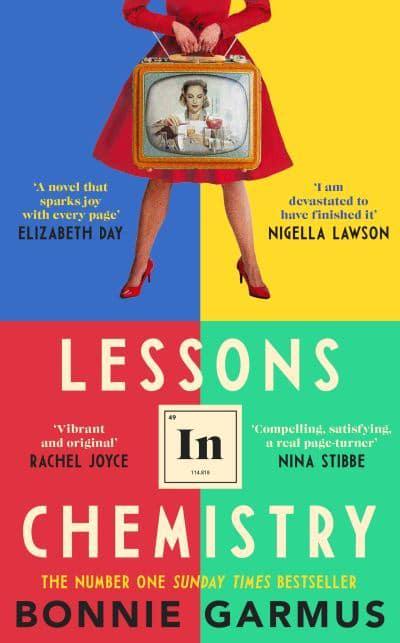
Firstly, the very lovely science-in-fiction or lablit novel:

Lessons in chemistry
Bonnie Garmus
Doubleday, 2022
ISBN 978-0-8575-2812-4

Which I am pleased to see has found a lot of attention elsewhere too, so you may already have heard about it or even read it. If not, do.

And secondly, an account on how meteorites impact life on Earth and especially humanity:

Impact: How rocks from space led to life, culture and Donkey Kong
Greg Brennecka
William Morrow 2022
ISBN 978-0-06-307892-5

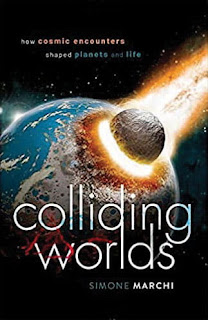
Meteorite impacts are of course hugely important for astrobiology, while some of the pop culture things that the author obsesses about are not, so for a more sober account of the actual science of meteorites, I might turn to Colliding worlds by Simone Marchi instead, which I reviewed recently, too. Impact might attract some who are intereted in the quirkiness though.

Paywalled PDF containing both reviews

See also my twitter thread listing books I read in 2022.

Friday, February 25, 2022

revisiting wastewater

During this pandemic it has been fascinating to learn how much information about disease spread can be obtained from wastewater analytics, even several weeks before patients start turning up in hospitals. It has also been frustrating to learn that the political leadership at least in this country has no interest in this information, as they prefer to wait and see if it really gets that bad, and then take measures only two weeks after it gets really bad.

I wrote a feature on the importance of wastewater monitoring around this time last year, when I still had some hope the information might be used to wipe out Covid-19. Now I revisited the field in a more sober (read: frustrated) state of mind and also looked at the uses of wastewater monitoring in other diseases, present and future. Maybe we have more luck with our leadership the next time a zoonotic disease outbreak threatens to turn into a global pandemic.

This new feature is out now in C&I:

Wastewater monitoring

Chemistry & Industry Volume 86, Issue 2, February 2022, Pages 26-29

access via:

Wiley Online Library (paywalled)

SCI (members only)

Any access problems give me a shout and I can send a PDF file.

In the same issue, on page 36, you'll also find my review of the book Colliding Worlds by Simone Marchi, which is astrobiology-related in that it reports the evolution of the Solar system under the aspect of collisions between bodies.

Wiley Online Library (paywalled)

As the book is more photogenic than a wastewater treatment plant, I'll use the cover here too:

I'm now running a twitter thread with this year's C&I features here.

Wednesday, February 09, 2022

visualising extraterrestrial molecules

I cover atomic force microscopy every once in a while, which results from my residual connections in chemistry and interest in the nanoworld, and because of the astrobiology book I am of course interested in all extraterrestrial molecules.

So the great news is that now these two threads of my work have met and I have been able to report the first AFM work on actual extraterrestrial molecules, which is really exciting, even though it hasn't taught us anything fundamentally new - except that you can visualise extraterrestrial molecules. So anybody who has meteorite materials, send a sample to my namesake Leo Gross, and he will get you lovely pictures of the organic molecules contained in them.

Read all about it on the Chemistry World website (open access if you restrain yourself and don't read more than two stories per month):

Chemical ecosystem of Murchison meteorite molecules revealed in snapshots

Tuesday, September 14, 2021

wonderful Welwitschia

The desert plant Welwitschia mirabilis has accompanied my writing for a while. It featured in my book Exzentriker des Lebens / Life on the Edge. The info in the books is mostly 1990s plant physiology. Now however, researchers have published a high quality genome structure of Welwitschia in comparison with its closest relative - which isn't very close. I've used the opportunity to also have a look at other plant life in deserts on other continents - in the context that the climate disaster will produce more extreme conditions for life to cope with, so we'd better understand how it does.

The resulting feature is out now:

How to survive in the desert

Current Biology Volume 31, Issue 17, 14 September 2021, Pages R1017-R1019

FREE access to full text and PDF download

See also my twitter thread with all 2021 features that are now in the open archives.

Welwitschia_mirabilis, Plate 5369 from vol89 (1863) Curtis's Botanical Magazine (source: wikipedia)

bonus illustration not included in my feature, as images in portrait format are awkward with the column format we use.

Thursday, August 05, 2021

astrobiology out now

I was slightly busy with other things and missed the actual publication day (Tue 3rd), but I can confirm that the third edition of

Astrobiology: an introduction

is out now across the habitable parts of the Universe. A lot of things happened since the second edition came out in 2011, so the page count has gone up, and it is no longer called "brief" in the title. Apart from that, the good old structure still stands, just with new findings added.

More details from:

* the publishers, Johns Hopkins University Press

* Blackwells bookshop

I seem to have acquired some grey hairs since the last edition ...

Wednesday, May 26, 2021

replicating the RNA world

I'm really excited about recent progress in the field of recreating the RNA world. The very small bunch of people pursuing this is now tantalisingly close to having an RNA molecule that can replicate itself or other RNAs of the same size. Once they achieve this, I naively imagine, they could just let the magic molecule loose in their in vitro RNA world scenario and watch it evolving all by itself, re-enacting the origin of life. I wrote a feature about this for Current Biology last autumn, but since then Peter Unrau's group has made another step forward in mimicking modern aspects of gene regulation on the the RNA World stage, in a move that also improves processivity, i.e. the replicating ribozyme staying on the template for as long as it takes. So, my new feature, taking this step into account, is now out in C&I:

Spark of life

Chemistry & Industry Volume 85, Issue 5, May 2021 Pages 26-29

access via:

Wiley Online Library (paywalled)

SCI - appears to be on open access right now

Loving the carnivorous plant closeup on the cover - nothing to do with my feature, but with a feature on plant peptides.

PS The previous issue (No. 4) includes my review of the book Stem cells: From hype to hope on page 37)

Monday, May 10, 2021

deep life

Among the neglected "extreme" environments that still provide habitat for a suprising number of species in surprising amounts, the deep subsurface has perhaps been the most underappreciated. Recognition of deep biotopes only really took off this side of the millennium, decades after environments like deep sea vents were explored.

The Deep Carbon Observatory (2009-2019) helped to fill that gap to some extent, and in its wake there are now several research stations exploring the deep underground, often based on disused mine shafts. Writing up the DCO results for the new edition of Astrobiology which comes out in August, I realised I hadn't covered this work since 2013. So about time for me to dig in and see what's going on below the surface.

My feature is out now:

Life underground

Current Biology Volume 31, Issue 9, 10 May 2021, Pages R415-R417

FREE access to full text and PDF download

Several research stations have now been established at disused mines to investigate life in the deep subsurface. The image shows DeMMO field coordinator Brittany Kruger at work in a former gold mine in South Dakota. (Photo: © Caitlin Casar.)

Saturday, March 20, 2021

a not so brief introduction

Once upon a time there was a book called Astrobiology - a brief introduction, which came out in 2006, and then in a second fully revised edition in 2011.

Now it's taken a bit longer, and a lot of things have happened out in space and here on Earth, but later this year we will have a third edition. We've spent the whole month of February checking the page proofs and preparing the index, so the book is now "in press" as far as I'm concerned. While the cover kept the basic layout, it now has a fresh new photo, and the other change you may notice is that the word "brief" has disappeared. Must be something to do with the fact that the book including index now has over 400 pages. Not quite so brief now. (Oh, and I am told the hardback will now also benefit from the lovely cover design. In the first two editions, the hardback was produced as a plain black "library edition", but I hear that policy has been dropped now.)

Further details to follow, I just wanted to share the lovely new cover at this stage:

Update 25.3.: details are now on the publisher's website, including:

Publication Date: 3 Aug 2021
Trim Size: 6" x 9"
Page Count: 416 pages
Illustrations: 37 b/w photos, 72 b/w illus.

Paperback: $34.95
ISBN: 9781421441290

Hardcover: $75.00
ISBN: 9781421441283

E-book: $34.95
ISBN: 9781421441306

Monday, October 19, 2020

closing in on the RNA world

As a former ribosome researcher, I tend to obsess about the tail end of the RNA world (the early phase of evolution when life used only RNA, no proteins or DNA) sometimes, namely the point when a ribozyme started making peptide bonds, and cleared the way for the division of labour between proteins, DNA and RNA that dominates life today. Now, however it is time to get really excited about the beginning of the RNA world, the point when the very first ribozyme started making more of its own kind. Experiments using in-vitro evolution to find such a ribozyme and they are tantalisingly close to success. Which would be amazing because from that point, we could rerun the evolution of the RNA world in the lab ...

So, while we're waiting for this breakthrough, here's my feature explaining just how brilliant that will be.

Towards the birth of evolution

Current Biology Volume 30, Issue 20, 19 October 2020, Pages R1233-R1235

FREE access to full text and PDF download

The images thrown in were even more symbolic this time than normally:

Some sort of membrane or other enclosure was necessary for the early precursors of life to keep their molecules together and protect them from harm. (Photo: Alexas_Fotos/Pixabay.)

Thursday, September 24, 2020

lichenous liaisons

Blogger no longer allows me to switch back to the "classic" version, so this is my first attempt at writing a blog entry with the new one, and anything could happen. I'll stick to the important info:

My latest feature is about the evolution of lichens. Recent findings suggest they are more recent than thought (which is disappointing from an astrobiology perspective as it means they didn't pioneer the vegetation on dry land), but their evolution was also more complex than thought, with the symbiotic link being made and broken and remade in some lineages, which called for the lovely title (which I nicked from the press release, and amazingly nobody else did that before me):

Lichenous liaisons

Current Biology Volume 30, Issue 18, 21 September 2020, Pages R1009-R1012

FREE access to full text and PDF download


Ophioparma, a lichen formed by a fungus and green algae, growing on rocks in the Alaskan tundra. The red spots are fungal fruiting bodies that release meiotically derived ascospores. (Photo: © Matthew P. Nelsen, Field Museum.)

Tuesday, July 23, 2019

first molecules - ever!

I might have naively assumed that the first molecules in the universe were hydrogen ones (H2) as H is the simplest atom, but I have now learned that this was not the case. In fact, helium hydride has a strong case for being the first altough the search for this molecule in the current universe has only discovered it recently. I've discussed all of this together with the science of another very early hydrogen compound, trihydrogen, in my latest feature about the chemistry that happened before the first stars were born (mindboggling thought):

Dawn of chemistry

Chemistry & Industry 83, No. 7, pp 30-33.

access via:

Wiley Online Library (paywalled)

SCI (members only)

Any access problems give me a shout and I can send a PDF.

Have a sneaky peek at the first page:

Monday, December 03, 2018

minerals and microbes

Microbes have been around on this planet for close to four billion years, so in their own unconscious, unicellular way, they know a thing or two about how to handle its minerals, and even how to produce new ones.

Our flawed human efforts to access the planet's resources have produced a lot of collateral damage, pollution and waste. So we should consider learning from microbes about mining, producing materials and recycling them. Which is the topic of my latest feature, out today:

Mining the mineral microbiome

Current Biology Volume 28, Issue 23, 03 Dcember 2018, Pages R1325-R1328

FREE access to full text and PDF download


Copper occurs naturally in a variety of chemical modifications. In this piece of rock it occurs in the minerals azurite and malachite as well as in metallic form. (Image: Parent Géry via wikipedia.fr.)

Monday, December 25, 2017

season for astrobiology

Open Archive Day

I've sometimes used the last CB issue of the year as an excuse to revisit astrobiology, seeing that it includes all the big questions of origin that also feed religions. This year, however, I've resisted the temptation, even though we had an interstellar visitor passing by just in time for xmas (see below). Instead, here comes the open archives link to last year's feature on the origin of life :


How life can arise from chemistry


This also means, of course, that all 24 of my 2016 features are now on open access, so go wild and enjoy.

Looking at the stats of this Open Archive tag, I am getting the impression that it is reasonably popular, so I'm planning to carry on in the new year, digging up one old feature on the Monday when no new feature comes out.


'Oumuamua: Interstellar Asteroid
Illustration Credit: European Southern Observatory, M. Kornmesser
source