Showing posts with label birds. Show all posts

Monday, February 23, 2026

eagle issues

There are animal species, often apex predators, which many humans seem to worship for their fierce power, such as lions, cheetahs and eagles. Sadly, this connection, often engrained in cultural traditions over centuries, doesn't automatically protect the admired animal. Although eagles are generally faring better than the less admired vultures, there are a few conservation concerns which I have covered in my latest feature which is out today:

Keeping an eye on eagles

Current Biology Volume 36, Issue 4, 23 February 2026, Pages R105-R107

Restricted access to full text and PDF download
(Unfortunately, this year's features will no longer become open access one year after publication - do contact me if you would like a PDF.)

See also my new Mastodon thread where I will highlight all this year's CB features.

My mastodon posts are also mirrored on Bluesky.

Last year's thread is here .

Eagles like this golden eagle (Aquila chrysaetos) have symbolised power since Roman times.
(Photo: Susanne Nilsson/Flickr (CC BY-SA 2.0).)

Monday, January 19, 2026

the urban ecology of feeding birds and squirrels

Back in December, I spotted a research paper about the ecological impact of human-provided food on squirrel populations, and I started to wonder whether similar work exists for the various species of "garden birds" that many of us like to feed in winter. Incidentally, I installed an inherited bird feeder outside my window around the same time, to get some first hand observations in. (It may be an age thing, too.)

It's always fun writing about squirrels, but the most spectacular results I discovered were those of the hummingbirds in California. Due to the widespread use of feeding stations with fake nectar, these birds have extended their range dramatically and also undergone measurable anatomical evolution.

Read all about it in my latest feature which is out today:

Feeding change in urban wildlife

Current Biology Volume 36, Issue 2, 19 January 2026, Pages R31-R33

Restricted access to full text and PDF download
(contact me if you would like a PDF)

Magic link for free access
(first seven weeks only)

See also my new Mastodon thread where I will highlight all this year's CB features.

My mastodon posts are also mirrored on Bluesky.

Last year's thread is here .

Squirrels like this Eastern grey squirrel (Sciurus carolinensis) thrive in urban parks and benefit from food supplied by humans. A study on the Eurasian red squirrel (Sciurus vulgaris) in Japan has shown that the urban populations also have improved reproduction chances compared with the rural ones. (Photo: Jules Verne Times Two/julesvernex2.com/CC-BY-SA-4.0.)

The same issue of CB also contains story of Veronika, the back-scratching bovine that probably wins the internet today (open access). I already saw a Guardian headline about it.

Monday, June 17, 2024

care about caracaras

Reading up on the neglected group of raptors, the caracaras, I was rather shocked to find a major skeleton in ornithology's closet. A collector of museum specimens who has several species named after him likely killed the last ten or so individuals of the Guadalupe caracara (Caracara lutosa). So here we have a species not just killed off by humans in general, but by one human specifically. Make that two species, as the bird also carried a parasite not known to use any other hosts.

The important point here is of course the lack of information - Rollo Beck had assumed that the species was still abundant, simply because he very quickly found the group which he then slaughtered. Lack of knowledge and understanding of the important ecosystem function of the caracaras and other raptors and scavengers is also what previously drove that species to the brink of extinction and is still endangering many others today.

So the feature is mainly a call to all humans to support and appreciate their local raptors, including those that have a shady reputation, like vultures and caracaras.

When raptors soar no more

Current Biology Volume 34, Issue 12, 17 June 2024, Pages R553-R555

FREE access to full text and PDF download

See also my Mastodon thread where I highlighted all CB features of 2024.

The thread for 2023 is here .

The striated caracara (Phalcoboenus australis) has been described as inquisitive and fearless by Charles Darwin and other visitors to the islands of the South Atlantic. (Photo: kuhnmi/Flickr (CC BY 2.0 Deed).)

Monday, March 25, 2024

the dangers of migrating

Many of us may envy the birds that migrate to warmer climate zones in winter. We may even naively assume that their expertise in long-haul travel may enable them to get out of harm's way when they face difficulties such as habitat loss and climate change. In reality, though, they are often more vulnerable than other comparable species, as they depend not on one habitat but on two, and on a safe passage between the two. Recognising these dangers, the UN set up the Convention on the Conservation of Migratory Species of Wild Animals (CMS), a global treaty that came into force in 1979 and holds regular COP meetings to check up on them. At the most recent meeting a global report was released that shows how the situation has become more difficult for many of the migrating species.

Starting from this report, I have prepared a feature on the conservation of migratory species which is out now:

Migratory species in danger

Current Biology Volume 34, Issue 6, 25 March 2024, Pages R217-R219

FREE access to full text and PDF download

See also my Mastodon thread where I highlighted all CB features of 2024.

The thread for 2023 is here .

The Indian skimmer (Rynchops albicollis, Endangered) is among the globally threatened or near threatened migratory species not yet listed in the CMS Appendices. (Photo: Mike Prince/Flickr (CC BY 2.0 Deed).)

Monday, October 09, 2023

birds that walk

New Zealand is home to many weird and wonderful bird species, including quite a few that can't fly. This is easily explained by the absence of land mammals on these islands since the time of the dinosaurs. Since human arrived and brought other mammals with them, many of these unusual bird species have become vulnerable. Like island species elsewhere, some have become extinct, and many others are now in danger of extinction.

Following a suggestion from the editorial team, I used my latest feature to study (from the other side of the world) the intriguing world of NZ birds and the conservation work that is needed to keep them alive:

Land of the birds that walk

Current Biology Volume 33, Issue 19, 9. October 2023, Pages R987-R990

FREE access to full text and PDF download

See also my Mastodon thread where I highlighted all CB features of 2023.

I'm not on Instagram myself, but I believe if you follow CurrentBiology there, you'll find my features highlighted there as well.

The endangered kakapo is one of New Zealand’s 16 surviving species of flightless birds. Twice winner of the Bird of the Year competition, it is benefiting from intensive conservation management. (Photo: Jake Osborne/Flickr (CC BY-ND 2.0).)

Monday, June 19, 2023

bird flu takes off

Bird flu only gets media attention very briefly each time it either affects industrial poultry farming or poses a danger to establish itself in humans as a new virus strain. It usually stays limited to the flu season, too.

The current outbreak is different in a number of important ways, however. It has left the seasonality behind, has spread around the globe, and killed large numbers of other animals too, especially marine and coastal mammals. It is thus a lot more worrying than recent outbreaks, and could have implications ranging from species extinctions through to another human health crisis. Which is why I had a closer look at it in my latest feature which is out now:

A flying pandemic

Current Biology Volume 33, Issue 12, 19. June 2023, Pages R659-R662

FREE access to full text and PDF download
(will become open access one year after publication)

See also my Mastodon thread where I highlighted all CB features of 2023.

I'm not on Instagram myself, but I believe if you follow CurrentBiology there, you'll find my features highlighted there as well.

Sandwich terns (Thalasseus sandvicensis) along the coasts of northern Europe have been suffering mass mortality in the current outbreak of H5N1 avian influenza. (Photo: Trish Hartmann/Flickr (CC BY 2.0).)

Monday, July 26, 2021

the music of the birds

Every once in a while, I've seen an exciting paper about birdsong in the news releases, but, somehow, the thought I should do something about birdsong hasn't resulted in action, until now. The work that made it happen was the PNAS paper on duetting wrens, which I discuss in some detail. As a less than perfect musician I am very impressed by the extremely rapid turn-taking between wren duet partners, which amounts to up to 300 events per minute. Playing three notes on a beat at 100 beats per minute is something I can manage on a good day with a following wind, but I might struggle doing it precisely on time in a duet situation, while paying attention to an equally fast-moving partner.

Another exciting thing I learnt is that the mockingbird doesn't just mock, it sticks together borrowed parts in original ways, just like any human composer would. Oh, and there is a cellist in there as well.

My musical musings on birdsong are out now:

Tuning in to bird behaviour

Current Biology Volume 31, Issue 14, 26 July 2021, Pages R879-R882

FREE access to full text and PDF download

See also my twitter thread with all 2021 features that are now in the open archives.

The rapidly alternating duet singing in plain-tailed wrens is one of the most impressive examples of cooperation in birdsong. (Photo: © Melissa Coleman.)

Update 9.4.2022: Regarding the cello/nightingale duo I mention in the introductory part of the feature, the BBC now admits that it brought in a human nightingale mimic to step in in case the bird failed to perform, as the Guardian reports today. So in the worst case, all of the recorded nightingale performance could be fake, but I guess it's impossible to be sure now.

Monday, September 07, 2020

value your vultures

Vultures are still suffering from image problems in many cultures, due to their association with death and decay. We should really appreciate them a lot more, however, as their removal of carcasses is an extremely important and valuable ecosystem service. India has lost large parts of its vulture population in recent decades and is already feeling the consequences which include opportunistic mammalian scavengers such as rats and feral dogs spreading diseases that also affect humans, such rabies and the plague. And now Africa is at risk of a similar decline in vulture populations, which could have even worse effects there.

In my latest feature I have looked at the causes and effects of vulture declines around the world, and also marvelled at the different cultural associations we have with various species. The Andean condor, for instance, is also a vulture but doesn't appear to have the same image problem as the other species.

The feature is out now:


Hard times for ecosystem cleaners

Current Biology Volume 30, Issue 17, 7 September 2020, Pages R963-R966

FREE access to full text and PDF download


Vultures are having a hard time in the Lucky Luke comics, too - targeted by jokes if not by bullets ...


If reading the feature is too much work, there is a video about vulture conservation here.

Monday, August 03, 2020

colourful characters

I spotted an interesting book review in Current Biology - Thinking like a parrot - and realised that this was a topic about which I haven't written a feature yet, so I closed that gap with a little help from Nicky Clayton (who starred in this feature) and her colleagues. Oh, and I should mention that I found a lot of inspiration on the ecology/conservation of parrots in the grrlscientist blog.

After the cats and mice, another fun topic, but world-saving services will resume soon.


Clever and colourful characters


Current Biology Volume 30, Issue 15, 03 August 2020, Pages R841-R844
FREE access to full text and PDF download


Parrots as companion animals require substantial amounts of attention — as does the threat to surviving parrot populations in the wild. (Photo: Michael Clarke/Unsplash.)

Monday, July 10, 2017

climate canaries

So I came across a story about albatrosses and how they are affected by ocean warming, and I wanted to do effects of warming more widely (other than corals), but all roads led to birds. Ocean warmings leads to more frequent extreme climate events, and it turns out that birds with their complex life cycles including migration, nest-building and parental care routines, are often quite vulnerable to these events. So they are our modern day coalmine canaries in a way.

All will be explained in my latest feature out now:


Volatile climate stirs bird life cycle


Current Biology Volume 27, Issue 13, pR623–R625, 10 July 2017


Restricted access to full text and PDF download
(will become open access one year after publication)


Magic link for free access
(first seven weeks only)


Sea birds like albatrosses are sensitive to changes in ocean temperatures. In one recent study, a well-studied population was shown to suffer from the increasing temperature variations but to benefit from recent warming bringing it closer to its temperature optimum. (Photo: Lieutenant Elizabeth Crapo/NOAA Corps. (CC BY 2.0).)

Tuesday, June 16, 2015

little birds lost

Some large iconic bird species have recovered across Europe, but many less conspicuous ones are still declining. Even "common" species like the house sparrow have suffered dramatic declines, and ecologists have argued that their loss in abundance may make more of an impact than than the plight of the rarer birds that conservation efforts tend to focus on.

This is the topic of my latest feature in Current Biology which is out now:

Europe’s bird populations in decline
Current Biology Volume 25, Issue 12, pR483–R485, 15 June 2015
DOI: http://dx.doi.org/10.1016/j.cub.2015.05.057
Open access

PS In lieu of a bird picture, enjoy this beautiful dinosaur on the cover of the issue:

Monday, July 08, 2013

people, pets, and predators

My latest feature in Current Biology covers the triangular relationship between humans, their pets, and undomesticated animals that may come in conflict with one or the other. I've specifically looked at two cases that made headlines recently, namely badgers vs. cattle, and cats vs. birds. As always, problems are complex, and emotional involvement that people tend to have with specific animal species can make it even harder to find rational solutions.

The feature is out in today's issue:

Where wildlife and tame life collide

Current Biology, Volume 23, Issue 13, R545-R548, 8 July 2013 doi:10.1016/j.cub.2013.06.038

Free access to

Full Text (HTML)

PDF file

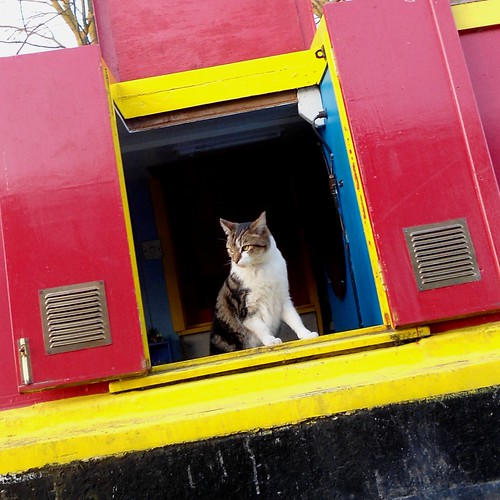
houseboat cat revisited

pet predator from my flickr pics.

Monday, July 19, 2010

lop-sided bird compass

More than 40 years ago, Wolfgang Wiltschko discovered that migrating birds use the Earth’s magnetic field for orientation. Further research has shown that the bird compass responds to the inclination of the magnetic field (i.e. its angle against the horizontal) rather than the north-south direction as such, and that it is likely based on chemical reactions involving molecules with unpaired electrons, i.e. radicals. This chemical compass is believed to reside in the eyes. In 2002, Wiltschko and coworkers have shown that the birds need the right eye but not the left eye for orientation – suggesting that the left hemisphere of the brain does the calculations on the magnetic measurements coming in from the right eye. Careful with the conclusion that the compass is located in the right eye only -- my guess would be that the left eye has the same compass but the right hemisphere of the brain just doesn’t know what to do with the signals.

Now Wiltschko’s group at the university of Frankfurt has reported that getting light into the right eye is necessary but not sufficient for the compass function (1). The right eye, the researchers find, actually has to be able to see properly. The experiment involves goggles that let through the same amount of light on both sides but blur the vision on one side. If the birds have a blurred view on the right eye, they lose the orientation, if it’s on the left, they orient just fine.

Wiltschko et al. discuss two possible explanations:

1) compass orientation may rely on computational connections between compass data and visual input. The case against this interpretation is that, in the 2002 experiment that first showed the dominance of the right eye in orientation, there was practically no visual input that could have served such a role. Still, the authors seem to prefer this version, as they go to great length to defend it.

2) the normal process of shutting down the input from the eye with the blurred vision may shut out the compass data as well. To me this is the more plausible interpretation (if only because it’s easier to understand).

Some fairly elementary questions remain, however, for instance, if one tests a reasonable number of birds, will there be a small population of “lefthanders” that has the compass processing on the other side ? Also, if a young bird lost the right eye in a fight, would the brain find a way to process compass data from the left eye? And lest we forget, the precise molecular details of the molecular compass also remain to be uncovered, see my pieces on the bird compass from last year, in Oxford Today (as a sidebar to the ESR feature) and, in German, in Chemie in unserer Zeit. A significant 2009 paper that I missed when I researched those articles comes from Stefan Weber's group at Freiburg and reports the observation that light can stimulate the formation of radical pairs in the most promising candidate molecules believed to host the chemical compass, namely cryptochromes (2). This adds to the growing body of evidence suggesting that the bird compass really is a radical pair mechanism residing in cryptochrome proteins.

Reference:
1. K. Stapput et al., Curr. Biol. 2010, doi:10.1016/j.cub.2010.05.070
2. T. Biskup et al, Angew. Chem. Int. Ed. 2009, 48, 404.

Tuesday, June 30, 2009

spinning around

What's the connection between bird migration, hydrogen storage materials, membrane protein structure, and quantum computation? Well, all these, and seven other topics are investigated at Oxford University with the help of Electron Spin Resonance (ESR) spectroscopy, thanks to the new(ish) interdisciplinary research centre CAESR. Read my feature in Oxford Today which should be freely accessible to all.

Also, a short piece on the bird migration research has appeared in German, in Chemie in unserer Zeit [PDF]

Monday, June 08, 2009

German pieces in June

this month we have all sorts of surprising finds including the compass of migrating birds, the magic of the number 7, NMR measured in living cells, and a "Burgess Shale" type fossil come to light in the land of my ancestors ...


Chemie in unserer Zeit 42, Nr 3, 126
Orientierungssinn: Ist der Kompass der Vögel eine chemische Reaktion?
[PDF]

Nachrichten aus der Chemie 57, Nr 6, 627
Chemie der Zahl 7

Nachrichten aus der Chemie 57, Nr 6, 660
Blickpunkt Biowissenschaften: Proteinstrukturen in lebenden Zellen

Spektrum der Wissenschaft Nr 6, 16
Exotischer Fossilfund im Hunsrück