Showing posts with label twitter. Show all posts

Tuesday, November 22, 2022

decline and fall of twitter

So the last time I wrote a blog entry about twitter was on the occasion of my 10th anniversary on the site, in July 2019. Sadly it now looks as though the blue bird is being strangled, plucked and roasted and may not be around for the 14th anniversary of my signing up.

Luckily I already had a mastodon account set up back in 2018 (then as a tumblr alternative), so now I only had the task of transferring my twitter network to the mastodon address, and that has worked surprisingly well. Last Monday I ran one of the relevant programs on my twitter contacts and discovered more than 150 people to follow. Many followed back fairly swiftly - it's so nice to be in a place where people are still curious about each other. Feels a lot like early days twitter, actually, when people were flooding in from the ruins of MySpace.

Since then, my Mastodon timeline is as lively as the one on twitter used to be. While it's numerically fewer than 10% of the contacts on the bird site, I guess that many of the accounts still listed as followers and/or followees over there are no longer active.

One thing still missing for Mastodon is Toot buttons on the websites where I find content to share. For instance on EurekAlert, the easiest way to generate a toot is to use the tweet button and then copy/paste the tweet (before hitting tweet, as twitter may abbreviate the links in ways that don't survive copy/pasting from the published version. I'm also continuing my calendar-year based twitter threads for features published, features transferring to open archives, and books read/reviewed until the end of the year and will relaunch them on Mastodon in the new year. The Every Picture series has already got its Mastodon thread which is now up to date.

So maybe it's time for final stats:
Following 2239
Followers 1572
Tweets 39k - may have to log in to get a precise number? Oooh, yes, after logging in it's 39066 (on 23.11.)

Mastodon looks like a welcoming sort of place:

Mastodon's official welcome pic, which I usually see before I log in.

so do find me there:

@proseandpassion@mastodon.social

I'm planning to stick with my general approach of using the short message sites to funnel attention to longer formats such as blog entries, which again guide the interested reader onwards to seriously long formats such as features and books.

PS to do justice to the title of this entry, I will compile here a few resources on the continuing implosion of the bird site, as I find them.

Sunday, July 21, 2019

22052 tweets

So as of today, 17:17h (BST, I assume) I have been on twitter for ten years exactly.

In those years I have posted 22052 tweets
accumulated 1275 followers
and followed 2090 other accounts.

I now realise that following that many was a mistake as it makes the timeline unmanageable and I don't want the algorithm to pick "top tweets" for me. But hey - just @ me if you think I should read a specific tweet of yours, because most of the rest will just float by.

Back in 2009, I signed up to twitter just a few weeks after coming back from a science communication conference where some of the other participants were already using it and talking about it all the time. The adoption was also accelerated by the fact that MySpace was beginning turn into a ghost town at around that time, and many of the contacts I had there migrated to twitter.

Since then, the tweets of a certain racist in high office have spoiled the experience a bit, I lost control of my timeline, and I also don't like the direction that twitter is changing (to become more like facebook, apparently). When the new version hit me earlier this week, I thought I would have to leave as I hated it so much, but then I discovered the North Star symbol in the top right corner above the timeline, where you can switch from algorithm-controlled nonsense (now including random people's likes - why?) to a simple format where all tweets are listed chronologically as they should be.

Anyhow, I guess I will stick around a bit longer, but don't expect me to see everything you tweet.


For reasons unknown, my twitter has reverted to the old style after a few days with the new one - so I'm immortalising its look here, in case they switch me again and I might never see the old twitter again.

Oh, and one of the things that I still love about twitter is that it is prepared to speak Galician to me. (Facebook should do, in theory, but often falls into English, and at one point sneakily tried to switch my language to English without asking my permission.)

Saturday, July 21, 2018

9 years on twitter

twitter tells me I've been on there for 9 years now - hover over the line where it says "joined in July 2009" and it will reveal the precise date and time. So many things have changed since then, but one thing I found surprisingly constant is the ratio of posts to followers, i.e. how many tweets to I have to send out to increase the number of followers by one. This ratio has been around 15 for as long as I can remember. Checking today, it is 15.04 posts per follower.

More intriguing still, the number is very similar on tumblr (15.98) where I do very different things. Much bigger on blogspot though (47), where the culture of following people never really took off. And smaller on flickr (7.13).

Obviously, for people who are more famous than I am this twitter impact ratio will be smaller, for others it may be bigger - so maybe it's a useful parameter for sociologists to study the social media pecking order (both figures that go into it are public)?


Another thing worth noting is that, since I started obsessing about the Galician language and occasionally tweeting in Galician or linking to Galician sources, these relatively rare ventures tend to spread very widely. Whenever I look at my stats, there's a Galician tweet in the top three. See for instance, from yesterday:


Friday, December 30, 2016

20 years online

I have no idea where that time went, but it appears that it’s 20 years ago today that I launched my first website, from which the current site evolved mostly by alternating courses of uninhibited random growth and moderate pruning.

In the last few years, and especially since my tumblr started to attract some followers from late 2012 onwards, I have neglected the old website a little bit, but just now I have cleaned it up a bit and updated things like the publications list. In a way, the various blogs and other online outlets could be seen as the shoots and flowers growing from the original tree I planted in 1996, so I’ll take this anniversary as an excuse to write up a short history of my web presence, although now, 20 years later, almost everybody on the planet has a web presence.

I feel my hair turning grey as I write this, but I actually managed to finish my PhD without ever having used the internet. I did write the thesis on a computer and had a Neolithic laptop, but the network as such was still under construction as I finished, and hadn’t reached my lab yet by the time I left. On arrival at Oxford in 1993 I learned about things like email, and the www, and some time in 1996 I must have realised that everybody could put a page (or twenty) on the web, so why not me?

In the xmas break I learned the essentials of HTML from a book and started composing my home page, which launched on 30.12.1996 under the not so original title of Michael’s Home Page. Rooted in an old technology newspapers and magazines background, I aimed at publishing a numbered issue every week, with sections including science, science communication, bilingualism.

On 13.1.1997, issue 3 appeared with title “Only Connect!”, based on the quote from EM Forster’s novel Howards End which still serves as a motto today and has provided the title and URL for my blog, proseandpassion.com.

After a year, the site had 43 pages, and it soon grew into a tree structure with eight or nine first level pages branching out into hundreds of second and third level ones. For nine years and a bit, it remained my main web presence, and I probably spent way too much time on updating it, which may well have killed my academic career.

Then, in the tenth year, and a few years after leaving the academic career behind, I found my way to MySpace and discovered blogging, as every MySpace account came with a blog by default. For comparison, I also tried yahoo/geocities and blogspot, which is the one I kept using after MySpace went down the drain.

When I moved out of Birkbeck College in 2006, a version of my website stayed there, and is still online here). Incidentally this is about the last version before I introduced the “bookshelf” design of the front page which is still up today, launched in July 2006.

After the great Exodus from MySpace, I joined Facebook, then twitter, and finally tumblr. Initially twitter worked best for me, but in the last few years tumblr has become the outlet where followers actually see and react to my stuff. Although the stats on blogspot aren’t too bad either these days.

With all the excitement of the more interactive and “social” sites, the old website got neglected a little bit, but I still polish it up when I have a new book to promote, or, as happened this year, when the delay in the publications list becomes too embarrassing.

At some point, I may even blow some dust off the 10-year-old front page design. I’ll put that on my (virtual) list of New Year’s resolutions.

My front page as it looks today - I think my initial idea was to change those bookends regularly to refresh the look, but I got stuck with the second pair I made ...

The site is at
http://www.michaelgross.co.uk/
as well as at
michaelgross.info

Thursday, February 12, 2015

how to burst the filter bubble

Review of The Filter Bubble
by Eli Pariser
Penguin 2011

Last year, when the publication of a psychology experiment conducted on facebook highlighted the dubious ways in which the company manipulates people’s timelines, some clever observers remarked that this wasn’t really new, and it was all described in Eli Pariser’s book. Which, amazingly, was the first time I heard of the book.

Having picked up a copy for £ 2 on the flea market (somebody clearly thought it was no longer relevant) I’ve now read the book. Essentially it confirms my hunch that the internet took a turn for the worse when the major global monopolists amazon, google and facebook personalised their services and started to pretend that they know which books I want to read, which search results I want to see and which ads I might be interested in. The resulting limitation to what one can see of the internet is the phenomenon that Pariser calls the filter bubble.

Pariser explains very eloquently why this is bad news. It’s bad for creativity, because it removes the possibility of serendipitous findings and unexpected connections (which are basically the things that pay my mortgage, so bad news for me especially!). It’s bad for democracy, because people only surrounded by the opinions they agree with and the friends that have similar views will fail to see that there may be another side to the argument. The anti-Islam movement Pegida in Dresden and other German cities originated as a Facebook group –although long after the Filter Bubble was published. And far from fulfilling the internet’s early promise of distributing power to the people, the application of opaque filtering methods concentrates unseen and unaccountable power in the hands of a small number of global companies.

What can we do about it? One can’t completely opt out of it, as an increasing number of services would just stop working if you chose to block all cookies. Pariser says companies should be open about what kind of filtering and personalisation they apply to any given product. But seeing that the key players hold quasi monopolies, what are the chances that they will comply with Pariser’s wish? Four years after his book was published, I haven’t seen it happening, and the affair around the Facebook experiment seems to suggest they are still blissfully unaware of the problem. Governments could perhaps legislate to enforce more openness, but then again, they never understood the internet anyway, and are already failing to make the companies pay their taxes. Not much hope there either.

Which leaves only consumer choice. I have always preferred social sites with an element of anarchy and randomness to facebook with its emphasis on real names and real friendships. Pariser, although he admits to enjoying facebook as much as the next person, praises twitter for its unfiltered timeline and clarity regarding where filtering is applied. For instance, in searching for hash tags, you can choose between “top results” and “all results”. I would add tumblr to that recommendation, as it also has an unfiltered timeline and the most amazing random people on the planet. (As far as I know, my 1260 followers on tumblr include only one person I have met in real life.) And if you do use Facebook (as I grudgingly do once a week), make an effort to venture outside your bubble. Befriend random people, do unpredictable things. Confuse the algorithms.

Similarly for search, try to think beyond Google, maybe use several search engines. I use duck duck go as default, and only resort to versions of Google when I need results in a different language, so for instance, google.de for family history explorations in Germany. Google’s bots must think that I’m only interested in dead people.

As for amazon, as I’ve explained before, they haven’t managed to figure me out in 15 years, and I don’t think they ever will. It would take a human being to actually read what I write, and they only have computers. So my remedy is: be wide ranging and unpredictable. Surprise yourself and the algorithms. Burst the filter bubble.

Thursday, July 03, 2014

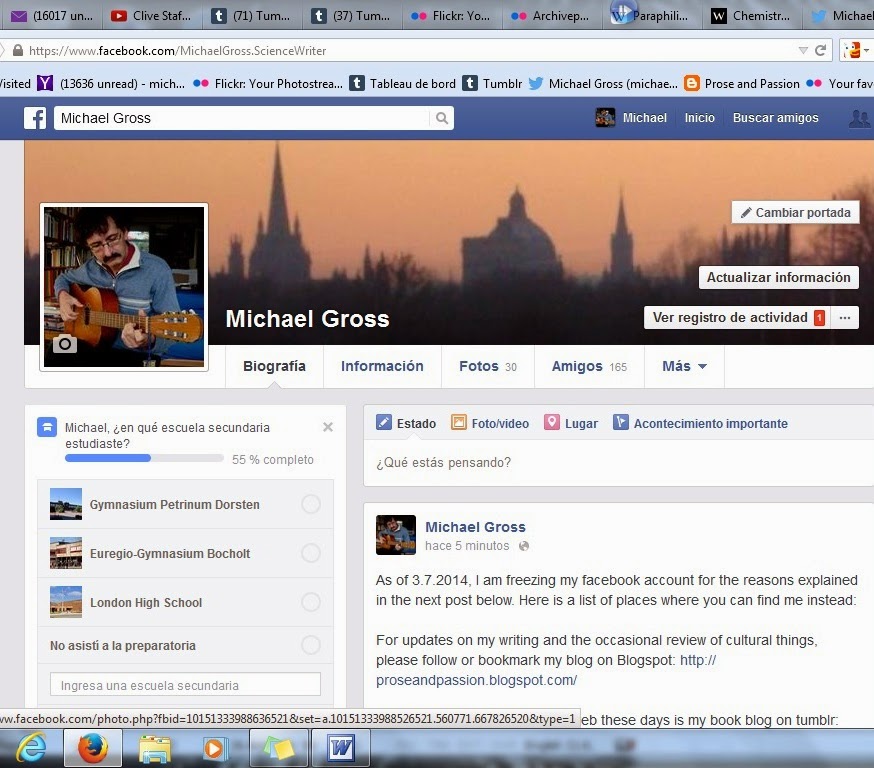
freezing facebook

After what I’ve learned this week about manipulation of timelines by facebook, I‘ve decided to freeze my facebook account. This means I will not close it, to make sure my sign-off post explaining the reasons remains visible and people can find the links to my pages on other social sites, but I’ve blocked twitter from forwarding my tweets, so there should be nothing new coming in.

It’s not mainly the fact that the research they carried out on “emotional contagion” was unethical because there was no informed consent, although this was certainly unacceptable. Personally I would have been unlikely to be hit by facebook's mood manipulation, as I rarely check the timeline. It's worrying to think what other uses the site might find for similar "experiments".

What affects me more and makes it pointless for me to share things on facebook are the routine manipulations that were revealed in the wake of the fiasco. From this story I’ve learned why my tweets forwarded to facebook no longer got any reactions: As I didn’t use facebook directly very often, so didn’t put many likes and responses on people’s posts and don’t interact much, I was accorded low priority in people’s timelines, so they were less likely to see my stuff unless they specifically visited my own page (and for those who are ready to put in this extra effort, I’d rather they visit my blog on blogspot).

Which is a vicious circle, really. If you’re not so popular on Facebook, the algorithm will make you even less so by de-prioritising your content in other people’s streams. This is a turbo-charged popularity contest, worse than anything happening in real life.

For regular updates, follow this blog, my twitter, and/or my tumblr - further links are under "VISIT MY" in the margin (underneath the green astrobiology cover).

Quote from one of the explanatory pieces in the Guardian:

How many stories is Facebook filtering out, and how? Backstrom explained in August that Facebook's news feed algorithm boils down the 1,500 posts that could be shown a day in the average news feed into around 300 that it "prioritises". How does this algorithm work? Backstrom explained that factors include: how often you interact with a friend, page or public figure; how many likes, shares and comments individual posts have received; how much you have interacted with that kind of post in the past; and whether it’s being hidden and/or reported a lot.
PS: I missed Eli Pariser's book The Filter Bubble when it came out - that would have warned me. A discussion of the Facebook newsfeed in relation to the filter bubble theory is here.

Tuesday, April 09, 2013

online culture

Why is tumblr like ancient Egypt? How do you recognise if a twitter user is part of a specific tribe? Will edit wars on Wikipedia end in peace deals or carry on forever? And why have some social networks turned into ghost towns?

All these questions and more are addressed in my feature on the cultural evolution of online social networks, which is out now in Current Biology:

What makes people click?

Current Biology, Volume 23, Issue 7, R255-R258, 8 April 2013
doi:10.1016/j.cub.2013.03.047

Free access to

HTML text

PDF file

Twitter users grouped into tribes, annotated with words typically used by each group. Graphic: John Bryden, Sebastian Funk and Vincent Jansen

Friday, November 23, 2012

tumblr and I

These days I am spending most of my online social networking time on tumblr, which is ironic, as it took me well over a year before I got the hang of it.

I had been homeless on the web since MySpace turned into a ghost town and the forums I had visited also died at around the same time – probably all due to the unstoppable rise of facebook. While I’ve been able to transfer quite a few of these contacts to facebook, I never really liked spending time there. In 2010, I signed up to twitter, which I like a lot, but it is a medium more than a place. I can use it to widen the audience for blog entries (on blogspot) or photos (on flickr), but if I spend more than five minutes watching my twitter timeline (following some 1600 people!), the futility and randomness of it gets to me. Unless there is some major political scandal to kick around, which is always fun on twitter. (I also tried google+ but that never took off, and I am registered with LinkedIn, but it bores me to tears.)

So, well, tumblr and I started out on the wrong foot. I signed up in June 2011 when somebody whom I knew from mutual blog-following on blogspot moved her blogging activity to tumblr and I wanted to stay in touch. However, she soon succumbed to the temptation of the NSFW blogs available on tumblr and ended up reblogging that kind of stuff endlessly without posting anything of her own.

In the first months I didn’t come across any individuals who were actually posting their own content. Everything I saw back then seemed to be just swirling round in circles (which I guess is where the name tumblr comes from?) and come from unattributed sources, i.e. probably stolen. Using tags like #science I found some vaguely interesting blogs that I still follow, like the mother nature network, which covers science and environment, but that didn’t really pull me in.

The legacy of my very first contact in tumblr meant that I had no shortage of addresses for erotica, but once I eliminated all peniswaving blogs, I was left with a few lesbian ones (which I still love) and one that systematically reblogs “topless Tuesday” photos. For a few months I just let these float by, but at one point I started to wonder who these women were. If I liked the face above the boobs I looked up the blog and found quite a few interesting people who – and that was rather important to me – did post their own content, rather than just reblogging all the time.

Some of them even very kindly followed me back, so by that stage – perhaps 1 year into the experience - I had around 20 followers (as many as my blog on blogspot has, except that I don’t think that anybody still checks the blogs they follow there). That gave me a little bit more confidence to expect that somebody, at some point might actually look at contributions I post, so I systematically posted links to my articles and blog entries from blogspot. That helped a little bit, some people became interested in the science bits I had to offer.

Then I widened my spectrum, discovered that there is a one-click option to share my flickr photos on tumblr, also posted the odd video, and ended up sharing everything I posted elsewhere (blogspot, twitter, flickr, facebook) on tumblr as well, and more. By the beginning of this month, the increased activity succeeded in attracting new followers on a daily basis, and catalysing new friendships in a way that I hadn’t really experienced since the demise of myspace.

Tumblr really has become a place on the web where I like to spend time, where I’m surrounded by people who I like, even if they are still mostly strangers. I find it amazing how openly people communicate about very intimate problems over there, and how supportive and loving most people are (apart from some anon. trolling – personally I’ve switched off anonymous asks, so I don’t have that problem). I’m beginning to worry that this is too good to last and that Murdoch might soon buy it up and ruin it (this irrational fear will in the future be called the MySpace trauma). I'm just hoping it stays exactly as it is.

Saturday, June 25, 2011

hidden treasures

After the most-viewed flickr pix, here now a selection of the least-viewed and underappreciated. There are quite a few flowers, such as this tulip with dew drops:

tulip1102

water fountains, like this one at Barcelona:

Plaça de Catalunya by night

pedestrian bridges, like this one in Amiens:

passerelle02

and our local bumblebees, such as this one:

bee10

Some of the other bumblebee pictures are in double figure views only because I posted specific links on twitter - this adds 10-15 views in a minute.

But maybe I just haven't found the right flickr groups yet to promote these types of photos ? Some of the highly specific groups I'm in, specialising on windows, pedestrian bridges, fountains, etc. seem to have little effect.


Anyhow, a set of my hidden treasures is here.

Wednesday, November 03, 2010

why the state should fund universities

I never thought this needed explaining, but seeing that the government releases details today of what they admit is a move "to shift a greater proportion of [Higher Education] funding from the taxpayer to the individuals who benefit" (quote from the comprehensive spending review, page 51, last bullet point), it may be time to spell out the blatantly obvious.

The three words "individuals who benefit" are the most insiduous piece of misleading political propaganda that I've come across in a long time. So, for the benefit of the individuals who are busy wrecking higher education:

* giving people as good an education as their brains can soak up is not primarily to benefit the individuals, it is in the best interest of society. We all, i.e. society, need well-educated scientists, medical doctors, even lawyers and accountants. These days, we need more of these than of people who can stack shelves without complaining.

* yes it is expensive to educate people, but the benefit to society outweighs the cost by a large factor. Imagine the talented people who would normally study decided to work as bar staff instead. In the words of one ex Harvard president: "If you think education is expensive, try ignorance"

* on top of the benefit that academically educated people offer society by doing intelligent work, they also earn more more on average, so pay more taxes (disproportionately so in a progressive tax system), so they also are "the taxpayer" who funds their studies.

* even when the state pays the full cost of tuition, students still have their bills to pay for the duration of the study, and often make a sacrifice in terms of what living standard they could afford if they went to work straight after leaving school.

* Burdening students with the cost of their tuition on top of that will definitely scare away some talents (no matter how clever the payback arrangements) - especially if they have the opportunity to study elsewhere for free.

* Furthermore, I am worried that the "market solution" will turn degrees into commodities. If students are regarded as paying customers and have to pay close to the full cost of their education, they could very easily get the idea that with the payment they have purchased the right to get a degree regardless of their talent or effort.

These are the reasons why in civilised countries the state does (and should continue to) fund higher education, collecting at most a small nominal fee from students to avoid abuse of the facilities offered. It's not that difficult to understand, is it?


(protest posters seen in Oxford last week)

I'm pleased to report that we have a very active protest group here, the Oxford Education Campaign, which has already managed to scare away business secretary Vince Cable (the fact that the business secretary is in charge of HE tells you a lot about what's wrong here!). You can look up OEC on facebook or email oxfordunicuts@gmail.com to find out more.

A nationwide demo against HE cuts will take place on Wednesday 10.11. 11.30am at London, starting at Horse Guards Avenue - more details here.

PS: More about today's government announcement in the Guardian.
Also, my blog entries now get a tweet button, please use it generously (noting that both the button and the counter refer to the URL shown at the top of the browser, so if you're looking at a page with several blog entries, you'll have to click a specific blog entry first to get a specific tweet and counter result for it):

Thursday, July 15, 2010

twitter 102

After nearly a full year on twitter (and 2180 tweets unleashed on up to 450 followers), I may have lost some of that gushing enthusiasm expressed in my twitter 101, but I’m still sticking with it.

Since my last post on this topic, I noticed a few changes in the general atmosphere in twitter, which, I think, are all going into the direction of bringing the new medium, which was amazingly democratic in its early days, into line with the rest of society (which, as someone once remarked, is partitioned into celebrities who appear on TV, yuppies who produce TV, and morons who watch TV – you may replace “TV” with any other established medium, of course).

I definitely noticed that my offerings, as those of a non-celebrity, are now finding less attention than they got last year. There was a time when any link I posted would get at least seven clicks within a few minutes (this was when I had only some 100-150 followers, so it meant that at any given time 5% of them were paying attention, which I found quite intriguing, and which may mean that some of the attentive followers were robots). This response rate fell away steeply; soon I could count myself lucky if there were two clicks, which is why I stopped checking. From following the traffic on my blog I can also confirm that I hardly ever have incoming traffic from twitter these days.

Simultaneously, the follow-back rate has worsened as well, turning twitter into a one-way medium much like the old media. An increasing number of people who aren’t actually famous in any meaningful sense of the word seem to be using twitter mainly as a way to broadcast to their fans without following back or paying any attention to those unfortunate tweeps who may be slightly lower in the pecking order than they are. Using friendorfollow.com I have discovered that a shocking number of fellow science writers have never followed back, even if I have retweeted some of their tweets or helped them in some way. As I started building up an unhealthy excess of followees over followers, I have had to unfollow some of those who didn’t follow back.

These moans aside, though, twitter still comes up with stimulating insights every day, and the number of two-way connections is also growing slowly but steadily, so all is not lost. There’s always the hope that one makes it into the ranks of those whose posts are actually read and retweeted.

PS my twitter ID is: @michaelgrr


PPS (20.7.) Just came across this nice blog entry by Jonah Lehrer, on why it makes sense to follow random strangers. Couldn't agree more - and am in fact following quite a large number of people from very different backgrounds, who only have one thing in common: they all use twitter.

Thursday, March 04, 2010

benign delusions, useful compulsions

I really love this quote which I found on twitter yesterday:

The best you can hope for in this life
is that your delusions are benign
and your compulsions have utility.


It comes from an equally insightful blog post from the creator of the dilbert cartoons, Scott Adams, and was posted by @lmg, whom I follow because he's the hero of this story.

If I ever write up "my philosophy", this quote will have its own chapter. And maybe I can print my own greeting cards with an edited version, such as:

May all your delusions be benign
and your compulsions useful ones.


I am, of course, a compulsive writer and under the delusion that people want to read what I have to say, and I am very grateful that my delusion is relatively harmless and my compulsion just about useful enough to pay the bills.

Wednesday, February 10, 2010

twitter 101

How to use twitter

… without wasting your time!

After a bit over six months on twitter, I’m still enjoying this enormously, but I have heard from a few tweeps who have struggled with addiction-like problems or have had to pull the plug because they found the medium too distracting. (Someone commented: “other online stuff is containable, but twitter plants apps in your brain!” and then seems to have deleted her account!) Not to mention those people who never really tried it for longer than 2 minutes and believe that it’s all full of rubbish. For me, however, although it sometimes feels like time-wasting, I believe that twitter works quite efficiently. So here’s a brief round-up of how I use it and how it helps me with my work.

I distinguish between two types of activity I do on twitter, namely 1) network-building/exploring beyond my existing contacts, and 2) reading from and broadcasting to the existing network. I do both things in turns, of course, but as 1) is what new users need to do first, I begin with that.

1) Exploring beyond my contact network is where I am most at risk of addiction, as there are so many interesting people out there, and each new site comes with another 100+ links to other interesting sites, so one could really spend all day clicking around the world just following the following links (or the lists people make). After the initial burst phase, I have restricted my explorations to specific topics and set maximum times for these explorations. For instance, I have spent an hour checking up on people and businesses tweeting from my city (Oxford), and then created a list from that. Once the list was there, it grew autonomously, as other people from Oxford found it and followed me because I had that list. I did the same for people tweeting in Spanish (there’s amazingly few of those), and more recently for French contacts. On other occasions, I build specific network extensions based on who uses hash tags I’m interested in, such as #astrobiology, or on who writes for specific publications, e.g. Guardian journos. It’s also worth checking whether the papers, magazines, scientific journals you’re interested in already have a tweet feed.

2) Hoping that one has done step 1) sensibly and hasn’t followed too many celebrities or lunatics with chronic logorrhoea, the reading and broadcasting part is quite straightforward. Most of the stuff that ends up in my timeline (NB: I never, ever look at the public timeline!) is actually interesting to me, and even with 400+ followees I can still read faster than people post, so it’s not overwhelming. My timeline has actually provided me with topics to write about, and with background info for certain stories. It’s essentially like a newspaper, except that I get to see the articles one day earlier than they appear in the printed papers, and that there is a higher concentration of things I am interested in than there would be in any newspaper or magazine. And if the headline (i.e. the tweet) isn’t all that interesting, I just skip to the next one, as I would in a paper. Oh, and there is of course the very handy option to unfollow people who clog your timeline with stuff you don’t want to read. I rarely use it, but if I see the same avatar five or more times in a row, I consider it.

In terms of my own broadcasting, I post links to my blog entries and other activities, just the occasional random thought, and RTs of things that I either consider worthy of wider attention, or want to be able to access again (if I RT it, it will be in my profile, so easy to find). Certain topics, e.g. at the moment anything to do with astrobiology, I RT systematically and add the hash tag if it isn’t there already. So I can later pull out all #astrobiology tweets and put them in a word doc and have all the links handy.

What I find tremendously useful is the link shortening at http://bit.ly – the site gives me instantaneous reports re. how many people clicked the link I shortened and posted on twitter. Typically there are around 7 hits within the first minute, but this can go up significantly if others retweet the link.

I sometimes use twitter from my phone, but find it a bit frustrating that I can’t retweet there, and have to retype people’s user names if I want to reply to them, so I only use it if I’m cut off from computer access for a day or longer.

One problem with getting heard is that twitter is sensitive to time zones, as everybody uses it in real time and doesn’t go back to old stuff. To address that I sometimes tweet links to my stories or blog entries in the morning (when Asia and Australia are still awake) and then again in a slightly different version in the late afternoon, when the Americas have joined the discussion. Assuming that nobody will be sitting on twitter and reading every tweet for eight hours, I think it’s OK to send out the same info twice, with a 5-8 hours interval. (Even though twitter does notice and complain if one posts the same thing unaltered!)

Easy, isn’t it?

@michaelgrr


PS just discovered: a useful site to see all the people you're following but who aren't following back is http://friendorfollow.com/username/following/ -- replace "username" with your username.

Tuesday, February 02, 2010

feliz diaaaaa!

a very happy birthday to the little girl shown third from left in this picture:


The twitter hashtag for the event is #HappyBDayShakira, and as I write this, it is already trending in Brazil (where it must be 5 am or something).

Tuesday, November 24, 2009

Darwin fatigue ?

It's the 150th anniversary of the publication of "On the origin of species" today, but I'm not getting much of a celebratory vibe. OK, the display at the library is saying something about virtual Darwin day, and Nature has done the third special issue on Darwin in the year, but it's not even trending on twitter, so it can't really be happening. Or it's less important than New Moon and Christmas. Or everybody is suffering from Darwin fatigue after commemorating his work nearly all year long ? Time to move on to the 2010 anniversaries ?

Oh, hang on, not yet. My domain name www.michaelgross.co.uk is turning 10 next month, so I'll prepare something special for that. Be afraid ...

Saturday, November 14, 2009

life philosophy

after stumbling around randomly for over four decades, I have finally figured out my priorities in life / work, or mission statement, or philosophy, whatever you want to call it. My main reason to formulate this was that most people over 30 seem to divide their time into life and work, earning money in one part of their time, to waste it in the other, and that doesn't make any kind of sense to me. I tend to do exactly what I want to do, and then if I'm lucky I find someone who pays me for it (if not, never mind, I can always put it on my blog!).

So here's my mission statement, conveniently condensed to tweet format (at 133 characters there's even place for a hashtag, any suggestions?):

I’m a science writer aiming 1) to educate and entertain myself, enabling me to 2) educate and entertain others, thereby 3) encouraging people to pay for 1 and 2.

Tuesday, November 10, 2009

busy

... no time for meaningful blogging today, but do check my tweet feed. Had great fun on Twitter last week, thanks to the home secretary and his inspired decision to shoot the messenger when he didn't like the message. The #NuttSack affair rumbles on ...

Monday, October 12, 2009

bees, genes, and tweets

The round-up of German publications in October includes bees that don't buzz so busily any more, gene diagnostics being replaced by genome diagnostics, and a look into a future where tweeting has become the main communications medium:

Bienensterben: Sag mir, wo die Bienen sind
Chemie in unserer Zeit 43 Nr. 5, S. 267
Published Online: Oct 9 2009 6:27AM
DOI: 10.1002/ciuz.200990054

Von der Gendiagnostik zur Genomdiagnostik
Nachrichten aus der Chemie S. 1000-1001
Published Online: Oct 12 2009 7:57AM
DOI: 10.1002/nadc.200967400

Schöne neue Welt
Nachrichten aus der Chemie S. 970
Published Online: Oct 12 2009 7:57AM
DOI: 10.1002/nadc.200969141

PS: oops, I forgot:

Der Autor zahlt
Trillium Report 7, Nr. 3, S. 109

this last one is about Open Access publishing, juxtaposed with another piece on the same area by Claudia Borchard-Tuch.

Tuesday, August 04, 2009

the tweet goes on ...

Two weeks into the Twitter experience I need to sum up before I forget what life was like before twitter ...

I have to admit that I only joined a bit reluctantly, but it all turned out a lot better than I expected.

For instance, the asymmetric "following" tool, as opposed to the mutually agreed "friendship" on MySpace. I was kind of expecting this to produce a class society where celebreties broadcast what they had for breakfast and followers just follow. I was surprised to find that in practice it is a lot more democratic than that, as most people "follow back" as a matter of courtesy, and even celebrities occasionally answer to the tweets of common people.

I really like the power of the simple linking between people using the @username tool -- that must be the easiest networking tool ever invented. Also the automatic recognition and abbreviation of hyperlinks is a clever trick.

140 characters is a limit I can live with -- which in fact often requires the use of some creativity to fit the message in, so it's a bit like poetry. If I do have something much longer to say, I put it on the blog and post a summary with a link on twitter.

As a way of making new contacts, it turns out to be much more efficient than MySpace or FaceBook -- I have gained as many followers in 2 weeks as I have FaceBook friends after 2 years.

Finally, it is really intriguing to see how fast the Twitterverse is evolving its own specific culture, with new language (tweets, tweeps, twibes ...) and new traditions (e.g. #followfriday). Social scientists should scrap whatever they were doing before and just point all their telescopes at the twitterverse.

What I'm missing is the music and the detailed profile pages from MySpace. In a perfect social networking world, I would have MySpace as the platform with twitter replacing the messages, comments and bulletins. MySpace missed a trick here.

You can find my little island in the vast Twitterverse here: http://twitter.com/michaelgrr


PS here's Shakira tweeting from her blackberry:

tweeting to you guys right now on Twitpic