Showing posts with label capitalism. Show all posts

Friday, July 28, 2023

how the monkey got stuck

Stuck monkey is an adorable metaphor for our civilisation's dilemma - said monkey has his hand trapped in a glass jar trying to pull out a banana, and gets stuck simply by not letting go the fruit. I read and reviewed the book mainly on the merit of the title, but it does have some interesting facts too.

Stuck monkey: The deadly planetary cost of the things we love
James Hamilton-Paterson
Head of Zeus 2023

My long essay review with some thoughts on how the monkey got stuck is out now:

Stuck monkey syndrome

Chemistry & Industry Volume 87, Issue 5, May 2023, Page 35

access via:

Wiley Online Library (paywalled PDF of the whole review section)

SCI (premium content, ie members only)

As always, I'm happy to send a PDF on request.

Here's a snippet of my review:

The author goes through the environmental costs of a wide variety of things that people like to do and don’t want to give up even if it kills the planet, from keeping carnivores as pets to getting internet shopping delivered the next day. He can be devastating in deconstructing some of the more outrageous examples of planet-destroying wealth issues, such as golf courses. There are 26 of them in Phoenix, Arizona, he claims, in a location which is fast becoming uninhabitable to humans.

Friday, November 29, 2019

buy nothing day

I hear that yesterday was Thanksgiving in the US, which means that today there's very little science news in my inbox, which is just as well as I can use today's entry to rave about my favourite holiday of the year, namely


BUY NOTHING DAY


Buying nothing is guaranteed 100% cheaper than everything you might have bought otherwise.

Buy Nothing Day is increasingly observed around the world and in many languages, so we have:

Dia de no comprar res

KAUF-NIX-TAG

Día de no comprar nada

Journée sans achat

Giornata del non acquisto

Niet-Winkeldag

Dia mundial sem compras

День без покупок

(Only including languages that I can read sufficiently to check I'm not promoting the wrong entry. Looks like I'll have to write the Galician entry myself.)

Below are some imaginative examples of promoting and observing this holiday which I discovered during the day. Let's do it all again next year.


source

The Guardian, disappointingly, fuels the black friday hype with a live blog but has also run a couple of opinion pieces warning against consumerism:


Before you jump on the Black Friday sales train ask yourself: do you need this?
Eva Kruse


Mass consumerism is destroying our planet. This Black Friday, let’s take a stand
Alan Bradshaw


I hear Aberdeen Social Centre had a stall with free books to take, bring or swap.

And Extinction Rebellion in New York wheeled empty shopping carts around.

Monday, June 02, 2014

coffee and chocolate

I generally avoid writing about food, as it gets written about too much already, but if the few food types I really care about (essentially: wine, chocolate, coffee) are under threat, I have to ride to their rescue.

So here comes a feature on how climate change, financial speculation, and growth in demand may make it harder to find decent coffee and chocolate at affordable prices in the near future:

Coffee and chocolate in danger

Current Biology Volume 24, Issue 11, pR503–R506, 2 June 2014
DOI: http://dx.doi.org/10.1016/j.cub.2014.05.035

OPEN access to full text and PDF file

own photo.

PS A few months after my feature appeared, the genome of Coffea canephora was published in Science magazine, accompanied by an excellent perspectives piece arguing that in light of the present dangers to coffee crops, researchers should urgently link up genome info with phenotype characterisation:

A wake-up call with coffee
Dani Zamir
Science 5 September 2014, vol 345, p 1124.
abstract and restricted access to full text

And I'm chuffed that the author cited my feature (even referred to it twice). It doesn't happen every day that my journalistic work gets cited in Science magazine.

Thursday, October 04, 2012

not buying that

Here comes a draft list of some companies I prefer (or ideally would prefer) not to support with my custom. Additional suggestions welcome

last updated 04.03.2016

food

TESCO supermarkets - notorious for their treatment of suppliers, and I also find the speed of metastasis quite scary, there are now half a dozen of them within easy cycling distance of my home. (I’ve also seen Tesco stores in Hungary and in the Czech Republic.) Support your local co-op store instead. As a member, you get profit shares, so if you pay too much the excess flows back into your pockets, not into those of some zillionaire shareholders.

A Tesco express at Budapest, Hungary.

Asda - owned by Walmart, which is the US equivalent to TESCO.

Nestle - there was a wave of boycotts and protest back in the last century, mainly based on the company’s aggressive marketing of infant formula milk in developing countries, where a lack of clean drinking water means that persuading mothers to replace breastfeeding with formula milk can actually cause additional deaths. I don’t think the company has resolved this issue in any satisfactory way, as a few local boycotts from recent years have highlighted, even though the global attention has faded. Also, coffee, chocolate etc. are product ranges where it is easy to find good quality FairTrade products, so there is no reason to buy unethical stuff.

Cadbury’s - OK, I know that they have now started to use FairTrade products (better late than never - but see what the BBC Watchdog programme says about their FairTrade aspirations!), but I seem to remember that they lobbied the EU to water down their definition of "chocolate" to allow the inclusion of soy fat instead of cocoa butter, and I still resent that. Currently, I buy either Divine Chocolate or Co-op own brand - which is also made by Divine.

books

A reader has nominated Amazon for being "union busters and tax dodgers". I agree with that argument, and I also would like to keep physical bookshops in business. However, as I'm normally after books that high-street bookshops would never dream of putting on their shelves, I couldn't do without a big online trader. As an author, I am also faced with the dilemma that amazon sells my books while most high-street bookshops don't.

I was interested to learn, however, that the website localbookshops.co.uk enables customers to order books online and have them delivered to their local bookshop. Which I guess helps to save the shops and stops all the cardboard packaging from piling up at our home. So I'll try that soon.

Update 2016: A piece in the Guardian on alternatives to amazon.

money

The big four high street banks: RBS/Natwest, Barclay’s, HSBC, Lloyds TSB - their failings have been well publicised in the context of the government bailouts for RBS and Lloyds, which were deemed “system-relevant and too big to fail.” Until recently, I wasn’t aware that there are alternatives, but it turns out one can find more ethical banks (e.g. the co-operative bank), and there are also a few credit unions in the UK (not as many as in the US) and a few building societies that survived the 1990s wave of demutualisation. Visit the Move Your Money website for more info.

Aviva insurances - just how much did they pay their bosses?

media

The Sun, The Times - I would never buy a copy of any newspaper owned by the Murdoch family, for obvious reasons. When I see one in a bin or on the ground I might pick it up, just to make sure the paper gets recycled. If I’m feeling very generous I might even flick through the pages.

Sky satellite TV – well, ideally.

Broadband providers – horrible people, but there are co-operatives springing up offering phone and broadband. Will try one of these soon and report back.

Google is among the companies passing on data to the NSA, so I'm now a happy user of DuckDuckGo. If for whatever reason I still need google, DuckDuckGo will run my google search anonymously for me in https mode. Still staying faithful to google's blogspot platform.

energy

Energy providers – as the main energy providers are selling the same electricity and the same gas through the same infrastructure, they can’t really compete properly, they can only trick people by offering cheaper rates in the short term, which will then revert to normal rip-off rates long term. – There are now a number of regional energy co-operatives, plus the co-operative energy operating across the UK, so, again, any excess flows back to the customers, not to the shareholders.

travel

Back in the days I used to book air travel via expedia, until I found out that they weren't offering any flights to Cuba. One can of course book directly from the airlines. In the UK, Co-operative travel is an alternative I'll try out the next time.

British Airways cancelled a return flight ticket when we had to change plans and couldn't use the outbound flight. They did so without telling us - even though they emailed about less important thing prior to the flights. The warning that they "may" do so is somewhere in the countless pages of small print you have to approve on booking, but it doesn't say they will do without warning. Here is a published report of a similar case. Not going to use them again.

Saturday, June 30, 2012

ecce torpet probitas

by sheer coincidence I recently stumbled upon a song from the Carmina Burana which seems to sum up this week’s scandalous events quite nicely – it’s all about how honesty lies in a coma (the title), greed rules the world, people bend the rules to get rich quick, etc. Isn’t it amazing how prescient people were in the 12th century? Or alternatively, have we fallen back to the dark ages?

Latin text below the video, Latin text with English translation here (song no. 4, on page 5).

1.
Ecce torpet probitas,
virtus sepelitur;
fit iam parca largitas,
parcitas largitur;
verum dicit falsitas,
veritas mentitur.
Omnes iura ledunt
et ad res illicitas
licite recedunt.

2.
Regnat avaritia,
regnant et avari;
mente quivis anxia
nititur ditari,
cum sit summa gloria
censu gloriari.
Omnes iura ledunt
et ad prava quelibet
impie recedunt.

3.
Multum habet oneris
do das dedi dare;
verbum hoc pre ceteris
norunt ignorare
divites, quos poteris
mari comparare.
Omnes iura ledunt
et in rerum numeris
numeros excedunt

4.
Cunctis est equaliter
insita cupido;
perit fides turpiter,
nullus fidus fido,
nec Iunoni Iupiter
nec Enee Dido.
Omnes iura ledunt
et ad mala devia
licite recedunt.

5.
Si recte discernere
velis, non est vita,
quod sic vivit temere
gens hec imperita;
non est enim vivere,
si quis vivit ita.
Omnes iura ledunt
et fidem in opere
quolibet excedunt.

Monday, June 04, 2012

the dream of the celt

review of

The Dream of the Celt
by Mario Vargas Llosa
Faber and Faber (7 Jun 2012)
ISBN-10: 0571275710
ISBN-13: 978-0571275717

This fictionalised biography of Roger Casement should be one story, as it is the story of one man’s life, but strangely it feels like two stories glued together that don’t really fit. First there is the story of the man who successfully exposed the cruelty of colonialism in the Congo and in Peru in the late 19th and early 20th century. Especially in the latter episode, where the sheer greed of the (London-based) rubber company fuels a culture of violence and torture against the indigenous workers who harvest the caoutchouc, the theme of corporate responsibility chimes very nicely with today’s concerns, and Casement emerges as an undisputed hero. As a dramatic historical development with interesting characters, exotic locations and clear relevance for today’s world, this would have made a very nice book on its own, either as a factual or as a fictionalised work.

The other story is Casement’s role in the much messier business of Ireland’s struggle for independence, culminating in the Easter uprising of 1916. Here he joins the more radical camp of those who don’t believe in the promise of autonomy and go for full independence, even if it takes armed conflict to achieve it. Even more controversially, at the beginning of World War I, he tries to forge an alliance with Germany. In the end, however, he wavers and wants to call off the uprising, while a shipload of weapons from Germany is already on its way and cannot be contacted. Under circumstances that are still debated, the arms delivery finds no recipients at the arranged rendez-vous, Casement gets arrested, and the uprising fails. He is sentenced to death, and his appeal is quashed amid the revelation of homosexual adventures detailed in his “black diaries.”

Vargas Llosa tells the whole life story in long flashbacks remembered by Casement in his final days in Pentonville prison. On the highly controversial issue of the diaries, he assumes that they are genuinely Casement’s writing, but that some of the events recorded are imaginative extrapolations of more innocuous beginnings, rather than precise records of a steamy (and at that time illegal) love life.

I mainly read the book because of the Irish part of the story (as a cousin of my great-grandfather was second officer on the Aud (Libau), which successfully broke the sea blockade but failed to find a recipient for those weapons), but found that part of the book less engaging than the Congo and Peru story. I wasn’t getting much of a sense of place of Ireland, or a sense of why Casement became so obsessively nationalistic. I understand why Vargas Llosas, coming from Peru, wants to tie in the Irish story along with the history that is closer to home for him, but maybe – memo for anyone who wants to make a film out of this – I might have focused on the colonial locations a bit more, covering only as much of the Irish tragedy as is necessary to explain his fall from grace and ultimate execution.

amazon.co.uk

PS The original (El sueño del Celta) came out in November 2010, I can't think why it took the UK publishers more than 18 months to bring out a translation???

Monday, February 13, 2012

move your money

Last week saw the UK launch of the "Move your Money" campaign, which aims to encourage people to move their accounts from the big casino banks to other institutions that operate more sustainably and for the benefit of the communities they serve, such as credit unions or the co-operative bank. There is an excellent overview of the options available to UK customers in last Saturday's Guardian:

Unhappy with big banks? You could move your money

You can find more info on the campaign sites of:

Move your Money (UK)
Move your Money (US)
Bankwechselkampagne "Krötenwanderung jetzt!" (Germany)

I've been slightly ahead of the (UK) wave and started moving my finances in November, though there are still some things left to move like insurances. (I have to admit though I was stung into action by hearing from someone who switched their finances to a credit union 20 years ago.)

While I'm not sure whether the gambling boys up there in the upper floors of those shiny skyscrapers actually notice what we're doing down here in the real world, I think it is important to withdraw their apparent legitimation, the pretence of doing a useful service to the real economy. If they are just left with their casino operations, it will be easier to legislate against them and to let them crash.


So while they are busy with the bonuses, and incidentally we're also celebrating the international year of the co-operatives, move your money now!

Thursday, January 12, 2012

year of the co-operatives

The UK launch of the UN-supported International Year of the Co-operatives is today, so watch out for activities up and down the country. I've joined the Mid-counties Co-operative a couple of years ago - think it was after writing this piece about bees problems and their "Plan Bee" initiative, which drew my attention to their membership info, which has a nice honeycomb design (as has my membership card).


(our local co-op foodstore)

Last year I also switched my energy supply to the newly founded cooperative energy, and started moving my finances from a bailed-out bank to a cooperatively owned one. Still a few thing left to switch (such as insurances), but I find it hugely comforting in these scary times that we can actually stop feeding the fat cats and support the existing alternatives to predatory capitalism, including cooperative businesses and fairtrade products.

Saturday, December 17, 2011

ten fatal flaws of the financial markets

The cover story of this week’s Spiegel (issue 50, page 40) is a lengthy but very enlightening report on the role of “the markets” in the whole mess we’re in, culminating in a list of ten things that are catastrophically flawed in the global financial system. As I didn’t find an English version I could link to, here’s my own summary:

1. The trillions circulating in the parallel universe of complex finance products (exceeding the turnover of the real world economy of goods and services by more than an order of magnitude) tend to multiply in ways that produce speculative bubbles.
2. These funds go looking for returns that would be unrealistic in the real world markets, thus sucking more and more money out of the real markets into the parallel world.
3. Banks keep inventing new finance products which tend to be opaque and often carry high risks.
4. Banks operate with insufficient levels of own (real world) funds.
5. Financial markets are intransparent and their risks unknown.
6. Concentration in these markets has produced mega banks that are too big to fail and thus a risk to the whole system.
7. Computerised trading encourages herding effects which lead to positive feedback loops, hence, disaster.
8. Interconnectedness of financial markets via derivatives synchronises them, another positive feedback loop that puts oil on the fire of any crisis in one market.
9. Financial markets resist attempts at regulation or supervision, evading into even more opaque systems.
10. Financial markets undermine conventional market economy and democracy.

The article concludes that of these 10 “monstrous” dangers, the G20 countries are currently addressing a grand total of 2, namely No. 5 transparency and No. 4 the minimum capital of banks. (Well done to our politicians – even I as a complete lay person in all things financial was aware of at least three of these! OK, only since I wrote the feature on food speculation this summer).

Now I’m really scared.

I’m beginning to realise that anything we do down here in the real world will have no effect whatsoever on this monster that’s probably going to eat us some time soon. Somebody should develop a clever algorithm that stops all these problems, for instance by introducing negative feedback and punishing herding behaviour. Trouble is, most of the people clever enough to do this are bound to be very busy making the problems worse.

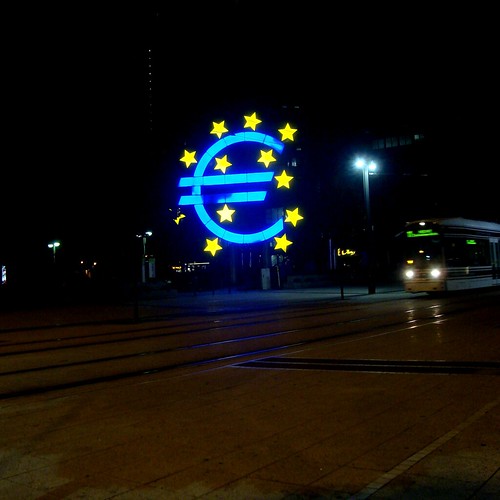
euro 1101

The €ye of the storm ... European Central Bank in Frankfurt.

Tuesday, October 11, 2011

don't play with food

Following the deregulation of the finance markets in the early 00s (whose bright idea was that?), finance people have discovered food commodities as a new toy to play with, and the prices have become unpredictable and decoupled from the real world parameters such as supply and demand. While the guilty parties deny that their gambling has any impact on the real world, experts increasingly believe that speculation does drive real people into real hunger.

For more info about this scandalous situation (and some of the science behind it, including, again, herding), read my feature in today's issue of Current Biology:

Don't play with food
Current Biology, Volume 21, Issue 19, pages R795-R798, 11 October 2011
doi:10.1016/j.cub.2011.09.037

summary and free access to pdf file

On the same issue, the World Development Movement (also mentioned in my feature) have today issued a press release:

450 economists call on G20 finance ministers to stop speculation fuelling hunger

Thursday, September 01, 2011

budapest globalised

The next thing I noticed about Budapest (after the red trolleybuses) was how thoroughly Western brands have taken over the place. It's not just the fast food outlets and coffee shops that you find everywhere in the world. The supermarkets are called Tesco and Spar, the banks are German, the phone booths (rusty and red, like the trolleybuses) were decorated in the livery of German Telekom (of T mobile fame) and had their trademark pinky-purple receivers:

globalised

Add to that the German-built cars that block the roads (traffic is a bit of a nightmare on the main routes through the city, but amazingly, drivers very willingly stop to let pedestrians cross), and you'll come to the conclusion that the profits of virtually every economic activity that goes on around there (with the possible exception of haircuts) will be skimmed off by somebody in the west. Oh well.

Funny that after 18 years in the UK, finding the German logos in Hungary is just mildly amusing. It's the Tesco branches, ranging from "expressz" to "hipermarket" that really annoyed me. From our experience here we know that these spread like Japanese knotweed.

BP1101

Tuesday, July 26, 2011

nature's value

At the end of June, I had the opportunity to take part in this year’s “World Forum for Enterprise and the Environment” at Merton College, organised by Oxford’s Smith School.

It was all about how we may still be able to avoid blowing up our planet if we get businesses to recognise the value of the natural resources they are using, polluting, or destroying with their activities.

Personally, I would prefer if people could just do the right thing because it is the right thing to do, and wouldn’t need price tags and bribes to steer them in the right direction. But as we do live in a society where money talks, and which isn’t going to change any time soon, I guess the ecosystem services idea may well be our best chance for saving what's left of our natural environment.

As this is all very topical and important, I wrote a feature about what I learned at the Forum, which is out in Current Biology today:

Valuing Nature
Current Biology, Volume 21, Issue 14, R525-R527, 26 July 2011
doi:10.1016/j.cub.2011.07.003
FREE access to full text and pdf file

Oh, and I especially enjoyed Sandra Bessudo's talk (in Spanish) on the natural wealth of Colombia, and what should be done to protect it, so here's a picture of her:


This is my own photo, but there are lots of official photos from the event at the Smith School of Enterprise and the Environment's photostream.

Friday, April 01, 2011

oddbins run dry

the Guardian reports it's the end of the road for mildly eccentric wine merchants chain OddBins, which happens to be my age. I loved their crazy catalogue graphics and used to buy my Havana Club (Cuban rum) from there, but I have to say that at least in the last three years, when I did some exploratory wine shopping, they never had any Cotes du Rhone bottles that might have tempted me. I mostly ended up importing them from the continent or buying them at M&S.

Just recently, I picked up brochure called "Oddyssey" from one of the branches (we have three within easy cycling distance), which relates the intriguing history of the chain, now looking certain to be coming to an end.

Here is a photo of the branch on Oxford's High Street,taken just a few days ago:


PS Possibly one of the last bottles they sold before going into administration arrived at my house just yesterday, it was the prize for spotting the odd book title that won the Diagram Prize.

Wednesday, November 03, 2010

why the state should fund universities

I never thought this needed explaining, but seeing that the government releases details today of what they admit is a move "to shift a greater proportion of [Higher Education] funding from the taxpayer to the individuals who benefit" (quote from the comprehensive spending review, page 51, last bullet point), it may be time to spell out the blatantly obvious.

The three words "individuals who benefit" are the most insiduous piece of misleading political propaganda that I've come across in a long time. So, for the benefit of the individuals who are busy wrecking higher education:

* giving people as good an education as their brains can soak up is not primarily to benefit the individuals, it is in the best interest of society. We all, i.e. society, need well-educated scientists, medical doctors, even lawyers and accountants. These days, we need more of these than of people who can stack shelves without complaining.

* yes it is expensive to educate people, but the benefit to society outweighs the cost by a large factor. Imagine the talented people who would normally study decided to work as bar staff instead. In the words of one ex Harvard president: "If you think education is expensive, try ignorance"

* on top of the benefit that academically educated people offer society by doing intelligent work, they also earn more more on average, so pay more taxes (disproportionately so in a progressive tax system), so they also are "the taxpayer" who funds their studies.

* even when the state pays the full cost of tuition, students still have their bills to pay for the duration of the study, and often make a sacrifice in terms of what living standard they could afford if they went to work straight after leaving school.

* Burdening students with the cost of their tuition on top of that will definitely scare away some talents (no matter how clever the payback arrangements) - especially if they have the opportunity to study elsewhere for free.

* Furthermore, I am worried that the "market solution" will turn degrees into commodities. If students are regarded as paying customers and have to pay close to the full cost of their education, they could very easily get the idea that with the payment they have purchased the right to get a degree regardless of their talent or effort.

These are the reasons why in civilised countries the state does (and should continue to) fund higher education, collecting at most a small nominal fee from students to avoid abuse of the facilities offered. It's not that difficult to understand, is it?


(protest posters seen in Oxford last week)

I'm pleased to report that we have a very active protest group here, the Oxford Education Campaign, which has already managed to scare away business secretary Vince Cable (the fact that the business secretary is in charge of HE tells you a lot about what's wrong here!). You can look up OEC on facebook or email oxfordunicuts@gmail.com to find out more.

A nationwide demo against HE cuts will take place on Wednesday 10.11. 11.30am at London, starting at Horse Guards Avenue - more details here.

PS: More about today's government announcement in the Guardian.
Also, my blog entries now get a tweet button, please use it generously (noting that both the button and the counter refer to the URL shown at the top of the browser, so if you're looking at a page with several blog entries, you'll have to click a specific blog entry first to get a specific tweet and counter result for it):

Friday, October 22, 2010

C'est la lutte finale

I had a crazy week, but finding this made my day:

The illustrations by Gerhard Seyfried with the German lyrics of the Internationale were originally a poster typically found on the toilet walls of shared student flats in the late 70s. Hitching his cartoons up to a recording is a brilliant idea. And of course there is plenty of stuff in there that fits this week's events in the UK amazingly well.

Friday, September 10, 2010

how greed wrecked our economy

I don't care much about money, so it takes exceptional circumstances to get me thinking about the state of the economy, but I have a feeling that the time has come to look at these things more closely than I normally do. What I'm particularly struggling to understand right now is why and how politicians (especially in the UK!) have allowed finance to run wild without realising that this would result in the systematic destruction of the real-world economy, i.e. of the companies that actually produce useful things but only yield modest profits.

There was an interesting comment by Andrew Simms in yesterday's Guardian, explaining how several British corporations originally founded with an agenda committed at least partially to moral principles (e.g. by Quaker families) came to be corrupted and wrecked by corporate finance. Some quotes I highlighted:

Twinings' fate highlights the quietly corrosive, long-term effect of the excessive privilege given to finance. Over decades its hypnotic hunger for unrealistic profit has corrupted or wrecked many other eminent corporations in Britain – often companies that, like Twinings, helped define our national identity.

Glib dismissals that this is the way of the world, the inevitable outcome of otherwise efficient markets, ignore the fact that indulging the lords of finance has wrecked the productive economy, just as much as it bankrupted the public finances.

If the corporation is to have a future, the public sphere will have to demand a redesign – and return finance to its proper, subservient role of supporting the wider economy.


On a related note, in a comment published last week, Cambridge economist Ha-Joon Chang challenges the notion that deregulated finance helps the economy overall. In the long term, Chang argues, the economy was doing better in the "bad old days" of the 1960s and 70s, when regulations were much tighter.


This charming little beast guards the boundary of the City of London, I think it may be telling us something about what's going on in the square mile!

Friday, February 05, 2010

radio revolt

I read in the Guardian this week that the UK broadcasting authorities aim to switch off analogue radio signals by 2015, and to speed up the switchover they want to introduce a scrappage scheme (like the one for old cars last year) to entice people to trade in their old radios for digital ones.

Now I understand that the people who sell the digital radios want to make loads of money, but why would radio users give up something that is absolutely indestructible and works a lifetime, only to buy new, probably less reliable gear that does the same for a lot more money? Considering my experience with CD and DVD players, these digital devices last about three years if you're lucky.

Our (analogue) radios, by contrast, are all doing fine, and the oldest is over 30. There is at least one in almost every room in the house (come to think of it, some rooms have more than one), so I'm supposed to be throwing them all away to buy something that will be horribly expensive and probably broken in three years time? I don't think so.

I hear the switchover date depends on how many DAB radios get sold. So there is a simple way of stopping it. If people don't buy digital radios, we can keep the technology that costs virtually nothing and actually works.

Thursday, January 14, 2010

the best things in life are free

I enjoyed Katharine Hibbert's recent piece in the Guardian on how she survived with (virtually) no money in London for a year, living in squats furnished from skips etc. Have to say I like to check skips as well, it's just the permanent moving around from one squatted house to the next, taking all one's possessions along, which would be a little bit tricky for me at this stage of my life.

That piece was extracted from a book which I understand is out today:

Free: Adventures on the Margins of a Wasteful Society by Katharine Hibbert, published by Ebury Press


but obviously, I'll wait and see whether I can get it for free ... Coming soon to a freecycle group near you.

Tuesday, March 17, 2009

the spirit level

There is an interesting new book looking at lots of parameters relating to quality of life, and coming to the conclusion that inequality harms not only the poor but creates damage across all layers of society:

The Spirit Level
Why More Equal Societies Almost Always Do Better
by Richard Wilkinson and Kate Pickett
published by Penguin in March 2009.


It is reviewed in the Guardian. While one always has to be careful with attributing simultaneous statistical changes to a causal relationship, the wealth of data pointing in the same direction suggests that inequality really is bad for everybody's wellbeing.

What needs explaining is the observation that even richer people are suffering in unequal societies (US and UK always at the top of these charts!). The one hypothetical explanation that might account for that paradox is status anxiety. When you live on such a steep slope that the mere thought of sliding down makes you sick or drives you to crimes, life is unhealthy even at the top.

Saturday, January 12, 2008

greed is bad for your mental health

It's always been kind of obvious to me, but apparently not to Tony Blair -- that greed doesn't make people happy. Psychologist Oliver James has explained this in a little more detail in his book "Affluenza" which came out a bit over a year ago, and now in a companion volume, which is a bit more academic, and which is called "The selfish capitalist: the origins of affluenza." Basically, James says that countries with a more social-democratic model of capitalism, such as Germany, have half the rate of depression and similar mental illness as the US, UK, and those that follow the "greed is good" philosophy of Blatcherism, so he concludes that a culture based on excessive greed and inequality is bad for people's mental health.

Basically, you'll probably find all the arguments in the works of Erich Fromm from the 60s and 70s already (e.g. To have or to be?), but if you need them spelled out in the modern context, take a look at these:

Affluenza (paperback edition) reviewed by Nicholas Lezard
The selfish capitalist reviewed by Madeleine Bunting
Selfish capitalism is bad for our mental health (an essay by Oliver James)