Showing posts with label düsselmann. Show all posts

Thursday, January 29, 2026

lives of Helene and Julius

continuing with the ancient info rescued from from the website about the Weiß chronicles, and following up from generations 10-6 in this blog entry, and Generation 5 here, we now come to:

4. The businessman

Helene Kauer, born in 1885 as the youngest of the five long-lived girls from the household of railway man Christoph Kauer and his wife Margarethe Imig, later told her grandchildren that she wanted to be a teacher when she was young, but that her parents couldn’t afford the fees to send her to the teacher’s seminar. Equal opportunities, she said, ended at the age of 10. Up to the fourth year of school, boys and girls had the same lessons. After that, girls were taught things like needlework and home economics, while boys studied more academic subjects like maths. Helene said she always considered that unfair, and when the time came she made sure that her daughters were able to study at university just as her son did.

Around 1905/06. she was still living with her parents at Adamsweiler (at the small railway station mentioned above, of which her father was the boss), when her cousin Julius Düsselmann (son of her aunt Elisabeth Catharina Imig, 1851-1924), came to live at Merlenbach, Lorraine, not all that far away. Julius (1883-1950) was an adventurous type and already had made a trip to the German colony in South West Africa (today’s Namibia), where he took part in the suppression of the Herero uprising. Historians now think that the colonial rule was upheld quite heavy-handedly, with interventions bordering on genocide.

The most notorious episode is the battle at the Waterberg of August 11, 1904, in which the German troups under the command of Lothar von Trotha surrounded 6000 Hereros, including women and children. The Hereros managed to break out into the Omaheke desert, where they were left to die of thirst and starvation. However, apart from some vague hints to “horrible things” he witnessed, we don’t know in detail what Julius did there or what he thought of it all.

In any case, he came back with ill health and had to settle for a quieter lifestyle, becoming the manager of a grocery shop belonging to the mining company in Merlenbach, 50 km east of the village of Adamsweiler, where his aunt and uncle lived with their two youngest daughters, Regina Katharina (“Kätha”) and Helene. Auguste and Anna were already married and had children of their own, while Johanna worked at Saargemünd at the post office.

Julius was the 4th child of a bunch of six produced by Karl Düsselmann (1841-1927) and Elisabeth Imig (1851-1924). I remember that my great-aunt used to refer to Julius’s younger sister Alwine anagrammatically as “Tante Lawine,” i.e. Aunt Avalanche. He also had a half-brother from Karl’s earlier marriage to Maria Schledorn.

Julius’s maternal ancestors were the Imigs from Simmern. On his father’s side, they all came from the Niederrhein area, i.e. the town of Krefeld, where many of them worked in the textile industry which Krefeld is famous for (see the Krefeld clan entry). Intriguingly, Karl’s mother was called Elisabetha de la Strada (1804-1882), whose paternal line we believe to have come from Italy. The current theory is that her great-great-grandfather had immigrated from Italy (a family tradition says it was from Capri, specifically) and worked as a gardener at a castle, which we believe to be Schloss Oranienstein at Dietz, Lahn. We now have a documented Johannes de Lastrada whom we believe to be that immigrant (though the gardener may have been in a different generation, and one de la Strada who is documented in archives relating to Oranienstein was a traiteur, not a gardener) . This Johannes de Lastrada married Elisabeth Hemmler at Wetzlar in 1681, they had 6 children baptised there between 1682 and 1691. In the marriage entry and in one of the baptisms, it is noted that the father of the family is Italian. (More about the Stradas here.)

The set of Karl’s ancestors is complete back to the 8th generation (i.e. Julius's great-grandparents), and there are some patches going back to the 10th generation, where we find the names Siepmann, Wilsberg, Röshof Wolffs, de la Strada, Hemmler, Jacob, Zeisen (=Zeutzem, Zeutzheim), Enkrich, Saur, Schönau, Giesen, Baxher (Bacher?) Vossen, and Gather.

In September 1907, Helene and Julius married. They spent their honeymoon at the Belgian seaside resort of Oostende, as my great-aunt told me in a letter. Apparently, Oostende was a very posh place back then, and the very posh ladies wore very posh frocks ensuring that their physical shape remained obscured even when they went swimming.

It is also said that, before they got married, Helene and Julius consulted a geneticist who assured them that their being first cousins would not affect their chances of having healthy children. (Which leaves me wondering exactly what kind of miracle diagnostic methods the geneticists of 1907 possessed?!)

And three healthy children they did have (although only one lived to an age commensurate to those of the Kauer girls):
1.   Ruth Düsselmann, 1908-1993, see below.
2.   Werner Düsselmann, 1911-1941.
3.   Esther Düsselmann, 1918-1983.

It is reported that Julius had been keen to emigrate to America, as his half-brother Karl had done already, and his brother Wilhelm would do as well in 1924 (while his oldest sister Elise only emigrated as far as the Netherlands, together with her husband Otto Finkensieper and their three sons). However, Helene dissuaded him from this plan.

Still, enterprising as he was, he set up his own shop in Luisenthal (Saar), which seems to have done well, as he opened a second one nearby, under the supervision of Helene’s sister, Kätha.

However, due to a heart defect that is believed to arise from a tropical disease he caught during his time in Africa (possibly typhus), he was forced to retire from business in 1918, at the age of only 35. The family, now complete after the arrival of the youngest daughter, Esther, moved to the Lower Rhine area, where the Düsselmann lineage came from. His brother Wilhelm helped him find a countryhouse with 6 acres of land and 200 apple trees at Mennrath, where they lived off the savings and the pension he received as a war veteran.

Only five years later, inflation put an end to this lazy life. Julius was forced to take on a sequence of jobs in various kinds of commerce. By 1928, the family lived in the town of Rheydt, Königsstr. 32, where the firstborn, Ruth, finished high school that year. (Rheydt is now part of the city of Mönchengladbach.)

In 1932, after a short spell of unemployment, Julius became a salesman for the textiles company C. Brühl & Co. at Rheydt (the company celebrated its centenary in 2023, but is now based in Rotenburg/Fulda). Following successful business in East Prussia, Julius was given the opportunity to start a new branch at Königsberg, which became a success. In 1936, the whole family, including faithful Aunt Kätha, moved to Königsberg, Münzstr. 10, renting a fourth floor flat with 8 rooms. They bought some of the furniture from a Jewish dentist who read the signs of the times and emigrated to Palestine. They let out the Mennrath estate. The factory, based at Kantstraße 10, started to run under Julius’s name, producing professional clothing and uniforms.

In 1937, Julius suffered severe injuries in a car accident. While he stayed in hospital, his son Werner interrupted his medical studies to run the business. At that point, the company had 150 employees and a new branch at Zinten, 30 km south of Königsberg. Werner then stayed on as a deputy manager until he was called up for military service at the beginning of the war.

In 1940, Julius split his business from C. Brühl by paying back the investment and a share of the profit.

Werner Düsselmann, who served as a simple soldier and truck driver on the Eastern front, was shot dead by snipers on the day of his 30th birthday, in 1941. His wife and young son both survived the war.

A week before Werner’s death, his sister Ruth had already paved the way for the family to return to the Hunsrück area (where her aunt Johanna Kauer lived in the house she built on her retirement in 1934), moving to Hahnenbach on the pretext of having to care for her aunt. After Werner's death, however, she returned to Königsberg to help out in the company.

In August 1943, Ruth went back west for good, taking both her children and Aunt Kätha to Hahnenbach. A year later, Königsberg suffered devastating air raids. Over 4,000 residents died, 200,000 were left without abode. Julius and Helene protected themselves from the firestorm by covering up with bath robes dunked into the water of the lake at the Königsberg castle. The factory was also damaged, but could continue production on a smaller scale, with 25-30 machines.

In December 1944, Helene went west and moved in with her sisters, daughter, and grandchildren at Hahnenbach. Julius stayed behind, but in January 1945, when visiting the seaside near Pillau, he spontaneously decided to board what turned out to be the last ship to leave the Königsberg area. Very wisely, he had been carrying his travel documents and essentials with him for a while. By the end of the month, the city was surrounded by Russian troups.

Julius arrived at Hahnenbach in February 1945. In August, as the war was over, and he set out to make a fresh start, he moved his family to Bad Nauheim (a famous art nouveau spa town north of Frankfurt), where they lived at Frankfurter Str. No. 26 at first, then moved to Frankfurter Str. 12, a substantial villa from 1898, which was to stay “in the family” until 1979. Initially, the family occupied only one room of this building. Using his old business contacts, Julius set up a wholesale trade for textiles. However, he did not have the time to develop this last business venture very much, as he died suddenly, in March 1950, at the age of 66, when visiting his daughter Esther at Frankfurt.

Helene continued to live at Frankfurter Straße 12 with her daughter Esther, who remained unmarried. They sold the property at Mennrath and set up a guest house catering for visitors to the spa facilities that Nauheim is famous for. (Come to think of it, maybe the town is more famous for the fact that Elvis Presley spent his military service time there, but I don’t know whether any of my relatives met him! They’re not very musical on that side of the family.) The two main floors of the “Pension Düsselmann” had 12 rooms with around 300 m2 total surface area, not to mention the small flat in the loft and the vast basement including a derelict bowling alley. Esther and Helene used three rooms themselves, leaving nine rooms plus the flat for paying guests or visiting family members.

Helene lived to the age of 87 in full possession of her wit and mental abilities. She died in November 1972, the only great-grandmother I got to know.

Despite having a diploma in economics and a PhD dissertation in the drawer (it had become meaningless after the war, as it dealt with trade opportunities in Eastern Europe, or something like that!), Helene’s daughter Esther did not inherit her father’s business sense. She kept spending inordinate amounts on changes to the interior layout of the house (we made jokes about how the toilets ended up in different locations each time we visited!), while leaving the roof and structure to rot. On top of that, she also liked to spend generously on taxi rides, furniture made to measure, and antiquarian books. (I shouldn’t moan about the latter, though, as she left the books to me!) When a series of strokes left her paralysed before the age of 60, the family found out that the sale of the villa was only just enough to cover her debts. She died in 1983, aged 64, leaving my grandmother, Ruth, as the last survivor of the three children of Julius and Helene.

PS I created a new portal to navigate family history blog entries in the shape of a permanent Who Is Who page. This is because the old webpage at michaelgross.info will go offline on February 2nd.

Monday, December 22, 2025

revisiting the Siepmann family

Back in 2009, I made a blog entry about the Siepmann family, based on the very detailed church record of the death of my ancestor Anna Elisabeth Siepmann who died in 1788 and on this occurrence of the name in an old book I found in a skip:

The ancient Siepmann post has been very popular, and this month I had another comment on it bringing the total to 18. A lot of new information has been contributed by the correspondents, so it's time to organise all of this into new post, working towards a family tree.

This will be a story of four parts that are not connected yet:


(1) family of Doris Siepmann from Bristol, UK, whose book inspired the old blog entry
(2) Siepmann families immigrated to the US in the 1870s to 1910s coming from Oberhausen, Germany
(3) early Siepmann families in the eastern Ruhr area, Germany, around Hattingen, Bochum and Herne and possible origins of the name (see the map below of how the name was distributed in 1890).
(4) the immediate family of my ancestor Anna Elisabeth Siepmann and her husband Henrich Tüselmann who lived first at Strünkede (Herne) and then Dahlhausen (Bochum) where they ran a mill.


(1) Doris's family

So let's start with Otto Siepmann, language teacher at Bristol and dad of Doris - I am quite excited to have found out just now that his letters to his son Harry are archived here. What if he writes about his ancestors in those letters? That could be really useful to the Otto descendants who have commented on my old blog entry.

Right now, my understanding of Otto's extended family now is looking as follows:

August Siepmann (1835-1908) oo Wilhelmine Henriette Hasenbach (1836-1891)
The eldest of 9 surviving children is:

1. Otto Siepmann * 1861 Waldbröl (east of Cologne, south of the Siepmann heartland in the Ruhr area) +1947
oo 1889 Grace Florence Baker (1858–1937)

They had three daughters and three sons:

Harry - the letters to him from his father while he was at school and at uni date 1902-1913.

one son missing here ?!

Edith Alicia aged 9 on census day 31.3.1901; oo Bankes-Jones

Phyllis aged 6 on census day

Doris (1895-1988) aged 5 on census day (owner of the book that inspired the blog entry of 2009, see her autograph and rubber stamp above)
oo 1920 Percival Waterfield (1888-1965), senior civil servant involved in the creation of the WW2 motivational posters like Keep calm and carry on.
son: John Waterfield (1921-2003), diplomat

Charles (1899-1985)
oo Charlotte "Dolly" Tyler (according to wikipedia) and/or oo Janey (according to an anonymous correspondent to the earlier blog entry)

Another son of August and Wilhelmine appears in Gedbas (the mother is called Hansenbach in this entry but that must be an error, there are multiple Hasenbachs in the right area and only this one occurrence of Hansenbach):

Update 9.1.2026 Note that the previous generation may not have been based in Waldbröl - the address book of Rhineland/Westphalia from 1834 does not include a Siepmann in this district (it seems to be more of a VIP list though, with no farmers or farm workers included?). There is a Peter Siepmann in Schwelm, however, which is mentioned below as a likely source of the Siepmann name.

2. Gustav Heinrich Siepmann * 26 Sept 1870 Waldbröl, + 16. August 1948
oo 11. 2. 1902 Hamburg Gisela ROOSEN ,
Ricardo SIEPMANN 6. 1. 1903 + 1948
Hans-Werner Heinrich SIEPMANN 14. 7. 1908 +1984
Ursula SIEPMANN 1. 11. 1913 + 1990


(2) Transatlantic Siepmann connections

Several people have contributed infos on immigration of Siepmann families to the US. The farthest back in time is the 1870s wave of catholic Siepmanns (everybody else in this story is protestant as far as I know) coming from Oberhausen, which is in the western part of the Ruhr area, but not too far away from the Hattingen/Bochum area where I think the nameline may have originated in the middle ages. According to Elianah we have:

Wilhelm and Catharina Lang Siepmann

Catherine Siepmann Hartgenbush,
Wilhelm (?),
Friedrich (Fred)Siepmann,
Joseph James,
Gertrude Siepmann Page,
Mary C Siepmann,
Frances Siepmann, and
Peter August Siepmann.

Elianah writes:

"The first to arrive was Wilhelm in Buffalo, NY. He eventually made it to Iowa. As far as I can tell, all of the other siblings came to Iowa directly, settling in Cedar, Linn, Johnson and Benton Counties. From there, the descendants went to Wisconsin, Minnesota, Nebraska, California, Washington and Oregon."

As Elianah also mentions, Oberhausen was a city made up of various towns and villages in 1862, so the Siepmanns coming from there may not have Oberhausen on their birth record but one of the places we now know as a district of Oberhausen. Note also that in the reorganisation of the area some historic units were split up, so we now have districts called Styrum and Borbeck in Oberhausen as well as in neighbouring cities (Mülheim and Essen, respectively).

In Gedbas.de I can't find any Siepmann in Oberhausen or any of the preceding towns and villages. The closest match would be this Wilhelm Siepmann born in Mülheim.

Debra has written about a separate lot of Siepmanns also coming from Oberhausen

"My grandfather Wilhem Siepmann sailed to the port of Boston on the Willehad from Germany, arriving sometime in August 1914. He came from a family of 11 siblings who were mostly teachers and musicians. His family was also from Oberhausen in Westfalia. My grandfather settled in New Jersey and is buried in Brielle, N.J."

Re Siepmanns in Oberhausen, note that there is a street called Siepmannstrasse in Oberhausen Dümpten, not far from Müheim, named after a Siepmann family who had their farm there before industrialisation.


(3) Early Siepmann families

We're going further back in time now to look for the origins of the Siepmanns and for potential relatives of my ancestor Anna Siepmann who died 14.12.1788 at Dahlhausen (now in the southwestern part of the city of Bochum) aged 82 - see further details under (4).

The distribution of the name in 1890, shown in this map, suggests that it has scattered from one origin in the general area of Westphalia. (Map is a screenshot from this site.)

Three separate lineages are going back to the 16th century, two from Schwelm, one from Hattingen. Schwelm is half way between Waldbröl and Dahlhausen, so a plausible departure point for the radiation of the later Siepmanns. I'll give the founding fathers of each name line capital letters starting with A (not strictly chronological):

(A) Johan Sipman / Im Siepen * 1590 + 5.1.1657 Schwelm, Ennepe-Ruhr-Kreis, lived "am Zipp" in Schwelm, which would plausibly explain the origin of the name. Zipp exists still today as a street ca. 2km SE of Schwelm, going off the A 483 main road and serving about 5 houses.

1. Johann SIPMANN about 1620-after 1690
1.1. Hans IM SIPPE about 1650-after 1713
1.1.1. Hans Evert ZIPMANN about 1681-1761 - lots of descendants listed here who seem to have kept the spelling "Zippmann"

1.2. Elsabeth IM SIPPE about 1659-1752

Note how fluctuating the family name still was then.

Two of the oldest Siepmann families I found on Gedbas go back to

(B) Jürgen Sippmann in der Wischen born Schwelm, late 16th century,

Now this is interesting: Henrich Siepmann * 1670 in Hattingen got the name via his mother who is a granddaughter of that very same Jürgen in der Wische from Schwelm, who appears here with a different set of descendants compared to the first lineage linked to under (B). Note also that Henrich married Elisabeth Kistner - his maternal grandmother was also a Kistner

let's aggregate these two lineages leading back to (B):

Jürgen (Sippmann) in der Wischen

1. about 1590 Peter in DER WISCHE

2. about 1600 Hans in DER WISCHE

2.a about 1607 Johannes SIEPMANN these two are the same person as both oo Elsa Kistner 4.11.1622 Holthausen, Borken

children listed for Hans:

2.1. Johannes im SIPEN * 13. 11. 1622 + 11. 12. 1685 Darmstadt, Hessen,

2.2. Elsabeth im SIPEN * 30. 5. 1627
oo 30. 4. 1666 Hattingen ev Wilhelm in DEN BERCKEN

2.2.1.Jurgen SIEPMANN * 1667
oo 8. June 1687 Hattingen ev Christina SIPMAN her nameline goes back to Adolph Sipmann * around 1560 Hattingen, ie the same generation as the founding father of this name line, see under (C) below.

2.2.2.Henrich SIEPMANN about 1670
oo 21. October 1697 Hattingen ev Elisabeth KISTNER Johann Henrich SIEPMANN * 18. 1. 1699 Hattingen ev + 8. 12. 1778 Hattingen oo Catharina Gertrud LEMBECK

2.3. Catharina im SIPEN * 27. April 1631

Catharina and Johannes are listed for 2.a Johannes Siepmann, but with the family name Siepmann / Sippmann, respectively. Both went off to marry in Darmstadt, Hessen, and I think Johannes's descendants may have stuck with the Sippmann spelling.

(C) Adolph Sipmann * around 1560 Hattingen died before 1615 (as wife married again)
oo Trine + 17. 2. 1625

1. Henrich SIPMAN about 1590-
1.1. Christina SIPMAN 1615-1615
1.2. Johannes SIPMAN 1617-
1.2.1. Christina SIPMAN 1668-
.3. Catharina SIPMAN 1620-
1.4. Maria SIPMAN 1624-
1.5. Gertrude SIPMAN 1629-
1.6. Adolph Sipman EFFMANN 1630-after 1702

2. Cathrina SIPMAN about 1595-
2.1. Everhard WISSMAN 1621-
2.2. Cathrina WISSMAN 1624-1625
2.3. Maria Gertrud WISSMAN 1636-

3. Adolph SIPMAN about 1605-1635
3.1. Henrich SIPMAN 1628-
3.1.1. Margreta SIPMAN

4. Else SIPMAN about 1600-1625

5. Anna SIPMAN -1625
5.1. Margarethe SIPMAN 1623-1625

Other 17th / 18th century Siepmann lineages include:

Hermann Siepmann
oo Margarethe BRÖGELMANN
1. Margarethe SIEPMANN * 3. 8. 1691 Hattingen

Arnold Siepmann
oo 1696 Anna Engels Solingen lots of descendants

Johann Diedrich Siepmann
Johannes Peter SIEPMANN * 1718 (lots of descendants)
Anna Margarethe SIEPMANN * 26. August 1719

Johann Henrich Frielinghaus oo Anna Christina Siepmann daughter 1725
Margarethe Christine SIEPMANN * 1725 Linden (now part of Bochum but next door to Dahlhausen where my ancestor died) + 1805

Henrich Adam Siepmann * 1712 + 21. 01. 1797 Himmelmert
oo Anna Christina Hustadt
1755 Johann Henrich SIEPMANN
1767 Diedrich Adam SIEPMANN

Peter Siepmann * 1730 in Moers.

Looking into the Siepmanns in the German Wikipedia, I found the industrialist brothers Hugo and Emil Siepmann from Hagen (Ruhr area). Their steel works at Warstein remain in the family to this day. Their ancestry is on Gedbas, going back to Peter Wilhelm Siepmann born in the mid 18th century, one generation younger than my ancestor.

Intriguingly, the mother of Emil and Hugo was also born a Siepmann, but Gedbas has her lineage only back to her grandfather Peter David Siepmann, who must have been born around 1800 as he had children between 1827 and 1839. Surely this wasn't a coincidence and the parents were some sort of distant cousins?


(4) Anna Elisabeth's family

Finally, we come to my ancestor Anna Elisabeth Siepmann, whose married life is described in some detail in this churchbook entry from December 1788.

My rough translation:

On the 14th of December, Anna Elisabeth Siepmans, widowed wife of the grain miller Henrich Tüselmann at the Dahlhausen grain mill, at an age of 82 years, after a 14-day suffering with severe chest illness, by death exchanged the temporary for the eternal and has on the 17th been buried with a sermon about the words of psalm 71 verse 9. With Henrich Tüselmann from the parish of Herne she entered matrimony in 1730, wherein she lived with him peacefully for 40 years, and [verb missing] 13 children, 10 sons and 3 daughters, of whom 4 sons preceded their father to eternity. In the status of widowhood she lived 18 years and awaited the salvation of her body.

Unfortunately, nothing about her origins. I'm sure she must be related to some of the Siepmann families listed under (3) but how?

Of those 13 Children we have some further info only about three:

1. Wilhelm Düsselmann oo 1772 Dahlhausen Anna Maria Düppen from Meinerzhagen (He is described as the young miller from the Dahlhausen mill, so I guess he must be the oldest surviving son and heir to the business.)

2. Jürgen Henrich Tüselmann, * 1743 Strünkede, oo 1.9.1778 Dahlhausen Marie Elisabeth Dünnewald

... ten more children ...

13. (Johann) Georg Wilhelm Düsselmann ~30.4.1757 Dahlhausen - the relevant ancestor for my lineage, who moved to Krefeld and had hundreds of descendants. Note that his mother was 50 or 51 at the time of his birth, which is impressive. And he definitely must have been the last of the 13 children.

Just about the only Düselmann person we can't quite account for is

Johann Wilhelm Düselmann, * 27.5.1778 Bochum

Update 25.1.2026: I created a new portal to navigate family history blog entries in the shape of a permanent Who Is Who page. This is because the old webpage at michaelgross.info will go offline on February 2nd.

Thursday, December 05, 2024

silk town through the centuries

I have written about the Krefeld clan on various occasions, but somehow didn't have a piece on Krefeld in the first series of #lostcities. The direct ancestors of my great-grandfather Julius Düsselmann are recorded there from 1764 to 1924. Descendants of Julius's cousins still live there to this day, so it's about time for an entry, which will lead us deeper into the past than anything in the first season.

Under William of Orange, Krefeld had a record of welcoming religious minorities that were persecuted elsewhere, including Mennonites and Quakers. One Mennonite family, the Von der Leyens, transformed the history of the town by running an extremely successful and lucrative silk weaving industry, for which they were awarded a monopoly by the king of Prussia in 1763. At that point, Krefeld had only 4756 residents. With the silk boom the town grew explosively and became relatively wealthy, even though it also had its share of social conflict including a weavers revolt in 1828. In 1888 it passed the 100,000 mark making it officially a city. Politically, the town had fallen to Prussia in 1702, became part of France from 1801 until 1814 (Arrondissement de Crévelt), and fell back to Prussia after Napoleon's defeat. On the 200th anniversary of Krefeld joining Prussia the first time, emperor Wilhelm II visited the city and promised to station a cavalry regiment there, which he delivered in person, four years later. More about this mildly amusing episode here. The K in today's spelling of the name only became official in 1925.

Rheinstrasse cuts across the rectangle defined by the four former city walls, so it's easy to find and I vaguely remember how it looks now. I'm assuming the view here is from the top of the St Dionysius church.
Source.

What happened - just to sketch the broad outlines (essentially everybody named here was born and died in Krefeld unless specified otherwise):

1764 Christophel Wilsberg from Hamm married Anna Sybille Wolff from Mülheim in Krefeld

1788 Johann Georg Wilhelm Düsselmann from Dortmund married their daughter Margarete Wilsberg in Krefeld (he had previously married Anna Christina Lohr in 1782, also in Krefeld)

1796 Jacob de la Strada from Fachbach married Margarete Giesen (born in Krefeld although her parents married in nearby St. Tönis, today Tönisvorst) in Krefeld

1804 At the birth of their son Wilhelm, Johann Georg Wilhelm Düsselmann and Margarete Wilsberg lived at Auf dem Alten Kirchhoff (see list of locations below). JGW Düsselmann did not sign the certificate as he was unable to write. The certificate is issued in French by the Mairie de Creveld, and dated according to the calendar of the French Revolution, 25. Thermidor XII = 13.8.1804.
At the birth of their daughter Elisabetha, Jacob de la Strada and Margarete Giesen lived "devant la porte de St. Antoine". 26. Frimaire XIII = 17.12.1804

1826 Protestant silk weaver Wilhelm Düsselmann married Catholic Elisabetha de la Strada in Krefeld. They had 13 children and brought up the boys as Protestants and the girls as Catholics. Their descendents are the Krefeld Clan listed here. The survival rates and long lifespans bear witness to the wealth that the booming silk business brought to the ordinary people of Krefeld. Compare and contrast with Wilhelm's grandfather Christophel Wilsberg, who had died from malnutrition in 1781, aged only 52.

1841 At the birth of their son Carl (later written as Karl) and his twin sister Maria (7th and 8th of the 13 children), Wilhelm Düsselmann and Catholic Elisabetha de la Strada lived in the Peters-Strasse, house number 1559 (I'm assuming this is the old numbering system, when one sequence of numbers covered the entire town, as opposed to one sequence for each street)

1883 Julius Düsselmann born as the fourth of six children of Karl and Elisabeth (Karl also had a son from a previous marriage) - sadly no address given on the birth certificate.

1890 The much bigger city gets a professional fire brigade. Its founding director is Karl's brother August Düsselmann, who previously led the volunteer force. As of 1882, at the birth of his adventurous son Walter, he was still a decorator (Anstreicher) in his day job, and lived at Elisabethstrasse 95.

1924 The residence of my direct ancestors in Krefeld presumably ended soon after the death of my great-great-grandmother Elisabeth Catharina Imig who died October 2nd. On her death certificate, her and her husband's address is given as Alte Linnerstrasse 2.

1927 Her husband, Karl Düsselmann survived her by two years and a half, but as he was well over 80 and then died in Neukirchen-Vluyn, where his daughter Alwine lived with her husband Willi Esser, I reckon Karl will have lived with her family for the last two years of his life. He died 11.4.1927 aged 86. The death certificate reports he was resident of Vluyn, without a street address.

Locations:

  • Alte Linner Straße 2. The Alte Linner Straße begins at the Ostwall, the Eastern long side of the rectangle, but it is numbered the wrong way round, with the lowest numbers furthest away from the centre, so number 2 is a lot further out than I have ventured so far. On google streetview the house looks like a 1950s redevelopment.
  • Auf dem Alten Kirchhof doesn't exist any more as a street name, but the protestant church in the old town is still the Alte Kirche, and the street describing a U-turn on the Western side of the church is called An der alten Kirche, so I guess that's where the address must have been.
  • "devant la porte de St. Antoine" it took me a while to realise that this must be the gate to St. Tönis, which was the Western gate of the old town. I don't think the gate survives, but it must have been where today's St. Anton-Straße crosses what was then the Western boundary of the town, the Dionysius-Straße. Just Southeast of that place is the Dionysius church, from which the Rheinstraße projects Eastwards, as seen in the postcard above.
  • Elisabethstraße 95 Not far from the Alte Linner Str., above. The house no. 95 appears to have been merged with 97, to create more garage space on the ground floor, with only one entrance for humans, and five for cars.
  • Petersstraße. This street is actually a major axis inside the rectangle of the former city walls, the first parallel to the Ostwall. Will have to work out how the house number translates to modern numbering.

In August this year, I visited Krefeld for the second time, got to meet some of my relatives who live there, and had a bit of an architectural trail. See the photos of the places I saw in my flickr album. I need to revisit to look up the street addresses mentioned above.

Previously in the #lostcities series:

  1. Elberfeld / Wuppertal 1919 - 1961
  2. Strasbourg 1901 - 1908
  3. Minden 1903 - 1952/ca.1970
  4. Tangermünde 1888 - 1916
  5. Rheydt 1923 - 1935
  6. Königsberg 1935 - 1945
  7. Aachen 1936 - 1940
  8. Idar-Oberstein 1940 - 1962
  9. Bad Nauheim 1945 - 1972/1983
  10. Würzburg 1961 - 1968
  11. Hamborn inlaws: 1922 - 1979/2015
  12. Bonn 1929-1934
  13. Lorsch 1890-1938/1973.

NB I have now added a second end date to the cities where other family members stayed on after the direct ancestors died. So far, that is the case for Minden, Bad Nauheim and Hamborn.

The Mastodon thread for season 2 starts here.

Update 8.12.2024 I've added the list of locations as a new feature which I am planning to introduce across the series (if and when any specific addresses are known at all). If only to make sure that the next time I visit the place I know exactly where to look for the footprints of my ancestors.

UPDATE 19.1.2025 I have now started a pin board "vintage postcards" on pinterest with postcards from the cities in this series.

Thursday, November 21, 2024

not yet a capital

Back in the first plague winter of 2020-21, I entertained myself with a blog series on the "lost cities" where my recent ancestors used to live - until the 1960s when my parents and grandparents (separately) thought it was a good idea to live in the sticks and embrace a car-dependent lifestyle. The series was born out of research for my musical family history memoir when I realised that Heinrich the cellist and Frieda the pianist each lived in several cities that I quite liked, and never, ever, in the country (while old Heinrich was in the military, his regiment was moved to the small town of Dieuze as a punishment, that was as close as they got).

This focus on Heinrich and Frieda obviously biased my first set of 10 lost cities (to which I then appended one from the inlaws side), so I always thought I might one day continue with a few more. It only took me four years, but now I think I have another 9 or 10 at hand to carry on. I'll include Hamborn in the list as number 11 and continue counting so here comes Bonn as number 12.

I initially didn't include Bonn, because my grandparents only moved there to study, so it was kind of an ephemeral presence our family had there. Then again, they first met there, and they both studied in other universities before doing their final years at Bonn, so history could have turned out differently, and their separate decisions to come to Bonn were kind of crucial for my existence to happen. And come to think of it, that's pretty much the same level of importance as Strasbourg has, where Heinrich and Maria met a generation earlier. Although I don't recall anybody having a romantic attachment to Bonn, in contrast to the Strasbourg affinity that has been passed down several generations.

Bonn doesn't need much of an introduction, as it served as the federal capital of West Germany for some four decades. (It also happens to be twinned with Oxford.) Just to note that before the war it was mainly the home of a well-respected university, which had been set up in 1818 after Bonn became part of Prussia. Located on the main north-south axis along the river Rhine, it was much more convenient to reach by rail than many of the smaller historic university towns such as Göttingen or Marburg. In the 1930s, it had around 100,000 residents.

What happened was that Heinrich's son Richard, after studying two semesters in Göttingen and one in Vienna, arrived in Bonn in 1929. Ruth moved to Bonn in the summer of 1930, after studying in Freiburg, Münster, and Freiburg again. In choosing Bonn, both moved closer to their parents, based at Wuppertal and Rheydt, respectively. They took their exams in 1933 and 1934, respectively. They finished more quickly than planned as they feared the imminent removal of some of their profs who were Jewish, including the mathematician Felix Hausdorff and the chemist Heinrich Rheinboldt.

There are lots of photos of Richard and Ruth from their student days in Bonn, of which I have included a few in my "every picture" series (eg: Richard, Ruth), although they don't offer much of a sense of place. I'm not sure if their correspondence from the student days has survived - if so I haven't seen it yet - so I don't even know the addresses where they lived in Bonn. So, more or less randomly, I picked an old postcard of the market square, because it is still recognisable today:

source

And here is a view I really like of the Poststrasse:

source

After preparing this entry, I revisited Bonn and realised this view is just a few metres away from the main entrance of the main station Bonn Hbf, so this is basically what you see when you come out of the station and cross the road (or pass through the tunnel, choose exit "Poststrasse"). The cigar shop on the right was obviously destroyed and rebuilt in the same contour but without the decorative elements. It is now a Macdonalds. The building on the left appears to have survived (probably the reason why the same contour was rebuilt on the right, to keep the symmetry).

bon5186

I also visited the Macke-Haus, where expressionist painter August Macke lived and worked until the first world war. Will rave about that separately.

Previously, I had visited the city a few times in the 2010s, as one of my children was studying there for a couple of years - back then the Macke Haus was closed for major refurbishment, but I did enjoy the Kunsthalle and the Arithmeum, two of the modern museums in the south of the city where the government quarters used to be.

Previously in the #lostcities series:

  1. Elberfeld / Wuppertal 1919 - 1961
  2. Strasbourg 1901 - 1908
  3. Minden 1903 - 1952/ca.1970
  4. Tangermünde 1888 - 1916
  5. Rheydt 1923 - 1935
  6. Königsberg 1935 - 1945
  7. Aachen 1936 - 1940
  8. Idar-Oberstein 1940 - 1962
  9. Bad Nauheim 1945 - 1972/1983
  10. Würzburg 1961 - 1968
  11. Hamborn inlaws: 1922 - 1979/2015

NB I have now added a second end date to the cities where other family members stayed on after the direct ancestors died. So far, that is the case for Minden, Bad Nauheim and Hamborn.

UPDATE 19.1.2025 I have now started a pin board "vintage postcards" on pinterest with postcards from the cities in this series.

Thursday, July 25, 2024

ladies of honour looking for dancers

a serendipitous find possibly of interest to the Krefeld Clan.

On a tumblr blog that posts lots of old postcards I discovered this group photo of young women from Krefeld, who in 1906 served as ladies of honour to welcome the emperor Wilhelm II to the city:

Die Ehrendamen beim Besuch Kaiser Wilhelm II in Krefeld, 2. April 1906. Source.

When I tried to find out who they were (seeing that our Krefeld Clan relatives had plenty of eligible daughters around that time), I discovered another group photo from an earlier imperial visit, and an amusing story to connect these two.

A few years earlier, the Kaiser had visited Krefeld on to celebrate the city's 200th anniversary of being part of the Kingdom of Prussia. (NB people in the Rhineland had rather mixed feelings about being ruled by faraway Prussia, but I guess by the time the 200th anniversary arrived they had gotten used to it.) On this visit, 20 young women of the city, all dressed in white, lined the stairs of the Kaiser Wilhelm Museum (built in 1894-97 as a memorial to Wilhelm I and still standing today) to welcome the monarch. Reportedly, he was quite impressed by this welcome and asked for their group photo to be taken:

Die Krefelder Ehrendamen beim Empfang der Kaiserl. Majestäten am 20. Juni 1902. Verkleinerung der von seiner Majestät gewünschten Original-Photographie. Source.

Various copies of this postcard are available for sale online (eg here and here). I'm dreaming of finding one with the inscription "hey look that's me" or at least with a useful name.

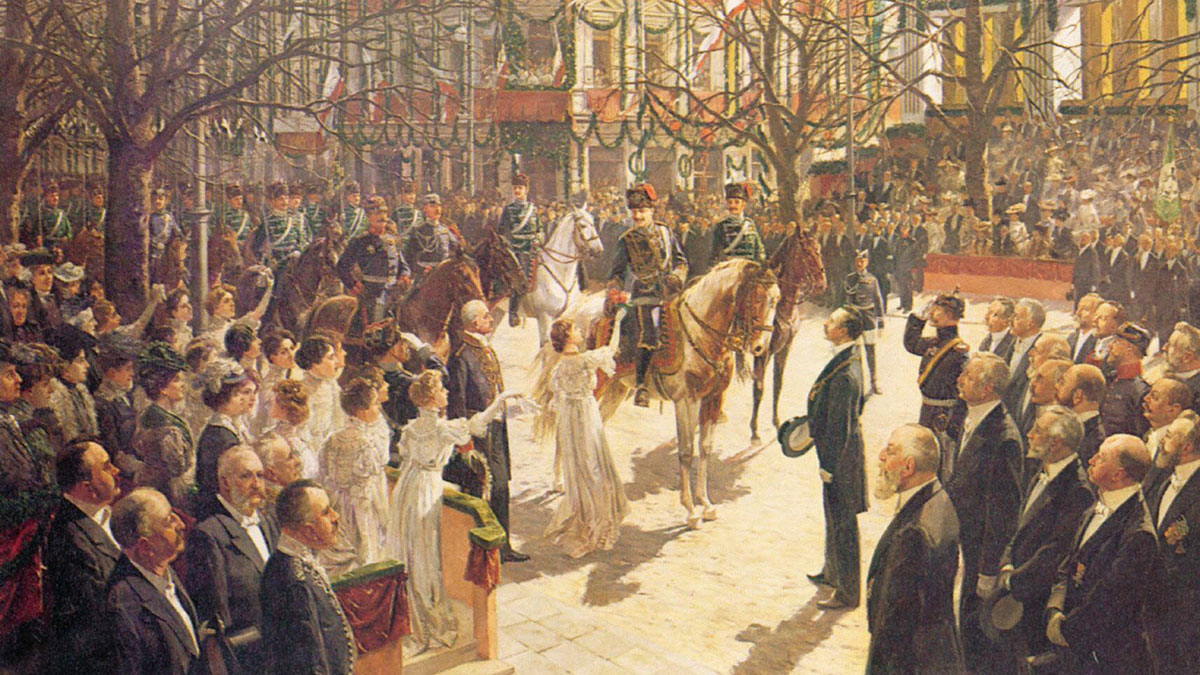
Legend has it (see eg here) that in subsequent smalltalk with the ladies, Wilhelm inquired whether they went out to dance quite regularly. He heard complaints that the young men of the city only had their textile businesses in mind so there wasn't all that much dancing happening. On the spot, the emperor promised to send some officers to Krefeld for the ladies to dance with. Chances are that the plans were already being hatched beforehand, but he did indeed order the 11th regiment of Hussars to be moved from Düsseldorf to Krefeld. That move happened on April 2 1906, and the emperor underlined his role in the deal by personally leading the regiment on the last mile into the city. The painter Carl Röhling immortalised the scene:

Source

Obviously, ladies dressed in white were lined up and photographed again on this occasion, hence the postcard photo dated 1906 shown at the top.

The soldiers were known as the Tanzhusaren in reference to the story:

Source: Wikipedia

Of course the residence of the regiment in the city only lasted eight years until the hussars were sent to France for a fight in which their role as dashing horsemen soon proved to be obsolete. Much like the monarchy and the ladies of honour, so those pictures are a bit like a last hurrah of that world about to vanish.

Thursday, April 11, 2024

gaudeamus igitur

In last week's Every picture story I mentioned the songbook that I inherited from my great aunt Esther. I am not sure whether the Hermann Bender who signed it was the confectioner or some eponymous stranger. The confectioner's wife, Henriette Düselmann was Esther's great aunt. (Is there a technical term for my great aunt's great aunt?)

I took photos years ago and must have shared them on my tumblr book blog (deleted by the Inquisition) but forgot to put them here. So here goes (with a fresh photo of the outside of the book):

Note the biernagels (beer nails) - the book is made to be used on drunken nights in unruly taverns, so these metal bumps are there to keep it safe from drink spills. The text on the cover is from a student song and translates as "Let's have fun while we are young." The song is called De brevitate vitae (on the shortness of life) and is entirely in Latin. (Video with text). I thought it was just a quaint old German thing, but Wikipedia tells me it is today widely used as an anthem of educational institutions of all sorts.

It is the 43rd edition of Schauenburgs allgemeines Deutsches Kommersbuch. The excellent Wikipedia entry seems to suggest that it must be from 1891-1893, as these years are documented for the 42nd and the 44th edition, respectively. Wikipedia also lists the multiple subtle changes made to the frontispiece over the years, so here's my version:

the inscription on the left says somebody used it as a guest of the Tueskonia on May 2nd 1896. The closest match I can find is the Tuiskonia in Munich. I'm not clear about the signature, will have another think on that. In any case it could be a nickname. Below it says "Pension Grenzland" - today there is a B&B of that name in Bad Brambach, on the Czech border, near Hof, Bavaria. Not very close to Munich though.

And here we have the beautiful signature of Hermann Bender, who may or may not be the confectioner. He also signed in pencil on the dark paper facing the inside of the cover, but that one is hard to see and not as beautiful.

From the Wikipedia entry I also learned just now that these two mostly illegible handwritten pages shown below are not specific to my copy. (It had always confused me that this seems to be dated 1858 while the book was printed much later, it contains references to events in the 1880s.) Turns out the original authors dedicated the first edition to the poet Ernst Moritz Arndt (see the printed text above right and below left), and it's his reply that was included in later editions as a facsimile. So, phew, I don't have to decipher that.

Thursday, April 04, 2024

a confectioner's business

Every picture tells a story, season 3, picture 17

last update: 11.4.2024

Let's go back to the Krefeld Clan - the 13 children of silk weaver Wilhelm Düselmann and Elisabetha de la Strada who married in 1826 and agreed to bring up the boys protestants (like their father) and the girls catholics (like their mother).

Of the 13 children, we have seen child number 7 Karl the foreman (and father of enterprising Julius) and child number 10 August the fireman (and father of adventurous Walter).

I don't think I have any photos of any of the other 11, so if any of the hundreds of descendants out there would like to share some I'd be very grateful.

What I do have though is the husband and three children of child number 9, Henriette Düselmann, who was born in 1843.

In 1863 she married confectioner (Conditor und Zuckerbäcker) Joseph Hermann Bender (born 1840). He has a database entry here, where funnily enough only the sons are listed, whereas all the info on descendants I have concerns two of the three daughters of the couple. Anyhow, here's the confectioner in around 1895 with his son Nicolas, left, both daughters, and an employee called Nik (or possibly Josef Hermann's brother Nicolaus - I have contradictory infos on this?!):

Firstborn child Gertrud married Wilhelm Heinrich Habrich; Josefine married Wilhelm Max Holler (brother of the painter Alfred Holler), shown here:

Each had four children, so the complete set of eight born between 1902 and 1912 is here (maybe around 1915 judging by the size of the youngest standing on the bench?):

And this is a wider family gathering for Pentecost (Whitsun) 1926

Here we have the confectioner's daughters Gertrud (2nd from left) and Josefine (3rd). Far left is Gertrud's husband, Wilhelm Heinrich Habrich. Josefine's husband, Wilhelm Max Holler, is the 6th from left. On either side of him two Holler children, and on the right of the picture four Habrich children lined up.

Open questions: The woman fourth from left is unidentified according to my source, but given the symmetry of the picture with three sisters ligned up on the right, I am tempted to speculate it could be the third daughter of the confectioner, Klara Bender, see below? Trouble is we don't know much about Klara. The 8th person is named as Adolf Peters. We don't know anything about him but note that the grandmother of Gertrud and Josefine, Elisabetha de la Strada, had a brother who married a Gertraud Peters, so there could be a remote family link.

In the ancient Krefeld Clan blog entry I had two other children of Henriette and the confectioner (in addition to Gertrud and Josephine):

9.3. Nicolas Joseph Bender * 22.4.1864 Krefeld

9.4. Klara Bender * Krefeld

Digging up some old correspondence I find that Nicolas moved to Berlin and Klara was severely injured in an accident with a horse carriage.

The database entry reveals a second son I didn't know of:

Heinrich Bender * 30.10.1871

But it shows no marriage or offspring for either of the sons.

So I had the sibling order all wrong,it should be:

  1. Nicolas Joseph Bender * 1864
  2. Gertrud * 1870
  3. Heinrich Bender * 1871
  4. Josefine * 1881

And we still don't know where Klara fits in - the biggest gap to accommodate her would be before Josefine.

Another mystery that's possibly related: I have a 19th century student song book signed Hermann Bender, inherited from Esther the travelling saleswoman who came from the Krefeld clan, so it could be an heirloom linked to the old confectioner, but then again she also bought antiquarian books, so it could be a coincidence. Will have to do a separate entry on that at some point (UPDATE: done now).

Should anybody have any answers to some of the many questions I am raising in this series, please leave a comment here (I'll need to vet it, so it may take a few days before it goes public) or contact me at michaelgrr [at] yahoo [dot] co [dot] uk

Navigation tools:

Season 3 so far:

  1. family holiday
  2. play time
  3. fashion show
  4. bakery to butcher's shop
  5. the Hamborn brotherhood
  6. all grown up
  7. sisters in the snow
  8. the last holiday
  9. village life
  10. family reshuffle
  11. push bike
  12. mystery trio
  13. confirmands at Hamborn
  14. streets of Hamborn
  15. more grandchildren
  16. a Russian winter
  17. a confectioner's business

The Mastodon thread for season 3 is here.

You can find Season 2 entries in this thread on Mastodon (complete now!) or via the list at the bottom of the last entry of the season (and also at the bottom of the first entry of this season).

The twitter thread for season 1 is still here. Alternatively, visit the last instalment and find the numbered list of entries at the bottom.

Thursday, April 20, 2023

the joy of botany

Every picture tells a story, season 2, picture 32:

staying with those students at Bonn University: While Hanna appeared to enjoy her chemistry, Ruth Düsselmann was more drawn to botany, so here she is picking up some plants:

And another one on a different occasion:

Both photos taken by our young chemist Richard Groß 1929 or thereafter.

Should anybody have any answers to some of the many questions I am raising in this series (or questions of their own), please leave a comment here (I'll need to vet it, so it may take a few days before it goes public) or contact me at michaelgrr [at] yahoo [dot] co [dot] uk

Navigation tools:

Season 2 so far:

  1. could be a cousin
  2. two weddings in Silesia
  3. off to Canada
  4. off to Australia
  5. a very romantic poet
  6. fireman August
  7. 50 hundredweight of coffee
  8. mysterious Minden people
  9. horses for Hedwig
  10. guessing the great-grandmothers
  11. cousin Charlotte
  12. three sisters
  13. travelling saleswoman
  14. family portrait
  15. dancing chemist
  16. games time
  17. desperately searching Wilhelm
  18. the third Hedwig
  19. patchwork portraits
  20. missing brothers
  21. the oberlehrer's family
  22. a double wedding
  23. mystery solved
  24. young Frieda
  25. old aunts and young children
  26. a semi-mysterious aunt
  27. a gathering at Gellrichs
  28. farm work at Bad Landeck
  29. meet the Weitze family
  30. a post-war wedding
  31. the joy of chemistry
  32. the joy of botany

I started a twitter thread for season 2 here. However, as the bird site seems to be turning into an evil empire, I have now switched to logging the entries in a similar thread on Mastodon.

The twitter thread for season 1 is still here. It only loads 30 tweets at first, so you have to click "show more" a couple of times to get all 40 entries. Alternatively, visit the last instalment and find the numbered list of entries at the bottom.

I'm also adding all photos from this series to my family history album on flickr.

Thursday, December 01, 2022

travelling saleswoman

Every picture tells a story, season 2, picture 13.

After Julius the shopkeeper and later textile businessman had to leave Königsberg he settled in Bad Nauheim and tried to start a new textile business from there based on his address book if not much else. From November 1945 he and Helene (and whatever other family members washed up) lived in a single room in Frankfurter Str. 12, an art nouveau villa which the family later bought, and which you can see here.

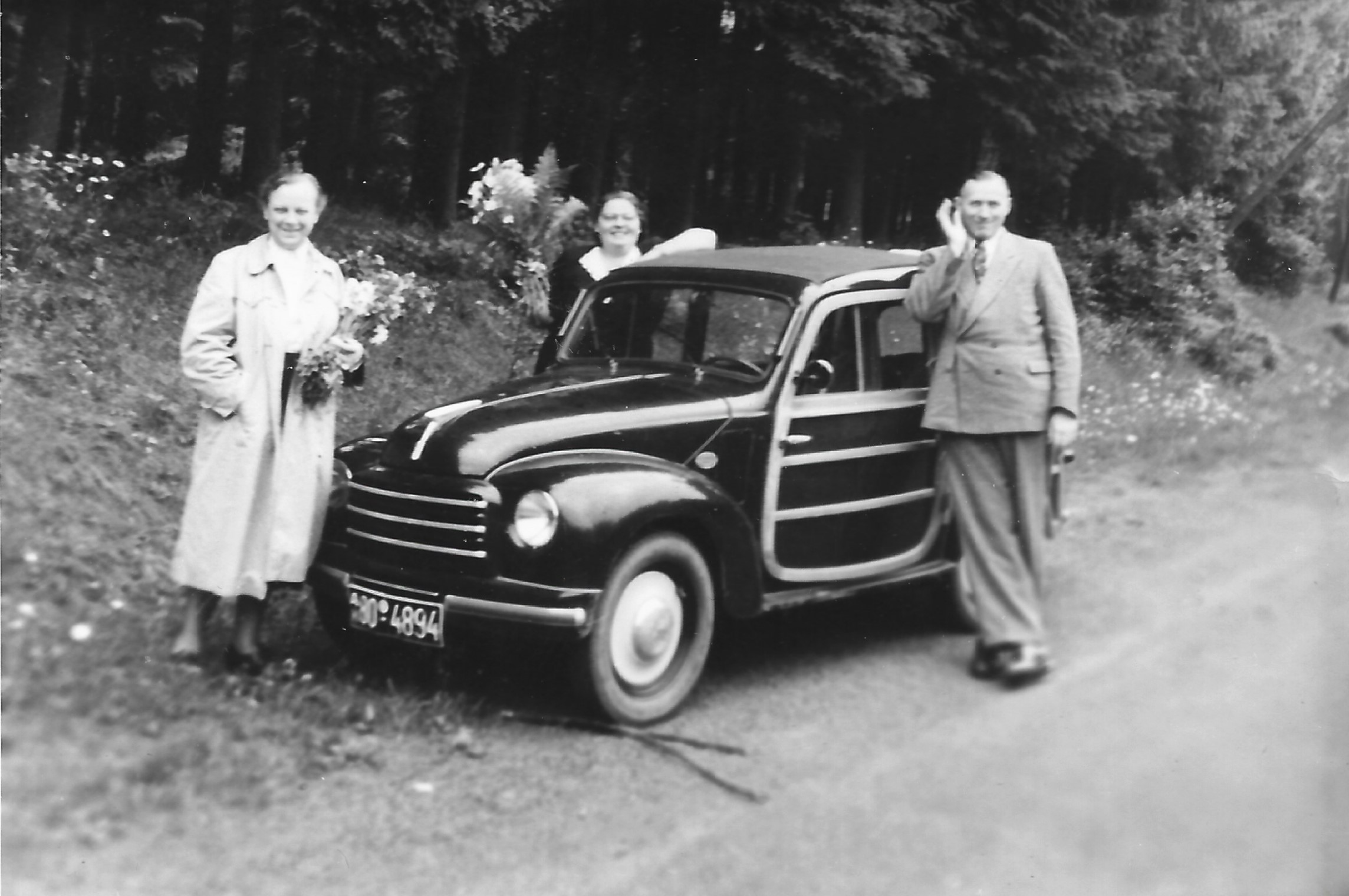
Julius died in 1950, aged only 66, which was possibly related to the tropical disease he caught as a young man in Africa. Julius had bullied his younger daughter Esther into studying economics against her wishes. She therefore sported the title of a Diplomkaufmann, which together with her last name of Düsselmann made for a lot of manliness on this woman's business card. Working with Otto Hummel first at Königsberg and then at Reichsuniversität Posen (Poznan), she had even prepared a doctoral thesis about the eastern European trade which became pointless after the war, had worked at Frankfurt with Ludwig Erhard between 1945 and 1950, and then after Julius' death felt obliged to keep his business alive. This involved her driving around as her own travelling saleswoman, for which purpose she got a car, namely a Fiat produced in Germany by NSU, so it was known as an NSU-Fiat. At this point, nobody else in the family had a car (people were still civilised and lived in cities and didn't need one!), so it made a big impression on her teenage nephew, and there are a few photos of her with the NSU-Fiat:

I love this one which kind of reflects her imposing nature.

I have no idea who her fellow travellers may have been.

Could be her sister Ruth in the passenger seat not sure.

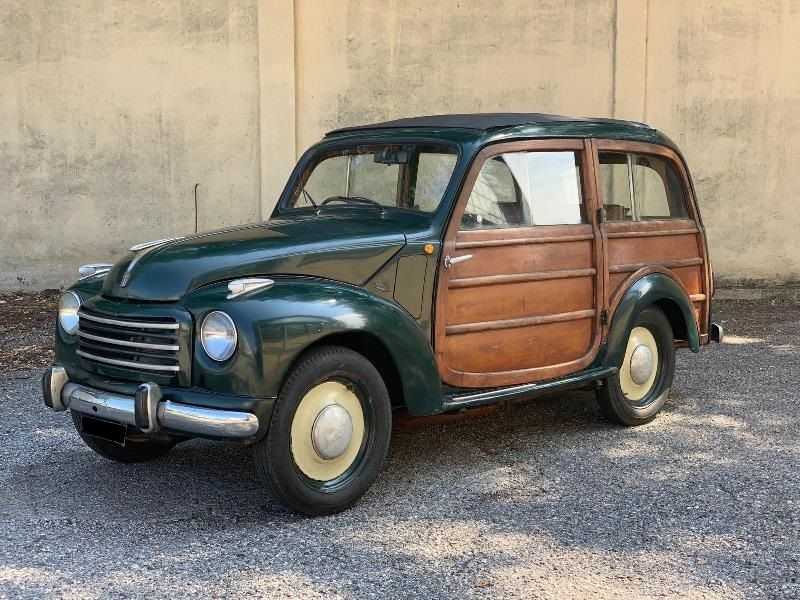
The closest match for the car I could find online is this:

I gather it could be a Fiat topolino 500C Belvedere, but have no strong opinion on this.

Esther's saleswoman life continued until 1960. Then, as compensation payments for the lost factory in Königsberg enabled the family to buy the house, she gave up the textile business and ran a bed and breakfast for spa visitors.

Navigation tools:

Season 2 so far:

  1. could be a cousin
  2. two weddings in Silesia
  3. off to Canada
  4. off to Australia
  5. a very romantic poet
  6. fireman August
  7. 50 hundredweight of coffee
  8. mysterious Minden people
  9. horses for Hedwig
  10. guessing the great-grandmothers
  11. cousin Charlotte
  12. three sisters
  13. travelling saleswoman

The twitter thread for season 2 is here.

As the bird site seems to be going the way of MySpace, I have built a similar thread on Mastodon, which is now up to date.

The twitter thread for season 1 is still here. It only loads 30 tweets at first, so you have to click "show more" a couple of times to get all 40 entries. Alternatively, visit the last instalment and find the numbered list of entries at the bottom.

I'm also adding all photos from this series to my family history album on flickr.

See also my Lost Cities series (which may get an extension at some point).

Thursday, October 13, 2022

fireman August

Every picture tells a story, season 2, picture 6.

We've met Carl Düsselmann, who was one of the 13 siblings in the Krefeld Clan. We don't have photos of many of his brothers and sisters, but we do have this one of his brother August:

The story behind it and the reason we found it in an old newspaper is that August was a volunteer firefighter at Krefeld, and happened to be the leader of the local fire brigade in 1890, when it decided to become a professional force. So August became the founding Branddirektor of the Berufsfeuerwehr (professional fire brigade), and at one point the brigade put up portraits of its past directors and realised the first one was missing. They published an appeal in a local paper and it turned out that our shared relatives in nearby Neukirchen-Vluyn (I think I met them once as a child) had a photo of old August which they donated to the fire service, and it was duly reported and shown in the paper in 1987. A happy ending for all.

August is also the father of Walter Düsselmann who survived the sinking of the Volturno and later smuggled arms for the Easter Rising. Let's say that carriers of the Düsselmann Y chromosome, including our old Julius, appear to have been happy to embrace risky endeavours. (The medals that both August and Carl are wearing in their photos seem to be pointing in that direction too, although I have no idea what they mean specifically. They probably have a story or two to tell, all hints appreciated.)

Navigation tools:

Season 2 so far:

  1. could be a cousin
  2. two weddings in Silesia
  3. off to Canada
  4. off to Australia
  5. a very romantic poet
  6. fireman August

The new twitter thread for the new season is here.

The twitter thread for season 1 is still here. It only loads 30 tweets at first, so you have to click "show more" a couple of times to get all 40 entries. Alternatively, visit the last instalment and find the numbered list of entries at the bottom.

I'm also adding all photos from this series to my family history album on flickr.

Saturday, September 10, 2022

jeder einmal in Berlin

Jeder einmal in Berlin
Offizieller Führer
Berlin und Umgebung
Potsdam und seine Schlösser
ca. 1928

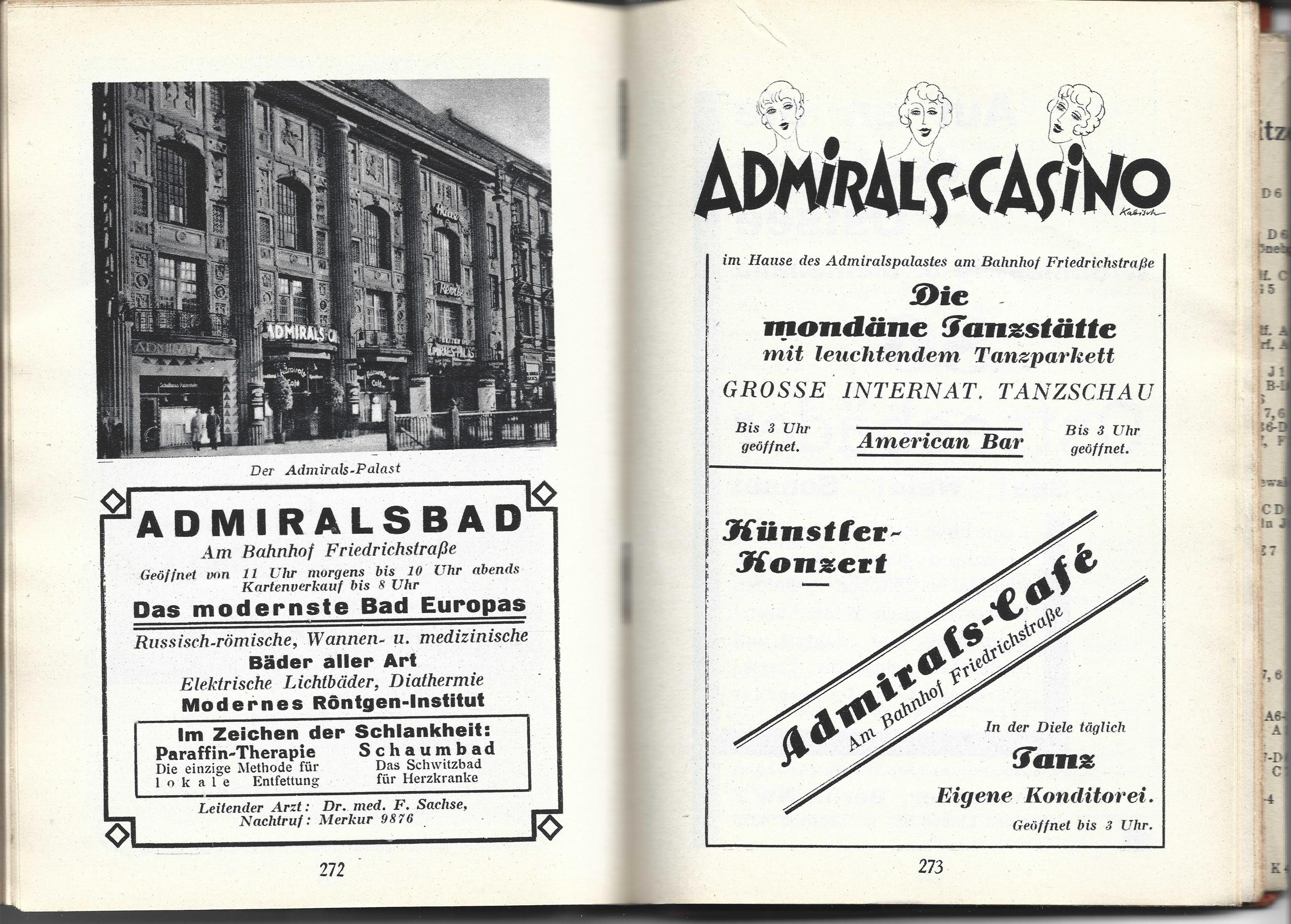
This century-old guidebook to Berlin (title roughly translates as: everybody has to visit Berlin at least once) came in handy when I looked up the addresses where my grandmother-in-law's re-discovered cousin Lotti Geppert lived. It might also serve as a companion to Babylon Berlin, it certainly has all the addresses of the venues seen there, and also conveys a bit of that roaring 20s spirit, in moderation, "mondän doch dezent" as one of the nightclub ads puts it.

I struggled to pin down the publication date though. It contains traffic data from 1927, so could be 1928 as the earliest. As the upper limit I can put 1934, because it contains a portrait of President Paul von Hindenburg, who died that year. It also contains a portait of the mayor, Gustav Böß, which narrows it down a bit, he was mayor from 1921 to November 1929. So let's call it 1928.

photo of my edition.

I inherited this from my great-aunt Esther Düsselmann who may have used it visiting Berlin as a teenager or as a student. Come to think of it, her brother married a woman from Berlin and settled there, so that would explain it. There aren't any marks from her, however.

There's a copy (lacking the rather lovely map) on sale here for just 13 euros which I find a bit disappointing. Given the interest in 1920s Berlin, I would have put a higher price on it (did I mention it's a first edition?).

I did some scans of nightclub ads and such like:

Update 15.10.2022: As season 4 of Babylon Berlin comes out, the Guardian has prepared a short guide of what's left to see of 1920s Berlin.

UPDATE 26.11.2022: A post I saw on tumblr gives "Jeder einmal in Berlin" as the title of episode 5 of the first series of Babylon Berlin, but I have yet to find an online episode guide that confirms that. The ones I found just have numbers for the episodes, no titles.

UPDATE 7.8.2023: Sky (Germany) has helpfully put a 1930 version of the map online and pinned the locations relevant to Babylon Berlin.