Showing posts with label microbiology. Show all posts

Monday, June 22, 2026

our less famous microbiomes

I attended a Cell Press symposium about microbiomes and their interactions with the host organism at Bruges in May. It was mostly about the one in the human gut and its interaction with the immune system, but for my feature I chose the road less travelled and focused on the microbiomes of other body parts, including vagina, skin and nose. I was really most inspired by the Belgian project Isala, which due to the lack of an animal model for the vaginal microbiome, relied on actual humans sending in their samples.

The resulting feature is out now:

Know your microbiomes inside and out

Current Biology Volume 36, Issue 12, 22 June 2026, Pages R677--R679

Restricted access to full text and PDF download
(Unfortunately, this year's features will no longer become open access one year after publication - do contact me if you would like a PDF.)

Magic link for free access
(first seven weeks only)

See also my new Mastodon thread where I will highlight all this year's CB features.

My mastodon posts are also mirrored on Bluesky.

Last year's thread is here .

The Isala project studying the vaginal microbiome was launched as a citizen science project and has received overwhelming support from thousands of participants. Symbolic picture on the theme of sisterhood, not actual participants of the project as far as I know. (Photo: Colin Anderson Productions pty ltd/Getty Images.)

brg9721

The view from the top floor of the (otherwise horrible) conference venue was ok.

Sunday, April 26, 2026

staying alive

In the madness of the UK's Covid response, public health expert Devi Sridhar was a lone voice of reason. Remembering this, I was keen to read her book about the wider application of her thinking to population scale life and death from all causes and found it quite enlightening. Most importantly, she demonstrates how dramatically the political decisions affecting public health differ between countries and how that leads to very different results in avoidable deaths from causes ranging from guns to cars.

How Not to Die (too soon): The Lies We’ve Been Sold and the Policies That Can Save Us
Devi Sridhar
Penguin Viking 2025

My review of the book is now out in the April issue of Chemistry & Industry:

Health accountability

Chemistry & Industry Volume 90, Issue 4, April 2026, Page 34

access via:

Wiley Online Library (paywalled PDF of the whole review section)

SCI (premium content, ie members only)

In the same issue I also have a feature about plant microbiomes. I've covered the field a couple of times in Current Biology (most recently in 2022), but this one is slightly different in emphasis as C&I wanted more about the application side of it than I have previously covered.

Plant probiotics

Chemistry & Industry Volume 90, Issue 4, April 2026, Pages 22-25

access via:

Wiley Online Library (preview of the first page and link to paywalled PDF)

SCI (premium content, ie members only)

Monday, March 23, 2026

save the microbes

Over the last few decades, there has been a growing awareness of the fact that commensal microbiota are important just about everywhere, from our bodies to the leaves of tomato plants. Funnily enough this hasn't quite translated into the realisation that saving life on Earth from another mass extinction will also require saving the microbes that are the foundation of all ecosystems as well as the little helpers in many symbiotic relationships.

Only last year did the IUCN (which looks after the Red List of endangered species) launch a specialist group focused on microbial conservation. Reason enough to write a feature about it which is out now:

Towards a Red List for microbes

Current Biology Volume 36, Issue 6, 23 March 2026, Pages R229-R231

Restricted access to full text and PDF download
(Unfortunately, this year's features will no longer become open access one year after publication - do contact me if you would like a PDF. Last year's features will still move to the open archives as this year advances.)

Magic link for free access
(first seven weeks only)

See also my new Mastodon thread where I will highlight all this year's CB features.

My mastodon posts are also mirrored on Bluesky.

Last year's thread is here .

The cyanobacterium Prochlorococcus is a major contributor to photosynthesis globally but may be more vulnerable to ocean warming than previously predicted. (Image taken by Anne Thompson, Chisholm Lab.)

Monday, February 07, 2022

the whole holobiont

Microbiota are important for so-called higher organisms that depend on their less sophisticated residents, like we do, for instance, on the bacteria in our guts. This is also the case for plants, and even in several different parts of each plant. In 2020, I wrote a feature on life on leaves (now in the open archives), an aspect that has so far been less appreciated than the symbiosis below ground, especially the root nodules providing photosynthesis services.

But now I spotted a paper that studied the acquisition of microbiota by young poplar plants above and below ground, both within and outside the plant's tissues, and I found the systematic approach to the development of the holobiont (the sum of the plant and all its microbiota) appealing, so that was my excuse to revisit plant microbiota. Also, the topic is still underappreciated.

The resulting feature is out now:

How plants grow their microbiome

Current Biology Volume 32, Issue 3, 7 February 2022, Pages R97-R100

FREE access to full text and PDF download

bean plant surrounded by tomato plants shows neighbourhood effects in its microbiome, especially if the surrounding plants are older. The photo shows the experimental setup at the end of the first month. (Photo: Kyle Meyer.)

NB: as the 2022 features move into the open archives, I will add them to this thread on Mastodon.

Monday, December 20, 2021

make antibiotics evolution-proof

My first article about the dangers of antibiotics resistance came out in September 1994, so I am getting a little bit frustrated that this problem hasn't been fixed in the last 27 years. We are now reaching a point where a post-antibiotic age, meaning widespread incurable bacterial infections wiping years off our life expectancy, is a very real possibility. While I was writing this feature, I needed a course of antibiotics myself, which very nicely focused my mind on what a post-antibiotic world might be like.

The only thing that cheered me up was finding that all the recent work I discussed is based on the premise that we need to find a fundamental new way out of the race we've been running against the evolution and spread of resistance genes. Basically, bacteria have been dealing with fungal antibiotics for hundreds of millions of years. Thus, thinking that we might overcome them with slightly different antibiotics was always naive. So if we want to win this, we need to find evolution-proof recipes.

My feature on the latest advances in this quest is out now:

How to avoid a post-antibiotic age

Current Biology Volume 31, Issue 24, 20 December 2021, Pages R1549-R1552

FREE access to full text and PDF download

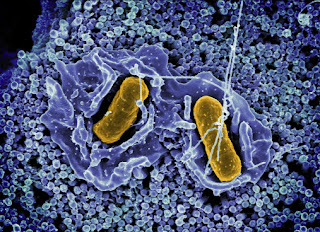
Drugs specifically suppressing virulence factors instead of eradicating the bacteria have been tried on Salmonella enterica serovar Typhimurium, among other pathogens. Here, Salmonella cells (yellow) invade a human gut epithelial cell (blue). (Photo: NIAID/Flickr (CC BY 2.0).)

Monday, October 05, 2020

sick of climate change

Today's issue of Current Biology includes a special section "The Microbial World". My contribution to the section looks into the effects of climate change on the ecology of pathogens. Amphibians are the canaries in the coalmine for this one, as they don't control their body temperature and changes in environmental temperature make them vulnerable to fungal infections that are already causing extinctions. But potentially climate-induced human diseases are also being investigated.

Disease in the times of climate change

Current Biology Volume 30, Issue 19, 05 October 2020, Pages R1104-R1106

FREE access to full text and PDF download

Other goodies in the special issue include a primer on the phyllosphere (the above-ground microbiome of plants) by Britt Koskella and a quick guide to giant viruses by Chantal Abergel.

Monday, December 03, 2018

minerals and microbes

Microbes have been around on this planet for close to four billion years, so in their own unconscious, unicellular way, they know a thing or two about how to handle its minerals, and even how to produce new ones.

Our flawed human efforts to access the planet's resources have produced a lot of collateral damage, pollution and waste. So we should consider learning from microbes about mining, producing materials and recycling them. Which is the topic of my latest feature, out today:

Mining the mineral microbiome

Current Biology Volume 28, Issue 23, 03 Dcember 2018, Pages R1325-R1328

FREE access to full text and PDF download


Copper occurs naturally in a variety of chemical modifications. In this piece of rock it occurs in the minerals azurite and malachite as well as in metallic form. (Image: Parent Géry via wikipedia.fr.)

Monday, December 18, 2017

bacterial voting

Quorum sensing is the fascinating mechanism by which bacteria decide whether they are present in sufficient numbers to have an effect, eg to produce light for a symbiotic host organism, or to launch an infection in an unsuspecting victim. This field has a fan community among those interested in the resulting phenomena (eg bioluminescence, infection) or in bacterial communications more generally, but I don't think it has received nearly the attention it deserves. Part of the reason may be that some of the most important areas where QS occurs are also incredibly complex. However, bioluminescence offers very simple and elegant model systems, and on the basis of things learned there, science can eventually progress to the messy ones, like our guts.

I think I last wrote about quorum sensing around 10 years ago (and, definitely, in my book Light and Life), so it was about time to revisit the field, which is becoming more important as we are beginning to appreciate the importance of the bacterial symbionts in our bodies. My feature on is out now:


Shining new light on quorum sensing

Current Biology Volume 27, Issue 24, pR1293–R1296, 18 December 2017


FREE access to full text and PDF download


Embryos of the Hawaiian bobtail squid (Euprymna scolopes), which are colonised specifically by the luminescent symbiont Vibrio fischeri, are an ideal model system to study aspects of symbiosis and quorum sensing.

(Image: Tim Miyashiro and Andrew Cecere (Appl. Environ. Microbiol. (2016) 82, 3082–3091.)

Monday, December 11, 2017

bacterial wires

Open Archive Day

I heard last week that the ability of bacteria to form pili that act as electrical wires is not limited to the species of geobacter in which it was first discovered (press release here).

This reminded me of a different kind of bacterial electricity which I described in a feature back in 2012, which is now freely accessible:

Surprises from the sea floor


Microbiologist Derek Lovley and colleaugues at UMass Amherst report finding electrically conducting pili or 'e-pili' in more bacteria species than just the original Geobacter discovery he made 30 years ago.
Credit: UMass Amherst

Monday, December 16, 2013

antibiotics in crisis

When I started out writing about science, 20 years ago, I tended to end my articles on an optimistic note, along the lines of: now the molecular structure of this problem is known, surely a solution will soon materialise. How little did I know.

One of the solvable problems I wrote about nearly 20 years ago – and I have an article published in September 1994 to prove it – is the spread of antibiotics resistance. Now the existence of antibiotics resistance traits is natural and there isn’t much we can do about it, but their spread is greatly facilitated by two human activities, namely the reckless use of antibiotics in agriculture, where they are essentially used to speed up growth, and their misguided use in human patients, including pointless prescriptions by doctors, and inappropriate application by patients.

All that was very well known and recognised in the 1990s, so it was deeply distressing for me to find out from a recent report into the problem that antibiotics are still misused in agriculture in the US, and from own experience I know that some doctors still prescribe antibiotics when they very clearly shouldn’t, e.g. for a common cold.

So, well, the problem we’re facing today is that there are hardly any new antibiotics in the development pipeline, and the old ones we have are being squandered through systematic and long-running misuse which should have stopped 20 years ago but for some strange reason hasn’t.

In the US alone, 23,000 people per year are dying from antibiotic-resistant bugs, and the bottom line is most of these deaths could have been avoided if antibiotics misuse had been stopped in time. And this will get worse. Infectious diseases which we’ve almost forgotten are returning because of this.

It’s a very very depressing subject, but if you can bear to read more about it, there is a new feature out in Current Biology today:

Antibiotics in crisis

Current Biology, Volume 23, Issue 24, R1063-R1065, 16 December 2013 doi:10.1016/j.cub.2013.11.057

full text and free access to PDF download

Extended spectrum beta-lactamase-producing strains of Enterobacteriaceae, including Klebsiella species and E. coli, are responsible for around 1,700 deaths per year in the US. (Photo: courtesy of CDC http://www.cdc.gov)

Tuesday, May 07, 2013

gut feelings

This week's issue of Current Biology has a special section of food and biology. My contribution is a feature on the gut microbiome and what it can tell us about widespread problems like obesity, diabetes and heart disease.

Does the gut microbiome hold clues to obesity and diabetes? Current Biology, Volume 23, Issue 9, R359-R362, 6 May 2013 doi:10.1016/j.cub.2013.04.047

Free access to the

HTML text

PDF file

The issue looks like this:

Saturday, August 06, 2011

phages and pili

the roundup of German pieces in August is all about bacteria, namely first the phages that infect them, and then the hairs that enable them to infect us.

Planet der Phagen
Spektrum der Wissenschaft August 2011, page


Wie die Haare der Bakterien wachsen
Chemie in unserer Zeit 45, No. 4, page 234
DOI: 10.1002/ciuz.201190057
abstract and limited access to PDF file


a chestnut tree, as featured in the phages work reported

Wednesday, June 01, 2011

protein portal

Gabriel Waksman's group at the Institute for Structural and Molecular Biology (shared between Birkbeck College and University College London) has an exciting article out in tomorrow's issue of Nature, on the molecular machine which builds pili, i.e. the "hairs" that pathogenic bacteria use to attach themselves to their host. I wrote the following summary for the ISMB website:


The ability of bacteria to cause diseases in humans or animals depends, among other things, on their ability to stick to their host in order to be able to establish an infection. Many kinds of bacteria do this with the help of very thin protein hairs, known as pili. Like our hair, these pili grow from the root. With a detailed structural analysis of how this growth happens, ISMB researchers have now laid the foundations for medical applications.

E. coli strains causing urinary tract infections are one of many examples of bacteria depending on pili, as they would otherwise get washed away with the urine. The outermost end of their type I pili is a sticky protein that attaches itself to the surface of the urinary tract, using the host’s carbohydrate receptors.

Following the pilus from the tip inward, we first find two linker units FimG and FimF and then a large number of copies of the main hair builder, FimA, which is anchored in the outer membrane. In 1999 and 2002, the team of Gabriel Waksmann (then at Washington University Medical School in St Louis, USA and now at the ISMB) showed that these subunits fit together like pieces of a linear jigsaw puzzle. Each protein subunit has a well known structural pattern (the same that is also found in antibodies), but one bit of this structure is missing. The following subunit brings along the missing bit that latches into the hole and completes the structure.

This structural incompleteness of each single subunit means that each of them on its own is unstable in the periplasm, the space between the outer and the inner membrane of certain bacteria (only Gram-negative bacteria have this feature), where pili are manufactured. Therefore, they are being looked after by molecular chaperones, i.e. proteins that can protect these contact points from aggregation.

Now Waksman’s group has elucidated the detailed structure of a complex involving the outermost, “sticky” FimH subunit of an E. coli pilus, as it is being exported through the outer membrane by a specialised protein export machine (the FimD usher) and still being guarded by such a chaperone, FimC. The structure, which shows the pilus tip protein lined up inside a hollow cylindrical channel of the usher protein, is unique in that it is the first such structure of a complete protein export machine including the proper protein to be exported.

Previous biochemical studies had implicated the front end of the usher protein, the N-terminal domain, as a binding site for the pilus proteins to be exported. The new crystal structure, however, shows this site to be idle, while a second site, near the other end of the usher protein, the C terminus, binds the FimH-FimC complex. The authors conclude that the usher has two binding sites such that the growing pilus can remain anchored to one, while the next subunit to be added to it docks to the other.

The authors also conducted a crystallographic analysis of the empty FimD usher for comparison (although the structure of a similar, empty usher, PapC, had been solved before). They found that the binding of the substrate proteins induces a major structural rearrangement. The empty usher has an oval pore sealed by a specific part of the protein, the plug domain, while in the presence of FimH-FimC, the protein adopts a perfectly cylindrical shape, and the plug domain moves out of the way to open the channel for the substrate proteins.

Because this highly complex mechanism by which E.coli and similar bacteria assemble their pili has no equivalent in higher organisms, it appears to be a very promising drug target for new antibacterial therapies. Researchers hope that structural details of this mechanism, such as those revealed in this study, will help them find a way of stopping bacterial hair growth. This may offer a fundamentally new way out of the current crisis caused by drug resistant bacteria, which seem to be spreading ever faster.

The crucial difference is that drugs targeting a non-vital virulence factor such as the assembly of pili, will not kill the bacteria, which has two significant advantages. Firstly, there is less evolutionary pressure in favour of resistance genes, and the evolutionary pressure only applies in the location where the pili would normally anchor the bacteria, e.g. the urinary tract. For the survival of bacteria outside this location, the pili aren’t necessary, so any drugs leaked into the environment don’t breed resistance – in marked contrast to leaked antibiotics.

Secondly, the “disarmed” bacteria may remain present in the organism for long enough to allow our immune system to learn how to fight them most efficiently, such that they act as an immunization against the disease.

Some substances targeted at pilus formation are already under investigation as potential drugs, but the detailed molecular understanding of the process will certainly help to address this target more systematically.

Reference:

G. Phan et al, Nature 2011, 474, 49–53 doi:10.1038/nature10109


Background:

Gross M:
Education in Chemistry 2008, 45 No 4, 141-143
Better than antibiotics?

Groß M:
Nachrichten aus der Chemie 2008, 56, Nr 2, 148
Blickpunkt Biowissenschaften: Bakterien am Schopf gepackt

Tuesday, April 26, 2011

planet of the phages

My feature about bacteriophages (viruses infecting bacteria), their chequered history and possible future as antibacterial therapeutics, is in today's issue of Current Biology:

Revived interest in bacteriophages
Current Biology, Volume 21, Issue 8, R267-R270, 26 April 2011

doi:10.1016/j.cub.2011.04.008

Summary and FREE access to pdf file

Among other things, I learned from the research for this story that there are a lot more phages on our planet than all other kinds of living things, so we cellular life forms really are a minority living on he planet of the phages ...


A horse chestnut tree in Headington Hill Park - these trees are infected by bacteria, which are in turn infected by phages ...

Monday, December 13, 2010

bioremediation of oil spills

Funnily enough, the microbial communities that can digest oil spills (given the right set of conditions) attract a lot of attention after each major disaster, but suffer from neglect soon after. I covered this issue briefly in my book Life on the Edge (1998) and have now revisited it on the occasion of the Deepwater Horizon spill.

Turns out the research hasn't made as much progress as one might have wished, it's still mainly guesswork if you want to predict whether a given spill will or will not be efficiently degraded by microbes.

I wrote a news feature about all this for Chemistry & Industry, which is out today:

Digesting a sticky problem
Chemistry & Industry No. 23, page 14-15.

Full text (open access)

Tuesday, January 20, 2009

bacteria stick together

... just one German piece published in January, and it's about bacterial "swarming", i.e. the phenomenon that groups of individuals of the same bacterial species may stick together and form visible boundaries to other groups. Just like humans really.

You can read part of the text here, and subscribers can download the pdf from that site.

Spektrum der Wissenschaft No 1, p. 16
Bakterielle Vereinsmeierei