Showing posts with label analyticalchemistry. Show all posts

Friday, February 25, 2022

revisiting wastewater

During this pandemic it has been fascinating to learn how much information about disease spread can be obtained from wastewater analytics, even several weeks before patients start turning up in hospitals. It has also been frustrating to learn that the political leadership at least in this country has no interest in this information, as they prefer to wait and see if it really gets that bad, and then take measures only two weeks after it gets really bad.

I wrote a feature on the importance of wastewater monitoring around this time last year, when I still had some hope the information might be used to wipe out Covid-19. Now I revisited the field in a more sober (read: frustrated) state of mind and also looked at the uses of wastewater monitoring in other diseases, present and future. Maybe we have more luck with our leadership the next time a zoonotic disease outbreak threatens to turn into a global pandemic.

This new feature is out now in C&I:

Wastewater monitoring

Chemistry & Industry Volume 86, Issue 2, February 2022, Pages 26-29

access via:

Wiley Online Library (paywalled)

SCI (members only)

Any access problems give me a shout and I can send a PDF file.

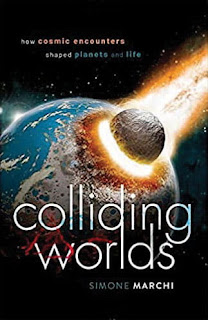
In the same issue, on page 36, you'll also find my review of the book Colliding Worlds by Simone Marchi, which is astrobiology-related in that it reports the evolution of the Solar system under the aspect of collisions between bodies.

Wiley Online Library (paywalled)

As the book is more photogenic than a wastewater treatment plant, I'll use the cover here too:
I'm now running a twitter thread with this year's C&I features here.

Friday, July 18, 2014

analytical about art

The July issue of Chemistry & Industry contains my feature on the use of analytical methods such as SERS (surface-enhanced Raman spectroscopy) in art conservation:

Fading pictures
Chemistry & Industry July 2014, pp32-35

One of the recent examples covered is the colour change through light damage in the painting Portrait de Madame Léon Clapisson by Auguste Renoir:

shown in a reconstruction of the original colours (left) in comparison to the faded original. (images: The Art Institute of Chicago).

Also in the same issue (p50-51) is my long essay review on fracking, the excuse being the book:

Hydrofracking: what everyone needs to know
by Alex Prud'homme

I'm afraid both pieces are premium content, but I have PDF files, so drop me a line if you want one.

Oh, and the art feature made the cover:

I'm loving the cover design by the way - I have often stood in front of the new(ish) C&I logo in the cropped circle and wondered: "Is it art?"

Wednesday, July 18, 2012

curiosity cover

Ahead of the arrival of the Mars Science Laboratory aka Curiosity on Mars (scheduled for Aug 6th), I have prepared a feature summarising what kind of things the new rover will investigate there. The article is in the July issue of Chemistry & Industry and it even made the cover:

Full text (HTML) - free access

PS the same issue also contains my review of the book
Advanced Oil Crop Biorefineries (RSC Green Chemistry)
that one is premium content, but I have a PDF file ...

Tuesday, February 12, 2008

... and the automatic coffee taster

following the automatic book author (see yesterday's blog) I can today report the automatic coffee taster (see my news story in Chemistry World).

Now I'm beginning to worry. Is there anything left that I can do but robots can't? Come to think of it, how many of the zillions of bloggers out there are real people and how many are computer programs ?