Showing posts with label entomology. Show all posts

Monday, May 24, 2021

a different kind of plague

With the pandemic and everything else going on, a different kind of plague has received very little attention, although it also causes devastation in several countries, the locust outbreak in East Africa and the Middle East.

Following a suggestion from the editorial team at Current Biology, I have looked into the fascinating science of why and how solitary insects turn into devastating swarms. While surveillance and early intervention can stop it from happening, there's no way of putting the genie back in the bottle, which is why insecticides are being applied at a massive scale. I find this a bit frustrating, as it would be both amazing and useful if chemical ecologists could come up with a pheromone that switches the swarm back into solitary animals that disperse and avoid each other. Might be useful for humans, too on occasions when they become a nuisance. (Oh, and I forgot to mention in the feature, the periodical cicadas now emerging in North America are unrelated, they are true bugs, while the locusts are grasshoppers. Will have to do a separate feature on cicadas some other time.)

My feature is out now:

How locusts become a plague

Current Biology Volume 31, Issue 10, 24 May 2021, Pages R459-R461

FREE access to full text and PDF download

Locusts, while harmless as solitary individuals, are among the worst pests known to mankind once they become gregarious. (Photo: christels/Pixabay.) NB while this image was labeled as "desert locust" on pixabay, I am told it may show a different species of grasshopper. So for illustration purposes only, don't use the picture as a field guide.

Monday, May 15, 2017

merian memories

Open Archive Day

Maria Sibylla Merian died 300 years ago, in January 1717. Ahead of the anniversary, I wrote a feature on the role of illustration in the life sciences using her hugely influential work as a prime example.

This feature is now on open access:

Putting biology in the picture


Image source: Wikipedia

Monday, April 24, 2017

arthropods at work

Both insects and spiders tend to have a bad press, so I collected up some examples of how insects make positive contributions to our world, apart from the pollinators which I have covered on numerous other occasions. And to round it up I've thrown in the recent study estimating how many insects end up being eaten by spiders. The feature is out today:

How insects shape our world

Current Biology Volume 27, Issue 8, pR283–R285, 24 April 2017

FREE access to full text and PDF download


Fairy circles in Namibia have caused lively debates. Recent modelling suggests that both feedback regulation of plant growth and competition between insect states play a role in creating these patterns. I just love this photo from Jen Guyton, check her website www.jenguyton.com for lots more amazing wildlife photography.

Tuesday, September 27, 2016

butterflies decline

As our species systematically reduces the biodiversity of our home planet, many groups of species are in decline, but few have been so comprehensively observed as butterflies and moths. Other insects may be more important for ecosystem health, but butterflies are beautiful, so they get plenty of attention. Which is also good, as it enables scientists to analyse biodiversity loss across vast areas and through centuries, using the accumulated amateur observations as well as specimen collections kept in museums.

Read more about butterflies in my latest feature which is out now:

Butterflies take a well-studied tumble

Current Biology Volume 26, Issue 18, pR823–R825, 26 September 2016

OPEN access to full text and PDF download

Der Schmetterlingsjäger (The butterfly hunter) by Carl Spitzweg, 1840. Source.

Monday, June 10, 2013

bees memories

Recent research and the EU's temporary ban on neonicotinoid pesticides has brought the threats to bees and other pollinators on the agenda again. While manufacturers insist that neonicotinoids aren't toxic to bees in concentrations found in the environment, the interest now focuses on the more subtle effects the substances may have. For instance, by making bees forgetful, even sublethal doses can endanger the survival of the colony.

Read all about it in my feature that came out in Current Biology last week:

EU ban puts spotlight on complex effects of neonicotinoids

Current Biology, Volume 23, Issue 11, R462-R464, 3 June 2013 doi:10.1016/j.cub.2013.05.030

Free access to

HTML text

PDF file

bumblebee 1103

(one of my many bumblebees on Flickr)

Incidentally, in this month's issue of Chemie in unserer Zeit I also have a piece on bees' memories. Unlike the neonicotinoids, caffeine seems to improve it.

Pflanzeninhaltsstoffe: Koffein stärkt Gedächtnis der Bienen

Chemie in unserer Zeit

Volume 47, Issue 3, page 146, Juni 2013 DOI: 10.1002/ciuz.201390029

Abstract and limited access to PDF file

Wednesday, October 17, 2012

ants, arsenates, and asteroids

This month's roundup of German publications is covering the letter a, with a feature on ant orientation (which I also covered in Current Biology recently), a report on evidence showing the arsenate-resistant bacteria have not managed to replace phosphates in their metabolism, and a humorous take on asteroid mining. Next month, we'll get to bees, black holes and bedbugs. See you then.

Arsenat-Stoffwechsel widerlegt Chemie in unserer Zeit Volume 46, Issue 5, page 276 (published online: 2 OCT 2012) DOI: 10.1002/ciuz.201290051 Restricted access

Wie sich Ameisen in der Wüste orientieren Nachrichten aus der Chemie Volume 60, Issue 10, pages 1007–1009 (published online: 4 OCT 2012) DOI: 10.1002/nadc.201290351 Restricted access

Asteroiden-Recycling Nachrichten aus der Chemie Volume 60, Issue 10, page 978 (published online: 4 OCT 2012) DOI: 10.1002/nadc.201290380 Restricted access

PS: the journal home page of Chemie in unserer Zeit currently displays a news item concerning the current exhibition of the industry painter Alexander Calvelli, with a reference to my article about him.

Tuesday, August 21, 2012

ant orientation

In a feature that was a bit off the beaten track for me, I've covered the orientation of desert ants, which can make use of a wide range of tools from step counter to vibration sensing. One of the interesting questions in the field is how the ants compute the information coming from their various navigation tools and how they eventually decide where to go.

My feature is out in Current Biology today:

How ants find their way
Current Biology, Volume 22, Issue 16, R615-R618, 21 August 2012
doi:10.1016/j.cub.2012.08.004

Read the story in HTML and PDF format.

(free access)

Photo: Kathrin Steck.

Monday, June 21, 2010

insect-plant interactions

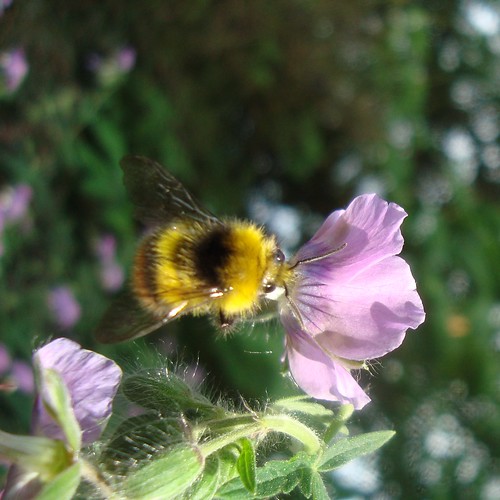
I'm studying insect-plant interactions, or stalking bumblebees, and gradually getting better at photographing them. Found out that there is no need to climb into trees, as there is plenty of bumblebee-friendly stuff in the front gardens up and down the road. Which also made me realise that having an area with lots of very small gardens is good for biodiversity, as everybody has different preferences in what they plant (or allows to grow) in their garden.


(as always, click the images to see the large version - and a lot more detail on the bumblebees)

Also acquired an identification guide which is very handy, it's the
Field Guide to the Bumblebees of Great Britain and Ireland
by Mike Edwards and Martin Jenner
(Paperback - Sep 2009)
so I'm learning to read those colourful bar codes, although I understand that in some cases there are several possibilities. (These ambiguous cases, the authors assure me, can easily be distinguished by a closer look at the genitalia. But maybe I'll just live with the uncertainty!)

PS These and a few more of my recent photos can now also be found on flickr.

PPS A full-page article on bee research has appeared in the Guardian:
Bee decline could be down to chemical cocktail interfering with brains

Tuesday, June 15, 2010

bumblebee biodiversity in the backyard

I've written quite a few pieces about colony losses in honey bees (Apis mellifera), but have to admit I didn't really know who's doing all the pollinating work in my own small garden. This weekend, after noticing one of the trees being visited by lots of insects, I took my camera and had a closer look. I think I have spotted four different species (not counting flies). All identifications below are tentative, so any helpful hints appreciated:


I think this could be a Bombus terrestris, or buff-tailed bumblebee ?


Love the orange neck-scarf on this one, think it might be Bombus hypnorum, which apparently only arrived in the UK in 2001 (according to Bumblebee Conservation Trust)?


Don't recall seeing its rear end, but if it's reddish, it might be a red-tailed bumblebee (Bombus lapidarius) ? I've definitely seen one of those elsewhere in Oxford.


I think this one is an ordinary European honey bee Apis mellifera - we may be in reach of the colony housed in the Oxford University Museum.

Tuesday, September 15, 2009

where have all the honeybees gone?

Three years after the first reports of a mysterious phenomenon of bee colonies disappearing without any apparent reason, termed colony collapse disorder (CCD), the causes are still as mysterious as ever. New research from the US, using DNA arrays and the known genome sequence of the honeybee has thrown up more questions than it answers. Meanwhile, UK beekeepers report unacceptably high losses for last winter, even though percentages are a bit less catastrophic than the year before.

Read my news focus in today's issue of Current Biology:

Bee mystery continues
Current Biology, Volume 19, Issue 17, R718, 15 September 2009
doi:10.1016/j.cub.2009.08.036
Abstract and restricted access to PDF file