Showing posts with label organic-chemistry. Show all posts

Friday, December 17, 2021

just take carbon

In my school days, pure carbon came in two allotropes, graphite and diamond. By now there are dozens of them, or maybe even an infinite number as you could stitch together any number of fullerenes and polyynes to produce a new molecule consisting only of carbon.

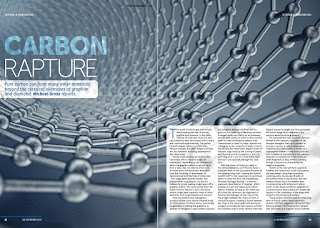
But even fundamentally new types of carbon materials keep popping up, so I wrote a feature on the latest patterns which is out now:

Carbon rapture

Chemistry & Industry Volume 85, Issue 12, December 2021, Pages 22-25

access via:

Wiley Online Library (paywalled)

SCI (premium content, ie members only)

I'm loving the design of the first double page spread (although I'm not sure about the title).

In the same issue, on page 39, there's my long essay review of the book

Ethics of chemistry

by Joachim Schummer, Tom Børsen, eds.

which is much better than the previous book on chemical ethics that I reviewed. (I may have forgotten to publicise that review, as the book was really not worth promoting.)

Friday, December 10, 2021

Diels Alder revisited

I don't often write about chemistry these days, but every once in a while I have great fun revisiting things that are so elementary and easy that even I can still remember them. Such as the Diels Alder reaction, which on paper goes like this:

Source

I wrote a news story for Chemistry World on an effort to observe the Diels Alder reaction happening on a surface, using atomic force microscopy (AFM). You can read the story here (open access if you haven't used up your quota of CW stories).

Sadly, the researchers had to make this very simple and elegant reaction quite complicated to achieve this. It made me wonder (after sending off the news piece) if biomolecules might offer a way of positioning a pair of simpler Diels Alder reactants on a surface.

It was long believed that nature didn't have Diels Alder enzymes, so various researchers took up the challenge to fill this gap and produced:

to catalyse the reaction.

More recently, however, natural Diels-Alderases were discovered, including this one earlier this year.

So there are plenty of biomolecules that by definition recognise and bind Diels Alder reactants. Surely one of them can be persuaded to handle the reaction in a way that is amenable to AFM studies?

Saturday, May 02, 2020

two decades of taking the mickey

Rounding up the science journalism published in German in March and April we have biodegradable plastics, molecular Ferris wheels, and the completion of my second decade of making scientifically-minded fun of things:

Umwelt: Biologie gegen Plastikmüll
Nachrichten aus der Chemie Volume 68, Issue 3, March 2020, Pages 76-78
Access via Wiley Online Library
related content in English

Ausgeforscht: Erkenne deine Grenzen

Nachrichten aus der Chemie Volume 68, Issue 3, March 2020, Page 106
Access via Wiley Online Library
(peer review helps authors to appreciate the limitations of their findings)

20 Jahre Ausgeforscht: Auf der Suche nach dem verlorenen Sinn
Nachrichten aus der Chemie Volume 68, Issue 4, April 2020, Page 14-15
Access via Wiley Online Library
This is my regular column celebrating its 20th birthday in the context of the April pages which are generally in the spirit of advanced tongue-in-cheekery; the second decade's worth of the column is collected in the Tabakschwärmer book, out now.

Aromaten: Ein Hückelsches Riesenrad
Chemie in unserer Zeit Volume 54, Issue, 2 April 2020, Page 76-77
Access via Wiley Online Library
Related content in English


Hey, I haven't done enough trumpet-blowing for the Tabakschwärmer book so I'll re-use it as illustration here ...

Tuesday, September 09, 2014

building molecules made easy

Let's have a news story for a change, here's one that just appeared in Chemistry World online, on a new combinatorial approach that is apparently so simple everybody could create new molecules. Just mix the building blocks and test if any of the resulting combinations has the properties you're looking for.

Bringing chemical synthesis to the masses

Chemistry World online 7.9.2014

Free access

Those lucky enough to get the print edition of Chemistry World can find the piece on page 21 of the October issue.

By the way, I may have forgotten to mention one or two other CW news stories in the last couple of years, such as this one:

Speeding up the experiment to fit the simulation

Thankfully, the CW website keeps track of my contributions here.

Tuesday, March 19, 2013

how to design new enzymes

Scientists are now able to design new enzymes to catalyse reactions for which a natural enzyme doesn't exist. I've rounded up some of the first success stories in enzyme design for my latest feature which is out now:

Evolving new types of enzymes

Current Biology, Volume 23, Issue 6, R214-R217, 18 March 2013

doi:10.1016/j.cub.2013.02.054

Free access to

HTML text

PDF

Wednesday, March 06, 2013

oxidation and procrastination

Ooops, now it's March and I haven't done the roundup of the German pieces published in February yet. Time, you're moving too fast.

So in Feb, we had quantum procrastination, reduction and oxidation at the sea floor, and cycloaddition with triple bonds:

Organische Synthese: Drei mal drei
Chemie in unserer Zeit 47, 6
FREE ACCESS (PDF file)

Neuartige Redox-Biochemie im Meeresboden
Nachrichten aus der Chemie 61, 134-135

Proquastination
Nachrichten aus der Chemie 61, 111

And talking of which, a late arrival: a short piece on addiction biochemistry that is nominally in the issue for the 4th quarter of 2012 of the magazine:

Trillium Report 10, 200-201
Die Biochemie der Sucht

Wednesday, June 27, 2012

molecular puzzles

I love rotaxanes - they are assemblies consisting of a ring loosely wrapped around a dumbbell shaped molecule, whose endgroups are so bulky that they stop the ring from escaping. They hold the same fascination as those puzzles made of chromed wire, one just can't help wondering: how on earth did that thing get around the other one? Or maybe it's just me.

Anyhow, I was pleased to hear from Oxford chemist Harry Anderson that his group and others have now succeeded in creating rotaxanes with polyynes (polyacetylenes) as the axle. Puzzles apart, such constructs are also of interest as possible molecular wires and as a first step towards a new modification of carbon. So I wrote a news story about all this, which is now out in Chemistry World:

Running rings around molecular wires

Free access.

Cartoon: Wikipedia

UPDATE (4.8.2012): you can now find the piece in this month's print edition as well, on page 33.

Friday, December 09, 2011

burning questions

My three pieces published in German this month are aiming to address three burning questions:

* how many lab procedures can fit on one microchip?
* which type of pluripotent cells will enable regenerative medicine to take off?
* who needs an electronically controlled Bunsen burner with menus and joystick?

Specifically:

Organische Synthese: Alles auf einem Chip
Chemie in unserer Zeit 2011, 45, 370.

Blickpunkt Biowissenschaften: Drei Optionen für die Ersatzteilmedizin
Nachrichten aus der Chemie 2011, 59, 1160.

Ausgeforscht: Vom Bunsenbrenner zum iBrenn
Nachrichten aus der Chemie 2011, 59, 1138.


Image Source: Wikipedia

Thursday, October 13, 2011

walking with molecules

Among the molecular motors of the cell, there are quite a few that appear to walk on two legs like we do. However, the rules in the nanoworld are very different from our world. Walkers there can't rely on gravity to keep them connected with the track, and they have to muddle through the chaos that is Brownian motion.

Researchers have been able to build synthetic walkers from DNA for a few years now, and recently have also introduced the first small molecule walker that matches the key criteria of the walking molecules in the cell.

I wrote a feature about all this which is out in Chemistry & Industry this week:

Walking in the nanoworld
Chemistry & Industry issue 19, pp 20-22

free access to full text (html)


A couple of macroscale walkers appear on the cover of the issue by coincidence.

Monday, May 09, 2011

vernier's chemistry

The only German piece out this month is a news story on Harry Anderson's "Vernier chemistry" using the mathematical principle of the Vernier scale (a device consisting of two scales with different numbers of divisions lacking a common denominator, e.g. 9 and 10, invented 380 years ago) for the construction of well-defined molecular rings.

Schieblehre inspiriert Aufbau von Nanoringen, Spektrum der Wissenschaft Nr 5, S. 21

The beginning of the text and a link to the PDF (restricted access) is here.

As you can tell from the number of reader's responses, I got the explanation of the Vernier scale the wrong way round. In fact, the additional, slightly different scale is squashed (typically by 10:9), while I wrote that it was stretched. I think I had this wrong version in my head since the age of five or so, so it didn't occur to me to get the caliper out and check.

Wednesday, April 06, 2011

chemistry all around the world

The round-up of German pieces published this month includes a clever application of llama antibodies, celebrations of the International Year of Chemistry circling the globe, and debates over the circling of the square story from last autumn.


Streit um die Quadratur des Kohlenstoffs
Chemie in unserer Zeit 45, 82

In 80 Feiern um die Welt
Nachrichten aus der Chemie 59, 403

Mini-Antikörper für Maxi-Effekt
Nachrichten aus der Chemie 59, 435-6

Monday, March 21, 2011

origin of life revisited

Origin of life researcher Jeffrey Bada and his team have analysed a set of old samples inherited from Stanley Miller. It was the first simulation of origin of life conditions to include sulphur, yet Miller never reported results. With modern methods, Bada's group show he missed out on something interesting.

Read my news story in Chemistry World (open access).

Thursday, December 16, 2010

silk and prizes

The roundup of German pieces for December includes a polymer science perspective on spider silk, a detailed look at this year's Nobel prize for chemistry (Heck reaction and similar couplings using palladium catalysts) and a look back over 20 years of the coveted IgNobel prizes in chemistry. The spiders even made it to the cover of Nachrichten:


Blickpunkt Biowissenschaften: Spinnenseide aus Sicht der Polymerforschung. Nachrichten aus der Chemie 59, 1250

Ausgeforscht: Was ist eigentlich Chemie? Nachrichten aus der Chemie 59, 1225

Verknüpfung von Kohlenstoffatomen mittels Palladium Spektrum der Wissenschaft Nr 12, 18 [free access]

Tuesday, October 12, 2010

wine, games, and geometry

Articles out in German this month include circled squares, quiz chemistry, the science of wine, and the computer game that folds proteins:

Die Quadratur des Kohlenstoffs, Chemie in unserer Zeit 44, 317, DOI: 10.1002/ciuz.201090063
abstract and access to pdf
(my blog entry on this story in English)

Ausgeforscht: Quizfragen für Computer, Nachrichten aus der Chemie 58, 1002.

Biowissenschaften: In vino Wissenschaft, Nachrichten aus der Chemie 58, 1028.

Proteinfaltung als Computerspiel, Spektrum der Wissenschaft Nr 10, 16.
full text
(my blog entry on this story in English)

Oh, and talking about protein folding, here's a swan folding back its flexible domain onto the compact core domain:

Wednesday, July 28, 2010

How to circle the square

-- updated 13.1.2011 --

Some of the simplest geometric shapes are really difficult to recreate in organic molecules. Carbon loves the flat hexagon that we find in benzene and its numerous derivatives. It is also happy with the five-membered analogues (such as the cyclopentadienyl anion or the nitrogen-containing pyrrole), but when it comes down to building squares, things are getting complicated. Firstly, the angles are all wrong, as carbon with a double bond wants 120 degree angles between its binding partners, not 90. Secondly, theoretical organic chemistry predicts that a ring with 6 (or, more generally, 4n+2) free-floating electrons (on top of the ones involved in the direct bonds) will be stabilised by these electrons. A ring with 4 (or any other 4n) will be destabilised.

Both these considerations suggest that a ring of four carbons with two double bonds should not exist. Chemists have, however, with a whole arsenal of tricks, managed to make such a molecule, but it could only exist at temperatures near absolute zero and only trapped inside a cavity within larger molecules. No structural information about this elusive molecular prisoner could be obtained – until now.

The group of Mihail Barboiu at the University of Montpellier, France, has now developed a new kind of cage to trap and study the elusive carbon square in. They made a crystalline matrix out of hollow molecules (calixarenes), which enabled them to perform crystallographic structure determination on several compounds along the reaction path that leads to the desired product, thus also clarifying open questions regarding its mechanism of formation.

As for the final ring of four carbons, there are two structural options: a square with the four (rather unhappy, anti-aromatic) electrons smeared out around the ring – the structure one could write as a square with a circle inside, in analogy to the benzene structure; or a rectangle with two shorter (double-bonded) and two longer (single-bonded) sides. It is known that the equally anti-aromatic ring of 8 carbon atoms prefers the uneven solution, with localised double bonds. For the 4-ring, chemists had to await the study by Barbou’s group to learn that the answer is … Well, in fact, the crystal structure shows both versions, the rectangular and the square shape. Faced with two equally uncomfortable solutions to its structural problems, the molecule just can’t make up its mind.

Reference:
Y-M Legrand et al. Science 2010, 329, 299.

Fig. 4 from the paper shows the structures obtained:


PS (Oct.2010): I've also written a one-page piece about this in German, which is now out in Chemie in unserer Zeit

PPS (Jan. 2011): The results of this work have been disputed by researchers using computer simulations, but defended by the original authors. See the technical comments in Science online, and a detailed discussion here
Wednesday, June 09, 2010

bhopal - the disaster continues

Following on from my earlier rant re. the 25th anniversary of the Bhopal disaster, there is further depressing news about this in yesterday's Guardian. A trial has come to an end but the disaster continues.

Seven convicted over 1984 Bhopal gas disaster (news report re. the outcome of the trial)

Editorial including an enlightening comparison with the current BP disaster.

Comment by Indra Sinh who says: "The people most responsible for the disaster in Bhopal were not in the courtroom today when the verdict against eight Indian employees of Union Carbide India Limited was announced."

Monday, February 22, 2010

making Mona Lisa smile

Analytical techniques used for characterising materials have progressed to the point where it is now possible to investigate the composition and internal structure of valuable pieces of art and cultural artefacts with only microscopically small sample removal or without even touching the object.

Key techniques that have revolutionised the analysis of art in recent years include Surface-Enhanced Resonance Raman Scattering (SERRS), where a spectacular signal enhancement is produced by nanoparticles, and the NMR-MOUSE (for MObile Universal Surface Explorer), a portable NMR device pioneered by Bernhard Blümich and colleagues.

I have summed up developments in this exciting field (am very jealous, in fact, of the scientists who get to play not just with fascinating instruments, but also with art objects!) in a feature article that should be out in Chemistry & Industry today, and should be showing up on their website soon (appears to be open access!).

I've also covered the SERRS work by Marco Leona at the Metropolitan Museum in New York in a recent Spektrum piece:

Spektrum der Wissenschaft 2009 Nr 11, 16-17
Madonna mit Schildlauslack

Tuesday, December 29, 2009

aromatase and cancer

There is a huge family of enzymes known as the Cytochrome P450 family, which I always used to find very confusing. Man species have hundreds of them, doing apparently unrelated things, so I never managed to remember anything about these proteins because whenever I came across a bit of information, it didn't seem to fit with the previous one.

Recently I've managed to figure out what it's about (the clue is in the spare oxygen atom left over after the reaction they all share -- with that they can do all kinds of chemistry) and written a couple of pieces about this field, pegged to the crystal structure of aromatase, an enzyme that plays a key role in a large number of breast tumours, and is thus a prime target for cancer therapy. Aromatase is also interesting for the chemist as it is so far the only known enzyme that can turn an aliphatic ring (such as cyclohexene) into an aromatic one (such as benzene), hence the name.

My latest musings on CytP450s, aromatase, and cancer appear in the January issue of Education in Chemistry (but not on their website, I'm afraid):

Aromatase: a target for cancer treatment.
Education in Chemistry 47, No 1, 22-24.

This is also my first publication of 2010, hooray!

Monday, December 14, 2009

responsibility of chemists

This time of the year, 25 years ago, I was a first term chemistry student, and one morning our inorg. chemistry prof put the periodic table aside to give us a stern lecture on our future responsibility as chemists. That's about the only thing I remember of the Bhopal disaster, which remains to this day (luckily, in a way) the worst industrial accident ever.

Despite being a responsible chemist and all that, I never looked all that closely at what happened and why, until reading this piece on the 25th anniversary.

Bhopal: 25 years of poison, by Indra Sinha

Reading this, you're left wondering whether the event should have been prosecuted as manslaughter, murder, or genocide, but the fact of the matter is that nobody has been prosecuted to this day. (Essentially, an extremely labile and dangerous substance was stored in a large tank, and somebody decided to switch off the cooling for that tank, to save costs, then water accidentally entered the tank and started a reaction -- there are several outrageously wrong decisions in this story that must not be allowed to happen inside a chemical factory.) And people in the area still ingest the poison and get diseases and birth defects from it.

Chemistry aside, what most angers me about these things is the inherent racism assuming that it's no big deal if 20,000 people die in India from negligence of a US-owned factory, while the deaths of 3,000 people in the US are an outrage that can be used as an excuse to invade two countries (again at the cost of tens of thousands less important lives). Clearly, all men are not created equal ...

Friday, May 15, 2009

origin of life breakthrough

In the big jigsaw that is the origin of life, there are two well-researched areas, namely the prebiotic chemistry giving rise to simple molecules such as amino acids, and the RNA world scenario, which concludes from today's peculiarities of biomolecules that RNA carried both genetic information and catalytic function in life before the evolution of proteins and DNA.

So far, there has been a huge gap between these two areas, as nobody could explain how prebiotic chemistry may have led to RNA. Now John Sutherland's group at Manchester has found a highly original new chemical approach to the issue. Bypassing the fundamental problem that the building blocks ribose, phosphate and the four information carrying nitrogen bases will not hook up in the right way under prebiotic conditions, the group found a new intermediate, 2-aminooxazole, which can be plausibly produced in a prebiotic setting, and which in turn can react to form a nucleoside including both the ribose and the pyrimidine base directly, without the need for a step hitching the sugar to the base.

While a similar path to purine bases remains to be discovered, I would reckon that this may well be the the biggest breakthrough in the origin of life field since the Urey Miller experiment more than 50 years ago. Suddenly, a complete solution, from prebiotic reactions to replicating living systems appears to be possible.

Reference:

Synthesis of activated pyrimidine ribonucleotides in prebiotically plausible conditions p239
At some stage in the origin of life, an information-carrying polymer must have formed by purely chemical means. That polymer might have been RNA, but until now this theory has been hampered by a lack of evidence for a plausible route in which the ribonucleotides could have formed on prebiotic Earth. Here, just such a route is reported.
Matthew W. Powner, Béatrice Gerland & John D. Sutherland
doi:10.1038/nature08013


News and Views:

Origins of life: Systems chemistry on early Earth p171
Understanding how life emerged on Earth is one of the greatest challenges facing modern chemistry. A new way of looking at the synthesis of RNA sidesteps a thorny problem in the field.
Jack W. Szostak
doi:10.1038/459171a