Showing posts with label writing. Show all posts

Friday, September 05, 2025

in statu nascendi

This month's issue of Nachrichten aus der Chemie is a special issue on science communication and for the occasion I was asked to observe myself during my writing process and do a piece about how I write. I guess for the future AI apocalypse and beyond this may turn out to be an archaeologically relevant thing as evidence that in the early 21s century humans were still able to write stuff.

Anyhow. I followed the process of my writing the feature on migrations and movements across the ancient Mediterranean, which appeared in Current Biology in July. I called the meta-piece "in statu nascendi" which of course is chemical lingo (and Latin) for something in the process of being born, but the journal chose the title:

Vom Gedanken zur Geschichte (From the thought to the story)

which is also nice, especially in its emphasis on thought, which may soon disappear ...

This appears on page of the September issue, so the citation is

Nachrichten aus der Chemie 2025, 73, issue 9, 74-76.

At the back of the same issue I also have one of my tongue in cheek columns, this time making fun of the epidemic of tripartite titles. The main publisher of my German books used these a lot, and I found many of them annoying, but a recent investigation of citations of published papers seems to suggest these titles work. So that fits in with the communications special as well, in a tongue-in-cheek way. The title is also tripartite (and alliterated) of course:

Titel, Thesen, Tintenkleckse

Nachrichten aus der Chemie 2025, 73, issue 9, 112.

Cover of the magazine Nachrichten aus der Chemie September 2025, showing a drawing of a person speaking into a megaphone

PS I haven't been very good at tracking my publications in German either here or on the website, but there should be around 10-12 each year in Nachrichten, half and half of the serious and not so serious type. This communications special piece was out of the normal sequence.

Saturday, September 23, 2023

the library of rejected manuscripts

I came across a lovely little film available on DVD in Germany (and sold at discount price by now), which revolves entirely around the book publishing business, so as an author I feel obliged to spread the word and say a few things about it.

Le mystère Henri Pick - France 2019, Rémi Bezançon, starring Fabrice Luchini, Camille Cottin, Alice Isaaz.

The central concept is a library of rejected manuscripts that have never been published, which a librarian in a remote village in Brittany set up in a spare room. (I just love the idea, which is referenced in the Spanish title, so I chose that poster for illustration, below.) There, a young editor of a major publisher discovers the manuscript of a novel under the name of the Henri Pick of the title, a deceased local pizza baker who had never been known to read or write anything in his lifetime. The book becomes a sensational success, but a cynical old literary critic (Fabrice Luchini) smells a rat and embarks on a quest to find out who really wrote the book and how it ended up in the library of rejected manuscripts.

I have seen Luchini in more movies than I care to remember, but strangely I don't get fed up with him, and I am enjoying his mature works combining literature with bicycle use (see also: Alceste a bicyclette (Bicycling with Moliere) - France 2013). The film is every bibliophile's dream in that the main locations are the library mentioned, the offices of a major publisher (Gallimard, who happen to be the publishers of the original novel by David Foenkinos, Le Mystère Henri Pick), and various living rooms of bookish people with very decent bookshelves. For the occasional breath of fresh air, the characters get to cycle around that village in Britanny. All very lovely and I'll happily watch the film again fairly soon.

One does end up wishing the story was real. The one thing I definitely don't believe to be true in real life is the assertion that a major publisher has an archive of all manuscripts they ever received. In my experience, they can barely be bothered to return them to the author. I've seen submission guidelines saying that they will destroy the manuscript if rejected, unless you add a franked return envelope.

Not released in the UK, so I'll add it to my list of films not shown in UK cinemas.

Sunday, September 09, 2018

Erlebnis Wissenschaft

for more than a decade, from Was Biotronik alles kann (2002) to Invasion der Waschbären (2014), my books in German were published by Wiley-VCH, mostly in their general pop-science series Erlebnis Wissenschaft (not quite translatable, this suggests science is an exciting experience).

Since the publication of the raccoons’ book in 2014, I have had no luck with further proposals, and have been given to understand that the sales of the series weren’t as good as the publisher hoped. Checking up the programme this summer, I realised that the last new title was published in 2016. One that is listed in 2018 is in fact the paperback version of a book previously published in hardback. Coming from the main website, the list doesn’t even have a link, so I had to use search engines to find it here. So, reluctantly, I am having to switch back to hustle mode and try to find a new publisher.

I can accept that on a purely balance-based reckoning, the books may not have been very profitable, but then again, Wiley-VCH is a huge publisher with successful academic titles (the white and blue design inherited from the original Verlag Chemie) as well as the licence for the German version of the hugely successful “For Dummies” series, not to mention a vast array of academic journals. All of which surely could help to fund a bit of an effort to help the public understanding of science with a series of intermediate level popular science books.

Oh well. I may have written critical reviews of one or two of the titles shown below, but I surely will miss the series.


For this photo I rounded up my own titles in the series and a few from other authors. Since taking the photo I keep discovering others that I forgot (eg the biographies of Haber and Lynen and the memoir of Schatz – for the biographies alone it would be worthwhile keeping the series alive).

Saturday, August 11, 2018

16,000 words

In a review of the book “vox” by Christina Dalcher I read the claim that people – men and women alike – speak an average of 16,000 words a day. The research, published in Science in 2007, was designed to debunk the myth that women talk three times as much as men, and it duly found that both talk the same amount within error.

Still, as somebody who prefers writing to talking, this strikes me as a huge amount. That must be around two hours of solid monologue, or four hours of conversation, if you allow the other person half the time. Longer, if you take time to reflect between your exchanges. Just to get a measure of how much text that is that people talk on average, consider this:

I typically write around 1000 words a day (I read a lot more, and I’d reckon I speak fewer). Just imagine I could come up with 16,000 meaningful words a day – which of course I would not dream of wasting on the fickle oscillations of air, but would rather write down for publication. At a fairly typical rate of 40p per word, these could theoretically earn £ 6400 in a day, or two million in a year.

Well the bug in that calculation is that I can’t come up with 16,000 words worth of meaningful content every day, nor can anybody else, which is why people tend to talk about the weather and repeat themselves all the time. Yes I do realise that all that small talk serves a social function, but why can’t people just rub each other’s backs instead? In that respect, chimps and bonobos are more civilised than we are. Failing that, playing music with people works for me. A way of communication as well, but with fewer words.

I appreciate that the 100-word limit imposed on women in Dalcher’s dystopian novel amounts to torture (the lowest word counts reported in the science paper were closer to 500), but 1000 words is probably a daily budget I could get along with. Add to that 1000 written words, and I’ll swap the rest of the 16,000 for wrong notes played at the wrong time. This blog entry contains 373 words, by the way.


PS: The Guardian reviewer doesn't like the book ...

Monday, April 09, 2018

seven years

Open Archive Day

From around 2000 until early 2011, I used to write occasional short to mid-length "news focus" or "news feature" pieces for the front pages of Current Biology. After a slight revamp of those pages in early 2011, the editors asked me if I could do a full length (2000 words) feature for every isssue, i.e. two per month, and I accepted the challenge.

If I have got my maths right, I have now published 167 of these features, so I must have been getting some things right. I only missed 3 issues I think, in 7 years. Here's the first one that appeared in the new format, seven years ago, covering a topic I have dealt with multiple times before and after, and like everything else from the first six years, it's in the open archives):

New fears over bee declines


(Own photo.)

Sunday, May 29, 2016

writing course

Just compiling a few links here to use them later at a writing course I will be teaching.

Wednesday, May 21, 2014

raccoon invasion

My next book in German, due to come out in September, is a collection of biology stories. Almost no chemistry/biochemistry this time, mainly ecology and organism level biology.

Invasion der Waschbären: und andere Expeditionen in die wilde Natur (Erlebnis Wissenschaft)

Wiley-VCH Verlag GmbH & Co. KGaA; (17. September 2014) 256 Seiten,
ISBN-10: 3527336680, ISBN-13: 978-3527336685
amazon.de

The raccoon on the cover points to a story on invasive species, by the way.

More info soon ...

Friday, April 11, 2014

prize coverage

I was recently awarded the GDCh Preis für Journalisten und Schriftsteller, that's the prize for journalists and authors from the German Chemical Society. This kind of thing is new to me, so I have no idea when where and how I should brag about it, but I'm guessing it might be useful to have an archive for the relevant press coverage, so here goes:

Chemistry Views magazine (10.3.2014)

Angewandte Chemie 2014, 126, 2570 (restricted access)

Angewandte Chemie Int. Ed. 2014, 53, 2536 (restricted access)

And I would never have found those three references if it hadn't been for the attention of chemists at my alma mater, the Phillipps Universität Marburg, who included them in their history brochure on page 21.

Articles connected to / motivated by the award:

Mein Weg zum Wissenschaftsjournalismus
Chemie in unserer Zeit 2014,48, 68-71 DOI: 10.1002/ciuz.201400659 [FREE access]

Es fehlt der wissenschaftliche Tiefgang
Nachrichten aus der Chemie 2014, 62, 750-752
An interview which the editors of Nachrichten conducted with me on the day after the award ceremony, referring back to some of the problems I addressed in my lecture.

photo of the event from the GDCh facebook page

Monday, October 28, 2013

the perks of being a book blogger

On September 2nd, I changed my “about” text to indicate that my tumblr blog would henceforth be focused on book-related things:

“I blog and reblog old books, new books, science books, story books, books I read, find, collect or write. Also: science, photography, art, movies with subtitles, pop/rock/latin music, cello and flute music, fair trade, and a modicum of nudity.”

This was simply because since December last year, the main source of notes for my material and new followers for my blog was reblogging from the lovely bookporn blog, so by September an overwhelming majority of my followers must have found me that way. In order to a) give those followers more of what they fancy, and b) increase the “stick factor”, i. e. the percentage among the visitors who find me via a bookporn reblog who then decide to follow me, I made the whole blog a bit more bookish. It’s not exclusively about books, but sufficiently so to get bookish visitors to accept it as a book blog.

Eight weeks into the experience, I can reveal that this switch has been quite successful. The perks of being a book blogger include:

* most trivially, having a focus that actually fits my existing URL and headline, which is a literary quote (from E.M. Forster, Howard’s End)

* by looking at other book blogs to find material to reblog, I’m getting to look at other people’s books at leisure …

* I’m still able to cover all topics that interest me, as all can be covered in books! Specifically, there is still science (especially scientific illustrations, as can be found in books), music, art, and politics.

* I can find a wider audience for my growing reservoir of book reviews, plus leave a scent mark for those books that I would really like to read but realistically will never find the time to (both are included in the “a book a day” tag)

* the bedtime belles I usually reblog as a sign-off at night look even more seductive if they are reading a lovely book,

* I‘m now gaining two followers per day (as opposed to one per day in the months since last December, while I was benefiting from bookporn influx but had no clear identity for the blog).

* I’m being constantly reminded to actually make time to read a book !

For the time being, this blogspot blog will remain the usual eclectic mix of science, culture etc., so if you like snooping around other people's books, find me at http://proseandpassion.tumblr.com/.

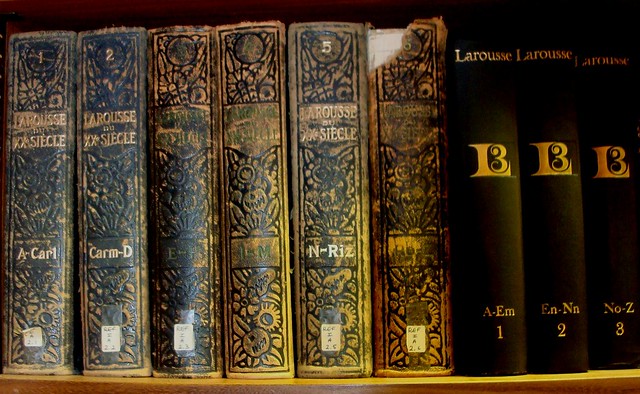
larousse

One of those bookish flickr pics of mine which have acquired hundreds of views from the tumblr book fandom.

Tuesday, December 04, 2012

evolution of writing

Something very scary happened in western Iran around 5000 years ago. People started using a writing system for their bookkeeping, used and developed it for a few centuries, and then stopped writing.

The system they used is called proto-Elamite script, it is obviously inspired by Mesopotamian cuneiform but has mostly developed its own symbols, which aren't completely decoded yet. Decoding it further may help to explain how and why people fell back to illiteracy.

I interviewed the leading researcher specialising in this script, who happens to be based in Oxford, and wrote a feature which is out in Current Biology today. And, writing for biologists, I've given the story a bit of a biological spin, hence the title:

The evolution of writing

Current Biology, Volume 22, Issue 23, R981-R984, 4 December 2012 doi:10.1016/j.cub.2012.11.032

Free Access to full text (HTML and PDF version available)

Photo of a proto-Elamite tablet from the Louvre, Paris © Marie-Lan Nguyen / Wikimedia Commons

Thursday, September 20, 2012

gecko book out now

My latest book, a collection of recent nanoworld stories in German, is now officially out and in the shops.

Michael Groß:
Von Geckos, Garn und Goldwasser:
Die Nanowelt lässt grüßen.
Wiley-VCH Sept. 2012
pp. 302, ISBN: 978-3527-33272-4,
€ 24.90, £ 22.50

Further information here. The shelf with my collected works now looks like this (there is a copy of everything that has its own ISBN number, hence hardback and paperback editions of the same title side-by-side):

Monday, July 23, 2012

Astrobiologie für Einsteiger

I’ve been quite busy over the last 12 months partly due to having two books to prepare in parallel, both to be published in German later this year. One is a collection of new(ish) nanoworld pieces, called Von Geckos, Garn und Goldwasser: Die Nanowelt lässt grüßen, due out in September.

The second, of which I’ve just finished processing the page proofs, is a German translation of Astrobiology: a brief introduction (based on the 2nd English edition which came out last year). This should be out in December, and you can already pre-order it on amazon.de and amazon.co.uk. And it will look like this:

And I just had a brilliant idea for a new project, so I’m off to write a new proposal …

PS: Astrobiologie für Einsteiger is one of the first two titles in a new series of short textbooks. The other one is: Chemie für Einsteiger und Durchsteiger by Thomas Wurm, out on the same day.

Friday, March 16, 2012

writing, sharing, privacy ...

As this is the 1000th entry in my blog on blogspot, I think I can get away with a bit of navel-gazing re. what I’m trying to achieve, what I’m sharing and why, privacy issues, and all that.

First some history

Back in the early noughties, I was very happily addicted to manually updating my rather large website, and I didn’t get the point of these new-fangled blogs at all. Only in 2006, on joining MySpace, where you had a blog by default, whether you wanted or not, did I start to try this timeline format and began to enjoy it. As a control freak, however, one wants to have more order in one’s thoughts than simply a chronological one, so I looked for some platform where I could maintain at least some sort of logical connectedness of the kind I had on my website. I tried Yahoo360 (as my website was on Yahoo’s Geocities and that blended in seamlessly), but after running various formats in parallel, I ended up using blogspot as the primary blog (though I did post copies of entries in MySpace for a while, until that site turned into a ghost town).

I do like the way Blogspot allows finding blogposts easily by date, by keyword, and by search, and with the additional “link-within” app I think the connectivity between things is practically perfect for me.


What to share and when

My main justification for blogging is of course to find additional audiences for my writing published in books and magazines. I like to think of it as a funnel, where, with luck, the media that have wider audiences with shorter attention times guide some of these audiences on to the media that require a bit more concentration, so for instance: twitter – blog – magazine article – book. I don’t have much evidence that this funnel is actually working and pulling the crowds in, but hey, there’s no harm in trying.

In addition, I do like to share random bits that I happen to be interested in with the wider world (if only because sometimes there are so few people interested in the same thing that the next person may be quite far away, so there would be no use shouting in the street or going to the pub to talk about these interests). A lot of this random sharing, when it is just a link or a picture has now migrated to Twitter, and for my own photos I mainly use flickr, so the blog is left with the somewhat more text-heavy stuff, such as short excerpts of science journalism pieces (funnelling towards the full-length piece), rants on politics, economy, life, and raves about music and movies. I also try to review every book I read, though in recent months I didn’t find time to read anything beyond the books I was commissioned to review anyway.

With these things, there is still enough material to do 3-4 blog entries a week (have done fewer in the last few months, as I had two book projects to finish at the same time, which swallowed a lot of my spare time). Ideally, it would be great to do daily posts on a variety of subjects, maybe visiting each area no more often than once a week. People writing about how to monetise blogs say you have to find a niche and stick to it, but that approach would hold no interest for me. I can do niche business with the existing niche magazines any time I want, but the beauty of blogging for me is that I can write on the whole spectrum of my interests, without having a chemistry editor complaining that there isn’t enough chemistry in my story.

To give an impression of what I blog about, these are the 20 most-used tags in the first 999 blog entries:

1-10
sciencejournalism 202 (label for science stuff published elsewhere)
sciencenews 182 (for science stuff not published elsewhere)
oxford 147
photo 114 (for every entry that contains one of my photos)
bookreview 86
currentbiology 85
biochemistry 84
environment 77
germany 72
medicine 63
11-20
pop 63
shakira 56
rants 55
nanoworld 54
literature 52
astrobiology 48
travel 48
history_of_science 47
genome 45
miscellaneous 44

So adding the first two labels together gives us a science content of 38%. Sounds about right.


What not to share

Given the recent developments around Google, Facebook et al, one has to consider privacy issues as well. Personally, I’d like to believe that I’m too weird for any algorithms to figure out what ads I might click on. As evidence I can point to amazon.com who have tried to figure me out pretty much since the company started in the US and haven’t succeeded to this day. What their bots can’t get their heads round is that I buy books and other things in different countries (have used US, UK, DE, FR and ES versions of amazon), and for different people (not always ticking the gift options), and that I also use their site as an author, as a marketplace vendor, not to mention as a reviewer – in which case I look up the details of the book, but get it sent via a magazine I write for. After 15 years or so, suggestions I get from amazon are still mostly useless – if it is something I’m interested in, I normally own it already. So good luck to google if they want to work out who I am, I’ll keep you posted on their progress.

Having said that, it is of course only sensible to withhold information when I can gain no benefit by revealing it. If only because nasty people from some “intelligence” agencies I could think of will probably be working on ways of tapping into Google’s information on people already. I don’t reveal my address, don’t say where my tweets are from, and seeing the recent cross-platform information sharing that google is starting now, I may want to do something to protect my searches.

In Facebook, I don’t fill in most of the details that the site asks for, and I happily accept friendships from random people who I don’t really know (as my profile is public, it doesn’t make any difference anyway). Just to confuse Facebook a bit more, I occasionally switch the language I use the site in. I don’t use the like button outside of facebook, and generally only create cross-links to divert traffic out of facebook, not to pull it in. I see facebook as a human zoo where people are caged for the benefit of the visitors / advertisers, so I still prefer the wild open spaces of the web to the zoos.


Who reads what

I haven’t done any serious visitors statistics on my blog, but the occasional look at the tracker that runs at the bottom of the right hand side column suggests that there is only modest traffic, some 20-30 visits per day, and that most of it comes from searches. There was a time when tweeting blog entries helped, but that has stopped working, not sure why. Tweeting links to a specific photo on flickr still gives me 15 extra clicks within a minute, but tweeting a blog entry gives one or two at best.

Google searches are especially successful in attracting visitors to topics that aren’t adequately covered by the English language media, e.g. Spanish language pop music or cinema. So if somebody using a search engine set to English as the preferred language looks for information on movies like Julio Medem’s Caotica Ana or Shakira’s impact on society, they are likely to end up on my blog. (Amazingly I get Medem and Shakira related visits practically on a daily basis, while areas where I can actually claim some level of expertise, like nanotechnology or extremophiles, pull in much less traffic, presumably because they are adequately covered by higher-ranking sites.) Other popular search terms include the philosophy of Lady Gaga and that of capitalism as well, the Headington shark and the architecture of Santiago Calatrava. For further popular search terms see this analysis I did in 2010.

All in all, I’m still happy with what this blog enables me to do and communicate, so I guess I’ll just keep going.

Monday, September 12, 2011

book projects

It turns out that I have two new books to complete by the end of January, so there won't be much time left for random blog entries until then. For the first time in nearly 12 years of self-exploitation, I've had to make a weekly timetable to allocate ringfenced time slots to both projects. Will keep plugging my feature articles though (one coming up tomorrow, in fact) and gradually reveal more about the upcoming books.

Meanwhile, the completely revised and updated second edition of Astrobiology: a brief introduction is available around the world now, so get your copy to find out everything you always wanted to know about Life and the Universe. (Note that the hardback is made for library use and therefore doesn't have a dustjacket, so it's just plain black and you don't get the lovely cover design.)

Monday, June 27, 2011

astrobiology - second edition

Back in 2006, Johns Hopkins University Press published Astrobiology: a brief introduction, which I had co-authored with Kevin Plaxco. Since then, the field has become quite popular. (I would love to take credit for it, but maybe it’s just dumb luck.) The quest for life or at least habitable planets in the rest of the Universe is now a universally supported endeavour to the extent that NASA now justifies much of its research and exploration work with that goal.

The discovery of extremophiles in the most unlikely locations here on Earth has played a large part in propping up our hopes that life may also exist elsewhere. Add to that the discovery of more than 500 extrasolar planets in just 16 years since the first one was reported, and you get a proper scientific gold rush.

Thus, our 2006 book was beginning to look out of date and there was a strong case for a new, revised and expanded edition, which we prepared over the last year or so. We have revised the entire text, added a glossary and lots of new illustrations. New discoveries are included up to and including last December’s arsenic eating bacteria. With all this, the book will be around 90 pages thicker than the first edition, but hopefully just as readable.

The cover design, which we all love, has been kept. Only the colour of the title will now be green instead of orange, so you can easily tell the second from the first edition. The new version should be available by September in the US, maybe a few weeks later in the rest of the world.


In preparation for the release, I’m also updating the astrobiology web pages, but that’s work in progress still. (At the moment the ISBN numbers and the cover are there, but the exact page number and amazon links are still missing.)

Thursday, March 10, 2011

Genghis Khan's winning ways

I’m so excited – just found out I’m in the shortlist for a literary prize. Well, errr, a book title that I suggested for the Diagram Prize (oddest book title of the year) is on the shortlist: Managing a Dental Practice the Genghis Khan Way. And last time I checked the online votes, it was leading by a large margin. [Update 28.3.: turns out Genghis Khan and I actually won the award! Woo hooooo!]

Still haven’t checked with my dentist whether she’s following this approach. We should be told.

The six titles on the shortlist are:

8th International Friction Stir Welding Symposium Proceedings
Various authors (TWI)
The Generosity of the Dead
Graciela Nowenstein (Ashgate)
The Italian's One-night Love Child
Cathy Williams (Mills & Boon)
Managing a Dental Practice the Genghis Khan Way
Michael R Young (Radcliffe)
Myth of the Social Volcano
Martin King Whyte (Stanford University Press)
What Color Is Your Dog?
Joel Silverman (Kennel Club)

I love the last one, actually, as it shows how you can achieve absurdity with very simple means, without using a single unusual word.

A collection of 50 book covers from the shortlists of the first 30 years of the prize was published in 2008: How to Avoid Huge Ships: And Other Implausibly Titled Books. Sadly my personal favourite "Procrastination and task avoidance, a practical guide" (shortlisted some time in the late 90s) isn't included.

Recently, oddity lovers in Germany have also set up a prize: Kuriosester Buchtitel. With my most recent title “9 Millionen Fahrräder am Rande des Universums,” I might be at risk of getting nominated. Which would be ironic and nicely circular, as the original Diagram Prize is covered in one of the chapters, greek rural postmen and all.


PS I don't think I own a single book from the Diagram shortlists. Maybe I should get this one, it got glowing reviews at amazon:


amazon.co.uk

Thursday, January 13, 2011

happy birthday Wikipedia

As Wikipedia celebrates its 10th birthday on Saturday, I have mixed feelings. Of course I hugely admire and support the spirit of freely sharing the encyclopaedic knowledge accumulating in Wikipedia, but on the other hand I am also trying to make a living from using my knowledge and writing skills, which means that I occasionally contribute to one of the competing traditional encyclopaedias, which are now finding it increasingly hard to sell the goods that Wikipedia offers for free, and thus have smaller budgets to pay contributors, and thus end up falling behind with the updating work, which happens much faster on Wikipedia anyway.

At the moment, I am not contributing to the English language edition of Wikipedia, as this would amount to biting one of the hands that feed me. I have created a small number of entries in the German edition though. If and when the hand mentioned above stops feeding me, I might write more for the English edition as well.

So happy 10th birthday, Wikipedia!


image source

PS I enjoyed and agreed with Timothy Garton Ash's comment in the Guardian on the Wikipedia anniversary.

Wednesday, September 29, 2010

writer's lament

I’ve come to realise that there are a few very good reasons why I ended up being a writer. It’s not just that I can do it, many people can put fingers on a keyboard and press them down, but I actually like to communicate in writing and often prefer it to speaking. So here’s my case for the written word.

Writing is, firstly, more advanced and civilised. People have been talking for hundreds of thousands of years, but writing only for something like 10,000, I guess. But that argument leads me into trouble, as writing is now at risk of being supplanted by more recent forms of communication like video and podcast which again rely on talking. So scrap this.

From the emitter’s point of view, I prefer writing to talking, because I can edit what I have written until I am happy with it, while I can’t withdraw what I have spoken once somebody else has heard it. There are many painful memories of things I have said and later regretted saying, but I can only remember very few things that I wrote and released to an audience and then regretted. And that is actually a very significant discrepancy, as I do in fact release more words in writing than in spoken language. So if I calculated the stats on a “number of regrets per million words released” basis, the difference would be very drastic. And it’s all down to that most wonderful achievement of civilisation, editing.

From the recipient’s point of view, I prefer reading to listening for a very selfish reason, namely that I am in control of what I read, but I’m not in control of what I hear. Unless, of course, if I decide to be very rude and walk away from somebody talking nonsense or hit them over the head. As time goes by, and I’ve accumulated enough life experience to be familiar with most of the nonsense that people talk, I find it increasingly difficult to be in a situation where I am forced to hear people talk about things I don’t want to hear. I’ve heard people conducting messy relationship break-ups from their mobiles in public places, and others describing their cancer operations to a carriage full of strangers on a train. Call it control freakery, but I do prefer to be in a quiet room with a book. If the writer bores or annoys me, I can always put the book away and pick up another one without offending anybody.

For these reasons I tend to be a bit bemused if people insist on calling me instead of emailing, “because it’s more direct” (the telephone uses the same electrons in the same cable!) , and slightly worried over the unstoppable rise of the podcast and the audiobook, and other technologies that go backwards in time in that they replace written communication with talking. Even if the talking is done by a machine that I can control via an “off” switch, I cannot change the way it speaks to me. Why do you want to have somebody else read a book to you with their chosen speed and emphasis, when you could pick your own instead?

So I could happily withdraw to my ivory tower and communicate with the outside world only by writing – except for my immediate family, who occasionally need to be yelled at – but there is one small problem. The fact of the matter is that people don’t buy books because they like how an author writes. Many tend to buy books by people who have appeared on (or at least been mentioned on) the telly. Preferably by people who have appeared on the telly and talked in a very persuasive way.

As I don’t appear on the telly all that much and have been hopeless on the one or two occasions I tried it, this leaves my books with a rather small (but, I like to think, highly intelligent) audience. And that’s a problem to which I haven’t found a solution yet .

Thursday, August 26, 2010

free range bloggers v. battery bloggers

(updated Thu 16.9.2010)

I have experience with both types of blogging, the free range one, like on this blog, where I can say or do whatever I like, but may only reach a limited audience, and the institutionalised blog, where I get some extra traffic courtesy of the hosting organisation and the other bloggers, but have to use the platform as it is provided by the organisation, and my content should probably also conform with the expectations of the hosting body.

In science blogging, in particular, I often come across such institutionalised "battery blogs" (eg the nature networks, and just now the Guardian has also started a network of science blogs), but I'm rarely tempted to follow any of them. Nothing against the people writing there, but if I see a platform where 30 people are blogging about science, I couldn't possibly make the time to follow them all, and so I take the shortcut of following none and sticking with my eclectic list of "wild bloggers" that I have accumulated over the years.

Also, in my understanding the whole point of blogs is that they are independent of the established media outlets, so if major newspaper or magazine publishers launch blog platforms, I am getting suspicious that they want to hark back the control they fear to lose.

Another reason why I prefer the wild ones is that the institutionalised ones are dominated by male writers - I always had this impression, now Jenny Rohn has collected data confirming it.

Am I the only one who feels that anarchic urge not to let blogging be locked up in cages ? All opinions welcome.

Friday, July 02, 2010

my double life at amazon.com

Just updated my profile pages at amazon.com and am still intrigued that I have separate identities as a reader / customer and as an author. I use the same username and password for both profiles, but the site doesn't make a connection, and the customer site regularly asks me to review my own books (based on the fact that I bought a few copies to be dispatched to friends directly from amazon).

Similarly, they haven't managed to get their head round the fact that I use amazon in four different countries (US, UK, D, F) both as an amazon associate and as a buyer, and in the UK also as a marketplace seller. (At one point they closed down my marketplace account in Germany, as it had the same password as the UK account, and apparently, the system no longer supported that. I would have had to sign up from scratch again with a new ID but didn't bother.)

Anyhow, I find it quite reassuring that I am still too complicated to be understood by the world's most successful online retailers, and long may it last ...


PS: I have to acknowledge, however, that the changes I made to my author profile on the US page today were swiftly passed on to the UK profile. So their computers do talk to each other ...