Showing posts with label coffee. Show all posts

Sunday, May 24, 2026

an international family history

Some thoughts on

Café Heimat
Louise Jacobs
Ullstein Taschenbuch 2007

This is one of several interesting books the street libraries of Düsseldorf offered me this month, and I read it immediately in my ongoing quest to learn how best to distil family history into book format.

Jacobs is a household name in Germany as a leading brand of coffee. It is the standard middle of the road coffee that your aunties would share at their Kaffeeklatsch since the 1950s and 60s. By the time I started drinking coffee, this brand was so desperately uncool I probably never bought their coffee. Also, I was shopping for fair trade, single origin coffee of course. Note that the whole Fair trade concept is largely motivated by companies like Jacobs who developed clever ways of keeping the money that consumers pay for their coffee in Bremen, rather than paying producers in the developing world a fair share of it.

Thus I didn't read the book for the coffee connection (although I'm sure the brand recognition helped the author to get it published), and I also don't care how much money the Jacobs family earned with the coffee business and how many race horses they bought with it. So let's look at it as just another family history with interesting international connections.

The story telling switches back and forth between two branches of her family tree, namely that of her maternal grandmother Ann Jessurun, whose name line descends from Sephardic Jews in Portugal who came to Hamburg at one point (glimpses of that lineage are on GedBas). During Nazi times her great-grandparents with two young daughter emigrated to Portugal, and onwards to the US. Later her grandmother ended up in Nicaragua, and her grandaunt in Bresil. I'm loving the Latin vibe here.

Her paternal family comes from a farmstead near Bremen, which has been handed down to the oldest son since the 16th century, so nothing too exotic there. The excitement comes from the younger sons who have to go out into the world to find another way of earning a living. Her great-granduncle went to Bremen to set up a shop there (born in 1869, so a little bit older than our shop keeper Julius, born 1883). Her grandfather Walther Jacobs went to America to learn all about capitalism and then came back to Bremen to work with his uncle in the shop, which he then turned into the successful coffee business.

That is obviously more than enough material to fill a book and keep readers interested with the back and forth, culture clashes, success stories and deathly dangers. The author adds an extra layer to it with the discovery story of how she found out about various relatives - not surprisingly as she was still around 20 when she investigated all this and discovered lots of things that clearly weren't discussed openly in the family.

She also dramatises the story with dialogues which may in part come from the memories her older relatives shared with her, but in other parts must have been made up. To me when I write about family history, this would be a bridge too far. While I am happy to speculate about thoughts and motivations, I wouldn't put words in people's mouths when I don't have a record or evidence that they actually said them. In summary, not an example I would follow, but an interesting read nonetheless. I suspect it may have been inspired in part by the Ullstein novel by Sten Nadolny about the Ullstein family who founded the eponymous publishing house where both books appeared.

What's missing from the book? There are obvious asymmetries in the way the Nazi times are treated in the two branches. The tribulations of the Jewish family having to emigrate are covered at great length, but for the coffee family the 1000 years seem to be passing quite quickly. Now that the membership files of the NSDAP are on open access, there may be another journey of discovery to be had here. I note also that two other grandparents are just floating by without revealing much about their lives, namely the wife of Walther Jacobs, Lore Beckmann, and the husband of Ann Jessurun, Fritz Grobien.

Oh, and the music is missing too. The one reason I am interested in the Sephardim is that I happen to love their music, and that isn't even mentioned. There is some singing on special occasions and I recall somebody in the family played cello at one point, and great-grandfather Fritz Jessurun shows off his dance moves late at night in a jazz bar in New York, but for wealthy and cultivated families in the early 20th century, there is less music than I would have expected. Oh, the Jessurun girls got to hear Albert Einstein play his violin - because they were staying with a family friend whose job involved delivering eggs to the great physicist.

Monday, April 12, 2021

coffee time

A little light relief for plague year two - there is a lot of research on the effects of caffeine, simply because it's easy to round up a bunch of students, give them caffeine or placebo, and let them do some tasks. However, we're still surprisingly uncertain about the real life effects of coffee consumption on heart, brain and everything else. As the people championing the legalisation of drugs like to point out, coffee is much more powerful than things like cannabis or ecstasy, so if coffee were to be invented today, it would risk being banned straightaway. (Some authorities did try banning it in the past and failed.)

So what do we know and what remains to be uncovered? In my feature I've rolled out a bit of the cultural history and discussed some of the questions being investigated right now. Bottom line, while we're still unsure about many things, the health advice has become more encouraging in recent years. Moderate consumption of coffee probably isn't going to be detrimental to your health.

The feature is out now:

What coffee does to body and mind

Current Biology Volume 31, Issue 7, 12 April 2021, Pages R311-R313

FREE access to full text and PDF download

Roasting beans is a crucial step in producing the complex mixture of flavours found in coffee. (Photo: Alexas_Fotos/Pixabay.)

Oh, and I was very glad to discover in the course of my research for this Bach's coffee cantata. Here's the video that inspired the introductory paragraph of the feature:

Wednesday, March 15, 2017

misa campesina

As part of Oxford twinning link with León, Nicaragua, it has become a tradition that the Misa Campesina Nicaragüense, a folk mass emphasising workers rights and their suffering under capitalism, is sung here once a year (although the most recent press report appears to be from 2011). To give an impression of the music, here's a 3-minute potpourri of the misa performed by Nicaraguan singer Katia Cardenal.

I managed to miss this in the last 22 instalments, but this year there was an official call for people to join the band and choir, which the young musician forwarded to me, so I got to play the lovely tunes on the flute, plus a few bars worth on the guitar.

There were a few people from Nicaragua in the audience, including a woman in the first row who watched us (the band) very closely. Before the last piece she got up to make a speech - turned out she is Guisell Morales, the Nicaraguan ambassador to the UK.


The choir warming up (own photo). The Nicaraguan embassy has shared some photos (of me even) on twitter.

Related to this, the Oxford Leon Link has an exhibition on the occasion of the 30th anniversary of the town partnership. This is at the South Oxford Community Centre in Lake Street, although I'm not sure about times and dates.

We also had a visit from a coffee farmer from Nicaragua who gave a talk during Fairtrade Fortnight.


Monday, February 27, 2017

fairer food

Open Archive Day

Today marks the start of Fairtrade Fortnight in the UK and a few other countries, so I'll combine this with my regular archive dip and dig up a feature from 2014 on threats to coffee and chocolate, which happen to be two of the fairtrade products which I buy regularly:

Coffee and chocolate in danger

enjoy, while you can ...


No coffee left (own photo)

Monday, February 29, 2016

time for fairtrade

Today starts the Fairtrade Fortnight in the UK, so watch out for special promotions and discover new fairtrade products. This year's fortnight runs under the slogan:

Make your breakfast count.

Mine consists mainly of Traidcraft's GEO muesli which you can see in this earlier roundup of fairtrade products and the content is in closeup on flickr.

So, instead, I decided to spill some beans this year:

PS: shockingly, the range of products I buy is still very much the same as in the 2012 roundup - plus fruit according to season. I really should go out and discover some new stuff.

Monday, June 02, 2014

coffee and chocolate

I generally avoid writing about food, as it gets written about too much already, but if the few food types I really care about (essentially: wine, chocolate, coffee) are under threat, I have to ride to their rescue.

So here comes a feature on how climate change, financial speculation, and growth in demand may make it harder to find decent coffee and chocolate at affordable prices in the near future:

Coffee and chocolate in danger

Current Biology Volume 24, Issue 11, pR503–R506, 2 June 2014
DOI: http://dx.doi.org/10.1016/j.cub.2014.05.035

OPEN access to full text and PDF file

own photo.

PS A few months after my feature appeared, the genome of Coffea canephora was published in Science magazine, accompanied by an excellent perspectives piece arguing that in light of the present dangers to coffee crops, researchers should urgently link up genome info with phenotype characterisation:

A wake-up call with coffee
Dani Zamir
Science 5 September 2014, vol 345, p 1124.
abstract and restricted access to full text

And I'm chuffed that the author cited my feature (even referred to it twice). It doesn't happen every day that my journalistic work gets cited in Science magazine.

Sunday, June 23, 2013

algae, bees, and chemists

The roundup of German pieces published in June includes red algae caught stealing, bees being invited for coffee, and chemists in high office.

Nachrichten aus der Chemie 61, 647
Blickpunkt Biowissenschaften: Extremophile Rotalge des Gen-Diebstahls überführt

Nachrichten aus der Chemie 61, 623
Ausgeforscht: Wir sind Papst (und mehr)

Chemie in unserer Zeit 47, 146
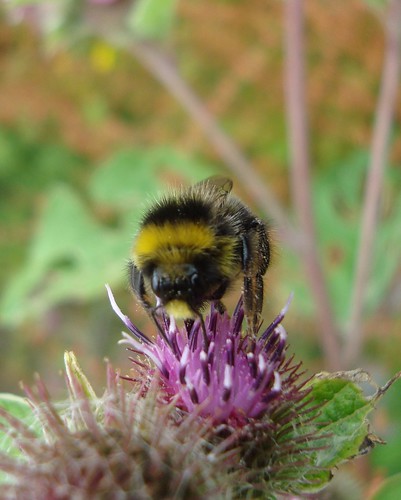
Koffein stärkt Gedächtnis der Bienen Abstract and restricted access to PDF file

bee25

one of the bumblebees buzzing around on my flickr photostream.

Monday, February 27, 2012

fairtrade fortnight

The UK's annual Fairtrade Fortnight starts today, so watch out for events near you supporting fair trade. I have rounded up some fairtrade supplies from our household for a family portrait:


A notable new addition to my shopping list since last year's fairtrade fortnight is the Geo muesly from TraidCraft, which I love to bits.


PS this is post no. 996 of my blogspot blog (there have been previous incarnations in MySpace and on yahoo 360, but not sure how many additional posts they had). Thinking of something special to do for the 1000th. Watch this space.

Monday, March 07, 2011

fairtrade fortnight

In the UK, fairtrade organisations are celebrating fairtrade fortnight (28.2.-13.3.), so I rounded up some of the fairtrade products I use regularly - turned out to be all coffee, chocolate, tea. There weren't any fairtrade fruit around at the moment, and I forgot to include the orange juice (fruit passion):

Friday, October 01, 2010

london art and architecture

Busy day at London yesterday - saw the Gauguin exhibition at Tate Modern on its first day:


I'm afraid I have to agree with the review in the Evening Standard - a biographical approach would have been more enlightening. Gauguin only discovered art in his 20s and became a professional painter in his 30s, then turned his back on the Parisian art scene to live in the South Pacific. Just how this unusual biography came to happen doesn't become clear in the exhibition.

I caught the tail end of the exhibition "Exposed" as well - Tate Modern offers a very affordable combined ticket for the two events while they overlap. More on that exhibition some other time.

I also visited the allegedly ugliest new building in the UK:


and still find it beautiful. What most puzzles me about the "ugly award" is that if you look round Elephant & Castle everything else (shopping centre, 60s tower blocks) is truly hideous, so the one way in which the "owl" doesn't fit in is that it is more beautiful than everything within a mile radius. (It isn't in fact substantially higher than the surrounding tower blocks.) Pleased to see that the Latin American restaurant "La Bodeguita" is still there in the Elephant & Castle shopping centre, it has in fact a perfect view onto the front side of the owl.

And I saw Anish Kapoor's mirrors in Hyde Park:


and the red pavillion at the Serpentine Gallery of which I posted a few (all-red) images on my flickr photostream.

Oh and I had a coffee that was just the right size:


Perfect day.

Wednesday, March 17, 2010

towards sustainable farming

Today there will be a couple of Earthwatch lectures at the Royal Geographic Society in London, covering research aimed at improving the sustainability of food production. Mark Chandler will talk about his work with coffee farmers in Costa Rica, while Ken Norris will focus on cocoa production in Ghana.

I have mentioned Mark's work in a news feature last November (blog entry and link), and Ken's in June 2008 (blog entry and link). Both very thought-provoking re. connections between the food we consume and the state the world is in.

Both projects are corporate partnerships (with Starbucks and Cadbury, respectively), and are also addressing issues of how economics can better cooperate with nature, rather than destroying it, as discussed in this recent story.

2010 Earthwatch Lectures

Farming and sustainable environments
Wednesday 17 March 2010
The Royal Geographical Society,
1 Kensington Gore, London SW7 2AR

Chaired by Countryfile and Watchdog presenter
Julia Bradbury

Speakers: Professor Ken Norris, University of Reading;
Dr Mark Chandler, Earthwatch

5.30pm to 6.30pm Citizen Science Competition Advice Clinic
6pm - Cash bar, photo exhibition
7pm – Lecture
8.30pm – Cash bar

Tuesday, November 17, 2009

enjoy your coffee

... while it's still available. I've learned from my research for the piece published in today's issue of Current Biology that coffee growers in central america would have to shift their plantations to higher altitudes at a rate of 3-4 metres per year -- which is physically impossible, as coffee grows slowly, and as they will be running out of suitable mountain surface area quite soon.

A stark reminder that climate change isn't something that's going to happen in 2050, it's happening now, and people are suffering the consequences already. For farmers in tropical countries, this means they may no longer be able to feed their families. For us, less catastrophically, it means we may not be able to drink as much tea and coffee as we used to. But maybe a few empty shelves in our supermarkets is what it takes to make people understand ?

anyhow, my article is here:

Coffee growers feel the heat
Current Biology, Volume 19, Issue 21, R965-R966, 17 November 2009
summary and restricted access to pdf file

Tuesday, February 12, 2008

... and the automatic coffee taster

following the automatic book author (see yesterday's blog) I can today report the automatic coffee taster (see my news story in Chemistry World).

Now I'm beginning to worry. Is there anything left that I can do but robots can't? Come to think of it, how many of the zillions of bloggers out there are real people and how many are computer programs ?