Showing posts with label blog. Show all posts

Friday, January 13, 2023

no longer famous

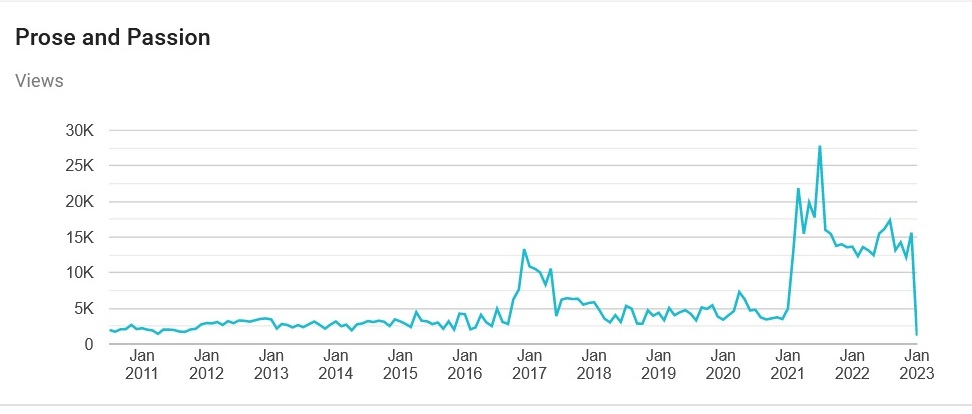
Two years ago, I was wondering why views of my blog had shot up by an order of magnitude in December (2020) and stayed high in the new year. They stayed consistently at the new high level for two years. Typically, a new entry had a good chance of making 1000 views within three months after posting. I never found an explanation for this sudden rise to (very moderate) fame.

In the week beginning 26.12.2022, the views appear to have crashed back down to the kind of level that was normal before December 2020. So I'm left wondering where my ephemeral fame went ...

This is how views per time went up (in the all time view) - the crash at the end isn't representative in this view, as the last data point is the incomplete month of January:

And this is how they came down, showing the last three months only. There was a spike before xmas which compensates the drop after xmas, so the drop doesn't show in the monthly figure for December in the first graph above.

I'm wondering if it's some sort of dark magic perpetrated by Google, making my blog more or less visible. The crash could also be linked to the current crisis at twitter (with the spike before xmas correlating to the high activity of twitter refugees on mastodon). But at the end of the day I'm still puzzled, so all hints appreciated (although I do realise that not very many people are going to see this entry).

Update 23.2.2023: It is now becoming clear that the curve has returned to its previous trajectory, a slow linear increase which I suspect is proportional to the number of blogposts that are out there for people to find. Compared to that line, currently at around 5,000 views per month, the exceptionally high stats of Dec 2020 to Dec 2022 were around threefold higher. The more dramatic effect is on the new posts - they achieved ten times better results during the special period, and dropped back to double figures after December 26. So whatever mechanism boosted my new posts in 2021/22 has now stopped working.

Wednesday, April 28, 2021

almost famous

I've seen a surprising increase in views of blog entries here. Between mid November and early December, views of similar entries (eg CB features, always blogged to the same protocol and promoted the same way) have gone up by a factor of 5-10, and stayed high since. Until November they were on a gradual decline curve, sliding to fewer than 100 in some cases.

I've selected one type of entry for clarity, but it's the same phenomenon for other types as well (eg family history), which is what makes me suspicious. It can't be that all these very different topics are suddenly finding a lot more interest. It could be something like improved visibility in searches. Or at worst, some kind of accounting glitch or increased activity by bots? If anybody has any idea what may have happened (or developed a surprising addiction to this blog since November), I'd be grateful for hints.

The one thing I did change around that time was giving up on the regular (up to four times a week) science news entries, which had also slipped in viewing stats since I introduced them a couple of years earlier. I absolutely don't see, however, how these would have scared away 80-90% of my audience.

Screenshot from today - you can read the actual numbers when you click on the pic.

PS (29.4.) I have now updated the profile info with a new photo (the other one was around 10 years old) showing lockdown locks and grey moustache. Might keep the views in check.

Friday, November 27, 2020

science news on the move

I started archiving the science news items here in January 2019 after tumblr started to hide my blog (which is also called proseandpassion), following the change to its censorship approach.

Recently, however, there have been days when blogger wasn't working when I needed it for the science news archive. As I have now started a new tumblr blog, which hasn't been hidden yet (prosepluspassion.tumblr.com), I'm now trying to move the science news back there, i.e. in addition to tweeting each item, I will also share it on tumblr with the tag "science" (plus up to four other tags for specific fields), so it should show up at https://prosepluspassion.tumblr.com/tagged/science.

You can access these pages without having an account with tumblr, just like any other blog. (If you do have an account, you can reblog them like you retweet things on twitter.) Seems to be working fine so far but let me know if there are any problems.

All other content that isn't strictly time sensitive, such as features, book reviews, etc remains here (and may be mirrored on tumblr if I remember to post the link). For these items it doesn't matter too much if the site isn't working one day and I have to post it the next.

Saturday, September 28, 2019

the quest of the absolute

The inspiration behind my new header pic:

At an Oxfam bookshop I discovered an ancient folio edition (matching my folio paperbacks from the 1980s) of the novel La recherche de l'absolu (the quest of the absolute) by Balzac. It is the story of a rich bourgeois of Douai in the North of France, who becomes so obsessed with chemical investigations that he neglects his social obligations and commercial interests and ruins his family. So the edition I found features a painting of an alchemist by Louis Gabriel Eugène Isabey, Le cabinet d'un alchimiste (Palais des beaux-arts de Lille), which I found very fitting:


I looked it up and found the complete painting here and adopted it as my new header. The old one with the word "LABORATORY", from the front door of the Dyson Perrins Laboratory, must have been in place for nearly 9 years. In the early days I changed the pictures monthly, to mimic a wall calendar, but at some point I got stuck. The most recent changes I can find recorded date from April and March 2010.

I bought the book too, although I'm not sure I'll ever read it. Somehow I doubt whether I still have the patience to put up with Balzac.

Saturday, July 21, 2018

9 years on twitter

twitter tells me I've been on there for 9 years now - hover over the line where it says "joined in July 2009" and it will reveal the precise date and time. So many things have changed since then, but one thing I found surprisingly constant is the ratio of posts to followers, i.e. how many tweets to I have to send out to increase the number of followers by one. This ratio has been around 15 for as long as I can remember. Checking today, it is 15.04 posts per follower.

More intriguing still, the number is very similar on tumblr (15.98) where I do very different things. Much bigger on blogspot though (47), where the culture of following people never really took off. And smaller on flickr (7.13).

Obviously, for people who are more famous than I am this twitter impact ratio will be smaller, for others it may be bigger - so maybe it's a useful parameter for sociologists to study the social media pecking order (both figures that go into it are public)?


Another thing worth noting is that, since I started obsessing about the Galician language and occasionally tweeting in Galician or linking to Galician sources, these relatively rare ventures tend to spread very widely. Whenever I look at my stats, there's a Galician tweet in the top three. See for instance, from yesterday:


Thursday, September 14, 2017

galician news

It looks like I have inherited the admin side of Oxford's Galician session, after the founder and all-round musical genius Mano has left town. At the same time I realised that I had a WordPress account that I haven't used in 10 years, so I will now advertise the sessions and generally rave about Galician music there as well as in the Facebook Group which I've just set up.

So, you choose:

Galician Session Oxford (WordPress blog)

Galician Session Oxford (Facebook group)

Oh, and I'm also running an email list, but that will only involve one mail per month, just the reminder I'll send one week ahead of the session. Drop me a note if you want to get on that list.

The sessions will continue to happen at the James Street Tavern, last Wednesday of every month, 8:30pm.


I will never get bored of the illustrations from the Cantigas de Santa Maria.

Thursday, July 03, 2014

freezing facebook

After what I’ve learned this week about manipulation of timelines by facebook, I‘ve decided to freeze my facebook account. This means I will not close it, to make sure my sign-off post explaining the reasons remains visible and people can find the links to my pages on other social sites, but I’ve blocked twitter from forwarding my tweets, so there should be nothing new coming in.

It’s not mainly the fact that the research they carried out on “emotional contagion” was unethical because there was no informed consent, although this was certainly unacceptable. Personally I would have been unlikely to be hit by facebook's mood manipulation, as I rarely check the timeline. It's worrying to think what other uses the site might find for similar "experiments".

What affects me more and makes it pointless for me to share things on facebook are the routine manipulations that were revealed in the wake of the fiasco. From this story I’ve learned why my tweets forwarded to facebook no longer got any reactions: As I didn’t use facebook directly very often, so didn’t put many likes and responses on people’s posts and don’t interact much, I was accorded low priority in people’s timelines, so they were less likely to see my stuff unless they specifically visited my own page (and for those who are ready to put in this extra effort, I’d rather they visit my blog on blogspot).

Which is a vicious circle, really. If you’re not so popular on Facebook, the algorithm will make you even less so by de-prioritising your content in other people’s streams. This is a turbo-charged popularity contest, worse than anything happening in real life.

For regular updates, follow this blog, my twitter, and/or my tumblr - further links are under "VISIT MY" in the margin (underneath the green astrobiology cover).

Quote from one of the explanatory pieces in the Guardian:

How many stories is Facebook filtering out, and how? Backstrom explained in August that Facebook's news feed algorithm boils down the 1,500 posts that could be shown a day in the average news feed into around 300 that it "prioritises". How does this algorithm work? Backstrom explained that factors include: how often you interact with a friend, page or public figure; how many likes, shares and comments individual posts have received; how much you have interacted with that kind of post in the past; and whether it’s being hidden and/or reported a lot.
PS: I missed Eli Pariser's book The Filter Bubble when it came out - that would have warned me. A discussion of the Facebook newsfeed in relation to the filter bubble theory is here.

Monday, October 28, 2013

the perks of being a book blogger

On September 2nd, I changed my “about” text to indicate that my tumblr blog would henceforth be focused on book-related things:

“I blog and reblog old books, new books, science books, story books, books I read, find, collect or write. Also: science, photography, art, movies with subtitles, pop/rock/latin music, cello and flute music, fair trade, and a modicum of nudity.”

This was simply because since December last year, the main source of notes for my material and new followers for my blog was reblogging from the lovely bookporn blog, so by September an overwhelming majority of my followers must have found me that way. In order to a) give those followers more of what they fancy, and b) increase the “stick factor”, i. e. the percentage among the visitors who find me via a bookporn reblog who then decide to follow me, I made the whole blog a bit more bookish. It’s not exclusively about books, but sufficiently so to get bookish visitors to accept it as a book blog.

Eight weeks into the experience, I can reveal that this switch has been quite successful. The perks of being a book blogger include:

* most trivially, having a focus that actually fits my existing URL and headline, which is a literary quote (from E.M. Forster, Howard’s End)

* by looking at other book blogs to find material to reblog, I’m getting to look at other people’s books at leisure …

* I’m still able to cover all topics that interest me, as all can be covered in books! Specifically, there is still science (especially scientific illustrations, as can be found in books), music, art, and politics.

* I can find a wider audience for my growing reservoir of book reviews, plus leave a scent mark for those books that I would really like to read but realistically will never find the time to (both are included in the “a book a day” tag)

* the bedtime belles I usually reblog as a sign-off at night look even more seductive if they are reading a lovely book,

* I‘m now gaining two followers per day (as opposed to one per day in the months since last December, while I was benefiting from bookporn influx but had no clear identity for the blog).

* I’m being constantly reminded to actually make time to read a book !

For the time being, this blogspot blog will remain the usual eclectic mix of science, culture etc., so if you like snooping around other people's books, find me at http://proseandpassion.tumblr.com/.

larousse

One of those bookish flickr pics of mine which have acquired hundreds of views from the tumblr book fandom.

Friday, November 23, 2012

tumblr and I

These days I am spending most of my online social networking time on tumblr, which is ironic, as it took me well over a year before I got the hang of it.

I had been homeless on the web since MySpace turned into a ghost town and the forums I had visited also died at around the same time – probably all due to the unstoppable rise of facebook. While I’ve been able to transfer quite a few of these contacts to facebook, I never really liked spending time there. In 2010, I signed up to twitter, which I like a lot, but it is a medium more than a place. I can use it to widen the audience for blog entries (on blogspot) or photos (on flickr), but if I spend more than five minutes watching my twitter timeline (following some 1600 people!), the futility and randomness of it gets to me. Unless there is some major political scandal to kick around, which is always fun on twitter. (I also tried google+ but that never took off, and I am registered with LinkedIn, but it bores me to tears.)

So, well, tumblr and I started out on the wrong foot. I signed up in June 2011 when somebody whom I knew from mutual blog-following on blogspot moved her blogging activity to tumblr and I wanted to stay in touch. However, she soon succumbed to the temptation of the NSFW blogs available on tumblr and ended up reblogging that kind of stuff endlessly without posting anything of her own.

In the first months I didn’t come across any individuals who were actually posting their own content. Everything I saw back then seemed to be just swirling round in circles (which I guess is where the name tumblr comes from?) and come from unattributed sources, i.e. probably stolen. Using tags like #science I found some vaguely interesting blogs that I still follow, like the mother nature network, which covers science and environment, but that didn’t really pull me in.

The legacy of my very first contact in tumblr meant that I had no shortage of addresses for erotica, but once I eliminated all peniswaving blogs, I was left with a few lesbian ones (which I still love) and one that systematically reblogs “topless Tuesday” photos. For a few months I just let these float by, but at one point I started to wonder who these women were. If I liked the face above the boobs I looked up the blog and found quite a few interesting people who – and that was rather important to me – did post their own content, rather than just reblogging all the time.

Some of them even very kindly followed me back, so by that stage – perhaps 1 year into the experience - I had around 20 followers (as many as my blog on blogspot has, except that I don’t think that anybody still checks the blogs they follow there). That gave me a little bit more confidence to expect that somebody, at some point might actually look at contributions I post, so I systematically posted links to my articles and blog entries from blogspot. That helped a little bit, some people became interested in the science bits I had to offer.

Then I widened my spectrum, discovered that there is a one-click option to share my flickr photos on tumblr, also posted the odd video, and ended up sharing everything I posted elsewhere (blogspot, twitter, flickr, facebook) on tumblr as well, and more. By the beginning of this month, the increased activity succeeded in attracting new followers on a daily basis, and catalysing new friendships in a way that I hadn’t really experienced since the demise of myspace.

Tumblr really has become a place on the web where I like to spend time, where I’m surrounded by people who I like, even if they are still mostly strangers. I find it amazing how openly people communicate about very intimate problems over there, and how supportive and loving most people are (apart from some anon. trolling – personally I’ve switched off anonymous asks, so I don’t have that problem). I’m beginning to worry that this is too good to last and that Murdoch might soon buy it up and ruin it (this irrational fear will in the future be called the MySpace trauma). I'm just hoping it stays exactly as it is.

Friday, March 16, 2012

writing, sharing, privacy ...

As this is the 1000th entry in my blog on blogspot, I think I can get away with a bit of navel-gazing re. what I’m trying to achieve, what I’m sharing and why, privacy issues, and all that.

First some history

Back in the early noughties, I was very happily addicted to manually updating my rather large website, and I didn’t get the point of these new-fangled blogs at all. Only in 2006, on joining MySpace, where you had a blog by default, whether you wanted or not, did I start to try this timeline format and began to enjoy it. As a control freak, however, one wants to have more order in one’s thoughts than simply a chronological one, so I looked for some platform where I could maintain at least some sort of logical connectedness of the kind I had on my website. I tried Yahoo360 (as my website was on Yahoo’s Geocities and that blended in seamlessly), but after running various formats in parallel, I ended up using blogspot as the primary blog (though I did post copies of entries in MySpace for a while, until that site turned into a ghost town).

I do like the way Blogspot allows finding blogposts easily by date, by keyword, and by search, and with the additional “link-within” app I think the connectivity between things is practically perfect for me.


What to share and when

My main justification for blogging is of course to find additional audiences for my writing published in books and magazines. I like to think of it as a funnel, where, with luck, the media that have wider audiences with shorter attention times guide some of these audiences on to the media that require a bit more concentration, so for instance: twitter – blog – magazine article – book. I don’t have much evidence that this funnel is actually working and pulling the crowds in, but hey, there’s no harm in trying.

In addition, I do like to share random bits that I happen to be interested in with the wider world (if only because sometimes there are so few people interested in the same thing that the next person may be quite far away, so there would be no use shouting in the street or going to the pub to talk about these interests). A lot of this random sharing, when it is just a link or a picture has now migrated to Twitter, and for my own photos I mainly use flickr, so the blog is left with the somewhat more text-heavy stuff, such as short excerpts of science journalism pieces (funnelling towards the full-length piece), rants on politics, economy, life, and raves about music and movies. I also try to review every book I read, though in recent months I didn’t find time to read anything beyond the books I was commissioned to review anyway.

With these things, there is still enough material to do 3-4 blog entries a week (have done fewer in the last few months, as I had two book projects to finish at the same time, which swallowed a lot of my spare time). Ideally, it would be great to do daily posts on a variety of subjects, maybe visiting each area no more often than once a week. People writing about how to monetise blogs say you have to find a niche and stick to it, but that approach would hold no interest for me. I can do niche business with the existing niche magazines any time I want, but the beauty of blogging for me is that I can write on the whole spectrum of my interests, without having a chemistry editor complaining that there isn’t enough chemistry in my story.

To give an impression of what I blog about, these are the 20 most-used tags in the first 999 blog entries:

1-10
sciencejournalism 202 (label for science stuff published elsewhere)
sciencenews 182 (for science stuff not published elsewhere)
oxford 147
photo 114 (for every entry that contains one of my photos)
bookreview 86
currentbiology 85
biochemistry 84
environment 77
germany 72
medicine 63
11-20
pop 63
shakira 56
rants 55
nanoworld 54
literature 52
astrobiology 48
travel 48
history_of_science 47
genome 45
miscellaneous 44

So adding the first two labels together gives us a science content of 38%. Sounds about right.


What not to share

Given the recent developments around Google, Facebook et al, one has to consider privacy issues as well. Personally, I’d like to believe that I’m too weird for any algorithms to figure out what ads I might click on. As evidence I can point to amazon.com who have tried to figure me out pretty much since the company started in the US and haven’t succeeded to this day. What their bots can’t get their heads round is that I buy books and other things in different countries (have used US, UK, DE, FR and ES versions of amazon), and for different people (not always ticking the gift options), and that I also use their site as an author, as a marketplace vendor, not to mention as a reviewer – in which case I look up the details of the book, but get it sent via a magazine I write for. After 15 years or so, suggestions I get from amazon are still mostly useless – if it is something I’m interested in, I normally own it already. So good luck to google if they want to work out who I am, I’ll keep you posted on their progress.

Having said that, it is of course only sensible to withhold information when I can gain no benefit by revealing it. If only because nasty people from some “intelligence” agencies I could think of will probably be working on ways of tapping into Google’s information on people already. I don’t reveal my address, don’t say where my tweets are from, and seeing the recent cross-platform information sharing that google is starting now, I may want to do something to protect my searches.

In Facebook, I don’t fill in most of the details that the site asks for, and I happily accept friendships from random people who I don’t really know (as my profile is public, it doesn’t make any difference anyway). Just to confuse Facebook a bit more, I occasionally switch the language I use the site in. I don’t use the like button outside of facebook, and generally only create cross-links to divert traffic out of facebook, not to pull it in. I see facebook as a human zoo where people are caged for the benefit of the visitors / advertisers, so I still prefer the wild open spaces of the web to the zoos.


Who reads what

I haven’t done any serious visitors statistics on my blog, but the occasional look at the tracker that runs at the bottom of the right hand side column suggests that there is only modest traffic, some 20-30 visits per day, and that most of it comes from searches. There was a time when tweeting blog entries helped, but that has stopped working, not sure why. Tweeting links to a specific photo on flickr still gives me 15 extra clicks within a minute, but tweeting a blog entry gives one or two at best.

Google searches are especially successful in attracting visitors to topics that aren’t adequately covered by the English language media, e.g. Spanish language pop music or cinema. So if somebody using a search engine set to English as the preferred language looks for information on movies like Julio Medem’s Caotica Ana or Shakira’s impact on society, they are likely to end up on my blog. (Amazingly I get Medem and Shakira related visits practically on a daily basis, while areas where I can actually claim some level of expertise, like nanotechnology or extremophiles, pull in much less traffic, presumably because they are adequately covered by higher-ranking sites.) Other popular search terms include the philosophy of Lady Gaga and that of capitalism as well, the Headington shark and the architecture of Santiago Calatrava. For further popular search terms see this analysis I did in 2010.

All in all, I’m still happy with what this blog enables me to do and communicate, so I guess I’ll just keep going.

Thursday, August 26, 2010

free range bloggers v. battery bloggers

(updated Thu 16.9.2010)

I have experience with both types of blogging, the free range one, like on this blog, where I can say or do whatever I like, but may only reach a limited audience, and the institutionalised blog, where I get some extra traffic courtesy of the hosting organisation and the other bloggers, but have to use the platform as it is provided by the organisation, and my content should probably also conform with the expectations of the hosting body.

In science blogging, in particular, I often come across such institutionalised "battery blogs" (eg the nature networks, and just now the Guardian has also started a network of science blogs), but I'm rarely tempted to follow any of them. Nothing against the people writing there, but if I see a platform where 30 people are blogging about science, I couldn't possibly make the time to follow them all, and so I take the shortcut of following none and sticking with my eclectic list of "wild bloggers" that I have accumulated over the years.

Also, in my understanding the whole point of blogs is that they are independent of the established media outlets, so if major newspaper or magazine publishers launch blog platforms, I am getting suspicious that they want to hark back the control they fear to lose.

Another reason why I prefer the wild ones is that the institutionalised ones are dominated by male writers - I always had this impression, now Jenny Rohn has collected data confirming it.

Am I the only one who feels that anarchic urge not to let blogging be locked up in cages ? All opinions welcome.

Friday, July 30, 2010

obscure search terms will find ... me!

My blog enjoys a reasonably good ranking in Google’s PageRank system, which decides which sources appear at the top of a list of search results. This means that from time to time, Google does actually send people my way. Naively, I might have thought that those googlonauts who touch down on my site would have started their voyage with search terms relating to the big issues that I write about, such as nanotechnology, genomics, autism, bioethics, etc. On second thoughts, however, one realises that such topics are also well-represented on sites that are still a few rungs higher up on the ranking ladder, including those of the BBC and major newspapers. The traffic that’s left for me is looking rather different and possibly more interesting.

When I realised that my visitors had typed in things like “philosophy of greed” or “think logarithmically” rather than biochemistry or nanotechnology, I started a month-long observation of the Google searches leading to my blog, of which I can now reveal the results. The only words I have excluded from the ranking are prose and passion – their presence in the title of my blog means that I get ranked highly in searches involving these words, even though people who look for prose pieces about cancer will not be very happy with the results my blog can offer. (I think the over-representation of “Prose of …” searches actually reveals a real flaw in Google’s algorithms; people setting up such things should realise that the title of a blog may be chosen in a roundabout way and may not literally specify the content of the site.)

So here comes the countdown:

In 6th place, Oxford – typically in combination with more unusual terms, including “Parson’s pleasure” which is the title of this blog entry. One customer’s search for “naked dons parson’s pleasure” led to the same entry, of course.

5th, an eternal favourite, and one that alerted me to the eccentric qualities of the search terms that lead people my way, is “greed philosophy” (or, more rarely, greed combined with other terms, such as “How is greed Neanderthal”). The relevant blog entry doesn’t really answer any deep philosophical questions about greed – it is in fact a short appreciation of a book by Naomi Klein.

4th, Sale el Sol – fair enough, that’s a video of a live appearance by Shakira which I embedded in my blog here. Oh, and there have been reports that this will also be the title of the album to be released later this year, so no wonder there are lots of searches.

3rd, another eccentric favourite, is “shark images” and other shark-related stuff. All I did was to write a blog entry about the Headington shark, an Oxford landmark somewhat off the beaten tourist track.

2nd, various members of the Strada family, including Katharina Strada (mistress of emperor Rudolph II), lumped together under Strada searches, and presented here.

And the unlikely winner is …

the Spanish painter Ana Medem, sister of film director and auteur Julio Medem. Ana died very young, and Julio used her paintings in the film “Caotica Ana,” which I reviewed here.

Obviously, having all these (relatively) popular search terms included in one blog entry will completely confuse the Google bots. So if you arrived at this entry hoping for insights regarding Ana Medem or one of the other five top topics, please follow the links provided.

For the future, what I really need to do to attract a larger audience via Google, is to cultivate more eccentric topics and to flag them up in my titles. Paradoxical but true. I should start a series about obscure composers right now.

Monday, March 01, 2010

march

new month, new title picture. This one features part of the beautiful backside of our family cello, cut out of this photo:


No German publications this month so far (there is one scheduled for late March publication, but I haven't even written it yet).

Wednesday, February 10, 2010

twitter 101

How to use twitter

… without wasting your time!

After a bit over six months on twitter, I’m still enjoying this enormously, but I have heard from a few tweeps who have struggled with addiction-like problems or have had to pull the plug because they found the medium too distracting. (Someone commented: “other online stuff is containable, but twitter plants apps in your brain!” and then seems to have deleted her account!) Not to mention those people who never really tried it for longer than 2 minutes and believe that it’s all full of rubbish. For me, however, although it sometimes feels like time-wasting, I believe that twitter works quite efficiently. So here’s a brief round-up of how I use it and how it helps me with my work.

I distinguish between two types of activity I do on twitter, namely 1) network-building/exploring beyond my existing contacts, and 2) reading from and broadcasting to the existing network. I do both things in turns, of course, but as 1) is what new users need to do first, I begin with that.

1) Exploring beyond my contact network is where I am most at risk of addiction, as there are so many interesting people out there, and each new site comes with another 100+ links to other interesting sites, so one could really spend all day clicking around the world just following the following links (or the lists people make). After the initial burst phase, I have restricted my explorations to specific topics and set maximum times for these explorations. For instance, I have spent an hour checking up on people and businesses tweeting from my city (Oxford), and then created a list from that. Once the list was there, it grew autonomously, as other people from Oxford found it and followed me because I had that list. I did the same for people tweeting in Spanish (there’s amazingly few of those), and more recently for French contacts. On other occasions, I build specific network extensions based on who uses hash tags I’m interested in, such as #astrobiology, or on who writes for specific publications, e.g. Guardian journos. It’s also worth checking whether the papers, magazines, scientific journals you’re interested in already have a tweet feed.

2) Hoping that one has done step 1) sensibly and hasn’t followed too many celebrities or lunatics with chronic logorrhoea, the reading and broadcasting part is quite straightforward. Most of the stuff that ends up in my timeline (NB: I never, ever look at the public timeline!) is actually interesting to me, and even with 400+ followees I can still read faster than people post, so it’s not overwhelming. My timeline has actually provided me with topics to write about, and with background info for certain stories. It’s essentially like a newspaper, except that I get to see the articles one day earlier than they appear in the printed papers, and that there is a higher concentration of things I am interested in than there would be in any newspaper or magazine. And if the headline (i.e. the tweet) isn’t all that interesting, I just skip to the next one, as I would in a paper. Oh, and there is of course the very handy option to unfollow people who clog your timeline with stuff you don’t want to read. I rarely use it, but if I see the same avatar five or more times in a row, I consider it.

In terms of my own broadcasting, I post links to my blog entries and other activities, just the occasional random thought, and RTs of things that I either consider worthy of wider attention, or want to be able to access again (if I RT it, it will be in my profile, so easy to find). Certain topics, e.g. at the moment anything to do with astrobiology, I RT systematically and add the hash tag if it isn’t there already. So I can later pull out all #astrobiology tweets and put them in a word doc and have all the links handy.

What I find tremendously useful is the link shortening at http://bit.ly – the site gives me instantaneous reports re. how many people clicked the link I shortened and posted on twitter. Typically there are around 7 hits within the first minute, but this can go up significantly if others retweet the link.

I sometimes use twitter from my phone, but find it a bit frustrating that I can’t retweet there, and have to retype people’s user names if I want to reply to them, so I only use it if I’m cut off from computer access for a day or longer.

One problem with getting heard is that twitter is sensitive to time zones, as everybody uses it in real time and doesn’t go back to old stuff. To address that I sometimes tweet links to my stories or blog entries in the morning (when Asia and Australia are still awake) and then again in a slightly different version in the late afternoon, when the Americas have joined the discussion. Assuming that nobody will be sitting on twitter and reading every tweet for eight hours, I think it’s OK to send out the same info twice, with a 5-8 hours interval. (Even though twitter does notice and complain if one posts the same thing unaltered!)

Easy, isn’t it?

@michaelgrr


PS just discovered: a useful site to see all the people you're following but who aren't following back is http://friendorfollow.com/username/following/ -- replace "username" with your username.

Monday, January 18, 2010

is big google watching you ?

Last week's cover story of the German news magazine Der Spiegel was all about the masses of information that google collects on its users, and the potential threat in that should the company one day go over to the dark side. Some of that really did sound scary, especially the quote from a top executive who didn't seem to have an understanding of the concept of privacy at all.

Personally, I am not worried that much, as I like to believe that my preferences and habits are sufficiently eccentric to confuse all market researchers that care to look at them. Amazon.com has been trying to figure me out for ten years now and aren't any closer to understanding what I really like, or to knowing what I haven't bought yet. They don't even understand that the same person can act as a writer, bookseller, and reader, and that in four different amazon markets (US, UK, France, Germany). So I'm not worried that the google robots, just from managing my blog, will figure out what I'm thinking (*wave to the nice robot*).

But I think that everybody should make sure they think about what information to reveal to whom, and, crucially, not to reveal all to the same company. I.e. if a given company is already handling my email and blog, I wouldn't want them to run my mobile phone and my bank account as well. It's just elementary "don't put all your e-eggs in one e-basket" kind of thing, but I think it can prevent considerable damage should one of the baskets go awol one day. Oh, and for anybody worried about what their search habits may reveal, there is ixquick.com a meta search engine that doesn't record customer details.

And come to think of it, my shiny new phone (not from google) doesn't have an off switch, but it does of course have a microphone and a camera. After reading this article I began to wonder whether the phone was maybe spying on me. Now that would be a big brother type scheme extremely easy to implement. I think the next few years in communications are going to be interesting.

PS some of the Spiegel content is online in English translation, but I don't think this article is.

Wednesday, December 16, 2009

decade of a domain

my first domain name, www.michaelgross.co.uk, is 10 years old today, so I'll take this as an excuse to post a brief history of my website, blog and associated activities. If nothing else, it shows how rapidly the online world has changed in the last 13 years.

History of Only Connect!

27.12.1996 learned HTML from a book.
30.12.1996 launched as Michael’s Home Page, then releasing a numbered issue every week. Main sections: Science; science communication; bilingual children. The site is hosted at the Oxford Centre for Molecular Sciences (www.ocms.ox.ac.uk).
13.1.1997 issue 3 appears with title “Only Connect!” Fourth section: miscellaneous eccentric ideas. Front page essentially a list of 4 sections and 4-5 subsections each, linking to specific pages. E.g. under science communication, there were links for my first books Nanoworld and Life on the edge, and one to the science journalism list.
29.12.1997 Issue 35 has 43 active files. Updates not necessarily weekly.
9.11.1998 Amazon.com associate.
19.4.1999 New section about Oxford (gargoyles, local authors …)
16.12.1999 registered domain name www.michaelgross.co.uk
3.1.2000 New design: front page now has images and titles to link to eight second level pages (each branching out to multiple third-level pages!): Life on the Edge, Nanoworld, Molecular Computation, Light and Life, journalism, bilingual children, books & music, links. Later added research as ninth second-level page.
12.5.2000 google affiliate (earning a fraction of a cent each time someone used google from my page, but it never added up to a payout!).
Jan 2001 joined associate programs of Amazon.de, .fr, .co.uk
Aut. 2001 moving out of Oxford University, site now hosted at Birkbeck crystallography (BBK).
18.10.2002 registered domain name www.proseandpassion.com
22.10.2002 backed up 150 html files, then redeveloped site with simplified structure and new style (using cascading style sheets). Front page now circle of eight icons (no text other than the “alt” text that appears when touching icon with mouse), rather than vertical list of icons plus text. Circle icons link to 4 books, plus pages called whoiam, journalism, research, prose and projects. The last one was soon replaced by a link to the Shakira page, developed Jan-Mar 2003. E.M.Forster quote now written across the top such that “the prose and the passion appears in the middle like a title.
Jan 2005 installed copy of site at geocities (main site still hosted at BBK).
10.4.2006 upgraded geocities to ad-free geocities-plus, pointed proseandpassion domain name at this.
Spring 2006 joined MySpace, started blogging there and on
10.5.2006 at yahoo 360.
11.5.2006 linked yahoo360 blog to geocities site, where it is mirrored in “red top version. Also joined and tried out blogger that month.
24.5.2006 moved michaelgross.co.uk domain to point at geocities site (stopped updating BBK site, which can still be seen here), pointed proseandpassion domain at yahoo360 blog.
10.7.2006 new front page with “book shelf” design. Slimmed down again, now only five second-level pages. (e.g.one for latest book and one for backlist, not one for every book). Title now “michael gross science writer”, with E.M.Forster quote in top right corner.
1.10.2006 all five second-level pages adapted to new structure.
28.2.2007 added family history page.
Summer 07 joined FaceBook.
2.7.2007 proseandpassion.blogspot.com becomes the main blog, with the proseandpassion domain name pointed at it. Blog posts copied manually to MySpace, and mirrored automatically in FaceBook.
14.5.2008 last entry in Yahoo360 / red top blog, as this has begun to function erratically, accepting only a fraction of the entries posted. All red top entries are still online today, at http://michaelgross.info/blog/index.html/.
Aut.2008 developed somewhat decluttered style for “platypus” page and gradually spread this style over the pages of the other books, e.g. linking to relevant blog label instead of having dedicated (and always out-of-date) “news and events” page.
July 2009 joined twitter as @michaelgrr.
Nov. 2009 Forced to move website to yahoo web hosting and new domain michaelgross.info following closure of geocities in October. Blog now has google page rank of 6/10 (when did that happen?) PR of website has dropped to 0 because of the move, though (it used to oscillate between 4 and 5 for the last few years).

Monday, December 14, 2009

archaeology of blogging

To my huge surprise, I've just discovered that the first incarnation of my blog (apart from the very first one on MySpace), which was hosted on the Yahoo360 / geocities network of sites has survived the demise of both yahoo360 and geocities. Apparently, blog entries have been moved, along with my website, to the new yahoo domain michaelgross.info.

I usually refer to it as the "red top" version of my blog, it ran from 10.5.2006 to 14.5.2008, with 503 entries, and the complete list of entries is here:

Prose and passion: the red-top version

So if any of my seven faithful readers should ever want to look up a vaguely remembered blog entry from the time before blogspot (i.e. older than summer 2007), that's where to find it. Please ignore the pedestrian design, though ...

PS one entry I just re-read is:

three reasons not to eat your partner

Friday, November 20, 2009

how to beat the tabloids

amidst all the fall-out of the Belle de Jour story, I loved yesterday's report in the Guardian, saying that a fellow blogger alerted her when the Daily Mail got wind of it. The clever chap called Darren had figured out her identity from the fact that she appeared to be an experienced blogger even when she started blogging as BDJ, so he looked round the small circle of people in the UK blogging scene and found the right one. He set up a website which casually mentioned both her real name and her pseudonym. At the time this was of course the only website to do so (technically called a GoogleWhack), so anybody searching for both names would end up on his site and register in his visitor stats. So he could sound the alarm when the Daily Mail computers showed up, and Brooke Magnanti was able to out herself before becoming a trophy on the Mail's wall.

Which goes to show -- UK prime ministers past, present, and future take note! -- that one can beat the tabloid press if one is clever enough.

PS With hindsight, there is a clue in her publication list too. Four of the seven scientific papers she co-authored have a title starting with the word "sex". I admit that the papers are not about sex, but about sex-specific effects in cancer epidemiology, but she could have used the term gender-specific ?

Monday, November 02, 2009

website news

As geocities closed down in October, I've had to move my website to the yahoo webhosting service. As part of the service, I'm also getting a domain name, which means that, in addition to www.michaelgross.co.uk, I now also have the domain name http://michaelgross.info/
Forwarding of traffic from www.michaelgross.co.uk to the new site seems to work. The address http://geocities.com/michaelgrr auto-forwards to the new name for the moment (but that may stop at some point, so if anybody has any links to the geocities address, please update them). Links to secondary pages, e.g. http://geocities.com/michaelgrr/journal.html will also auto-forward, but to the front page, and not to the specific page. So again, please adjust your links accordingly if you have any.

Oh, and in the brave new world of bit.ly, my web address is: http://bit.ly/1XVNXb or http://bit.ly/1v7bQK

The blog is unaffected by all this, physical address still proseandpassion.blogspot.com, and the domain name www.proseandpassion.com points at this.

While we are talking domain names, please note that I can not read email addressed to the domain names (such as michael@michaelgross.co.uk ) as both domain names attract hundreds of spams per day and I have been forced to target this traffic directly to the trash folder.

Also, as a novelty, I am now putting up a new title photo every month, like a good, old-fashioned wall calendar ...

PS I just noticed (Nov 5th) that the front page of my blog now has a google ranking of 6 (that's out of 10). How on earth did that happen ? Thanks to everyone who linked here !

Wednesday, July 22, 2009

guardian technology & the dead tail of blogging

Recently, I've been looking through a pile of Guardian technology sections which I had piled up for a rainy day, and found a comment by technology editor Charles Arthur (Blogging's long tail is dying), where he explains how he tracks blog entries that comment on content of his technology section. So I reckon he must find this -- hi Charles, *wave*.

Anyhow, to Charles's point about blogging, his conclusion is based on two observations: 1) the reported finding that 95 % of blogs out there haven't been updated for 120 days, so are presumed dead. I don't find that terribly surprising, as there are lots of people who try opening a blog, post two entries with their favourite song lyrics, and find it's not for them, leaving the ruin standing for eternity. In MySpace alone one finds thousands of ghost blogs like this.

Observation no. 2) is that the comment tracking device that Charles set up is giving fewer hits than it used to (and being the editor of the section, he hopes it hasn't become less inspiring over the years). So I'll make a point of regularly commenting on the section to buck this trend :)

At least where I'm standing, which is probably somewhere in the middle of the long tail of blogging, I still feel that blogging is alive.

PS: I forgot to mention that I'm now on twitter:

http://twitter.com/michaelgrr