Showing posts with label hungary. Show all posts

Sunday, July 14, 2024

upstream journey

Some thoughts on

The Danube: A Journey Upriver from the Black Sea to the Black Forest
Nick Thorpe
Yale University Press 2014

I have spent 6.5 years living at Regensburg less than 250 metres from the banks of the Danube. For the first three years, it was so close that its waters came up to our front door once. And yet, much of its watershed still feels exotic to me - as my family history typically drains into the North Sea or rarely into the Baltic. I can think of only two Danubian links, the Black Sea migrants and an elusive Austrian soldier who came to Baden in the 1790s, but his past remains obscure. I have visited Vienna and Budapest but not much else.

Anyhow, as a balance to obsessing about the river Rhine, I felt obliged to read this Danubian travelogue when I discovered it. In the process, I learned a lot about the complex history of the Balkans and the Ottoman influences travelling upstream into Europe, including coffee, tobacco and paprika. I guess this cultural drift from East to West (along with the movement of modern day migrants) was what motivated the author to travel against the flow. Otherwise, most travellers, especially if they use bikes or boats, will prefer to go downstream, from Donaueschingen to the Black Sea, like my ancestors did back in 1806.

The author is a BBC journalist who has been based at Budapest for several decades, so the Austro-Hungarian and Ottoman empires and Eastern Bloc histories are his strength. Upstream of Passau he loses interest a bit - for instance he misses out completely on everything that makes Regensburg special (much like Alexander McCall Smith whose novels allegedly set there have no sense of place whatsoever). And some of the information on German things appears to be confused. For instance he mentions Ingolstadt as a car manufacturing city and then goes on about Opel which is based elsewhere. The famous Ingolstadt car manufacturer is of course Audi.

Also, at the very end, he discusses the work of German adventure writer Karl May (1842-1912), dwelling on his Old Shatterhand persona in the Wild West (with absolutely no connection to the Danube), but forgetting to mention the book "In den Schluchten des Balkan" (1892), which describes an itinerary probably not all that far from the Danube.

So I guess I would recommend it for the stretch of Belgrade to Vienna. For the Black Sea, I prefer Neal Ascherson's eponymous book, and Germany is much more vividly represented in Simon Winder's Germania (incidentally, Winder also has a book about the Danube region which I haven't got yet). Still, it might become handy for a feature on Danubian ecosystems one day. Watch this space.

Blackwells

Thursday, June 07, 2012

a Belgian in the family

As I’ve mentioned before, my ancestors, who appeared to be German through and through in the 19th and 18th century, suddenly turned out to be a load of immigrants when we reached the 17th century. So far, we have found one move from Hungary, one from Italy, several from France and seven from Switzerland. I've now discovered the 16th immigration event in my family tree, which is the first one from today’s Belgium.

Linard Jacque, who later called himself Leonhard Jacob in Germany, arrived in Fachbach on the river Lahn in the 1670s. (This is very close to where the Lahn meets the river Rhine, and just a little bit upstream of Koblenz, where the Mosel joins the Rhine from the other side.) New ironworks were built there from 1671 onwards by the Mariotte family from Liege, Wallonia. That area was leading the world in metal processing technology at the time and had developed blast furnaces long before the industrial revolution came along with its steam engines. Expanding into other European countries, the Walloons brought skilled workers to the site, maybe from places in Wallonia where they had other ironworks. This also happened in Fachbach, where there is a marked influx of people with French names including also Jacquemot, Grisar, Permantier (from France, though), and others.

Historic painting of the Nieverner Hütte, from Wikipedia.

One family that seems to have been closely linked with my ancestors, judging by the mutual services as godparents and marriage witnesses, is the Grisar (Grisard, Grysar, Krisar) lineage, coming from Yvoir near Namur, and in previous generations from Sauheid near Liege. One might speculate that the Jacque family came from the same place and the families knew each other before they arrived in Germany, but I also found a source saying that recruiters working for the Mariotte family came to the town of Theux near Liege, so they may have just scoured the region for skilled workers in which case it would be quite hopeless to try and find the departure region of my Belgian ancestor.

Under the name of Jacob, his descendents did reasonably well in Fachbach, to the extent that in the mid 18th century there are two males called Johann Jacob who are the same generation but I’m not sure which belongs to my branch of the family (Leonhard Jacob junior) and which to Leonhard’s brother Wericus Jacob.

In any case, my lineage only stayed there for four generations, as Leonhard junior’s grandson, Philipp de la Strada, moved to Krefeld to work in the textile industry there and left lots of descendants.

Additional sources:

L'évolution des sciences et des techniques en Wallonie - (1995) by Robert Halleux et al. (Intriguingly, this source mentions that Ottavio Strada was involved in the Wallonian ironworks industries, he was granted a patent in Liege.)

genealogy of the Grisar family by Gerhard Hufnagel

Patrimoine - Les industries sidérurgiques de la basse ourthe (about ironworks in Sauheid near Liege)

Thursday, September 01, 2011

budapest globalised

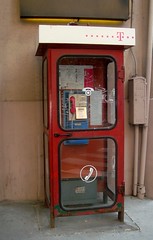
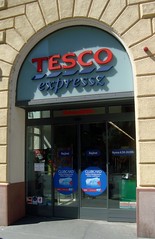
The next thing I noticed about Budapest (after the red trolleybuses) was how thoroughly Western brands have taken over the place. It's not just the fast food outlets and coffee shops that you find everywhere in the world. The supermarkets are called Tesco and Spar, the banks are German, the phone booths (rusty and red, like the trolleybuses) were decorated in the livery of German Telekom (of T mobile fame) and had their trademark pinky-purple receivers:

globalised

Add to that the German-built cars that block the roads (traffic is a bit of a nightmare on the main routes through the city, but amazingly, drivers very willingly stop to let pedestrians cross), and you'll come to the conclusion that the profits of virtually every economic activity that goes on around there (with the possible exception of haircuts) will be skimmed off by somebody in the west. Oh well.

Funny that after 18 years in the UK, finding the German logos in Hungary is just mildly amusing. It's the Tesco branches, ranging from "expressz" to "hipermarket" that really annoyed me. From our experience here we know that these spread like Japanese knotweed.

BP1101

Saturday, August 27, 2011

budapest's red trolleybuses

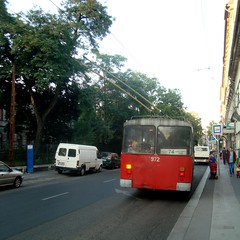
Third stop on the recent trip, Budapest. I soon realised I love the city to bits, all the crumbling splendour (as in Havana, Venice), plus you can walk along the Danube for miles (easier on the Pest side than on the other one, but also nice on the island). Love the falling plaster and the art nouveau villas, and the red and rusting trolleybuses (electrical buses with overhead cables):

BP1113

They kept reminding me of a lovely song by Bulat Okudzhava (1924-1997):


I actually saw Okudzhava playing live many years ago, when we lived in Regensburg. I knew his work as I was learning Russian at the time. There was a cultural centre on the opposite side of the square where we lived and one day I just walked past the door of that centre and spotted a plain A4 sheet of paper taped to the door, saying Bulat Okudzhava will be playing here on (date, time), which happened to be the day after I saw the notice. That was the only announcement there was, and accordingly it was a very intimate event. I seem to remember there was a translator who read out German versions of the lyrics before each song.

Well, anyhow, more about Budapest to follow.