Showing posts with label antarctica. Show all posts

Monday, July 20, 2026

antarctic in danger

The Antarctic is in danger of losing both its ice shield and its biodiversity. These two issues are typically treated separately, but are both linked via the climate catastrophe we are causing, so I hooked them up together in my latest feature, which is out now:

The Antarctic faces climate threats

Current Biology Volume 36, Issue 14, 20 July 2026, Pages R777--R779

Restricted access to full text and PDF download

Magic link for free access
(first seven weeks only)

(Unfortunately, this year's features will no longer become open access one year after publication - do contact me if you would like a PDF and the magic link has expired.)

See also my new Mastodon thread where I will highlight all this year's CB features.

My mastodon posts are also mirrored on Bluesky.

Last year's thread is here .

Gentoo penguins (Pygoscelis papua) have recently been recognised as four separate species,
three of which are threatened. (Photo: Liam Quinn/Flickr (CC BY-SA 2.0).)

Monday, April 04, 2022

eccentric penguins

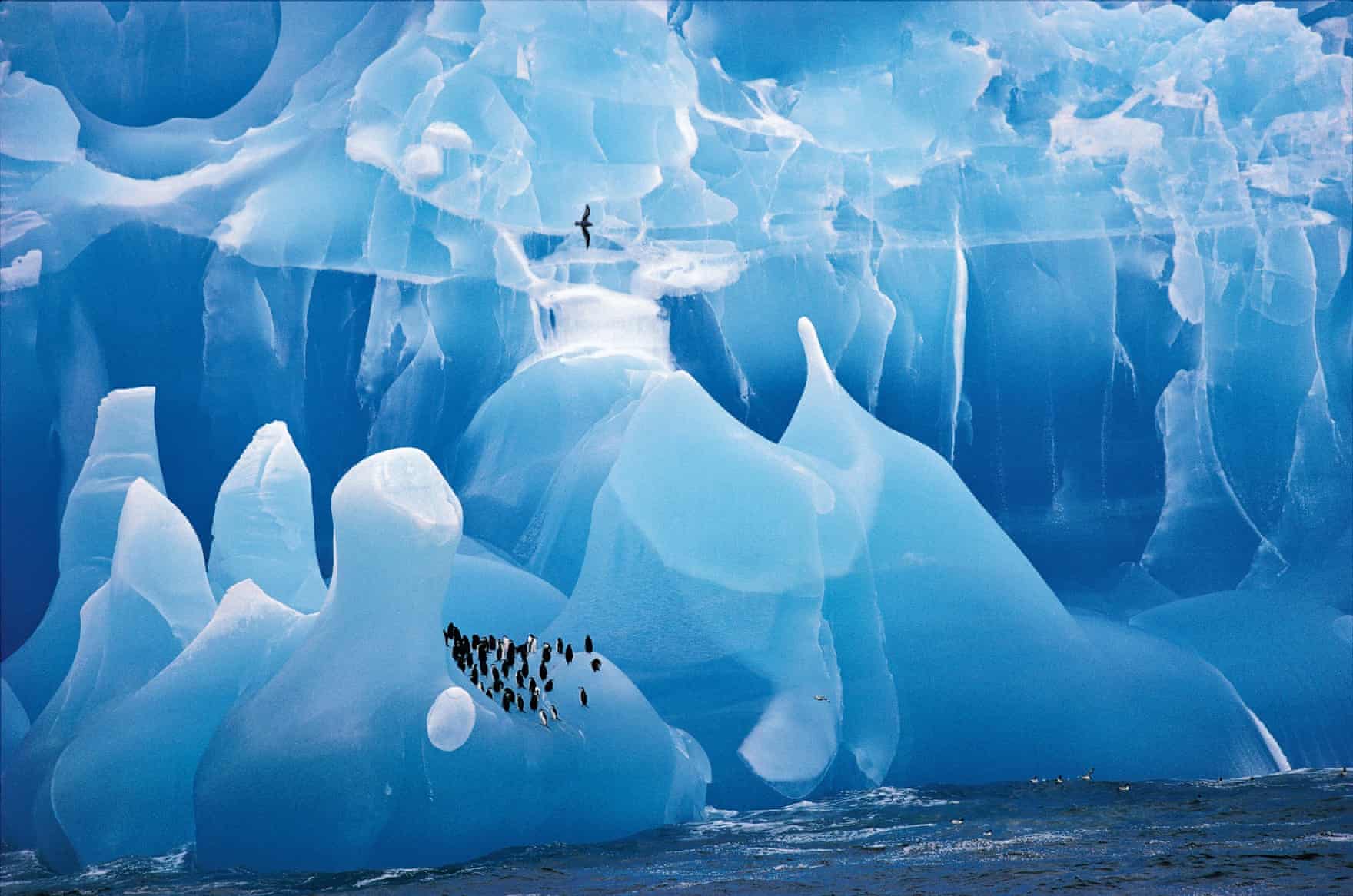
The French edition of my book Life on the Edge, La vie excentrique, was published with a lovely picture of penguins in an Antarctic landscape of blue ice on the cover:

Every once in a while I come across the original photo and then I forget again where I saw it, so this time I am bookmarking it for future reference.

The original is by Cherry Alexander and won the Wildlife Photographer of the Year award in 1995 according to this report.

I'll just hotlink it here:

For the book cover it was flipped such that the penguins can be on the front of the book and the penguin-less right half of the original photo wraps around the back of the book.

NB I also have a new feature out about Antarctica.

Monday, March 28, 2022

antarctic under threat

Both Antarctic and Arctic temperatures were breaking records last week, and an Antarctic ice shelf collapsed - plenty of worrying news to underscore the point of my feature (prepared before these events), which is that Antarctica's frozen splendour is under threat from both climate change and invasive species.

Oh, and the discovery of the Endurance was reported the day before my copy deadline, I just about managaged to squeeze that in. Lots going on down there.

My feature is out now:

Pristine Antarctica exposed to change

Current Biology Volume 32, Issue 6, 28 March 2022, Pages R247-R249

FREE access to full text and PDF download

The arrival of ships from around the world raises the risk of non-native invasive species establishing populations in Antarctica. (Photo: Jason Auch/Wikimedia Commons (CC BY 2.0).)

NB: as the 2022 features move into the open archives, I will add them to this thread on Mastodon.

Monday, March 04, 2019

rising waters

There has been a deluge of papers on the shrinking continental ice caps in the last couple of months, warning of the imminent more literal deluge which will threaten major coastal cities and indeed countries within decades.

I've tried to compile all these rather scary developments from both polar regions and even the high mountain glaciers in my latest feature which is out now in today's issue of Current Biology:

Shrinking ice caps, rising oceans

Current Biology Volume 29, issue 5, pages R137-R140, March 4, 2019

FREE access to full text and PDF download


Studies of the Antarctic ice sheet increasingly detect the accelerating disappearance of ice. (Photo: Commander John Bortniak, NOAA Corps.)

Wednesday, December 03, 2014

seasonal offerings

My German pieces published in December are embarrassingly seasonal - there is ice and snow aplenty in a feature about the subglacial biosphere of Antarctica, and the target of my regular fun-poking is Poinsettia (Euphorbia pulcherrima), which is known in Germany as Weihnachtsstern (christmas star). That's quite enough xmas for me, I don't want to hear it mentioned again until next year ...

Mikrobielle Artenvielfalt unter dem Eis der Antarktis
Nachrichten aus der Chemie 62, 1186-1187, 2014
[related content in English]

Die Wissenschaft vom Weihnachtsstern
Nachrichten aus der Chemie 62, 1251, 2014

Monday, October 06, 2014

science in antarctica

I had a feature on the shrinking arctic sea ice a couple of years ago, so here comes the southern counterpart. Apart from the concerns over climate change and loss of continental ice, I'm also looking at the recent investigation of biotopes in the subglacial lakes and their importance for astrobiology.

Shrinking ice caps in the spotlight

Current Biology Volume 24, Issue 19, 6 October 2014, Pages R941–R944
DOI: 10.1016/j.cub.2014.09.040

abstract and limited access to full text and PDF file
(should become free access one year after publication)

A mosaic of satellite images of Antarctica taken by RADARSAT-2.

Credit: RADARSAT-2 Data and Products © MacDonald, Dettwiler and Associates Ltd. (2008) All Rights Reserved. RADARSAT is an official mark of the Canadian Space Agency. (PR)

Tuesday, July 24, 2012

losing our ice caps

I've recently read "The goldilocks planet" for review (watch this space) and learned to appreciate the variability of Earth's climate on geological time scales. 3 million years ago (just a moment, for a geologist), we didn't have a permanent ice cap on the Arctic, and just over 30 million years ago, we didn't have one on the Antarctic either.

The way the carbon dioxide concentrations in the atmosphere are developing right now suggests that we may be heading back to those warmer days, and man-made climate change is happening faster than any previous geological climate change.

How are ecosystems in the Arctic and Antarctic responding to the loss of polar ice that is happening already? And which of their responses may lead to dangerous positive feedback loops? I've looked into these problems for my latest feature which is out in Current Biology today:

Life changes as polar regions thaw

Current Biology, Volume 22, Issue 14, R547-R550, 24 July 2012 doi:10.1016/j.cub.2012.07.009

Read the story in HTML and PDF format.

Actress Lucy Lawless (Xena the warrior princess) took part in the Greenpeace campaign "Save the Arctic" (see this lovely interview in the Guardian. Maybe the scariest feedback loop of them all: that the disappearance of the Arctic ice will give us access to more fossil fuels to burn ...

PS More ice-melting news

Wednesday, April 28, 2010

breakthrough in Antarctica?

It's always dangerous to announce things that are just around the corner in publications, as they tend to change their minds and make the would-be prophet look silly. This happened to me with a few things, including the exploration of the sub-glacial lake Vostok in Antarctica. If memory serves, I already announced that event in my book Life on the Edge in 1998, and it still hasn't happened.

Mind you, there were very good reasons not to proceed with this project too hastily, as researchers are hoping to find a unique biotope down there and don't want to destroy it by connecting it with the outside world.

Now, after lots of thinking about the contamination risks and developing new methods to avoid it, Russian researchers at Vostok station say they are ready to proceed to the lake surface in the next Antarctic summer, 2010-11. I wrote a news feature about the drilling project and what it might discover, which is out in this week's issue of Current Biology:

Final drive for Antarctic breakthrough
Current Biology, Volume 20, Issue 8, R337-R338, 27 April 2010
doi:10.1016/j.cub.2010.04.005

Abstract and restricted access to PDF file


PS (Feb 2011) I hear that the drilling didn't make it to the surface of Lake Vostok this season, the quest will continue next year ...

Tuesday, February 24, 2009

fertile debates

The productivity of the southern oceans is typically limited by the lack of iron -- hence if an iceberg breaks off the Antarctic shelf and carries iron to the ocean, algal blooms are observed.

In an effort to understand these processes and to figure out whether and how they might help to slow down climate change, researchers from Germany and India using the research vessel Polarstern have started a comprehensive experiment (LOHAFEX), fertilising a well-defined eddy of the south atlantic with iron, and monitoring the effects in much more detail than ever before.

Still, the experiment has triggered intense debate in Germany. Amusingly, the chancellor and the research ministry support the experiment, while the environment minister is opposing it quite fiercely. Read my story in

Current Biology vol. 19, issue 4, pp R143-44


There is also a blog (in German) reporting directly from the ship: Polarstern unterwegs.

Thursday, February 19, 2009

lift a leg

Tomorrow, the 3rd incarnation of Germany's Antarctic research station, Neumayer III will be officially opened. Staying safe and warm, the German research minister is planning to do the job remotely via phone connection from Berlin.

Replacing a structure that was under the ice, Neumayer III is revolutionary in that it is designed to stay on top of an ever-growing and ever-moving ice shield. For this purpose, the station has 16 extendable legs to stand on, which can be adjusted individually (the association of a 16-legged dog comes to mind) and collectively. As there is no precedence for such a design and a lack of data on the mechanical properties of the snow and ice it stands on, it will be exciting to see how the structure copes with the harsh reality down there. Break a leg, so to speak.

Like the research vessel and ice breaker Polarstern, currently engaged in a controversial iron fertilisation experiment (more on this next week!), Neumayer III is run by the Alfred Wegener Institute.