Showing posts with label strasbourg. Show all posts

Thursday, August 20, 2026

1664: something brewing in Strasbourg

After discovering various ancestors in 17th century Strasbourg (still a Free Imperial City at that point), it occurred to me that Kronenbourg, having named one of their beers "1664" might have been around at that time too. Unfortunately, the history of the brewery doesn't appear to be very well presented anywhere (it is extremely thin on the company website), so I'll use this entry to compile the bits and pieces I find.

Von Florent from Paris, France - 1664, CC BY-SA 2.0, https://commons.wikimedia.org/w/index.php?curid=10911888

In 1664 Geronimus Hatt IV (Jérôme Hatt in French; 1633-1675), son of a dyer, started brewing in a house called Zur Kanone (cannon) at the square Rabenplatz (now known as Place du Corbeau). It was named after the raven as in the Middle Ages this area was the place of executions and the birds came to consume the dead bodies. More recently though, this has become a very desirable address, just across the river Ill from the cathedral (reached via the raven's bridge). The brewery business stays in the possession of the Hatt name line until 1977, across more than three centuries and eight generations, which is very impressive. According to his French Wikipedia page (no other language versions available at this point), he had obtained his brewer's licence the same year, whereas this F1 fan page suggests a slightly different version.

According to the F1 page, his son Claude took over the brewery in 1683. However, this name and date doesn't appear in the Wikipedia overview of the family history. There, many different descendants are brewers in various places in Strasbourg and beyond, so to simplify things I'll try to pick out the lineage that leads to the last owner of the family business.

1) Jérôme Hatt IV (1633-1675) marries in 1664 Marguerite Hamm, daughter of the baker Johann Hamm. As described above, he starts brewing in 1664 at Rabenplatz (Place du Corbeau). The very amazing website Maisons de Strasbourg has info on the house numbers 1, 7, 8 and 9 and none of these had a Hatt person (nor a brewer) in the 1660s. The numbering around the square (see the map) only went up to 9, so that only leaves numbers 2-6. Number 5 is huge, so for the humble beginnings of a newly licensed brewer I'd imagine one of the smaller houses.

2) Jérôme Hatt V (1668-1734), brewer renting the house Zum Vogelgesang / Chant des Oiseaux in 1692 (7 quai des bateliers, just a few doors down from the Rabenplatz), marries Catherine Boch the same year. In 1713, he inherits the birdsong house from his mother, who had married the owner Hans Jacob Verius in 1675 and bought the house with him in 1689 when the previous owners filed for insolvency.In 1716 he marries Catherine Goll, mother of brewer number 3). She was previously married to a priest called Georges Frédéric Leonhard, and in 1736 marries Philippe Guillaume Milius In 1746 her son, the brewer Jean Daniel Hatt and his wife (oo 1740) Susanne Marie Kammerer inherit the house. It stays in the Hatt family until 1759. Search "Hieronymus" on the page about the house to find 25 entries relating to the Hatt family. For instance, in the 1730s they also buy neighbouring properties and apply for permission to knock through walls to expand their business space.

3) Jean Hatt (Strasbourg, 14 août 1720-Strasbourg, 29 octobre 1753), founder of the brewery l'Espérance en 1745 à Strasbourg then at Schiltigheim. Marries Marguerite Barbe Heyl 1746 at Strasbourg. Rents the basement of 6 rue de la Croix in 1747. (There are many more hits for Espérance on the website, probably enough info to reconstruct the history of the breweries operating under that name.)

4) Jean-Louis Hatt (Strasbourg 1752 - 1804), brewer at l'Espérance. Marries Anne Barbe Kellervitter in 1780 at Strasbourg.

5) Philippe Jacques Hatt (Strasbourg 1787 - 1862), brewer at l'Espérance, founder of the brewers' association of Strasbourg. Marries Marie Catherine Rothenbach (1791-1838) 1812 at Strasbourg.

6) Philippe Jacques Hatt (Strasbourg, 16 november 1813)

7) Frédéric Guillaume Hatt (Strasbourg 1849 - 1916), leads the brewery at the Kronenbourg quarter of Strasbourg. Marries Eugénie Boersch (1854-1883) 1874 at Strasbourg.

We have a bit of a consistency problem here, as the company website claims that Frédéric Guillaume Hatt moved the brewery to Kronenbourgh in 1850, at which point he would have been around one year old. Maybe he had an uncle with the same name who is missing in the wiki family history. That would also fit the counting of generations on the website as they say sixth generation. The reason for the move was the flood risk in the city centre. The Kronenbourg district is on hills and thus safe. Wikipedia gives 1862 as the date of the move (still inconsistent) and also mentions that hills enabled the use of cellars for cold storage during longer brewing procedures.

8) Maurice Jérôme Hatt (Strasbourg 1869 - 1958), acquires the brasserie du Tigre and creates the brand Tigre Bock. Marries Hélène Nessmann 1897 at Strasbourg, then after her death, Valérie Fischer 1911 à Strasbourg.

9) Jérôme Maurice Hatt (Strasbourg 1912 - Perthuis 1998). The last leader of the family business.

Production at the Kronenbourg site ceased in 2014. All brewing is now happening in Obernai.

Which is all very interesting but not much use for my family history. I need to find the first three bearers of the name Geronimus Hatt, as they would have overlapped with our goldsmith Franz Bolion von der Rosen and his wife Ottilia Flach.


Stop Press: This Lutheran vicar Matern Hatten (1470-1546) moves from Speyer to Strasbourg and marries Barbara Hager from Regensburg has a son called Hieronymus, who marries Agnes Stock and again has a son of the same name, and he is a dyer. Now that looks very promising.

In the history of the birdsong house we find the marriage entry of Hieronymus Hatt IV with the name of his late father given as Hieronymus Hatten.

With the search term Hieronymus Hatt (as opposed to Geronimus which I had from the wiki page of the first brewer) I also found a family tree for the brewery founder in Geneanet. So, going backwards now, we have:

1. Hieronymus Hatt IV (1633-1675)

2. Hieronymus Hatt 1596-/1633 (this marriage in 1630 also in Gedbas)
3. Maria Gassner /1613-

4. Hieronymus Hatt 1573-
5. Susanna Jung 1575-/1625
6. Daniel Gassner †1631/
7. Anna Maria Mischler (according to GedBas)

8. Philipp Hatt /1550-/1611
9. Dorothea Windisch 1552-
10. Martins Damian Jung /1540-1595/
11. Margaretha Jud /1549-/1576

18. Matthes Windisch †/1577
19. Ursula Baldner †/1558
20. Martin Jung †1566/
22. Jacob Jud /1507-1566/
23. N Post /1510-

Sadly, Geneanet runs out of Hatt ancestors at this point, although we're still one Hieronymus short, if the one born 1633 is the fourth. I think this fits quite plausibly with the son of the vicar mentioned above though. So if we trust the numbering of the Hieronymuses, we could fill in Hieronymus I as number 16. and the vicar would be 32. Actually, Wikipedia says that Hieronymus (son of Matern Hatten) had sons called Hieronymus and Philipp. So that works. We then have, based on that Wiki entry:

16. Hieronymus Hatt + after 1566
17. Agnes Stock + before 20. Mai 1546

32. Matern Hatten * around 1470 Speyer + 14. März 1546
oo before July 1537
33. Barbara Hager * Regensburg

64. Matern von Hatten (from the place Hatten near Wissembourg?)
65. Margarethe Reuß (from a family with lots of clerics at Speyer)

While these brewers are not attached to my ancestry (yet), there are parallels to the history of the Kirner Pils brewery, where we have a known family connection, so I do have an excuse for being nosy.


Confused about who is who? - see my new name index for all things family history.

There's also a nascent index of place names here.

And here's the index of migration events.

Thursday, July 30, 2026

pioneering printers

Our Strasbourg goldsmith Franz Bolion von der Rosen married Ottilia Flach, born around 1560, and I have seen speculation that she might descend from the Strasbourg printers Martin Flach the Elder and his son, the Younger. So let's see how these fit together:

Martin Flach the Elder was born mid 15th century in Küttolsheim near Strasbourg, and died 20.11.1500 in Strasbourg. After an apprenticeship with Johannes Mentelin, he started his own printing workshop in Strasbourg in 1487 and mainly printed religious works eg by Albertus Magnus. For reference, Gutenberg completed his pioneering printing of the bible in 1454 and died in 1468.

Bust of Johannes Mentelin at the humanists' library in Sélestat
Source: Von Alexandre Dulaunoy from Les Bulles, Chiny, Belgium - La bibliothèque humaniste de Beatus Rhenanus / Humanist Library of Beatus Rhenanus, CC BY-SA 2.0, https://commons.wikimedia.org/w/index.php?curid=11779810

His son, Martin Flach the younger, was also a printer and active in Strasbourg between 1500 and 1539.

Our earliest Flach, Adam Flach (the Elder) was born around 1480 in Maisonsgoutte (source). (Note that this local tourism website says the village was called Hisselbach in the 14th century, which then mutated to the French Maisonsgoutte, which was Germanised in 1603 to read Maisengott and then became Meissengott in 1665.) Judging by his age, he could be a brother or cousin to Martin the Younger. He died 6.3.1533 in Schlettstadt (today Sélestat).

Following the nameline down from Adam, we have Adam the Younger, Gabriel, then Ottilia:

Adam Flach was born in Schlettstadt around 1510, immatriculated at the University of Freiburg in 1538 , died at Weilertal after 1539.

Gabriel Flach was born 1524 in Weyerthal near Strasbourg, and died 1580 in Strasbourg.

The second question is if and how Ottilia is related to the Flach ancestors of Albert Schweitzer (which is claimed in this forum contribution). The longest Flach nameline I could find online goes up from his great-grandmother Marie Madeleine Flach (1782-1847) to

Jean Jacques Frederic, born 1756, then

Johann Christoph, 1725

Johann Christoph, 1701

Johann Christoph, 1656

So we're still a century or 3-4 generations away from a potential brother of Ottilia.

On both fronts, I could do with a few more Flach people to join those dots.


Confused about who is who? - see my new name index for all things family history.

There's also a nascent index of place names here.

And here's the index of migration events.

Thursday, July 23, 2026

all our Alsatian connections

My (paternal) grandparents met at Bonn, but each had a family background with (temporary) stays in Alsace and Lorraine. I knew them well, but the extent of this shared cultural background only dawned on me long after they both died.

Ironically both were born in Lorraine (just outside Alsace), but more attached to Alsace. The main connections are the railway station of Adamsweiler hosting Ruth's grandparents (after many years of migrating between other stations in the Alsace Lorraine network) and the Strasbourg love story of Richard's parents. Beyond that, they were probably unaware of additional Alsatian roots that both their families had much deeper in the past, which only came to light through recent research. I had started a list of Alsatian connections at the bottom of the recent entry about the Adamsweiler station but then realised there are around ten different stories, so they need a blog entry all of their own.

I'll separate his and her Alsatian ancestries, starting with Ruth, and having earliest stories first. On Ruth's side, there are twice as many stories, but there is a conspicuous gap between 1681 and 1870, which is the time when Strasbourg and the Alsace were under French rule.


Ruth's six connections:

The goldsmith of Strasbourg, Franz Bolion von der Rosen (ca. 1552 - ca. 1620). While the von der Rosen nameline only passes through Strasbourg (coming from Liege and moving on to Winterburg), his wife, Ottilia Flach appears to be from a resident Alsatian family that also turns up in the ancestry of Albert Schweitzer through his maternal line great-grandmother Marie Madeleine Flach (1782-1847). Ottilia's father Gabriel Flach was born 1524 in Weyerthal near Strasbourg, and died 1580 in Strasbourg. Her grandfather Adam Flach was born in Schlettstadt (today Sélestat) around 1510, immatriculated at the University of Freiburg in 1538 (he might be another clergyman???), died at Weilertal after 1539. Her great-grandfather, also called Adam Flach, was born around 1480 in Meissengott (today Maisonsgoutte, Alsace) and died 6.3.1533 in Schlettstadt. So that seems to be a solidly Alsatian background, although we sadly don't have the names and origins of the women involved. The assertion that these Flachs are Schweitzer's ancestors too rests on this forum entry. As yet, I haven't been able to find the whole connection, will do a new entry when I find it.

Conon the contrarian (1546-1602) studied theology in Rostock and Strasbourg, then spent two years as an assistant priest in Mundolsheim (today part of the Strasbourg metropolitan area), before moving on to the Mosel valley. His Alsatian years must have been in the 1560s.

Conon's son in law Christian Nesselius (ca. 1576-1631), whose bio is included in the same blog entry) studied in Strasbourg as well, that must have been in the 1590s. In 1600 he came to Birkenfeld where he served as a schoolmaster under Conon's supervision and ended up marrying his daughter.

Nicolaus Andreae (1580s to 1640s) studied in Strasbourg and married there, which became an issue when he arrived in Kastellaun in 1607 as a young schoolmaster needing accommodation. He would have been at Strasbourg in the first years of the 17th century, but could in theory have overlapped with Nesselius. Sadly we don't know who the wife of the Strasbourg and Kastellaun years was and whether she also was the founding mother of the Andrae lineage at Gebroth and the widow who survived Nicolaus and married again. Probably not, considering the record of domestic violence in between. Also, considering the known background of his widow (Anna Amalia Orth), I don't see how he would have married her at Strasbourg.

Johann Conrad Arnoldi I (1628-1711) Matriculated at the University of Strasbourg 25.2.1645. Now that's what I call a clear and specific date. By 1651 he was in office in the Hunsrück area.

Cover of a timetable brochure from 1902. Source: Wikipedia.

The family of the stationmaster of Adamsweiler Christoph Gottlieb Kauer (1845-1909), who joined the Imperial Railways in Alsace Lorraine (Reichseisenbahnen in Elsass-Lothringen) after the war of 1870/71 and stayed in their service until he died. His widow and all remaining family members were evicted from Alsace Lorraine in 1919.


Richard's three connections (four if I split the second one):

I had a vague memory that my Bondam / Bonnedame huguenots had an Alsatian connection, but that turns out to be Phalsbourg just beyond the border to Lorraine, a town in a German-ruled enclave founded in 1570 specifically to offer refuge to Huguenots persecuted in France. Then again, I read that after the town fell under catholic rule in 1608, many of the protestants fled to Bischwiller in Alsace. So there could be another Alsatian connection waiting to be explored.

The migrating miners and the Trimbachs are two strands that converge in the supremely unsearchable Paul Simon (1740-1813), who was born in Sainte Marie aux Mines but left Alsace to settle in Böchingen, Palatinate, where he got married in 1768. The Simon name line only passes through Alsace (Paul's father Johann Christoph Simon was born in Niederhosenbach, Hunsrück), but his mother, Maria Susanna Trimbach (1713-1752) has six Alsatian great-great-grandparents we can account for, including two local councillors in Munster and a woman born in Badonvillier. These were born around 1570. We know that the Trimbach name line came from Switzerland in the 16th century, but there must be at least some ancient Alsatian lineages among the others. Family names in Maria Susanna Trimbach's ancestry include Klein, Monschat, Saass, Fabry, Sturm. All of her ancestors with a known birth place were born in Alsace, with the earliest births in the 1540s. My 8th generation ancestor Maria Susanna Trimbach is also my strongest claim to (1/256) Alsatian ancestry. The more wobbly connection to Ottilia Flach, above, only gives me 1/4096 Alsacianicity (plus Albert Schweitzer as a bonus).

And finally, Heinrich the cellist meeting Maria at Strasbourg in 1903 and writing 160 poems for her. The other two Alsatians connections above are both via Maria and her mother. As she had grown up on the other side of the river Rhine in Bruchsal, Alsace wasn't so far away from her, whereas for Heinrich, coming from eastern parts of the German Empire, it must have been a more exotic location.

Strasbourg-Neustadt (German quarter):
the former Sängerhaus, which today is the Palais des Fetes in rue Selenick.


After 1918

In September 1943, Ruth and Richard revisited Strasbourg in the awareness that the war was lost and Strasbourg might be lost and/or destroyed. Fortunately, both they and the city survived the war and we have been visiting the region quite often ever since. Might do a separate entry with old photos relating to some of those visits.


Confused about who is who? - see my new name index for all things family history.

There's also a nascent index of place names here.

And here's the index of migration events.

Thursday, March 12, 2026

from the vicar of Gebroth to the mayor of Marburg

In the Weiß Chronicles, Johann Gottlieb Weiß (1736-1800) the mayor of Pferdsfeld (see generation 8) marries Anna Katharina Andrae (1742-1816) from Gebroth. She is the paternal grandmother of the author of the chronicles but he did not supply any additional information about her. He was born around 1821, after she died. By 2000, we still didn't know anything about her. By 2013, we had found the names of her parents. Based on that information, my father hired a professional genealogist who came back with a report of six pages (including two pages from an earlier effort published by Ulrike Kühne in 1994 (Mitteilungen der WGgF Bezirksgruppe Mittelrhein). From that I extracted the names and dates that go into our official family tree but somehow I never got round to looking at it in depth and searching some of the new names that came up.

The main result of the professional report was establishing that, in spite of some gaps in the church books of Gebroth, the name line Andrae can be traced back to Nikolaus Andrae or Andreae, who was the vicar of Gebroth from 1632 presumably until his death, but records aren't all that complete in the middle of the 30-Years War. Although not all parent-child links are clearly documented, the genealogist made a convincing case based on mutual exchanges of godparents between families. Also, it appears that the name Andrae, which survives in Gebroth to this day (I checked 28.2.2026; see also their cemetery), was introduced to the village with the arrival of that vicar, so the lineage of our Anna Katharina must be going back to him even if one of the links may be a bit wobbly.

The genealogist also discovered a skeleton in the vicar's closet - there is a file about Nikolaus with allegations of domestic violence from 1613, during his earlier tenure as the vicar of Gödenroth. Apparently the church was so short of candidates with the right academic qualification willing to take up poorly paid posts in remote Hunsrück villages that they couldn't dismiss him but gave him a second chance when he promised it wouldn't happen again. He stayed until 1632, when he was moved to Gebroth. His redemption appears to have worked out well as his nameline descendants remained in Gebroth and networked with everybody who was anybody and found some rather interesting spouses, including the granddaughter of the Strasbourg goldsmith about whom I raved last week. Incidentally, her brother Johann Conrad von der Rosen also became vicar of Gebroth (more about the clan of the Roses).

Some 13 years after the report came in I now looked at the earliest ancestors listed there again, because I had been looking into the social network of the vicars of Eckweiler and wondered whether there were any more to be found in the vicinity of the vicar of Gebroth. I found quite a few new ancestors, including four additional protestant priests (total now stands at 9, or 10 if I include the one listed as "probably" the father of another, below), as well as connections to the ancestries of Goethe through common ancestors in Marburg and, separately, Albert Schweitzer. Of course these links are too remote to be of any biological significance, but they are enormously helpful as these VIP family trees tend to be well researched and documented. Oh and I'm still discovering more things that will go into another blog entry. I do wonder why our old chronicler didn't show any interest in the family of his grandmother.

Merian engraving of Marburg in 1605, a time when lots of Orth people were active there. Unfortunately I couldn't find any interesting illustrations of Gebroth. The church has burned down and been rebuilt since Nikolaus Andrae was the vicar there and there aren't any historic postcards of the place online (although I have a tiny image of one in a web page that I printed out 20 years ago). Source.

So here we go, starting from Anna Katharina, generations 0-4 all born in Gebroth unless otherwise specified. The five protestant priests in her direct ancestry are set in bold:

1. Anna Katharina Andrae 1742-1816

2. Franz Nikel Andrae 1705-1765, juror in Gebroth
oo

3. Maria Magdalena Metzler 1711-1779

4. Johann Nikolaus Andrae from Gebroth appears as a godfather at christenings in nearby Winterburg in 1689 and 1700.
Intriguingly, the list of protestant parsons in the area has one by the same name born in Krummenau in 1685, but without a clear connection to Gebroth.

8. Frantz Nickel Andrae died before 1685. The genealogist argued that the combination of Franz and Nikolaus is rare outside this family, so this guy would likely be the grandfather of the eponymous ancestor number 2.
oo 21.2.1654 Winterburg

9. Maria Ottilia von der Rosen

16. Nikolaus Andrae, born in Enkirch on the river Mosel, an area where the name Andrae is more common; vicar of Gödenroth 1609-1623 and of Gebroth from 1632 until his death before 1643
oo

17. Amalia NN in the genealogist's report, but nowadays, various online sources identify her as Amalia Orth, from an ancient family from Hessen (Marburg / Butzbach) traced back to before 1400, which also appears in Goethe's family tree. After Nikolaus Andrae died, Amalia became the third wife of the clergyman Johann Valentin Corvinus who had also been married to two other Orth women before. The Goethe pages (see VI 59) note that one was her sister, the other her cousin.

18. Johann Conrad von der Rosen born 1599 Strassburg, died Winterburg 13.9.1656
oo 1628 Winterburg

19. Elisabeth Nesselius born 1606 Winningen


NB From here on we leave Gebroth behind and the known lineages mainly involve relatively famous ancestries easily found online, so I'm only listing them as far as necessary to demonstrate the connections to the four additional clergymen I just discovered:

32. In the quest for further Andreae ancestry I have screened various candidates and decided to adopt the lineage of Johannes Andreae of Schönbach in the end. He could be the father or the grandfather of 16. Nikolaus. Even if he's no blood relation, we know that they met because they worked in the same small town, Kastellaun, for a couple of years, one as the old vicar, the other as a young schoolmaster.

34. Heinrich Orth, , * Kirn ca. 1561, + … 1612/15, Braunsberg, Amtmann des Grafen Wilhelm v. Braunsberg, in Merxheim.
oo

35. Katharina Caesar (Kaiser?) ,

36 Franz Bolion von der Rosen, the goldsmith of Strasbourg
oo 21. November 1581 Strassburg,

37 Ottilie Flach born in Schlettstadt, Alsace, from the Flach family that also features in Albert Schweitzer's ancestry.

38 Georg Christian Nesselius vicar of Winterburg, Kaplan at Winningen, Diacon at Birkenfeld. Studied at Strasbourg.
oo 15. August 1602 Birkenfeld

39. Ursula Conon

68.Johann Balthasar Orth, *ca. 1526 Bingen, + Kirn/Nahe 5.1.1569, Kaplan 1555, From 1560 until his death in 1569 he was the second protestant vicar of Kirn. As it happens, his predecessor, Peter Siegel, is in my family tree too, though through the Imig rather than the Kauer route. See further Orth ancestry here. Johann Balthasar is IV.43, and apparently there are three different lineages that are proposed for his ancestry, but all lead back to Antonius Orth, below.

70 Konstantin Caesar / Keiser Vicar in Sien (1585), Enkirch (1593-98), Dill (1598-1600)
oo

71 Sara NN

72 Humbert von der Rosen, from Liege

74 Gabriel Flach * 1525 Schlettstadt May be related to the Strasbourg printer Martin Flach who died in 1500?

78 Johann Conon (ca. 1542-1602) vicar of Trarbach, Dill, Birkenfeld; born Reichenbach, Vogtland, studied at Rostock and Strasbourg. Note that a couple of generations earlier there was a monk with that name who was praised by Erasmus.

140 ? Sixtus Caesar O. Penningroth writes that 70. Konstantin Caesar was "probably" the son of Sixtus Caesar, who was a vicar at Demmingen and Salzungen (Monatshefte 1933). Not sure how reliable this guess is, but I'm adopting him. The blog entry dedicated to the lives of the Caesars is now online.

For the common ancestor with Goethe, I have to go 3 generations up from the vicar of Kirn to generation I in this Orth genealogy, arriving at:

544. Antonius Orth, (Donges) * Butzbach or Wetzlar + 1486/93 Marburg , Bürgermeister of Marburg 1463/64, where he was a merchant, and where his seven children were born.
oo ca. 1454

545. Grete from Mardorf

This couple sits at the top of three different lineages leading to Goethe (and probably everybody else with ancestors in Hessen).


Note that Anna Katharina, with five vicars in her family tree (six if we count Sixtus Caesar, and there may be more, I'm still digging!), went on to marry the son of a vicar, who had several more in his extended family. Oh and the Johannes Andrae from Gebroth who went to study theology at Gießen 1767 may well have been her brother.

Makes me wonder to what extent she was aware of her family history, and why none of this information percolated down to her grandson.

I'm chuffed to have found this connection to Marburg actually, going back to the time before the university was founded in 1527. Antonius Orth lived there exactly 500 years before I went there to study.


Who is who? - see my new name index for all things family history.

Thursday, March 05, 2026

a goldsmith at Strasbourg

I recently revisited the family history around the Weiß chronicles, which I hadn't touched in a long time, and discovered quite a few new things and some old things that I knew superficially but never investigated in depth. Among the latter is an ancestry line that came to the Hunsrück from Liège via Strasbourg and included a goldsmith or three.

Specifically, my (presumed) ancestor Johann Conrad von der Rosen was born 1599 in Strasbourg, came to Winterburg (not far from Eckweiler) and married Elisabeth Nesselius (daughter and granddaughter of another ,two protestant priests) and settled as an innkeeper and "Gerichtsherr" (juryman?) at Winterburg where he died in 1656.

His father, Franz Bolion von der Rosen is the goldsmith whose story I want to explore here. He worked at Strasbourg from 1579, so quite possibly in the rue des orfèvres, just northwest of the cathedral. Although it was only named thus in 1680, this street housed goldsmiths since the Middle Ages.

Photo: Par Nikolai Karaneschev, CC BY 3.0,

According to old family histories where he pops up, he was world famous in his time, see for instance this text from Karl Heinz Armknecht from the 1950s. As one of the genealogists who mention him pointed out, he has an entry in Thieme-Becker Künstlerlexikon, where I could track him down. As they spell him as Roosen, he appears in vol 28: Ramsden–Rosa. E. A. Seemann, Leipzig 1934, on pp 583-584:

Basically the entry lists like a dozen sculptures by him that were known to be in the art collection of Elias Brackenhofer (1618-1682). I love they way the author specifies for each single item that the figure is naked. With classical sujets like Venus, Cupid et al. you would rather expect that they aren't wearing too many clothes but this entry spends a significant fraction of its word count on spelling that out every single time. Note also that the dictionary has nearly 150,000 entries so being included doesn't quite make you a household name.

Apparently he had to flee from Liège to Strasbourg where he is recorded in 1579 (although I've failed to find a specific event at that time that might have endangered his life in Liège). At that time he was simply Franz von der Rosen. The Bolion being an extra he acquired upon acceptance into the goldsmiths' guild in Strasbourg, which happened before his marriage to Ottilia Flach on 21.1.1581 in St. Thomas church, Strasbourg. Which is interesting because ... Ottilia is from the Flach family that appears in Albert Schweitzer's family tree (his maternal line great-grandmother was nee Flach), and Schweitzer used to play the organ in St. Thomas church when he studied in Strasbourg some 320 years later. (Find Ottilia on GedBas too.)

Anyhow, what troubles me is that the world-famous goldsmith has been completely forgotten outside the circles of genealogists who proudly present him in their family trees. While there is a family "de Rosen" in Liege, the members who turn up online tend to be much more recent than our refugee, apart from the earliest ancestor, Pierre Rosen, who was a citizen of Liège in 1520. So he could theoretically be the father of our earliest ancestor, the father of the Strasbourg goldsmith:

Humbert / Humprecht Bolion von der Rosen born ca. 1530 in Liege, mentioned 1544-53 as an engraver in the guild list of the goldsmiths of Liège, married Gertrud de Pealier before 1560, then Ursula Meyer in Strasbourg in 1562, which seems to suggest that he came to Strasbourg earlier than the first date noted for his son.

One generation on, we're running out of Roses, but his father in law, Jean de Pealier, was mentioned as an engraver and member of the goldsmiths' guild at Liège from 1548-54. His wife was called Marie Surdelle (which sounds like a made-up name as it translates as "sure of herself").

So we have a whole lot of goldsmithery going on here across three generations, shame that these people have fallen into oblivion.


Who is who? - see my new name index for all things family history.

NB these folks are completely unrelated to my great-grandparents Heinrich (the cellist) and Maria, who met at Strasbourg in 1903 and gave the place a prime position in my lost cities series.

Update 12.3.2026: The connection between these Strasbourg ancestors and those in the Weiß Chronicles is now outlined in this new blog entry.

Update 13.3.2026: I've just discovered two descendants of the goldsmiths have Wikipedia entries: Philipp Caspar Roos (1717-1805) and his son Johann Philipp Roos (born 1754). The first one includes a footnote listing the ancestors of Philip Caspar back to our common ancestor Johan Conrad von der Rosen, who came to Winterburg from Strasbourg.

Friday, October 18, 2024

all about the gaze

Some thoughts on

Dans la ville de Sylvia (In the city of Sylvia)
José Luis Guerín, starring Pilar López de Ayala
France, 2007

When I researched the adventures of my great-grandparents in Belle Epoque Strasbourg (1901-1908) I started following the #Strasbourg tag on tumblr and mastodon, and via tumblr I discovered this movie which is set in central Strasbourg (not many movies are, actually, I'd struggle to name another one?!). Took me a while to get hold of it, but this week I got lucky and found a DVD in the library of the Maison Francaise.

So, in Strasbourg, we follow the footsteps of a slightly clumsy young artist who returns to the city in search of a young woman he met there six years earlier. He spends three days looking intensely at a number of women in the streets and in a cafe, stalks one of them (Pilar López de Ayala, who played an obsessive lover herself in Juana la Loca), but eventually has to admit defeat. The conversations of the people he observes in the cafes are strangely muted, so we are left with what is essentially an Eric Rohmer film without the dialogue. Just the glances.

And the glances are getting a bit uncomfortable in a male gaze kind of way. The searchlight of the artist's eyes rests on the young women a little longer than would be socially acceptable, and we as audience become complicit in this intrusive male gaze. I don't think that the sketches he draws are a viable excuse these days. I was left wondering what kind of discussions the male director and female cinematographer (Natasha Braier) had about this at the time, and whether they would see it the same way today. The stalking bit in the middle is explicitly discussed in words, but the gaze isn't. However, it is alluded to in the presence of advertising displays which also appear to take part in the network of gaze connections. A recurring graffity tag reading "je t'aime" also appears to comment on the obsession.

It is a shame, in a way, that the young artist doesn't pay more attention to the lovely city that surrounds him, which also happens to be a model of sustainable transport. We do get to see a lot of the modern tram system (handy device for the cinematographer to reflect or hide people), and there are bikes everywhere. In a very refreshing contrast to most movies, I don't recall seeing any cars in this one. The tumblr where I first saw this movie mentioned is a blog that matches up stills from films with an online map of the locations. Would be fun to revisit Strasbourg and follow the trail of 7 locations listed, without staring too much at all the elusive Sylvias out there.

Still from the stalking sequence, where an ad display looks on. (source)

PS after consulting IMDB on other films shot in Strasbourg, these might be of interest:

Tous les soleils (2011)

Baden Baden (2016)

quite a few films listed in IMDB with Strasbourg as filming location are actually meant to show Paris, including Amelie. Not sure about Truffaut's last one Vivement Dimanche, will have to investigate.

Friday, January 26, 2024

Strasbourg in the Belle Epoque

One hundred years of cellotude continued:

Second part of

Chapter 1

A cello called Heinrich

Previous section: A railway family

The Sängerhaus (today Palais des Fetes) on a postcard sent in 1905. Source

Strasbourg in the Belle Epoque

At the beginning of 1901, 18-year-old musician Max Heinrich signed up with the infantry – voluntarily. Although military service was compulsory in theory, only half the male population coming of age was drafted. Entering as a voluntary recruit rather than being drafted had the advantage for the recruit that he could choose which branch of the military he wanted to join.

I’m not quite clear whether Max Heinrich had a musical role in the infantry from day one. His military record card notes promotions to the ranks of Gefreiter, Unteroffizier (both 1903), Sergeant (1906) and Hoboist (1908). Although Hoboist literally means oboe player, and we spent some time thinking that Max Heinrich must have played oboe, we later found out that all musicians in the infantry were given titles based on this word, from the Hilfshoboist through to the Stabshoboist, regardless of which instrument they were playing. In the cavalry they were all trumpeters and in the pioneer brigades they were hornists. Very weird. The only piece of evidence we have regarding his instrument is a tuba mouthpiece. Based on this, let’s assume that from 1908 onwards his main job in the infantry was playing the tuba. Until then he may have had to muddle through as a common or garden infanterist, not sure. Based on this assumption, I’ll come back to the hoboist life later.

On April 25 1901, Max Heinrich started his service in the infantry regiment No. 138 (IR138), which one year later acquired the regional name of Lower Alsatian regiment by decree from the emperor. The regiment was based in the Manteuffel barracks in Strasbourg, at the time an exemplary modern building quadrangle with all bells and whistles. Even today it is still presentable. Under the name Quartier Stirn it serves the French military as an army education facility. The bicolour facade in brick and sandstone was then the biggest (of many) barracks in Strasbourg, and the only one equipped to modern hygiene standards. It had been erected after the Franco-Prussian war of 1870-71 and the annexation of Alsace Lorraine as part of a comprehensive urban development plan.

In a large-scale concept inspired by Haussmann’s reinvention of Paris in the 1850s and 1860s and executed from 1880 onwards, a new quarter shot up northeast of the historic town centre with large boulevards, a new central railway station, university buildings, administration, residential blocks, theatres and shops.

This quarter known as Neustadt (new town) became a complete new city designed to show of the capabilities of the empire – even though the central government shifted the burden of the costs for the works back to the city itself. The built surface area of Strasbourg tripled between 1871 and 1914, and the number of residents rose from 80,000 to 180,000. New arrivals included numerous civil servants, as well as lots of soldiers.

Postcard sent in 1917, showing the view across the Neustadt with the neogothic church (inspired by the Elisabethkirche in Marburg), towards the medieval core of the city with the gothic cathedral.
Source

When young Max Heinrich first arrived in Strasbourg in the spring of 1901, the Neustadt development was mostly completed, even some small parts remained unfinished even until 1914. As of 1900, the city had 151,041 residents. including 90,000 native to the Alsace-Lorraine region, 56,000 from the rest of the German Empire, and fewer than 4,000 from abroad. For the wide-eyed young recruit from the remote provincial town of Tangermünde, this modern model city must have been an impressive experience. We can imagine that he didn’t get bored in his spare time. There were cultural activities and entertainment aplenty. And he found his future wife.

Maria Pfersching hailed from Bruchsal on the other side of the river Rhein, so she had a much shorter route when she came to Strasbourg to train as a secretary. Both her parents came from families associated with the wine growing traditions in the area. Her father Heinrich Pfersching (1850-1905) was a cooper and her mother Mutter Barbara Klundt (1847-1886), who had died very young, was from a long line of wine growers at Godramstein, near Landau in the Palatinate. Two separate family vineyards in the area still trade under the family name, but the exact connection to Anna Barbara’s ancestry remains unresolved. Both parents had interesting migration stories in their background including emigration to the Odessa region and Huguenot ancestors (plus some more Huguenots) on the Klundt side, as well as lots of Swiss ancestors on the Pfersching side.

Portrat of Maria Pfersching undated. Taken by the atelier of Fritz Rühl, official court photographer of the King of Bavaria, at Landau (Pfalz) where Maria's maternal relatives, the Klundt clan lived.

Maria’s godfather (no idea who he was - maybe one of the Klundts?) had financed her training as a secretary at Strasbourg – presumably this opportunity would otherwise not have been within her reach. Her niece remembered stories from her childhood suggesting that Maria worked for „Professor Lederhose“ (professor Leather Trousers), which the children then found hilarious. In fact it is only one typo away from the truth.

At the medical faculty in Strasbourg we find the surgeon Georg Ledderhose (1855-1925), with just the doubled-up letter „d“ setting him apart from the word for a garment. Like Maria, he had arrived from the other side of the Rhine, coming to Strasbourg as a medical student and staying on as a professor until 1918. He even has a morbus Ledderhose to his name, a benign swelling in the sole of the foot.

We can even figure out where Maria and the professor worked. The official hospital for academics of the University is the Hopital Civil, which has a long and distinguished history going back to the Middle Ages. After several moves it was established in its current location in 1398, just south of the main island where you find the old town and cathedral. It evolved as a loose settlement with separate buildings for distinct functions, originally including a bakery and a wine cellar, and with the diversification and specialisation of medicine, each discipline had its own building. This principle was only abandoned in 2008, with a large new-built block designed to house everything.

During the German Empire, the Hopital Civil (then known as Bürgerhospital) became a showcase project like the Neustadt on the other side of the city. New buildings were erected for surgery (1881), psychiatry (1885), gynaecology and obstetrics (1887) and eye health (1891). Professor Ledderhose was a surgeon, so I assume that the surgery building from 1881 was their workplace, as the second surgery department was only opened in 1914. Sadly, the 1881 building is no longer there – it has been replaced with a car park.

To recap: Maria was working south of the old town in the hospitals quarter, while Max Heinrich was stationed north of the centre in the Neustadt. We don’t know how and why Maria from Baden and native Thuringian Max Heinrich found each other, but I suspect that music may have played a part, if only in the shape of dance events. Although we can’t prove any musical activity for Maria herself, we know that her half-brothers were musicians playing at local events like fairs, and there are several professional musicians among the offspring of her nieces.

Musical entertainment will have been plentiful in Strasbourg. In 1905, for instance, the city hosted the first Alsace-Lorraine Music Festival, which in the spirit of understanding between nations presented a programme alternating between German and French music. Highlights included works by César Franck and Gustave Charpentier, conducted by Camille Chevillard. The composers Gustav Mahler and Richard Strauss came from Vienna and Berlin, respectively, to conduct their own works as well as those of Beethoven, Mozart and Wagner.

The event took place in the Sängerhaus (singers’ house), a very beautiful Art Nouveau venue which opened in 1903 as part of the Neustadt development (see the postcard above). It is now known as the Palais des Fetes and still hosts cultural events to this day. You can find it in rue Sellénick (named after the French musician Adolphe Sellenick (1826-1893)), just one block away from Max Heinrich’s barracks. Back then the street was unoriginally named “Beim Sängerhaus.” We could almost speculate that he and Maria witnessed the performances of some of those illustrious guest musicians.

From 1904/05 the Sängerhaus also hosted the regular subscription concerts of the city of Strasbourg led by Franz Stockhausen (1839-1926). The first season already featured stellar soloists including cellist Pablo Casals. I hereby decree that they must have heard Casals play – no excuses will be accepted.

I took up the trail of musical events in Strasbourg after I read in Simon Winder’s book „Germania“ that Strauss and Mahler had jointly performed Strauss’s freshly written Opera Salomé in a piano shop in Strasbourg in 1905 – just a factoid the author dropped without further details or references. I found out that the shop in question was Musikhaus Wolf, which in June 2020 was forced to close after 195 years in business. Press reports on the closure of the shop note that Strauss played his new oeuvre for Mahler, his young wife Alma and some baffled customers of the shop. Clearly impressed by this sneak preview, Mahler wanted to premiere the work at Vienna, but was blocked by the censors due to the content of the libretto based on Oscar Wilde’s work. The actual premiere then took place in December 1905 in Dresden.

Albert Schweitzer (1875-1965) also resided in Strasbourg after finishing school and until he took up working in Africa. Max Heinrich and Maria may well have heard him playing the organ and/or delivering a sermon in the St. Nicolas church where he held the Strasbourg sermons between 1898 and 1913. The church is south of the old town, near the Hopital Civil. Although he already had a habilitation (post-doctoral degree as qualification for a professorship) in theology and held a teaching position, Schweitzer chose to study medicine at Strasbourg from 1905 to 1913. He thus will have had things to do at the Hopital Civil. During his Strasbourg time, Schweitzer also made his name as an expert on the music of Johann Sebastian Bach.

Read on:

What happened in the Orangerie

Thursday, May 18, 2023

ancient recipes

Taking a short break from the old photos, here are some ancient recipes for cooking, baking, and household things like polishing furniture and marble tiles.

I visited our family “museum” in March (the place where stuff from various households washed up over the last 90 years – including quite a few things dating from the 19th century). Between my grandmother’s gardening books, I discovered a handwritten book of recipes prepared by her mother-in-law Maria (wife of old cellist Heinrich who wrote all those romantic poems for her) mostly during the year in which they got married.

She signed the front page:

Marie Pfersching

Strassburg/Els.

1908

– after their wedding she would have lived in Dieuze, Lorraine, the small town to which Heinrich’s regiment was moved as a punishment in 1906.

There are some complexities here, so let me take you on a quick tour through the book which appears to have been written in four phases. There is an earlier signature on the front page, which Maria crossed out, so it is a bit hard to decipher but I read it as

Mieze Reinecke 1905

which, if true, is a peculiar name to go by, as Mieze is a nickname for a cat (also used in a not very respectful way for women) and Reinecke the name of the fox in old fables, and also a fairly common family name. So I am guessing the last name is genuine, but her real first name would have been something less colourful, like for instance, Maria. Which makes me wonder: perhaps younger Maria may have made up an alter ego for a diary project that never happened? But obviously, if you do know of any person called Mieze Reinecke or similar who was alive in 1905 I'd be grateful for a hint.

Phase 1, the first 19 pages of the book have a distinct style which I suspect suggests they were written by Mieze, not Maria. For instance, the headings all end with an exclamation mark, there are strange old-fashioned symbols for units that are no longer used after page 20, and the writing is ever so slightly less neat and elegant than what we know from Maria (who trained as a secretary in Strasbourg and probably would have made a bit more of an effort). There are no dates given on these pages.

Phase 2, from page 20 to 46 (the photo below shows pages 20-21, the very first line is carried over from page 19 in the old style). Here some recipes are marked with dates ranging from 19.4.1908 onwards. The recipe that straddles pages 20 to 21 is dated to 7.6.08, and the date of the following day, 8.6. appears five pages later, so I’m guessing that she did sometimes write in a lot of material on one day, which would explain that there aren’t all that many dates. The wedding was 8.10.1908, but isn’t mentioned in the book.

Photo of pages 20/21

Phase 3 from page 47 to 52 covers the year 1909 (first date is 1.3.09), which saw the birth of her son in July. Very few recipes, and more household and cleaning concoctions than actual edible stuff. Notably, nothing whatsoever on how to feed or otherwise deal with a baby. Then there must be a 5-year gap, because:

Phase 4 starts under the headline “war recipes”. These are more difficult to read and headings no longer marked, so I’ll decipher them some other time. After a few pages, normal layout returns, but some entries continue to be marked as war recipes with the acronym KR for Kriegs-Rezepte.

There is an alphabetical index for phases 1-3, covering 190 recipes. So together with the war recipes yet to be deconvoluted, I guess we have over 250 entries. I don’t think I’ll transcribe them all, but I’ll paste in some examples below (in German):

Transcription of the recipes shown in the photo:

Paprika-Kartoffeln.
Zu einem Kilo Kartoffeln, die in ziemlich dicke Scheiben geschnitten werden,
dünstet man in beiläufig 120g Fett vier große Zwiebeln, läßt selbe semmel-
braun werden, gibt 3-2 Messerspitzen voll Paprika und gleich darauf die Erd-
äpfel hinein, rührt selbe gut um, salzt sie genügend, stäubt ein wenig Meh
darunter und gießt so viel Fleischsuppe darauf, daß die Erdäpfel ganz über-
deckt werden, bis sie weich sind, wobei man darauf achte, daß sie ziemlich
viel Saft behalten.

Kalbfleischklösse.
1Pfd Kalbfleisch wird mit 125 g Speck sehr fein gehackt, ¼ Pfd abgeriebene und in
Wasser ausgedrückte Semmel, 2 Eigelb, Salz, Pfeffer gut vermengt, davon sehr
große Klöße geformt und in heißem Fette gebacken. Dann wird eine Tunke
von Butter, Mehl, Schnittlauch und Petersilie darüber gegeben. 19.4.08

Maitrank.
Man nimmt in eine Schüssel zwei Hände voll frischen Waldmeister, 750 g
in Stücke zerschlagenen Zucker, gießt vier Flaschen weißen Wein darauf, doch
so daß zuerst nur eine kleine Quantität den Zucker auflöst und der übrige Wein
nach ungefähr zehn Minuten vollends dazu kommt. Man deckt die Schüssel zu
und läßt es ¼ Stunde anziehen. Man kann das Getränk durch ein Sieb gießen,
doch ist es besser man stellt es mit den Kräutern auf. Auch kann man eine in
Scheiben geschnittene Orange hineintun.

Mürber Teig.
340g feines Mehl, 250g ausgewaschene Butter, 100g durchgesiebter Zucker, 1 Ei,
2 Eßlöffel Rum, 2 Eßlöffel Wasser. Die Butter wird zu Sahne gerieben, Zucker, Ei,

21

Rum, Wasser und Mehl allgemach dazuzugeben, noch eine Weile gerührt und
zu verschiedenen Obstkuchen benutzt. Auch kann man den Teig erst backen und
dann verschiedenes Obst auflegen. 7.6.08

Kerbelsuppe.
Man wasche und schneide drei Hände voll Kerbelkraut, lasse 100g Butter heiß
werden, dämpfe darin das Kraut, streue 2 Löffel Mehl darüber, röste dies ein
wenig mit, gießt Fleischbrühe auf und gebe beim Anrichten Rahm und
Muskat dazu.

Kirschen in Dunst einzumachen.
Die Kirschen werden abgepflückt und in Gläser gefüllt. In jedes Glas gibt man
2 Eßlöffel Zucker, schließt dieselben luftdicht, umwickelt sie mit Stroh, stellt sie
vorsichtig, daß die Gläser einander nicht berühren, in den Wasserkessel, feuert
so lange, bis das Wasser kocht, läßt die Kirschen dann ruhig darin erkalten
und stellt sie an einen kühlen, luftigen Ort.

Sandtorte. (Sehr gut.)
Nimm ein Pfund gute Schmalzbutter und rühre sie eine gute halbe Stunde, dann
gib nach und nach 12 Eigelb hinein, dann gib löffelweise 1 Pfund gestoßenen
Zucker, 1 Pfund Puder und abgeriebene Citronen abwechselnd hinein, auch 1-2
Eßlöffel voll Rum oder Arrak und fein gestoßene Vanille. Nachdem es 1 Stunde
lang gerührt ist, gib noch den Schnee hinzu und backe es bei gelinder Hitze
2 Stunden lang.

Füllsel für die Kalbsbrust.
70g Butter werden gerührt, 3 Eidotter, Muskat, Salz, 375g geriebene
Semmel, 1/4 l. Rahm und die zu Schnee geschlagenen Eiweiße beigegeben.

Note the four bottles of white wine going into the May Punch (the third recipe) - it doesn't say how many guests she was catering for but it sounds like quite the party. Here is a modern recipe in English to compare (two bottles of dry white and one of fizz).

This discovery will come in very handy to fill a few more pages in the musical family history I am still adding to. Until now I had very little info about life in Dieuze, which was a conspicuous gap after all I found out about the Strasbourg years, so now at least I know what the newlyweds had to eat and how they polished their marble tiles and nutwood furniture.

Sunday, October 30, 2022

blue flower finally found

I recently discovered a collection of 160 poems written by Heinrich the cellist for his beloved Maria in 1903/04, within a year after meeting her at Strasbourg. In a previous blog entry I discussed the meta-information I gathered from the album, ie dates and places of their first year together (out of more than 50), based on a quick assessment of the work.

The frontispiece of Heinrich's poetry album.

As I have now transcribed the entirety of the poems (more than 16,000 words, which I think may be more than we have from Walther von der Vogelweide?) I can also analyse what is and what isn’t discussed.

Given the context of my musical memoir project, I was hoping to find mentions of any instruments that Heinrich may have been playing at the time, but was disappointed. There is no mention of cellos anywhere, and very few other instruments either. There is one mention of violins in a rather clichéd way to describe a party situation which our poet swiftly leaves behind. One fiddle I will discuss below. One mention of a harp as a metaphor for women being sensitive (can’t help sounding when I’m touched), a few bells ringing, and that’s about it. Otherwise music mostly comes in the shape of singing, which can have strong emotional impact.

There are a couple of poems I found quite interesting in that they are elaborating on the strong impact of a song or melody on a person’s mind. One rather haunting example is about a young soldier who gets executed for deserting his post. It turns out that he was alone on his watch when a passing craftsman sang a song to himself, and this reminded him so much of his home and the loved one he left behind that he couldn’t help himself, left his post to head home. I found it quite a remarkable piece of writing, considering the author was both a soldier and a musician at the time, describing a deadly outcome of conflicting loyalties between these two identities. A similar story is also told in the song "Zu Strassburg auf der Schanz": In the late 19th century version with music from Gustav Mahler, which Heinrich may have known, an alphorn inspires a soldier of Swiss origin to desert.

The other is written in the voice of a woman who comes across a travelling musician, whose fiddle playing reminds her of somebody she knows and makes her long for that absent person. It's not the only one written in a female voice. Although only four poems are in Maria's handwriting, I wonder to what extent she may have contributed to those, eg by sharing her experiences, impressions, views.

In many other poems, the music of nature, eg winds, waves, streams, birds singing does have an emotional effect, and a few of the poems are marked as songs (but missing the dots).

There is a lot of nature going on, with forests, rivers, mountains and all the rest of it, but no specific geography of any sorts. No specific river, mountain or place is mentioned in any of the poems, although some are marked as having been written in response to specific events at specific places.

There are way too many flowers for my taste, including some I didn’t know, but mostly the usual suspects from roses to forget-me-nots. Maria is guilty of that as well, one of the four texts she has contributed is about flowers too. There were also some small flowers pressed between the pages.

As I was transcribing some of these poems while some soggy pop ballads were playing on the radio, it struck me that they were really very similar. A lot of the material reads like listening to “Eternal flame” on closed loop. In defence of Heinrich the young poet, however, we have to remember that when he was writing, in 1903/04, there was no recorded music, no radio, no pre-fabricated entertainment of any description. Thus, all the things that we’ve come to regard as clichés after decades of overexposure to industrially manufactured love songs, including the rhyming couple of Herz and Schmerz made notorious by German Schlager, would have sounded a lot less worn out back then. And there are some nice original ideas too.

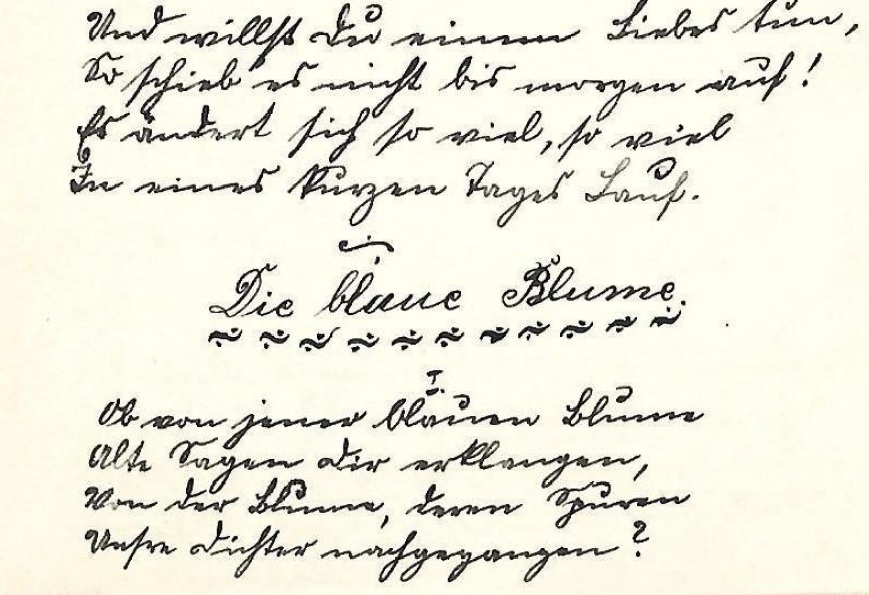
As a poet he is a slightly belated but unashamed romanticist, he even wrote one poem about the blue flower, which is a key symbol of German romanticism attributed to Novalis (Die blaue Blume). While literary romanticism was well and truly over before Heinrich was even born, Romantic composers were still going strong, so I guess as a young musician in love he should be allowed a bit of romanticism in his poetry too. Spoiler alert: he found the blue flower in Maria’s eyes.

Beginning of the blue flower.

Thankfully, there is no testosterone poisoned patriotism on display anywhere. Quite the contrary, our young poet comes across as the quiet and sensitive kind, so that's kind of a relief. Quite a few poems with titles such as "Mahnung" are advising the reader on how to be a good person - these remind me of Albert Schweitzer, who was at Strasbourg at the same time (1893-1913). Conceivably, Heinrich and Maria may have heard his sermons in St. Nicolas church (close to the hospital where Maria worked) and/or his organ playing.

All of this has required another additional sub-chapter to my Heinrich chapter (PDF here and also here), so the Strasbourg years are now covered quite well (and I am quite obsessed with Belle Epoque Strasbourg now), even though I am still in the dark re any musical activities.

The scans I made of the handwritten pages are now on Google Drive in two parts, see Part 1 (37 double pages), Part 2 (26 double pages). I have formatted my preliminary transcription on double pages to match the page spreads and uploaded them here and also here. If and when I get a chance to edit those PDF scans, I will be aiming to produce a version where original and transcription can be viewed on facing pages.

Heinrich's musical initials under one of the poems, with the notes H (B in international nomenclature) and G identified by the ledger lines below the (imagined) staff. Note that this idea seems to be pointing to a violin and/or guitar player - I can't play those notes on the flute and they wouldn't be written that way for cello or piano.

Thursday, October 06, 2022

a very romantic poet

Every picture tells a story, season 2, picture 5.

I didn’t think that this studio portrait of a young couple taken at Strasbourg (then Straßburg and a showcase development of the German Empire) was telling much of a story, but clearly I wasn’t listening to it the right way.

Photo by Photo F. Mehlbreuer, Strassburg i/E., Moerschhauserstr. 29
(the street address not given on our photo but on others you can find online when you search Mehlbreuer).

Now I discovered a booklet containing more than 150 very romantic poems written by him (our cellist Heinrich) after he fell madly in love with her (his future wife Maria) within a year, starting on November 18, 1903, the date when he clearly went batshit crazy for her. The poems are in old-style German handwriting but reasonably straightforward to read. The only thing that’s slowing me down in my transcription efforts is that there is only so much emotional intensity I can cope with in a given day (think Eternal flame times 150), so it may take me a month to get through all of them.

As a reference point, Rainer Maria Rilke only published his Stundenbuch collection of poems, the one that made him famous, in 1905. So, at the time of writing, Heinrich wouldn't have known of Rilke, and this really boggles my mind.

The poems themselves contain very little reference to the real world, which is mainly mentioned as a place to be avoided, because the cloud 9 that the young lovers inhabit is so much nicer. However, the dates and a few place names are interesting. So, chronologically:

18.11.1903 Poor old Heinrich goes completely crazy for her, several poems including one consisting of “3 love songs” are referenced as being written in memory of that date. Christmas 1903 seems to have been significant too, see the dedication on the front page:

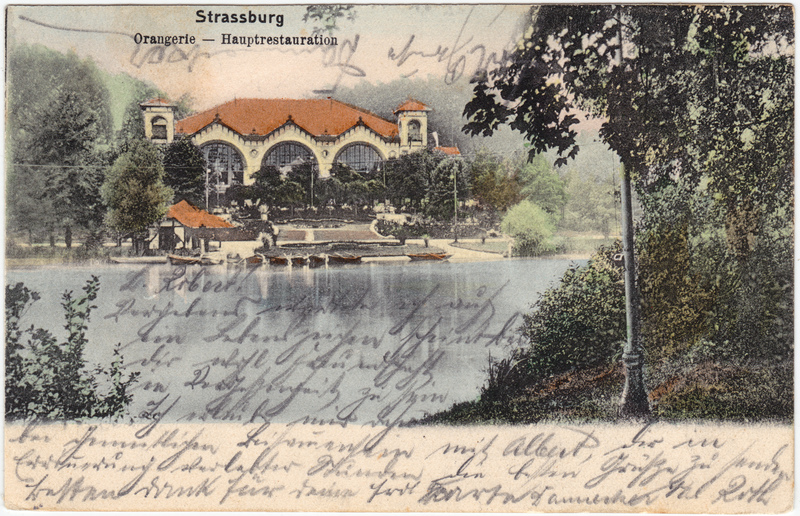
18.4.1904 On Maria’s 23rd birthday, he proposes to her at the Orangerie Strasbourg (today the European Parliament stands next door to this park). One poem, To the bride, carries this date and an earlier one, so I assume it was used in the process. Another poem written a few days later looks back on the big day. And she did say yes, phew. We assume that the studio portrait of the couple was taken on the occasion of the engagement. UPDATE 7.6.2025 I still need to revisit Strasbourg and explore the Orangerie Park. Just now, I found a report showing they have a very lovely Free Library there, which kind of fits our poet and his romantic moment.

The vintage postcard site I usually consult on these issues has quite a few cards of the Orangerie, here's one example from 1905, showing the main restaurant:

I might have to do a #lostcities entry on this some other time.

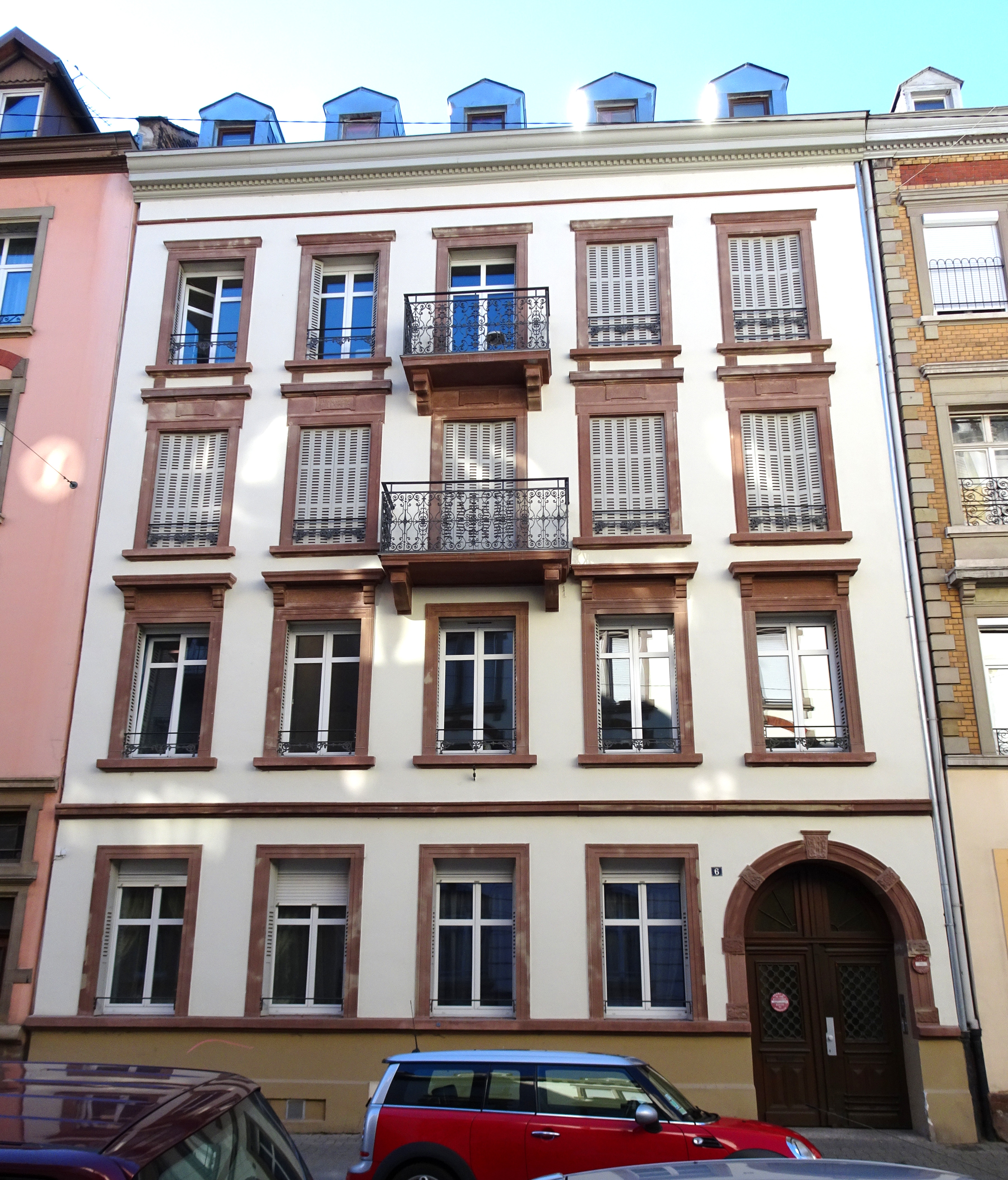
31.5.1904 A farewell has to be said for a few weeks spent apart, and this happened at Schwendistr. 6. Now this is really interesting because the address (in one of the small side roads leading directly to the barracks where Heinrich was stationed, today Rue Schwendi still) has an archi-wiki entry, so you can read all about the construction history of the house (from 1887-88) and look at the photos. Very lovely house it is too.

Source: Archi-wiki

I can’t find any evidence that it has ever been a café or similar place where they might have met. The archi-wiki mentions a painter-decorator’s workshop, possibly in the back building. Conceivably, Maria could have lodged at the address, although we also have another address for her on an undated postcard (also containing a poem), this time it’s Steinstr. 54 (today Rue du Faubourg de Pierre, next to Impasse de Louveteau). As she spent six years at Strasbourg, she may well have lived at both addresses at different times. Notably, both addresses are much closer to Heinrich's barracks than to the hospital where Maria worked with Professor Ledderhose.

All this made for a substantial addition (2,000 words) to chapter 1 of my biography of Heinrich the cello - search "orangerie" to find the new section, which also contains some of the poems in full. A few small adjustments were also necessary in the sections before and after the new one. And I'll look at this photo with different eyes from now on.

PS This entry is based on transcribing something like a dozen poems as well as all titles, dates and places. As I am now working through the whole thing (more than 16,000 words according to my current estimate), a few other topics are emerging, which I'll discuss in separate entries. And I think some further expansion of the chapter will also become necessary, as I am getting to know young Heinrich so much better.

Update 6.11.2022: I have now transcribed everything and done a new blog entry on the content of the poems, which also contains links to PDFs of both the scans and my transcriptions. Have also finished the expansion of the book chapter.

Navigation tools:

Season 2 so far:

  1. could be a cousin
  2. two weddings in Silesia
  3. off to Canada
  4. off to Australia
  5. a very romantic poet

The new twitter thread for the new season is here.

The twitter thread for season 1 is still here. It only loads 30 tweets at first, so you have to click "show more" a couple of times to get all 40 entries.

I'm also adding all photos from this series to my family history album on flickr.

Thursday, September 22, 2022

revisiting lost cities

My #lostcities series on this blog has influenced my thinking about various things and indeed my travel plans, as I have (re)visited a few of the cities where my ancestors used to live in the last two years and really enjoyed discovering those I didn't know. I'm only missing Königsberg now, but I'm getting the impression that this city doesn't exist any more in any meaningful way, and given the current situation, I have no plans to travel to Kaliningrad.

I have compiled a B-list however of cities that are also relevant in this context, even if the case may be less clear and/or information harder to find. For instance, some of my direct ancestors lived in Breslau (today's Wrocław) for something like 40 years in the 19th century, but I can't pin down start and end dates, nor an address where they lived or worked, so it's all a bit hazy and virtually impossible to get a sense of place to attach to their lives. Information is slightly better for Krefeld, but I don't have a start date either. In any case, I'll see what I can do about these and a few others, so watch out for #lostcities season 2 at some point.

In the meantime, let's reshuffle the 10 cities of the first series to do some rankings.

First, ranked by longest stay of direct ancestors:

  1. Minden 1903 - 1952 = 49 years
  2. Elberfeld / Wuppertal 1919 - 1961 = 42 years
  3. Tangermünde 1888 - 1916 = 28 years
  4. Bad Nauheim 1945 - 1972 = 27 years
  5. Idar-Oberstein 1940 - 1962 = 22 years
  6. Rheydt 1923 - 1935 = 12 years
  7. Königsberg 1935 - 1945 = 10 years
  8. Würzburg 1961 - 1968 = 7 years
  9. Strasbourg 1901 - 1908 = 7 years
  10. Aachen 1936 - 1940 = 4 years

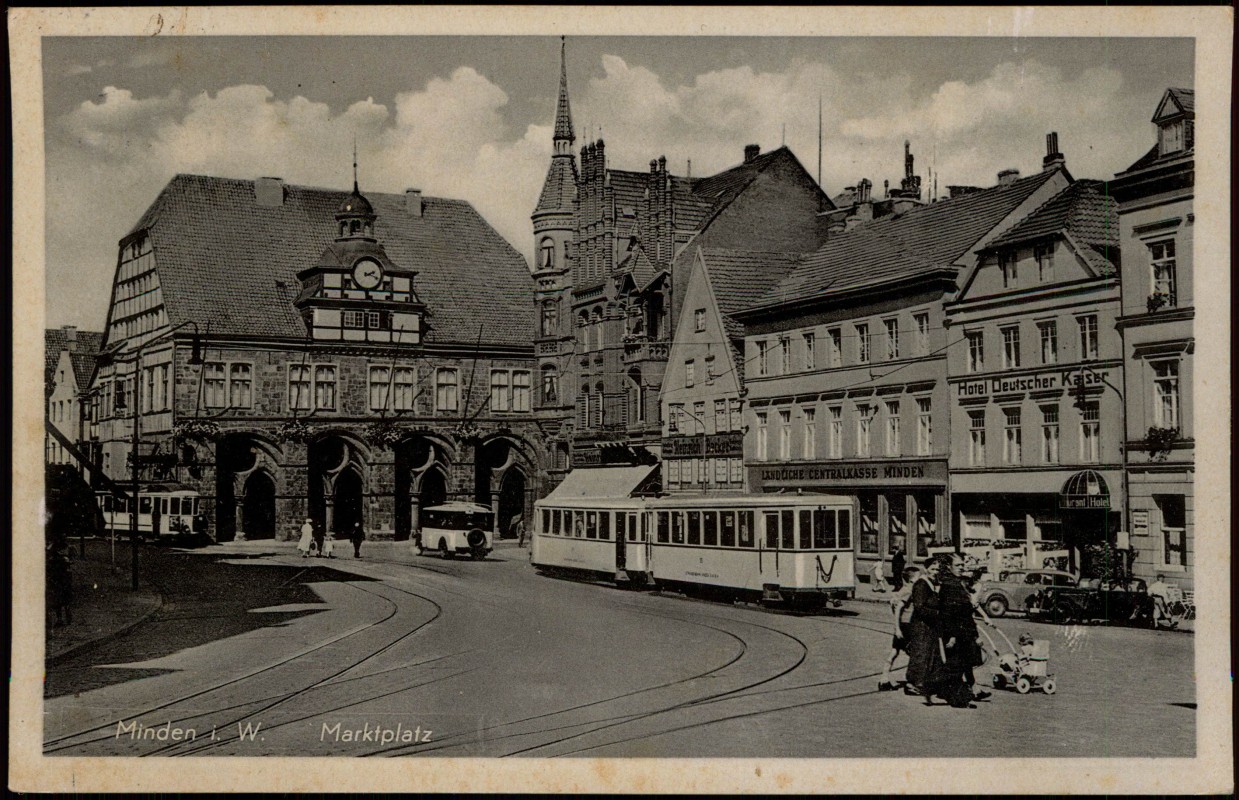
Have a postcard from Minden, winner of the longevity ranking:

Source

Second, cities ranked by most recent stay of direct ancestors

  1. Bad Nauheim 1945 - 1972
  2. Würzburg 1961 - 1968
  3. Idar-Oberstein 1940 - 1962
  4. Elberfeld / Wuppertal 1919 - 1961
  5. Minden 1903 - 1952
  6. Königsberg 1935 - 1945
  7. Aachen 1936 - 1940
  8. Rheydt 1923 - 1935
  9. Tangermünde 1888 - 1916
  10. Strasbourg 1901 - 1908

third, cities ranked by my personal/emotional attachment:

  1. Würzburg 1961 - 1968 - well, you only have to look at my Würzburg photos on flickr to figure that one out.
  2. Minden 1903 - 1952 - railway memories, mostly, and a lovely river.
  3. Bad Nauheim 1945 - 1972 - missing the art nouveau villa, mostly, but the town is ok too even though it lacks a river and a university
  4. Strasbourg 1901 - 1908 - an obsession with Strasbourg has travelled down the generations ...
  5. Elberfeld / Wuppertal 1919 - 1961 - whereas Wuppertal was obliterated in the collective memory, but I really like the place
  6. Idar-Oberstein 1940 - 1962 - I can't forgive what they did to the river Nahe, otherwise it might be a nice place. memories of the school and the gemstone museum.
  7. Aachen 1936 - 1940 -visited a few times, but it still feels slightly foreign
  8. Königsberg 1935 - 1945 - as a fairytale place of times gone by, the lakeside is really lovely.
  9. Tangermünde 1888 - 1916 - looks lovely but feels foreign
  10. Rheydt 1923 - 1935 - some nice buildings but not much of a spark ...