Showing posts with label unusual instruments. Show all posts

Sunday, July 09, 2023

string drum

This week I stumbled across an unusual instrument I had never heard of before, so I need to obsess a bit about it and pile up a few links here.

So the story is I saw this piece in the Guardian how the Occitan language, which the central governments of France have tried to eradicate since the time of the troubadours, is today kept alive by a hardy bunch of folk musicians, including the band Cocanha (presumably the Occitan equivalent of French cocagne, as in pays de cocagne = paradise?). The picture in the Guardian showed members of Cocanha carrying this strange instrument:
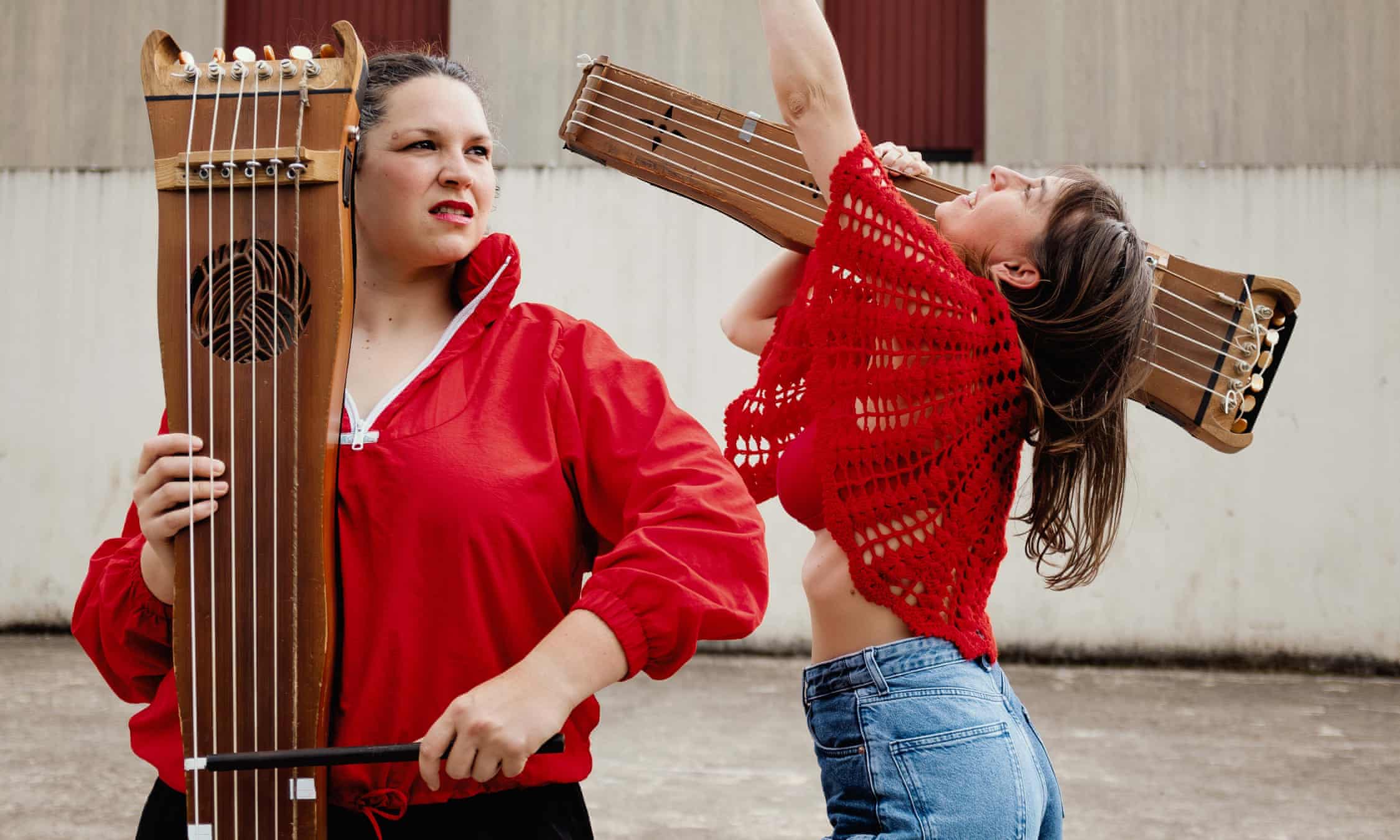
hotlinked from the Guardian article

In this lovely video, you can see them playing the instrument - it is obviously a tuned percussion instrument which they beat with a stick:

I looked up their website but didn't get any answer except percussion. Finally, looking up the French Wikipedia entry of the group, I learned that it is a Tambourin à cordes or Tambourin de Bearn, in English also called a string drum. The strange shape is built so you can wedge it under the arm that plays a single-handed whistle (as in pipe and tabor) while beating it with the other arm. The English Wikipedia entry shows photos of how this is done.

PS Although I have seen performances in medieval Occitan, I wasn't quite aware that the language is still being spoken today, so that article brought two revelations at once. I understand that it is quite close to Catalan. I'm a bit confused about the terms Occitan, Provençal (made famous by the Nobel winning writer Frederic Mistral) and Franco-Provençal, but as the Edition L'harmattan doesn't seem to have the title "Occitan" in their fabulous series "Parlons ...", I assume that the title Parlons Provençal is actually about the same language. Separately, they also have a book called: L'occitan tel qu'on le parle (Occitan as it is spoken).

Wednesday, October 04, 2017

unusual instruments

The Oxford Music Festival is mainly for young musicians playing orchestral instruments, guitar or piano, but there is also a space for people of all ages playing weird and wonderful instruments.

Following my suggestion, the committee has launched a new class called:

Show us your unusual instrument

Non-competitive. Any non-orchestral instrument from early music, folk, non-European traditions, including home-built or -modified or newly invented instruments. 5mins to play a piece and explain the instrument.

Time limit 5 mins.

It's class 160 near the bottom of this page

IMPORTANT: registration deadline is Sat 14th of October. (Although the festival itself takes place on the last weekend in January and the first weekend in February.)


So sign up now for a chance to show and play your ophicleide, hurdy-gurdy, nyckelharpa, khene, theremin, morin khuur (horsehead fiddle), tromba marina (marine trumpet), crumhorn, txalaparta, shawm, or whatever other instrument you play, and help to show the world that music doesn't always have to be played on violin and piano.

For those who don't know the festival format: There is an entry fee to pay (£9 for this class), which buys you the opportunity to perform to an expert audience, constructive criticism from the adjudicator - a professional musician and music teacher, who normally will dispense a carefully crafted sandwich with criticism surrounded by praise - plus the chance to meet other unusual instrumentalists, plus free entry to the festival on the day you perform, so you can listen to other musicians performing all day if you like. There are typically four strands of classes running parallel, so you can pick and mix.

I'm signing up to improve my skills on our home-built hammered dulcimer, and I'm advertising the class to make sure it won't be just me hammering the dulcimer ...


Angel with viola a chiavi ('keys'), Cappellina di Palazzo Pubblico, Siena, Italy. Fresco by Taddeo di Bartolo, 1408. Image source: Wikipedia


PS (19.10.2017) in related news, the Society for strange and ancient instruments has just completed crowdfunding to build a quartet of marine trumpets.


Friday, April 14, 2017

dulci tunes

our home-built hammered dulcimer is a year old now, and while I'm still struggling with the hand alternations, the young musician has performed some lovely music on it, so here are a couple of videos to prove it:

Blossom by Bob Pasquarello & New Year's Waltz by John Dipper

Duo: The sliding dulcimer (by Ed Pritchard, who also plays the other dulcimer and recorded the video)

... and a photo of dulci in action at the French session, James Street Tavern:

Friday, April 22, 2016

how to hammer a dulcimer

We seem to have given birth to a new string instrument, and now I'm trying to rationalise what happened:

So the young musician in the family wanted a hammered dulcimer. Her mother found a build-your-own instruction online. Her grandad helped her build the box. And I helped with the bridges and all the metal that goes on top (20 hitch pins, 40 tuning pins, more than 30 metres of piano wire for 20 courses of strings). And miraculously, the international 3-generation project actually resulted in a real musical instrument, which is now playable:

And here's what it sounds like shortly after completion of the work:

It's not very difficult to play (essentially it works like a xylophone with strings) and the construction isn't too challenging either. We disobeyed the instruction in adding more courses on the bass bridge, and by making the treble and bass bridges in one piece each with holes in it, rather than as many little ones.

With hindsight, I would suggest that the "simplification" of building the box rectangular rather than as a trapezoid as in commercially available dulcimers is causing as much trouble on the strings side as it avoids on the box building side, so I might one day try to do one with the proper shape. As for the cost, it's just under £ 4 per course of 2 strings for the metal work - plus the wood, paint glue etc. if you don't have that lying around anyway. In our household we probably have several dulcimers worth of broken furniture that could be recycled, so watch this space.