Showing posts with label history-of-science. Show all posts

Tuesday, January 27, 2026

on the origins of radio

Some thoughts on:

Listen in: How radio changed the home
Beaty Rubens
Bodleian Library Publishing 2025

I saw this small exhibition at the Weston Library last year and came away with not much more than some memories of a few old radios and covers of early editions of the Radio Times (published since 1923). It wouldn’t have occurred to me to invest £ 30 in the accompanying book. Less than a year later, however, I spotted it in a street library and picked it up. That’s the thing with street libraries, you can always return what you don’t like, so there’s zero risk in trying something out.

In the event I surprised myself by reading the entire book cover to cover. It starts from the invention of radio and the first technologies that enabled pioneering spirits to “listen in” (as they said in the 1920s) from the comfort of their own homes, albeit with the discomfort of fiddly equipment and bulky headphones.

Rubens describes the impact broadcasting had on home life in Britain, from its start in 1922 until the second world war - after which television sets started to invade homes and diminish the importance of radio. Of special interest to me was the ambiguous role of radio in giving access to culture (including eg live music) to households, but in many cases replacing the live entertainment that people were making for themselves before (gramophones and TV sets were also complicit in this). By making some of the best performances of classical music, for instance, available to all, broadcasting discouraged mere mortals from trying for themselves, because they would not be able to compete. This led to today’s situation where playing your own music has become a niche hobby, while most people think of music as something that streams out of their devices.

It was instructive to me to follow this development in the UK setting, not only because the BBC pioneered the technology, but also because in Germany we have the “1000 years” interlude where the Volksempfänger was Joseph Goebbels’ propaganda machine and the medium had to be reinvented after the collapse. As Rubens briefly mentions, part of the idea of rolling out a cheap and cheerful radio for all to the entire population was that these devices didn’t have the power to pick up foreign stations, so they tied listeners to the Nazi propaganda.

As it happens, I don’t know whether the musicians starring in my musical memoir had radio in the 1920s. Both Frieda the pianist and Heinrich the cellist will have had radio after the war, and both households went to join neighbours for shared TV viewing, but about the radio listening of the 1920s I am entirely in the dark, which made Rubens’s findings from early sociological studies of radio listening interesting.

Another very interesting thing I learned from the book was the earlier existence of systems that transmitted audio from theatre or music events live through phone lines to paying subscribers. This was first demonstrated in France in 1881 as the théâtrophone, and found commercial use there and in Britain (as the electrophone in 1896). Marcel Proust is among the few contemporary users of the service who left us written testimony. Allegedly there is no written testimony from subscribers to the British service, but I am struggling to believe that. I’m sure it’s out there somewhere, in some old letters kept in a drawer. The number of electrophone users in Britain peaked at just over 2,000 in 1923, before the technology was swept away by the wireless.

The book comes with lavish illustrations (as you would expect from a volume accompanying an exhibition) with historic photos, cartoons and covers of magazines. What is sorely missing is a timeline - as I discovered when trying to find the dates I referenced above. Wikipedia has one for developments globally, from which I learned that Argentina started broadcasting entertainment programmes in 1920. The book didn’t mention that either. The centenary to which the book and the exhibition were pegged is that of the first broadcasts from the 500ft tall Borough Hill transmitter near Daventry in Northamptonshire, which for the first time reached most of the UK in the summer of 1925.

Here's a review in the Observer (when it was still part of the Guardian group)

Sunday, October 12, 2025

violins played by Einstein

Einstein's violin sells for £860k at auction, the BBC reported this week (on 8.10.2025). The trouble is, he owned several violins through his life time, apparently called all of them Line (US sources tend to say "Lina"), so I'm getting confused and need to sort this out.
  • According to the BBC the one sold in October 2025 was made by Anton Zunterer in 1894 and believed to be his first (although he supposedly learned from age 5, which would have been much earlier - so this may have been his first full size one, or the first he bought for himself as another source said). Zunterer (1858-1917) was a Mittenwald-trained luthier who established his workshop in Munich in 1888.
  • One that the top notch luthier workshop of W.E. Hill in London saw when Einstein visited in October 1933 which may or may not be the same as the above. As Kate Kennedy reports in the book Cello (based on her research using the Hill workshop diaries), the luthiers were disparaging about Einstein's instrument, and somewhat unfairly made him compare it with a Stradivarius they happened to have around.
  • A later one which was made by Oscar Steger. a cabinet maker, amateur cellist and hobby luthier in the US after Einstein found refuge there. It sold at auction in March 2018 for just over $ 500,000. According to this page, Einstein eventually gave it to a Princeton University janitor whose son was learning the violin.
  • Of another late violin, Paul Halpern tells me that Einstein "bequeathed in his will one of his violins to his grandson Bernhard Caesar (who is no longer alive). Consequently, Albert's great-grandson Paul Einstein became a violinist and has played that violin in concert". I think this is the event and the instrument mentioned in my entry about Einstein's favourite sonata, K304 (which incidentally I am meaning to learn on the violin too). German newspaper clippings of the event held at Ulm in March 2004 on the occasion of Einstein's 125th birthday are here.
  • One violin he didn't accept was a Guarneri that was offered to him according to this article from Oxford physicist Brian Foster. He stuck with his more ordinary instrument on the grounds that more sophisticated players would make better use of the power and complexity of the Guarneri. I presume he tried it at least, so I'm listing it here among the instruments he touched.

Here's a longer piece about his violin playing first published in 1980, based on interviews with musicians who played chamber music with him. It includes the names and short bios of many people with whom Einstein played, including both scientific colleagues like Max Planck and professional musicians like Fritz Kreisler. There's also glimpses of the kind of music that that he played, preferring Bach, Mozart and Haydn more recent composers like Brahms or Wagner. Sadly though, not a single word about the instruments as such.

This is a more recent article in National Geographic but very much the same content as the earlier pieces as far as I can tell.

There is also a musical theatre piece about Einstein's violin playing, by Paul Wingfield, who also helped to authenticate his first violin when it came up for auction. Trouble is, after this record-breaking auction result, the title of the piece, "Einstein's violin" has become virtually unsearchable.

Einstein playing the violin. Photo by Wanda von Debschitz-Kunowski - Zeitbilder 21/1927, 1927-05-22, p. 1 (online), Public Domain, from Wikipedia

While getting that photo from the English edition of his Wikipedia entry, I found out that the German edition, although marked with a star as an outstanding entry, lacks the info on his music playing - there's only one mention of his learning to play violin as a child, under his education record, but no mention that it was a lifelong passion. I'm afraid that may be telling us something about the lack of appreciation for amateur music making in German culture.

Researching all of the above, I realised that Einstein (1879-1955) was a near contemporary of the amateur chamber music player in my family, Heinrich the cellist (1882-1958). Surely I can find an excuse to include a few paragraphs about Einstein in my 100 years of cellotude?

I was also amused to learn from several of the sources that Einstein's counting during playing was very much relative. Which is very true of my playing as well.

Friday, July 18, 2025

a radiant legacy

I quite enjoyed learning about all the alumnae of Marie Curie's lab by reading:

The elements of Marie Curie
Dava Sobel
Fourth Estate 2024

It was also a good excuse to brush up on her life more generally, as it's been a fair few years since I read the biographies by Eve Curie and by Susan Quinn (long before I started to trouble the world with my reviews). My review is out now:

A radiant legacy

Chemistry & Industry Volume 89, Issue 7-8, July-August 2025, Page 31

access via:

Wiley Online Library (paywalled PDF of the whole review section)

SCI (premium content, ie members only)

Sunday, January 12, 2025

quantum mechanics in the snow

some thoughts on

The Universal Theory
(Die Theorie von Allem)
Timm Kröger
Germany 2023

This film had a grand total of three screenings at Oxford's Ultimate Picture Palace, and I was lucky to catch the last one. IMDB doesn't even list a UK release for it, although the Observer had a review.

So a quantum mechanics meeting in the Swiss Alps gets derailed when the multiple universes theory gets a bit too real and weird things start to happen. I loved the black and white cinematography - films set in the 1960s should be in black and white really! - and the portrayal of the 1960s physicists, and also the underlying romance thread. Not everything made sense, but that's very fitting for a film about quantum mechanics, and I tend to like things I don't understand completely. Also, to be taken as evidence on how weird a European movie must be to have a chance of even a fleeting appearance in UK cinemas.

I am sure that people more knowledgeable in sci fi and classic American cinema will find lots of references to all sorts of things (as some reviewers have pointed out), but I'm more of a naive viewer in that respect and can enjoy the film on its own merits.

A good one to see on the big screen with the glorious Alpine views if you can, but I might also be tempted to rewatch it in a smaller format at a later point. Also, I'm a bit tempted to watch Drei Männer im Schnee to compare and contrast - also black and white Alpine scenery, I expect, but no quantum mechanics, as far as I remember from reading the book multiple times when I was growing up.

Not adding this to my films not shown list as it was obviously shown, if ever so fleetingly, but will add the tag regardless.

Tuesday, October 22, 2024

star struck

History of astronomy typically begins with the ancient civilisations and the ways stargazing changed their view of the world. The book "Starborn" by Roberto Trotta goes back further. The author explores the question how humans evolved under a starry sky and whether we would have turned out different under a permanent cloud cover. Some of the answers are mindboggling yet convincing.

Read all about it in my latest essay review:

Stars in their eyes

Chemistry & Industry Volume 88, Issue 10, October 2024, Page 35

access via:

Wiley Online Library (paywalled PDF of the whole review section)

SCI (premium content, ie members only)

As always, I'm happy to send a PDF on request.

Here's a snippet:

More intriguing still, Trotta recounts a hypothesis that argues in favour of a shared human experience of observing the stars dating back more than 70,000 years ago. The Pleiades, as we know them today, are six stars, but many cultures from Ancient Greeks through to Australian Aborigines associate these stars with a legend of seven sisters, and one of them disappearing. With modern telescopes, astronomers can see the seventh sister, too close to one of the others to be distinguishable by the naked eye. They also see a few more, so there is no explanation for the number seven. Calculating back the movements, however, they have found that around 100,000 years ago, an average human eye would have seen seven Pleiades. Thus the myth of the seventh sister lost could be the oldest evidence of human observation of the night sky, as well as just about the only thing that humanity has preserved from the time before the expansion out of Africa.

I don't think the title captures the content of the book very well - it makes me think of how our very atoms have come from stardust, whereas the main gist of the book is how our minds have been shaped by the sight of the firmament. Hence the title of this entry.

Friday, April 19, 2024

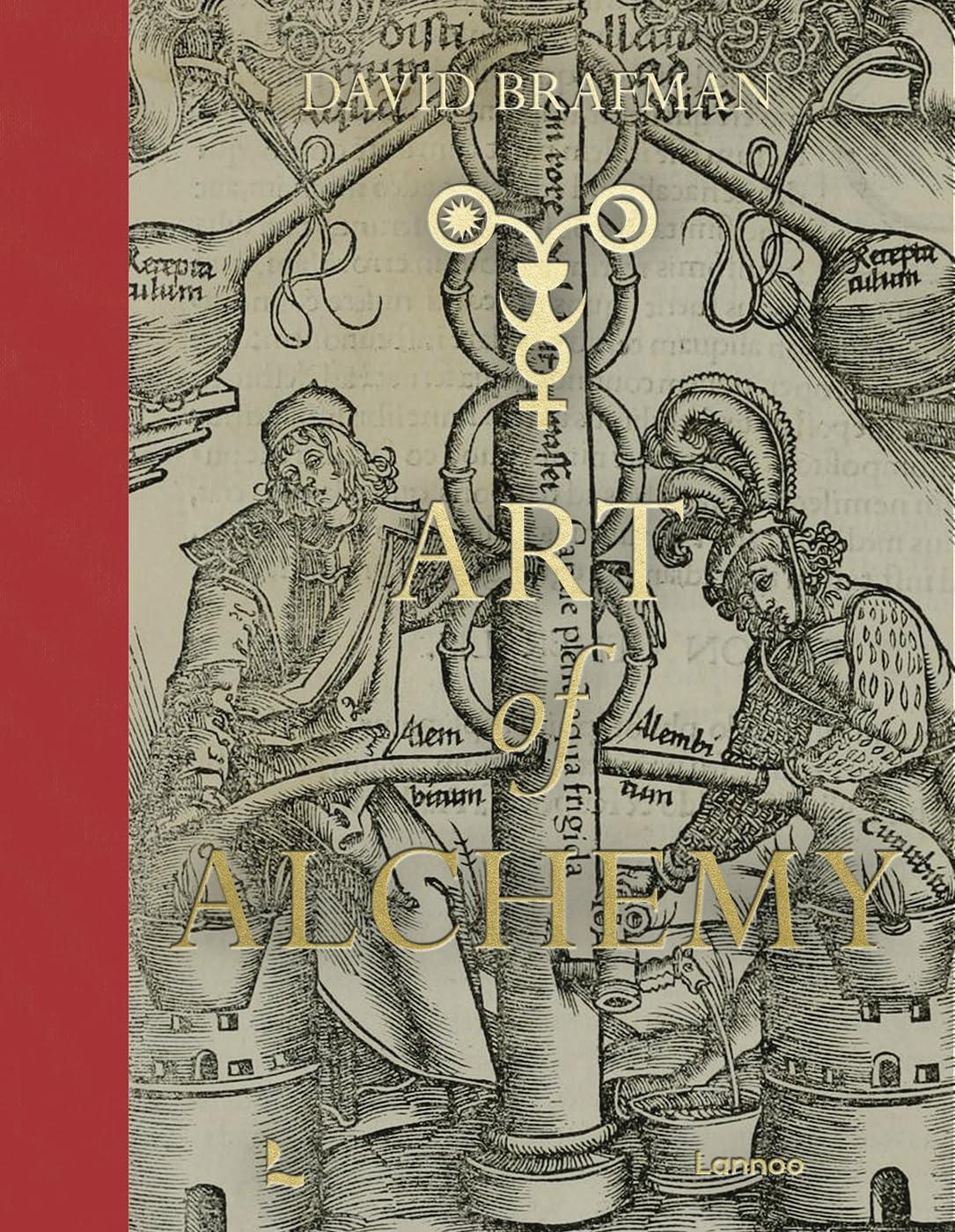
the art of alchemy

Alchemy is of course a fascinating subject but also a frustrating one, and I always end up dazed and confused when I try to get into the mindset of the old alchemists. The medieval imagery connected with it, showing alchemists at work, their lab glassware, or their allegorical concepts of the world, may be somewhat more accessible, so I took the opportunity to read and review the book

Art of Alchemy: From the Middle Ages to Modern Times (Wunderkammer)
by David Brafman

which contains equal amounts of glorious images and almost comprehensible text. Now I'm still confused, but at least I have another beautiful book on my shelf.

More about my struggles with alchemy in my long essay review now out:

Alchemy in pictures

Chemistry & Industry Volume 88, Issue 4, April 2024, Page 35

access via:

Wiley Online Library (paywalled PDF of the whole review section)

SCI (premium content, ie members only)

As always, I'm happy to send a PDF on request.

Blackwells

Saturday, November 18, 2023

in praise of old technology

I was keen to read and review this book

Reimagining Alternative Technology for Design in the 21st Century
by Brook S. Kennedy

as I'm really interested in the idea of using and modernising the sustainable technologies that we have had for a long time, rather than inventing new ones that turn out to be unsustainable. It was an interesting read but also a bit frustrating as written purely from an American perspective and thus telling the reader about allegedly extinct alternatives that many of us in Europe still have been using all the time, such as bikes, trams and clotheslines, shutters on windows, etc. Anyhow, a slim volume and thus a quick read with some interesting insights into the history of technology and how it took wrong turns in the 20th century, as well as some smart ideas on how to do better in this one. (Incidentally, this week's crop of EurekAlert press releases included one called: Sticking with old technology can be a strategic move).

More about it in my long essay review now out:

Back to the future

Chemistry & Industry Volume 87, Issue 11, November 2023, Page 38

access via:

Wiley Online Library (paywalled PDF of the whole review section)

SCI (premium content, ie members only)

As always, I'm happy to send a PDF on request.

Blackwells

Monday, August 22, 2022

from plague to covid

I noticed recently that the ancient DNA researchers are finding out lots of fascinating things about historic plague pandemics and other diseases, and it occurred to me that we are catching up with those pandemics of the past, while also still handling our present pandemic. And how lucky we are that at least we can very quickly figure out what our problem is and what to do to fix it, whereas people hit by the Black Death had no clue and could do nothing. Now we only have to find a cure for misinformation ...

So anyhow, out of these thoughts grew my latest feature which is out now:

Pandemics past and present

Current Biology Volume 32, Issue 16, 22 August 2022, Pages R855-R857

FREE access to full text and PDF download

NB: as the 2022 features move into the open archives, I will add them to this thread on Mastodon.

The National COVID-19 memorial in London commemorates the 200,000 who died with the disease in the UK. (Photo: Geoff Henso/Flickr (CC BY-ND 2.0).)

Saturday, May 28, 2022

vaccinated in 1883

As monkeypox and the smallpox vaccine are becoming a bit of an issue these days, I am grateful that I am just about old enough to have received the smallpox vaccine, so hoping the protection lasts, even though the scars have faded a bit.

I can also report that Heinrich the cellist, who would be 140 this year, received his vaccinations, the first one in 1883:

and the second one in 1894:

with the Ts and Cs on the back of each explaining that vaccinated "for the first time" didn't mean the first dose, but that they made up to three attempts in cases when there was no visible reaction. Here's the back of the first certificate, which once was red:

The text on the green one is the same except for the explanation that green is for the second dose.

What I also love about these is that they never mention what disease is targeted by the vaccine. Obvious reason: the one against smallpox was the only vaccine known.

Some background: The vaccination was legally required in Prussia since 1815 and in the German Empire since 1874. Thus, each of the certificates emphasises the fact that the legal requirment has been fulfilled.

Tuesday, January 25, 2022

Heisenberg's cubes

It was great fun and slightly scary to learn about uranium cubes left behind by Nazi Germany's research programme into nuclear fission. Some of these cubes are being investigated in US labs right now and are still yielding information about the events that happened more than 80 years ago.

I combined this with other developments happening in nuclear forensics for a feature that is out now in C & I:

Nuclear legacy

Chemistry & Industry Volume 86, Issue 1, January 2022, Pages 30-33 DOI:10.1002/cind.861_11.x

access via:

Wiley Online Library (paywalled)

SCI (members only)

This is one of the 664 uranium cubes from the failed nuclear reactor that German scientists tried to build in Haigerloch during World War II.

Credit: John T. Consoli/University of Maryland

In the same issue, on the very next page, you'll also find my review of the book Great adaptations, by Morgan Phillips.

Wiley Online Library (paywalled)

I'm also starting a twitter thread with this year's C&I features here.

Friday, April 23, 2021

Tinbergen connections

Cello teacher Janet Tinbergen, who taught our young musician for more than 10 years, has passed away in December 2020, aged 75. I wrote an obituary for the amazing “Other Lives” series in the Guardian, which you can read here. A separate appreciation by the Oxford Music Festival, where she served for decades, is here.

I was wondering whether to explore some of the local connections in a longer obituary or feature for a local paper, but it looks like the Oxford Times and Mail don’t do obits any more, and they didn’t respond when I tried to contact them, so I’ll just drop a few notes here.

Janet inherited the family trait which her father’s biographer, Hans Kruuk, described as “pathological modesty.” So she went as far as admitting that her father was a scientist, but would never have mentioned that he was anything special. In fact, Niko Tinbergen, a pioneer of behavioural biology, won a Nobel prize, as did her uncle, Jan Tinbergen for economics. (I believe the two are still the only pair of siblings among Nobel laureates.) When I got to know her through sitting in and taking notes on my daughter’s cello lessons, I figured out the connection and read the biography (review here). Over the following years, I always enjoyed the stark contrast between her perspective as a daughter, typical quote: “he and his bloody birds”, and the knowledge that she was talking about one of the greatest minds of the 20th century.

To me, a key indicator of his greatness was that he devised experiments that were so simple you could get a bunch of primary school children to replicate them, but they still did answer important biological questions. So it struck me as almost tragic that he hadn’t been able to communicate the beauty of his achievements to all of his family. However, where scientific (eg mathematical or anatomical) information was helpful for improving cello technique, she did not shy away from using it, sometimes prefaced by: “As the daughter of a scientist, you will understand …”

Niko’s disciples at Oxford included the globally famous science communicators Richard Dawkins and Desmond Morris. The latter did come up in conversation at times. Intriguingly, Janet was aware of Morris’s work as an artist late in life, although she described herself as blind to visual arts.

The Oxford ecologist David Lack was reportedly the person who invited Niko to visit Oxford and consider moving here, which he did in 1949. This I only found out when researching Janet’s obituary. For a decade, I played wrong notes in the Festival’s family class also attended by the Lack family (one generation later), and I didn’t know about their Tinbergen connection.

Oxford University named the massive 1960s brutalist building housing the Zoology and Psychology departments after Niko Tinbergen (opened in 1971). In 2017, it was diagnosed with an incurable asbestos problem and cleared for demolition (although I wasn’t quite sure how it can be safe to demolish if it can’t be made safe to use - maybe the university just wanted another world-beating new building and welcomed the excuse). The last walls of the building disappeared around the same time as Janet died, ending seven decades of Tinbergen presence in Oxford. Although, of course, quite a few cellists around here will remember Janet's creative technique vocabulary, from rigmarole to flapping chickens, for many years to come.

Reflections on the Tinbergen legacy ...
(own photo, taken Dec 2018, when the mirrors were set up to secure the gates of the demolition site)

Update 16.6.2022: The house where the Tinbergens lived for decades now has a blue plaque, see my photos on flickr.

Saturday, April 03, 2021

flattening the Earth

Some thoughts on

Mercator: The man who mapped the planet
Nicholas Crane
Weidenfeld & Nicolson 2002 / Phoenix paperback 2003

The Mercator projection is everywhere these days, although some of us are aware that it is problematic because it inflates the size of countries further away from the equator, thus creating the wrong impression that South America is no bigger than Greenland, and Africa smaller than North America. Alternatives are available but rarely used.

The reason is, of course, Google maps. The Mercator projection is mathematically the simplest way of straightening a globe to make a flat map. You just use the longitude and latitude lines as an orthogonal coordinate system, as your x and y axes. So once you know coordinates of places, it is computationally extremely simple to create a flat map. Nothing wrong with that when you do that for a city map or even a small country, but when people use Mercator to (mis)represent the globe, as Royal Mail does, I come out in a rash.

Reading the biography of the man behind the projection, I learned that mathematical simplicity wasn’t his motivation. He had happily drawn heart-shaped maps of the world before, and he had produced much-coveted globes. The problem he set out to solve was based on the fact that sailors in his time navigated by compass bearing, i.e. the angle between their direction of travel and the measured direction of magnetic north. The simplest way to navigate would be to keep this bearing constant throughout. However, this isn’t the shortest route on a globe, and on most maps it isn’t a straight line. So, to Mercator, the attraction of the orthogonal projection was that the longitude lines will always be straight and vertical, so a route following compass bearing will always be at the same angle to them and thus also be a straight line. Simples.

Born in 1512 as Gerard Kremer, the son of a cobbler latinised his name in line with humanist contemporaries such as Erasmus. His life of just over 80 years neatly falls into two halves, split by a near death experience courtesy of the Spanish Inquisition, after which he decided the Spanish Netherlands weren’t safe for him and settled in the small town of Duisburg on the other side of the river Rhine. Having grown up not too far from that place, which in the 20th century became a major centre of heavy industry complete with Europe’s largest inland harbour, I found it cute to read about the peace and quiet Mercator found in the town, where he completed most of the work that he is remembered for, including the first maps using his famous projection and the book of maps that gave us the word “atlas”.

His move was linked to plans to launch a university at Duisburg, which then fell through. The town later did get a university, which was founded in 1655 but dissolved in 1815. The modern university was set up in 1972 as a Gesamthochschule. In 1994 it was named Gerhard-Mercator-Universität, but in 2003 Mercator lost this honour again, as his university merged with the University of Essen.

Another irony is that, while Mercator mapped all of the known world, and even some speculative geographies that turned out to be fictional, such as a ring of islands surrounding the North Pole, he never left the boundaries of a map of the Rhineland area shown at the front of the book, which covers around 400 km by 600 km. (It amused me that this map prefacing a book about a map maker shows Cologne on the wrong side of the river Rhine. As Colonia is a Roman foundation, it’s not hard to remember that it belongs on the left bank.)

Crane published the biography in 2002, before Google maps started flooding the world with Mercator projections, but I was still a bit disappointed that the epilogue doesn’t even mention the perception problems it creates and the alternative projections that others have produced to create a fairer representation of the planet. The biography is available as an e-book but the paper version seems to have gone out of print, unfortunately. Mercator's 500th birthday in 2012 would have been an opportunity for a new edition both to celebrate his work and re-assess it in the brave new world of Google maps.

PS: I just discovered his descendants are on GedBas. No obvious connection to my family history, but good to know.

Tuesday, December 08, 2020

following Nansen's drift

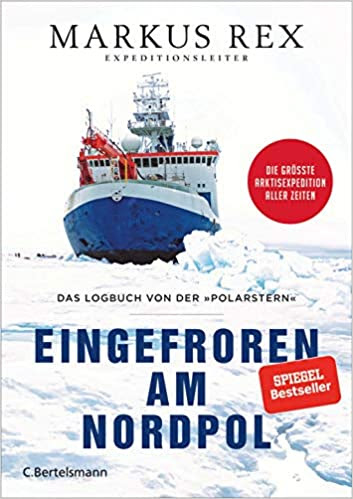
The polar research vessel Polarstern recently returned from a year-long expedition into the Arctic, essentially retracing the voyage of Fridtjof Nansen with the Fram in the 19th century. The comparison of observations and measurements made by both expeditions is troubling. What was a slowly drifting but largely solid ice cap in the 19th century is now turning into a puddle.

I've rounded up Fram, Polarstern and some other Arctic news in my latest feature which is out now:

Arctic meltdown

Current Biology Volume 30, Issue 23, 07 December 2020, Pages R1391-R1393

FREE access to full text and PDF download

Researchers onboard RV Polarstern experienced a “dying Arctic” with temperatures 10 degrees warmer than what Fridtjof Nansen recorded 125 years earlier. (Photo: Alfred Wegener Institute/Stefanie Arndt (CC-BY 4.0).)

In other news, the last feature of the year is about Covid-19 genomics, due out December 21, but you can read a preprint here (open access).

PS only after my feature came out I discovered that the expedition leader, Markus Rex, has published a book about the expedition, which has turned up in the Spiegel bestsellers chart this month:

Saturday, July 13, 2019

fleur de tonnerre

A year ago I got the impression that the situation was perhaps improving re the showing of films in more interesting languages than English in UK cinemas, but this seems to have been a blip. This year has been a bit of a disaster in this respect, so I am left to catch up with my DVD collection and to watch out for movies shown on TV5Monde (no longer on Sky in the UK, but free on the Internet here).

This week I watched Fleur de Tonnerre, a biopic of Hélène Jégado who was executed for five murders but is alleged to have killed dozens and may have been the most prolific serial killer ever. The weapon of choice being arsenic, this counts as history of chemistry as well as history of crime.

Her life unfolded in rural Brittany, with the folk belief in Ankou as an impersonation of death, combined with her psychiatric problems, appear to have led Jégado to believe she had to obey Ankou's orders and kill people. The film handles this somewhat disturbing story with subtlety. Rural Britanny in the first half of the 19th century comes across as a dark place -we also meet people who operate a moving lighthouse in order to lure ships onto rocks and then scavenge the wrecks. Tellingly, the move into the city of Rennes spells the end of Jégado's killing career as her new employer discovers her phiol of arsenic and sends it off for analysis.

Déborah François is impressive in this - it took me a while to realise that I had seen her in three other films before, including Mes cheres etudes, Female agents, and the page turner. She made her debut with the Dardenne brothers. She also appears as the artist's wife in Cezanne et moi which I haven't seen yet, see above.


There also is an English title (Poisoning Angel) for the film and a poster in English, but IMDB doesn't list any release date for the UK.

Monday, July 23, 2018

bottom-up biology at Birkbeck

Way back in 2001, when I was switching to full-time writing but wanted to keep some kind of connection with the world of academia, I used to trek to London twice a week to reside at the School of Crystallography, Birkbeck College, as a science writer in residence. That was an interesting experience while it lasted, and I got some good articles out of it, but as the railway connection got worse and more expensive over time, it wasn't really sustainable in the long run. (In 1999 I had even applied for a few London-based jobs thinking the railways situation can't get worse but it did!) Moreover, as Birkbeck set up a joint Institute of Structural Molecular Biology (ISMB) with UCL in 2003 and turbo-charged its research in this field, the space I used to have just disappeared.

The ISMB hosts an international symposium every other year, and as I was there when the first one happened, I enjoy the nostalgia trip of attending the latest instalments if and when I'm organised enough to make it happen. This year I was lucky and got there for both days of the symposium. I was rewarded with an amazing meeting that covered both the distinguished history of BBK structural biology (Rosalind Franklin, Aaron Klug, JD Bernal ... ) and its very exciting present. And I got another article out of it which is out now:

Building blocks for bottom-up biology

Current Biology Volume 28, Issue 14, 23 July 2018, Pages R761–R764

FREE access to full text and PDF download


The famously dilapidated pair of Georgian townhouses, 21 and 22 Torrington Square, where Rosalind Franklin worked for the last five years of her life, were later demolished and gave way to this, the Clore Management Centre, which is where the symposium was held (own photo).


PS and I got to test-ride the new rail line Oxford to Marylebone, with Chiltern Rail, which is indeed a bit better than what we had so far.

Tuesday, May 29, 2018

the science of Angélique

Trying to organise my book reviews, I came across this text I wrote in March 2016 after re-reading Angélique, which for some reason I didn't post then. As my recent reviews masterpost has a dramatic shortage of French novels, I'm now adding this as an almost review:

reasons to read Angélique

Each time my random path through life intersects with a copy of the historic novel Angélique by Anne and Serge Golon, I get asked why I would read that kind of nonsense. As it happens, I can think of a few good reasons, so here goes:

For the science – the first volume of the franchise revolves around a trial for sorcery, the pretext for which is the mining operation of the accused, which involves extraction of gold from minerals using lead as a solvent (cupellation). The argument why this is just chemistry and not the “transmutation” the mediaeval alchemists were after is a difficult one and handled competently. Serge Golon (1903-1972), who was probably more of a technical advisor than a co-author, was an engineer and geologist, so he would have known this sort of stuff.

For the social history – I don’t care what the courtiers were wearing for the wedding of Louis XIV, but the whole mining story also involves skilled miners immigrating from Germany. Plus there is the backdrop of the Huguenot persecution. Both issue figure prominently in my family history. Also fun to explore 17th century Paris – much of which disappeared when Napoleon III and Haussmann set to their grand-scale building project that created the city we know today.

For the literary merit – I wouldn’t vouch for the translations, but the original doesn’t quite deserve the trashy reputation it appears to have. One can certainly make out the author’s ambition to write a Dumas novel with a female lead, and I’m guessing that much of the stick she’s been getting over the year was simply sexism – a historic novel by a woman about a woman can’t be any good. Of note, for a book written in the 1950s, it is remarkably fearless in dealing with issues that were unmentionable back then, such as rape.

Incidentally, I only found out recently that Anne Golon has re-published the series to correct some mutilations that the original publishers made without her knowledge. Think I might just invest in a copy of that version.

-----

Update 2018

Checking the facts for this post, I just found out that Anne Golon died on Bastille Day last year, aged 95. I was travelling at that time and must have missed the news.

It looks like those "restored" versions of at least four of the Angélique novels have been published as "version augmentée", swiftly followed by a new edition billed as "version originale" to confuse readers completely. So the restored / augmented version looks like this, but sadly volume 1 doesn't seem to be available right now, although the following ones are:


Oh and from today, the tag for French books is livres en français


Wednesday, March 21, 2018

radium girls

My review of

The radium girls
Kate Moore
Simon & Schuster 2016
ISBN 978-14711-5387-7

is out in Chemistry & Industry, issue 2, page 43, with the very fitting headline:

Death watch

restricted access via SCI (premium content).

very scary stuff but also an inspiring story of women fighting for their rights and winning in the end, thereby saving hundreds of lives:

snippet:

Young women who had worked as dial painters during the war and then moved on to other things started dying of mysterious symptoms, but it took years before the dots were duly joined. In June 1925, the first male employee died and gained a dubious honour: His post-mortem marked the first time that radioactivity was detected in a human body.


Wednesday, August 23, 2017

life and her children


Life and her children:

Glimpses of animal life - From the amoeba to the insects.

By Arabella B. Buckley.

With upwards of 100 illustrations

This is a popular science book from 1885. As the author states in the preface: "Its main object is to acquaint young people with the structures and habits of the lower forms of life; and to do this in a more systematic way than is usual in ordinary works on Natural History, and more simply than in text-books on Zoology."

I bought this one from an Oxfam shop - more expensive than what I usually buy, but still under £10. I could almost claim I need it for my work. The writing and the animals are embossed and gilded, which doesn't show very well in my photos but looks lovely in real life. Also, the lower parts of the letters have a horizontal stripe pattern, presumably suggesting they emerge from the water, as life did.

It turns out Arabella Buckley (1840-1929) was Charles Lyell’s secretary and started writing and lecturing about science after Lyell’s death (1875), see her short Wikipedia entry. And it seems to have worked out well for her, considering this impressive list of titles published:

A short history of natural science and of the progress of discovery from the time of the Greeks to the present day. For the use of schools and young persons (1876)
Botanical Tables for the use of Junior Students (1877)
The Fairy-Land of Science (1879)
Life and Her Children (1880) with illustrations by John James Wild
Winners in Life's Race or the Great Backboned Family (1883)
History of England for Beginners (1887)
Through magic glasses and other lectures : a sequel to The fairyland of science (1890)
High School History of England (1891) co-authored by W.J. Robertson.
Moral Teachings of Science (1892)
Insect Life (1901)
Birds of the Air (1901)
By Pond and River (1901)
Wild Life in Woods and Field (1901)
Trees and Shrubs (1901)
Plant Life in Field and Garden (1901)
Eyes and No Eyes (1903)

additional photos are in my tumblr post about the book.

Monday, May 15, 2017

merian memories

Open Archive Day

Maria Sibylla Merian died 300 years ago, in January 1717. Ahead of the anniversary, I wrote a feature on the role of illustration in the life sciences using her hugely influential work as a prime example.

This feature is now on open access:

Putting biology in the picture


Image source: Wikipedia

Monday, March 21, 2016

plague's progress

Here in Europe we have the plague so firmly associated with the Middle Ages that many are not aware that the disease's causative agent, the bacterium Yersinia pestis, is still going strong in natural reservoirs eg in the western parts of the US. At the moment we don't need to worry too much, as it can be easily treated with antibiotics, but what if it develops multidrug resistance? Or if some unsavoury characters develop it as bioweapon complete with drug resistance?

Reason enough to worry a bit and to look at the trail of destruction that Yersinia has left in the past as well as its current presence and future risks. All this cheerful stuff appears in my latest feature which is out now:

A plague on mankind
Current Biology Volume 26, Issue 6, p R219–R221, 21 March 2016
Abstract and FREE access to full text

The city of Marseille suffered the last major outbreak of the second plague pandemic in Europe in spite of sophisticated quarantine procedures. After heavy casualties, the epidemic was confined to this area and died down there. This contemporary engraving is by the artist Michel Serre (1658–1733), who distinguished himself in the city’s response to the disaster. (Photo: Robert Valette/Wikipedia.)