Showing posts with label Romance philology. Show all posts

Sunday, December 15, 2024

one plague to the next

Some thoughts on

Violeta
by Isabel Allende
Plaza & Janes 2022

In recent years I haven't quite managed to keep up with Isabel Allende's publishing speed (here's the last one I read), but picked this one because I thought I remembered her saying in an interview that it was based on the life of her mother, who was then in her 90s. Turns out that it isn't quite, but the 100-year timeframe may have been inspired by it. The fictional Violeta was born in 1920 during the flu pandemic and died in 2020 during the covid pandemic, so this is a very neatly defined life span from plague to plague. Even though it's not a real memoir, it is written like one, so I'll also tag it as such, to go in my memoir inspiration file.

Other than not being the biography of her mother, this is very satisfying for aficionados of the Allende universe, as we get elements of her family history and her early novels remixed and extrapolated into the 21st century. Criminal involvement of the CIA looms over people's lives as you would expect. Reviewers tend to emphasise that her novels are set in an un-named South American country, but here as in many of her previous books Chile is so clearly recognisable that no other interpretation is possible.

A bit more unexpected to me were the multiple links to European countries including Germany and Norway. With both Germany and Chile moving into and out of brutal dictatorships within the 20th century, it is kind of logical that there has been traffic of refugees in both directions, and some families have even moved back and forth. This connection between Germany and Latin America is also featured in a film from 2012, El amigo aleman (my German friend, by Argentinian-German director Jeanine Meerapfel), but other than that I haven't seen all that much coverage of it.

Naturally, with a focus on female character and the 100 year time span, progress in women's rights is a thread, but not waved around too much.

Overall a big and bold sweep of a female centred and unconventional family saga that may come to be seen as one of her major achievements.

I do like the cover designs they are now using for her novels. At one point, when El cuaderno de Maya came out, I hated the cover so much I couldn't bring myself to buying the book.

PS have now created a tag for libros en español - also, as promised in 2020, I will create a new book review master post at the end of the year.

Sunday, July 09, 2023

string drum

This week I stumbled across an unusual instrument I had never heard of before, so I need to obsess a bit about it and pile up a few links here.

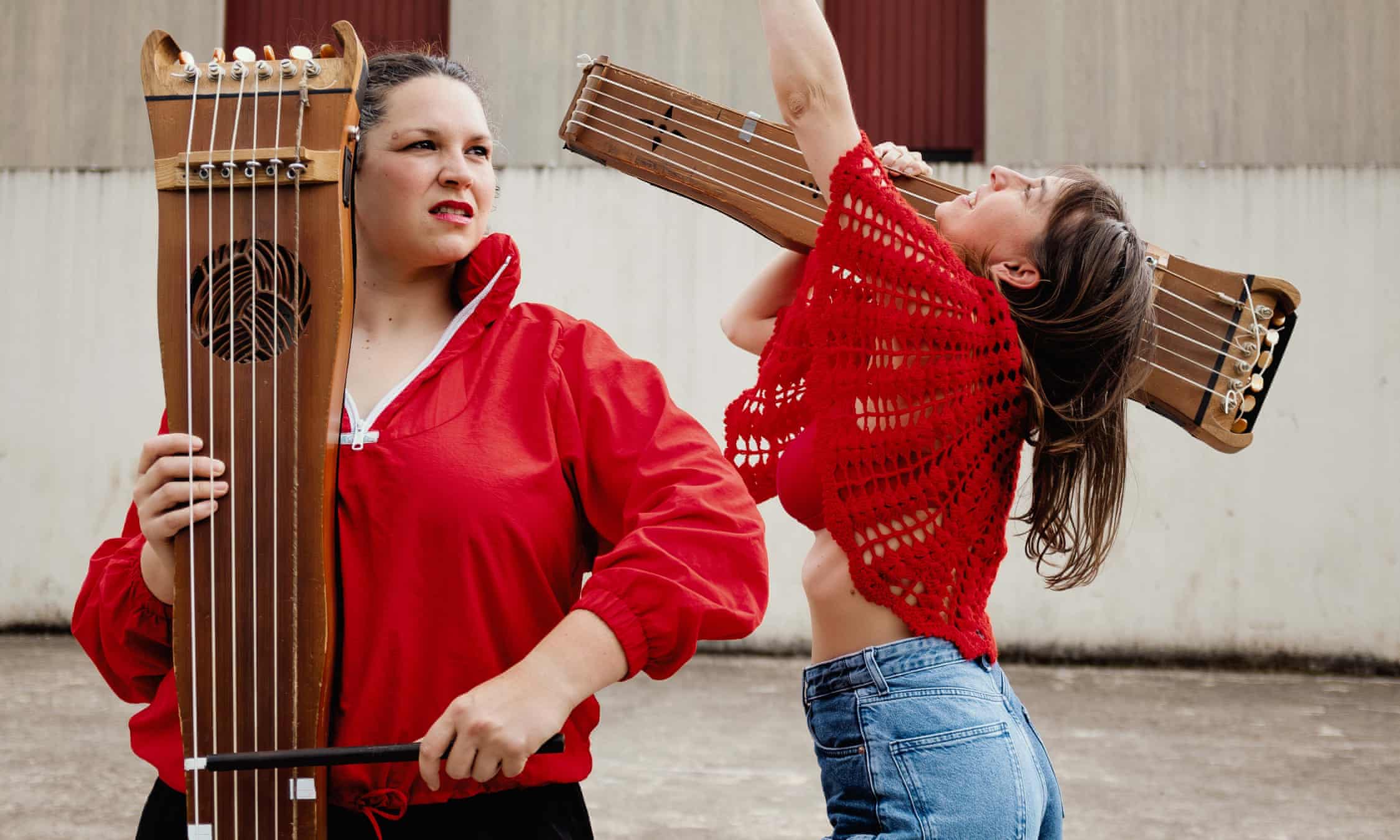
So the story is I saw this piece in the Guardian how the Occitan language, which the central governments of France have tried to eradicate since the time of the troubadours, is today kept alive by a hardy bunch of folk musicians, including the band Cocanha (presumably the Occitan equivalent of French cocagne, as in pays de cocagne = paradise?). The picture in the Guardian showed members of Cocanha carrying this strange instrument:

hotlinked from the Guardian article

In this lovely video, you can see them playing the instrument - it is obviously a tuned percussion instrument which they beat with a stick:

I looked up their website but didn't get any answer except percussion. Finally, looking up the French Wikipedia entry of the group, I learned that it is a Tambourin à cordes or Tambourin de Bearn, in English also called a string drum. The strange shape is built so you can wedge it under the arm that plays a single-handed whistle (as in pipe and tabor) while beating it with the other arm. The English Wikipedia entry shows photos of how this is done.

PS Although I have seen performances in medieval Occitan, I wasn't quite aware that the language is still being spoken today, so that article brought two revelations at once. I understand that it is quite close to Catalan. I'm a bit confused about the terms Occitan, Provençal (made famous by the Nobel winning writer Frederic Mistral) and Franco-Provençal, but as the Edition L'harmattan doesn't seem to have the title "Occitan" in their fabulous series "Parlons ...", I assume that the title Parlons Provençal is actually about the same language. Separately, they also have a book called: L'occitan tel qu'on le parle (Occitan as it is spoken).

Friday, March 18, 2022

Latin without limits

Some thoughts on

Ad Infinitum – A biography of Latin
by Nicholas Ostler
Harper Press 2007

The remarkable thing about Latin is how little it changed in 2,500 years, so its CV could be told very quickly, as indeed the author does in the last two pages of the book. The exciting story in the rest of the book, however, is mostly about all the other languages that it touched upon or that developed interestingly different trajectories.

So, for instance:

* Etruscan – why don’t we know much about it? The author offers some explanations, and in the appendix a list of presumed Etruscan words that survived in Latin.

* Greek – it is intriguing how the two languages each claiming to represent civilisation co-existed for many centuries and divided the Mediterranean world between them.

* Arabic – fascinating how after the Norman conquest of Sicily from the Arabs and the gradual rollback of Arabic power in Iberia learned texts (including those originally in Greek) were translated from Arabic into Latin and thereby came to lay the foundations of the Renaissance in Europe. Mathematical terms like algorithm and algebra show their Arabic roots.

* Romance languages – by the late 8th century, Latin was a written elite language, coexisting with the local spoken vernaculars drifting away from it. In a similar situation, Arabic and Chinese maintained their unity through the shared written language even though speakers of distant dialects may fail to understand each other. Why did the dialects of Latin crystallise into new languages, even while the elite version was still widely used eg in church and legal texts? According to Ostler, it was kind of an own goal for Alcuin from York, who in 781 was appointed director of Charlemagne’s Palace School in Aachen. He drew up strict rules for standard Latin pronunciation. At the stroke of a pen, those versions spoken in France and Spain were no longer accepted as Latin, so they were free to become their own languages. An immediate practical problem: priests using the standard pronunciation prescribed by Alcuin were harder to understand for their flock, so had to cultivate both Latin and their local Romance language as bilinguals. Using Alcuin's pronunciation rules in the reverse direction, they could easily produce written versions of their local vernaculars. “Romance” interestingly became a word for the type of text typically written in these new languages (hence “roman” in French and German for novel), before being recruited to describe both the language family and the romantic entanglements.

* English – virtually all of the Western Roman Empire now speaks Romance languages, with the interesting exception of Britannia. There isn’t a simple explanation really, and quite a few open questions feed into this, so I can’t answer this here, but the author spends a few pages on this.

* Romanian – in the Eastern Roman Empire, the competition with old rival Greek meant that Latin didn’t stick, even though Roman rule persisted for many centuries longer. The one exception on that side of the map is Romanian.

* Native American languages - it was surprising to me to learn that the Spanish conquest of what we now call Latin America (coined in 1856!) brought quite a few interactions between Latin and the major indigenous languages such as Quechua and Nahuatl. The idea being that to get the approval of the Catholic Church the conquistadores had to create the impression that their endeavour was all about saving more souls for the Lord, which at one stage also required training native people to become Catholic priests, and learn Latin. It was at that stage, in the 16th century, that Latin had a truly global spread that the Romans could not have dreamed about.

* Spanish – in a shocking coincidence, the year 1492, when Columbus reached the Caribbean and the fall of Granada completed the reconquista, also saw the publication of the first grammar of a language that wasn’t Latin or Greek. It described Spanish and with remarkable foresight aimed to provide the language manual for a new empire, following after Rome. Scholars had long written about the classical languages as if they were the only ones worth bothering with. It is shocking in a way that it took until 1492 for people to realise that every language has its own grammar. (Related to this, the infinity of the title alludes to the Roman habit of mistaking their Latin-speaking bubble for the whole world.)

* Science – these days the binomial names introduced by Linnaeus are the kind of Latin I use most regularly. Although the Industrial Revolution coincided with the loss of Latin as a lingua franca across Europe, it has pervaded most of science and technology, often with pseudo-Latin neologisms. The author points out that it took until the mid-20th century before physicists started to call new elementary things by English names like quark, charm.

All in all fascinating stuff, and I am particularly pleased to have learned of a coherent explanation for the origin of Romance languages (even if the author refers to medieval Galician as “Portuguese” – long before Portugal even existed). A minor moan is his unquestioning support for the Christian church – expressions like “heroic missionaries” make me shiver. That aside, this is a compelling history not just of Latin but of Western Europe and its languages.

Cover of the hardback edition I found at a charity shop.

PS the author's Wikipedia entry in Latin is still a stub, you can help to expand it...

Now made another slow-moving thread: books read in 2022.

Sunday, December 26, 2021

new from Simone de Beauvoir

I read all of Simone de Beauvoir's novels and some of her autobiographical writing at a young and impressionable age when sitting in a Paris cafe writing books was my idea of a sensible career path. (Now, of course, after the rather strict lockdowns they had in France, I realise that writing from where I'm sitting right now is much more sensible.)

Seriously, though, having been imprinted on Beauvoir as an intellectual role model, I was thrilled to see she's got a new book out, at the age of 110 plus. I only found out this year, when the English translation was published, but the original came out in 2020.

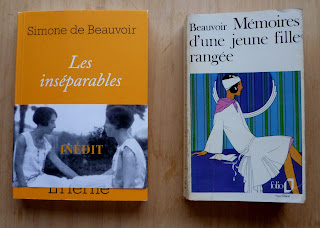
Les inséparables is a fictionalised account of her childhood friendship with and crush on school friend Elisabeth Lacoin, called Zaza, who died in 1929 aged 21. The account written in 1954 was deemed to be too emotionally sensitive to be published in her lifetime. A more distanced version was include four years later in Mémoires d'une jeune fille rangée.

In a detailed preface to this belated publication, Beauvoir's adopted daughter Sylvie Le Bon de Beauvoir explains the complex relations between the real life story, the short novel, and the memoir, which I found really helpful. It also comes with 18 pages of photos and copies of letters between Simone and Zaza.

I may be biased for imprinting reasons cited above, but I found the novel very moving and relatable (as we've only started saying long after it was written), and I'm very grateful that it came out at last. At 150 pages, the text is much more accessible than the memoir (which I bought 38 years ago but I'm not sure if I actually read it!), and I guess it might help to introduce new generations to the emotional and sensitive side of the great philosopher and feminist.

My editions of both books, own photo. I was too impatient to wait for a folio paperback to match my collection of Beauvoir's other works.

PS: My grandmother Ruth, shown here with a friend in her student days, was born the same year as Simone de Beauvoir, which makes the story even more relatable.

Tuesday, November 16, 2021

elusive memories

Impressions of

Dans le café de la jeunesse perdue
Patrick Modiano

Rummaging around the library I inherited I discovered a few books by the 2014 Nobel laureate for literature Patrick Modiano, including this one both in the French original and in a German translation:

I loved the French title and the German cover art, so went on to read the original. It is very short, with chapters from different perspectives describing the comings and goings of people who remain enchantingly mysterious, plus, it’s Paris shrouded in darkness and a haze of nostalgia, so what’s not to like. I disapproved of the ending though. And I'm wondering if, by not saying much at all about the characters, the author lets me do all the work. I mean I do love his elusive protagonist, Jacqueline, but I realise that I may be projecting my own expectations onto a blank canvas here.

After enjoying the misty mysteries of this one, I also read Du plus loin de l’oubli, which turns out to be very much the same, with some of the characters possibly overlapping (hello again, Jacqueline!), except that now part of the story (?) is moved to London, which somehow put me off a bit. So I guess I know the pattern now, and I don’t have to read the third one I found, which is called Pour que tu ne te perdes pas dans le quartier.

Saturday, November 21, 2020

learning from Balzac

Balzac et la petite tailleuse chinoise

Dai Sijie

First published in 2000 and hugely successful, this is a short novel about two teenage boys caught up in Mao’s Cultural Revolution and sent to the remote countryside for re-education by the hardworking villagers. Instead, they find intellectual solace in an illicit stash of French novels by Balzac, Dumas, Flaubert et al. and also use them to re-educate themselves as well as the little seamstress of the title. Lives are changed, although perhaps not quite in the way they may have hoped.

(Cover of the 2001 folio edition I have, too. Later editions typically have images from the film.)

I managed to miss this when it came out and was swiftly made into a movie as well, I only vaguely remember seeing the title some time and wondering what it was about. Catching up with it now, I enjoyed the novel and I was amazed at how well it connected with my own experience of growing up around the same time. I was also stuck in the sticks, maybe not as remote and spectacular as the phoenix of the sky mountain villages with their dangerous paths, but still, as a vastly exaggerated fairytale metaphor for my youth, the novel works surprisingly well. And I found solace in the very same 19th century French novels. Today, I wouldn’t find time for Balzac, but I might revisit Flaubert one day.

It does make me think. Maybe there was a bit of Cultural Revolution going on in Europe as well? Between 1900 and 1960, everybody from whom I inherited DNA lived in towns and cities (eg Heinrich the cellist did all his life). Then, in the 1960s, People got cars, moved to the sticks, commuted to work. A slippery slope. I still get an allergic reaction when, ahead of the TV news, I see trailers for shows pretending that moving to the countryside is a good thing. The Cultural Revolution caused between 200,000 and 20 million deaths, depending on who you choose to believe, and traumatised millions like the author, Dai Sijie. We should heed that warning.

Saturday, February 08, 2020

bed bug

review of

bed bug

Katherine Pancol
Albin Michel 2019

A few years ago I discovered Pancol’s novel Les yeux jaunes des crocodiles (2006), which featured a scholar of mediaeval romances struggling with her own 21st century romantic life. I really enjoyed that one, although it appears that I forgot to review it.

So I was thrilled to see that her latest work seems to be doing something similar to biosciences. A biochemist studying insects and knowing all about their weird and wonderful love life, but finding her own more weird than wonderful.

Rose studies the firefly Lamprohiza splendidula in Paris and discovers that it produces a molecule that is very efficient at killing tumour cells. Her molecule may also be of interest to the cosmetics industry, which could lead to much faster profits for the start-up she’s planning to launch. Decisions, decisions. Meanwhile her mental health also needs attention due to traumatic events that are being dug up in the course of the novel. All being made more global by professional transplantation to New York.

I found the novel interesting as an example of science in fiction (with a few references to actual research papers listed at the end), although I’m slightly spooked when it travels too close to our dystopian present. We are clearly in the present day with Drumpf and all the rest of it.

The science remains a bit superficial, and one of Pancol’s contacts should have told her that there is no such thing as a Nobel prize for biology. Also, the dilution series that Rose performed to prove the miraculous effect of her compound reminded me of homeopathy and the “memory of water” claimed by some real-life Parisian researchers more than of any real science.

Scientists in the book have only two possible motivations – get rich quick by launching a start-up (allegedly the driver of all the researchers at the lab in New York), or curing disease. The actual quest for knowledge and understanding – so important for Rose in her private life as she struggles with her past trauma – doesn’t get a mention as motivator of scientific ambition.

Pancol is hugely successful in the French market, but as far as I can make out her work hasn’t been translated into English. Even the English title and the setting in New York didn’t help. Of course, the same book written in English by an author based in New York, with the converse excursion to Paris, would be translated into 30 languages within a year.

So catch the bed bug en français if you can.


Saturday, May 18, 2019

In the midst of winter

Más allá del invierno
Isabel Allende


I think I first read Isabel Allende in 1984, when her first novel, La casa de los espiritus came out in translation and was very successful worldwide. From the next novel De amor y de sombras onwards, I read almost all her novels in the original version (a quick count gets me to 15). I skipped the young adult ones and may have missed one or two in recent years. (I really hated the cover of El cuaderno de Maya so much I couldn’t buy or read that one. Would have to wrap it in paper or something.)

Having started the shared reader/author journey 35 years ago with what was then the recent history of the coup in Chile, and having made all sorts of excursions to remote times such as the early days of the European conquest of the Americas, it feels a bit weird to be jolted into the present day New York and the eve of the Drumpf election with this novel published in 2017. However, it mostly works well.

It starts a bit slowly with a wintry encounter between the three very different characters, but then she throws in a dead body hidden in the trunk of a car and all goes swimmingly. Three interesting back stories relating to different parts of Latin America interwoven with the quest to do something meaningful about the body makes an interesting tapestry. Although the characters manage to sort out their mess, this doesn’t really tell us what to do about the rest of the horrid world.

PS looking for the cover of this one, I found out that the next novel is due out on May 21, called Largo pétalo de mar. I really do need to pull my socks up and keep up a bit better.

Tuesday, September 25, 2018

threads and patterns

O club de calceta
María Reimóndez
Edicions Xerais 2006

This book has been translated into Spanish, Italian and French, but apparently not into English. If it was, I would call it the knitting circle, rather than club, as I imagine the six protagonists sitting in a circle and knitting, but more importantly each telling the story of her life. As we go round the circle, the joint story also advances, as it becomes clearer what connects these women and how they can help each other, so while the movement is circular, it is also going forward. Like knitting a sock, I suspect. Threads and patterns are important, too.

The cast makes me think: Why hasn’t Almodóvar made the film yet? We have a prostitute fed up with the profession she inherited from her mum, a one-legged woman who wants to become a bus driver, a secretary with the ambition to be her own boss, a cleaner haunted by the ghost of her aunt, a political activist (communist?) in remission, and an old lady who spent her life looking after the local church (dressing the saints, as I think they say in Galicia).

Six women on the verge of a major breakthrough, because knitting does change the world. Six lovely stories with convincing voices that we would not normally hear. In the final chapter the whole thing is tied together maybe a little bit too neatly, but never mind. You don’t want to have any loose threads dangling when you’re knitting a masterpiece.

PS The Galician edition of Wikipedia tells me there has been a TV adaptation, but I still want to see Almodóvar’s take on this. Wiki also reveals that the story is set in the city of Vigo (whose literary fame was secured by Martin Codax in the 13th century).

Saturday, September 08, 2018

Madame Robinson

Leïla Slimani
Dans le jardin de l’ogre


When Leïla Slimani won the Prix Goncourt in 2016 for Chanson douce (English title: Lullaby), I really wanted to read her book but shied away from it because of the subject matter (as a parent, I am a bit squeamish about children being murdered). Then on my recent travel I stumbled across some kind of literary programme on TV5 Monde, where Slimani spoke about her most recent book (Sexe et mensonges : La vie sexuelle au Maroc), discussing the sex lives of Moroccan women with a panel of three blokes and looking as relaxed as if that was the most ordinary thing in the world to do.

So, looking up her oeuvre, I discovered her first novel, Dans le jardin de l’ogre, which looked less scary than the prize-winning one, so I read that. It’s in a way a Madame Bovary for the post-Catherine M. times. Which means, we have our medical doctor and his bored wife, but things get rather more out of hand than what I remember from Flaubert’s novel, and the move to rural Normandy (also the setting of Madame Bovary) comes as an attempt to fix things.

Slimani applies a cold psychiatric eye to report a case study of sex addiction – a condition only recognised as a mental health problem by the WHO last month, i.e. several years after her novel was published. She doesn’t spend much time on describing the external settings (Paris, Normandy, Boulogne sur Mer), and I kind of filled in from own memories what I missed there. But the internal landscapes are quite impressive and match the places. Hers, a city bustling with anonymous figures and existential angst, his, the yawning countryside and longing for steady normality, her parents’ the provincial small town of Boulogne (at some point, Napoleon planned to invade England from there, but I think he got side-tracked or something).

All of which reveals Slimani as a sharp and fearless writer, and one day I’ll even drum up the courage to read her other books.

An English translation of this book is scheduled to appear in February 2019 under the title of Adèle.


Available as a very lovely Collection Folio paperback, although I am not happy with the font they are now using for the author's name, which is the main difference between the current design and my collection of folios from the last century.

Tuesday, June 19, 2018

origins of Indo-European languages

I've always been obsessed with languages (Romance ones preferably, but will also consider others), so it's only natural to take any opportunity to write about science-language interface. There haven't been all that many (the 2012 feature on the evolution of writing and my ancient paper on the linguistics of protein folding spring to mind), but recent work on ancient DNA has yielded a good excuse to revisit the family tree of Indo-European languages, comparing results from archaeology, genetics, linguistics and cultural history.

The resulting feature is out now:

The Indo-European ancestors' tale

Current Biology Volume 28, Issue 12, 18 June 2018, Pages R679–R682

FREE access to full text and PDF download


Statistical analyses can show that ancient fairy tales have likely evolved from common ancestors of the Indo-European language groups or even from the culture that spoke the Proto-Indo-European language. (Image: From The Folktales of Bengal illustrated by Warwick Goble.)

Sunday, May 27, 2018

book reviews reviewed

I'm trying to find some way of organising my literary book reviews published here, which are currently in the same tag (bookreview) as non-fiction and indeed as the reviews of science books that I write for Chemistry & Industry magazine. Plus, in the early days I also had some entries just pointing to other people's reviews of books I hadn't read. With 147 entries, that tag is getting a bit unwieldy.

So let's start with a master post sorting reviews by language (and maybe I'll introduce a new tag for each language, as I have already done for Galician), starting with the Romance languages which I am more interested in than in the Germanic ones:


Galician
(tagged biblioteca galega)

María Reimóndez: O club de calceta

Anxos Sumai: Así nacen as baleas, Galaxia 2007

Santiago Lopo: Hora Zulu, Galaxia 2012

Santiago Lopo: A arte de trobar, Xerais 2017


Spanish
(libros en español)

Isabel Allende: Más allá del invierno

Gioconda Belli: El país de las mujeres (2010)

Almudena Grandes: Castillos de cartón

Mario Vargas Llosa: El sueño del Celta

Elvira Valgañón: Luna cornata Sobrelamesa Ediciones 2007

Gioconda Belli: La mujer habitada

Gioconda Belli: El pergamino de la seduccion

Alicia Yanez Cossio: El Cristo feo


French
(livres en français)

Dai Sijie: Balzac et la petite tailleuse chinoise (2000)

Katherine Pancol: Bed bug (2019)

Leila Slimani: Dans le jardin de l'ogre

Anne Golon: Angélique, Marquise des Anges

Jean-Yves Ferri, Didier Conrad: Asterix - Le papyrus de César (2015)

Anna Gavalda: Ensemble, c'est tout

Alain Mabanckou: Verre Cassé


English

Ursula Le Guin: Lavinia

Laila Lalami: The Moor’s account

Esther Freud: Lucky break

Sefi Atta: Swallow Interlink 2010

Jennifer L. Rohn: The Honest Look Cold Spring Harbor Laboratory Press 2010

Weam Namou: The feminine art Hermiz Publishing 2004

Jennifer L. Rohn: Experimental heart Cold Spring Harbor Laboratory Press 2009

Esther Freud: Love Falls 2007

Salman Rushdie: The enchantress of Florence Jonathan Cape 2008

Belle de Jour: The intimate adventures of a London call girl Weidenfeld & Nicolson 2005

Megan Clark: Seduce me Kensington Books 2008


German

Daniel Kehlmann: Die Vermessung der Welt


Translations from other languages

Hong Ying: K - the art of love


Oh well that is an eclectic old list. And I should definitely review more French novels ...


In the meantime, here's my little Galician library:


PS I'm still adding a couple of links to more recent reviews but will at some point (end 2020?) leave it alone, lest it grows to become unmanageable. After that I might try and do a reviews master post at the end of every calendar year. Watch this space.

Wednesday, May 23, 2018

the trouble with whales

Así nacen as baleas
by Anxos Sumai
Galaxia 2007

English edition, translated by Carys Evans-Corrales:
That’s how whales are born, Small Stations Press, Sept. 2017

This short novel presents a triptych, with the outer parts set in a recognisably 21st century present and narrated by the nameless female protagonist, and the core in 1984, around her third birthday, with a detached narrator referring to her as “a Nena”, the girl.

The girl is grown up now and has an obsessive interest in the whales that serve as the leitmotiv, which she has managed to channel into a budding career as a marine biologist. Just now, however, her family has summoned her away from her field research in Baja California, Mexico, to attend to the family business built by her mother, which has created considerable wealth, with considerable strings attached.

The apparent conflict between her ambition as a scientist and the family expectations for her to take care of the business appears to be her big problem initially, but the look back into her childhood reveals a whole cupboard full of (whale-sized) skeletons and stray emotional baggage. In comparison, the present human resources problem appears eminently solvable. After all, working out who should run a thriving chain of hardware stores, that’s not the worst imaginable problem a family can have.

In the present, our marine biologist struggles in her dealings with the various females from her bed-ridden, possibly malade imaginaire, mother through to the girlfriend she left behind with the whales of the Pacific. Men tend to be mysteriously absent, such as her sea-faring father who never returned since she was born, and her brother whose room is preserved as a shrine and who only appears in the central 1984 narrative, or barely visible, like her uncle.

There is poetry in the way objects, animals and plants play important roles when the human communications fail in the claustrophobic environment of the family home where most of the novel is set. In spite of all the trauma involved, it manages, as the whale mascot with its 400-kg heart suggests, to remain very warm-hearted and optimistic.


Sunday, May 20, 2018

reading in Galician

So this week saw the annual Dia das letras galegas (Galician Literature Day, May 17), about which I have obsessed here and here, and also in the twitter hashtag #Euleoengalego (I read in Galician).

But why do I? One obvious reason is that I need to learn the language so I understand the naughty bits in the songs we sing at the Galician sessions, and reading novels has served me well as a learning strategy for English, French and Spanish, so why not. (Also, there is a special deal with Romance languages, you buy two and get the third one free.)

There are additional motivating factors, however, which I am only beginning to discover. All other languages I have learned before were languages of empires at some point, and were aggressively inflicted on the less-well armed people. Galician, by contrast, only had a modest kingdom for a few decades in the Middle Ages, and has since then been a minoritized language, suppressed over centuries by the Castilian-speaking imperialists. So helping to keep it afloat is among other things also an anti-imperialist statement.

Then there is the familiar and related problem that everything published in English is overrated by default and spread around half the globe even if it has no merit whatsoever. Given this language privilege, all sorts of shady people publish books in English for political or commercial motives, regardless of whether they are any good.

The resulting problem for me as a reader is that not only there is way too much stuff being published in English to keep up even with the reviews, let alone the books, but also there is a substantial risk of picking up something that is downright rotten.

My impression is that this doesn't happen in a minoritized language. Especially in the Spanish situation where anybody who is literate enough to write a book in one of the co-official languages could just as well write it in Spanish instead and reach a potential market more than 100 times larger. So people who do write in Galician, I suspect, do it because they love the language and want to make a contribution to keeping it alive. (Incidentally, the author featured in this year's Dia das letras galegas, Maria Victoria Moreno, learned Galician as an adult and describes her relation with the language as a love affair - one that was downright dangerous under Franco.) And that, according to my theory, explains why, five novels into the Galician reading experience, I haven't yet found a book I didn't like. Prove me wrong.

Here's book No. 5 (almost finished):

Friday, April 20, 2018

romance of wikipedia

I've been slightly obsessed with Galician and some other Romance languages recently, which must have been a side effect of being exposed to and then inheriting the admin of the amazing Galician Session Oxford. I discovered that the Galician version of Wikipedia is quite amazing (considering the number of speakers of the language), so I looked up some other Wiki versions in Romance languages with a view to use one or the other as study aids, and found that their sizes don't necessarily scale with the numbers of speakers:

1 000 000 +

Français 1 975 000+ articles

Italiano 1 430 000+ voci

Español 1 404 000+ artículos

100 000+

Português 997 000+ artigos

Català 577.879 articles.

Română 385.164

Galego 147 109 artigos.

Latina 128 288 paginarum


10 000+


Occitan 84 312 articles
Asturianu 74 671 artículos
Piemontèis 64 327 artìcoj
Aragonés 32 946 articlos
Sicilianu 25 949 vuci
Nnapulitano 14 516 artícule
Vèneto 11 145 voxe

1 000+

Corsu
Emigliàn–Rumagnòl
Lìgure
Malti*
Mirandés
Picard
Rumantsch
Sardu

* NB: I realise Maltese is a semitic language, but half its vocabulary is of romance origin.


Image: Wikipedia

Saturday, March 24, 2018

time interrupted

review of

Hora zulú
by Santiago Lopo
Editorial Galaxia 2016 (in Galician)
Mar Maior 2016 (Spanish)

In January 2000, a man is washed up on the coast of Galicia and is referred to a psychiatric hospital, as he appears to have lost his memory. Known as “the professor”, he is going to spend the rest of his life there although we are increasingly suspecting that he isn’t quite as mad as we thought, and maybe he hasn’t lost his memory either.

After his death, Ana, who was one of the psychiatrists at the hospital at the time of his referral, pieces together the mysteries of the professor’s previous life from a set of five stories that he had written and hidden in different places. Ana reports the progress of her quest in emails to a former colleague and love interest, but we don’t know whether he ever reads her emails – she never refers to anything he might have said in reply, so it’s a strong possibility that the ex, now living in New York and married to somebody else, deletes her messages unread.

The novel intersperses these emails with the professor’s writings and the psychiatrists’ case notes to create a jigsaw puzzle that remains mysterious to the last. We begin to suspect that the mad professor may have been a sane man in a mad world, as becomes clear from the questionnaire he designs to test the sanity of his doctors. He is thinking about the mysteries of time in a quest to stop the man-made destruction of the environment. (Hora Zulú (Zulu Time), by the way, which occurs at the end of each of his texts, is just a navy / aviation code for Greenwich Mean Time.)

Meanwhile, Ana has her own problem with time. She wants to wind back the clock to be back with her ex (or was he just an almost lover?). As the personality of the patient is gradually beginning to make more sense, that of the psychiatrist is becoming a shade crazier, although her voice, emailing into the void with the mixture of exciting discoveries and the mourning for lost love, (to me) really was the main attraction of the book. I’d happily read more of her emails any time.

The whole tackles some big questions, including:
* what is the nature of time, and can it be stopped or reversed? and:
* am I crazy or is the world around me going crazy? speaking of which:
* can dogs read our minds?
The answers, however, remain a mystery.


(cover of the Galician edition, although Amazon Spain seems to think it is in Spanish).


Saturday, January 06, 2018

a arte de trobar


The year is 1237. As the king of France and the Inquisition are finishing off the genocide of the Cathars in Occitania, King Fernando III of Castile is about to marry his second wife, Juana de Dammartin at Burgos (she narrowly avoided marrying the English king, Henry III). To mark the occasion, a contest of some of the most respected troubadours is held at the castle. At the very last minute, Maria Balteira introduces an odd duo to the event – a Galician xograr (minstrel), Nuno Porco, and an Occitan refugee shrouding herself in mystery and going by the name of Elvira, whom Balteira had discovered performing at an inn in the town.

They get to perform last, and in the presence of the royal couple and Fernando’s teenage son, Alfonso. After they have blown away the bickering competitors (including eg Pero da Ponte and Bernal de Bonaval) and stunned everybody into silence, the king’s son is the first to applaud. He is, of course, the future king Alfonso X, el Sabio, the author of the Cantigas de Santa Maria. This imagined encounter between the brutally extinguished culture of the Occitan troubadours and the new wave of the Galician mediaeval music is at the heart of this short novel.

Many of the characters are loosely based on historical figures (follow the wikipedia links above to find out about them), but who the hell is Elvira? That is the mystery the novel plays with to great effect, and I’m not going to spoil it here. I’m slightly embarrassed to admit that I missed all the clues. The answer only hit me when I got to the very last sentence. So I’ll just have to read the novel again – it will be a completely different experience, knowing what I know now.

I’m thinking it might work well in English translation, actually. Would just need a few footnotes. Maybe the Galician Studies Centre and the Oxford Trobadors should conspire to make this happen …


Santiago Lopo
A arte de Trobar
Editorial Xerais, October 2017.


UPDATE 18.8.2022: Very excited to report that an English translation is due to be published under the title "The art of making verses", you can read the first 1/5 of the text here.

PS: on a related note, here is an article about the female oral tradition behind the medieval Galician poetry (in Galician):

O trobador eran elas

Boa parte da lírica medieval galego-portuguesa era tradición oral feminina, segundo Ria Lemaire

Tuesday, June 07, 2016

how Romanian lost its romance

I taught a workshop at Bucharest recently and just before the trip I discovered an old French book about the Romanian language at an Oxfam store, so I read much of it on the way there, and found it really intriguing. As the book is probably out of print, I’ll summarise some of the points I found interesting.

Latin heritage: The area was only under Roman control for a century and a half (106-275) – and the Latin derived language only became prevalent after the Romans left. The invasion of the Huns in 375 and destruction of the towns drove the Latin-speaking townsfolk out to the countryside, where they mingled with the peasants who spoke a Thracian language related to modern Albanian, and from this encounter Romanian was born. Then, the language was fairly isolated from the other Romance languages, and thus kept old-fashioned terms when medieval Latin changed and passed those changes on to Italian and French. Intriguingly, the Iberian languages, on the other end of the continent, retain some of the same old-style expressions, so they sometimes resemble Romanian more than the geographically closer languages Italian and French. For instance, when Latin, French and Italian switched from mensa to tabula for table, the peripheral Romance languages in Iberia and Romania didn’t get the memo, so we have mesa in Spanish and Portuguese and masӑ in Romanian.

German influences include cartof (Kartoffel) for potato, and halba (Halbe) for half a measure of beer, and a word derived from “Schmecker” for their argot. The name of the region around Bucharest, Wallachia, derives from the Germanic word for non-Germanic people, as in Welsch, Wallon, Welsh, etc.

Alphabet: Romanian used the Cyrillic alphabet until 1860, which it had originally adopted from Bulgarian for complex reasons linked to the shared orthodox religion.

Romance language that lost the romance: Again as a consequence of being isolated from the Romance languages in central Europe, Romanian lost Latinate terms from the area of love, romance, relationships. While most areas of Western Europe got their romantic ideas from the troubadours, Romanian lost the words derived from Latin amor, amare, carus and sponsa, and replaced them with the Slav words iubi, dragoste, drag and nevasta, respectively. So it became a Romance language that loves in Slav terms.

Later however, Romanian reconnected with French and got many words from modern French (eg bej, ruj, coafor, creion …), as well as lexical and grammatical influences from Hungarian, Turkish, and Slav languages, often even within the same word. So it ended up as a unique mixture not just of several language influences but also of languages from unrelated families, and with connections all across Europe.

Source:

Gilbert Fabre: Parlons roumain, langue et culture Editions L’Harmattan 1991

PS - a quick check on French amazon revealed that it is available as an e-book as well as second-hand. Plus, from the same series there are books about dozens of other languages, mainly those not so commonly taught, so this is a huge temptation. (Lots of them have the same title with only the name of the language exchanged, so you find them easily with the search terms: parlons langue culture. However, there are also recent deviations from the pattern, eg Parlons slovaque, une langue slave, from 2009)

Tuesday, October 27, 2015

writing history

Asterix: Le papyrus de César

The 36th Asterix album – the second from the new team, Jean-Yves Ferri and Didier Conrad – addresses a question of utmost importance for the historical consistency of the whole oeuvre: Why on earth did Caesar not mention the indomitable Gauls and their numerous victories against his legions in his famous De Bello Gallico? Did he falsify the historical record by omission? Are all the zillions of schoolchildren who start their Latin reading with “Gallia est omnis divisa …” fed a pack of lies?

The issue is addressed with a very satisfying story, resulting in an album worthy to be read alongside the Golden Era ones written in the years before Goscinny died. On the basis of this story, there are deep discussions to be had about how history is written, the contribution of reportage, the value of oral tradition, and the philosophy of truth. Oh, and the vanity of writers and the publishing industry. And Assurancetourix the bard (Cacofonix / Troubadix) plays an early example of a Stroh cello, so what’s not to love?

Intriguingly, this arrived on my doorstep just after I started reading another recently published book featuring the origins of Caesar’s famous opus. In the third volume of his fictionalised biography of Cicero, Robert Harris imagines Cicero’s secretary Tiro visiting Caesar in Gaul and reading the beginning of his 12th chapter: “Flumen est Arar quod per fines Haeduorum et Sequanorum in Rhodanum influit, incredibili lenitate ita ut oculis in utram partem fluat iudicari non possit.” Seeing that Tiro is believed to have written a biography of Cicero which is lost, while Caesar’s book is so ubiquitous that it would survive the apocalypse, this encounter between two authors is also an interesting reflection on the vagaries of history writing.

looks like a fragment of the lost scroll survived in the font of the word "papyrus" - maybe the authors should reveal that in full ...

PS: here's an interview with the creators, from the Guardian.