as I have been saying since I wrote a book chapter on Molecular Computation (1998), the fundamental processes in a living cell are essentially computation. This could potentially be used in two ways - building computers based on molecules and cells, or manipulating important biological processes (eg in medical or agricultural context) using computational tools.
Back in the 1990s, the molecular computer was a promising avenue, but it never quite took off. Now the other way round, programming biology, seems the more exciting prospect. This has given a major boost by the recent invention of a compiler that can translate computer code into DNA regulatory networks, which in most cases even work in the cell.
As we are increasingly becoming aware that complex regulatory networks (rather than single genes and enzymes) are the things that we need to understand and control if we want to change biological processes, this development could very well revolutionise several areas where we interfere with living beings, from agriculture to medicine.
Read all about it in my latest feature in Chemistry & Industry:
Cellular computer
Chemistry & Industry Volume 81, Issue 4, pages 26–29
DOI: 10.1002/cind.814_7.x
Full text (Wiley Online Library)
Showing posts with label computer. Show all posts
Showing posts with label computer. Show all posts
Friday, June 09, 2017


Sunday, July 19, 2015
beyond silicon
Moore's law, the famous (partially self-fulfilling) prophecy that has defined the current technology revolution, turned 50 this spring, and, give or take a few tweaks, it's still holding up ok. However, we are now in sight of some serious physical limits to the further improvements possible with silicon technology. Thus, experts are asking what comes beyond silicon, and in my latest feature in Chemistry & Industry I have rounded up some of the answers, both speculative and real-world ones.
Beyond Silicon
Chemistry & Industry No. 7, pp 42-45
limited access to full text and PDF download.
This all reminds me of the 1990s, when we were also worrying about limits to chip technology, only then it was the wavelength of visible light that limited the optical techniques. Overcoming these limits enabled the boom in nanotechnology and all of today's communication tech. Exotic alternatives such as molecular computation, which I discussed in a chapter in this book:

were already explored back then, but remain in the realm of the less likely paths today.
In the same issue, there's also my review of the book
Low cost emergency water purification technologies by Ray and Jain.
Tuesday, March 22, 2011
data deluge
As I may have mentioned before, advances in genome sequencing are moving faster than those in computing (still following Moore's law, i.e. doubling capacity every 18 months or so). In the long term, of course, this means that scientists are going to produce more data than they can store or handle. Similar problems also arise in other fields e.g. neuroscience.
I've written a feature on the data deluge and how biologists are hoping to cope with it for Current Biology, which is out today:
Riding the wave of biological data
Current Biology, Volume 21, Issue 6, R204-R206, 22 March 2011
doi:10.1016/j.cub.2011.03.009
summary and FREE access to PDF file

One of the sources of the data flood: second generation genome sequencing machines at the Wellcome Trust Centre for Human Genetics, Oxford.
I've written a feature on the data deluge and how biologists are hoping to cope with it for Current Biology, which is out today:
Riding the wave of biological data
Current Biology, Volume 21, Issue 6, R204-R206, 22 March 2011
doi:10.1016/j.cub.2011.03.009
summary and FREE access to PDF file

One of the sources of the data flood: second generation genome sequencing machines at the Wellcome Trust Centre for Human Genetics, Oxford.
Monday, January 18, 2010
is big google watching you ?
Last week's cover story of the German news magazine Der Spiegel was all about the masses of information that google collects on its users, and the potential threat in that should the company one day go over to the dark side. Some of that really did sound scary, especially the quote from a top executive who didn't seem to have an understanding of the concept of privacy at all.
Personally, I am not worried that much, as I like to believe that my preferences and habits are sufficiently eccentric to confuse all market researchers that care to look at them. Amazon.com has been trying to figure me out for ten years now and aren't any closer to understanding what I really like, or to knowing what I haven't bought yet. They don't even understand that the same person can act as a writer, bookseller, and reader, and that in four different amazon markets (US, UK, France, Germany). So I'm not worried that the google robots, just from managing my blog, will figure out what I'm thinking (*wave to the nice robot*).
But I think that everybody should make sure they think about what information to reveal to whom, and, crucially, not to reveal all to the same company. I.e. if a given company is already handling my email and blog, I wouldn't want them to run my mobile phone and my bank account as well. It's just elementary "don't put all your e-eggs in one e-basket" kind of thing, but I think it can prevent considerable damage should one of the baskets go awol one day. Oh, and for anybody worried about what their search habits may reveal, there is ixquick.com a meta search engine that doesn't record customer details.
And come to think of it, my shiny new phone (not from google) doesn't have an off switch, but it does of course have a microphone and a camera. After reading this article I began to wonder whether the phone was maybe spying on me. Now that would be a big brother type scheme extremely easy to implement. I think the next few years in communications are going to be interesting.
PS some of the Spiegel content is online in English translation, but I don't think this article is.
Personally, I am not worried that much, as I like to believe that my preferences and habits are sufficiently eccentric to confuse all market researchers that care to look at them. Amazon.com has been trying to figure me out for ten years now and aren't any closer to understanding what I really like, or to knowing what I haven't bought yet. They don't even understand that the same person can act as a writer, bookseller, and reader, and that in four different amazon markets (US, UK, France, Germany). So I'm not worried that the google robots, just from managing my blog, will figure out what I'm thinking (*wave to the nice robot*).
But I think that everybody should make sure they think about what information to reveal to whom, and, crucially, not to reveal all to the same company. I.e. if a given company is already handling my email and blog, I wouldn't want them to run my mobile phone and my bank account as well. It's just elementary "don't put all your e-eggs in one e-basket" kind of thing, but I think it can prevent considerable damage should one of the baskets go awol one day. Oh, and for anybody worried about what their search habits may reveal, there is ixquick.com a meta search engine that doesn't record customer details.
And come to think of it, my shiny new phone (not from google) doesn't have an off switch, but it does of course have a microphone and a camera. After reading this article I began to wonder whether the phone was maybe spying on me. Now that would be a big brother type scheme extremely easy to implement. I think the next few years in communications are going to be interesting.
PS some of the Spiegel content is online in English translation, but I don't think this article is.
Monday, July 06, 2009
round-up of German pieces
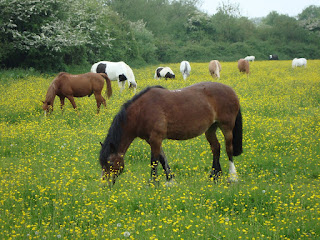
It's very rare that I get artwork from my own production published along with my text, so I'm thrilled to see that my recent feature on farm animal genomics is illustrated with the photo of our local horse population, snapped maybe 100 metres from my doorstep. Note that the origin of different colours in horses is part of the subject matter of the piece, and the horses belonging to the local riding school display a nice range of colours.
I'm also pleased to have acquired a new outlet for my writing in German, in the shape of the medical magazine Trillium Report. My contribution is an essay on the possibility of higher cognitive function emerging in computer networks.
So there are 3 pieces in German this month:
Tycho Brahes Elemente, Nachrichten aus der Chemie p. 741
more about this
Genomik auf dem Bauernhof, Nachrichten aus der Chemie p. 779
Der Geist des Netzwerks Trillium Report 7, Nr 2, 57

I'm also pleased to have acquired a new outlet for my writing in German, in the shape of the medical magazine Trillium Report. My contribution is an essay on the possibility of higher cognitive function emerging in computer networks.
So there are 3 pieces in German this month:
Tycho Brahes Elemente, Nachrichten aus der Chemie p. 741
more about this
Genomik auf dem Bauernhof, Nachrichten aus der Chemie p. 779
Der Geist des Netzwerks Trillium Report 7, Nr 2, 57
Saturday, September 06, 2008
when computers were female
Timed to coincide with google's 10th birthday, Nature is running a special issue with lots of pieces on "big data" this week. One thing that I found particularly intriguing, and that was completely new to me, is the story of the women hired as data crunchers between the middle of the 19th and the middle of the 20th century, who were referred to as "computers", as described by Sue Nelson on page 36 of the issue.
There's a wonderful quote in this paragraph of the essay:
Even though the computers' work was mainly dull routine, the author also cites examples of women who made original contributions and built successful scientific careers on this occupation.
Full text is here, and appears to be open access.
Full reference:
Big data: The Harvard computers p36
The first mass data crunchers were people, not machines. Sue Nelson looks at the discoveries and legacy of the remarkable women of Harvard's Observatory.
Sue Nelson
doi:10.1038/455036a
There's a wonderful quote in this paragraph of the essay:
In 1901, William Elkin, the director of Yale Observatory, expressed a view typical of the time as to who was best suited for this work. "I am thoroughly in favour of employing women as measurers and computers," he said. "Not only are women available at smaller salaries than are men, but for routine work they have important advantages. Men are more likely to grow impatient after the novelty of the work has worn off and would be harder to retain for that reason."
Even though the computers' work was mainly dull routine, the author also cites examples of women who made original contributions and built successful scientific careers on this occupation.
Full text is here, and appears to be open access.
Full reference:
Big data: The Harvard computers p36
The first mass data crunchers were people, not machines. Sue Nelson looks at the discoveries and legacy of the remarkable women of Harvard's Observatory.
Sue Nelson
doi:10.1038/455036a
Thursday, July 10, 2008
PC v. Mac
my daughter's laptop PC has just come back from repair, it needed a new hard drive after 18 months.
During the 10 days it was away I used my old Macintosh LC75, built 1993, which I had in daily use until autumn last year (2007), and only stopped using for reasons not related to the computer (e.g. that computers at the library no longer have a floppy drive, which I needed to transfer files written at home).
I admit that the comparison is slightly unfair, as my Mac came out of a pool of maybe a dozen similar machines at the lab, and I picked it as my personal Mac in around 1999, so at that time any computers that may have broken down after 18 months would no longer have been in the pool. So it is a "survivor" by default.
But still, 15 years vs. 18 months, that is quite remarkable. The last laptop PC I bought for myself, back in the 90s, didn't survive more than 2 years either.
During the 10 days it was away I used my old Macintosh LC75, built 1993, which I had in daily use until autumn last year (2007), and only stopped using for reasons not related to the computer (e.g. that computers at the library no longer have a floppy drive, which I needed to transfer files written at home).
I admit that the comparison is slightly unfair, as my Mac came out of a pool of maybe a dozen similar machines at the lab, and I picked it as my personal Mac in around 1999, so at that time any computers that may have broken down after 18 months would no longer have been in the pool. So it is a "survivor" by default.
But still, 15 years vs. 18 months, that is quite remarkable. The last laptop PC I bought for myself, back in the 90s, didn't survive more than 2 years either.
Saturday, May 17, 2008
blogless scientists?
Earlier this month, I held my annual half-day writing course for scientists at Cambridge. Like I did the last few times, I asked people at the end of the proceedings whether they were using blogs or other web2.0 features for their scientific communications, and each time I had an overwhelming silence as a response.
Is that because scientists are stuck on web1.7, or are they afraid to admit that they waste time on facebook, I wonder? I haven't spent all that much thought on the possibilities, but it strikes me that a lot of the communications that have in the past been channelled through boring meetings could be made a lot more efficient (and searchable!!!) through the use of blogging.
Thus, instead of the journal clubs we used to have back in the 90s, each lab could have a journal blog highlighting papers relevant to their field of inquiry. Instead of workshop meetings, there could be online exchanges of some kind.
Maybe these things are going on somewhere and I've just missed them, but my impression is that research scientists, who were very quick to pick up email and websites in the 90s, have somehow managed to miss out on the opportunities of the web2.0 revolution. Any opinions ?
Is that because scientists are stuck on web1.7, or are they afraid to admit that they waste time on facebook, I wonder? I haven't spent all that much thought on the possibilities, but it strikes me that a lot of the communications that have in the past been channelled through boring meetings could be made a lot more efficient (and searchable!!!) through the use of blogging.
Thus, instead of the journal clubs we used to have back in the 90s, each lab could have a journal blog highlighting papers relevant to their field of inquiry. Instead of workshop meetings, there could be online exchanges of some kind.
Maybe these things are going on somewhere and I've just missed them, but my impression is that research scientists, who were very quick to pick up email and websites in the 90s, have somehow managed to miss out on the opportunities of the web2.0 revolution. Any opinions ?
Wednesday, March 12, 2008
a molecular hub
This almost looked like a breakthrough in molecular computing, but after a lot of thinking I've come to the conclusion that it's probably just a molecular hub, i.e. a device that can distribute an input signal to eight output channels.
But then again, I may be wrong, and this may really be a work of staggering genius :) Judge for yourself.
But then again, I may be wrong, and this may really be a work of staggering genius :) Judge for yourself.
Tuesday, February 05, 2008
an apple a day
The lives of mathematician Kurt Gödel and computer pioneer Alan Turing are the subject of a slightly fictionalised biography, reviewed here.
Lots of things I didn't know about them -- have a biography of Turing sitting on the shelf unread and managed only a third of "Gödel Escher Bach" back in the 80s when it was all the rage.
Most shockingly, I didn't know how Turing killed himself: as he was obsessed with Disney's Snow White, he bought a red apple every day. The last one he injected with cyanide. What a story.
PS the book is:
A Madman Dreams of Turing Machines
by Janna Levin
230pp, Weidenfeld & Nicholson, £14.99
Lots of things I didn't know about them -- have a biography of Turing sitting on the shelf unread and managed only a third of "Gödel Escher Bach" back in the 80s when it was all the rage.
Most shockingly, I didn't know how Turing killed himself: as he was obsessed with Disney's Snow White, he bought a red apple every day. The last one he injected with cyanide. What a story.
PS the book is:
A Madman Dreams of Turing Machines
by Janna Levin
230pp, Weidenfeld & Nicholson, £14.99
Friday, August 03, 2007
do you ndiyo ?
Amazing the number of things one can learn from just one newspaper article. Yesterday there was one from which I learned the swahili word for "yes", the fact that there are plenty of short and snappy domain names left, if you are prepared to use swahili words, and most importantly, that www.ndiyo.org is aiming to give people in the developing world access to computer capacity by developing a device (called a Nivo box) that allows you to use remote computers without actually having a computer yourself. I think even here University libraries could save a lot of money switching to that kind of device. What's the point of having an array of state of the art computers that only serve as interface for stupid things like catalogue searches, which could easily run on a central server ?
So it's smiles all around. Plus a lovely quote:
For an example, Stafford-Fraser points to the railway station in Cambridge which for months had three display screens high on a wall in the main hall: one said "arrivals"; one "departures"; and one "Press Control-Alt-Delete to log in".
I think the monitors were in that condition when I visited Cambridge in May. but I didn't think of the logical solution.
Anyhow, here's the full
article.
PS: Ndiyo founder Quentin Stafford Fraser is also famous for setting up the world's first webcam, the Cambridge Coffeepot Cam.
So it's smiles all around. Plus a lovely quote:
For an example, Stafford-Fraser points to the railway station in Cambridge which for months had three display screens high on a wall in the main hall: one said "arrivals"; one "departures"; and one "Press Control-Alt-Delete to log in".
I think the monitors were in that condition when I visited Cambridge in May. but I didn't think of the logical solution.
Anyhow, here's the full
article.
PS: Ndiyo founder Quentin Stafford Fraser is also famous for setting up the world's first webcam, the Cambridge Coffeepot Cam.
Subscribe to:
Posts (Atom)


