Showing posts with label evolution. Show all posts

Monday, September 08, 2025

on the origins of alcohol consumption

A recent news release about researchers recycling an ancient word, namely scrumping, drew my attention to the issue of apes and other animals seeking out fermenting fruit that likely contain alcohol. Historically, alcohol appreciation in animals has been dismissed as accidental or anecdotal, but recent investigations seem to suggest there are good reasons for animals to seek fermenting fruit, and thus consumption of some amounts of alcohol may be more widespread than previously thought. It turns out in fact that we share our remarkable ability to digest alcohol with the African great apes, so it is older than our species.

My feature is out now:

Apes appreciate alcohol

Current Biology Volume 35, Issue 17, 8 September 2025, Pages R819-R821

Restricted access to full text and PDF download
(contact me if you would like a PDF)

Update 18.9.2025: The alcohol uptake of chimps has now been quantified reports the Guardian based on a paper in Science Advances.

See also my Mastodon thread where I highlighted all CB features of 2025.

The thread for 2024 is here .

Fruit flies of the Drosophila genus are well adapted to the presence of ethanol in decaying fruit and can even tolerate a limited amount of methanol. (Photo: Martin Cooper/Flickr (CC BY 2.0).)

Monday, January 06, 2025

tiny survivors

Tardigrades (water bears) have often appeared in my writing as an example of remarkable resilience under extreme conditions. Our shared history goes back to the German edition of Life on the Edge, which came out in 1997, and from there they spread into the pages of Astrobiology. I just noticed I even created a tag for them back in the 00s when they took up space travel. Since then, they even landed on the Moon.

Surprisingly, however, I haven't had a full feature dedicated to them. As there have been several new developments in the field of tardigrade evolution, ecology and resilience accumulating in the last few months, and as I often use the first feature of the new year to describe "fantastic species", I felt the time had come to put the spotlight on tardigrades. In the process, I learned that apart from individual specimens surviving the most horrendous physical conditions one can imagine, their lineage has also survived the last three of the five big mass extinctions. Hence it isn't even a an exaggeration to call the feature:

Ultimate survivors

Current Biology Volume 35, Issue 1, 6 January 2025, Pages R1-R3

FREE access to full text and PDF download
(will become open access one year after publication)

See also my Mastodon thread where I highlighted all CB features of 2025.

The thread for 2024 is here .

Much about the distribution, ecology and physiology of tardigrades remains to be explored. (Photo: Frank Fox/Wikimedia Commons (CC BY-SA 3.0 DE).)

Update 7.4.2025: A tardigrade has just been voted Invertebrate of the Year!

Monday, December 02, 2024

aurochs dead and alive

My latest feature in Current Biology is about a big beast of the Pleistocene that has been extinct for almost four centuries, but is also present in the genomes of current livestock: the aurochs. A large scale study of ancient genomes has revealed the population history of the Eurasian species from which today's domestic cattle descends, and based on this wealth of information, the chances are improving to recreate an aurochs-like bovine that could serve the ecosystem services of the defunct species.

Big bovines lost and reborn

Current Biology Volume 34, Issue 23, 2 December 2024, Pages R1159-R1161

FREE access to full text and PDF download

See also my Mastodon thread where I highlighted all CB features of 2024.

The thread for 2023 is here .

Cave art at Lascaux, shown here, depicts the aurochs among other large mammals present across Europe in the Pleistocene. (Photo: JoJan/Wikimedia Commons (CC BY 4.0).)

Monday, October 21, 2024

flapping pterosaurs

Today's issue of Current Biology is a special theme issue on physics and biology, so there's lots of exciting stuff there from this particular interdisciplinary intersection. My contribution looks at the biomechanics of animals of the deep past, including one of the first species to crawl around on the sea floor as well as the very impressive pterosaurs, which were the first vertebrates to evolve powered flight. As some pterosaurs grew to sizes much larger than today's biggest flying birds, researchers have some explaining to do here.

Modelling moves

Current Biology Volume 34, Issue 20, 21 October 2024, Pages R947-R950

FREE access to full text and PDF download

See also my Mastodon thread where I highlighted all CB features of 2024.

The thread for 2023 is here .

Investigations of the bone structure of different pterosaur species suggest some evolved to meet the mechanical demands of soaring flight, whereas others were optimised for flapping. (Image: © Terryl Whitlatch.)

Monday, October 07, 2024

a whale of a tale

The rise of cetaceans (whales and dolphins) to become the dominating megafauna of the oceans happened remarkably quickly, within only 50 million years since some sort of hippopotamus-like species took the plunge to go fully aquatic. Their demise, which very nearly might have led to the extinction of a number of species, happened even more rapidly, within less than a century.

A couple of recent studies have enlightened us on the rise of whales, and ongoing news regarding whaling remind us of their entirely human-made fall, so I combined these two to the feature called:

The rise and fall of whales

Current Biology Volume 34, Issue 19, 7 October 2024, Pages R877-R879

FREE access to full text and PDF download

See also my Mastodon thread where I highlighted all CB features of 2024.

The thread for 2023 is here .

Baleen whales like this humpback typically feed on krill. (Photo: Admitter/Flickr (CC BY-ND 2.0).)

Wednesday, June 05, 2024

some very old molecules

Belated horn-tooting for my latest feature on molecular paleontology which is out in the May issue of C&I:

Molecules of lost time

Chemistry & Industry Volume 88, Issue 5, May 2024, Pages 22-25

access via:

Wiley Online Library (paywalled PDF)

SCI SCI members only.

As always, I'm happy to send a PDF on request.

Mammoths are only a small part of the story but I am loving the one that fills the first page of the article:

Monday, April 08, 2024

menopausal mammals

I knew about orca females enjoying a post-reproductive lifespan (ie going through menopause), but in recent years the number of non-human mammalian species doing this has grown to five, and all of them are toothed whales, which is intriguing. So I took a new paper on the evolution of this trait in whales as an occasion to write about the menopause of whales an women. (I recently had Of elephants and men, so I'd better give poor old John Steinbeck a rest now.)

The feature is out now:

Of whales and women

Current Biology Volume 34, Issue 7, 8 April 2024, Pages R261-R263

FREE access to full text and PDF download

See also my Mastodon thread where I highlighted all CB features of 2024.

The thread for 2023 is here .

Killer whales (Orcinus orca) typically spend their lifetime in family groups led by a matriarch. (Photo: Courtesy of Dr Brandon Southall, NMFS/OPR (CC BY 2.0 Deed).)

Monday, December 18, 2023

cockles and mussels

... not only share the title of a folk song, they are also both bivalves, which is the topic of my latest feature. Considering that bivalves including mussels, clams, scallops, oysters and such like are omnipresent in cultural history, we still know surprisingly little about some important aspects of their biology. Accordingly, I have rounded up some things we are still learning from them, from underwater adhesion through to mirror optics.

The resulting feature is out now:

Learning from bivalves

Current Biology Volume 33, Issue 24, 18. December 2023, Pages R1263-R1265

FREE access to full text and PDF download

See also my Mastodon thread where I highlighted all CB features of 2023.

I'm not on Instagram myself, but I believe if you follow CurrentBiology there, you'll find my features highlighted there as well.

I wrote a few lines about Botticelli's very famous painting The birth of Venus but didn't include a picture of it in the article, so I'm showing it here instead. Image: Wikipedia

Monday, December 04, 2023

snake toxins

I have a feeling I did a feature on protein toxins in the early days, maybe 20 years ago, but couldn't find it. So I guess it was about time to revisit this field, which is a bit scary but also fascinating.

My feature is mainly about the evolutionary arms race between venomous snakes and their prey species, but I also included a shoutout for other toxic vertebrates including frogs, birds, and of course the duck-billed platypus. Read all about them:

The venom menace

Current Biology Volume 33, Issue 23, 4. December 2023, Pages R1209-R1212

FREE access to full text and PDF download

See also my Mastodon thread where I highlighted all CB features of 2023.

I'm not on Instagram myself, but I believe if you follow CurrentBiology there, you'll find my features highlighted there as well.

Sequence studies show that the three-finger toxins produced by elapid snakes like this banded krait (Bungarus fasciatus) all evolved from a membrane protein that lost its anchor. (Photo: Rushen/Flickr (CC BY-SA 2.0 Deed).)

Monday, July 10, 2023

prime time for primates

It's always handy when a whole bunch of papers on a suitable topic arrives in a package - saves me the trouble of having to look for them in different places. So when Science magazine published a special issue on a major release of primate genomes and additional research based on these, I grabbed the opportunity to do a feature about them, which is out now:

A tree full of primate genomes

Current Biology Volume 33, Issue 13, 10. July 2023, Pages R699-R702

FREE access to full text and PDF download

See also my Mastodon thread where I highlighted all CB features of 2023.

I'm not on Instagram myself, but I believe if you follow CurrentBiology there, you'll find my features highlighted there as well.

The phylogenetic history of macaques in Asia has also been complicated by hybridisation and admixture. The image shows long-tailed macaques (Macaca fascicularis). (Photo: Martin Harvey/Getty.)

Monday, May 22, 2023

weird relatives

I've been writing about archaea on and off since the 1990s - there were quite a few of them kicking around at Regensburg biology department when I was there. Until very recently, this field was mainly of interest (especially to me) for its sheer weirdness. Which is why archaea star in some of my weird books, from Life on the Edge onwards.

Now, however, we know for certain that some of our ancestors were archaea. Specifically the Asgard group of archaea, which are extremely difficult to culture, have been shown to include the root out of which all eukaryotes evolved.

I hadn't followed this development all that closely in the last few years, but the recent report of the second Asgard species to be grown in culture has reminded me that I really should, so my latest feature on our ancestors among archaea is out now:

Archaic ancestors

Current Biology Volume 33, Issue 10, 22. May 2023, Pages R377-R379

FREE access to full text and PDF download

See also my Mastodon thread where I highlighted all CB features of 2023.

I'm not on Instagram myself, but I believe if you follow CurrentBiology there, you'll find my features highlighted there as well.

Imaging work with Candidatus Lokiarchaeum ossiferum reveals that actin provides the cell with a complex cytoskeleton reminiscent of eukaryotes. (Image: Margot Riggi, The Animation Lab, University of Utah.)

Monday, December 05, 2022

soundscape evolution

Soundscape ecology is beginning to get more attention these days, but what about soundscape evolution? It is intriguing to think that all the biological sounds we associate with life going on around us only evolved within the last half-billion years. After all, the microbes that dominated our planet for most of its lifetime have no way of producing sound.

The origins of biological sound production, first pinned to the rise of grasshoppers some 250 million years ago, are moving back in time, however, as more and more living species are being recorded as sound producers. A recent study suggests that the common ancestor of all terrestrial tetrapods, that fish that started to walk on land some 400 million years ago, was already vocal.

Inspired by this finding, I had a look at the evolution of our soundscape for my latest feature which is out now:

When animals learned to speak

Current Biology Volume 32, Issue 23, 5. December 2022, Pages R1287-R1289

FREE access to full text and PDF download

NB: as the 2022 features move into the open archives, I will add them to this thread on Mastodon.

Hatchlings of aquatic turtles face danger as they emerge from underground nests and move to their watery habitat. Several studies now suggest they may be using acoustic communication to coordinate their emergence and thus improve the survival chance for each individual. (Photo: Omar Torrico/WCS.)

Monday, November 07, 2022

going bananas

Various things have gone completely bananas around here, to the extent that Der Spiegel called the UK the banana island, so a feature about the evolution and ecology of bananas appears to fit the zeitgeist. Starting from a recent genomes study, I also looked at the problems with pests and diseases, as well as the economic structures that gave bananas a bad name. Oh, and Jules Verne is in there too, as he made an important contribution to banana history.

The resulting feature is out today:

The trouble with bananas

Current Biology Volume 32, Issue 21, 7. November 2022, Pages R1201-R1203

FREE access to full text and PDF download

NB: as the 2022 features move into the open archives, I will add them to this thread on Mastodon.

In the producing countries, like here in Indonesia, a wider variety of bananas are grown and consumed locally. (Photo: Taufan Prasetya/Pixabay.)

Monday, October 10, 2022

on the origins of donkeys

A recent paper on genomes of ancient donkeys made a good excuse to heap some praise on this much-maligned beast of burden, which has, in fact, served us longer than the current lineages of domesticated horses. It was intriguing to learn that in Ancient Mesopotamia, hybrids of donkeys and wild asses served in prestigious roles and were included in royal burials - until horses came along.

All this is in my latest feature which is out now:

A brief history of donkeys

Current Biology Volume 32, Issue 19, 10 October 2022, Pages R985-R987

FREE access to full text and PDF download

NB: as the 2022 features move into the open archives, I will add them to this thread on Mastodon.

An equid burial within the royal burial complex of Umm el-Marra likely contains the highly valued kunga known from ancient texts. Sequencing has now identified one of the animals as a first-generation hybrid of donkey and hemippe. (Photo: Glenn M. Schwartz.)

Monday, September 12, 2022

town bat vs country bat

I have very strong feelings on the old town mouse vs country mouse dichotomy,* and I love a bit of urban ecology and evolution, so when I spotted a new paper on town bats and country bats, it was a good enough excuse to revisit this field, which I last covered in 2018. Along with the bats I also covered other recent highlights of urban biology including those dustbin-opening cockatoos in Sydney and the global study of urbanisation in white clover.

The resulting feature is out now:

Tales from the urban jungle

Current Biology Volume 32, Issue 17, 12 September 2022, Pages R897-R900

FREE access to full text and PDF download

NB: as the 2022 features move into the open archives, I will add them to this thread on Mastodon.

Sydney’s sulphur-crested cockatoos (Cacatua galerita) like to scavenge waste. Some of them have recently learned to open hinged lids of wheelie bins and the knowledge spreads locally by social learning. (Photo: B.C. Klump.)

* Just after I sent off this feature, there was this yougov poll suggesting that a majority (44%:32%, with 24% don't know) of people in the UK believe it is better to bring up kids in the countryside than in towns or cities. Intriguingly, the country-mouse constituency grew with age. Those who still remembered being kids were against, those in the age group of typical young parents were already in favour, and those my generation and older were just going crazy. I by contrast have moved in the opposite direction. I didn't think much about it as a youngster as I was heading to university and city life, but the more life experience I've accrued in cities, including the experience of bringing up my own children in a city, the angrier I get about the many opportunities that I missed growing up in the sticks.

Monday, July 11, 2022

the sixth mass extinction

Human activities are driving lots of species towards extinction. Many experts now recognise this as the beginning of the sixth mass extinction.

In my latest feature I discuss the evidence for this claim:

Extinction in progress

Current Biology Volume 32, Issue 13, 11 July 2022, Pages R721-R723

FREE access to full text and PDF download

NB: as the 2022 features move into the open archives, I will add them to this thread on Mastodon.

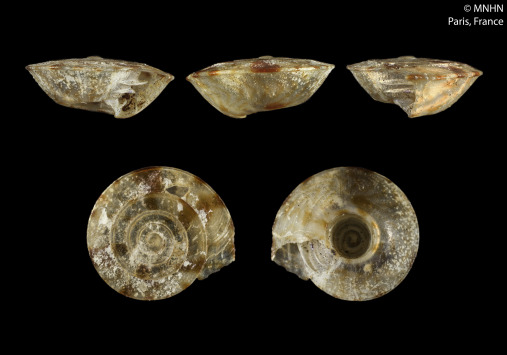
Mollusc shells such as these of extinct lamellar disc snails (Endodonta lamellosa) are useful as records of species that have become extinct within recent history. (Photo: Muséum national d’Histoire naturelle, accession number MNHN-IM-2000-22719 (CC BY 4.0).)

Monday, January 24, 2022

a family tree of life

I enjoyed drawing my family tree when I was young, but have long since run out of space to fit in all my ancestors, so I was quite impressed to see people have found a solution to fitting 2 million species onto a family tree of "all" life. I'm having a bit of trouble with the claims that it is complete and covering all of life though, as the estimates I recall for species numbers of eukaryotes are on the order of 8 million, and for all cellular life there was a calculation predicting one trillion species. So, it's rather a family tree of every species that has a binomial name, but still quite impressive.

I took that as an excuse to discuss the cultural history of using trees for data visualisation as well. The resulting feature is out now:

A family tree of everything alive

Current Biology Volume 32, Issue 2, 24 January 2022, Pages R55-R58

FREE access to full text and PDF download

Following the evolution of our ancestry from the last universal ancestor, one has to watch out for the places where we take a small side road, while the road ahead leads to a larger number of species. This is the case first for the split between deuterostomes and protostomes and then, shown here, when mammals part ways with the rest of four-legged animals. (Image provided by OneZoom.)

PS The PNAS special issue on the Earth BioGenome project, which aims to sequence the genomes of all named eukaryotes, so a very similar number of species (1.8 million) unfortunately arrived too late to be mentioned in this feature. I covered that project on its launch in 2018, and will do an update on it elsewhere.

NB: as the 2022 features move into the open archives, I will add them to this thread on Mastodon.

Monday, January 10, 2022

here be dragons

I like to start the new year with a feature on the theme of "fantastic species and where to find them". This year's instalment is on dragons - various reptile species that look like mythical beasts and/or are named after them. (Not including leafy sea dragons though, as I covered them in the original fantastic species feature.) Essentially, although (European) myths and legends tell us dragons need to be slayed (Chinese dragons are getting a bit more respect), the message here is that some of them may need saving:

Dragons in danger

Current Biology Volume 32, Issue 1, 10 January 2022, Pages R1-R3

FREE access to full text and PDF download

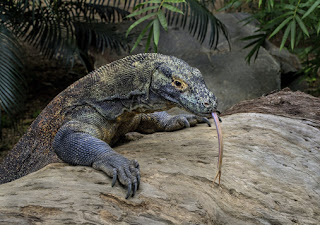
The Komodo dragon (V. komodoensis) has had its Red List status upgraded recently, as climate change is bound to shrink its surviving populations. (Photo: David Clode/Unsplash.)

PS As I write this, fossil dragons are in the news, too. Maybe keep those for the next dragon feature.

service announcement: a new twitter thread to connect this year's CB features starts here.

NB: as the 2022 features move into the open archives, I will add them to this thread on Mastodon.

Monday, December 20, 2021

make antibiotics evolution-proof

My first article about the dangers of antibiotics resistance came out in September 1994, so I am getting a little bit frustrated that this problem hasn't been fixed in the last 27 years. We are now reaching a point where a post-antibiotic age, meaning widespread incurable bacterial infections wiping years off our life expectancy, is a very real possibility. While I was writing this feature, I needed a course of antibiotics myself, which very nicely focused my mind on what a post-antibiotic world might be like.

The only thing that cheered me up was finding that all the recent work I discussed is based on the premise that we need to find a fundamental new way out of the race we've been running against the evolution and spread of resistance genes. Basically, bacteria have been dealing with fungal antibiotics for hundreds of millions of years. Thus, thinking that we might overcome them with slightly different antibiotics was always naive. So if we want to win this, we need to find evolution-proof recipes.

My feature on the latest advances in this quest is out now:

How to avoid a post-antibiotic age

Current Biology Volume 31, Issue 24, 20 December 2021, Pages R1549-R1552

FREE access to full text and PDF download

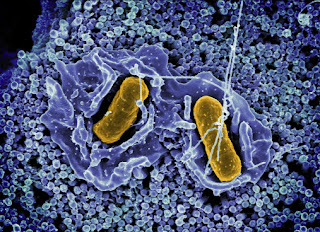
Drugs specifically suppressing virulence factors instead of eradicating the bacteria have been tried on Salmonella enterica serovar Typhimurium, among other pathogens. Here, Salmonella cells (yellow) invade a human gut epithelial cell (blue). (Photo: NIAID/Flickr (CC BY 2.0).)
Wednesday, May 26, 2021

replicating the RNA world

I'm really excited about recent progress in the field of recreating the RNA world. The very small bunch of people pursuing this is now tantalisingly close to having an RNA molecule that can replicate itself or other RNAs of the same size. Once they achieve this, I naively imagine, they could just let the magic molecule loose in their in vitro RNA world scenario and watch it evolving all by itself, re-enacting the origin of life. I wrote a feature about this for Current Biology last autumn, but since then Peter Unrau's group has made another step forward in mimicking modern aspects of gene regulation on the the RNA World stage, in a move that also improves processivity, i.e. the replicating ribozyme staying on the template for as long as it takes. So, my new feature, taking this step into account, is now out in C&I:

Spark of life

Chemistry & Industry Volume 85, Issue 5, May 2021 Pages 26-29

access via:

Wiley Online Library (paywalled)

SCI - appears to be on open access right now

Loving the carnivorous plant closeup on the cover - nothing to do with my feature, but with a feature on plant peptides.

PS The previous issue (No. 4) includes my review of the book Stem cells: From hype to hope on page 37)