Showing posts with label zoology. Show all posts

Monday, February 27, 2023

a flamboyance of flamingos

Flamingos are eternal favourites of visitors in zoos everywhere and have been held in captivity for centuries. Surprisingly, it still isn't all that easy to breed them successfully, and only a few zoos have succeeded on that front. A recent review of reproductive success or lack thereof using the ZIMS (Zoological Information Management System) database of life history information gathered in zoos around the world has led to new recommendations. More generally, the findings highlight the issue that, if zoos are to act as a refuge for endangered species, we have to make sure we understand their life histories well enough. Other recent zoo stories covered include the longevity of parrots, cancer risks in mammals, and rewilding of sea otters.

If you always wondered how to breed flamingos (or how to rewild sea otters), here are some answers:

Learning lessons at the zoo

Current Biology Volume 33, Issue 4, 27. February 2023, Pages R123-R126

FREE access to full text and PDF download

See also my Mastodon thread where I highlighted all CB features of 2023.

I'm not on Instagram myself, but I believe if you follow CurrentBiology there, you'll find my features highlighted there as well.

Flamingos use their characteristically bent beaks upside down for filter feeding on plankton. This is a P. jamesi in Bolivia. (Photo: Murray Foubister/Flickr (CC BY-SA 2.0).)

PS 6.3.2023 Speaking of zoos, here's the director of London Zoo on their new offer of £ 3 tickets for ppl on benefits. (I was a bit shocked that the regular price is 10 times more, but then again I haven't been at a zoo in decades.)

Monday, January 10, 2022

here be dragons

I like to start the new year with a feature on the theme of "fantastic species and where to find them". This year's instalment is on dragons - various reptile species that look like mythical beasts and/or are named after them. (Not including leafy sea dragons though, as I covered them in the original fantastic species feature.) Essentially, although (European) myths and legends tell us dragons need to be slayed (Chinese dragons are getting a bit more respect), the message here is that some of them may need saving:

Dragons in danger

Current Biology Volume 32, Issue 1, 10 January 2022, Pages R1-R3

FREE access to full text and PDF download

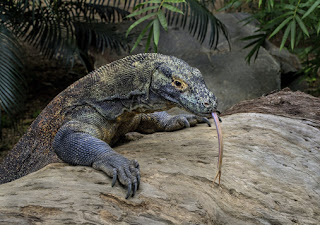
The Komodo dragon (V. komodoensis) has had its Red List status upgraded recently, as climate change is bound to shrink its surviving populations. (Photo: David Clode/Unsplash.)

PS As I write this, fossil dragons are in the news, too. Maybe keep those for the next dragon feature.

service announcement: a new twitter thread to connect this year's CB features starts here.

NB: as the 2022 features move into the open archives, I will add them to this thread on Mastodon.

Monday, June 07, 2021

giraffe genomes

I tend to write about species that are underappreciated, eg because they are living underground or in the deep sea or because they are invisibly small. Every once in a while, however, I also cover the big beasts that everybody knows from their local zoo or wildlife park. So this week it's the debut appearance in my writing of the mighty giraffe. I had noticed a paper on its collective behaviour, as well as one on genomics explaining its extreme adaptations, and then it turned out Current Biology had another one in the pipeline with more giraffe genomes.

So here goes, the questions you were asking on your first visit to a zoo, can finally be answered:

Survival of the tallest

Current Biology Volume 31, Issue 11, 07 June 2021, Pages R697-R699

FREE access to full text and PDF download

Giraffe mothers with calves are more often seen near human settlements, presumably due to the lower risk of predation from lions and hyenas. (Photo: 12019/Pixabay.)

Monday, August 03, 2020

colourful characters

I spotted an interesting book review in Current Biology - Thinking like a parrot - and realised that this was a topic about which I haven't written a feature yet, so I closed that gap with a little help from Nicky Clayton (who starred in this feature) and her colleagues. Oh, and I should mention that I found a lot of inspiration on the ecology/conservation of parrots in the grrlscientist blog.

After the cats and mice, another fun topic, but world-saving services will resume soon.


Clever and colourful characters


Current Biology Volume 30, Issue 15, 03 August 2020, Pages R841-R844
FREE access to full text and PDF download


Parrots as companion animals require substantial amounts of attention — as does the threat to surviving parrot populations in the wild. (Photo: Michael Clarke/Unsplash.)

Monday, July 20, 2020

playing cat and mouse

After the Covid communications feature, I needed a little bit of light relief and was very grateful to discover through the twitter feed of French newspaper Libération a recent paper about how mice became associated with human settlements. Obviously, once we had mice in our houses eating all our grain provisions, we also needed cats. Libération referenced an ancient story about cat domestication from the 00s, but I was sure I had seen something more recent elsewhere, and I found it, and so I could close the circle of life: humans - grains - mice - cats - humans. That was very satisfying, and it fits in really nicely with lots of earlier features I wrote about things like the evolution of agriculture, the Indoeuropean languages, dogs, Bronze Age civilisations, and more.

So, great fun, and I hope you enjoy it too.


Of mice and men, cats and grains

Current Biology Volume 30, Issue 14, 20 July 2020, Pages R783-R786

FREE access to full text and PDF download


New analyses of ancient rodent remains suggest that the house mouse moved in with Neolithic humans even before they started storing grain. (Photo: Chris Game/Flickr (CC BY-SA 2.0).)


PS It just dawned on me that this was my 222nd feature in this format, published on July 20, 2020. Also, if you're on instagram (I'm not), you can find the feature here, and like, share, comment, or whatever people do on instagram.

Monday, November 18, 2019

in praise of bats

Back in July I took part in a guided bat-watching tour in Düsseldorf (run throughout the summer holidays by fledermaus.nrw), and learned so many things that I thought I really should do a feature about bats. Add to that the seasonal bat obsession in the run-up to Halloween and a few recent research papers, and the feature came to life. It is out today in Current Biology:

Why we should care about bats
Current Biology Volume 29, issue 22, R1163-R1165, November 18, 2019

FREE access to full text and PDF download


image source

Monday, July 08, 2019

living the lazy life

I may be a little bit lazy, but learning about sloths last month I found out that there are lots of higher levels of laziness that humans can only dream of, such as lowering your body temperature, or slowing down your metabolism and going to the loo only once a week. We're clearly not worthy to share a planet with a species (or five) so ardently committed to energy saving.

Seriously though, and laziness aside, there are lots of very interesting evolutionary and ecological connections around the sloth which made this a really exciting feature to write (once I'd overcome my own sloth). The resulting feature is out now:


How sloths got their sloth


Current Biology Volume 29, issue 13, pages R603-R606, July 8, 2019

FREE access to full text and PDF download


a sloth I bumped into at a railway station in the week when I was preparing the feature.

Monday, July 02, 2018

plight of the primates

Open Archive Day

We all know that orangutans are in trouble, and the other great apes are also having a rough time in the anthropocene. While these are our closest relatives in the animal kingdom, our extended family, the order primates, is endangered across the board, with over 60% of the species listed as threatened.

In a paper based on literature review and modelling of land use until the end of the century, researchers from the German Primate Centre (Deutsches Primatenzentrum, DPZ) highlight the plight of the primates and paint an even darker future for them.

Which chimes with the take-home message of my feature from a year ago, which is now on open access (and which happens to have the same title as the DPZ press release, but I admit it wasn't a terribly original title anyway):

Primates in peril


a male mongoose lemur (Eulemur mongoz)
Image source: Wikipedia

Monday, April 16, 2018

zoo research by numbers

Open Archive Day

A recent paper claims to be the first to have quantified the scientific output of zoos and aquariums:

Quantifying the contribution of zoos and aquariums to peer-reviewed scientific research


which reminded me of my own more qualitative effort from 2015, which is now in the open archives:

Can zoos offer more than entertainment?


Zoos and aquariums are facing criticism for keeping animals in captivity under conditions that might not always match their requirements. (Photograph: Mike Peel www.mikepeel.net.)


Monday, January 08, 2018

save the rhinos

Rhinoceroses are one of many families of Pleistocene megafauna that have declined dramatically and come close to extinction. Of the five surviving species, three are critically endangered right now, another has made a dramatic recovery after it was believed to be extinct a century ago.

As growing demand for illegal products from the rhino horn fuels a new crisis and conservation science has to pull all the stops keep the species that are still with us, I've looked at the hopes and fears for the surviving rhino species in my latest feature:

Last call to save the rhinos

Current Biology Volume 28, Issue 1, 8 January 2018, Pages R1–R3


FREE access to full text and PDF download


Oh, I should also mention there are two research papers on rhino conservation in the same issue (I briefly mention them in my feature too):

Cindy Harper et al.: Robust forensic matching of confiscated horns to individual poached African rhinoceros, pages R13-R14, open access

H. L. Mays et al.: Genomic Analysis of Demographic History and Ecological Niche Modeling in the Endangered Sumatran Rhinoceros Dicerorhinus sumatrensis, pages 70-76, open access

which explains why there's a rhino on the cover as well:


This is an Eastern black rhino (Diceros bicornis michaeli), apparently. No relation of mine as far as I'm aware.


And here's abonus illustration which I added before I saw the cover:


Rhinos depicted in the Chauvet Cave (southern France, ca. 30,000-32,000 years ago)

source


Tuesday, June 20, 2017

primate problems

There are around 500 primate species on our planet. Two thirds of them are threatened with extinction, because one, Homo sapiens, isn't quite as wise as the binomial name suggests. In my latest feature I have discussed some of the threatened species and the problems they are facing:

Primates in peril

Current Biology Volume 27, Issue 12, pR573–R576, 19 June 2017


OPEN access to full text and PDF download


Ring-tailed Lemur (Lemur catta) at Berenty Private Reserve in Madagascar. Source: Wikimedia

Monday, August 22, 2016

talking to animals

Inspired by the recent news of mutual communication between honeyguide birds and humans, I have had a look at our exchanges with other animals, including barking and meowing ones. The resulting feature is out now:

Talking with animals

Current Biology Volume 26, Issue 16, pR739–R742, 22 August 2016

FREE access to full text and PDF download

The Yao in northern Mozambique cooperate with honeyguide birds to raid bees’ nests, which the birds locate and the humans then break up to provide food for both. Humans and birds have specific calls for their joint honey-hunting expeditions, which have been established for several centuries at least. (Photo: Claire N. Spottiswoode.)

Monday, May 23, 2016

lumbricus terrestris

Earthworms have found very little appreciation in mainstream biology ever since their biggest fan, Mr Charles Darwin, died. Now, however, several projects are underway aiming to reveal the ecology, diversity and economic benefits of worms and other soil invertebrates - including a new Earthwatch-sponsored "citizen science" project encouraging you to survey the earthworms in your garden. Read all about it in my latest feature which is out now:

Putting earthworms on the map

Current Biology Volume 26, Issue 10, pR387–R390, 23 May 2016

restricted access to full text and PDF download
(will convert to open access one year after publication)

Darwin’s interest in earthworms led to the publication, in the last year of his life, of a book about them. This is a caricature of Darwin’s theory in the Punch almanac for 1882, published at the end of 1881, just after publication of his book, The Formation of Vegetable Mould through the Action of Worms with Observations of their Habits. (Image: PD-ART(cc PD-old-100)/Wikimedia Commons.)

Monday, February 08, 2016

cultured chimps

I hear today is the start of the year of the Monkey in the traditional Chinese calendar. Not quite sure which species it refers to, but by sheer coincidence, I also have a primate-related feature out today, exploring the concept of cultural learning in chimpanzees and also reflecting the conservation worries for both our nearest relatives, chimps and bonobos.

Chimpanzees, our cultured cousins

Current Biology Volume 26, Issue 3 (February 08, 2016) pp R83-R85

OPEN access to full text.


Chimpanzees in the wild are known to use both stones and wooden hammers to crack nuts. Groups differ in the patterns of tool choice for this task. (Photo: C. Boesch/MPI EVA.)

Monday, January 11, 2016

the great megapoo escalator

What links whale poo, the genome of the woolly mammoth, geo-engineering, megafauna extinction, gene editing, Homo sapiens' role as a predator, phosphorus, and the Haber Bosch process (which turns nitrogen from the air into fertiliser)?

Apart from the fact that these are topics I have written about in the past, they have all come back in my latest feature, which combines previous interests in a way that is downright spooky. I've counted 7 cross references to previous Curr. Biol. pieces alone, and there are some connections to work published elsewhere as well. Most surprisingly of all, it all makes sense, at least to me.

So the grand unifying principle that links all these issues is, ahem, megafauna excrement (or megapoo, to use my shorthand for the article). It turns out that large animals are good at moving nutrients against the flow, from the bottom of the oceans to the top of the mountains, with the actions of whales, seabirds, migrating fish, and terrestrial megafauna combining to form one gigantic nutrient escalator. Whereas we humans tend to do the opposite, we flush our droppings down the toilet and use sophisticated engineering to ensure that they disappear from circulation as fast as possible. And our domesticated livestock isn't much use at nutrient dispersal either.

Not for the first time, I've just learned about an amazing way in which the biosphere functions to keep our planet habitable, only to find out in the process that with our combined use of plumbing and and decimation of megafauna, we've found yet another way to wreck biosphere functions. So this was simultaneously very inspiring and very depressing.

Read the story here:

Megafauna moves nutrients uphill
Current Biology Volume 26, Issue 1, pR1–R5, 11 January 2016
Open access to full text and PDF download
This article is now in the open archives as it was published more than a year ago.

Poo makes the world go round - although large animals make a bigger contribution than the modest dung beetle. Image: Kay-africa/Wikimedia Commons.

Monday, October 19, 2015

killing the wrong animals

I don't often write about food, but when October approaches I somehow feel obliged to contribute to the various harvest festivities happening in the northern hemisphere, so I wrote a feature about humanity's unsustainable hunger for meat from an ecology / evolution perspective.

The feature is out now:

Can we change our predatory ways?

Current Biology Volume 25, Issue 20, pR965–R967, 19 October 2015

abstract and open access to full text, PDF file

A vegan cafe/shop I snapped on my recent visit to Leipzig, Germany.

Monday, July 20, 2015

animals on the move

Thanks to the ongoing revolution in communication technology which now tracks our every move, it is also much easier to track wild animals, even small ones. What's more by tracking many and diverse animals, we can learn more about the biosphere than was possible previously, as animals can become reporters in the service of science, and may help their own survival in the process.

I've discussed these things and the recent book "Das Internet der Tiere " (The internet of animals), shown below, in my latest feature in Current Biology which came out today:

Animal moves reveal bigger picture
Current Biology Volume 25, Issue 14, pR585–R588, 20 July 2015
Open access

Das Internet der Tiere: Der neue Dialog zwischen Mensch und Natur, by Alexander Pschera, October 2014.

Tuesday, May 19, 2015

arks or prisons?

In my latest feature in Current Biology I've explored the ethical quandaries around animals being held captive in zoos and aquariums. Starting from a binary of the animal ark vs animal prison kind, I discovered that there is a third dimension to it as zoos are increasingly also using their expertise to help animal conservation in situ, i.e. in the natural habitat where they belong.

Read all about it:

Can zoos offer more than entertainment?

Current Biology Volume 25, Issue 10, pR391–R394, 18 May 2015
Open access

Expatriate animals in Lille, France (own photo).

Tuesday, December 16, 2014

the trouble with animals

It's all very well having animals around as food or for company, but the trouble is that we pick up diseases from them, and those can be deadly, especially in the initial phase after jumping across to our species. At the end of the year in which Ebola hit the headlines for months, I've discussed the wider problem of zoonotic disease and the lessons to be learned from the failure to tackle Ebola in time to stop it running out of control.

Our shared burden of diseases

Current Biology Volume 24, Issue 24, pages R1139–R1141, 15 December 2014 Open access

(I can send PDF "reprints" on request, and the article should become freely accessible one year after publication)

Monday, September 08, 2014

deviant desires

My latest feature in Current Biology, partially inspired by the recent book Perv – the sexual deviant in all of us, by Jesse Bering, covers the biological diversity of sexual orientations in humans (and some animals) and our society's inability to deal with this serious problem in a rational manner.

Paraphilia or perversion?

Current Biology Volume 24, Issue 17, pR777–R780, 8 September 2014
DOI: http://dx.doi.org/10.1016/j.cub.2014.07.047

OPEN access to full text and PDF

Leda and the Swan, a 16th-century copy by Peter Paul Rubens, after a lost painting by Michelangelo (National Gallery, London)