Showing posts with label alsace. Show all posts

Thursday, August 20, 2026

1664: something brewing in Strasbourg

After discovering various ancestors in 17th century Strasbourg (still a Free Imperial City at that point), it occurred to me that Kronenbourg, having named one of their beers "1664" might have been around at that time too. Unfortunately, the history of the brewery doesn't appear to be very well presented anywhere (it is extremely thin on the company website), so I'll use this entry to compile the bits and pieces I find.

Von Florent from Paris, France - 1664, CC BY-SA 2.0, https://commons.wikimedia.org/w/index.php?curid=10911888

In 1664 Geronimus Hatt IV (Jérôme Hatt in French; 1633-1675), son of a dyer, started brewing in a house called Zur Kanone (cannon) at the square Rabenplatz (now known as Place du Corbeau). It was named after the raven as in the Middle Ages this area was the place of executions and the birds came to consume the dead bodies. More recently though, this has become a very desirable address, just across the river Ill from the cathedral (reached via the raven's bridge). The brewery business stays in the possession of the Hatt name line until 1977, across more than three centuries and eight generations, which is very impressive. According to his French Wikipedia page (no other language versions available at this point), he had obtained his brewer's licence the same year, whereas this F1 fan page suggests a slightly different version.

According to the F1 page, his son Claude took over the brewery in 1683. However, this name and date doesn't appear in the Wikipedia overview of the family history. There, many different descendants are brewers in various places in Strasbourg and beyond, so to simplify things I'll try to pick out the lineage that leads to the last owner of the family business.

1) Jérôme Hatt IV (1633-1675) marries in 1664 Marguerite Hamm, daughter of the baker Johann Hamm. As described above, he starts brewing in 1664 at Rabenplatz (Place du Corbeau). The very amazing website Maisons de Strasbourg has info on the house numbers 1, 7, 8 and 9 and none of these had a Hatt person (nor a brewer) in the 1660s. The numbering around the square (see the map) only went up to 9, so that only leaves numbers 2-6. Number 5 is huge, so for the humble beginnings of a newly licensed brewer I'd imagine one of the smaller houses.

2) Jérôme Hatt V (1668-1734), brewer renting the house Zum Vogelgesang / Chant des Oiseaux in 1692 (7 quai des bateliers, just a few doors down from the Rabenplatz), marries Catherine Boch the same year. In 1713, he inherits the birdsong house from his mother, who had married the owner Hans Jacob Verius in 1675 and bought the house with him in 1689 when the previous owners filed for insolvency.In 1716 he marries Catherine Goll, mother of brewer number 3). She was previously married to a priest called Georges Frédéric Leonhard, and in 1736 marries Philippe Guillaume Milius In 1746 her son, the brewer Jean Daniel Hatt and his wife (oo 1740) Susanne Marie Kammerer inherit the house. It stays in the Hatt family until 1759. Search "Hieronymus" on the page about the house to find 25 entries relating to the Hatt family. For instance, in the 1730s they also buy neighbouring properties and apply for permission to knock through walls to expand their business space.

3) Jean Hatt (Strasbourg, 14 août 1720-Strasbourg, 29 octobre 1753), founder of the brewery l'Espérance en 1745 à Strasbourg then at Schiltigheim. Marries Marguerite Barbe Heyl 1746 at Strasbourg. Rents the basement of 6 rue de la Croix in 1747. (There are many more hits for Espérance on the website, probably enough info to reconstruct the history of the breweries operating under that name.)

4) Jean-Louis Hatt (Strasbourg 1752 - 1804), brewer at l'Espérance. Marries Anne Barbe Kellervitter in 1780 at Strasbourg.

5) Philippe Jacques Hatt (Strasbourg 1787 - 1862), brewer at l'Espérance, founder of the brewers' association of Strasbourg. Marries Marie Catherine Rothenbach (1791-1838) 1812 at Strasbourg.

6) Philippe Jacques Hatt (Strasbourg, 16 november 1813)

7) Frédéric Guillaume Hatt (Strasbourg 1849 - 1916), leads the brewery at the Kronenbourg quarter of Strasbourg. Marries Eugénie Boersch (1854-1883) 1874 at Strasbourg.

We have a bit of a consistency problem here, as the company website claims that Frédéric Guillaume Hatt moved the brewery to Kronenbourgh in 1850, at which point he would have been around one year old. Maybe he had an uncle with the same name who is missing in the wiki family history. That would also fit the counting of generations on the website as they say sixth generation. The reason for the move was the flood risk in the city centre. The Kronenbourg district is on hills and thus safe. Wikipedia gives 1862 as the date of the move (still inconsistent) and also mentions that hills enabled the use of cellars for cold storage during longer brewing procedures.

8) Maurice Jérôme Hatt (Strasbourg 1869 - 1958), acquires the brasserie du Tigre and creates the brand Tigre Bock. Marries Hélène Nessmann 1897 at Strasbourg, then after her death, Valérie Fischer 1911 à Strasbourg.

9) Jérôme Maurice Hatt (Strasbourg 1912 - Perthuis 1998). The last leader of the family business.

Production at the Kronenbourg site ceased in 2014. All brewing is now happening in Obernai.

Which is all very interesting but not much use for my family history. I need to find the first three bearers of the name Geronimus Hatt, as they would have overlapped with our goldsmith Franz Bolion von der Rosen and his wife Ottilia Flach.


Stop Press: This Lutheran vicar Matern Hatten (1470-1546) moves from Speyer to Strasbourg and marries Barbara Hager from Regensburg has a son called Hieronymus, who marries Agnes Stock and again has a son of the same name, and he is a dyer. Now that looks very promising.

In the history of the birdsong house we find the marriage entry of Hieronymus Hatt IV with the name of his late father given as Hieronymus Hatten.

With the search term Hieronymus Hatt (as opposed to Geronimus which I had from the wiki page of the first brewer) I also found a family tree for the brewery founder in Geneanet. So, going backwards now, we have:

1. Hieronymus Hatt IV (1633-1675)

2. Hieronymus Hatt 1596-/1633 (this marriage in 1630 also in Gedbas)
3. Maria Gassner /1613-

4. Hieronymus Hatt 1573-
5. Susanna Jung 1575-/1625
6. Daniel Gassner †1631/
7. Anna Maria Mischler (according to GedBas)

8. Philipp Hatt /1550-/1611
9. Dorothea Windisch 1552-
10. Martins Damian Jung /1540-1595/
11. Margaretha Jud /1549-/1576

18. Matthes Windisch †/1577
19. Ursula Baldner †/1558
20. Martin Jung †1566/
22. Jacob Jud /1507-1566/
23. N Post /1510-

Sadly, Geneanet runs out of Hatt ancestors at this point, although we're still one Hieronymus short, if the one born 1633 is the fourth. I think this fits quite plausibly with the son of the vicar mentioned above though. So if we trust the numbering of the Hieronymuses, we could fill in Hieronymus I as number 16. and the vicar would be 32. Actually, Wikipedia says that Hieronymus (son of Matern Hatten) had sons called Hieronymus and Philipp. So that works. We then have, based on that Wiki entry:

16. Hieronymus Hatt + after 1566
17. Agnes Stock + before 20. Mai 1546

32. Matern Hatten * around 1470 Speyer + 14. März 1546
oo before July 1537
33. Barbara Hager * Regensburg

64. Matern von Hatten (from the place Hatten near Wissembourg?)
65. Margarethe Reuß (from a family with lots of clerics at Speyer)

While these brewers are not attached to my ancestry (yet), there are parallels to the history of the Kirner Pils brewery, where we have a known family connection, so I do have an excuse for being nosy.


Confused about who is who? - see my new name index for all things family history.

There's also a nascent index of place names here.

And here's the index of migration events.

Thursday, July 30, 2026

pioneering printers

Our Strasbourg goldsmith Franz Bolion von der Rosen married Ottilia Flach, born around 1560, and I have seen speculation that she might descend from the Strasbourg printers Martin Flach the Elder and his son, the Younger. So let's see how these fit together:

Martin Flach the Elder was born mid 15th century in Küttolsheim near Strasbourg, and died 20.11.1500 in Strasbourg. After an apprenticeship with Johannes Mentelin, he started his own printing workshop in Strasbourg in 1487 and mainly printed religious works eg by Albertus Magnus. For reference, Gutenberg completed his pioneering printing of the bible in 1454 and died in 1468.

Bust of Johannes Mentelin at the humanists' library in Sélestat
Source: Von Alexandre Dulaunoy from Les Bulles, Chiny, Belgium - La bibliothèque humaniste de Beatus Rhenanus / Humanist Library of Beatus Rhenanus, CC BY-SA 2.0, https://commons.wikimedia.org/w/index.php?curid=11779810

His son, Martin Flach the younger, was also a printer and active in Strasbourg between 1500 and 1539.

Our earliest Flach, Adam Flach (the Elder) was born around 1480 in Maisonsgoutte (source). (Note that this local tourism website says the village was called Hisselbach in the 14th century, which then mutated to the French Maisonsgoutte, which was Germanised in 1603 to read Maisengott and then became Meissengott in 1665.) Judging by his age, he could be a brother or cousin to Martin the Younger. He died 6.3.1533 in Schlettstadt (today Sélestat).

Following the nameline down from Adam, we have Adam the Younger, Gabriel, then Ottilia:

Adam Flach was born in Schlettstadt around 1510, immatriculated at the University of Freiburg in 1538 , died at Weilertal after 1539.

Gabriel Flach was born 1524 in Weyerthal near Strasbourg, and died 1580 in Strasbourg.

The second question is if and how Ottilia is related to the Flach ancestors of Albert Schweitzer (which is claimed in this forum contribution). The longest Flach nameline I could find online goes up from his great-grandmother Marie Madeleine Flach (1782-1847) to

Jean Jacques Frederic, born 1756, then

Johann Christoph, 1725

Johann Christoph, 1701

Johann Christoph, 1656

So we're still a century or 3-4 generations away from a potential brother of Ottilia.

On both fronts, I could do with a few more Flach people to join those dots.


Confused about who is who? - see my new name index for all things family history.

There's also a nascent index of place names here.

And here's the index of migration events.

Thursday, July 23, 2026

all our Alsatian connections

My (paternal) grandparents met at Bonn, but each had a family background with (temporary) stays in Alsace and Lorraine. I knew them well, but the extent of this shared cultural background only dawned on me long after they both died.

Ironically both were born in Lorraine (just outside Alsace), but more attached to Alsace. The main connections are the railway station of Adamsweiler hosting Ruth's grandparents (after many years of migrating between other stations in the Alsace Lorraine network) and the Strasbourg love story of Richard's parents. Beyond that, they were probably unaware of additional Alsatian roots that both their families had much deeper in the past, which only came to light through recent research. I had started a list of Alsatian connections at the bottom of the recent entry about the Adamsweiler station but then realised there are around ten different stories, so they need a blog entry all of their own.

I'll separate his and her Alsatian ancestries, starting with Ruth, and having earliest stories first. On Ruth's side, there are twice as many stories, but there is a conspicuous gap between 1681 and 1870, which is the time when Strasbourg and the Alsace were under French rule.


Ruth's six connections:

The goldsmith of Strasbourg, Franz Bolion von der Rosen (ca. 1552 - ca. 1620). While the von der Rosen nameline only passes through Strasbourg (coming from Liege and moving on to Winterburg), his wife, Ottilia Flach appears to be from a resident Alsatian family that also turns up in the ancestry of Albert Schweitzer through his maternal line great-grandmother Marie Madeleine Flach (1782-1847). Ottilia's father Gabriel Flach was born 1524 in Weyerthal near Strasbourg, and died 1580 in Strasbourg. Her grandfather Adam Flach was born in Schlettstadt (today Sélestat) around 1510, immatriculated at the University of Freiburg in 1538 (he might be another clergyman???), died at Weilertal after 1539. Her great-grandfather, also called Adam Flach, was born around 1480 in Meissengott (today Maisonsgoutte, Alsace) and died 6.3.1533 in Schlettstadt. So that seems to be a solidly Alsatian background, although we sadly don't have the names and origins of the women involved. The assertion that these Flachs are Schweitzer's ancestors too rests on this forum entry. As yet, I haven't been able to find the whole connection, will do a new entry when I find it.

Conon the contrarian (1546-1602) studied theology in Rostock and Strasbourg, then spent two years as an assistant priest in Mundolsheim (today part of the Strasbourg metropolitan area), before moving on to the Mosel valley. His Alsatian years must have been in the 1560s.

Conon's son in law Christian Nesselius (ca. 1576-1631), whose bio is included in the same blog entry) studied in Strasbourg as well, that must have been in the 1590s. In 1600 he came to Birkenfeld where he served as a schoolmaster under Conon's supervision and ended up marrying his daughter.

Nicolaus Andreae (1580s to 1640s) studied in Strasbourg and married there, which became an issue when he arrived in Kastellaun in 1607 as a young schoolmaster needing accommodation. He would have been at Strasbourg in the first years of the 17th century, but could in theory have overlapped with Nesselius. Sadly we don't know who the wife of the Strasbourg and Kastellaun years was and whether she also was the founding mother of the Andrae lineage at Gebroth and the widow who survived Nicolaus and married again. Probably not, considering the record of domestic violence in between. Also, considering the known background of his widow (Anna Amalia Orth), I don't see how he would have married her at Strasbourg.

Johann Conrad Arnoldi I (1628-1711) Matriculated at the University of Strasbourg 25.2.1645. Now that's what I call a clear and specific date. By 1651 he was in office in the Hunsrück area.

Cover of a timetable brochure from 1902. Source: Wikipedia.

The family of the stationmaster of Adamsweiler Christoph Gottlieb Kauer (1845-1909), who joined the Imperial Railways in Alsace Lorraine (Reichseisenbahnen in Elsass-Lothringen) after the war of 1870/71 and stayed in their service until he died. His widow and all remaining family members were evicted from Alsace Lorraine in 1919.


Richard's three connections (four if I split the second one):

I had a vague memory that my Bondam / Bonnedame huguenots had an Alsatian connection, but that turns out to be Phalsbourg just beyond the border to Lorraine, a town in a German-ruled enclave founded in 1570 specifically to offer refuge to Huguenots persecuted in France. Then again, I read that after the town fell under catholic rule in 1608, many of the protestants fled to Bischwiller in Alsace. So there could be another Alsatian connection waiting to be explored.

The migrating miners and the Trimbachs are two strands that converge in the supremely unsearchable Paul Simon (1740-1813), who was born in Sainte Marie aux Mines but left Alsace to settle in Böchingen, Palatinate, where he got married in 1768. The Simon name line only passes through Alsace (Paul's father Johann Christoph Simon was born in Niederhosenbach, Hunsrück), but his mother, Maria Susanna Trimbach (1713-1752) has six Alsatian great-great-grandparents we can account for, including two local councillors in Munster and a woman born in Badonvillier. These were born around 1570. We know that the Trimbach name line came from Switzerland in the 16th century, but there must be at least some ancient Alsatian lineages among the others. Family names in Maria Susanna Trimbach's ancestry include Klein, Monschat, Saass, Fabry, Sturm. All of her ancestors with a known birth place were born in Alsace, with the earliest births in the 1540s. My 8th generation ancestor Maria Susanna Trimbach is also my strongest claim to (1/256) Alsatian ancestry. The more wobbly connection to Ottilia Flach, above, only gives me 1/4096 Alsacianicity (plus Albert Schweitzer as a bonus).

And finally, Heinrich the cellist meeting Maria at Strasbourg in 1903 and writing 160 poems for her. The other two Alsatians connections above are both via Maria and her mother. As she had grown up on the other side of the river Rhine in Bruchsal, Alsace wasn't so far away from her, whereas for Heinrich, coming from eastern parts of the German Empire, it must have been a more exotic location.

Strasbourg-Neustadt (German quarter):
the former Sängerhaus, which today is the Palais des Fetes in rue Selenick.


After 1918

In September 1943, Ruth and Richard revisited Strasbourg in the awareness that the war was lost and Strasbourg might be lost and/or destroyed. Fortunately, both they and the city survived the war and we have been visiting the region quite often ever since. Might do a separate entry with old photos relating to some of those visits.


Confused about who is who? - see my new name index for all things family history.

There's also a nascent index of place names here.

And here's the index of migration events.

Thursday, July 09, 2026

a station lost

Update on the railway families:

I just learned that the small railway station of Adamsweiler (Adamswiller), where Christoph Gottlieb Kauer (1845-1909) spent the last 15 years of his life and career as a station master with his wife and five daughters, no longer exists. It was still standing on September 21st, 1989 when I visited the village, and it looked like this:

Own photo

We found the door where the Kauer family had posed for a family portrait around 1900, so here's my grandmother and myself in front of that door (I think it's the street side entrance, the platform side one doesn't have the extra wings on the sides):

Photo by Jörg Groß.

compare and contrast 90 years earlier:

The station master's family outside the station at Adamsweiler, around 1900. The daughters, left to right: Helene, Kätha, Johanna, Auguste, Anna. See also this postcard where family and staff stand between the tracks.

There was even a train stopping there (on the line from Sarregemuines to Strasbourg), although I'm not sure whether that was a regular service. The station building was up for sale at the time, so there definitely weren't any services happening there, but it may have functioned as an unmanned halt.

Own photo

Another descendent of the Kauer family happened to visit the station that same year in June, and even managed to get inside.

Photos by Lothar Bladt.

He told me later that he met a group of young folks from Berlin who wanted to restore the building but ran into a structural problem with the roof which they couldn't fix. So this may well have been why it disappeared.

Checking google streetview on 25.6.2026 I see lots of big lumps of stone by the roadside, ready to be removed. Apparently they belong to the quarry at the end of the station road, Carrières Rauscher.

I found some other photos online, most recent first:

In 2022, a train passes the site of the former station, some lumps of stone from the quarry also visible on the left.

In 2007, the station is still standing but the roof missing.

On this page, if you hover on the railway line next to the name of Adamswiller, a photo of the station will magically appear. The vehicles look like they may be from the 1960s/70s.

A postcard dated 1905 may well be showing Christoph Gottlieb Kauer on the right. The flirtatious messages from several writers are a mix of German, French and atrocious spelling mistakes.

Adding insult to injury, the French Wikipedia entry of Adamswiller lists the stations of Diemeringen and Tieffenbach-Struth as transport options, showing a photo of the latter which looks quite similar to the one that Adamswiller had. It doesn't even mention the station the village lost.

One reason why this little railway station was a bit more important than other properties where people lived at the time is that significant parts of the household contents are still with us, including the 20 volume encyclopedia from the 1870s, the Schiller edition from the early 19th century, and some pieces of furniture and kitchen gadgets. The house that Johanna Kauer built for her retirement has been useful for the preservation of the spirit of her childhood home.


Confused about who is who? - see my name index for all things family history.

There's also a nascent index of place names here.

All things Alsatian are tagged alsace. Note that there are four separate strands of Alsatian stories in my family history (most recent first):

Heinrich the cellist meeting Maria at Strasbourg.

The family of the stationmaster of Adamsweiler (above, also tagged kauer).

The migrating miners and the Trimbachs These two strands converge in the supremely unsearchable Paul Simon (1740-1813), who left Alsace to settle in Böchingen, Palatinate, where he got married in 1768.

The goldsmith of Strasbourg, Franz Bolion von der Rosen (ca. 1552 - ca. 1620). While the von der Rosen nameline only passes through Strasbourg, his wife, Ottilia Flach appears to be from a resident Alsatian family that also turns up in the ancestry of Albert Schweitzer.

PS I had a vague memory that my Bondam / Bonnedame huguenots had an Alsatian connection, but that turns out to be Phalsbourg in Lorraine, a town in a German-ruled enclave founded in 1570 specifically to offer refuge to Huguenots persecuted in France. Then again, I read that after the town fell under catholic rule in 1608, many of the protestants fled to Bischwiller in Alsace. So there could be fifth Alsatian connection waiting to be discovered.

Update 16.7.2026: I nearly forgot to mention that four of the clergymen studied in Strasbourg, so that calls for a new blog entry with all the Alsatian connections!

Thursday, March 05, 2026

a goldsmith at Strasbourg

I recently revisited the family history around the Weiß chronicles, which I hadn't touched in a long time, and discovered quite a few new things and some old things that I knew superficially but never investigated in depth. Among the latter is an ancestry line that came to the Hunsrück from Liège via Strasbourg and included a goldsmith or three.

Specifically, my (presumed) ancestor Johann Conrad von der Rosen was born 1599 in Strasbourg, came to Winterburg (not far from Eckweiler) and married Elisabeth Nesselius (daughter and granddaughter of another ,two protestant priests) and settled as an innkeeper and "Gerichtsherr" (juryman?) at Winterburg where he died in 1656.

His father, Franz Bolion von der Rosen is the goldsmith whose story I want to explore here. He worked at Strasbourg from 1579, so quite possibly in the rue des orfèvres, just northwest of the cathedral. Although it was only named thus in 1680, this street housed goldsmiths since the Middle Ages.

Photo: Par Nikolai Karaneschev, CC BY 3.0,

According to old family histories where he pops up, he was world famous in his time, see for instance this text from Karl Heinz Armknecht from the 1950s. As one of the genealogists who mention him pointed out, he has an entry in Thieme-Becker Künstlerlexikon, where I could track him down. As they spell him as Roosen, he appears in vol 28: Ramsden–Rosa. E. A. Seemann, Leipzig 1934, on pp 583-584:

Basically the entry lists like a dozen sculptures by him that were known to be in the art collection of Elias Brackenhofer (1618-1682). I love they way the author specifies for each single item that the figure is naked. With classical sujets like Venus, Cupid et al. you would rather expect that they aren't wearing too many clothes but this entry spends a significant fraction of its word count on spelling that out every single time. Note also that the dictionary has nearly 150,000 entries so being included doesn't quite make you a household name.

Apparently he had to flee from Liège to Strasbourg where he is recorded in 1579 (although I've failed to find a specific event at that time that might have endangered his life in Liège). At that time he was simply Franz von der Rosen. The Bolion being an extra he acquired upon acceptance into the goldsmiths' guild in Strasbourg, which happened before his marriage to Ottilia Flach on 21.1.1581 in St. Thomas church, Strasbourg. Which is interesting because ... Ottilia is from the Flach family that appears in Albert Schweitzer's family tree (his maternal line great-grandmother was nee Flach), and Schweitzer used to play the organ in St. Thomas church when he studied in Strasbourg some 320 years later. (Find Ottilia on GedBas too.)

Anyhow, what troubles me is that the world-famous goldsmith has been completely forgotten outside the circles of genealogists who proudly present him in their family trees. While there is a family "de Rosen" in Liege, the members who turn up online tend to be much more recent than our refugee, apart from the earliest ancestor, Pierre Rosen, who was a citizen of Liège in 1520. So he could theoretically be the father of our earliest ancestor, the father of the Strasbourg goldsmith:

Humbert / Humprecht Bolion von der Rosen born ca. 1530 in Liege, mentioned 1544-53 as an engraver in the guild list of the goldsmiths of Liège, married Gertrud de Pealier before 1560, then Ursula Meyer in Strasbourg in 1562, which seems to suggest that he came to Strasbourg earlier than the first date noted for his son.

One generation on, we're running out of Roses, but his father in law, Jean de Pealier, was mentioned as an engraver and member of the goldsmiths' guild at Liège from 1548-54. His wife was called Marie Surdelle (which sounds like a made-up name as it translates as "sure of herself").

So we have a whole lot of goldsmithery going on here across three generations, shame that these people have fallen into oblivion.


Who is who? - see my new name index for all things family history.

NB these folks are completely unrelated to my great-grandparents Heinrich (the cellist) and Maria, who met at Strasbourg in 1903 and gave the place a prime position in my lost cities series.

Update 12.3.2026: The connection between these Strasbourg ancestors and those in the Weiß Chronicles is now outlined in this new blog entry.

Update 13.3.2026: I've just discovered two descendants of the goldsmiths have Wikipedia entries: Philipp Caspar Roos (1717-1805) and his son Johann Philipp Roos (born 1754). The first one includes a footnote listing the ancestors of Philip Caspar back to our common ancestor Johan Conrad von der Rosen, who came to Winterburg from Strasbourg.

Thursday, January 22, 2026

life of the station master of Adamsweiler

continuing with the ancient texts rescued from from my old website about the Weiss chronicles, here's the short biography of Christoph Gottlieb Kauer, so following up from generations 10-6 in this blog entry, we now come to:

5. The railway man

A fateful day

August 18th, 1870, must have been one of those days when everything goes wrong. Either that, or some people in very high positions were extremely stupid.

In either case, the early morning of that day saw some 200,000 German soldiers moving at an angle of 45 degrees towards a line of 112,000 French soldiers who occupied a safe position on high ground a few kilometre from the city of Metz, and who had had time to dig trenches for their protection. The strategic vision of the German commander, Helmuth von Moltke, was to outflank the French line. There were a few problems with that plan. First that he didn’t know how long that line was, as nobody had actually gone to check. Second that some of the generals at the front just ignored his orders to hold still and drove their men into the gunfire regardless.

On the other side, things went just as spectacularly wrong. General Bazaine, a distinguished soldier who had simply been promoted one step too far (in an early example of the Peter principle), did not even consider the possibility that he might be able to win this battle. His only ambition was to secure his retreat to Metz, which was to prove the trap in which Moltke eventually caught him. A single day of supreme stupidity and pointless slaughter left more than 12,000 French soldiers dead, wounded or prisoners. The German side counted 20,160 men who were left dead or wounded. Among the latter was a 25-year-old from Simmern, Christoph Gottlieb Kauer.

Christoph Gottlieb Kauer was born at Simmern in 1845 as the first child of shoemaker Mathias Kauer and his wife Sophie Weiß. He completed an apprenticeship as a shoemaker, but then worked as a clerk for a notary.

Simmern was then part of the Kingdom of Prussia. For young men this meant that they had to do obligatory military service for three years, starting at the age of 20, followed by another four years in the reserve and one year in the “Landwehr.” Thus, Christoph Gottlieb will have done his service years from 1865 to 68. In July 1870, when Bismarck’s infamous Ems telegram tricked France into declaring war on Prussia, he was well within his reservist years. Within two weeks of the declaration of war, he must have been in the army of over 1.1 million men dispatched towards French border.

Christoph served as a corporal in the 8th company of the 3rd infantery regiment of the 29th brigade. This was part of the First Army led by General Karl von Steinmetz (1796-1877), a veteran of many wars, starting with the liberation of Napoleonic rule in 1815. This time, however, Steinmetz soon became a liability by following his own impulses and ignoring the subtle strategies and direct orders of the chief of staff, Helmuth von Moltke (1800-1891).

This problem became most obvious in the battle of Gravelotte on August 18, 1870, the biggest and bloodiest battle of this war. Steinmetz was supposed to pin down his end of the French line near the village of Gravelotte while other parts of the German Army moved towards the far end to outflank the French. Moltke had stripped Steinmetz of the command of two of the Corps in his First Army, including the VIII Corps in which Christoph served. Furthermore, Moltke had ordered him to hold still during the 18th, to allow the left wing of the German armies time for the planned strategic move.

Around noon on that day, however, Steinmetz grabbed the command over the VIII Corps back without anybody’s authorisation. By 2:30 pm he had enough of sitting still and -- in clear breach of direct orders -- sent three of the four brigades of the VIII Corps, including Christoph’s 29th brigade, forwards in an attempt to take the farm St Hubert, an exposed outpost in front of the French lines. To get there, the infanterists had to advance across a ravine with no protection, utterely exposed to the French troups equipped with superior mitrailleuses and long range rifles.

The three German brigades didn’t have the slightest chance to get there and were mowed down within minutes. The survivors sought shelter and only much later managed to take St. Hubert, after the German artillery had forced the French out of it. And even then it didn’t bring them any luck and they had to evacuate it again before nightfall.

Legend has it that Christoph shouted “Hooray” a little too enthusiastically when storming towards French positions, allowing a projectile to enter his wide-open mouth and take a large chunk of his jaw-bone on the way out. He grew a rather large beard to cover up the disfigured jaw. But considering the many thousands who died on that day, he (and our lineage) had a lucky escape.

On the next morning, the German troups found that the French had given up and retreated to Metz, where Bazaine’s army surrendered on the 28th of October. By then, the empire of Napoleon III had collapsed, following the defeat of Sedan, where the emperor was taken prisoner. In compensation, Bismarck constructed a new German empire, under Prussian leadership, as King William of Prussia became the emperor William I on January 18, 1871. General Steinmetz was “promoted” to the position of governor of Posen in a move designed to keep him out of mischief (and out of what remained of Moltke’s hair!), while Bazaine was court-martialled and found guilty of treason for giving up too easily.

In spite of (or because of) this traumatic event, Christoph was an early enthusiast of the European idea, later inscribing his family bible with a short poem including the line: “Europa ist mein Vaterland.” In compensation for his battle injury he was offered a career in the railways of the newly conquered Alsace-Lorraine region, the state-owned Reichseisenbahnen in Elsass Lothringen.

Marriage

In 1874 he married Margarethe Imig (1847-1930), also from Simmern, daughter of Weißbender (a cooper who made smaller vessels for dairy and kitchen use from lightly coloured wood, hence the "white" part) Wilhelm Imig (1820-1877) and Regina Catharina Strack (1817-1877). These two had seven children and 40 grandchildren. Margarethe was number two, but number four, Elisabeth, is also of interest, as her son, Julius Düsselmann, married Margarethe’s daughter Helene Kauer, and these two happen to be my great-grandparents.

Margarethe’s ancestors are all from the Hunsrück area for as far as we can tell (to the 10th generation, counted from myself). The Imig lineage can be traced back to Mathias Immig, born 1657 at Fronhofen near Simmern. He lived to the age of 71, but his wife Magdalena outperformed him, reaching the age of 88, which for somebody born in 1651 must have been a miracle. This may be where Margarethe and her five daughters got their longevity genes from.

There is a lovely story of a bunch of would-be emigrants in the early 18th century, including an Imig family, coming from the Pfalz region and heading for America, who got stuck after some 200 km near Kleve, on the Lower Rhine, and founded a “colony” comprising the villages of Pfalzdorf and Luisendorf.

To this day, there are many Imigs in both villages. The most prominent of them was the historian and poet Jakob Imig, 1905-1994. The ancestors of the Imigs in this group of frustrated emigrants have been traced back to Peter Imig, born 1620 in Fronhofen and his wife Gertrud, who was born in Biebern (1621) but died in Fronhofen (1684). While the link to “our” Imigs cannot be established with certainty, Peter and Gertrud Imig might very well be the parents (or other close relatives) of Mathias Imig, who was born 37 later in the same village.

After the war, Christoph Kauer worked with the nascent railways in the Alsace region, moving along with the job, as becomes obvious from the different birth places of his children (Mulhouse, Morhange, Fontoy). His last appointment was that of a station master at Adamsweiler (Adamswiler), where three of his daughters got married in 1900-1907, and where he died in 1909. I have a picture postcard of Adamsweiler showing the railway station as one of the four “tourist attractions” of the village. In front of the station you see a lineup of a station master with a very big beard, his wife, his 5 teenage daughters, and the station staff. When I visited the place in 1989, the station at Adamsweiler was still standing, essentially unchanged, but boarded up and put up for sale.

After Christoph’s death, Margarethe went to live with her second daughter, Auguste Fuchs (see below) at Saargemünd (Sarreguemines), Lorraine. The area became part of France in the Versailles Treaty, and in June 1919 Margarethe was forced to leave. She moved to Bad Münster am Stein, where she lived with her daughter Johanna (or Auguste?) until she died in September 1930, aged 83.

There are quite a few objects from the household of Christoph and Margarethe still in the family today, including a 20-volume encyclopaedia (Pierer’s Conversations-Lexicon), a grandfather’s clock, the bible mentioned above, and six pieces of furniture.

Intriguingly, Christoph and Margarethe produced two sons who died in infancy, and 5 daughters who lived between 73 and 87 years (which, for children born in the 1870s and 1880s is quite an achievement). Clearly, they weren’t meant to spread the name Kauer any further. While two of the five daughters remained childless, the other three had a total of nine children, including my grandmother, her brother and sister, and their six first cousins. With a few of them my grandparents and my great-aunt still held contact when I was a child. Names including Nelly and Martha were mentioned frequently, only I didn’t have the faintest clue who these people were!

1. Christoph Gottlieb Matthias, born 12.10.1875, died within a month.
2. Johanna Sofia, born 9.11.1876 Mühlhausen, died 26.11.1953 Hahnenbach. She remained unmarried, worked as a secretary at Bad Kreuznach. In 1934, she took early retirement and used her savings to build the house at Hahnenbach, which is still in the family. The land was provided by the distant relatives from the Weiß/Schmidt/Weirich/Giloy lineage (descended from Maria Magdalena Weiß, second child of the teacher Christian Gottlieb Weiß). These families have been running the only pub in the village over centuries.
3. Auguste (1879-1952) married in 1900 Wilhelm Fuchs (1872-1963) Postinspektor at Münster a.St.
  1.   Helene (1901-1965) married Mr Petz
  2.   Natalie “Nelly” (1906-1984) married (1931) Christian Paust. One son, Dieter, and two grandsons.
4. Anna Katharina (1880-1965) married Heinrich Thiebold (1877-1948), a teacher from Brebach (Saar).
  1.   Erwin born 1902, died in infancy.
  2.   Martha (1907- ) married Willi Helmer, Saarbrücken, one son, two daughters.
  3.   Robert born 1910, married Aenne Schmidt.
  4.   Herta born 1917.
5. Louise Regina gen. Kätha (1883-1960), remained unmarried, served as household helper to her sister Helene.
6. Helene, married Julius Düsselmann
  1.   Ruth (1908-1993)
  2.   Werner (1911-1941)
  3.   Esther (1918-1983)
7. Karl (1888-1891) died of measles.

More details re the descendants in the Kauer Clan entry.

Update 25.1.2026: I created a new portal to navigate family history blog entries in the shape of a permanent Who Is Who page. This is because the old webpage at michaelgross.info will go offline on February 2nd.

Thursday, June 12, 2025

the Trimbach connection

Ten years ago, I looked into the story of the miners migrating from Fischbach (Nahe) to Markirch (Sainte Marie Aux Mines) and mentioned several interesting leads connected to the Trimbach family which stayed in Markirch for several generations. (NB I'm using the German name for Sainte Marie aux Mines because it's a lot shorter. As I explained in the migrating miners entry, the town was split between territories, languages and confessions for several centuries.) There is a likely Huguenot connection, as well as a link to a wine-growing business still active today. All safely buried in a great big materials file I compiled at the time.

I was reminded of the Trimbachs now because I became interested in family names that are also place names and go back far enough to support the hypothesis that the first in the name line took the name of the place where he came from, for instance after being displaced and on arrival at a new place becoming known as the person from the previous place.

So Trimbach is such a case, and intriguingly one place with this name is half way on the well trodden path of the migrating miners between Fischbach and Markirch. Another is in Switzerland. But which could it be? Let's introduce some Trimbach people first:

We're starting from the supremely unsearchable Paul Simon, born 1740 in Markirch, who migrated to Böchingen, Palatinate, where his descendants became entangled with the Klundt Clan.

His mother was Maria Susanna Trimbach * 1713 + 1752 Markirch. Her male line ancestry goes:

Paul Trimbach * 1682/83 (calc.) Echery (now part of Sainte-Marie-aux-Mines) ~ 1682 Markirch oo Maria Salome Klein five children + 1760 Markirch aged 77

Johann Georg Trimbach ~ 1635 Markirch oo (II.) 1667 Elisabeth Saass + 1693 Echery (the same person, identified by baptism and death dates and names of parents and first wife, is known as Paul Trimbach in the Gaudel genealogy)

Jakob Trimbach oo 1623 Ermelind Monschat (Irmel Besuchet) from Lapoutroie + 1669 Markirch

Jean Jacques Trimbach * around 1570 oo Susanne Marchand at least three children including a Jean Trimbach who on 15.9.1625 married Marguerite Reisser in Riquewihr. I'm assuming he is the same Jean Trimbach who in 1626 established himself as a wine grower in that very town, according to the Trimbach website. The business moved a couple of times while staying in the Trimbach family and is now located in Ribeauvillé. (Incidentally both Ribeauvillé and Riquewihr are today tourist destinations for all things Alsatian.) If I've got my maths right, the founder must be my 9xgreat grand uncle.

Laurent Trimbach * around 1540 Markirch oo 1570/71 Marie Anne Sturm in Riquewihr

the name line ends here, but six generations of Trimbachs in one spot isn't too shabby.

Now one village with the name of Trimbach is in the northeast corner of Alsace region, around 100 km north-northeast of Markirch. It has always had just a few hundred residents (435 in 1793). I was keen to connect the name to this one, as it is on the route from Fischbach, but others seem to have other information:

The history page of the Trimbach winery, however, says the family came to Markirch from Switzerland in the 16th century to work in the silver mines. There is a Trimbach town in the Canton Solothurn in the north of Switzerland, not all too far from Alsace (also just over 100 km from Markirch), so that would make sense too.

Trimbach is one of three names in my family tree that appear on wine labels to this day. The others are Klundt and Minges. All three are in the ancestry of Barbara Klundt (1847-1886).

The miners' tower at Echery.
Image source: Wikipedia / Von Rauenstein - Selbst fotografiert, CC BY-SA 3.0

In the hope that this will grow into a series, here's my nucleus list of blog entries exploring name/place connections:

  1. Wolff (named after the Wolffskotten farm in Styrum);
  2. Zeuzheim; further details re. the Zeuzheim family
  3. Trimbach

Update 25.1.2026: I created a new portal to navigate family history blog entries in the shape of a permanent Who Is Who page. This is because the old webpage at michaelgross.info will go offline on February 2nd.

Thursday, January 26, 2023

the oberlehrer's family

Every picture tells a story, season 2, picture 21.

Anna Kauer, the middle one of the five daughters of the station master of Adamsweiler, Alsace, was born just before Christmas 1880 in Mörchingen (Morhange, dept. Moselle). In 1901, she married Heinrich Thiebold, a teacher from Weislingen (Alsace, near Adamsweiler) who ended up as Oberlehrer (one step up from the common or garden teacher) at the protestant Volksschule (standard school from primary up to the end of compulsory schooling) in Brebach, which is now part of Saarbrücken. Their first child, born in Brebach, died from croup or diphtheria in 1906, aged only three years and three months. Air pollution in the heavily industrialised area may have been an issue. They later moved to a lovely house in nearby Güdingen where they had three more children of whom we have various photos.

Here we have the parents with Martha (born 1907, just a year older than her cousin Ruth) and Robert (born 1910) and their dog (I presume):

And here we have all three surviving children (the youngest, Hertha, was born in 1917):

And the two sisters outside their house in Güdingen:

A systematic list of Anna Kauer's extended family is here (she is under 1.4).

Should anybody have any answers to some of the many questions I am raising in this series, please leave a comment here (I'll need to vet it, so it may take a few days before it goes public) or contact me at michaelgrr [at] yahoo [dot] co [dot] uk

Navigation tools:

Season 2 so far:

  1. could be a cousin
  2. two weddings in Silesia
  3. off to Canada
  4. off to Australia
  5. a very romantic poet
  6. fireman August
  7. 50 hundredweight of coffee
  8. mysterious Minden people
  9. horses for Hedwig
  10. guessing the great-grandmothers
  11. cousin Charlotte
  12. three sisters
  13. travelling saleswoman
  14. family portrait
  15. dancing chemist
  16. games time
  17. desperately searching Wilhelm
  18. the third Hedwig
  19. patchwork portraits
  20. missing brothers
  21. the oberlehrer's family

I started a twitter thread for season 2 here. However, as the bird site seems to be turning into an evil empire, I have now switched to logging the entries in a similar thread on Mastodon.

The twitter thread for season 1 is still here. It only loads 30 tweets at first, so you have to click "show more" a couple of times to get all 40 entries. Alternatively, visit the last instalment and find the numbered list of entries at the bottom.

I'm also adding all photos from this series to my family history album on flickr.

Sunday, October 30, 2022

blue flower finally found

I recently discovered a collection of 160 poems written by Heinrich the cellist for his beloved Maria in 1903/04, within a year after meeting her at Strasbourg. In a previous blog entry I discussed the meta-information I gathered from the album, ie dates and places of their first year together (out of more than 50), based on a quick assessment of the work.

The frontispiece of Heinrich's poetry album.

As I have now transcribed the entirety of the poems (more than 16,000 words, which I think may be more than we have from Walther von der Vogelweide?) I can also analyse what is and what isn’t discussed.

Given the context of my musical memoir project, I was hoping to find mentions of any instruments that Heinrich may have been playing at the time, but was disappointed. There is no mention of cellos anywhere, and very few other instruments either. There is one mention of violins in a rather clichéd way to describe a party situation which our poet swiftly leaves behind. One fiddle I will discuss below. One mention of a harp as a metaphor for women being sensitive (can’t help sounding when I’m touched), a few bells ringing, and that’s about it. Otherwise music mostly comes in the shape of singing, which can have strong emotional impact.

There are a couple of poems I found quite interesting in that they are elaborating on the strong impact of a song or melody on a person’s mind. One rather haunting example is about a young soldier who gets executed for deserting his post. It turns out that he was alone on his watch when a passing craftsman sang a song to himself, and this reminded him so much of his home and the loved one he left behind that he couldn’t help himself, left his post to head home. I found it quite a remarkable piece of writing, considering the author was both a soldier and a musician at the time, describing a deadly outcome of conflicting loyalties between these two identities. A similar story is also told in the song "Zu Strassburg auf der Schanz": In the late 19th century version with music from Gustav Mahler, which Heinrich may have known, an alphorn inspires a soldier of Swiss origin to desert.

The other is written in the voice of a woman who comes across a travelling musician, whose fiddle playing reminds her of somebody she knows and makes her long for that absent person. It's not the only one written in a female voice. Although only four poems are in Maria's handwriting, I wonder to what extent she may have contributed to those, eg by sharing her experiences, impressions, views.

In many other poems, the music of nature, eg winds, waves, streams, birds singing does have an emotional effect, and a few of the poems are marked as songs (but missing the dots).

There is a lot of nature going on, with forests, rivers, mountains and all the rest of it, but no specific geography of any sorts. No specific river, mountain or place is mentioned in any of the poems, although some are marked as having been written in response to specific events at specific places.

There are way too many flowers for my taste, including some I didn’t know, but mostly the usual suspects from roses to forget-me-nots. Maria is guilty of that as well, one of the four texts she has contributed is about flowers too. There were also some small flowers pressed between the pages.

As I was transcribing some of these poems while some soggy pop ballads were playing on the radio, it struck me that they were really very similar. A lot of the material reads like listening to “Eternal flame” on closed loop. In defence of Heinrich the young poet, however, we have to remember that when he was writing, in 1903/04, there was no recorded music, no radio, no pre-fabricated entertainment of any description. Thus, all the things that we’ve come to regard as clichés after decades of overexposure to industrially manufactured love songs, including the rhyming couple of Herz and Schmerz made notorious by German Schlager, would have sounded a lot less worn out back then. And there are some nice original ideas too.

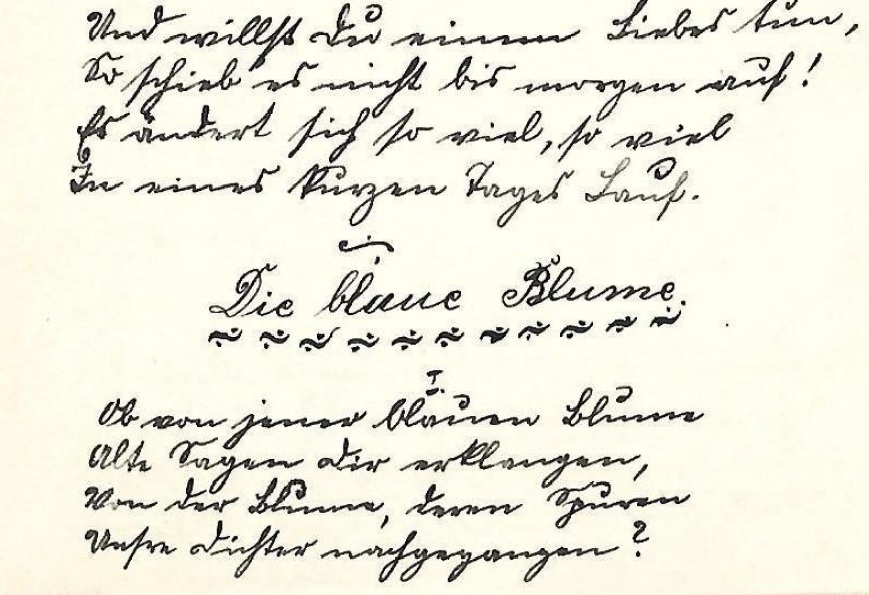
As a poet he is a slightly belated but unashamed romanticist, he even wrote one poem about the blue flower, which is a key symbol of German romanticism attributed to Novalis (Die blaue Blume). While literary romanticism was well and truly over before Heinrich was even born, Romantic composers were still going strong, so I guess as a young musician in love he should be allowed a bit of romanticism in his poetry too. Spoiler alert: he found the blue flower in Maria’s eyes.

Beginning of the blue flower.

Thankfully, there is no testosterone poisoned patriotism on display anywhere. Quite the contrary, our young poet comes across as the quiet and sensitive kind, so that's kind of a relief. Quite a few poems with titles such as "Mahnung" are advising the reader on how to be a good person - these remind me of Albert Schweitzer, who was at Strasbourg at the same time (1893-1913). Conceivably, Heinrich and Maria may have heard his sermons in St. Nicolas church (close to the hospital where Maria worked) and/or his organ playing.

All of this has required another additional sub-chapter to my Heinrich chapter (PDF here and also here), so the Strasbourg years are now covered quite well (and I am quite obsessed with Belle Epoque Strasbourg now), even though I am still in the dark re any musical activities.

The scans I made of the handwritten pages are now on Google Drive in two parts, see Part 1 (37 double pages), Part 2 (26 double pages). I have formatted my preliminary transcription on double pages to match the page spreads and uploaded them here and also here. If and when I get a chance to edit those PDF scans, I will be aiming to produce a version where original and transcription can be viewed on facing pages.

Heinrich's musical initials under one of the poems, with the notes H (B in international nomenclature) and G identified by the ledger lines below the (imagined) staff. Note that this idea seems to be pointing to a violin and/or guitar player - I can't play those notes on the flute and they wouldn't be written that way for cello or piano.

Sunday, October 09, 2022

from Alsace to Morocco

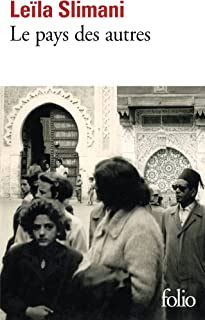
Leïla Slimani

Le parfum des fleurs la nuit

Le pays des autres

This June was the first time in too many years that I got to spend some time in France, so I had some catching up to do. In a bookshop at Nimes, I spotted a pair of paperbacks by Leila Slimani lying around on a table where they didn't belong, and as I loved her first novel, Dans le jardin de l'ogre (published in English as Adele), and generally have a soft spot for her, I read this as a sign and bought the pair unseen.

I read the slimmer one first, and it turned out to be an autobiographical sketch about an occasion when she agreed to spend a night locked into a museum in Venice and write about it. I mainly learned from this that she smokes too much, doesn't care much about visual arts, and had a grandmother from Alsace. As I had two grandparents from Alsace/Lorraine, I was intrigued and wanted to know more.

Luckily, the other book told me all about the Alsatian grandmother, albeit in fictionalised form. In the novel she's called Matilde and married a Moroccan soldier stationed near her home during the second world war, and followed him to his native country then still under French rule, but with calls for independence getting louder. Very much the type of book I want to read right now, making sense of our recent past and migration stories in an appealing format.

Ooh, and I hear there is a sequel too, called Regardez-nous danser. will have to get my hands on that (as soon as it comes out in paperback).

See also my twitter thread listing books I read in 2022.

PS Wikipedia names the real-life grandmother as Anne Ruetsch. My Alsatian grandparents were the son of Heinrich and Maria who fell in love in Stasbourg but then were forced to move to Dieuze (Lorraine), and the granddaughter of the stationmaster of Adamsweiler. Both lineages only came to the region after 1871, but Maria also had a much earlier Alsatian ancestor from Sainte-Marie-aux-Mines, unfortunately called Paul Simon, which must be the most useless name for online searches one can imagine. Considering all of this, I'm now creating a tag for all things Alsatian.

Thursday, December 30, 2021

five sisters, five decades

Every picture tells a story, No. 18

The five daughters of the station master of Adamsweiler all lived to a respectable age and had a tendency to regroup on family occasions so we have portraits of the quintet spanning half a century.

This one is the most recent I have, dated 1950, so presumably from Auguste's golden wedding celebrations. The place is Bad Münster am Stein, where Auguste lived with her husband who had worked at the post office.

A few decades earlier, the five of them with their mother on her 80th birthday in 1927 (the station master had died in 1909):

And then the classic 1900 family portrait outside the Adamsweiler station (which I've used in the master post on railway families):

In this one we have from left to right: Helene, Kätha, Johanna, Auguste, Anna. Good luck working out who's who in the other two. Their descendants are listed in the entry about the Kauer clan. (Quick cross-references to my branch of the tree: Helene married her cousin Julius, their first child was Ruth. I will have to reconnect with Johanna later in the series because she built the house that has preserved the bulk of our memorabilia.)

So much sh*t happened in the first half of the 20th century, thinking of the 250 years of life experience accrued between the first photo and the last just boggles my mind. Note also that their parents' magical recipe for long life did not work for boys: both their brothers died before reaching school age.

This photo is also on flickr.

Every picture tells a story series so far:

  1. string quartet Wuppertal Elberfeld 1927
  2. greetings from Adamsweiler
  3. Gastwirthschaft Ferd. Weirich
  4. quartet times three
  5. Neumühl 1923
  6. Tangermünde railway station 1889
  7. a singing lesson
  8. bei Wilhelm Geppert
  9. a bakery at Lorsch 1900
  10. Consumgeschäft von Julius Düsselmann
  11. Hanna and Ruth
  12. a young chemist
  13. school's out at Reichenstein, 1886
  14. a patchwork family in East Prussia
  15. the case of the missing grandmother
  16. checkpoint Glaner Brücke 1929(ish)
  17. finding Mimi
  18. five sisters, five decades

Twitter thread

In a somewhat roundabout way, this series relates to my research for the family history music memoir I'm writing.

Thursday, October 14, 2021

railway families

Four separate lines of my family tree involved a family kept alive by a railway job in the late 19th and early 20th century. The four railway employees were from wildly different geographic areas and never met each other, but they all benefited hugely from the opportunities provided by the railways and there are intriguing parallels in their lives.

I've made separate blog posts about each of them already, but here comes the masterpost bundling the key information for the complete quartet, so I can draw comparisons and have all the links in one place. Arranged chronologically by date of birth we have:

1. Johann Anton Lütkemeyer 1843-1887 from Schwaney
job: railway worker in 1872 / railway guard in 1877, Gütersloh, presumably active from 1860s until he became ill with tuberculosis of which he died aged 44.
family: married Johanna Catharina Charlotte Kosfeld, born 1854 in Gütersloh. Five daughters and two sons born within 12 years of marriage, five children survived him. First son died within three months of his birth, not sure which child was the second to die early, as data are missing on several siblings.
blog entries: the Gütersloh connection; a village becomes a city

[ No family portrait known. ]

2. Christoph Gottlieb Kauer 1845-1909 from Simmern
job: severely injured in the war of 1870/71, joined new Alsace railways as compensation, moving frequently (children born in Mulhouse, Morhange, Fontoy). Final stop and career step: station master in Adamsweiler from mid 1890s to his death aged 64.
family: married Margaretha Imig, born 1847 Simmern Five daughters and two sons. Both sons died in early childhood, all five daughters lived to ages ranging from 73 to 87.
blog entries: greetings from Adamsweiler; finally, the Kauer clan; Gastwirthschaft Ferd. Weirich

The station master's family outside the station at Adamsweiler, around 1900. The daughters, left to right: Helene, Kätha, Johanna, Auguste, Anna.

3. Richard Groß 1852-1913 from Breslau (today: Wrocław, Poland)
job: railway (office) assistant active in Neurode (Silesia) 1880. Zella St. Blasii (Thuringia) 1882, Stendal-Tangermünde 1886 until his death aged 60.
family: married Maria Louise Mentzel, born 1844, twice widowed; one daughter, one son. Wife also had a son from a previous marriage.
blog entries: Tangermünde railway station 1889; a railway man; once there were emperors

Railway parents seated in the middle, the young folks around them are left to right: their son, Max Heinrich Groß, his fiancee Maria Pfersching, his step-brother Arthur Reim, and his sister Gertrud Groß. Presumably taken on the occasion of Heinrich and Maria's engagement in 1904 (they married in 1908).

4. Heinrich Nagel 1879-1952 from Neesen, today part of Porta Westfalica
job: joined Minden district railways as an assistant around 1900, rising through the ranks to become station master at Minden Stadt by 1914, serving until retirement in 1944. Housed in railway company courtesy flats near that station from 1914 to his death at age 73.
family: married Catharine Luise Lütkemeyer, born 1880, one daughter. Wife was the daughter of 1., but her father was long dead at the point when she found herself a new railway man.
blog entries: railway memories; finding Minden

Heinrich Nagel with his first wife Luise Lütkemeyer and their daughter Frieda.

Patterns and similarities

The first two families both had five girls and two boys each, each lost two children in the early years, at least three of the four casualties were boys. Not sure about the fate of the fourth boy, but there's a real possibility that all four boys died in early childhood and all ten girls survived, which would be a bit spooky.

In contrast, the other two couples only had two children and one child respectively. Each produced a professional musician (Heinrich and Frieda), which is the connection that motivated me to dig deeper into the railway families.

Number 2 and 4 became station masters with very modest stations under their command, but this would still have involved a number of workers to boss around. The status of that job is reflected in the fact that both families bought a massive 17 volume encyclopaedia (Pierer and Brockhaus, respectively). If you're wondering how to become a station master on the Prussian / German Empire railways, Google Books has a scan of the book: "Die Prüfung zum Stationsvorsteher und Güterexpedienten, sowie zum Stationsassistenten im Deutschen und insbesondere Preußischen Staats-Eisenbahndienste."

With an average lifespan of 60 years, I guess they fared about normally for their times, but not better. Note that only number 4 got to enjoy a period of retirement and significant overlap with grandchildren (one great-grandchild even).

All of them had an opportunity boost that has to count as social mobility, compared with their backgrounds. All except number 4, who only moved from his village to the nearest town, also achieved significant geographic mobility, with 2 and 3 ending up hundreds of kilometres away from their respective birthplace.

The wives of 1 and 2 also had railway employees among their brothers and nephews who were perhaps inspired by the precedents. As these two had very modest jobs, I don't think they had any real power in providing jobs for the extended family.

Bottom line, as one of my four grandparents and three of my eight great-grandparents were children of railway families, that makes me a 1/4 + 3/8 = 5/8 railway descendant.