Showing posts with label flute. Show all posts

Saturday, May 31, 2025

more quartets of simple character

In our occasional attempts at playing chamber music, we have very much appreciated the collection of

Original String Quartet Movements of Simple Character

by Walter Höckner.

Now I discovered that there is a sequel to it, containing complete string quartets of simple character, which I found at a local Oxfam shop and added to my quartets collection. A bit of searching revealed that Mr Höckner also did similar editions for string trios, some music for "incomplete" string quartets (so they have something to play while waiting for the last one or two members to show up), for flute quartets, and more. Oh, and a third volume of quartets too. Might take a while to complete the collection without paying extortionate prices to some of these online dealers.

Amazingly, I can't find any information about him as a person. IMSLP, in the entry on the pair of quartet collections, speculates he may be related to Hilmar Höckner, who at least has a Wikipedia entry, as the two edited some works together.

The painting that graces both my quartet volumes is called Haydn quartet and is by the Austrian painter Julius Schmid (1854-1935). I'm still on the lookout for paintings of people playing chamber music and I quite like this one so will show it here on its own:

Scanned from my copy of The String Quartet vol. 2.

Note the lovely violin case taking centre stage at the front - it is the same build as the historic case that came with my current favourite violin, number 22. I do remember that I still need to do a blog entry dedicated to that case.

UPDATE 6.6.2025 When I took the photo of vol I and II, I carefully covered up the address sticker of a previous owner on the cover of vol I. Looking at it again I realised that his address is Simrock House - so he named his house after the original publishing company that first published the quartets (although his edition was a licensed one by Alfred Lengnick for the UK). So I became curious and did a bit of searching. Turns out that Richard Schauer of Simrock House was a music publisher himself, and came to London in 1939 a Jewish refugee from Germany. He died in London in 1952, but the company Schauer & May Ltd. still exists, although it moved out of Simrock House in 2002.
Oh, and the copy of the incomplete quartets arrived today. It contains a preface by Walter Höckner signed in March 1962 at Schloss Ortenburg, a castle in Bavaria (near Passau).

Sunday, April 06, 2025

the evolution of early music

I visited the Bate Collection on the last day before they closed for the move from St. Aldates to the new building in Jericho (named after one of the billionaires who co-funded the ongoing trumpocalypse, so I won't name it here). As they were desperate to clear out stuff from their shop, I helped by taking on the last 20 issues they had of the journal Early Music, which look like this:

The random issues span the years 1974 (the journal started in 1973) to 2004. The journal published four issues per year until recently - I am a bit worried that the most recent issue online dates from May 2024, so they may either be in trouble or just running late with their publication schedule?

I browsed through all 20 issue going backwards in time and it is amazing to observe how the field has moved in those three decades - starting with "what is a hurdy-gurdy?" and ending up discussing really subtle differences between medieval bows, or details of Renaissance notation on ten pages.

A few things I learned or noticed:

Small violins were a thing long before they were inflicted on children. As Margaret Downie Banks explained in November 1990 (vol 18, pp 588-596), violino piccolo is specified in early baroque compositions (including some by Bach even) in ways that suggest the violins were used like recorder consorts, with smaller instruments to reach the higher notes. This was useful because at the time the normal technique used by violinists didn't include higher positions. The chin rest hadn't been invented yet, and the ways of holding the instrument were all over the place, meaning that when you move up to higher positions you would have trouble coming back down (moving the hand away from the chin) without dropping the instrument. So people played first position only, plus a few extra notes that can be reached by stretching while the thumb stays in place. Like today's folk fiddlers. There isn't much explicit info on this from the time, because people who only knew this way of playing didn't know what they were missing. A key source is the violin instruction book published by Leopold Mozart (father of Wolfgang Amadeus), who noted in 1756 (just after what we now regard as the official end of the Baroque period) that small violins are no longer necessary, because players can now play higher notes by shifting their hand. He also mentions that the small instruments no longer needed by grown-ups could be useful in music education for children, although he doesn't whole-heartedly support this use.

Another article in August 1984 addresses the issue of early violinists not using higher positions from the point of view of fingerings marked in the scores. This article notes that the chin rest was invented by the composer Louis Spohr (1784-1859).

I am left wondering now if cellists / viola da gamba players discovered higher positions earlier than violinists, because they can move their left hand freely anyways. Will have to investigate.

An ad that appeared in October 1980 notes that "In 1522 the Croydon Waits were beheaded for performing crumhorn consorts on comb and paper while waiting for their instruments to be delivered." The ad goes on to reassure readers that in the 20th century this couldn't happen any more, as the waiting time for their crumhorns "has been reduced to a reasonable length."

I noticed that across the whole 20 issues with all the luscious illustrations, there isn't a single picture of a nyckelharpa (keyed fiddle) even though these instruments are present in medieval iconography. Doing a word search on the online archive, there appears to be only one mention of the word nyckelharpa in the entire corpus of the journal, and that was in the review of a recording where the instrument was used. Given the popularity of the instrument in Scandinavian folk today, I am puzzled as to why the Early Music crowd chose to completely ignore it. By contrast, hurdy-gurdies are well represented. Obviously, it is difficult to do stats based on the issues I have, as they are a negative selection, left behind by earlier visitors to the collection. Somebody may have picked all issues that had a viola da gamba on the cover. But the absence of nyckelharpas is a real thing.

In November 2003, we find the late Jeremy Montagu (1927-2020) reminding us that "trump" is another name for the Jew's harp. He wrote "it is a term of historical usage ... and today safe from any potentially offensive connotation, which many of us have adopted as a result." Those were the days.

In the same issue, there is an interesting article on Quantz's flute quartets which had been rediscovered recently.

Oh and I also learned that the early music festival Tage Alter Musik Herne is still going strong and happening each year in November. Back in the last century when we were spoilt rotten by the Tage Alter Musik Regensburg (held in magnificent historic venues matching the age of the music) we were a bit snobbish about the competition from the less lovely city of Herne, but now that I have a base in Dusseldorf, I could easily attend some of the concerts at Herne.

May add further discoveries as they turn up ...

Tuesday, December 10, 2024

trios reshuffled

After the reshuffled quartets list, here's a fresh version of the trios as well

Trios without a viola part:

Anonymus (Venice, around 1700): Due sonate a due flauti e basso (in F and C)

Bach: Trio sonata in C minor from the Musical Offering.

Bach: Allegretto and Andante from the 3-part inventions for soprano, alto and tenor recorder

Bach: 15 Three-part inventions for two violins and cello. Number 11 is the Allegretto from the recorder edition listed above.

Bach: concerto in d minor for oboe, violin and cello. adapted from the concerto for two harpsicords BWV1060

Bach: Little Bach suite No. 2 for woodwind or string or mixed trio - includes Bb clarinet option.

CPE Bach: Trio in Bb major for flute, violin, cello.

WF Bach: Two fughettas for soprano, alto and tenor recorder (all parts in treble clef)

Corelli: 2 Chamber sonatas for two violins & BC: op 2 No. 4 in E minor, op 4 No. 9 in Bb major.

Corelli: Trio sonatas for two violins (or flute and violin) and BC: op. post. 4-6

Haydn: Four London trios for two flutes or violins and cello Hob IV
Very accessible to amateur players and extremely lovely, these are from Haydn's second visit to London in 1794 and may have served as a sandpit where he tried out ideas for his later symphonic works. I discovered the Edition Peters set of trios 1-3 at Oxfam exactly when I needed it for our plague-time bandstand adventures, and we played them on several occasions.

YouTube recordings (see also my new playlist):

London Trio No. 1
London Trio No. 2
London Trio No. 3
London Trio No. 4

Haydn, Trio No. 4 in F for flute or recorder, violin, cello or piano, op 11 No. 4 (Schott). First published by Hummel in 1770, this is presumably an adaptation of one of the 128 baryton trios, but it’s not No. 4.

Gottfried Keller (died 1704) Trio sonata in Bb for treble recorder/violin, oboe/violin, basso continuo

Haydn: Trio in G major for alto, tenor and bass recorder (all parts in treble clef)

Jean-Marie Leclair l'aine: Two trio sonatas for two violins and bc, op 13, no. 1 and 2

JB Loeillet, sonata No. 1 G major for two violins & piano

JB Loeillet, Trio sonata in C minor (op. II/6) Parts are marked: alto recorder/flute; oboe/violin; b.c./cello/bassoon/viola da gamba.

Mozart: serenade in C for two violins and cello "Ganz kleine Nachtmusik" KV 648. This is the piece that was rediscovered in 2024 youtube premiere here. We played it a couple of months later, very exciting to play a new Mozart piece. Presumed to be an early teenage work, it appears to prefigure the famous serenade "Eine Kleine Nachtmusik" K525 in some elements. Score and parts are available to download for free from ISMLP.

Quantz: Trio sonata in G, K46, for oboe, bassoon or cello, and bc.

Sammartini: Twelve sonatas for two alto recorders (violins) and bc.

JM Sperger (1750-1812), terzetto primo a flauto, violino e violoncello

Carl Stamitz, six trios for two violins and violoncello, op 16

Various composers: Chamber Music for beginners, Editio Musica Budapest. Very easy trios with melody parts available for violin or flute/oboe or Bb clarinet, bass part for cello or bassoon.

Trios with a viola part:

Jean Barriere: Trio sonata in d minor for viola, cello and bc (also has a cello version of the viola part).

Beethoven: Serenade for violin viola cello op. 8 We played parts of this in October, lovely stuff. A youtube performance is here.

Beethoven: Serenade for flute violin viola op. 25

Boccherini: Three trios for violin, viola, and cello, Opus 38

Haydn: Four London trios for two flutes or violins and cello Hob IV
After the version described above I also found a different edition including all four trios from Southern Music that also includes parts for Bb clarinet, viola and bassoon. I think we once tried combining both sets and it didn't work. Arrangers must have changed more than just the instrumentation.

Haydn: Trio for violin, viola, cello in Eb, Hoboken V Es1

Telemann: Concerto a tre in F, for recorder, horn or viola and bc or bassoon or cello.

Various composers: Chamber Music II, Editio Musica Budapest. Very easy trios with parts for violin/flute/oboe, viola or Bb clarinet, cello or bassoon.

Two recent acquisitions in the category trios with a viola part.

Update 20.12.2024, added the Mozart trio which we played this week. Funnily enough, there wasn't a single Mozart piece in the trio collection before.

Update 21.8.2025 added the 15 Inventions by Bach and the three trios by Boccherini.

Update 5.6.2026 added posthumous Corelli and Sammartini.

Sunday, December 08, 2024

quartets reshuffled

My list of the quartets in my growing chamber music collection is becoming unwieldy, and I also need to split it into those that have a viola part and those that don't - because when we (random subsets of Cowley Orchestra) meet up in the holidays to try some chamber music, we may or may not have a viola (and the viola parts are written in a different clef that most others can't read).

So first up the list of quartets (and one quintet) that have a viola part (in some cases there are also alternative parts offered, such as 3rd violin), I'll note specifically what the alternatives are in each case:

Bach: 14 fugues from the Well-Tempered Clavier arranged for string quartet by R. Hofmann. Part 2 (No. 8-14)
Bartok: Valse (Ma mie qui danse) arranged for string quartet by Devich Sandor.
Beethoven: quartet op.18, No. 1 in F (lovely performance by GoYa quartet here)
Beethoven: quartet op.18, No. 3 in D
Boccherini: 9 string quartets (various opus numbers).
Borodin: string quartet No. 2 in D
Boyce: Symphony No. 2 (from 8 symphonies), arranged for strings and two oboes by Constant Lambert. Works fine as a quartet. Also includes a violin 3 part to replace viola if necessary.
Dvorak: string quartet in a minor, op 16
Dvorak: string quartet in Eb major, op 51
Dvorak: string quartet No. 12 in F major (American quartet)
Haydn: Quintenquartett Op 76, Nr. 2, in D minor
Haydn: Quartet in d minor Op 103, his last quartet, which remained unfinished, there are only two movements, of which the first is performed here.
Haydn: 30 famous quartets, Edition Peters 289a, 289b
Janacek: String Quartet No. 1
Felix Mendelssohn-Bartholdy: string quartet in a minor, op.13 (youtube)
Mozart: string quartets I, Edition Peters 16 – contains 10 famous quartets
Mozart: string quartets II, Edition Peters 17 – contains 17 quartets including two flute quartets, the oboe quartet, and K525 Eine kleine Nachtmusik.
Mozart (arr. John Auton): Three pieces for strings (choice of violin 3 / viola)
Mozart: quartet in B flat, K485, played by Carmel Quartet here
Mozart: Adagio for cor anglais (oboe/viola), 2 violins and cello, K580a. Another unfinished work, a lovely performance is here;
Pachelbel: Canon in D, arranged for string quartet by Donald Fraser
F. X. Richter (1709-1789): String quartet in B flat Op 5 No. 2, audio here
Schoenberg: String quartet in D major (1897). Composed in the year Schoenberg turned 23, this sounds a lot like Dvorak's American period.
Schubert: Excerpts from 5th symphony, strings pack
Schubert: Quartet for flute, guitar, viola and cello (YouTube). Found this in an edition published 1956 - it later turned out that Schubert had just arranged a trio by Czech guitarist Vaclav Matiegka (1773-1830) and added the cello to give it a bit more oomph. The original trio (Notturno op 21) is lovely, actually, but doesn't harm to have the cello part too.
Shostakovich: String Quartet No. 1 Op 49.
Pyarelal Sharma: Indian Summer. enchanting pieces for string quartet.
Shostakovich: String Quartet No. 1 Op 49.
Francesco Veracini: Chamber sonata for violin and strings Gm. (so that's solo violin plus string quartet). We've played most of this and it is really lovely. Can't find a recording with this instrumentation online, only violin plus piano/cello accompaniment.
Various composers: The String quartet: Original string quartet movements of simple character by old masters; Walter Höckner, ed.
Various composers: The String quartet II: 6 Original string quartets of simple character by old masters; Walter Höckner, ed. Note the last one by Stamitz is written for three violins and cello - although the violin 3 part is playable on viola, there isn't a version in viola clef included. See the table of contents for both volumes on IMSLP - or download the PDF if you want. IMSLP seems to think they date from 1953/55, but I think they are older than that.
Various composers: The Incomplete String quartet, Walter Höckner, ed. - This one contains duets and trios for all conceivable combinations of quartet players waiting for the others to show up. Plus a quartet that also works without the first violin and/or the cello, so if these are missing, one could start playing that one and let the late comers join in when they arrive. I love the thinking behind this whole collection.

List of quartets and quintets that don't have a viola part. Many of these have a clarinet part in Bb, some also a horn part in F:

Anonymus: 2 Hoftänze from the Hessen Books for 5 instruments. All parts in C; 1 in bass clef others in treble.
Anonymus: My Loves an Arbutus arr. for woodwind quartet by A.L. Wyver
Malcolm Arnold: Three shanties for wind quintet
Bach: Bourree from the 3rd cello suite arranged by Gordon Lewin for Flute oboe clarinet bassoon.
Gordon Jacob: Four old tunes for flute, oboe, clarinet & bassoon.
Darius Milhaud: La cheminée du roi René, suite for woodwind quintet (incl. French horn in F ) - see a lovely performance with costumes here.
Mozart: Divertimento Nr 9 in B K240 arranged for wind quintet by Günther Weigelt
Mozart: Divertimento Nr 12 in Eb K252 arranged for wind quintet by Werner Rottler
Mozart: Divertimento Nr 13 in F K253 arranged for wind quintet by Günther Weigelt
JC Schickhardt, sonata in F major op 22 no. 1 for 2 treble recorders (flutes) oboe and basso continuo
Christopher Tye, In nomine I (Weep no more, Rachel) four parts in treble and one in bass clef

The three Mozart quintets I recently found at an Oxfam shop - loving the covers, even though I wouldn't count Mozart as Alte Musik (early music).

PS List of trios is here.

I do realise that my collection of trios and quartets is still lacking any female composers - they just haven't filtered through to the charity shops yet. May have to buy something new to fix this (eg the string quartet in e Minor by Emilie Mayer). I do have some cello sheet music by Rebecca Clarke and Rita Stohl though.

Updated 30.5.2025 after discovered Walter Höckner's six quartets of simple character (sequel to the quartet movements of simple character).

Updated 6.6.2025 to add Walter Höckner's Incomplete Quartets

Updated 24.7.2025 to add the very lovely Schoenberg quartet (which I discovered a couple of months earlier and added to the youtube playlist but forgot to add here)

Updated 20.8.2025 with the Boyce "symphony" which we played today (as a quartet). Not sure when I bought this but must have forgotten to add it when I did.

Updated 7.9. to add Christopher Tye, an English renaissance composer new to me.

Updated 6.10. after discovering sets from two composers not previously represented in the collection, Bartok and Felix Mendelssohn-Bartholdy. (Went through a great big pile of chamber music at a charity shop today, and frustratingly, these were the only complete sets, everything else was just stray parts or two parts of the same work at best.)

Updated 5.6.2026 added the Janacek quartet.

Friday, September 15, 2023

a famous flautist

Some thoughts on

Friedrich der Große: Musiker und Monarch
Sabine Henze-Döhring
CH Beck 2012

Published in the year of Frederick the Great’s 300th birthday, this is a thorough appraisal of what we really know about the Prussian king’s music making. It turns out that all the anecdotes and the widely reproduced images such as the painting by Adolph Menzel appearing on the cover of the book and below, of the king playing a recital to an attentive audience, aren’t corroborated by any hard evidence.

Flötenkonzert Friedrichs des Großen in Sanssouci (painting by Adolph von Menzel, 1850–1852)
Source: Wikipedia

Typically, the author maintains, he will have played the flute in the company of his paid court musicians only, with no audience. Said musicians included his flute teacher, the composer Johann Joachim Quantz (at the right margin of the painting), as well as JS Bach’s son CPE Bach (at the harpsichord). Which is why Bach senior paid that very famous visit to Friedrich’s court. And given the circumstance that nobody could really go on record with judgements on the reigning monarch, we can’t really know how accomplished his playing was. So, it’s all a bit frustrating on the flute front.

What we know a lot more about, however, is his role as an impresario of professional and public concerts (in which he didn’t play), as well as court opera, where he championed the opera buffa as a new form imported from Italy, as well as star castrato singers also coming from there. The simple reason that we know a lot about these is that these musicians needed to be recruited and paid, which already involved correspondence and record keeping. And once they were doing their thing, Frederick liked to write letters about their music making to his relatives - and to Voltaire, obviously. As you do.

I also learned that, after he fought three wars against Austria over the possession of Silesia (which Prussia gained in the process), shared musical interests enabled he king to reconnect with Maria Theresia’s son, the future Austrian Emperor Joseph II. Music saves lives, again.

PS I missed the memo when this came out but discovered it on a recent visit to Potsdam where Old Fritz used to toot his flute.

Saturday, November 26, 2022

the right instrument

A recent obituary in the Guardian came with a photo of the person playing the flute, so I read it although the name didn’t ring a bell. As it turned out, flautist Atarah Ben-Tovim (with her husband Douglas Boyd) was the author of a book that I read in the 1990s and that has influenced my life more than most books I read: The right instrument for your child.

As I recall it, the book is extremely good at pointing out all the little things that may become a deciding factor in whether or not a young (or even not so young) person is attracted to a specific instrument and will also stick with it. Such as the physical energy you can pump into a cello, which suits a slightly more assertive child, shall we say. Or that flute fingering is easy when you transfer from the recorder.

I believe (with the authors) that more consideration on the instrument choice could save a lot of people from an unhappy learning experience. Too many people just go for piano or violin as the default without considering the personality of their child and what kind of instrument would be a good match.

The book helped me a lot in kicking off the musical education of my children, which then rubbed off to my own, belated learnings, so it helped to generate many person-years of music making in this family alone, just imagine what its effect may be on its entire readership. I think of this book as plan A, with the equally interesting “Never too late” by John Holt, being the plan B. There are two more recent editions than mine, but it seems to have gone out of print after the 2012 release.

Like most of the things I'm obsessing about these days, this is related to my musical memoir project, specifically to chapter 4.

Saturday, April 09, 2022

suites à suivre

Plague Year(s) Bach Project, 17th month
(resuming after a 9-month interval from July 2021 to March 2022)

As of the beginning of April, my shoulder has improved to the extent that I can practice Bach suites for one hour, which I think is the amount I need to make meaningful progress. So, here we go again (and the pandemic is still going strong, thanks to the unwavering support of the death eaters in government).

For this month, I am tackling the Courante from the 4th suite. Part of the idea is that I really need to get my head around the geography of Eb major on the cello, because key signatures with 3 flats or more are holding me back in my orchestral adventures (which relaunched last September).

I also really like this Courante, and with its 64 bars it will likely keep me busy for two months.

As usual, I am picking up useful hints and tips from Inbal Segev.

Loving this performance by Emanuelle Bertrand so much that I won't be looking for any other. (Very artsy video, too, involving shadow play and a mirror, which can be a bit confusing when she seems to be playing with the wrong hand.) I also have Inbal Segev's and Rostropovich's recordings on CD.

In terms of the movements I learned until June last year, I can still play 1.3-1.6 and 3.5 from memory. Will take some time to recover the movements I learned from the 2nd suite. I'll resume the list once I have something to add, rather than to substract.

In other Bach-related news:

  • I read Steven Isserlis's companion to the suites, see my review here. While he was writing the book, he also recorded suites 1 and 3 in this lovely cafe performance (he mentions his work on the book in the intro).
  • Now reading: Friedemann Bach by Albert Emil Brachvogel, a novel about JS Bach's oldest son, Wilhelm Friedemann Bach, alleged to bear very little resemblance to his real life.
  • Spending more time with my other instruments, I'm also looking at a flute adaptation of Bach's partita No. 2 for violin in D minor (I have the entire partita for flute on my revision list, it's kind of the motor that drives me to keep the revision schedule going!).
  • when I have a really ambitious day I also try playing bits of the Brandenburg concerto in F on my alto recorder. A solo adaptation of this happens to be in the big Altblockflöten-Solobuch by Barbara Hintermeier and Birgit Baude. Just give me a few years for that one.
  • I'm now building a twitter thread for the #PlagueYearBachProject, one tweet for each movement tackled.

Wednesday, September 01, 2021

quartets for random instruments

In addition to duets and trios, we (a hardy subset of Cowley Orchestra and some newbies) have also played some quartets over this summer. These included baroque pieces set for three melody instruments plus basso continuo (Baroque composers didn't mind very much what melody instruments were used). On some meetings, when we had a strong ensemble, we also ventured into the string quartets of classic/romantic periods.

This Bank Holiday Monday we had a particularly strong ensemble (nothing to do with me, I am either the weakest link or hiding behind a stronger player) with an interesting variety of instruments and played Dvorak's American quartet among other things. It struck me that I actually prefer our version with five different instruments (violin, flute, oboe, clarinet on the viola part, cello) to the string quartet performance. Listening to string quartets, I don't really like the fact that the four string instruments have similar sound textures and all blend into one sauce - having a variety of different sounding instruments is actually an improvement to me. Also, with its richness of textures, the random instruments version is a lot closer to the New World symphony.

(UPDATE 11.9.2021: Just discovered it's been done before. Somebody called David Walter arranged it for wind quintet (flute, oboe, clarinet, bassoon, horn, published by Billaudot - Paris 1986) and YouTube has live videos from the Amsterdam Wind Quintet (fourth and first movement) as well as sound-only recordings from the Royal Flemish Philharmonic (complete) and Meliora Winds.)

Anyhow, here's my nascent collection of quartets so far:

Bach: 14 fugues from the Well-Tempered Clavier arranged for string quartet by R. Hofmann. Part 2 (No. 8-14)
Beethoven: quartet op.18, No. 1 in F (lovely performance by GoYa quartet here)
Beethoven: quartet op.18, No. 3 in D
Boccherini: 9 string quartets (various opus numbers).
Borodin: string quartet No. 2 in D
Dvorak: string quartet No. 12 in F major (American quartet)
Haydn: Quintenquartett Op 76, Nr. 2, in D minor
Haydn: Quartet in d minor Op 103, his last quartet, which remained unfinished, there are only two movements, of which the first is performed here.
Mozart: quartet in B flat, K485, played by Carmel Quartet here
Mozart: Adagio for cor anglais (oboe/viola), 2 violins and cello, K580a. Another unfinished work, a lovely performance is here;
Pachelbel: Canon in D, arranged for string quartet by Donald Fraser
F. X. Richter (1709-1789): String quartet in B flat Op 5 No. 2, audio here
Schubert: Excerpts from 5th symphony, strings pack
Schubert: Quartet for flute, guitar, viola and cello (YouTube). Found this in an edition published 1956 - it later turned out that Schubert had just arranged a trio by Czech guitarist Vaclav Matiegka (1773-1830) and added the cello to give it a bit more oomph. The original trio (Notturno op 21) is lovely, actually, but doesn't harm to have the cello part too.
Shostakovich: String Quartet No. 1 Op 49.
Various composers: The String quartet: Original string quartet movements of simple character by old masters; Walter Höckner, ed.

And a bunch of baroque quartets I borrowed for the summer:

MA Charpentier, Noels (9 short pieces, some christmassy)
Naudot, concerto in C major
A. Scarlatti, Sonata in F major
GP Telemann, concerto in G major
JB Fasch, quartet in Bb major
JC Schickhardt, sonata in D major

The last page of the autograph score of Dvořák's American quartet with his inscription: "Finished on 10 June 1893 in Spillville. Thanks God. I'm satisfied. It went quickly."

Source

Updated 6.9.2021 to add the Schubert quartet based on the Matiegka trio.
Updated 21.4.2022 to add Haydn op 103, Mozart, Richter, and Various.
added Beethoven and Mozart K485.
Updated 23.2.23 to add Bach and Borodin

Sunday, August 08, 2021

goldilocks instruments

Discussed alto flutes and other size variations at a session earlier today and it struck me that I have a very clear preference in several instrument groups, but they don't line up. Basically, I like to make deep sounds, but there are limits to the amount of suffering I am willing to take for that, such as straining my arm to lift a bass flute, or spreading my fingers more than a comfortable width to play low recorders. So the balance works out as follows:

* strings: cello (obviously)

* flutes: concert flute (I just don't feel the few extra notes added at the bottom are worth the suffering with heavier flutes).

* recorders: alto (a discovery I only made a few years ago, when I saw an alto recorder at a fleamarket and bought it on the spot - basically, it feels exactly right, presumably because it scales to the adult hands exactly like the soprano recorder to primary school kid hands).

* saxophones: tenor (haven't tried any of the other sizes, but the tenor feels so right, I can't imagine any of the others being a better fit).

Based on this, I should try low whistles, which I haven't done yet. And while I never cared much for trumpets, I am curious about tubas, euphoniums and such like.

Different sizes of recorders, from bass to sopranino. Image source: Wikipedia

PSA: this is blogpost no. 2000, and also a reminder to myself that I will resume the all our instruments series once the plague years are definitely over.

Sunday, July 11, 2021

trios for flute, violin, cello

As the orchestra I joined back in 2017 is now reduced to a maximum of four people showing up to play every week (outdoors, while summer lasts), I have been obsessing about chamber music a bit, to make sure we don't get bored. Following up on the duos for cello and flute, here's a list of a some trios we have enjoyed playing in the last two months. I'm dreaming of scaling this up to reach the Schubert octet one day ...

My nascent collection:

Anonymus (Venice, around 1700): Due sonate a due flauti e basso (in F and C)

Bach: Trio sonata in C minor from the Musical Offering.

Corelli: 2 Chamber sonatas for two violins & BC: op 2 No. 4 in E minor, op 4 No. 9 in Bb major.

Haydn: Four London trios for two flutes or violins and cello Hob IV
Very accessible to amateur players and extremely lovely, these are from Haydn's second visit to London in 1794 and may have served as a sandpit where he tried out ideas for his later symphonic works. I discovered the Edition Peters set of trios 1-3 at Oxfam exactly when I needed it. A bit later I also found a different edition including all four trios from Southern Music that also includes parts for Bb clarinet, viola and bassoon (but has the slightly covid-unfriendly aspect that the two flutes are supposed to read from the same score). Combining these two sets, we could turn the trios into very colourful sextets ...

YouTube recordings (see also my new playlist):

London Trio No. 1
London Trio No. 2
London Trio No. 3
London Trio No. 4

Haydn, Trio No. 4 in F for flute or recorder, violin, cello or piano, op 11 No. 4 (Schott). First published by Hummel in 1770, this is presumably an adaptation of one of the 128 baryton trios, but it’s not No. 4.

Gottfried Keller (died 1704) Trio sonata in Bb for treble recorder/violin, oboe/violin, basso continuo

JB Loeillet, sonata No. 1 G major for two violins & piano

JB Loeillet, Trio sonata in C minor (op. II/6) Parts are marked: alto recorder/flute; oboe/violin; b.c./cello/bassoon/viola da gamba.

JM Sperger (1750-1812), terzetto primo a flauto, violino e violoncello

Carl Stamitz, six trios for two violins and violoncello, op 16

Borrowed sets we used (now returned):

JS Bach, Trio sonata Eb major, BWV 1031
A. Corelli Triosonata in d minor from concerto grosso in c minor op 6 no. 3
Matthew Locke, Suite in G from Tripla concordia
JB Loeillet, trio sonata in F major
JC Pepusch, trio sonata Bb major
JJ Quantz, trio sonata A minor - haven't played these two Quantzes yet, tried a different one though.
JJ Quantz, trio sonata C minor
Telemann triosonata in C minor

It amuses me that these three stellar soloist took time out of their world tours to have a bit of fun with the Haydn trios.

Although at least three of the trios were published in Haydn's lifetime, they fell into oblivion and had a somewhat romantic rediscovery. In 1878, a Berlin antiquarian and manuscript collector died - Haydn's complete autograph of the London trios was found among his belongings and transferred to the Berlin Staatsbibliothek. Published in 1909 on the occasion of the centenary of Haydn's death, they arrived just in time for the last flourishing of Hausmusik before it was wiped out by the advent of broadcasting and recorded music.

Edits and updates:
26.7. added the Corelli (just found at Oxfam)
31.7. ditto for Gottfried Keller
10.8. ditto Anonymus
21.4.2022 added Sperger
5.3.2023 added Stamitz
1.4.2023 added Bach
20.4.2023 added Loeuillet C minor trio.

Sunday, June 27, 2021

more chamber music for cello and flute

When I revisited our ancient noteflight scores of duets we arranged for cello and flute, I also remembered the list of duets that I had discovered online back then and that I found helpful for some initial directions. Back in 2011 it was hosted on the comprehensive flute website of jazz flautist Larry Krantz and credited to Julia Larson Mattern and others. Sadly it is no longer online, so I've used the copy I kept as a starting point to make my own list by adding in youtube links and dropping those items of which I could not find any performance. I also removed the comments from the original list and added some of my own. Oh, and I made a YouTube playlist.

Work in progress. Surely there must be more music that works well for cello and flute? Suggestions welcome.

So here's my list of published editions in alphabetical order (editions I own are in bold):

1. Beethoven - Three Duets (published by Kalmus) Lovely music from a young Beethoven, written for clarinet and bassoon but available in several other combinations too. We played four or five of the 9 movements back then, some in arrangements derived from an edition for violin and viola, see the list of our scores. YouTube performances of duo No.1: Duo Dare plays first movement only, but clearer sound than this recording of the whole duo.

2. Besozzi, Alessandro - Divertimento in F (published by Urtext Premiere Publication) YouTube I thought this sounded a bit lame? (Besozzi has lots of trios though, which I'll still need to check)

3. Cambini, Guiseppe - Six Sonatas (published by Amadeus) YouTube

4. Carter, Elliott - Enchanted Preludes (published by Boosey and Hawkes) YouTube

5. Carrick, Richard - La Scene Miniature (self published) for piccolo and cello a quartet version with composer on piano.

6. Danzi, Franz - Three Duos, Op. 64 (published by Musikverlag Hans Sikorski) I'm loving the Danzi, might buy a copy Duo No.1; Duo No. 2; Duo No. 3

7. Doran, Matt - Sonatina (published by Western International Music) first movement; third movement

8. Febonio, T.G. - Rustic Airs and Folk Dances (published by ALRY) a selection of the pieces

9. Fiala, Joseph - Duo Konzertant in F Major (published by Amadeus) first movement

10. Handel - Acht Stücke (published by Amadeus) NB I have this edition, not clear where the pieces come from, no opus number etc. can’t spot any of them on youtube.

11. Heiss, John - Five Pieces (published by Southern) YouTube

12. Hofmann, Leopold - Divertimento (published by Amadeus) YouTube

13. Jevtic, Ivan - Musica per Due (published by LeDuc) YouTube

14. Tann, Hilary - Llef (published by Oxford University Press) YouTube loving the haunting sound of this.

15. Uebayashi, Yuko - Suite for Flute and Cello YouTube

16. Vali, Reza - Folk Songs (set No 9, published by MMB Music, Inc.) YouTube Fascinating but way beyond amateur standard.

17. Villa-Lobos - Assobio a Jato (Jet Whistle) One of many recordings available on YouTube

18. Whiteman, Lauren - Six Haiku (published by ALRY) a selection

Flautist Martha Long and cellist Marilyn de Oliveira performing Folk Songs Set No. 9 by Reza Vali. A still from this YouTube video

Friday, May 14, 2021

chamber music revisited

As Cowley Orchestra reconvened outdoors this week in much-reduced force just sufficient for duos and trios, I revisited the chamber music scores the young cellist and I prepared many years ago for our duo adventures. As the Flash previews which I embedded in the relevant blog entries at the time are no longer working (at least not on my computer), this is a new list I've prepared to have the playable ones handy (the noteflight list also includes some projects that didn't quite succeed or didn't get finished, although the "likes" added by users give you an impression of what works and what doesn't, I'm putting the more popular ones first in the list below).

Beethoven 3 duets (written for clarinet and bassoon originally):
1.1. Allegro comodo in C (video flute and cello)
1.3. Rondo in C
2.2. Rondo in Dm (video clarinet and cello)

JS Bach
Bourree in e minor, from the lute suite (the famous bourree used by many people including Jethro Tull)

Dvorak
Adagio (from the cello concerto)
Humoreske

Haydn
Menuet and trio (This was the first duet we performed, very basic stuff, and I probably still managed to make mistakes.)

Faure
Sicilienne (op78) This looks ok and we did perform it, not sure why it didn't get any likes.

Unfinished work: One of my favourite pieces for cello and flute to listen to is the Trio (op 78) by Johann Nepomuk Hummel, but unfortunately the piano has quite a prominent role in it. We made an effort to kick out the piano and arrange the piece for cello and flute alone, but never quite got it to a presentable shape.
First movement
Second movement (its a theme with variations, but we only got one of the variations done)

own photo

PS (27.5.2021) Now beginning to add YouTube links of professional performances to each of the pieces.

Saturday, July 25, 2020

Telemann's dozen

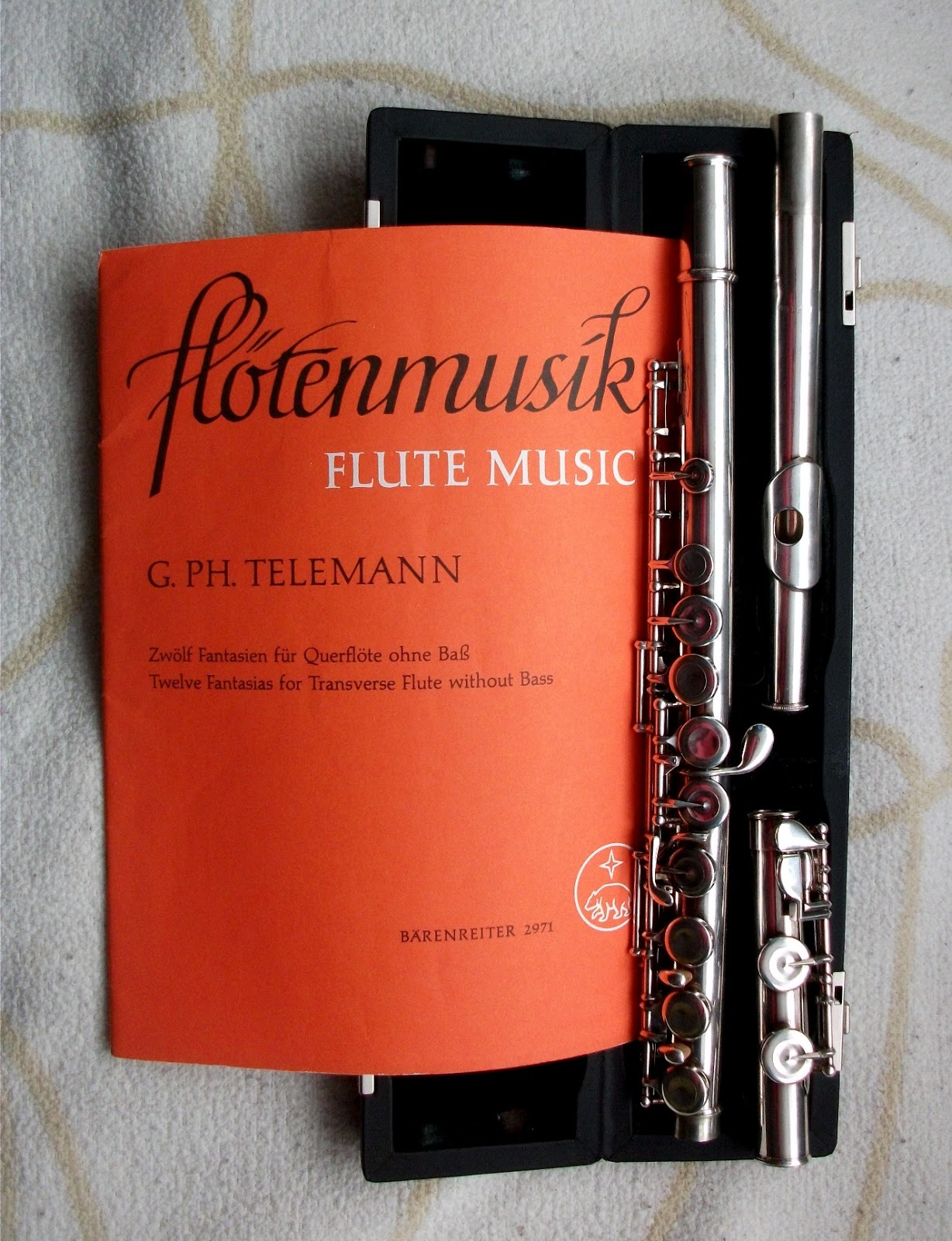
Two years (and a bit) ago I learned to play Telemann's fantasia No. 2 in a minor, which must have flicked a switch in my flute brain, as I have been playing a lot of unaccompanied baroque pieces ever since. In May, with the lockdown going on and flute lessons being off, I decided on an exploratory run through the remaining 11 fantasias, trying each one for a week, to see if I find one I want to spend more time with. I'm now in the last week of the project, so I have played every note in this lovely book, although not necessarily at the right time:


Oh, and I have added a version of each to my YouTube playlist with flute repertoire.

I have already earmarked No. 11 G major for further study, might also consider 6, 8 or 9. Number 9 is in E major (4 sharps, ####) but what I learned from it is that the fourth #, namely D#, is actually making life easier compared to playing ###, as you don't have to lift the little finger coming down from the E to play the note below. (Obviously, I haven't practiced all of my scales, otherwise I would have known that.)

Here are some interesting thoughts on the fantasias from Rachel Brown, who also has released a CD with the complete set.

Any flute players out there, tell me which one is your favourite?

PS Various artists have identified dance forms in the movements. None of them is marked in the score so I'll add to the list here whatever I can find:

1. Fantasia in A major (Vivace – Allegro=Passepied)
2. Fantasia in A minor (Grave – Vivace – Adagio – Allegro)
3. Fantasia in B minor (Largo – Vivace – Largo – Vivace – Allegro=Gigue)
4. Fantasia in B-flat major (Andante – Allegro=Polonaise – Presto)
5. Fantasia in C major (Presto – Largo – Presto – Dolce – Allegro – Allegro=Canarie)
6. Fantasia in D minor (Dolce – Allegro – Spirituoso=Hornpipe/Rondeau)
7. Fantasia in D major (Alla francese=including a Rondeau – Presto=Folk dance?)
8. Fantasia in E minor (Largo=Allemande – Spirituoso – Allegro=Polonaise)
9. Fantasia in E major (Affettuoso=Sarabande – Allegro – Grave – Vivace=Bourrée)
10. Fantasia in F-sharp minor (A Tempo giusto=Corrente – Presto – Moderato=Minuet)
11. Fantasia in G major (Allegro – Adagio – Vivace – Allegro)
12. Fantasia in G minor (Grave – Allegro – Grave – Allegro – Dolce – Allegro – Presto=Bourrée)


PDF sheet music is freely available, eg from flutetunes.com, from where I also nicked the bourrées and rondeaus that weren't specifically assigned in Rachel Brown's essay about the fantasias.

Saturday, March 14, 2020

alla turca

After the festival, I've had a quick and dirty go at Mozart's famous Turkish March, which is the third movement of the piano sonata number 11, in A (K331). I was inspired to try this by the Ayoub sisters who arranged it as a lovely string duo (see their video here - watch out for the Scottish reel they threw in just for the heck of it). As luck would have it, flutetunes.com has a score for solo flute ready and waiting for me. I also nicked some ideas from this performance by Ion Bogdan Stefanescu, flute with piano accompaniment.

As it's a piano piece originally, it's only fair to include our old piano in the picture, which has now been in the family for more than a century:


I might also try and learn the right hand of the original piece, although coordinating that with the left hand would probably be beyond my non-existing skills.

After this little divertimento, I am now ready to tackle another serious baroque suite from that grey book ...

Saturday, February 29, 2020

take a leap

On this leap day I am hoping to make a leap forward on the cello, studying the bourree I&II from Bach's 3rd cello suite.

The young cellist took her copy of the suites with her, but I discovered an edition at a charity shop earlier this month so now I have my own copy. And I've played JSB's only work for unaccompanied flute, the partita in A minor, a year ago, so it feels like a logical step up to tackle the cello suites. (Come to think of it, I've even played this very pair of bourrees on the flute a few years ago, but in an edition transposed to A, which I wouldn't really recommend.)

I expect the suites will keep me busy for a while. At three movements per year, this is going to take 12 years ...


Oh and here is Steven Isserlis who recorded the bourrees for his 60th birthday:


The video is also on my brand new playlist of cello repertoire.


Going through my collection of Bach CDs, I discovered I have two recordings of guitar adaptations of the third suite, one by Pepe Romero and one by John Williams. In fact it does translate quite nicely to the guitar.


Update 30.3. - just discovered a helpful video with performance notes by Inbal Segev, who seems to have done videos about most if not all of the movements of the suites. Oh and her performance of the bourrees is here. And I need to buy her CD.

Sunday, February 23, 2020

what shall I play?

I hear youtube turned 15 this month, and although I haven't been using it excessively, the list of my "liked videos" is approaching 1000 items, so it's no longer a way of quickly finding something that I earmarked a while ago. So I had to create some playlists, most importantly for the repertoire / inspiration videos concerning the various instruments I am attempting to play.

I started with a playlist for my classical flute repertoire pieces I've been playing over the last few years. See the flute tag on this blog for further info on the pieces, eg which editions I used. Then I added a more modest list for cello, then I got carried away and also started one for alto recorder and one for singing. These two still need some work.

On the folk front, the Oxford Slow Session, where I learned many folk tunes that I play on any or all of the instruments mentioned above, now also has a playlist with 64 tunes in alphabetical order.


PS Compiling these playlists and generally obsessing about music I played a lot more classical music videos on youtube than before - the immediate effect seems to be that in the suggestions youtube allegedly tailors to my interests, I now find videos from the Sun, Sky news and the torygraph, many of which feature Nigel Garbage or Bojo. I don't quite see the connection ...

Saturday, January 25, 2020

capricious Quantz

After more than a year of bouncing back and forth between Bach father and son (CPE), I felt ready for a different composer, so tried some unaccompanied Quantz pieces for the first time. I found them in the collection "Die Soloflöte" edited by Mirjam Nastasi (CF Peters 1991). They were selected from a volume with 24 unaccompanied caprices by Quantz.


For this year's Festival, I prepared a short fantasia in e minor, and Alla Francese. (The other piece I had also worked on but didn't select for the festival was the capriccio in G.)


For the Alla francese, I really like this recording by Zoe Sorrell, where it appears first in a set of four Quantz pieces.

For the fantasia, there isn't much choice - this video by "tuning fork music" appears to be the only video on Youtube where you can see somebody play the piece (as opposed to audio tracks presumably ripped off some CD).

For a separate Festival class I have also prepared the Bach Badinerie (with the minuet, the movement that precedes it in the suite), about which I raved earlier. The amazing vocal version by Sheila Blanco arrived just in time to give me an extra push for this one.

----

Update 28.1.20:
The main thing I learned from performing the Quantz pieces on Sunday morning: don't schedule performances for 9:30am. Within the preparation time (building opened at 9am) I had a real struggle to get one of the trickier bits in the pieces to work. Clearly my flute isn't a morning person. Which amused me as it doesn't have any problem playing all night until 5 am.
Also, I created a YouTube playlist of the repertoire pieces I have attempted to play since 2016.

Update 15.2.20:
Only after completing my YouTube playlist did I discover that the editor of the work, Mirjam Nastasi, has recorded her own version of many of the pieces in the book. CDs are available from her website, and some of the tracks are on a playlist on Youtube. From her website, I also learned that she has just published volume 5 of "Die Soloflöte", covering 1960 to 2000. I'm still happily stuck in the baroque volume though.

Saturday, September 07, 2019

hilary's tune

If you remember the biopic "Hilary and Jackie" (about cellist Jacqueline du Pre and her flautist sister Hilary), there is a scene where Hilary plays a piece to impress her new flute teacher. The teacher, however, tells her to go back to basics and focus on one note - the B at the beginning of the piece.

She was playing the Badinerie from the Orchestral Suite No. 2 in B minor by JS Bach, and in spite of the unhappy outcome of that performance in the movie, the piece has stayed with me and I am very pleased that I am now able to find my way through it. I think the trigger for actually learning it was stumbling upon this rendition from the young Spanish flautist, Andrea Rozas, on some sort of talent show.

Although it is written for flute and harpsichord, it works very nicely for solo flute. And I've managed to memorise it (it is a very short piece). I've also learned the previous movement of the suite, which is a minuet. Both are also very nice for the alto recorder. Check also this version of both movements on the pan pipes.


I used the sheet music from flutetunes.com, so I have no beautiful antiquarian edition to show, but here's a flute portrait I took last month at the Half Moon:


I love the fact that pubs have flute-sized mats to put your instrument down ...


After a year spent with JSB and CPE, I am now ready to play a composer whose last name is not Bach.

UPDATE 20.1.2020: Just a week before I am due to perform this piece, the jazz singer Sheila Blanco released a vocal version with a text (in Spanish) praising the life and work of JSB, called Bach es Dios. (Makes perfect sense, as Bach's music is mostly about praising God, so if she uses his music to praise him, and he is God, the circle is closed.) I will play this on closed loop until my performance in the hope of persuading my brain that it can actually work at this speed. The vocal version has 100 crotchets per minute, which sounds scary but is a bit slower than the 120+ speed that professional flautists choose for this piece. Personally I prefer my music a bit slower, so I find the 100 nice to listen to and maybe even achievable to play.

Saturday, July 27, 2019

father to son

Crikey, looking up my entry on JS Bach's partita I realise that I spent half a year trying to get my head round his son's response, CPE Bach's sonata for solo flute, also in A minor. Slightly less catchy than the father's opus, the son's work is weird in a whole new range of ways, sometimes so modern that the time gap could be 300 years rather than 30. I really like this recording by Georgia Browne, on a baroque flute.

Not sure if any musical psychoanalyst has worked out what this piece tells us about CPE's relationship to his dad, but it surely would be an interesting exercise in understanding humans through the music they produce.

In any case, I had great fun with the first two movements and maybe didn't appreciate the third quite as much, so now decided to move back to the father's work.

Here's my still life with an edition of solo pieces which contains both the CPE sonata and the partita as well as lots of other solo works useful for those who don't have a tame pianist at hand ...

Sunday, January 27, 2019

partita for flute

It may not be quite as famous as the six cello suites, but JS Bach also wrote a suite of dances for the unaccompanied flute, which only survived in a single transcript, and which after its rediscovery became known as the partita for flute (BWV 1013). Like the cello suites it involves a lot of jumping around between higher and lower registers to create the illusion that the soloist can simultaneously play the tune and the accompaniment. Here is a recording of the entire partita by Peter-Lukas Graf.

I prepared the second movement, the Corrente, for this year's festival and performed it yesterday, which was a huge challenge, but I got through in one piece. In a desperate attempt to persuade my brain that it has seen the notes before and doesn't need to panic at every accidental, I memorised it, meaning that for each line I have at one point been able to play it from memory (slowly), although some lines may have faded once I moved on to tackle the next bit. Intriguingly, even though recall from memory is too slow to be useful for performing, this helped with playing it from the sheet.

I've also learned the first movement, the allemande. The main difficulty in that one is that the composer seems to be blissfully unaware of the fact that flautists need to breathe to survive. Among the references the Wikipedia article cites, most focus on the Allemande, and one, intriguingly, even on one note, the F# in bar 20: Michel, Winfried. 1992. "'Ein Ton': Das fis im zwanzigsten Takt von Bachs Flötenpartita". In Travers und controvers: Festschrift Nikolaus Delius, edited by Mirjam Nastasi, 67–87. Celle: Hermann Moeck. ISBN 3-8754-9057-6.

I will also go through the last two movements, but at first reading they seem to be much more accessible than the Corrente.

So here comes the still life with Grandfather(ish) clock:


Again, a score found at Oxfam, and based on the copyright date it could be as old as I am.


PS: A couple of weeks after the performance, I've now decided to move from father to son ....