Showing posts with label chamber_music. Show all posts

Sunday, June 15, 2025

dvořák's American adventures

Some thoughts on

Dvorak in Love: A light-hearted dream
Original title of the Czech edition: Scherzo capriccioso
1984
Josef Škvorecký

I have always been a fan of Antonín Dvořák's works from the American period (1893-1895), including his cello concerto in B minor, the New World symphony, the American quartet, the Sonatina, and the humoresque. I did not however, have a very clear view of how this body of work came into being, i.e. how the composer's "discovery" of this new world came about.

Josef Škvorecký's (1924-2012) light-hearted and indeed boisterous novelisation of this part of the composer's life gives a very vivid impression of how it may have happened. Although the second part of the title seems to suggest it's probably imagined. I guess to find out which parts of this were true I will have to re-read the relevant 30 pages of Neil Wenborn's biography: Dvořák: His life and music, which didn't leave much of a lasting impression when I read them more than 10 years ago.

Škvorecký's version is a very elaborate choreography swirling around just about everybody who had anything to do with the composer's decision to move to New York, and then with the decision not to stay after the expiration of his first contract. The best parts go to the women around him, including his employer, the very remarkable Jeannette Thurber (1850-1946), his wife Anna, her older sister Josephine, and his daughter Otylia. Men come in as love interests for these formidable women, and also for comic relief, which often involves some very heavy drinking.

Many of the chapters are like crowded rooms where it is at times difficult to keep track of the many characters and their multiple interactions, with the narration typically jumping between times as they reminisce about earlier encounters with each other or with the great composer. With hindsight I should have drawn a flow chart for this. The author must have had one and I imagine it may have had a beautiful symmetry too complex for me to grasp while juggling all these connections in my mind while reading.

Leaving aside the gossipy bits involving a lot of heavy drinking and extramarital adventures, there is enough food for musical thought to justify reading the book as a source to learn about Dvořák's work of the American period. Musical and other soundscape influences of the New World that we now find immortalised in his works are pointed out and put into their biographical context (or quite possibly into an imagined context). Conversely, there is also some thoughts on how Dvorak's work in New York influenced the nascent American music scene, and how both sides of the deal might have co-evolved further, if Dvořák had decided to stay in New York. Which he might have done if his daughter, allegedly torn between two admirers, had opted for the one based in the US. So this musical question kind of justifies the reporting of young Otilya's New World adventures.

Apart from the works mentioned above, the American (inspired) output also includes a string quintet (with a second viola) and a suite (written for piano then arranged for orchestra), both of which I only discovered recently, and the opera Rusalka, which strangely didn't capture me when I listened to it once or twice. Will try again.

Saturday, May 31, 2025

more quartets of simple character

In our occasional attempts at playing chamber music, we have very much appreciated the collection of

Original String Quartet Movements of Simple Character

by Walter Höckner.

Now I discovered that there is a sequel to it, containing complete string quartets of simple character, which I found at a local Oxfam shop and added to my quartets collection. A bit of searching revealed that Mr Höckner also did similar editions for string trios, some music for "incomplete" string quartets (so they have something to play while waiting for the last one or two members to show up), for flute quartets, and more. Oh, and a third volume of quartets too. Might take a while to complete the collection without paying extortionate prices to some of these online dealers.

Amazingly, I can't find any information about him as a person. IMSLP, in the entry on the pair of quartet collections, speculates he may be related to Hilmar Höckner, who at least has a Wikipedia entry, as the two edited some works together.

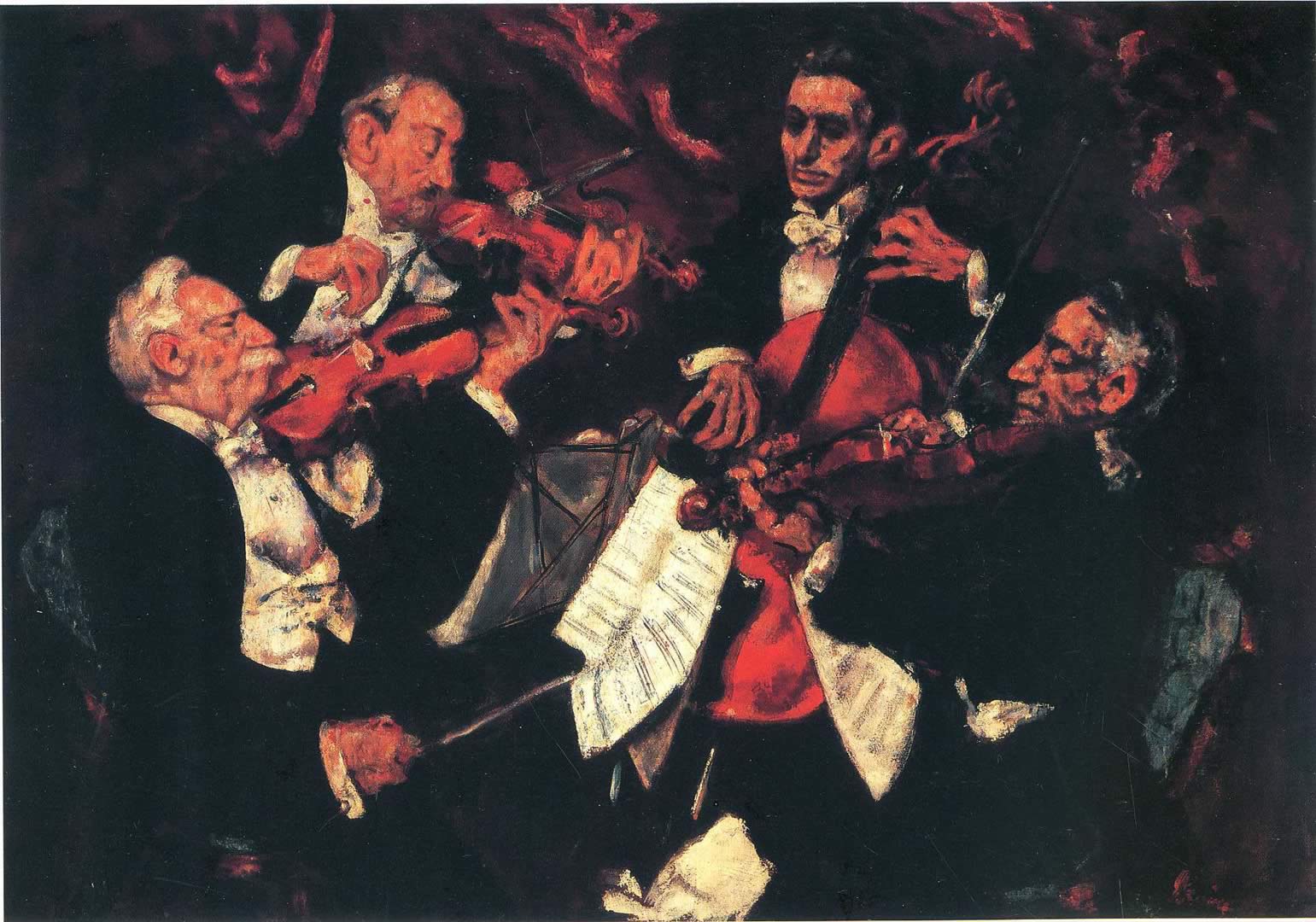
The painting that graces both my quartet volumes is called Haydn quartet and is by the Austrian painter Julius Schmid (1854-1935). I'm still on the lookout for paintings of people playing chamber music and I quite like this one so will show it here on its own:

Scanned from my copy of The String Quartet vol. 2.

Note the lovely violin case taking centre stage at the front - it is the same build as the historic case that came with my current favourite violin, number 22. I do remember that I still need to do a blog entry dedicated to that case.

UPDATE 6.6.2025 When I took the photo of vol I and II, I carefully covered up the address sticker of a previous owner on the cover of vol I. Looking at it again I realised that his address is Simrock House - so he named his house after the original publishing company that first published the quartets (although his edition was a licensed one by Alfred Lengnick for the UK). So I became curious and did a bit of searching. Turns out that Richard Schauer of Simrock House was a music publisher himself, and came to London in 1939 a Jewish refugee from Germany. He died in London in 1952, but the company Schauer & May Ltd. still exists, although it moved out of Simrock House in 2002.
Oh, and the copy of the incomplete quartets arrived today. It contains a preface by Walter Höckner signed in March 1962 at Schloss Ortenburg, a castle in Bavaria (near Passau).

Tuesday, December 10, 2024

trios reshuffled

After the reshuffled quartets list, here's a fresh version of the trios as well

Trios without a viola part:

Anonymus (Venice, around 1700): Due sonate a due flauti e basso (in F and C)

Bach: Trio sonata in C minor from the Musical Offering.

Bach: Allegretto and Andante from the 3-part inventions for soprano, alto and tenor recorder

Bach: 15 Three-part inventions for two violins and cello. Number 11 is the Allegretto from the recorder edition listed above.

Bach: concerto in d minor for oboe, violin and cello. adapted from the concerto for two harpsicords BWV1060

Bach: Little Bach suite No. 2 for woodwind or string or mixed trio - includes Bb clarinet option.

CPE Bach: Trio in Bb major for flute, violin, cello.

WF Bach: Two fughettas for soprano, alto and tenor recorder (all parts in treble clef)

Corelli: 2 Chamber sonatas for two violins & BC: op 2 No. 4 in E minor, op 4 No. 9 in Bb major.

Corelli: Trio sonatas for two violins (or flute and violin) and BC: op. post. 4-6

Haydn: Four London trios for two flutes or violins and cello Hob IV
Very accessible to amateur players and extremely lovely, these are from Haydn's second visit to London in 1794 and may have served as a sandpit where he tried out ideas for his later symphonic works. I discovered the Edition Peters set of trios 1-3 at Oxfam exactly when I needed it for our plague-time bandstand adventures, and we played them on several occasions.

YouTube recordings (see also my new playlist):

London Trio No. 1
London Trio No. 2
London Trio No. 3
London Trio No. 4

Haydn, Trio No. 4 in F for flute or recorder, violin, cello or piano, op 11 No. 4 (Schott). First published by Hummel in 1770, this is presumably an adaptation of one of the 128 baryton trios, but it’s not No. 4.

Gottfried Keller (died 1704) Trio sonata in Bb for treble recorder/violin, oboe/violin, basso continuo

Haydn: Trio in G major for alto, tenor and bass recorder (all parts in treble clef)

Jean-Marie Leclair l'aine: Two trio sonatas for two violins and bc, op 13, no. 1 and 2

JB Loeillet, sonata No. 1 G major for two violins & piano

JB Loeillet, Trio sonata in C minor (op. II/6) Parts are marked: alto recorder/flute; oboe/violin; b.c./cello/bassoon/viola da gamba.

Mozart: serenade in C for two violins and cello "Ganz kleine Nachtmusik" KV 648. This is the piece that was rediscovered in 2024 youtube premiere here. We played it a couple of months later, very exciting to play a new Mozart piece. Presumed to be an early teenage work, it appears to prefigure the famous serenade "Eine Kleine Nachtmusik" K525 in some elements. Score and parts are available to download for free from ISMLP.

Quantz: Trio sonata in G, K46, for oboe, bassoon or cello, and bc.

Sammartini: Twelve sonatas for two alto recorders (violins) and bc.

JM Sperger (1750-1812), terzetto primo a flauto, violino e violoncello

Carl Stamitz, six trios for two violins and violoncello, op 16

Various composers: Chamber Music for beginners, Editio Musica Budapest. Very easy trios with melody parts available for violin or flute/oboe or Bb clarinet, bass part for cello or bassoon.

Trios with a viola part:

Jean Barriere: Trio sonata in d minor for viola, cello and bc (also has a cello version of the viola part).

Beethoven: Serenade for violin viola cello op. 8 We played parts of this in October, lovely stuff. A youtube performance is here.

Beethoven: Serenade for flute violin viola op. 25

Boccherini: Three trios for violin, viola, and cello, Opus 38

Haydn: Four London trios for two flutes or violins and cello Hob IV
After the version described above I also found a different edition including all four trios from Southern Music that also includes parts for Bb clarinet, viola and bassoon. I think we once tried combining both sets and it didn't work. Arrangers must have changed more than just the instrumentation.

Haydn: Trio for violin, viola, cello in Eb, Hoboken V Es1

Telemann: Concerto a tre in F, for recorder, horn or viola and bc or bassoon or cello.

Various composers: Chamber Music II, Editio Musica Budapest. Very easy trios with parts for violin/flute/oboe, viola or Bb clarinet, cello or bassoon.

Two recent acquisitions in the category trios with a viola part.

Update 20.12.2024, added the Mozart trio which we played this week. Funnily enough, there wasn't a single Mozart piece in the trio collection before.

Update 21.8.2025 added the 15 Inventions by Bach and the three trios by Boccherini.

Update 5.6.2026 added posthumous Corelli and Sammartini.

Sunday, December 08, 2024

quartets reshuffled

My list of the quartets in my growing chamber music collection is becoming unwieldy, and I also need to split it into those that have a viola part and those that don't - because when we (random subsets of Cowley Orchestra) meet up in the holidays to try some chamber music, we may or may not have a viola (and the viola parts are written in a different clef that most others can't read).

So first up the list of quartets (and one quintet) that have a viola part (in some cases there are also alternative parts offered, such as 3rd violin), I'll note specifically what the alternatives are in each case:

Bach: 14 fugues from the Well-Tempered Clavier arranged for string quartet by R. Hofmann. Part 2 (No. 8-14)
Bartok: Valse (Ma mie qui danse) arranged for string quartet by Devich Sandor.
Beethoven: quartet op.18, No. 1 in F (lovely performance by GoYa quartet here)
Beethoven: quartet op.18, No. 3 in D
Boccherini: 9 string quartets (various opus numbers).
Borodin: string quartet No. 2 in D
Boyce: Symphony No. 2 (from 8 symphonies), arranged for strings and two oboes by Constant Lambert. Works fine as a quartet. Also includes a violin 3 part to replace viola if necessary.
Dvorak: string quartet in a minor, op 16
Dvorak: string quartet in Eb major, op 51
Dvorak: string quartet No. 12 in F major (American quartet)
Haydn: Quintenquartett Op 76, Nr. 2, in D minor
Haydn: Quartet in d minor Op 103, his last quartet, which remained unfinished, there are only two movements, of which the first is performed here.
Haydn: 30 famous quartets, Edition Peters 289a, 289b
Janacek: String Quartet No. 1
Felix Mendelssohn-Bartholdy: string quartet in a minor, op.13 (youtube)
Mozart: string quartets I, Edition Peters 16 – contains 10 famous quartets
Mozart: string quartets II, Edition Peters 17 – contains 17 quartets including two flute quartets, the oboe quartet, and K525 Eine kleine Nachtmusik.
Mozart (arr. John Auton): Three pieces for strings (choice of violin 3 / viola)
Mozart: quartet in B flat, K485, played by Carmel Quartet here
Mozart: Adagio for cor anglais (oboe/viola), 2 violins and cello, K580a. Another unfinished work, a lovely performance is here;
Pachelbel: Canon in D, arranged for string quartet by Donald Fraser
F. X. Richter (1709-1789): String quartet in B flat Op 5 No. 2, audio here
Schoenberg: String quartet in D major (1897). Composed in the year Schoenberg turned 23, this sounds a lot like Dvorak's American period.
Schubert: Excerpts from 5th symphony, strings pack
Schubert: Quartet for flute, guitar, viola and cello (YouTube). Found this in an edition published 1956 - it later turned out that Schubert had just arranged a trio by Czech guitarist Vaclav Matiegka (1773-1830) and added the cello to give it a bit more oomph. The original trio (Notturno op 21) is lovely, actually, but doesn't harm to have the cello part too.
Shostakovich: String Quartet No. 1 Op 49.
Pyarelal Sharma: Indian Summer. enchanting pieces for string quartet.
Shostakovich: String Quartet No. 1 Op 49.
Francesco Veracini: Chamber sonata for violin and strings Gm. (so that's solo violin plus string quartet). We've played most of this and it is really lovely. Can't find a recording with this instrumentation online, only violin plus piano/cello accompaniment.
Various composers: The String quartet: Original string quartet movements of simple character by old masters; Walter Höckner, ed.
Various composers: The String quartet II: 6 Original string quartets of simple character by old masters; Walter Höckner, ed. Note the last one by Stamitz is written for three violins and cello - although the violin 3 part is playable on viola, there isn't a version in viola clef included. See the table of contents for both volumes on IMSLP - or download the PDF if you want. IMSLP seems to think they date from 1953/55, but I think they are older than that.
Various composers: The Incomplete String quartet, Walter Höckner, ed. - This one contains duets and trios for all conceivable combinations of quartet players waiting for the others to show up. Plus a quartet that also works without the first violin and/or the cello, so if these are missing, one could start playing that one and let the late comers join in when they arrive. I love the thinking behind this whole collection.

List of quartets and quintets that don't have a viola part. Many of these have a clarinet part in Bb, some also a horn part in F:

Anonymus: 2 Hoftänze from the Hessen Books for 5 instruments. All parts in C; 1 in bass clef others in treble.
Anonymus: My Loves an Arbutus arr. for woodwind quartet by A.L. Wyver
Malcolm Arnold: Three shanties for wind quintet
Bach: Bourree from the 3rd cello suite arranged by Gordon Lewin for Flute oboe clarinet bassoon.
Gordon Jacob: Four old tunes for flute, oboe, clarinet & bassoon.
Darius Milhaud: La cheminée du roi René, suite for woodwind quintet (incl. French horn in F ) - see a lovely performance with costumes here.
Mozart: Divertimento Nr 9 in B K240 arranged for wind quintet by Günther Weigelt
Mozart: Divertimento Nr 12 in Eb K252 arranged for wind quintet by Werner Rottler
Mozart: Divertimento Nr 13 in F K253 arranged for wind quintet by Günther Weigelt
JC Schickhardt, sonata in F major op 22 no. 1 for 2 treble recorders (flutes) oboe and basso continuo
Christopher Tye, In nomine I (Weep no more, Rachel) four parts in treble and one in bass clef

The three Mozart quintets I recently found at an Oxfam shop - loving the covers, even though I wouldn't count Mozart as Alte Musik (early music).

PS List of trios is here.

I do realise that my collection of trios and quartets is still lacking any female composers - they just haven't filtered through to the charity shops yet. May have to buy something new to fix this (eg the string quartet in e Minor by Emilie Mayer). I do have some cello sheet music by Rebecca Clarke and Rita Stohl though.

Updated 30.5.2025 after discovered Walter Höckner's six quartets of simple character (sequel to the quartet movements of simple character).

Updated 6.6.2025 to add Walter Höckner's Incomplete Quartets

Updated 24.7.2025 to add the very lovely Schoenberg quartet (which I discovered a couple of months earlier and added to the youtube playlist but forgot to add here)

Updated 20.8.2025 with the Boyce "symphony" which we played today (as a quartet). Not sure when I bought this but must have forgotten to add it when I did.

Updated 7.9. to add Christopher Tye, an English renaissance composer new to me.

Updated 6.10. after discovering sets from two composers not previously represented in the collection, Bartok and Felix Mendelssohn-Bartholdy. (Went through a great big pile of chamber music at a charity shop today, and frustratingly, these were the only complete sets, everything else was just stray parts or two parts of the same work at best.)

Updated 5.6.2026 added the Janacek quartet.

Wednesday, August 07, 2024

finding Rita Strohl

After bringing up a young cellist and spending quite some time obsessing with cello music myself, it was a bit of a shock to discover a couple of truly amazing cello pieces from a composer I never heard of before.

The composer is Rita Strohl (1865-1941)

source

As was the case with many other female composers, her music was played during her lifetime, but forgotten after her death as there was nobody willing to champion it. Some of her works have been rediscovered, published and recorded in recent years.

The pieces are

Grande Sonate Dramatique "Titus et Bérénice" (1898) played by Hermine Horiot & Hélène Fouquart, Youtube

It does have a story to tell, based on the eponymous tragedy by Racine, but on the first couple of hearings I was so blown away by the music I didn't pay any attention to texts between the movements. By the day I first watched this, the video had only around 5860 which is just scandalous.

Solitude for cello (or violin) and piano played by Hermine Horiot, cello & Hélène Fouquart, piano, Youtube

Sheet music for this one is available on IMSLP and it does sound as if it might be playable for mere mortals (unlike the sonata which is pushing the limits of cello technique). On closer inspection, the cello part reaches a couple of quite high notes that I don't use very often (up to the F just over 2/3 up the A string), but the violin version of the solo part fits the instrument range more easily, and it is also very handy for the flute without any alterations. Actually great fun to play on the flute alongside with the cello video.

Here's cellist Sandra Lied Haga raving about Strohl's work in Strad magazine, April 2023. She has released a recording of Titus et Bérénice together with César Franck's sonata in A.

Oh and I've added the two videos to my youtube playlist with female composers.

Thanks to lesser-known-composers on tumblr.

Tuesday, March 29, 2022

a painted quartet

Back in February, I spotted a painting of a string quartet in the window of a charity shop and was almost tempted to buy it. It was a bit more expensive than the sort of stuff I might buy spontaneously, so I didn't and just took a few photos. There were other items blocking the view, so here's the best angle I could get:

I also took a separate photo of the artist's signature, which I only deciphered weeks later, it's Bernard Dunstan. Now it turns out Dunstan was a very prolific and successful painter who died in 2017, aged 97, see his obituary in the Guardian. Apparently he often painted musicians playing, along with the usual sujets such as nudes and Venice.

All of which means, assuming that this was an original painting rather than a print, I really should have bought it on the spot. It was too expensive for a print but would have been a very attractive price for a painting from a recognised artist. Even though his style reminds me of Bonnard, whose work I don't really like that much.

Another reason why this painting has been stuck in my brain for weeks now is that it made me think - using the three photos we have of Heinrich's string quartet, maybe an artist could create a vision of the quartet playing? Does anybody know any artists who might be up to the task?

Update 23.11.2022 Another image search washed up one that I quite like, by Artist Jack Levine:

Update 6.12.2024: Oops, that hotlink appears to have stopped working, I think it was this painting.

Wednesday, September 01, 2021

quartets for random instruments

In addition to duets and trios, we (a hardy subset of Cowley Orchestra and some newbies) have also played some quartets over this summer. These included baroque pieces set for three melody instruments plus basso continuo (Baroque composers didn't mind very much what melody instruments were used). On some meetings, when we had a strong ensemble, we also ventured into the string quartets of classic/romantic periods.

This Bank Holiday Monday we had a particularly strong ensemble (nothing to do with me, I am either the weakest link or hiding behind a stronger player) with an interesting variety of instruments and played Dvorak's American quartet among other things. It struck me that I actually prefer our version with five different instruments (violin, flute, oboe, clarinet on the viola part, cello) to the string quartet performance. Listening to string quartets, I don't really like the fact that the four string instruments have similar sound textures and all blend into one sauce - having a variety of different sounding instruments is actually an improvement to me. Also, with its richness of textures, the random instruments version is a lot closer to the New World symphony.

(UPDATE 11.9.2021: Just discovered it's been done before. Somebody called David Walter arranged it for wind quintet (flute, oboe, clarinet, bassoon, horn, published by Billaudot - Paris 1986) and YouTube has live videos from the Amsterdam Wind Quintet (fourth and first movement) as well as sound-only recordings from the Royal Flemish Philharmonic (complete) and Meliora Winds.)

Anyhow, here's my nascent collection of quartets so far:

Bach: 14 fugues from the Well-Tempered Clavier arranged for string quartet by R. Hofmann. Part 2 (No. 8-14)
Beethoven: quartet op.18, No. 1 in F (lovely performance by GoYa quartet here)
Beethoven: quartet op.18, No. 3 in D
Boccherini: 9 string quartets (various opus numbers).
Borodin: string quartet No. 2 in D
Dvorak: string quartet No. 12 in F major (American quartet)
Haydn: Quintenquartett Op 76, Nr. 2, in D minor
Haydn: Quartet in d minor Op 103, his last quartet, which remained unfinished, there are only two movements, of which the first is performed here.
Mozart: quartet in B flat, K485, played by Carmel Quartet here
Mozart: Adagio for cor anglais (oboe/viola), 2 violins and cello, K580a. Another unfinished work, a lovely performance is here;
Pachelbel: Canon in D, arranged for string quartet by Donald Fraser
F. X. Richter (1709-1789): String quartet in B flat Op 5 No. 2, audio here
Schubert: Excerpts from 5th symphony, strings pack
Schubert: Quartet for flute, guitar, viola and cello (YouTube). Found this in an edition published 1956 - it later turned out that Schubert had just arranged a trio by Czech guitarist Vaclav Matiegka (1773-1830) and added the cello to give it a bit more oomph. The original trio (Notturno op 21) is lovely, actually, but doesn't harm to have the cello part too.
Shostakovich: String Quartet No. 1 Op 49.
Various composers: The String quartet: Original string quartet movements of simple character by old masters; Walter Höckner, ed.

And a bunch of baroque quartets I borrowed for the summer:

MA Charpentier, Noels (9 short pieces, some christmassy)
Naudot, concerto in C major
A. Scarlatti, Sonata in F major
GP Telemann, concerto in G major
JB Fasch, quartet in Bb major
JC Schickhardt, sonata in D major

The last page of the autograph score of Dvořák's American quartet with his inscription: "Finished on 10 June 1893 in Spillville. Thanks God. I'm satisfied. It went quickly."

Source

Updated 6.9.2021 to add the Schubert quartet based on the Matiegka trio.
Updated 21.4.2022 to add Haydn op 103, Mozart, Richter, and Various.
added Beethoven and Mozart K485.
Updated 23.2.23 to add Bach and Borodin

Sunday, July 11, 2021

trios for flute, violin, cello

As the orchestra I joined back in 2017 is now reduced to a maximum of four people showing up to play every week (outdoors, while summer lasts), I have been obsessing about chamber music a bit, to make sure we don't get bored. Following up on the duos for cello and flute, here's a list of a some trios we have enjoyed playing in the last two months. I'm dreaming of scaling this up to reach the Schubert octet one day ...

My nascent collection:

Anonymus (Venice, around 1700): Due sonate a due flauti e basso (in F and C)

Bach: Trio sonata in C minor from the Musical Offering.

Corelli: 2 Chamber sonatas for two violins & BC: op 2 No. 4 in E minor, op 4 No. 9 in Bb major.

Haydn: Four London trios for two flutes or violins and cello Hob IV
Very accessible to amateur players and extremely lovely, these are from Haydn's second visit to London in 1794 and may have served as a sandpit where he tried out ideas for his later symphonic works. I discovered the Edition Peters set of trios 1-3 at Oxfam exactly when I needed it. A bit later I also found a different edition including all four trios from Southern Music that also includes parts for Bb clarinet, viola and bassoon (but has the slightly covid-unfriendly aspect that the two flutes are supposed to read from the same score). Combining these two sets, we could turn the trios into very colourful sextets ...

YouTube recordings (see also my new playlist):

London Trio No. 1
London Trio No. 2
London Trio No. 3
London Trio No. 4

Haydn, Trio No. 4 in F for flute or recorder, violin, cello or piano, op 11 No. 4 (Schott). First published by Hummel in 1770, this is presumably an adaptation of one of the 128 baryton trios, but it’s not No. 4.

Gottfried Keller (died 1704) Trio sonata in Bb for treble recorder/violin, oboe/violin, basso continuo

JB Loeillet, sonata No. 1 G major for two violins & piano

JB Loeillet, Trio sonata in C minor (op. II/6) Parts are marked: alto recorder/flute; oboe/violin; b.c./cello/bassoon/viola da gamba.

JM Sperger (1750-1812), terzetto primo a flauto, violino e violoncello

Carl Stamitz, six trios for two violins and violoncello, op 16

Borrowed sets we used (now returned):

JS Bach, Trio sonata Eb major, BWV 1031
A. Corelli Triosonata in d minor from concerto grosso in c minor op 6 no. 3
Matthew Locke, Suite in G from Tripla concordia
JB Loeillet, trio sonata in F major
JC Pepusch, trio sonata Bb major
JJ Quantz, trio sonata A minor - haven't played these two Quantzes yet, tried a different one though.
JJ Quantz, trio sonata C minor
Telemann triosonata in C minor

It amuses me that these three stellar soloist took time out of their world tours to have a bit of fun with the Haydn trios.

Although at least three of the trios were published in Haydn's lifetime, they fell into oblivion and had a somewhat romantic rediscovery. In 1878, a Berlin antiquarian and manuscript collector died - Haydn's complete autograph of the London trios was found among his belongings and transferred to the Berlin Staatsbibliothek. Published in 1909 on the occasion of the centenary of Haydn's death, they arrived just in time for the last flourishing of Hausmusik before it was wiped out by the advent of broadcasting and recorded music.

Edits and updates:
26.7. added the Corelli (just found at Oxfam)
31.7. ditto for Gottfried Keller
10.8. ditto Anonymus
21.4.2022 added Sperger
5.3.2023 added Stamitz
1.4.2023 added Bach
20.4.2023 added Loeuillet C minor trio.

Sunday, June 27, 2021

more chamber music for cello and flute

When I revisited our ancient noteflight scores of duets we arranged for cello and flute, I also remembered the list of duets that I had discovered online back then and that I found helpful for some initial directions. Back in 2011 it was hosted on the comprehensive flute website of jazz flautist Larry Krantz and credited to Julia Larson Mattern and others. Sadly it is no longer online, so I've used the copy I kept as a starting point to make my own list by adding in youtube links and dropping those items of which I could not find any performance. I also removed the comments from the original list and added some of my own. Oh, and I made a YouTube playlist.

Work in progress. Surely there must be more music that works well for cello and flute? Suggestions welcome.

So here's my list of published editions in alphabetical order (editions I own are in bold):

1. Beethoven - Three Duets (published by Kalmus) Lovely music from a young Beethoven, written for clarinet and bassoon but available in several other combinations too. We played four or five of the 9 movements back then, some in arrangements derived from an edition for violin and viola, see the list of our scores. YouTube performances of duo No.1: Duo Dare plays first movement only, but clearer sound than this recording of the whole duo.

2. Besozzi, Alessandro - Divertimento in F (published by Urtext Premiere Publication) YouTube I thought this sounded a bit lame? (Besozzi has lots of trios though, which I'll still need to check)

3. Cambini, Guiseppe - Six Sonatas (published by Amadeus) YouTube

4. Carter, Elliott - Enchanted Preludes (published by Boosey and Hawkes) YouTube

5. Carrick, Richard - La Scene Miniature (self published) for piccolo and cello a quartet version with composer on piano.

6. Danzi, Franz - Three Duos, Op. 64 (published by Musikverlag Hans Sikorski) I'm loving the Danzi, might buy a copy Duo No.1; Duo No. 2; Duo No. 3

7. Doran, Matt - Sonatina (published by Western International Music) first movement; third movement

8. Febonio, T.G. - Rustic Airs and Folk Dances (published by ALRY) a selection of the pieces

9. Fiala, Joseph - Duo Konzertant in F Major (published by Amadeus) first movement

10. Handel - Acht Stücke (published by Amadeus) NB I have this edition, not clear where the pieces come from, no opus number etc. can’t spot any of them on youtube.

11. Heiss, John - Five Pieces (published by Southern) YouTube

12. Hofmann, Leopold - Divertimento (published by Amadeus) YouTube

13. Jevtic, Ivan - Musica per Due (published by LeDuc) YouTube

14. Tann, Hilary - Llef (published by Oxford University Press) YouTube loving the haunting sound of this.

15. Uebayashi, Yuko - Suite for Flute and Cello YouTube

16. Vali, Reza - Folk Songs (set No 9, published by MMB Music, Inc.) YouTube Fascinating but way beyond amateur standard.

17. Villa-Lobos - Assobio a Jato (Jet Whistle) One of many recordings available on YouTube

18. Whiteman, Lauren - Six Haiku (published by ALRY) a selection

Flautist Martha Long and cellist Marilyn de Oliveira performing Folk Songs Set No. 9 by Reza Vali. A still from this YouTube video

Friday, May 14, 2021

chamber music revisited

As Cowley Orchestra reconvened outdoors this week in much-reduced force just sufficient for duos and trios, I revisited the chamber music scores the young cellist and I prepared many years ago for our duo adventures. As the Flash previews which I embedded in the relevant blog entries at the time are no longer working (at least not on my computer), this is a new list I've prepared to have the playable ones handy (the noteflight list also includes some projects that didn't quite succeed or didn't get finished, although the "likes" added by users give you an impression of what works and what doesn't, I'm putting the more popular ones first in the list below).

Beethoven 3 duets (written for clarinet and bassoon originally):
1.1. Allegro comodo in C (video flute and cello)
1.3. Rondo in C
2.2. Rondo in Dm (video clarinet and cello)

JS Bach
Bourree in e minor, from the lute suite (the famous bourree used by many people including Jethro Tull)

Dvorak
Adagio (from the cello concerto)
Humoreske

Haydn
Menuet and trio (This was the first duet we performed, very basic stuff, and I probably still managed to make mistakes.)

Faure
Sicilienne (op78) This looks ok and we did perform it, not sure why it didn't get any likes.

Unfinished work: One of my favourite pieces for cello and flute to listen to is the Trio (op 78) by Johann Nepomuk Hummel, but unfortunately the piano has quite a prominent role in it. We made an effort to kick out the piano and arrange the piece for cello and flute alone, but never quite got it to a presentable shape.
First movement
Second movement (its a theme with variations, but we only got one of the variations done)

own photo

PS (27.5.2021) Now beginning to add YouTube links of professional performances to each of the pieces.

Tuesday, October 04, 2016

k525

As the young cellist has moved out now, I am left to focus on my solo flute work (although there’s never a shortage of jolly company for playing a few folk tunes around here, so I’m keeping up some of those sessions as well). I’ve decided to post a musical still life for every work I’ve learned to play, starting with my very first Köchel number, K525, which is, of course, Eine kleine Nachtmusik, all four movements of it. I might play the third movement at the Festival next year, be afraid …

Next up is a work that Mozart actually wrote for flute, the Andante K315.

Tuesday, March 17, 2015

rondo from Beethoven duo No 2

Here comes a new chamber music score we've prepared for cello (grade 7+) and flute (hopeless, i.e. me). It's the third movement of the second duet from Beethoven's three duets which I think were originally written for clarinet and bassoon.

PS (July 2015): We've now performed this at a street party and made a tentative recording - not good enough for sharing yet but getting there. Meanwhile, here is a clarinet/cello duo playing the piece exactly twice as fast as we do (as a listener I prefer our speed, it allows me to actually understand what's going on in the music).

Tuesday, September 30, 2014

Guillaume Paque

Continuing the theme of obscure composers, the young cellist recently played Souvenir de Curis, a piece for four cellos by the Belgian cellist and composer Guillaume Paque.

Here are four blokes playing it (but if you prefer to see four girls playing it give me a shout and I'll send the private link):

The information I could find about him reads, in its entirety (and the years / ages don't add up):

"GUILLAUME PAQUE must be mentioned, born at Brussels on July 24, 1825. At ten years of age he became a pupil of the Conservatoire, where, during a course of six years, he received his entire artistic training. Dismissed from the institution with the first prize, he entered the orchestra of the Royal Theatre in his native town. After he had belonged to it for some years, he took up his abode in Paris, with the intention of permanently settling there. But an offer which he received in 1840, of entering, as solo cellist, the Italian Opera at Barcelona, induced him to leave the French capital. Scarcely had he arrived at Barcelona, when the Professorship of the Musical School was committed to him. In 1849 he played before the Queen of Spain in Madrid, and in 1850 he travelled in the South of France giving concerts. In the same year he fixed his residence in London, where he gained popularity as a chamber music player. He found his particular sphere of work as solo cellist at the Royal Italian Opera, as well as teacher at the London Academy of Music, until his death on March 3, 1876. Amongst his compositions he published several "Fantasias," Variations, and Drawing- room pieces."

source

Friday, September 26, 2014

sicilienne

The Sicilienne by Gabriel Fauré is a popular repertoire piece for both flautists and cellists, but here comes the version for cello and (a somewhat less competent) flute, arranged by the young cellist in the family.

PS (9.2.2015) We've performed that at the Oxford Music Festival (family class) now, so the version now on noteflight is the final one as we will move on to fresh challenges.

Monday, September 30, 2013

Dvořák abbreviated

The latest addition to my growing collection of arrangements for cello and flute is an adaptation of the slow movement from Dvořák's cello concerto. I've left out a section in the middle, bringing it down to 6 minutes length. The rest in bar 66 marks the spot.

As the original work is largely a dialogue between the solo cello and the woodwind instruments in the orchestra, I'm hoping that my edit makes some kind of musical sense, but all hints and suggestions for improvements are welcome.

PS: Noteflight members can see a handy list of our other scores here. Mere mortals can access them individually through the earlier blog entries.

Wednesday, March 13, 2013

Beethoven rondo

Moving on from first movement of the Beethoven Duo no. 1, we're now trying to play the third movement of the same piece, which is actually a little bit easier.

Here's the score:

As of 2021, the Flash view of the score disappeared, but this link is working.

This is mainly adapted from the Kalmus edition for violin and viola. A slightly different version is included in the duets for violin and cello from Editio Musica Budapest.

PS: Note that I added the first bar just to count me in and allow me time to get my hand back to the flute after pressing start.

Saturday, February 02, 2013

Bach for cello and flute

Looking through the flute tag on tumblr earlier this week I came across an ancient video of Jethro Tull performing "Bouree" (not sure what happened to the second "r" but that's what they call the piece), based on Bach's Bourree from BWV996, which I played on the guitar many years ago.

As Jethro Tull play the Bach bit with flute and electric bass, I thought that should work for flute and cello as well, so I found a guitar version on noteflight and converted it to cello and flute, with both instruments taking turns in the repeats.

Sounds ok when noteflight plays it (though it doesn't do the pizz I wanted). Will try out with real instruments soon.

Friday, June 22, 2012

Beethoven for cello and flute

We're currently trying to play the first movement of Beethoven's duet No. 1 (originally written for clarinet and bassoon, but we're adapting an adaptation for violin and viola). Here's the score I've prepared - all the notes are there now (I hope), but dynamics aren't quite complete yet (requires Flash -but I can email PDF file on request):

As of 2021, the Flash thing no longer works at least on my computer, but this link should take you to the score, and you can look at it without being registered with noteflight.

If you click play above, you'll get a computer-sound version - but here is how it should sound like when it's played by proper musicians.

PS: an amazing and growing list of repertoire for cello and flute is here.

PPS: We played this at the Oxford Music Festival in January 2013. The adjudicator used words like "brave" and "challenging" a lot, but we made it to the end, so I count that as a success. We're now moving on to the third movement of the same piece, which appears to be a little bit easier (hoping I can get my head round the triplets). After writing up around 40 bars, I realised that a version of Movt. 2 and 3 playable with our instruments is actually published in the book:

Duets for Violin and Violoncello for Beginners, Vol 2
(Arpad Pejtsik & Lajos Vigh, eds.)
Editio Musica Budapest Z. 14062

so we'll work with that at the moment, maybe finish the draft on noteflight later.

Saturday, May 19, 2012

Beethoven duo

one of our current chamber music projects is the Duet no. 1 by Beethoven (originally written for clarinet and bassoon). Maybe if I practice hard for a year I can learn to play it at half the speed. Anyhow here is what the first movement should sound like

Thursday, April 19, 2012

Haydn for cello and flute

Here's a score we prepared earlier (and played last year). It's from a string duet by Haydn, and we adapted it for the flute. It's quite easy to stick together as the rhythm is mostly identical in both parts, and the parts individually are grade 3-4 level I would guess.


Next up is an adaptation of Johann Nepomuk Hummel's trio for piano, cello and flute in A major, op.78, which is essentially a set of variations on a Russian folk song called "Beautiful Minka." As the piano is quite dominant in this work and we don't have a pianist in the house, this one involves quite a bit of rearranging. We did just the theme last year, and I have now added one of the variations. Work in progress here:

Russian theme & variations