Showing posts with label klundt. Show all posts

Thursday, June 12, 2025

the Trimbach connection

Ten years ago, I looked into the story of the miners migrating from Fischbach (Nahe) to Markirch (Sainte Marie Aux Mines) and mentioned several interesting leads connected to the Trimbach family which stayed in Markirch for several generations. (NB I'm using the German name for Sainte Marie aux Mines because it's a lot shorter. As I explained in the migrating miners entry, the town was split between territories, languages and confessions for several centuries.) There is a likely Huguenot connection, as well as a link to a wine-growing business still active today. All safely buried in a great big materials file I compiled at the time.

I was reminded of the Trimbachs now because I became interested in family names that are also place names and go back far enough to support the hypothesis that the first in the name line took the name of the place where he came from, for instance after being displaced and on arrival at a new place becoming known as the person from the previous place.

So Trimbach is such a case, and intriguingly one place with this name is half way on the well trodden path of the migrating miners between Fischbach and Markirch. Another is in Switzerland. But which could it be? Let's introduce some Trimbach people first:

We're starting from the supremely unsearchable Paul Simon, born 1740 in Markirch, who migrated to Böchingen, Palatinate, where his descendants became entangled with the Klundt Clan.

His mother was Maria Susanna Trimbach * 1713 + 1752 Markirch. Her male line ancestry goes:

Paul Trimbach * 1682/83 (calc.) Echery (now part of Sainte-Marie-aux-Mines) ~ 1682 Markirch oo Maria Salome Klein five children + 1760 Markirch aged 77

Johann Georg Trimbach ~ 1635 Markirch oo (II.) 1667 Elisabeth Saass + 1693 Echery (the same person, identified by baptism and death dates and names of parents and first wife, is known as Paul Trimbach in the Gaudel genealogy)

Jakob Trimbach oo 1623 Ermelind Monschat (Irmel Besuchet) from Lapoutroie + 1669 Markirch

Jean Jacques Trimbach * around 1570 oo Susanne Marchand at least three children including a Jean Trimbach who on 15.9.1625 married Marguerite Reisser in Riquewihr. I'm assuming he is the same Jean Trimbach who in 1626 established himself as a wine grower in that very town, according to the Trimbach website. The business moved a couple of times while staying in the Trimbach family and is now located in Ribeauvillé. (Incidentally both Ribeauvillé and Riquewihr are today tourist destinations for all things Alsatian.) If I've got my maths right, the founder must be my 9xgreat grand uncle.

Laurent Trimbach * around 1540 Markirch oo 1570/71 Marie Anne Sturm in Riquewihr

the name line ends here, but six generations of Trimbachs in one spot isn't too shabby.

Now one village with the name of Trimbach is in the northeast corner of Alsace region, around 100 km north-northeast of Markirch. It has always had just a few hundred residents (435 in 1793). I was keen to connect the name to this one, as it is on the route from Fischbach, but others seem to have other information:

The history page of the Trimbach winery, however, says the family came to Markirch from Switzerland in the 16th century to work in the silver mines. There is a Trimbach town in the Canton Solothurn in the north of Switzerland, not all too far from Alsace (also just over 100 km from Markirch), so that would make sense too.

Trimbach is one of three names in my family tree that appear on wine labels to this day. The others are Klundt and Minges. All three are in the ancestry of Barbara Klundt (1847-1886).

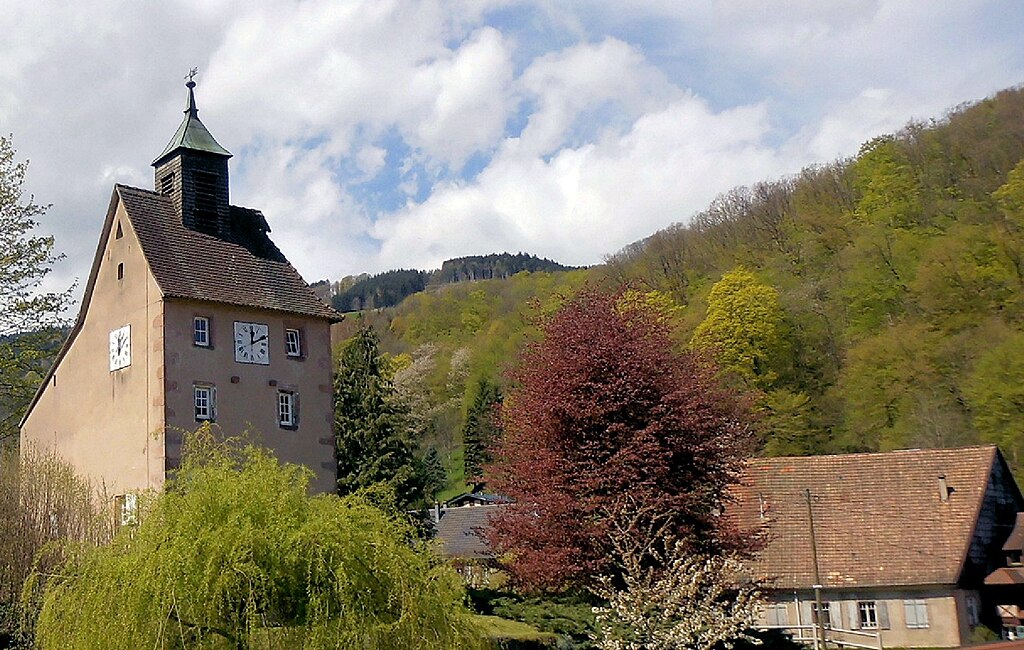
The miners' tower at Echery.
Image source: Wikipedia / Von Rauenstein - Selbst fotografiert, CC BY-SA 3.0

In the hope that this will grow into a series, here's my nucleus list of blog entries exploring name/place connections:

  1. Wolff (named after the Wolffskotten farm in Styrum);
  2. Zeuzheim; further details re. the Zeuzheim family
  3. Trimbach

Update 25.1.2026: I created a new portal to navigate family history blog entries in the shape of a permanent Who Is Who page. This is because the old webpage at michaelgross.info will go offline on February 2nd.

Tuesday, June 08, 2021

brother Klundt

Nearly seven years ago, I wrote up what I knew about the descendents of my ancestors Johannes Klundt and Eva Hust, who had emigrated to the Black Sea (today’s Ukraine) with their youngest children, while the oldest son, Johann Jacob Klundt (1782-1853; my four-times-great-grandfather) stayed in Germany.

The post has created a lot of interest (as well as inspiring a master dissertation from the young historian in the family) and most recently, two readers have been able to fill me in on the descendants of the youngest son, Georg Michael Klundt (1805-after 1866), about whom I knew nothing back then. It turns out his son became famous as a founder of the Baptist community in Bulgaria, but let’s start from the beginning again, from the migrating couple, and the new village of Rohrbach where they settled.

I found the historic report of school master Fritschle (an English translation available here) who taught at the village school in 1848 and wrote a detailed account of its history with its ups and downs. It started in 1809 with 26 families, and another 69 families arrived in 1810. Another arrival of five families brought the number to 100 families with 475 individuals. There were numerous Fritschle individuals among the settler families, so the schoolmaster definitely came from within that community, but I don't know his first name and haven't been able to identify him in the databases.

Fritschle noted that this happened under the authority of the governor “Rischileu”. I recently learned from Neal Ascherson's excellent book Black Sea that the city of Odessa, founded around the same time, was essentially run by French nobility that escaped the French Revolution. So this governor was Armand-Emmanuel Sophie Septimanie de Vignerot du Plessis, the 5th Duke of Richelieu and Fronsac (1766 –1822) who later returned to France to serve in the restored monarchy.

In 1810, my relatives at Rohrbach accounted for two households with nine individuals:

Founder family: Johannes Klundt, 51; Eva Katharina Hust, 48; Eva Catharina, 18; Heinrich, 13; Johann Michael, 9; Georg Michael, 5.

First generation family: Wilhelm Klundt, 25; Ottilia Golum, ca. 22; Jakob, 3

Fritschle notes that the Russian government paid for a stone-built house for every family. All other necessities such as farming equipment, seeds, animals and food were provided on a credit basis.

According to Fritschle, the colony failed to thrive in the first 18 years, because the colonists were lacking the relevant skills and/or work ethic, and for most of the time, the village didn’t have a pastor to instil the fear of God in its residents. Pastorn Elias Hübner was appointed in 1812, but died after less than two years in the job.

In 1824, the pastor Johannes Bonekemper (1795-1857) was appointed as pastor for both Rohrbach and the neighbouring colony of Worms (7km away). Bonekemper was of Reformed protestant faith, but was also tasked with offering Lutheran services. Also, from 1826, a new schoolmaster arrived, Wilhelm Eberhard, who taught until 1843 and is credited with a change of culture.

Bonekemper spread the “Erbauungsstunde” idea (a daily hour of spiritual recollection) around the Southern parts of Russia, creating what became the “Stundist” movement. A more extensive account of his role in the Reformed faith is here, scroll down to the subheading "Life in Russia". By 1847, the spiritual fervour of Bonekemper's followers got out of hand to an extent that authorities persuaded him to move on which he did in 1848. Schoolmaster Fritschle, by contrast, created the impression that Bonekemper resigned voluntarily and praised the spiritual renewal he achieved: "The blessings of his 24-years' work with us will long be remembered." Bonekemper was intending to emigrate to the USA, but didn't make it.

In the early 1840s, seven families from Rohrbach, including Georg Michael Klundt and his wife Elisabeth Feiock (* 1817 Rohrbach) moved to the new colony Neu-Danzig and took the stundist idea there. They had married in 1836 and had three children, including Margaretha (1837), Jakob (1839) and Barbara (1841). They may have had additional children in Neu Danzig, possibly including Beatha Klundt.

By 1840, the founder couple Johannes Klundt and Eva Hust had died, but all their children had families, with up to eight children. In stark contrast to the school master's moans about the colony’s initial lack of economic success, this family was thriving rather nicely, as judged by survival rates. Not counting the descendants they left behind in Germany, the founders had at least 19 grandchildren, and 22 great-grandchildren.

In 1864, the Klundts in Neu Danzig became Baptists, which was a growing but illegal faith in Russia. In 1866, Jakob and his young family fled to Katalui, in the Danube delta, which was then a German colony under Osman rule, now known as Cataloi, Romania. This wider area on the West Coast of the Black Sea is called Dobruja, and the German settlers were known as the Dobrujan Germans. Georg Michael followed them and died there after 1866. The above-mentioned Beatha Klundt and her husband Johann Wilhelm Graf also moved there. Their first three children were born in Neu-Danzig in 1862-1865, but the fourth was born in Cataloi in 1867.

Jakob started a Baptist community in Katalui, which appears to have been so successful that he was hired by the British and Foreign Bible Society as a Bible colporteur for Bulgaria and part of Macedonia and Albania in 1872. For eight years he worked and traveled from Albania, but dangers and difficulties he faced there led him to move his base to Bulgaria.

From 1880 and for the rest of his life his base was in Lompalanka, now Lom, Bulgaria, and any history of Baptism in Bulgaria includes his biography (see eg here) and sometimes even a portrait (see below). His name in Bulgarian looks like this: яковъ клундтъ (in case anybody wants to dive into Bulgarian sources). Accounts mention his wife Regina as an active participant in the Baptist community, but don’t mention his descendants by name. He did have a son in law who later took over his role as pastor in Lom, so at least one daughter survived. We believe that no sons survived to adult age.

Jakob died on March 28, 1921, in Kazanlak, Bulgaria, where he was staying with his son in law (the obituary does not mention his daughter at this point, not sure if she was still alive).

Of Jakob’s sisters, we know nothing about Margaretha beyond her date of birth, but his younger sister Barbara married Philipp Krause and had five children. Only Barbara Krause (* 1864 in the Black Sea colony of Worms) survived to adulthood, she married Johann Brandner, emigrated to South Dakota (as many other descendants in her generation did too) and had 14 children.

Portrait of Jakob Klundt which appeared with his obituary in The EVANGELIST, Organ of the Evangelical Baptist Union of Bulgaria, editor: Rev. V. Tachtadjieff, Tchirpan.

Special thanks to Mihai, whose comment under the original Klundt Clan post already contained a lot of information about Jakob Klundt and set further investigations and contacts rolling.

Friday, April 30, 2021

united colours of the Black Sea

Some thoughts on

Black Sea
Coasts and conquests: from Pericles to Putin
Neal Ascherson
Vintage Paperback 2015

When I suggested writing the feature that came out this week, on the Scythians, the editor recommended the book Black Sea, and I managed to read most of it in time for the feature and the rest shortly after. While it was very instructive on the Scythians and their role as “barbarians” in the eyes of the Ancient Greeks, their history (which I’ve written about in the feature) is just one of many slightly crazy things that have been going on around the Black Sea over the last 3000 years.

In ten chapters (untitled, keeping the suspense as to what they may be about) Neal Ascherson covers the cultures that have lived around the Black Sea, rounding the book off with a chapter about the water body itself as an ecosystem. Apart from the Scythians, Cossacks and Sarmatians of the northern shore, we get to know Pontic Greeks in today’s Turkey, many of whom decided to return to their homeland in the 1920s, after 3000 years of absence, and then wondered why people in Greece weren’t quite like their idea of Greekness.

We get insights into the birth of Polish nationalism, dreamed up at the sea port of Odessa (run by French aristos who fled the Revolution), at a time when Poland didn’t exist. Ascherson, who has also written a history of Poland, is very engaging on the weird and wonderful ways in which groups of people conjure up a national identity when they don’t have a country and perhaps no more than a shared language and/or religion to support the idea of “nation”. In some of the smaller groups scattered around the area, even the language is in need of saving, and some appear to have adjusted their religion flexibly to whoever ruled the land.

Alternative models to the modern nation state have worked around the Black Sea, such as the Greek trading ports that coexisted peacefully with Scythians and Sarmatians in the hinterland. The multi-national empires of the Ottomans and Russian Tsars, and then the Soviet Union, suppressed the regional nationalisms, which then came back with a vengeance. After the demise of the Soviet Union, nations around the Black Sea engaged in regional wars, including the 1992 war between Georgia and Abkhazia, and the current conflict in Ukraine.

All in all a rich tapestry of cultural diversity and historical ironies, also reflected in the light of recent events – this edition was updated in 2015. Sadly, not much is said about the German settlers in the Odessa region, whose number included two of my ancestors (see the legendary Klundt clan blog entry). I suppose these people were just too normal and boring compared with the likes of Pontic Greeks and Scythians.

Monday, November 23, 2015

more Huguenots

When I reported on the suspected Huguenot connection of my ancestor Jean Bonnedame (* 1699 at Billigheim) , I didn’t know the last name of his wife, Maria Sara, whom he married in 1724. We now know that she was called Maria Sara Bouquet, (*1699 Minfeld).

Correction 9.7.2026: I corrected the birth year of Jean B. to 1699. There seems to have been a confusion with his father, also called Jean, who was born 1666 at Mörlheim. See eg here.)

It turns out that her family appears to be of Huguenot origin as well. Specifically, her father Philipp Bouquet was probably born around 1655 in the pays de l'Alloeu, a small patch of land just west of Lille (today in north of France) which originally was one of the provinces of the Spanish Netherlands. He came to the town of Billigheim (in the Palatinate, just south of Landau), which had a significant population of Huguenot refugees, with his father Laurent Bouquet (Boquai) in 1664. We don’t know anything about his mother. In 1685 he married Christina (last name unknown) at Archenweyer near Billigheim. Their son Isaac Bouquet was born in Archenweyer in the same year.

Like many other Huguenots, the Bouquets followed the invitation from the Duke of Prussia and moved on to the East, to the Uckermark area around Prenzlau in 1686, and were still there in 1690. (A list of residents confirms there were no Bouquets left behind in Billigheim by 1692.) However, there are no family events recorded in the Uckermark and by 1699 they were back in the Palatinate, where Philipp was administrator (Hofbeständer) at Minfeld. Sara Bouquet was born there in December 1699. Philipp Bouquet died on the Baltic island of Rügen, which must have been in Swedish possession at that time. We have no idea how or why he got there, so any clues appreciated. Christina died at Mörlheim in 1733.

There are a few Bouquet (Bocquet, Boquai, etc.) families documented in the area that is now the region Nord/Pas de Calais, but most are catholics, so ours are the black sheep. If anybody knows anything about protestant Bouquet families in that space and time, all hints would be much appreciated.

A couple of generations down the line this means that the couple that emigrated to the Black Sea, Johannes Klundt and Eva Maria Hust, may both have had quite a lot of “migration background”. Johannes Klundt has three grandparents of suspected French or Swiss origin. The odd one out is Anna Apollonia Schmitt. And the name Hust may also be of French, ultimately of Hungarian origin.

Sailly sur la Lys - one of the four towns of the pays de l'Alloeu.

« Prevote » par Médard — Travail personnel. Sous licence CC BY-SA 3.0 via Wikimedia Commons - https://commons.wikimedia.org/wiki/File:Prevote.jpg#/media/File:Prevote.jpg

Wednesday, April 15, 2015

an ancient copper mine

After writing about the Simon family who were miners in Fischbach (Nahe) and then 170 km further south in Markirch (Sainte-Marie-aux-Mines, Alsace), I had the opportunity to revisit the ancient copper mine at Fischbach, which is where Johann Christoph Simon must have worked before migrating to Markirch, and where some of his brothers as well as his father Nickel Simon also worked.

Specifically the five men who were linked to the Fischbach mining industry were (with made-up translations of the job titles Schmelzer, Röster, Bergschmied):

  • Johann Nickel Simon, born Niederhosenbach in 1672-3, worked as a smith and as a miner, married Anna Francisca in 1700, died 1754 aged 81.
    as well as his four sons:
  • 1701 Johann Nickel Simon jun – roaster and smelter at Allenbach
  • 1703 Johann Jacob Simon – smith at the mines in Markirch
  • 1705 Georg Nickel Simon – miner at Fischbach and Kautenbach
  • 1707 Johann Christoph Simon – smelter at Markirch

They were part of the second and final era of success for the Fischbach mine, which had a fair number of ups and downs throughout the centuries. Here’s my potted history which I also wrote up in German for Wikipedia:

According to a document from 1461, copper mining in the valley of the Hosenbach creek near Fischbach dates back to at least 1400. In 1473, the two counts whose territories met on the hill above the mines signed an agreement to split all income from mining equally between them.

In the 16th century, the mines were thriving with up to 300 miners working there. Copper was sold beyond the region, for instance to Dinant (today’s Belgium), which was a centre of brass making. Due to the 30-Years War and the difficulties in maintaining the safety of the mines and the transport of the metal produced, mining ceased from 1624.

Mining was resumed at the Hosenberg site in 1697, but not in the sites on the opposite bank of the creek. From 1730 to 1765, the industry flourished once again. Johann Christoph Simon and his brother Johann Jacob Simon must have been in Markirch already (Johann Christoph married there in 1732 Around 1750 there is also the earliest evidence of the use of explosives in mining – even though the know-how was already developed half a century earlier in eastern German mining regions such as Saxony, and migration from those areas to Fischbach has been described by Bühler and Brandt. Between 1765 and 1776, the mining business went into decline, and in 1792, war forced its closure once again. Several attempts to revive it were undertaken in the 19th and in the 20th century, but all failed, due to high costs and low yields.

In 1975, the mine was opened to visitors. Guided tours around the impressive network of man-made caves are offered all year round. Above ground, there are also exhibits demonstrating copper smelting, as well as a sight-seeing circuit.

Back to the family history – Bühler and Brandt note that the Fischbach miners were highly respected professionals, as evidenced by the fact that they married into well-known families of nearby market town Kirn. However, my Fischbach ancestors and those in Kirn represent completely different lineages and cross-links between them have yet to be found. We have a few more generations of Simon ancestors, back to Mathes Simon, born around 1600 in Allenbach, but no details of what they were doing while the copper mine was closed.

Fischbach copper mine with life-size figures of miners, own photo.

Friday, March 13, 2015

migrating miners

When I investigated the possible Huguenot origins of my Bondame ancestors in the Palatinate region, I looked at a map of Huguenot settlements in German-speaking areas, which also showed one in Markirch / Sainte-Marie-aux-Mines in Alsace. As one of my ancestors in the Palatinate came from that little town, I was intrigued and wondered whether some of his folks may have also been Huguenots or other refugees for religious reasons.

The guy who left Markirch to settle at Böchingen in the Palatinate was Paul Simon (1740-1813). The name Simon is completely useless for internet searches as it is a very common family name and also a widely used Christian name, and both these things across several European languages (never mind the famous namesake). Moreover, the male line only spent a few decades at Markirch. Before that, the Simons came from the Hunsrück area (where in a separate Simon lineage we have seen the name become a family name based on the Christian name of the founding father).

Thus, I really needed to look at Paul Simon’s mother and grandmothers. His mother was called Maria Susanna Trimbach (1713-1752). So I did a search on “Trimbach Markirch” and on the first page of ten results there were three separate items of interest. First I learned that there is a Trimbach winery in that area to this day. This is the third name in that small part of my family tree that is being printed on wine labels as we speak, along with Klundt and Minges, but I’ll rave about this another day. Second, a gravestone still exists of a Jacob Trimbach who died in September 1649. I still need to work out how he relates to my Trimbachs.

And third, there was a whole research paper on migration of miners across Europe, with Fischbach and Markirch being the focal points, and migration routes leading onwards to France. Paul’s father Johann Christoph Simon was among the miners who migrated from Fischbach to Markirch, and as his marriage to Maria Susanna Trimbach is mentioned in the text, this document turned up in my search. I would never have been able to find it based on his name.

So that migration of the miners, broadly westbound, is in addition to the eastbound flight of the Huguenots who also settled at Markirch, as the map suggested. The town, which allegedly was the third-largest in upper Alsace (today’s department Haut-Rhin) until the 19th century, must have been an interesting place to be at the time. Here’s the potted history of the town, adapted from the French Wikipedia article:

From the 14th century through to the French revolution, the town was split in two parts, with the small river Lièpvre representing the frontier between separate territories, and after the reformation, between confessions. The right bank of the river was part of Alsace, German speaking, and under the rule of the lords of Rappolstein (Ribeaupierre). On the left bank it was ruled by the dukes of Lorraine, French speaking, and would remain catholic after the reformation.

The mining which gave the town its post-reunification name of Sainte-Marie-aux-Mines has been an important activity since the 10th century, but it was the rise of silver mining in the 16th century that brought affluence to the town, with its peak activity from around 1545 to 1580. However, mining ceased during the 30-years war (1618-1648) and was only revived in 1710-1711.

At that time, the counts of Rappolstein, who owned the German side of the town, had close links to the Hunsrück area through marriages with the house of the Wild and Rheingrafen who ruled there. As a result, there were close political connections between the areas from 1673 to 1776, which may explain the very lively migration of miners from the Hunsrück to Markirch, including my ancestor Johann Christoph Simon (1707-1756) and his brother Johann Jakob Simon (1703-1761).

This was part of a larger pattern of westwards migration of skilled workers often originating in the eastern German regions like Harz and Erzgebirge, and leading as far west as southwest France. The historians Hans-Eugen Bühler und H. Peter Brandt have analysed this phenomenon in a detailed study published in 2003: “Muster europäischer Migration im Bergbau des frühen 18. Jahrhunderts: Fischbach/Nahe und Markirch/Elsaß als Drehscheiben des Austauschs” which also features the Simon family, who must have arrived at Markirch before 1732 (the date of Johann Christoph’s first marriage there).

Those typically Lutheran miners arriving from Fischbach will have found an interesting multicultural scene at Markirch where there were five different religious affiliations to choose from, including Anabaptist, Lutheran, German Reformed (Calvinist), French Reformed (Huguenot), and Catholic (NB that’s only on the German side of town, there was a separate Catholic parish on the French side). I understand the Amish also have their roots at Markirch, resulting from a schism in the local Anabaptist community that occurred in 1693.

The origins of this diversity go back to 1566, when the count of Rappolstein, Eguenolf III, introduced the Lutheran creed (although he was officially subject of the catholic Habsburg empire). Soon after, the 1572 St. Bartholomew’s Day massacre in France brought a wave of Huguenot refugees, joined by Calvinists expelled from Lorraine by the duke Charles III in 1585, and the complete parish of Badonviller in Alsace, fleeing the count of Salm in 1625. It was a lively little refugee camp there, where worshippers were mainly divided by language. German services were held at a little chapel “in the fields” (Mattenkirch) and attended by refugees and miners alike, while the French-speaking protestants used Saint-Pierre-sur-l'Hâte.

The field chapel succumbed to arson in 1757 but was rebuilt three years later and served until 1867. It was there that a tombstone was discovered with the name of Jacob Trimbach, who died on September 3rd 1649.

In 1768, Paul married Anna Christine Jungbluth in Böchingen in the Palatinate and settled there. By that time, there wasn’t much opportunity left in mining at Markirch. The new game in town was textiles, which were to become the dominant industry in the 19th century.

Bühler and Brandt note in their paper the surprising mobility of skilled miners in the 18th century. Not only did they migrate half-way across Europe to find opportunities in new or reviving mining regions. They often stayed mobile over several generations, with Fischbach and Markirch serving as relais stations for onward migrations that led second and third generations of mobile families as far afield as western France.

In the case of my ancestors, however, onward migration led Paul out of the whole mining business and into a wine growing area (not sure what he did for a living, but almost everybody in Böchingen has some connection to wine making!) – maybe this has something to do with the fact that his mother was a Trimbach? That’s the Alsatian wine connection which I need to unravel some other time. (Oh, and there still is the possibility that some of Paul's non-Simon ancestors in Markirch actually were Huguenots. Stay tuned.)

Sainte-Marie-aux-Mines. Photo: Bernard Chenal / Wikipedia.

Friday, February 13, 2015

a Huguenot connection?

Every self-respecting family tree needs a Huguenot ancestor. Our best bet for this is Johanna Bondam (Bodang, Bondamm, Pondam, Bontam), the mother of the emigrant Johannes Klundt, who left the Palatinate for the shores of the Black Sea and left descendants around the world.

Maria Johanna Bondam, protestant, was born in Mörlheim (today a part of Landau town) around 1735 as one of at least three children of Johannes Bondam and his wife Maria Sara, last name unknown. Her older sister Maria Eva Bondam (born at Mörlheim as well) went on to marry a Jacob Frary of Swiss descent and went on to have nine children. Her descendants are listed on GedBas. The younger brother Pierre Bondam was born in 1737 at Billigheim, a few kilometres south of Landau.

Now both Mörlheim and Billigheim are not just any old villages in the Southern Palatinate. Mörlheim was the first place in Germany where Waldensians from the Piedmont (then part of the Duchy of Savoy, now in the northwest of Italy) settled after they began to be expelled from their home region. There is a whole book about the trek of the Waldensians from the Alps to Germany with a big chapter about Mörlheim, complete with lists of inhabitants of the manor, which had been founded in 1148 as a subsidiary to the Cistercian abbey of Eußerthal.

There were originally only three or four families of peasants working there, but in 1655, 15 families of Waldensians arrived, with 60-70 people in total. In the privileges set out for them by the prince elector, it is specified that there should be at least 40, but no more than 1000 families of settlers. They moved into the abandoned buildings of the abbey, which had been dissolved with the reformation in 1560. The first list of settlers, consisting exclusively of Waldensians from the Piedmont, does not contain a Bondam person.

But further fugitives arrived, as the colony began to thrive. The settlers planted mulberry bushes and produced silk. By 1670, there were around 100 families represented by a council of 12.

However, most of these fled when French troops advanced in 1688/89, although the invadin troops ended up using the former abbey for storage and didn’t destroy it. In the spring of 1691 some of the refugees returned, along with a few new settlers, among them our Jean Bonnedame. He is listed among the group of 11 new arrivals as owning 1 Pflug (i.e. around 20 hectares) of land.

The next round-up, made in March 1699 on the occasion of a lawsuit against the lease holder of the land, who apparently tried to cheat the peasants out of their land and possessions, lists Jean Bonnedame among the group of “Walloons, Huguenots”, kept separately from the Piemontais. In 1697, a group referred to as “the Walloons” left the place due to the animosities surrounding the lawsuit. This group includes two from the five people named in the Walloon/Huguenot mixed list but not Jean Bonnedame, so we conclude that he was one of the Huguenots (of which there were only three left at most, after deducting those identified as Walloons).

Considering that Jean Bonnedame was listed as a grown-up in 1691, so must have been born no later than 1670, he will have been too old to be Johanna Maria’s father in 1735 and is likely to be her grandfather.

At the same time, Billigheim was also a place that hosted refugees persecuted for religious reasons. The church records from the 17th century are lost, but in 1699 there was also a Bonnedame person living there, so the family appears to have been split between these two locations, which might explain why Johannes Bondam’s family seems to have moved from Mörlheim to Billigheim before the birth of their son in 1737. Also, there is a Jakob Bondam who was born at Mörlheim in 1720, but his father was called Wilhelm, so the connection to our Bonnedames isn't very clear at all. (To confuse things further, there is a prominent Dutch historian called Peter Bondam (1727-1800), but I don't know where his ancestors came from either.)

So, we’re still not entirely clear what happened there, nor where the Bonnedame families came from prior to 1691, but I think the case for a Huguenot ancestry is growing stronger. As always, any hints appreciated.

Sources

Saint Bartholomew's Day Massacre
Image source: Wikipedia

Monday, October 13, 2014

Klundt Clan

Migration in my family tree normally works like this – direct ancestors coming in (eg from Wallonia), and aunts/uncles going out (eg to Brazil). There is one married couple of direct ancestors, however, who emigrated to Russia and stayed there for the rest of their lives (to make matters worse, many of their great-grandchildren later emigrated to the US). Fortunately, their firstborn son and his family stayed in Germany, otherwise I wouldn’t be here now and you might be staring at an empty screen. So here comes a story of fearless migrants and wine makers:

Johannes Klundt was born November 2nd 1759 in Wollmesheim, a village near Landau in the Southern Palatinate, a traditional wine growing region, the second of five children of Konrad Klundt and Maria Johanna Bodang (this name appears to be a palatinate distortion of the French name Bonnedame). His parents had a very small vineyard there (just half a hectare), and some 3.5 ha other agricultural land. Splitting this between him and his older brother would have left too little for either party to survive.

Johannes married Eva Hust (1762-1837) in 1781 – she may also have a migration background, as the name Hust is almost non-existent in Germany, but there are lots of them in France and Belgium. They had five sons and a daughter, born between 1782 and 1805.

Moving out

At the beginning of the 19th century, the Russian Tsars actively encouraged settlers from southwest Germany to move to the Odessa area at north coast of the Black Sea, which was then a new addition to the Russian empire and is today part of Ukraine. A village called Rohrbach (today: Новосвітлівка - Novosvitlivka), some 120 km north-northeast of Odessa, was built in 1805 and the first German settlers arrived there in 1806. My ancestors Johannes Klundt and Eva Hust got there in 1809, after a journey of 80 days, most of which was done by ship (specifically, in improvised wooden boxes that were used one-way only) down the Danube.

Source

So who came along and who stayed behind? When Johannes Klundt left, his parents were no longer alive. We know that of his five sons, the first one, Johann Jacob (1782-1853; my four-times-great-grandfather), stayed behind. He had already set up his own family in nearby Godramstein, with his wife Katharina Barbara Müller (1781-1813) from that village and his son Georg Nicolas (1805-1851) who was to become a farmer and wine maker.

The second, Wilhelm (* 1785) was still unmarried and came along. Their only daughter Eva Catharina (* 1792) and two younger sons, Heinrich (1797-1851) and Johann Michael (1801-1876) were still children when the Klundts emigrated, so they came along by default and lived their lives in the German colony near the Black Sea. We don’t know what happened to the other son.

Johannes’s older brother Johann Jacob (1756-XXX) presumably inherited the modest house and land of Konrad Klundt and worked as a cooper and farmer. (There are two family vineyards called Klundt in neighbouring Mörzheim today (led by Sven Klundt and Walter Klundt), but we’re not sure exactly how they are related to this family.)

Intriguingly, one of the many Klundt descendants in Rohrbach, Heinrich’s granddaughter Katherina Klundt (1857-1949) later married a man called Johann Hust, who was also born in Rohrbach, which makes me think that a brother or cousin of our Eva Hust may have emigrated together with the Klundt family. We don't really know much about Eva Hust's family at all, except the names of her parents, so we don't know whom she left behind or may have taken along for the ride.

The four children who came along to Rohrbach between them provided Johannes and Eva with 26 grandchildren, who all (except one) appear to have stayed in the Odessa area all their lives. (Intriguingly the three sons contributed 13 grandsons carrying the name onwards). When Johannes died in 1833, and Eva in 1837, they left behind a healthy and thriving clan that seemed to have established itself in its now environment.

The village economy in general seemed to be doing well in those times, according to this report. Villagers grew large amounts of wheat, but also held sheep and produced some wine. The population of the village grew from 602 in 1816 to 1581 in 1859.

Moving on

From 1871 onwards (with a ten-year transition period), the colonists lost the privileges that they had enjoyed for two generations, and life on the Black Sea suddenly looked a lot less attractive. Apart from the loss of financial incentives, the young men were also facing the obligation of six years service in the Russian army. Thousands of German settlers emigrated again. The population of Rohrbach peaked in 1894, then dropped by a third, mainly as a consequence of migration to the US. Of the more than 60 great-grandchildren of our founding couple, at least 12 emigrated to the US, where they kept the reproduction rate up, so there must be hundreds of descendants of the Klundt families from Rohrbach in the US and also in some other parts of the world. They are listed here by a descendant of Heinrich and here by a descendant of Eva, but I haven't counted.

In 1884, Jacob Klundt (1855-1939), the eldest of Johannes's great-grandchildren, and his wife Maria Lutz (1854-1939) with their children (three were born in Russia, but not sure if all three survived) took the lead and emigrated to Mitchell County, South Dakota. Then they moved to the city of Alexander, South Dakota. Jacob’s mother, Juliana Kulatus (1835-1925), five brothers and one sister, Katherina (the one who married Johann Hust) joined them there in 1889. As the remaining three siblings and their father Heinrich Klundt had died before the emigration, this means the entire surviving clan moved to the US, where Juliana became a proud grandmother of 50. A bunch of Johann Michael’s grandchildren also emigrated to the US between 1893 and 1907, as did a few scattered individuals and families across the board. They had a lucky escape, because the 20th century held disaster in store for those settler families who stayed in Russia.

In 1889, the combined Klundt families moved to Dakem, North Dakota, on three covered wagons. During the years in South and North Dakota, Jacob Klundt and Maria Lutz had another eight children. They tried to establish a farming business there, but found the climate too different from what they were used to on the shores of the Black Sea.

Thus, in 1902, Jacob’s family (with ten children) migrated further west to Franklin County, Washington, where they bought land near the Snake River, north of the town of Walla Walla, from a Mr Page – after whom the location was named in 1903. Conrad’s family followed them, while Katherina and the other brothers stayed in North Dakota.

Until 1919, the Klundts ran a ferry across the river as well as their farm. Jacob’s son Charles Klundt became the first postmaster of Page when a post office was installed in 1903, later to be followed by two of his brothers.

The Klundts also set up a shop, a church, and fisheries. They also established a modest vineyard of two acres and actually produced wine. This makes me think that they probably handed down their wine-making traditions over the generations since they left the palatinate, and also grew vines in Rohrbach. For a more detailed account of their lives in the US, see the historical sketch provided on this page. The village of Page no longer exists, sadly, as it disappeared under water in 1961, when a dam was built on the Snake River. But there are a lot of vines growing on the slopes near the Snake river nowadays, and maybe the Klundts have something to do with that.

So the bottom line is I have every excuse to obsess about wine, it runs in or veins …

Note: Alternative spellings of the name in old records include Clund, Klund, Chlundt.