Showing posts with label art. Show all posts

Wednesday, November 19, 2025

a chemist's art collection

On the second-last full day of my recent trip to Germany I accidentally discovered a catalogue of the Ziegler collection, a corpus of more than 100 20th century paintings collected by Nobel laureate Karl Ziegler (as in Ziegler Natta catalyst), his wife and their children. Ziegler held the patent for a process that is used globally to make plastics like polyethylene, so with the royalties from that, the Zieglers were able to decorate their home with original art.

I must have seen his name on labels back in the 1980s, when visiting exhibitions of painters like Karl Schmidt-Rotluff or Christian Rohlfs eg at the Folkwang Museum in Essen, and more recently at the big Marc/Macke exhibition at Bonn in 2014. But I completely missed the memo when the collection got its permanent home at the Kunstmuseum Mülheim, now housed in the former central post office of that city, where it can be seen in various reshuffles. The museum was closed for renovations for a few years until May 2024, but I also missed the memo when it reopened. So after finding out about it rather belatedly, I obviously had to visit on the following day.

Currently they are showing part 1 of a 2-part (or more?) exhibition showcasing the Ziegler collection, with Nolde, Klee and Feininger being the stars this time. The special exhibition is housed in a suite of six rooms, with three dedicated to Nolde, one each to Klee, Feininger and the Zieglers.

This exhibition runs until January 11, 2026. From February, part 2 will be focused on the works of Marc and Macke. One of my favourite works in the first exhibition is Lyonel Feininger's Roter Turm II:

Wikipedia

I also loved Klee's Seiltänzer, 1923 and Deutsche Stadt BR., 1928, along with most other things on show. I was a bit grumpy that they didn't show all of the 115 works at once, that would be quite spectacular (it's worth buying the catalogue to see them all at once!). I'm looking forward to seeing all of the 15 Macke paintings in the second exhibition, they make a very impressive set (wheras Franz Marc is less well represented in the collection and their fellow Blue Rider Kandinsky is surprisingly absent). The thing to remember about the collection is that the Zieglers very much chose pretty pictures to decorate their home. Luckily they had good taste (from my point of view) but when browsing the entire catalogue, the dominance of the decorative and the absence of challenging abstract art like, for instance, Kandinsky's are quite obvious. Also, the collection is very German, so no Chagall, van Gogh, Miro, Braque, Picasso, although some of these artists are represented elsewhere in the museum's collection. (I seem to remember from the history bits written on the staircase walls that the museum lost 90% of its collection to a fire during WW II, which would explain why their holdings outside the Ziegler collection are quite limited.)

PS there is a recent Chiuz article on chemists as art collectors which includes a short biography of Ziegler, but no more than you would find in his German Wikipedia entry as well. The other example that also occurred to me is also covered, namely Alfred Bader, of Aldrich chemicals, whose art works were featured on the covers of Aldrich catalogues back in the days (before they were swallowed by Sigma).

Sunday, September 14, 2025

a callipygian book

Some thoughts on

Museum bums: A cheeky looks at butts in art
Mark Small and Jack Shoulder
Chronicle Books 2023

Back in the good old days of twitter, I used to follow @museumbums for a daily dose of cheeky art, but now our ways have parted as they're on bluesky and apparently haven't bridged to Mastodon (yet). Hence it made my day when I accidentally discovered their book in charity shop and I mainly bought it as a souvenir to remind me of the happy days of twitter.

Turns out, however, that the cheeky text accomppanying the callipygian photos is very educational too, so I gave the book a proper reading. In the process I learned that callipygian means "with a beautiful bum" - I don't know how I missed that before, that's what you get for not having Ancient Greek at school. I will now use this word at every opportunity to make up for lost time.

The authors are proper museum bums, sorry, experts, who know their art history from the bottom up, and they manage to tie it in with today's social concerns in a highly entertaining way, bringing up all the inherent biases and prejudices in the Western art canon without ever losing the fun side out of view.

Now if only they could bridge their account to Mastodon, I could continue to educate myself every day ...

PS I hear they may be doing wall calendars as well - will look out for that!

ukbookshop.org

Wednesday, August 13, 2025

colours of time

Some thoughts on

La venue de l'avenir
Cédric Klapisch
France 2025
starring Suzanne Lindon, Cécile de France ...
released in Germany 14.8.2025

I was lucky to catch a subtitled preview of this latest oeuvre by Klapisch in a Düsseldorf cinema this week. The advance info wasn't very clear so I was expecting something family-heavy like Ce qui nous lie (Back to Burgundy). It turned out to be a much broader and more ambitious film that serves an astonishing number of my obsessions including family history,old photos, the handover of visual guide culture from sculpture and painting to photography and film (see the biographies of Renoir father and son), Paris in the Belle Epoque, as well as the music of Pomme (who plays a very cute supporting role that has nothing whatsoever to do with the story).

So the central and ancestral character is Adele (Suzanne Lindon), born in 1873 (which places her in the generation of my great-grandparents, six of whom were born before and two after that year). Her house in rural Normandy hasn't been opened since 1944, but now the local council wants to put up a shopping centre and a massive parking lot in its place, so Adele's 30 or so living descendants are convened to come to an agreement regarding the property. The four family delegates sent to the location discover lots of old photos inside as well as letters and an impressionist painting, so are able to piece together the life story of Adele, which is very cleverly (and very Klapisch-ly) interspersed with the present day lives of the descendants. (There are probably similarities with Woody Allen's Midnight in Paris, which I need to rewatch some time, to compare and contrast.)

Although I prefer the untranslatable word play of the original title (literally: the arrival of the future, which reflects all that excitement about modernity in the period), the German and English titles (Colours of time / Farben der Zeit) have a justification in referring to the colours, as those are obviously of prime importance in impressionist art, and the flashbacks are remarkably colourful even when they are pegged to monochrome photos.

There is a lot of art in the film, with the Musée d'orsay at Paris, the Musée d'art moderne André Malraux at Le Havre and Monet's garden all playing significant parts.

Official poster design. The red dress serves as a reminder that Paris in 1894 was just as colourful as today's world.

Monet's painting Impression, Soleil levant plays a role in the film.

NB the film was shown at Cannes this year but the Grauniad hasn't reviewed it?! Shocking.

PS: I have been following Klapisch's films on and off ever since Chacun cherche son chat (When the cat's away) was shown at the Phoenix Picturehouse in Oxford, back in 1996 - those were the days when weird little French films still got a UK release! Strangely, I haven't reviewed any of those that I saw since then, so I should at least list them if only to jog my memory:

  • 1996 Chacun cherche son chat
  • 1996 Un air de famille (I hated that one, and I have avoided the Jaoui/Bacri comedies ever since)
  • 2002 L'auberge espagnole (I rewatch this at least once every 10 years when a sequel comes out)
  • 2005 Poupees russes (sequel to Auberge espagnole)
  • 2008 Paris
  • 2011 Ma part du gateau
  • 2013 Casse-tetes chinois (Auberge part 3)
  • 2017 Ce qui nous lie
  • 2025 La venue de l'avenir

Update 21.4.2026 It did actually get a UK release and showed up in the Phoenix Picturehouse Oxford this week, so I went and watched it again. Still love it to bits. Now it also has a review in the Guardian - Peter Bradshaw seems to like it only grudgingly.

Sunday, November 24, 2024

art to take part in

Some thoughts on
Yoko Ono: Music of the mind
Kunstsammlung NRW: K20
Düsseldorf
(until 16.3.2025)
(in collaboration with the Tate Modern)

I came to this exhibition a bit by accident and without knowing much about Yoko Ono beyond the bits that everybody knows, so it was an interesting learning experience. I found out that much of her work is based on the concept of making the audience create the art, eg by just displaying an object and an instruction what to do with it. Such as lots of white walls to draw or write on. or a blanket to create interesting shapes with. Some of the creations were naturally ephemeral, like the game of chess with two sets of white pieces, to be played until you lose track of which ones are yours (professional chess players probably wouldn't have much of a problem?), whereas the ones drawn on the walls presumably last (and evolve) as long as the exhibition.

The artist compared her work to that of a composer who only creates the score as an instruction, from which musicians then produce the work of art - with potentially different outcomes depending on how much effort and skill goes into the execution, the acoustic of the venue, the support of the audience, etc. I'm guessing that this is also the thought that inspired the title of the exhibition: the artist creates the art in the mind of the participating audience, much like the composer creates it in the mind of performing musicians.

In the last 10 years I have come to realise that (to me at least) trying to play music is much more enlightening and enjoyable than only listening to it, so this participatory approach to art made a lot of sense to me on that level. Even though in the event I didn't leave any permanent traces in the exhibition, as I was too busy watching other people responding to the instructions. In that sense it was a similar experience to the recent Tony Cragg exhibition (Please touch, Kunstpalast Düsseldorf), where the best thing was watching people interact with the sculptures, although the touching as such was fun too.

The room in the photo below, for instance, had lots of white walls to draw on and a white rowing boat in the middle, to leave messages on the theme of migration and refugees, with blue sharpies provided. Thankfully, the people willing to pay for a Yoko Ono exhibition appear to be a very sensible lot, so the quality of the contributions was a lot better than what you might find on other blank spaces. I also loved the multiple trophic layers of interactions: the artist, the participant, the participant's friend taking a photo, then me taking a photo of both:

own photo

More photos on my flickr.

Tuesday, November 19, 2024

blue riders on film

Some thoughts on

Münter & Kandinsky
Marcus O. Rosenmüller
Germany 2024

I didn't quite get my act together to catch the Münter & Kandinsky exhibition at the Tate Modern this summer, but I made up for it by watching the movie at Dusseldorf, and I also visited the Macke Haus at Bonn and revisited some of the Blue Rider works at the K20 at Dusseldorf this month. Earlier this year, I saw the Kandinsky and af Klint exhibition and read the book about the women of the Blue Rider, so all in all I feel I have my blue riders lined up reasonably well this year.

So, the film - a bit like the one about Hilde Coppi I saw a day earlier - is pegged to the female protagonist being troubled by Nazi officials, and then reflecting on the twists and turns of her life that brought her to this point. Unlike Coppi, Münter manages to outwit the Nazis in that her stash of Kandinsky paintings remains undiscovered when they raid her house. Looking back from that point, it's a pretty straight telling of the story of Münter's life from the time she signed up for Kandinsky's art course in Munich to the time he ghosted her as we would say now.

I've seen critics moaning that there is too much soap opera in this film and not enough art, but I was reasonably happy with the coverage of the art. The artsy angles of the locations, from the light-flooded landscapes to the hand-painted staircases, come out well, and I felt I did get to relate to Münter's creative process sufficiently. I was also excited to see that she appears to have taken lots of photos as well - will look out for those. Maybe the title is a bit of a misnomer, as Kandinsky spends much of the time withdrawing himself from her attentions, and accordingly we see less of him and also get less than perfect insight into his creative work (ironically, IMDB lists a Russian title for the movie which translates as "Kandinsky and his muse" managing to be both offensive and a misrepresentation of the film). Also, the other artists of the group, Marc, Macke, Klee, Jawlensky, Werefkin only drift by rather fleetingly. So to fix that, one could have reduced the time frame to the time when all of them were alive (until 1914) and the title characters were together. Or have separate biopics for the others. I would be really keen on one covering Macke and Klee's trip to Tunis - but that's obviously another story for another movie. But as a Münter biopic, and in terms of flying the flag for female artists wronged by the arts world, this film does the job.

IMDB

PS 25.11. Upon my return I read the review in epd-film - they object that the film does too much telling as opposed to showing, and that it is a lot more conventional than the work of the artists concerned. Which is of course true, but in a biopic, we just want the story of the relevant life or lives to be told. A piece of film art as revolutionary as the Blue Rider paintings were would be interesting but would not serve this purpose. I would also watch it though.

Saturday, August 17, 2024

a river landscape

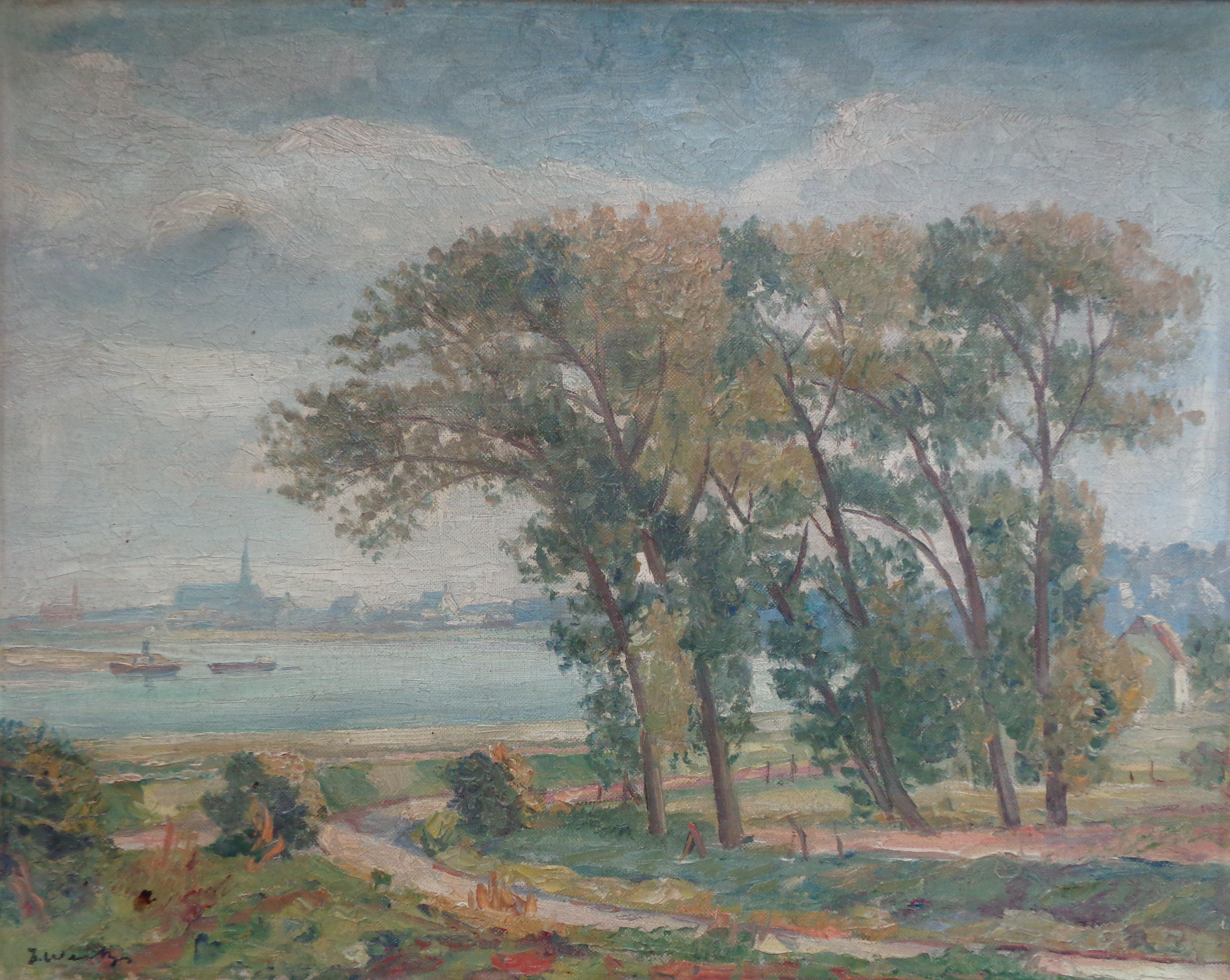
Somebody in Düsseldorf put an actual oil painting out with their bins this week and I liked the look of it when I cycled past it, so I am now the proud owner of a landscape by Jakob Weitz (1888-1971) which looks like this:

It measures 40cm x 50cm and came with a bulky frame which isn't quite to my taste so I took that off to hang it just as the canvas (with the light wood frame underneath on which it was painted). The canvas has two bumps, a big one in the clouds which is interesting as it makes the clouds look more real, and a smaller more inconspicuous one in the landscape which also involves a little bit of tear. I'm wondering if it may become a bit more luminous if I try to wash the surface. Then again the paint is cracking in places so humidity may get in?

When I saw it by the roadside I thought the riverside landscape looked like it might be near here and my first thought was Volmerswerth, on the southern edge of the city. However, a bit of DuckDuckGo research (Google had fewer relevant results) revealed a similar painting by the same artist, which is captioned as Kaiserswerth, so that is still on the edge of Düsseldorf but on the opposite end, downstream from the city centre.

Hotlinking here to contrast and compare:

A few other paintings by this artist are shown on this auction site. Nothing to raise a gasp from the Antiques Roadshow audience, but some of them come with estimates of a few hundred euros.

Saturday, August 10, 2024

women and the blue rider

Some thoughts on

Malerinnen und Musen des »Blauen Reiters«
by Hildegard Möller
Piper Verlag 2007

I am definitely going to see the current exhibition on German expressionists of the "Blue Rider" group at the Tate Modern (Expressionists: Kandinsky, Münter and the Blue Rider, until October 20), but as I haven't quite made it yet, I read this book in preparation, which is a joint biography of five women associated with the group, namely the painters Gabriele Münter, Marianne von Werefkin, and Maria Marc, and the muses and wives Lisbeth Macke and Lily Klee. We have had the book since it came out in 2007 but I hadn't read it yet. Partially, I presume, due to the misguided feeling that there wasn't much left to discover in it, as the four core members of the group (Marc, Kandinsky, Macke, Klee) represent the art I grew up with. (Funnily enough, these are also the ones that are represented in the compact art books series from Taschen.) Jawlensky is the one rider I am less familiar with - strangely the one work I associate his name with appeared on a postage stamp in the 1970s. Of the women I was aware of Gabriele Münter as a painter but not so much of the other two.

So, well, although I was familiar with the art of the Blue Rider, I did learn a lot about the lives behind it, and it was an interesting experience to follow these lives from the perspectives of the women involved. Ironically, although I perceive many of the very colourful paintings of the group as joyful, the lives weren't all that much fun, seeing that Marc and Macke died young in WW1, while Münter and Werefkin had rather troubled relations with their more famous painter boys, and Klee only lived to age 60 and a half. So in significant parts this is the story of three widows and two women abandoned by the artist partners they supported to the point of self-sacrifice. Although the roots of the Blue Rider are in the Schwabing district of Munich, there is a lot about moving out of the city to remote farm houses, eg at Murnau, which I find a bit scary. The painters in the story shared the dubious honour of being branded "entartete Kunst" (degenerate art) by the Nazis, which obviously has become a badge of honour since but didn't help the careers of those who were still alive when it happened.

Considering all the very exciting (to me at least) and brightly coloured art that is being created in this story, I find the author's writing style a bit subdued and grey. I realise she's obviously striving to stay neutral, not to make any feminist statements in support of the women wronged one way or another, but still I find this neutrality clashes with the revolutionary nature of the art in question and of some of the lives being lived as well.

It was interesting too to meet some of the marginal figures of the Blauer Reiter, including August Macke's less famous cousin Helmuth Macke, who hailed from Krefeld, so I will have a look at his art the next time I'm there, and will also have a look at his family history in case his maternal ancestry throws up anything connected to my Krefeld clan.

It was also interesting to learn that the one and only almanac "Der Blaue Reiter", which gave the group its name and identity, was published in 1912 by a young man called Reinhard Piper - whose publishing house survives to this day and has indeed published this very book as well. A paperback edition came out on the centenary of the almanac's publication. I'm surprised it hasn't been translated ahead of the Tate Modern exhibition - could have sold well there.

PS I'll take the opportunity to list here the relevant exhibitions I (may) have seen (the childhood ones still need research:
22.8.-12.9.1969 Museum Folkwang, Essen
Paul Klee, Aquarelle und Zeichnungen. No memory of this whatsoever but I found the catalogue of the exhibition among my possessions so assume I will have seen it as a 5-year-old.
1970s: Pretty sure I saw a generic Blauer Reiter exhibition at the Museum Folkwang as a child. Definitely sure I saw one about Karl Schmidt Rottluff a bit later (maybe ca. 1980). May have seen exhibitions featuring Campendonk and/or the trip to Tunisia undertaken by Macke and Klee.
1980s: Visited Lenbachhaus in Munich with the Jaenicke research group in 1989/90?
1.8.-19.9.2004 Von-der-Heydt-Museum Wuppertal,
Wassily Kandinsky: Der Klang der Farbe 1920-1921
2.11.2013 Tate Modern
Paul Klee
2014 (ab 25.9.) Bundeskunsthalle Bonn
August Macke und Franz Marc: Eine Künstlerfreundschaft
25.2.2024 Kunstmuseum Pablo Picasso Münster
Brücke zur geistigen Welt: Meisterwerke des Expressionismus
17.5.2024 K20 Düsseldorf
Hilma af Klint und Wassily Kandinsky: Träume von der Zukunft

Updates and additions:

8.2.2026 Mackehaus Bonn
Macke and friends
11.2.2026 Stadtmuseum Mülheim (Sammlung Ziegler)
Marc, Macke, Heckel, Jawlensky
exhibition coming up
23 Okt 26 — 21 Feb 27 Museum Wiesbaden
Die Blauen Reiterinnen,

Tuesday, May 28, 2024

abstract comparisons

I saw two amazing exhibitions on my recent visit to Düsseldorf, will rave about both in separate entries, starting with the one that is still running in case anybody out there gets the idea to go and see it:

Hilma af Klint und Wassily Kandinsky Träume von der Zukunft 16.3. — 11.8.2024

The exhibition at the Kunstsammlung NRW (K20) compares and contrasts the abstract paintings of Wassily Kandinsky (1866-1944) and Hilma af Klint (1862-1944), who were near contemporaries and developed similar kinds of abstraction at around the same time - but independently of each other. There are all the obvious conclusions to draw from the fact that the male artist was successful in his lifetime whereas the female pendant was discovered long after they both died.

To me personally, the intriguing thing though was the contrast of the very familiar and the unknown. Kandinsky is very much the kind of art I grew up with, seeing the Folkwang Museum and the Kunstsammlung NRW were within daytrip distance. I don't have a record of my childhood exposure, but a lot of his work just looks like home to me. The most recent exhibition of his work I have seen before this one was at the Von der Heydt Museum in Wuppertal in 2004: "Wassily Kandinsky: Der Klang der Farbe 1920-1921".

By contrast, I remembered Hilma af Klint's name only because it featured in a recent novel I read, namely Bed bug by Katherine Pancol. This French novel is set mainly in New York and it mentions the 2018/2019 retrospective at the Guggenheim Museum which made Hilma af Klint postumously famous. The author couldn't really have known that the show would be such a success, as the novel appeared in the same year when it was on.

Her work very much feels like a foreign country - the colours and shapes are all different from what I'm used to in abstract art, but still it is all very interesting and intriguing. I am wondering how she arrived at all those shapes that are eerily reminiscent of molecular orbitals, long before quantum theory suggested those shapes for the clouds of electrons holding molecules together. There were some very impressive huge format paintings as well, and we overheard a helpful tour guide explaining how she painted those after placing her canvas flat on the floor. Long before Jackson Pollock, as the guide pointed out.

I'm loving the irony that a museum in Stockholm declined to accept her work as a gift in 1970, citing the parallels with Kandinsky as a reason for the rejection. So, well, see for yourself.

Tuesday, March 29, 2022

a painted quartet

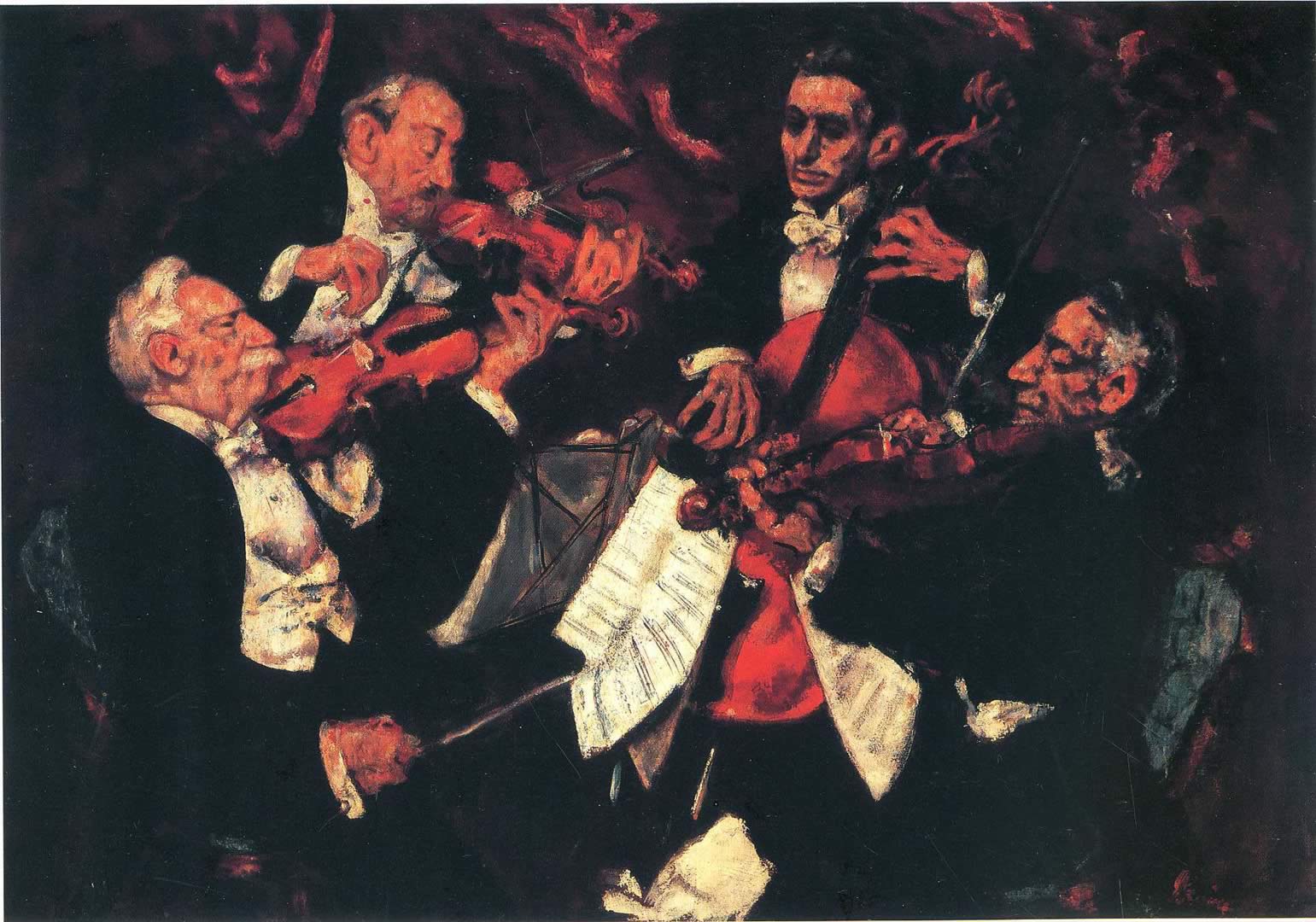
Back in February, I spotted a painting of a string quartet in the window of a charity shop and was almost tempted to buy it. It was a bit more expensive than the sort of stuff I might buy spontaneously, so I didn't and just took a few photos. There were other items blocking the view, so here's the best angle I could get:

I also took a separate photo of the artist's signature, which I only deciphered weeks later, it's Bernard Dunstan. Now it turns out Dunstan was a very prolific and successful painter who died in 2017, aged 97, see his obituary in the Guardian. Apparently he often painted musicians playing, along with the usual sujets such as nudes and Venice.

All of which means, assuming that this was an original painting rather than a print, I really should have bought it on the spot. It was too expensive for a print but would have been a very attractive price for a painting from a recognised artist. Even though his style reminds me of Bonnard, whose work I don't really like that much.

Another reason why this painting has been stuck in my brain for weeks now is that it made me think - using the three photos we have of Heinrich's string quartet, maybe an artist could create a vision of the quartet playing? Does anybody know any artists who might be up to the task?

Update 23.11.2022 Another image search washed up one that I quite like, by Artist Jack Levine:

Update 6.12.2024: Oops, that hotlink appears to have stopped working, I think it was this painting.

Tuesday, October 19, 2021

views of ships and cities

This blog's favourite industry painter, Alexander Calvelli, is opening his next exhibition this coming Sunday at Elmshorn (Schleswig-Holstein):

Schiffsblicke und Stadtsichten
opening Sunday 24.10. at 11am (until Nov 14)
Kunstverein Elmshorn
Torhaus Probstendamm 7
Elmshorn

more info (in German)

Here's a glimpse at a ship from the prospectus:

Friday, August 13, 2021

real life art

Art exhibition with works by Alexander Calvelli about real life (working lives) opening in real life today:

The venue, Kunstraum Eigelstein, does not seem to have a web presence outside Facebook - find them there if you must.

Tuesday, March 16, 2021

father and son

some thoughts on

Pierre-Auguste Renoir, mon père
by Jean Renoir
Hachette 1962 / Gallimard 1981
an English translation from 2001 is also available

Back in 2013, the film Renoir was one of the few French movies that still made it to our local independent cinema, and I was lucky to catch it there, and then watched it again when it came out on DVD. It is about the last years in the life of the painter, after the death of his wife, Aline Charigot, in 1915. Auguste Renoir (1841-1919) is stuck in a wheelchair and barely able to move his hands, two of his sons get injured in the war, but he creates some of his most vibrant and life-affirming art.

By the time I started looking at paintings, the impressionists had become mainstream to the point of commercial overload, so I’ve never been a huge fan these works although I don’t mind seeing them every once in a while. The film, however, made me appreciate Renoir a bit more and as a result I picked up a few books about him at various charity shops and antiques fairs, including the memoir by his middle son, the film director Jean Renoir (1894-1979). The idea of the changing of the guard in visual arts, one of the first great film makers writing about one of the last impressionists to remain active in the 20th century, intrigued me so I actually read the book, assisted by the other volumes to look up paintings mentioned and consult timelines.

The biography is based on conversations Jean Renoir had with his father in the last year of his life, as well as with his long-serving model Gabrielle Renard (1878-1959) and other surviving witnesses. As the age gap between father and son is more than half a century, his own recollections only become useful towards the end of the story.

It is organised broadly chronologically, although the author tends to digress on thematic excursions, and covers a staggering range of historical change. From his childhood in the 1840s, Renoir remembered an old man who visited his parents regularly and happily shared memories of how he helped operating the guillotines in the French Revolution. Renoir’s family moved to Paris before it was completely reshaped by Haussmann in the 1850s, he experienced the restored monarchy and as he lived in the Tuileries, he played under the windows of the actual queen. Like some of the other impressionists, he lived and worked in Montmartre when it was still a village with wooden shacks, long before Sacré Coeur was built.

The complete rejection of the impressionists by critics, public and art officialdom in the 1870s is a well-trodden story but always fun to read. Apart from having fun with quoting from the hilarious reviews of the first exhibitions (one of which gave us the word “impressionists” for the artists who had called themselves “les intransigeants” initially), he highlights the occasions when French institutions like the Louvre wouldn’t even take the paintings for free, resulting in many of them winding up in North America. For instance, the painter and collector Gustave Caillebotte died in 1894 leaving his vast collection to the state and installing Renoir to execute his will. Initially the Louvre (as the official repository of the state’s art collection) didn’t want to be bothered with any of it. Three years later, they saw sense and accepted a part of the collection. Not sure if anybody has calculated what the Caillebotte collection would be worth today – I suspect you’d have to be very good in calculating with trillions and such like.

Renoir, who famously identified as a craftsman rather than an artist and considered the word intellectual an insult, comes across as an interestingly complex mixture of old-fashioned and revolutionary, which is part of the force field that keeps this book interesting, even though it isn’t the most organised biography ever written. That and the chance to meet the people you already know from those famous paintings. In another very famous French movie, Amélie, there’s the painter who copies Renoir’s Déjeuner des canotiers (1881) over and over again. Jean Renoir describes the setting and can identify most of the participants, mostly faithful friends of the painter. The woman at the front left, playing with a little dog, is Aline, the author’s mother. When we see these pictures in museums or on countless wall calendars, they are just paintings – but for Jean Renoir and the rest of the family they were life.

Oh, and I'll just have to watch the movie a third time, now I know the family so much better.

Saturday, April 11, 2020

art for hard times

With museums and galleries now firmly closed and off limits, I have been obsessing about art on twitter a bit, following a few artbots and checking their back catalogues. One of the artists I discovered this way is the British neoclassicist John Godward (1861-1922), who painted lots of very melancholy looking women with mediterranean backdrops. I'm a bit of a sucker for melancholic looking people at the best of times, but now these paintings seem to fit the general mood as well, and I also found lots of people taking inspiration from Godward's paintings and either using them for "mood" posts or recreating their looks.

So here's a little gallery of my favourites, enjoy:


(I haven't made notes of the complete titles, but trying to reconstruct titles from my filenames, we have: 1890 reverie; 1899 letter; 1902 When the heart is young; 1906 tambourine girl; 1906 Violets, sweet violets; 1909 Summer idleness: day dreams; 1918 Lycinna)

Blame it all on this artbot on twitter.

And artrenewal.org has a page with more than 200 of his works.

This website claims it has the complete works (210 of them) but it also has some annoying pop-up ads.

His models included: Ethel Warwick (1882-1951); the sisters Lilly, Harriet and Rose Pettigrew;

PS other artists whose work acquires a new meaning these days include Edward Hopper, whose lonely people look like they may have been quarantined too.

Sunday, March 08, 2020

Angelica Kauffman

There is a brilliant exhibition of the 18th century portrait and history painter Angelica Kauffman (German spelling: Angelika Kauffmann) on at the Kunstpalast Düsseldorf. I must have seen several of her works before, including a portrait of Goethe, and must have walked under four of her painting on the ceiling of the Royal Academy at Burlington House, but somehow never joined the dots and explored her life which was quite remarkable. So after seeing the exhibition earlier this week, I am now reading her biography to catch up.

In her time, she was famous as a portraitist, honing her skills first in Italy, where she allegedly painted "all the Englishmen" passing through on their Grand Tour, as well as other celebrities. Thanks to the contacts with the travelling Englishmen she was then able to move to London, establish herself as a history painter and became a founding member of the Royal Academy of Arts.

The portraits are amazing, but what really makes her relevant to our times is the depiction of gender in her history paintings - she shows the heroes of Homer's epics as soft and feminine figures torn by hard decisions, and women like Penelope as strong forces for peace in a world shaped by male views of heroism and conflict. So she really did manage to impose her own viewpoint, in spite of some critics (like Schlegel) grumbling about her "inability" to paint proper male heroes.

This pioneering feminist perspective apparently helped her rediscovery and appraisal in the late 20th century (the biography I'm reading, written by Waltraud Maierhofer, dates from 1997), but I completely missed the memo back then. Partly explained by the fact that many of her works are in private collections still or in obscure museums, and exhibitions are few and far between. So go and see her work either now at the Kunstpalast Düsseldorf (until 24.5.2020) or later this year at the Royal Academy London (28.6.-20.9.2020).


The artist torn between music and art - I can relate to that ...
[image source]


Check this thread of women painted by women ...


Saturday, October 19, 2019

art and nature

Back in August I visited Olafur Eliasson's brilliant retrospective at the Tate Modern (still showing until Jan 5, 2020) and I was hoping to publish a photo story about it, but the exhibition allowed photography only for personal use, and the Ts and Cs for the use of the official photos somehow clashed with my publishers' conditions, so it didn't work out. So strictly non-commercially and for personal use only, I've put 15 of my own photos on flickr (see this album) and the text here:

The art of shaping our environment

Art reflects our environment. Art can also create new environments that we can enter to reflect on ourselves and our place in the world. In the Anthropocene, humanity is transforming the planet in many largely uncontrolled ways. Artists like Olafur Eliasson are reflecting on this transformation with their smaller, more controlled installations of artificial environments.

Eliasson, whose works are currently featured in a major retrospective at the Tate Modern in London, UK, rose to fame in 2003 with “The Weather Project” for which he installed a gigantic sunset in the turbine hall of the same gallery. The retrospective now shows how his dialogue with nature evolved from structural aspects to perceptions of environment and climate. The show includes indoor installations of a very dense fog, rain on a window, water waves, a moss wall and a rainbow of sorts.

The environment is only one side of the equation, however. What turns the boxed weather phenomena into art is the observation of how humans interact with them, how they disappear in the fog or marvel at the water features. Accordingly, many other works are providing the visitor with an environment where they see themselves – as colourful shadows, for instance, or as fragmented reflections when they walk through a multi-faceted kaleidoscope.

The take-home message seems to be: We are our environment, our environment is us, all is one dynamic system. That can be more easily grasped on the scale of an art gallery, but it is also true for planet Earth.


(own photo)

Saturday, August 17, 2019

the lost world of tumblr

Eight months after the Great Tumblr Purge, the site appears to be going the way of MySpace now. Press reports of its sale to the owners of WordPress this week suggested the price tag was just $3 million, down by a factor of 300 on what Verizon paid for it just two years ago. Which reminds us, again, of MySpace in the doomed tenure of Murdoch's empire.

Here is a very detailed article in El Mundo which cites the $3 million price as a fact, while the Guardian calls it unconfirmed.

(UPDATE 21.8. I like this analysis asking: Could WordPress + Tumblr create an alternative to Facebook? which would be good but I'm not terribly optimistic.)

Since the purge, I have made it a habit to log into tumblr just once a week to inspect the damage. The situation is very much as it was in January - the art has gone, much of the porn is still there. Clearly censorship has done a brilliant job at blowing this up.


Screenshot of my tumblr archive when I still had one (mid Dec 2018). At that time, I shared a bit more NSFW content than usual in protest against the censorship, upon which I was sent to the naughty corner - no archive, no profile pic, posts can only be accessed by scrolling in a sidebar, so older posts are basically unretrievable (they don't show up in searches either).

One of the effects of the purge is that some NSFW artsy things that would have been all the rage on tumblr are now a bit harder to find. Following my December listing of free the nipple things, here are a few more things that should be on tumblr but don't have a home there any more.

La perla expuesta (a Spencer Tunick style art project connecting public spaces with human forms, which happened in Guadalajara, Mexico, last year apparently).

Performance Leonardo Otero (this is the title of the youtube video, don't know anything else about it, but it also seems to be set in Mexico).

Tove Lo live - a compilation of revealing moments ...

... and speaking of LGBTQ-related synth pop, here's t.A.T.u. in a Sept. 2013 reunion concert which I only just discovered. The notorious stage kisses have given way to hugs, and there are dancers with hilarious costumes and inflatable props, so what's not to like? This has given me some serious noughties nostalgia now. And made me realise that I need to work on reviving my Russian.

Reminiscing of the lost world of tumblr also reminded me of Clayton Cubitt's iconic series of videos Hysterical Literature, which has since then been transferred into many other languages including:
Spanish (?),
Catalan,
Portuguese,
Russian,
Chinese (?) ...
and here's author Candice Dawn using the format to promote her book Reclaiming Eros
and here is one of the original videos with the artist's explanations of his thinking.

PS sadly the alternative site 2mblr which I mentioned in previous posts never became fully functional - last time I checked it still worked as an uncensored archive but not as a live site where you can blog and reblog things. And the last time they copied content across from tumblr appears to have been in early May, so maybe they have given up entirely now?


Saturday, March 30, 2019

harz heritage

The industry painter Alexander Calvelli is having a busy time opening two exhibitions in the Harz area this weekend, both covering motifs found in the natural and cultural heritage of that area.

One at The Cistercian Museum Walkenried Monastery today:


The other opens at the World Heritage Site Rammelsberg tomorrow, see the announcement here, and runs until October 27.


Some local press coverage I just found:

Walkenrieder Nachrichten

Göttinger Tageblatt

Thursday, December 27, 2018

Chagall vs La Fontaine

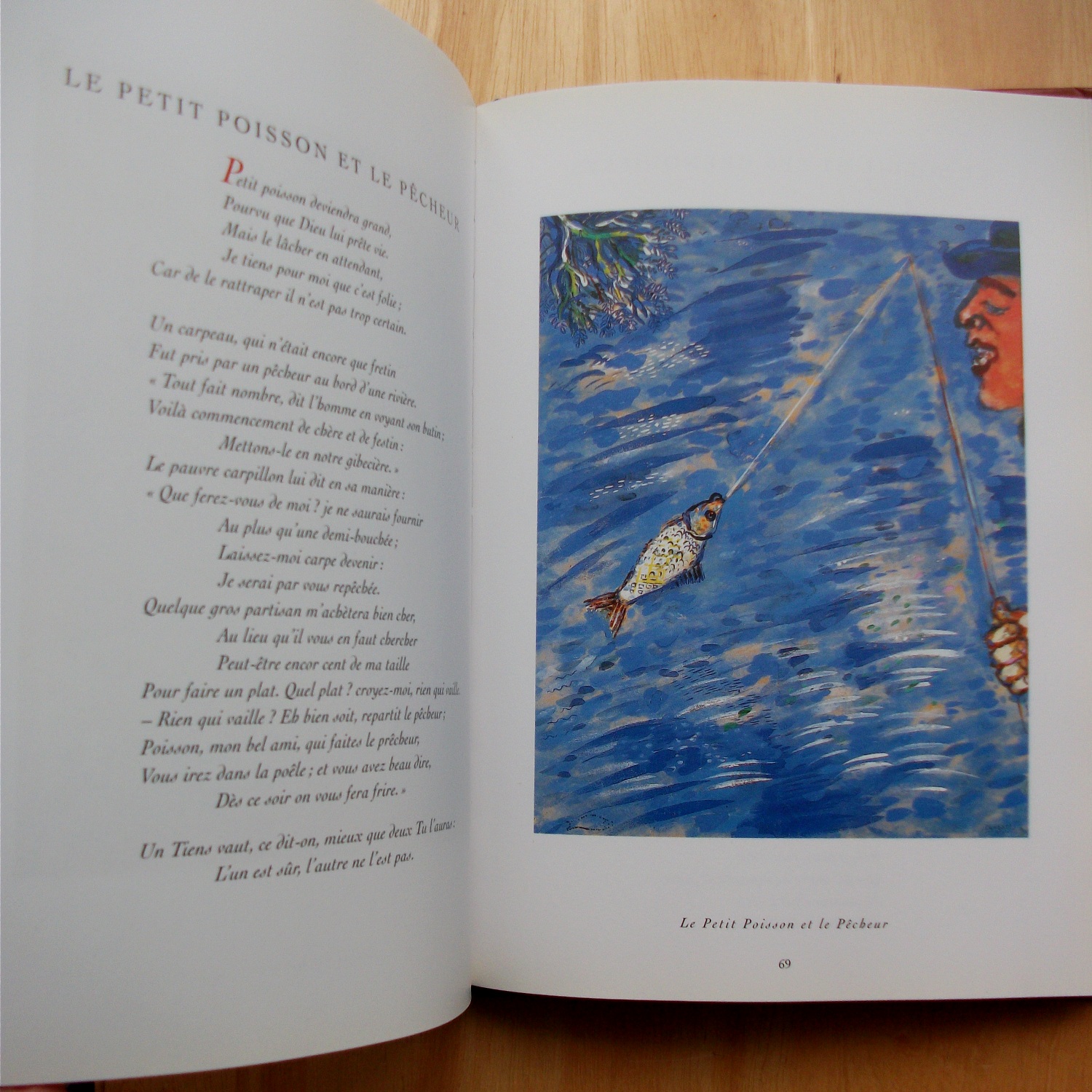
A lovely antiquarian book I bought recently at the antiques fair in Gloucester Green combines the fables of La Fontaine with illustrations by Chagall. Until discovering the book there I didn't even know these pictures existed.


Some random examples of the presentation of text and images inside the book:


Not terribly antiquarian though - amazon.fr sells an edition from 2003 that has the same cover.


Thursday, March 08, 2018

a cellist lost

I came across Alfonse Mucha’s lithograph of Zdeňka Černý, “The greatest Bohemian violoncellist”, on tumblr and wondered why I had never heard of her. Although the artwork is dated 1913, Google found no recordings of her or reviews of performances, so by the time I reblogged the image I was slightly worried about her and included a question about her further fate in my reblog.

Within 24 hours a helpful follower pointed me to a recent memoir published by Zdeňka Černý’s daughter, Jetta Marie Vasak (My Bohemian Heritage), which I ordered and which answered most of the questions I had. The simple answer to the main question: she married a banker (and non-musician) who wanted her to give up her musical career, and she obliged. The book uses Mucha's lithograph (without the text) as cover art:


The book is a charming collection of vignettes with a catastrophic lack of editing or structure of any kind, so I’ll try to extract from it what I learned about Zdeňka Černý’s life and put it into a short biography (may revise and add to it later):


Zdeňka Olga Černý was born in Chicago 26.8.1895 as the second of three children of Albert Vojtech (“AV”) Černý (* 1.5.1872 Jilove, immigrated to USA in 1888, + 14.6.1964) and Frances (Fanny) Engelthaler (* 5.4.1873 + 24.2.1918). Her father was a successful music teacher (piano, cello, violin, voice) and the founder of the first Bohemian Conservatory of Music in Chicago .

In 1905-6 the artist Alfonse Mucha stayed several months with the Černý family in Chicago and painted several pictures of the older daughter Milada (1892-1973), who was famous as a child prodigy on the piano. Zdeňka asked him to paint her as well, and he promised to do so once she became a virtuoso cellist. At that point, she had only recently started to take an interest in the cello and take lessons with her father.

In March 1913, Mucha visited the family again. By this time, Zdeňka had become an accomplished cellist and played a recital for Mucha with her father accompanying her on the piano. After the performance, she reminded the artist of his earlier promise, and he agreed to start immediately. A photo of Zdeňka with her cello was taken at a studio. Mucha mainly worked from this photo, which he divided in squares. He made a drawing which he then coloured in gouache.

As Zdeňka and her father were preparing for a European tour planned for the following year, Mucha took the drawing to Prague to have the lithographer Neubert print posters under his supervision. For these, Mucha also designed the lettering underneath: “Zdeňka Černý, The greatest Bohemian violoncellist”.

On 29.6. 1914, AV and Zdeňka Černý were on the train to New York to catch a ship to Europe when they read the news of the Sarajevo assassination the day before. They still travelled to London and onwards to Prague, although I’m not sure how many (if any) concerts they actually played and where.

By the time they reached Prague, AV was worried that he might be called up for military service in the Austro-Hungarian army and thus started to plan the return. In March 1915, AV played a recital in Prague, but soon afterwards they took the steamship St. Louis from London and by the summer they were back home in Chicago.

During the 1915 summer holiday Zdeňka spent with her father on the shores of Bear Lake near Haugen, Wisconsin, they met Otto Vasak (14.7.1882- 23.6.1961), then 33 and a bachelor, with whom she fell in love. After he returned to the city while the Czerny family still stayed in the summer cabin, they exchanged love letters via a helpful neighbour.

After a night staying out longer than allowed and fearing corporal punishment, Zdeňka eloped, which appeared to be the normal way for daughters to leave the house in that family. She broke off a previous, secret engagement to violinist Jiri Hruso and married Vasak at Chicago on 11.3.1916.

Jetta Vasak reports that Otto forbade her to pursue her musical career or indeed any teaching. A planned performance of the Saint-Saens cello concerto with the Chicago Symphony Orchestra under Frederick Stock is cancelled. There is no mention of any discussion or resistance (apart from AV who sulked for two years). There is a small hint of a controlling relationship, as the author mentions that Otto did the family shopping at one point to keep Zdeňka indoors, but no indication of any trouble whatsoever. The next time Zdeňka is mentioned touching her cello is after her second husband dies in 1977, when she is already 82 years old.

They had two sons in quick succession, Otto (* 22.5.1917) and Francis (* 25.2.1919)
and then Jetta (* 26.1.1927). Otto played clarinet, Francis trumpet and Jetta French horn, but Zdeňka appeared to be restricted to the role of appreciative audience.

In 1955, Zdeňka and Otto moved from Berwyn to La Grange Park, a suburb of Chicago. Otto died suddenly on 23.6.1961 aged 78. After Zdeňka reported her loss to an old family friend, Robert Dolejsi who lived in California, it emerged that he, too, had become a widower almost at the same time. The two found more common ground and married in 1963.

Zdeňka moved to California to live with Robert. There she came in contact with artists and academics interested in the Mucha lithograph of her, which thus was rescued from oblivion. After Robert’s death, the above-mentioned attempt to reconnect with her cello failed. She died in 1998, aged 102. Sadly, “the greatest Bohemian violoncellist” appears to have spent around 90 years of her life not playing the cello.

Update August 2020 - I only now discovered that there is an obituary of Zdeňka's son Otto online. He also published a memoir. And I was pleased to learn that he continued playing the clarinet throughout his long life until he died at the age of 97. I'm not sure whether it's worth buying his memoir as well, as it seems to be mostly about his time in WWII, but from the preview pages available at Amazon, I learned that his grandfather, AV Cerny, returned to Czechoslovakia between the wars, stayed five years and served as the principal cellist at a Prague orchestra. (That's also mentioned in Jetta's book but I may have overlooked it at the time.)

Friday, June 17, 2016

melting points

Alexander Calvelli's latest exhibition, Schmelzpunkte (melting points) opens today at Henrichshütte Hattingen, Germany. It runs until October 23rd, opening times Tue-Sun 10-18h, Fri till 20h.

Am E-Ofen. Georgsmarienhütte, 2001.
Foto: Alexander Calvelli

Here's the press release from the museum (seems to be available in German only, sorry!):

"Schmelzpunkte" heißt eine neue Ausstellung mit Gemälden des Kölner Künstlers Alexander Calvelli, die der Landschaftsverband Westfalen-Lippe (LWL) vom 17. Juni bis 23. Oktober in seinem Industriemuseum Henrichshütte Hattingen (Ennepe-Ruhr-Kreis) zeigt. In einer historischen Halle präsentiert das LWL-Museum rund 150 Gemälde des Künstlers. Darüber hinaus laden einige der Bilder im Außengelände zum direkten Vergleich zwischen dem Motiv und seiner künstlerischen Bearbeitung ein. "So treten Industriekultur und Malerei in ein besonderes Spannungsverhältnis", sagte Kurator Dr. Olaf Schmidt-Rutsch vom LWL-Industriemuseum am Montag (13.6.) bei der Vorstellung der Ausstellung in Hattingen.

"Ich male vergängliche Architektur" - mit diesem Satz beschreibt Calvelli sein Werk und verbindet so inhaltlich die nahezu fotorealistische Darstellung von Blumen mit den Motiven der Schwerindustrie. Letztere bilden den Mittelpunkt der Ausstellung. Schmelzpunkte stehen dabei für Transformationsprozesse: Mit den Aggregatzuständen ändern sich Strukturen und Gefüge. Metalle werden aus Erzen erschmolzen, umgeschmolzen, in Formen gegossen und geformt. In Konverter und Elektroofen löst sich alter Schrott auf, bevor er erneut in Form gebracht einem neuen Nutzungszyklus zugeführt wird. Diese Transformationsprozesse prägen das Erscheinungsbild des Strukturwandels.

So spannen die Gemälde Calvellis den Bogen vom Erz zum Schrott, vom Ursprung zum Niedergang. Sie zeigen mittelständische Betriebe und Großkonzerne, archaisch wirkende Kleinschmieden und gigantische Schmiedepressen. Die Darstellungen von längst verschwundenen Werken, aktiven Arbeitsstätten und im industriekulturellen Kontext neu entdeckten Anlagen vermitteln einen Eindruck von den Wandlungsprozessen, denen die Montanindustrie seit jeher ausgesetzt ist.

"Die Gemälde Calvellis ziehen den Betrachter durch den hohen Realismus in ihren Bann. Die Strukturen der Arbeitsorte treten plastisch hervor. Es braucht eine Zeit intensiver Betrachtung, um zu erkennen, wie künstlerische Akzentuierungen die scheinbare Realität bewusst verfremden", so Olaf Schmidt-Rutsch. "Der intensive Blick in die Werke vermittelt einen nachhaltigen Eindruck von der Arbeit mit glühenden Metallen. Tatsächlich geht es nicht um die Dokumentation industrieller Anlagen oder die Illustration technischer Prozesse, sondern um die kritische und distanzierte Auseinandersetzung mit den Zeugnissen des Industriezeitalters."

Bei der Eröffnung am Freitag (17.6.) um 19.30 Uhr wird der Künstler anwesend sein. Die musikalische Begleitung erfolgt durch den Klangkünstler Georg Zangl. Gäste sind herzlich willkommen. Der Eintritt ist frei.

Schmelzpunkte: Alexander Calvelli - Industriemalerei
17. Juni bis 23. Oktober 2016
LWL-Industriemuseum Henrichshütte Hattingen
Werksstraße 31-33
Geöffnet Di-So 10-18 Uhr, Fr -20 Uhr

source