Showing posts with label medicine. Show all posts

Monday, June 08, 2026

preventing pandemics

In mid-May, at the tail end of my recent travel, the hantavirus outbreak on board the cruiseship Hondius dominated the news for a few days to be swiftly replaced by news from the Ebola epidemic in the Democratic Republic of the Congo. So I decided to do another feature on infectious diseases and what we can do to stop them from becoming pandemics.

Thankfully, the hantavirus hasn't spread further beyond the people already known to be infected at the time when it made the headlines. Meanwhile, the Ebola problem is still with us and growing, with various issues including deforestation and the cutting of aid budgets making it worse and more dangerous for the rest of the world.

My feature is out now:

Preparedness prevents pandemics

Current Biology Volume 36, Issue 11, 8 June 2026, Pages R465--R467

Restricted access to full text and PDF download
(Unfortunately, this year's features will no longer become open access one year after publication - do contact me if you would like a PDF.)

Magic link for free access
(first seven weeks only)

See also my new Mastodon thread where I will highlight all this year's CB features.

My mastodon posts are also mirrored on Bluesky.

Last year's thread is here .

The MV Hondius anchored in the port of Granadilla de Abona, during the outbreak of hantavirus disease. (Image: AcfiPress Noticias Canarias/Wikimedia Commons (CC BY 4.0).)

PS: Note also that today's issue is a special issue about plant evolution, with lots of reviews, articles, primers and quick guides on that field. All looks very exciting.

Monday, March 09, 2026

the mysteries of syphilis

Many infectious diseases have managed to establish themselves in human populations after the advent of agriculture, when dense settlements enabled them to spread and persist. Later, trade and warfare carried them around the world, typically from densely populated Eurasia to other parts of the world where the lack of immunity led to catastrophic consequences.

Syphilis is the great exception to this scenario. It likely originated in the New World (if it hasn't spread with humans since the expansion out of Africa) and has now been shown to predate intensive agriculture and dense settlements. The pathogen Treponema pallidum has been challenging researchers, but ancient DNA is now showing up that clarifies the origins and early evolution of this disease, which has terrified Europeans since Columbus came back from his transatlantic voyages.

Read all about it in my latest feature which is out now:

An ancient disease from the New World

Current Biology Volume 36, Issue 5, 9 March 2026, Pages R171-R173

Restricted access to full text and PDF download
(Unfortunately, this year's features will no longer become open access one year after publication - do contact me if you would like a PDF. Last year's features will still move to the open archives as this year advances.)

Magic link for free access
(first seven weeks only)

See also my new Mastodon thread where I will highlight all this year's CB features.

My mastodon posts are also mirrored on Bluesky.

Last year's thread is here .

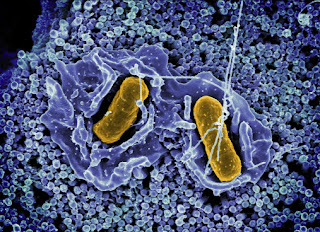
Treponema pallidum, which causes several diseases including syphilis, has proven difficult to cultivate and to study. (Image by the National Institute of Allergy and Infectious Diseases.)

Thursday, February 05, 2026

aptamer sensors patched up

My astrobiology co-author Kevin Plaxco has been pioneering the development of biosensors based on aptamers (the artificially generated DNA equivalent of antibodies) for many years now and every once in a while I write about the progress in this fascinating field. Now the work has reached its first clinical trial, so I wrote a news story for Chemistry World to help spread the word.

The news story is out now:

World first for clinical trial of skin patch to monitor therapeutic drugs in real time

Chemistry World 5.2.2026

Source: © Marsilea A Booth et al/Springer Nature America 2026

Previous episodes in this serie are listed here.

Monday, November 18, 2024

good news

It doesn't happen very often these days, but my latest feature has some very good news to report, so enjoy:

Prophylactic progress against AIDS

Current Biology Volume 34, Issue 22, 18 November 2024, Pages R1109-R1111

FREE access to full text and PDF download

See also my Mastodon thread where I highlighted all CB features of 2024.

The thread for 2023 is here .

Even 40 years after its discovery, HIV is still a major health problem across the global south. This transmission electron micrograph shows HIV-1 virus particles budding out of an infected H9 cell. (Photo: NIAID/Flickr (CC BY 2.0).)

Wednesday, August 21, 2024

travelling pathogens

When humans travel, they tend to bring their infectious diseases along. With Covid and air travel we have seen that an outbreak can become a global pandemic within weeks. With historic, slower mode of travels, the situation is more complex. Consider a sailship going half way round the world - by the time it reaches the destination, the pathogen may have run out of hosts to infect and thus the disease may have died out without any intervention. I spotted a paper applying the tools of ecological theory to the intercontinental transfer of pathogens in the times of sail and steam and found that topic really fascinating, so I mixed in a bit of Covid and air travel and some pre-historic travellers to widen the scope and made it my latest feature which is out now.

Travelling pathogens

Current Biology Volume 34, Issue 16, 19 August 2024, Pages R747-R749

FREE access to full text and PDF download

See also my Mastodon thread where I highlighted all CB features of 2024.

The thread for 2023 is here .

This painting by Jacob Knijff (1639–1681) purportedly shows “Ships, Galleys and Other Vessels off an Italian Port”, although the location could not be identified and the scene is not thought to depict a specific event. (Image: Jacob Knijff/Wikimedia Commons.)

Monday, November 20, 2023

mission not accomplished

Not so very long ago, the end of 2023 was the target date by which wild polio strains would have been eradicated and the vaccine-derived variants been brought under control. It is now clear that these goals will not be accomplished this year or any time soon. Like meaningful climate saving measures and action against antibiotic resistance, the planned second-ever eradication of a human disease remains a movable feast.

I've taken the approaching target date as an opportunity to have a closer look at what went wrong, what still needs to be done, and how we can overcome diseases more generally. The resulting feature is out now:

Can we wipe out diseases?

Current Biology Volume 33, Issue 22, 20. November 2023, Pages R1163-R1165

FREE access to full text and PDF download
(open archives)

See also my Mastodon thread where I highlighted all CB features of 2023.

I'm not on Instagram myself, but I believe if you follow CurrentBiology there, you'll find my features highlighted there as well.

The new generation of polio vaccines features stabilising manipulations to the RNA, designed to stop the attenuated virus from mutating back to the more virulent form. (image: National Institutes of Health.)

Monday, May 08, 2023

animal health services

We know a lot about how animals protect themselves against scary big predators, but not quite so much regarding how they keep safe from smaller enemies such as pathogens and parasites, both by instinctive avoidance (ecology of disgust) and also by behaviours that can be described as self-medication.

I've rounded up a few recent examples from this underappreciated part of ecology and poked at the question of where in human evolution ecology ends and the history of medicine begins.

The resulting feature is out now:

Animal health services

Current Biology Volume 33, Issue 9, 8. May 2023, Pages R333-R335

FREE access to full text and PDF download

See also my Mastodon thread where I highlighted all CB features of 2023.

I'm not on Instagram myself, but I believe if you follow CurrentBiology there, you'll find my features highlighted there as well.

UPDATE 8.5.2024: A report concerning an orangutan applying a known medicinal herb to a wound has just come out a few days before this feature moved to the open archives.

Great bustards (Otis tarda) have been shown to preferentially consume two species of plants during their mating season that may protect them from both parasites and pathogenic fungi. (Photo: © Carlos Palacín.)

Monday, March 27, 2023

silver linings

It's three years since some political leaders learned about exponentials and we all started the journey of discovering the lockdowns, contact tracing, zoom meetings, PPE crises, and all the other side effects of the COVID-19 pandemic. There have also been some silver linings, and one of them is that it has given a massive boost to medical research. We will soon see other mRNA vaccines for instance, and even the fight against malaria, a disease that has nothing in common with Covid, stands to benefit from some silver linings of the covid cloud, after a setback at the beginning of the pandemic.

So I've written a feature on the post-pandemic fresh start in the malaria field, which is out now:

New beginnings for malaria research

Current Biology Volume 33, Issue 6, 27. March 2023, Pages R203-R205

FREE access to full text and PDF download

See also my Mastodon thread where I highlighted all CB features of 2023.

I'm not on Instagram myself, but I believe if you follow CurrentBiology there, you'll find my features highlighted there as well.

The photo shows Anopheles stephensi, a mosquito species that is native to Asia but has recently been linked to urban outbreaks of malaria in Africa. (Photo: Jim Gathany.)

Monday, August 22, 2022

from plague to covid

I noticed recently that the ancient DNA researchers are finding out lots of fascinating things about historic plague pandemics and other diseases, and it occurred to me that we are catching up with those pandemics of the past, while also still handling our present pandemic. And how lucky we are that at least we can very quickly figure out what our problem is and what to do to fix it, whereas people hit by the Black Death had no clue and could do nothing. Now we only have to find a cure for misinformation ...

So anyhow, out of these thoughts grew my latest feature which is out now:

Pandemics past and present

Current Biology Volume 32, Issue 16, 22 August 2022, Pages R855-R857

FREE access to full text and PDF download

NB: as the 2022 features move into the open archives, I will add them to this thread on Mastodon.

The National COVID-19 memorial in London commemorates the 200,000 who died with the disease in the UK. (Photo: Geoff Henso/Flickr (CC BY-ND 2.0).)

Monday, December 20, 2021

make antibiotics evolution-proof

My first article about the dangers of antibiotics resistance came out in September 1994, so I am getting a little bit frustrated that this problem hasn't been fixed in the last 27 years. We are now reaching a point where a post-antibiotic age, meaning widespread incurable bacterial infections wiping years off our life expectancy, is a very real possibility. While I was writing this feature, I needed a course of antibiotics myself, which very nicely focused my mind on what a post-antibiotic world might be like.

The only thing that cheered me up was finding that all the recent work I discussed is based on the premise that we need to find a fundamental new way out of the race we've been running against the evolution and spread of resistance genes. Basically, bacteria have been dealing with fungal antibiotics for hundreds of millions of years. Thus, thinking that we might overcome them with slightly different antibiotics was always naive. So if we want to win this, we need to find evolution-proof recipes.

My feature on the latest advances in this quest is out now:

How to avoid a post-antibiotic age

Current Biology Volume 31, Issue 24, 20 December 2021, Pages R1549-R1552

FREE access to full text and PDF download

Drugs specifically suppressing virulence factors instead of eradicating the bacteria have been tried on Salmonella enterica serovar Typhimurium, among other pathogens. Here, Salmonella cells (yellow) invade a human gut epithelial cell (blue). (Photo: NIAID/Flickr (CC BY 2.0).)

Friday, September 10, 2021

journey inside my guts

In January 2019, as I was 55 then, I was invited to a bowel scope screening. According to the brochure I was sent at the time, "The NHS offers bowel scope screening to all men and women aged 55." It sounded like a good idea, because "for every 300 people screened it stops 2 from getting bowel cancer and saves 1 life from bowel cancer."

While experiences may vary, I didn't find it terribly unpleasant and as a scientifically curious person I rather enjoyed the opportunity to follow the camera view on a large screen and travel through my own guts.

I just found out that the programme has since been scrapped, and its history, shall we say, adjusted to the situation. The relevant NHS website now says:

"Previously, some people aged 55 were invited for a one-off test where a healthcare professional uses a tube with a camera to look inside the bowel. This is called bowel scope screening. Bowel scope screening is no longer offered."

NB: some people were invited. When it was my turn, the official info said, as quoted above "all men and women aged 55."

For a competent analysis of the withdrawal of the screening programme, see this blog entry from a cancer charity.

Although I was lucky in getting the screening before it disappeared, I find it upsetting that there is very little interest around here in preventing disease before it happens. The NHS is brilliant because it's free at point of use as it should be and good at treating people when they get ill, but preventative measures aren't its strongest point and they are the first to suffer when things get difficult.

To me preventing disease is the most important job of the health system. I remember my grandparents being in and out of hospitals for bowel operations repeatedly, and I'm quite sure I prefer a camera up my bum to their experience.

Checking up the numbers:

There are 900,000 people in the UK aged 55 right now. We're talking about 3,000 lives that could be saved every year and 6,000 bowel cancer cases that could be prevented according to the NHS info I cited above. This may be small fry in comparison to the numbers currently killed by the mishandling of the Covid pandemic, but I am sure those 3,000 55-year-olds would have liked to live a bit longer ...

Cover of the brochure I received in 2019. Shows it's good to keep the paperwork, because online info gets adjusted to political convenience.

Monday, June 21, 2021

mRNA therapies coming soon

One of the major changes brought about by the Covid-19 pandemic is that it lifted medical applications of RNA out of obscurity and to global stardom. Just imagine, trying to promote an mRNA in a lipid nanovesicle as a therapeutic in December 2019. You would have had to work very hard to persuade people that it's probably safe and might actually work. Now you can just point to the mindboggling fact that hundreds of millions of people have received vaccines based on this principle - within six months.

Given that all the experts in the field are currently either busy developing new products or already counting their billions, I went through the back catalogue of RNA therapeutics that were in development before Covid happened, on the assumption that these will now find it much easier to find funding and get approval and actually reach the market.

My feature on those other, non-Covid medical applications of RNA is out now:

The renaissance of RNA therapies

Current Biology Volume 31, issue 12, pages R763-R765, June 21, 2021

FREE access to full text and PDF download

mRNA researcher at the German company BioNTech, which in collaboration with Pfizer brought the first mRNA vaccine to regulatory approval. The company also develops treatments for cancer and other diseases based on mRNA. (Photo: © BioNTech SE 2021, all rights reserved.)

Monday, December 21, 2020

viral variants

Four weeks ago I prepared the last Curr. Biol. feature for this year, about Covid-19 related sequencing work and the mutations and variants observed. (Even longer ago I planned this topic as a way of drawing a line under this plague year. Didn't quite work out that way.) It has been online as a preprint for a couple of weeks, but the proper version just came out today, as the whole world is debating this new UK variant of the virus. Oh well.

Pandemic genomics

Current Biology Volume 30, issue 24, pages R1455-R1457, December 21, 2020

FREE access to full text and PDF download

The coronavirus SARS-CoV-2 has spread globally and caused a pandemic on the scale of the 1918 flu pandemic. The rapid elucidation of its structural biology and genomics, however, offers opportunities to better understand its spread and to develop vaccines and treatments. (Photo: used with permission of Sai Li, Tsinghua University (Cell (2020) 183, 730–738).)

Monday, October 05, 2020

sick of climate change

Today's issue of Current Biology includes a special section "The Microbial World". My contribution to the section looks into the effects of climate change on the ecology of pathogens. Amphibians are the canaries in the coalmine for this one, as they don't control their body temperature and changes in environmental temperature make them vulnerable to fungal infections that are already causing extinctions. But potentially climate-induced human diseases are also being investigated.

Disease in the times of climate change

Current Biology Volume 30, Issue 19, 05 October 2020, Pages R1104-R1106

FREE access to full text and PDF download

Other goodies in the special issue include a primer on the phyllosphere (the above-ground microbiome of plants) by Britt Koskella and a quick guide to giant viruses by Chantal Abergel.

Monday, April 06, 2020

debunking stem cell cures

Against coronavirus like against any other kind of medical problem, there are people out there trying to sell you a stem cell cure. Sadly, most of them are on the spectrum from unproven to utter nonsense. In reality, there are only very few proven stem-cell based treatments.

It's been a while since I last covered stem cells, in part I presume, because the progress we've been hoping for since the 00s hasn't materialised quite as fast as expected. This delay between hopes and realisations has in fact helped to the vendors of dubious cures. In my latest feature I revisited the field to do a reality check.

Reality check for stem cell cures

Current Biology Volume 30, Issue 7, 06 April 2020, Pages R287-R289

FREE access to full text and PDF download


Pigs are similar to humans in many ways to the extent that growing human organs in a pig host is a realistic avenue currently under investigation, although many challenges remain. (Image: Kenneth Schipper Vera.)

Sunday, March 22, 2020

stay home save lives

I came back from Germany on March 14 and it took me a while to realise just how badly the Coronavirus pandemic is being mismanaged here in the UK. Essentially, the UK is 2 weeks behind Italy on the same trajectory, but has done nothing to learn from the disaster unfolding in Italy.

Everything the govt has done so far has happened more than a week too late, and the exponential function of the virus spread grows by a factor of 10 every 8 days (33% daily growth rate) so stopping the spread 8 days later than you could have done means ten times as many people get infected and 10 times as many people die (possibly more, due to the health service running out of capacity).

Some of the things I realised with great horror this week:

1) key people in govt. and some reporters don't understand exponential functions. They talk about the spread entering a different phase, accelerating, or whatever - all nonsense. It obeys an exponential function which very neatly means that every freaking day there will be 33% more infections than there were the day before. And there will be 33% more deaths than the day before.We had 233 deaths by yesterday Saturday 21.3., and we will have 2330 death by this time next week, Sunday 29.3. Nothing surprising about it, that's what happens when you let an infectious agent run wild. As significant behaviour change only really started this weekend, we're already committed to those 2000 extra deaths. Any benefits from measures we see now will only show up later.

2) That herd immunity approach that the UK govt. proposed on March 12 and then dropped allegedly after hearing of new scientific data in the report from Imperial College. In my view, all that the Imperial College people did was a multiplication of 3 numbers that I had previously done in my head and I assume everybody else with multiplication skills as well: 65 million people times 60% infection rate times 1% mortality = 390,000 people dead. Plus those who would die from lack of treatment as the health system can't cope with anything near the peak, even if it is flattened by mild precautionary measures. My reading is that BJ didn't understand this, while DC did understand it and didn't care (which is also the message of the piece in the Sunday Times that is causing a bit of a stir right now). In any case, the Imperial College people made it clear to BJ in terms that he could understand. He then realised that half a million dead people would look bad on his CV and changed course. Sadly, it was a week too late.

3) as there has been far too little testing in the UK, we don't really know how many cases we have. Based on the 233 deaths, it must have been more than 20,000 infections more than a week ago. So, that means 200,000 infections now. See, exponentials are easy. You just add a zero every 8 days.

4) Commiserations to all in the US, they may very well be heading for an even bigger disaster for the same reason.

Watch this space - I'm adding new developments here rather than having repeated blog entries on the pandemic.

* I'm seeing serious sources reporting that a sudden loss of smell is a symptom of Covid-19 infection. Knowing this can help to reduce the spread via otherwise asymptomatic carriers.

* antiviral remdesivir gets orphan drug status, slightly ironic as it might help to save millions of lives. It was originally developed against Ebola, however, which fits the bill a bit better.


So my belated message is don't wait for the govt to introduce a curfew, just stay away from other people now. Act as if getting infected could kill you. If it doesn't, it might very well kill somebody else you pass it on to before you even show symptoms.

The last gathering of more than 4 people that I attended was on March 4th. And it will remain the last for months, if not years, I'm afraid.

By lagging more than a week behind the curve, the government is causing preventable deaths. We can all save lives by doing more to stop the spread than we are being asked to do.


Related reading:

My recent feature on the animal sources of the coronaviruses that cause SARS, MERS, and the current pandemic.

A long report by John Vidal
on animal links and how nature destruction makes zoonotic transfers more likely.

Richard Horton, editor of The Lancet, on the UK govt's failure to act.

Epidemiologist William Hanage demolishes the UK govt. herd immunity plan.

A very clear summary by Devi Sridhar of the many ways in which the UK govt f*cked up the response to the epidemic so far (until 23.3.). These errors are on track towards causing tens of thousands of additional deaths.


Monday, March 09, 2020

how the pandemic began

The time my features spend in limbo between submission and publication is 18 days, and a lot of things can happen in that time span if you have a virus outbreak becoming a pandemic. Thus, when I'm trying to address the corona crisis in a feature I cannot say much about the current events or what people should do about them, but what I can write about is how and why the problem originated, and in this context I can think of lots of things that people shouldn't have been doing, and which contributed to this virus becoming a problem. Like hunting endangered pangolins and selling them on markets.

Virus diseases like SARS, MERS, and the various brands of flu come from animals, they are zoonoses, and the first time they spread in a human population that hasn't been exposed to them before, they can be quite devastating. Over time, human populations build up a level of immunity, and the viruses mutate a bit, so both sides learn to live with each other.

For my feature I looked at the animal sources of the recent coronavirus outbreaks (SARS, MERS and Covid-19) and kept discovering shockingly stupid things that people do with animals. The trouble is that in this day and age, everybody in the world is connected to Wuhan in China through a very short chain of contacts. So if people insist on selling palm civets, pangolins, bats and snakes on a market in Wuhan, this is not just a conservation problem, it is a danger to the whole globalised human population.

Conversely, if you want to run a global economic system, you'd better not make it too dependent on a place where people do stupid things to wild animals or live very closely with their domesticated poultry, which has the habit of breeding new flu strains.

So, well, my slightly more coherent thoughts on this are in the feature which is out today (although the scale of the crises has worsened since I wrote the first para, the title is still true):

Virus outbreak crosses boundaries


Current Biology Volume 30, Issue 5, 09 March 2020, Pages R191-R194

Open access


This illustration shows the ultrastructural morphology of the novel coronavirus responsible for the 2019–2020 outbreak of the COVID-19 coronavirus disease. (Photo: Alissa Eckert, MS, Dan Higgins, MAM.)

-------------------------

PS Here I'll collect some of the important things I've learned since submitting the piece, mainly concerning the public health aspect:

* Why large events should be cancelled sooner rather than later becomes obvious if you look at this analysis of the 1918 Spanish flu - PNAS paper from 2007, Fig 1 in particular has been widely shared.

* Cell Press journals have combined their Coronavirus publications in this Open Access Resource Hub

* see my blog entry on the disastrous UK govt response from March 22nd for further new developments.

Monday, May 06, 2019

roll back malaria (again)

The global effort to roll back malaria has been a success for a while, but in the last three years, progress in disease reduction appears to have stalled. In my latest feature I am looking at the problems holding back the fight against the disease and at some potential solutions:

Fresh efforts needed against malaria


Current Biology Volume 29, issue 9, pages R301-R303, May 6, 2019


FREE access to full text and PDF download


The mosquito Anopheles gambiae, which transmits malaria in Africa and thereby causes hundreds of thousands of deaths each year, has been called the world’s deadliest animal. (Photo: ArtsyBee/Pixabay.)

Monday, January 28, 2019

fighting Ebola

Open Archive Day

A year ago, I published my second feature about Ebola virus disease, and since then the Democratic Republic of the Congo has suffered two further outbreaks of the disease. Scientific efforts geared up after the devastating outbreak in West Africa in 2014 are now beginning to bear fruit, and the past few weeks have seen some interesting developments in this field. Specifically, the hypothesis that wild bats are the natural reservoir from which outbreaks in the human population originate (especially if and when bat populations are disturbed eg by deforestation) has been strengthened by the discovery of Ebola in a West African bat. Also, there are further related filoviruses found in bats that could become a worry some day. A new genus of such viruses has now been discovered in bats in China. Meanwhile, the vaccine work is making progress, and researchers have this month reported that a candidate vaccine is safe and effective in monkeys.

And not to forget my feature is now freely accessible:

Preparing for the next Ebola epidemic


(and the first one from 2014, too, of course)

but if things continue to develop at this pace, I may have to write a third one soon ...


This is a Leschenault's rousette fruit bat (Rousettus leschenaultii) seen in a temple in Madurai, Tamilnadu, India. Researchers discovered a new genus of filoviruses in this species.
Credit: Rajesh Puttaswamaiah, Bat Conservation India Trust

Tuesday, January 23, 2018

revisiting Ebola and Marburg

I wrote a feature about Ebola Virus Disease three years ago, when the largest Ebola epidemic so far was still happening in West Africa. I recently came across a structural study of the Ebola virus capsid and so I thought it would be a good time to revisit this disease and see how the experience from the 2014 epidemic and progress in fundamental science can help to avert or at least manage further epidemics.

As an alumnus of Marburg University, I also had to mention Ebola's closest relative, which is known as, you guessed it, Marburg virus, as it was discovered in that town.

Read all about these viruses in my feature which is out now:


Preparing for the next Ebola epidemic


Current Biology Volume 28, Issue 2, pR51–R54, 22 January 2018


FREE access to full text and PDF download


Have a photo of Marburg town, much nicer than the eponymous virus. (own photo, taken 2013).