Showing posts with label education. Show all posts

Thursday, April 16, 2026

sicut pater sic filius

(like father, like son)

Philipp Nicolaus Ebner (1682-1734), vicar of Alterkülz is one of the two clergymen in the family tree we knew about from the Weiß Chronicles. He was the father in law of the other one, namely Johannes Weiß, the vicar of Eckweiler. Earlier in his life, he was a teacher at the Lateinschule Trarbach (a secondary school teaching mostly Latin, preparing pupils for university), following in the footsteps of his father, Johann Jacob Ebner. The school had confirmed this, but we didn't know much more about the Trarbach times.

Recently, when I was looking for details concerning the difficulties that Johann Conon had in Trarbach (from the other side of the Weiß family tree, so not linked to the Ebners in his lifetime), I found the book Trarbach in alter Zeit by Ernst Schütz online, which dates from 1909. It contains a lot of information about the Lateinschule and provides enough material for biographies of Ebner father and son:

A German version is available on request - deutsche Fassung auf Anfrage.


Johann Jacob Ebner

Johann Jacob Ebner came from Hungary - as the book states in agreement with the Weiß Chronicles. We don't know any specifics. Intriguingly, there is another Ebner family from the Black Forest, whose members emigrated to Hungary and came back a few generations later, but the timings don't match. (See eg this Joseph Ebner from Zechenwihl who emigrated to Hungary in 1767, long after our Ebners arrived from there.)

He arrived at the Lateinschule in 1675, where he taught the younger pupils (Infima, admitting boys and girls) at first in his dual role as Kantor and Präzeptor. At that time, Johann Thomas Hase was the Konrektor, which meant that he taught the middle section (Secunda) students, boys only from here onwards, who learned Latin and the basics of Greek, and Johann Tobias Germann was the Rektor teaching the Prima, preparing them for university. The whole school was under the supervision of the vicar of Trarbach in his role as the inspector of the Oberamt. From 1671-78 that role was held by Johann Heinrich Horb. He was replaced with Johann Peter Rodaug who served until his death in 1699.

Johann Jacob Ebner married a woman from Trarbach in December 1674 (the same year he started teaching at the Lateinschule), but we aren't told her name. In Gedbas she appears as Maria Brigitta, without a family name, calculated birth year 1646. Schütz notes, however, that among the ten godparents of his first child there are four members of the local nobility, adding that he appears to have been well connected. I might add that it could be a hint that she was from a well-connected local family?

Stop Press - familysearch names the wife as Brigitta Maria Christophor, baptised 21.12.1650, surprisingly in a Catholic church in Cologne (St. Paul which no longer exists). This entry reveals six children, three more than in Gedbas, namely:

Hetwig Magdalena Sophia Ebner 2.10. 1676– apparently the first child with the big baptism.
Christianus Ebner 1679–1679
Johann Andreas baptism 30. January 1680 Trarbach,
Philipp Nicolaus baptism 25. May 1682 Trarbach, see his CV below
Anna Elisabetha Ebner 1685–1749 She married Philipp Georg Hornmann in 1711.
Carl Ludwig baptism 18. January 1688 Trarbach, died 1692

Familysearch also provides names for her parents but not for his. The site suggests that Johann Jacob Ebner was born in Wurttemberg, which is rather vague and in conflict with the statements elsewhere that he was from Hungary. Maybe his parents were, and he was born en route to Trarbach. The site pins his birth to 30. July 1660 which can't be right as it would mean he started teaching and got married at age 14. A plausible interpretation would be a reading error with the real birth year being 1650, which would match the birth year of his wife too. However, the age noted with the record of his death would give us 1646 or late 1645.

Johann Jacob was promoted to Konrektor at the Lateinschule in 1686. Johann Conrad Arnoldi, the son of an earlier Rektor and himself an alumnus of the school had replaced Rektor Germann the year before and stayed on until 1708 (more about him below and in Wikipedia). Johann Friedrich Fritzsche became the new teacher for the Infima.

In 1693 his wife died. In 1695 he married the widow of the mayor Mülberger. Earlier in the book, the mayor is further identified as Johann Ruprecht Mülberger from Cronweißenburg (Wissembourg, Alsace), who came to the town after the war and became its first apothecary. In 1665, he married the daughter of the Kirchenzensor Meurer. From this incomplete info I could pin down Johann Jacob's second wife as:

Ursula Elisabeth Meurer, born 11.12.1646 Trarbach, died 9.10.1705 Trarbach. Her parents were both born in Trarbach, the origin of her grandparents aren't specified in the Gedbas entries. Note that her mother was born Haussmann. The Lateinschule had a schoolmaster by that name for many years until 1618. Her husband the apothecary Mülberger had been the mayor from 1673 until his death in 1692 at the age of 56.

After Ursula Elisabeth died in 1705, Johann Jacob felt his forces dwindle (although he was only 60) and relied on the help of his son Philipp Nicolaus (see below) who served as an adjunctus.

In 1708, Johann Jacob retired and Philipp Nicolaus took over his role, although some church records after that still call the father the Konrektor and the son the adjunctus.

When his son moved to Alterkülz, Johann Jacob may have gone along with him, as it was there that he died in October 1726 at the age of 80.


Trarbach - The Lateinschule is the building to the left of the church. Source: Wikipedia. Von Rolf Kranz - Eigenes Werk, CC BY-SA 4.0


Philipp Nicolaus Ebner,

He was born in 1682 in Trarbach.

In 1708, he officially took over his father's role as Konrektor at the Lateinschule. The same year, he married Dorothea Elisabetha Hammers in Traben, just across the river. As I only found out in the process of preparing this blog entry, Dorothea was the daughter of Christoph Hammes and Anna Dorothea Arnoldi. Her maternal grandfather, Johann Conrad Arnoldi was the vicar of Traben until his death in 1711, so he may have well held her wedding service. Oh, and his brother Johann Justus Arnoldi was the Rektor at the Lateinschule back in the 1650s. Johann Conrad Arnoldi II, the Rektor of the Lateinschule from 1685 until 1708, was Johann Justus Arnoldi's son and thus Anna Dorothea's first cousin. He became quite famous later as a professor at Giessen, see his Wikipedia entry.

Philipp Nicolaus and Dorothea Elisabetha had at least ten children, as I conclude from combining incomplete lists from Gedbas and from a Pfalzdorf researcher.

Gedbas lists six children born in Trarbach:
11. June 1709 Johann Conrad - died in October that year
16. September 1710 Johann Christoph - died February 1712
6. November 1712 Catharina Elisabetha
30. April 1715 Maria Margaretha
27. August 1717 Anna Maria
17. March 1720 Susanna Margaretha

In 1720, he became the vicar of Alterkülz, where he remained for the rest of his life. Times were particularly hard for the people of Trarbach around this time, as the latest peace settlement had assigned the strategically important castle Grevenburg just next door to the Archbishop Elector of Trier, who refused to pay for the repair of its unusable living quarters and instead ordered his garrison to be housed in the town. Thus the fiercely protestant little town was, for the third time in a century, under a hostile occupation lasting many years. This situation may have made the move to remote village of Alterkülz look attractive.

In Alterkülz, four more children were born. Two died in infancy, and of the other two we have no further information.

In 1732, the firstborn, Catharina Elisabeth married Johannes Weiß, who became the vicar of Eckweiler.

Philipp Nicolaus died in August 1734 in Alterkülz aged 53. In 1741, his widow married Johann Hasselbach (Familienbuch Kastellaun, he also appears in Gedbas with his previous wife)

In 1742, Maria Margaretha married Johann Matthias Krämer in Traben. The couple had six children according to GedBas.

In 1749, Anna Maria married Carl Morlang from Weiler and had four children with him. The family settled at Pfalzdorf in the Lower Rhine area, together with a whole group of would-be migrants who had wanted to go to America via Rotterdam but only got that far as the Netherlands refused to let them pass.


Long story short, between them, Ebner father and/or son taught at the Lateinschule for a continuous period of 45 years.


And I just found out that the building of the Lateinschule now serves as a hostel for pilgrims, I think I will have to make a pilgrimage too! They do mention cyclists too, so I'll bring a bike.

A brief history of Trarbach and its Lateinschule will follow in two weeks time.

PS A glimpse of my own experience of learning and teaching Latin is in the first paragraph of this book review.


Confused about who is who? - see my new name index for all things family history.

Thursday, August 18, 2016

never too late

Never too late: My musical life story
by John Holt
Delacorte 1978; Da Capo 1991

After years of troubling the family class at the Oxford Music Festival in a duo with the young cellist, I also tried my luck as a solo flautist in the late beginners class this year. As I produced my first note on the flute at age 35, I considered myself qualified for this event. The adjudicator made lots of encouraging noises and recommended John Holt’s book to the class, consisting only of me and a pianist, mentioning that the author had taken up flute and cello at a similarly advanced age.

Closer inspection revealed that Holt had started the flute at 35 and the cello at 40, which quite closely matches the ages at which I got involved with the same instruments, so I just had to read the book to find out how he got to that point. (Part of my trajectory is outlined in this blog entry about our family cello.)

So I found out that the author had no exposure to music at home (must be bad when he writes down the five notes that his grandfather used to whistle as a musical influence!) and discovered singing when he joined the glee club late in high school. Having had no luck with music at college, he briefly sang in a barbershop quartet in his 20s, later taught himself three chords on the guitar, still blissfully unaware of what the #s and bs were for. Asked a musician what orchestral instrument to learn and was recommended the flute. Got on alright but dropped out when life got busy, then discovered the cello and threw himself into learning it. At the time of writing (in his early 50s) he was busy playing in three different amateur ensembles every week and practicing four hours a day.

In real life, Holt tried teaching, got disillusioned, and ended up writing books about education policy, home schooling and “un-schooling”, so he also has interesting observations on the process of learning in people of all ages. The important messages in this book are that 1) the widely held beliefs that many people are “tone-deaf” and that the ability to learn a musical instrument to amateur proficiency is rare are plain wrong, and 2) while an early start has its advantages, a late start also has some.

Like the adjudicator I would recommend the book to any grown-up toying with the idea or feeling the urge to learn an instrument. It’s the perfect protection against those who try to tell you you’re too old – as the head of a council music school told me at the ripe old age of 16. Holt’s story shows that it’s never too late.

Friday, September 06, 2013

fun with chemistry

Since April 2000, I've been publishing a humorous column called "Ausgeforscht" (vaguely: all done with research - the launch coincided with the end of my research career) in the magazine of the German chemical society (GDCh), Nachrichten aus der Chemie, every even-numbered month. As of this month, the column will begin to appear in every issue, and it has moved to the very end of the magazine, i.e. to the inside back cover. Easy to find, easy to rip if you want to collect the pieces like I do.

Columns until October 2010 are collected in my book 9 Millionen Fahrräder am Rande des Universums - hopefully with the higher frequency I won't have to wait quite as long to build critical mass for another book ...

Oh, and this was also the round-up of the September pieces, as there is only this one:

Ausgeforscht: Chemie nur für Jungs?
Nachr. Chem. 2013, 61, 991.

The piece features the Let toys be toys campaign against gender stereoptypes in the marketing of toys - several large retailers in the UK seemed to think that chemistry kits were toys for boys, until the campaign started poking them.

9 Millionen Fahrräder am Rande des Universums, Wiley-VCH 2011.

PS (7.9.) latest news from the toys front: LEGO is releasing its first minifigure of a female scientist, and she's a chemist, more info here.

Wednesday, November 30, 2011

inverted moons

Love the story about the inverted moons on christmas cards: Your moons are rubbish, astronomer tells Christmas card artists

I should just add that one doesn't need to know about waning moons and what time they rise - it is completely sufficient to know that both Sun and Moon move from left to right in the sky (seen from the Northern hemisphere outside the tropics) and that the bright side of the moon points towards where the Sun is. So in the wrong xmas card, the bright side points to the left, so the Sun is trailing the Moon and will rise in a couple of hours, so it must be early morning. For an evening scene, you want a Sun that has recently set, so bright side of the Moon must point to the right. Simples.

Are these artists the same people who insist on putting inverted helices on the covers of books and magazines, I wonder ...

Friday, April 08, 2011

"exceptional" fees

both Oxford University and the former polytechnic, Oxford Brookes University have now announced that they will charge tuition fees of £9000 per year, the value introduced by government as an "exceptional" option, while most universities were expected to charge "up to" £6000, i.e. £6000 exactly. Over 30 other universities have also announced the £9k charge (listed here). Even the lowest-ranked university of all has announced a fee of £8450, well clear of what was supposed to be the standard.

Now I do understand that the universities feel they can't carry on without the exceptional fees, seeing the government is pulling the funding rug out underneath their feet. But in my limitless naivete, I would have hoped that instead of rushing to milk the students, the universities might have united in protest and made it clear to the government that they can't do their job of offering education to the people if they aren't getting proper (state) funding for it. I have a dream ...

Wednesday, March 09, 2011

20 años de Ecos

Ecos de España y Latinoamérica, the magazine for learning Spanish, is 20 years old this month (as is a member of my family). Funny that. I've already praised the magazine here, so I'll just add "many happy returns" to that. Our household does in fact have a subscription at the moment, so long may it prosper.


Ecos Online


PS in other Latinamerican news, biochemist Alberto Granado, Che Guevara's travelling companion of Motorcycle Diaries fame, has died aged 88. There is an interesting obituary in the Guardian

Wednesday, December 08, 2010

fighting education cuts

My news feature about the UK protests against the savage cuts to higher education funding suggested by the government is out in this week's issue of Current Biology:

Fees hike leads to UK student riot pR999
Current Biology, Volume 20, Issue 23, R999-R1000, 7 December 2010
doi:10.1016/j.cub.2010.11.043

summary and restricted access to pdf file

Monday, November 29, 2010

who should demonstrate tomorrow?

Vice-chancellors, profs, lecturers, schoolkids, parents, … that’s who.

I don’t really read the right-wing papers, but have heard rumours that they are trying to dismiss the current wave of student protests against education cuts and tuition fees as “self-serving.” Which is of course a blatant lie, as the current students of year 2 and higher will not be affected by the changes, and those who have just started will only be affected in their final year.

The student protest is very much based on the principle that higher education is a public good that serves society as a whole and should therefore be funded by the state and free to those who have a sufficiently large brain to soak it up. The students’ side of the deal, of course, is that they are investing three years of their lives into the improvements of their minds, when they could just go after the money (the schoolgirl with the placard “Fine – I’ll be a stripper” comes to mind here).

Seeing that the government is trying to demolish this fundamental principle of higher education, the professors and lecturers should be first in line to man the barricades. The message the government has for them is that their work is really not in the public interest but only helping the individual customer. Now if I were a vice-chancellor of a UK university, I would have a word or two to say about this presumption. (And I am sure that if the Oxbridge VCs had spoken out on this issue, the world would have taken notice.)

Then, if we have to think materialistic thoughts, the school-children now under 16 will be hit hardest. If they are from below-average earning households, they stand to lose the Education Maintenance Allowance (EMA), and on top of that have to face the prospect of up to £27k tuition fees (plus the student loan they will need to cover living costs. Those who will be hit hardest may not have started following political events yet, so it’s their parents who should demonstrate on their behalf.

As the old Manics tune said so fittingly: “If you tolerate this, then your children will be next” (and yes I know where the slogan comes from, but that’s how bad the situation is).

So, if people think this through, the students may have some company during tomorrow’s demos.


Thursday, November 25, 2010

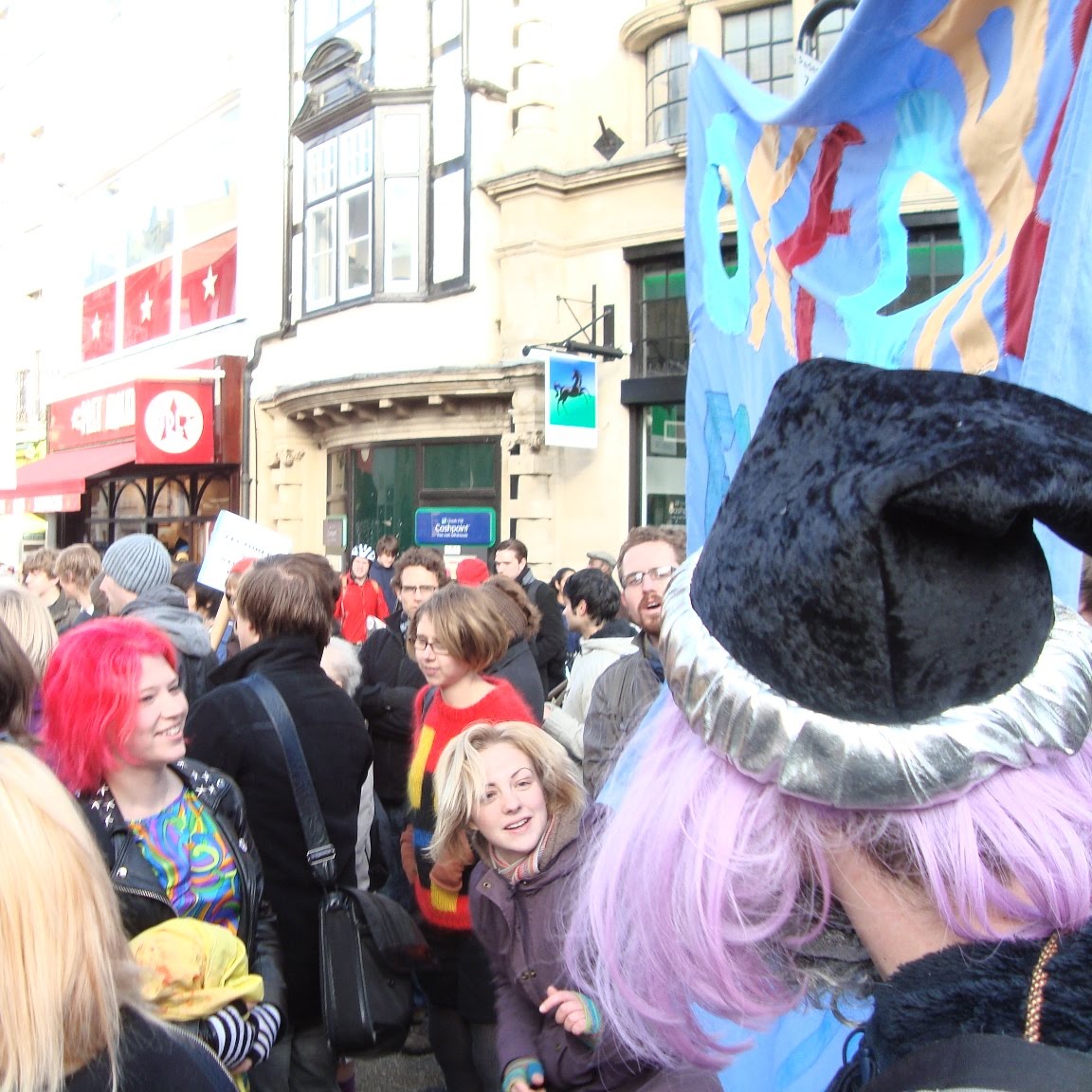
Oxford occupied

I visited the Radcliffe Camera today, the historic library building occupied by student protesters since yesterday's demo. Situation looked rather grim, as police aren't letting anyone in, and a represeantative of the university read a statement threatening consequences to the education prospects of the occupants. As if their education wasn't threatened enough already by the government. Also not clear why Oxford University students shouldn't be allowed in their own library (at least during opening hours).

Here are some photos I took today:


A rather fierce looking police cordon sealing off the building.


Communicating with balloons.


A don discussing with students in front of the occupied building.

See protesters' blog with links to other occupation events around the country, and their twitter feed.

According to BBC Radio Oxford the students were evicted from the library around 5pm today, after police managed to get in.

Wednesday, November 24, 2010

fight education cuts

We had a nice little demo here at Oxford this afternoon, starting from Carfax tower and culminating in an occupation of the Radcliffe Camera, which has been declared a "public library" by the occupants (see their statement, twitter feed). Clever to occupy a library complete with lots of computers and fast internet access ...

Here are a few pictures I took:


Meanwhile, events in London are a bit more scary, see Laurie Penny's report.

Saturday, November 13, 2010

if you tolerate this, then your children will be next

The song/video to match this extraordinary week should really be "If you tolerate this ... " by the Manic Street Preachers, which you can find here but which sadly has the embedding blocked.

So, instead I'll embed another Manics song, which - in normal times - I like better anyway because it features an interesting female voice (courtesy of Nina Persson from the Cardigans):


Thursday, November 11, 2010

protests and riots

(updated Fri 12.11.)

I'm writing something about Wednesday's protests and riots, here's a reading list of stuff I liked:

Spending cuts: the fightback begins by John Harris

"What happened on Wednesday afternoon was not some meaningless rent-a-mob flare-up, nor an easily-ignored howl of indignation from some of society's more privileged citizens. It was an early sign of people growing anxious and restless, and what a government pledged to such drastic plans should increasingly expect."


Student protest: we're all in this together by Nina Power

"It was a protest against the narrowing of horizons; a protest against Lib Dem hypocrisy; a protest against the increasingly utilitarian approach to human life that sees degrees as nothing but "investments" by individuals, and denies any link between education and the broader social good."


Inside the Millbank riots by Laurie Penny.

"It's scary, isn't it?" I ask. The boy shrugs. "Yeah," he says, "I suppose it is scary. But frankly..." He lights up, cradling the contraband fag, "frankly, it's not half as scary as what's happening to our future."


Browne's Gamble Stefan Collini in th London Review of Books

"But while it may be true that the present system embodies an unnecessary pretence that all institutions called universities perform the same set of functions, it is no good deluding ourselves that simply leaving 18-year-old applicants to cash in their vouchers at a university of their choice will lead to a more intelligently conceived provision of diverse, high-quality institutions. It may just lead to a few private jets and a lot of Ryanairs."


Oxford Education Campaign Facebook page


Flickr groups and tags:

Anglia Ruskin Student Union
tag "studentmarch"
Protests ... group


Oh, and here is LibDem leader Nick Clegg speaking about tuition fees before the election:


Wednesday, November 03, 2010

why the state should fund universities

I never thought this needed explaining, but seeing that the government releases details today of what they admit is a move "to shift a greater proportion of [Higher Education] funding from the taxpayer to the individuals who benefit" (quote from the comprehensive spending review, page 51, last bullet point), it may be time to spell out the blatantly obvious.

The three words "individuals who benefit" are the most insiduous piece of misleading political propaganda that I've come across in a long time. So, for the benefit of the individuals who are busy wrecking higher education:

* giving people as good an education as their brains can soak up is not primarily to benefit the individuals, it is in the best interest of society. We all, i.e. society, need well-educated scientists, medical doctors, even lawyers and accountants. These days, we need more of these than of people who can stack shelves without complaining.

* yes it is expensive to educate people, but the benefit to society outweighs the cost by a large factor. Imagine the talented people who would normally study decided to work as bar staff instead. In the words of one ex Harvard president: "If you think education is expensive, try ignorance"

* on top of the benefit that academically educated people offer society by doing intelligent work, they also earn more more on average, so pay more taxes (disproportionately so in a progressive tax system), so they also are "the taxpayer" who funds their studies.

* even when the state pays the full cost of tuition, students still have their bills to pay for the duration of the study, and often make a sacrifice in terms of what living standard they could afford if they went to work straight after leaving school.

* Burdening students with the cost of their tuition on top of that will definitely scare away some talents (no matter how clever the payback arrangements) - especially if they have the opportunity to study elsewhere for free.

* Furthermore, I am worried that the "market solution" will turn degrees into commodities. If students are regarded as paying customers and have to pay close to the full cost of their education, they could very easily get the idea that with the payment they have purchased the right to get a degree regardless of their talent or effort.

These are the reasons why in civilised countries the state does (and should continue to) fund higher education, collecting at most a small nominal fee from students to avoid abuse of the facilities offered. It's not that difficult to understand, is it?


(protest posters seen in Oxford last week)

I'm pleased to report that we have a very active protest group here, the Oxford Education Campaign, which has already managed to scare away business secretary Vince Cable (the fact that the business secretary is in charge of HE tells you a lot about what's wrong here!). You can look up OEC on facebook or email oxfordunicuts@gmail.com to find out more.

A nationwide demo against HE cuts will take place on Wednesday 10.11. 11.30am at London, starting at Horse Guards Avenue - more details here.

PS: More about today's government announcement in the Guardian.
Also, my blog entries now get a tweet button, please use it generously (noting that both the button and the counter refer to the URL shown at the top of the browser, so if you're looking at a page with several blog entries, you'll have to click a specific blog entry first to get a specific tweet and counter result for it):

Tuesday, September 14, 2010

a very useful formula

I am puzzled that my children's secondary school doesn't seem to teach the most elementary form of the binomial theorem, i.e.

(a+b)2 = a2 + 2ab + b2
(a-b)2 = a2 - 2ab + b2
(a+b)(a-b) = a2 - b2

In German selective secondary schools (Gymnasium) you get these 3 equations drilled into your head until you know them in your sleep, backward and forward (well at least this was still the case when I went to school), and rightly so, as they are incredibly useful for everything from quadratic equations through to mental arithmetics (allowing you to calculate things like 53 * 47 in a flash). They are known as "binomische Formeln" and have jokingly been attributed to a mathematician called Binomi, though of course the name refers to the fact that they are about algebraic expressions based on two terms.

Looking them up on Wiki, I found that the German entry Binomische Formel, which explains their usefulness in great detail, is linked to the English entry Binomial theorem, which is about the more general version [(a+b)n], applying to powers of all sorts. The latter would of course be too difficult for most pupils, so I am wondering whether it's only the German system that has come up with the the idea of rebranding the simplest case to make it accessible and useful. (A quick check of the wiki entries in Spanish, French, and Dutch reveals they also focus on the general formula.)

Any clues to this mystery appreciated.

Tuesday, August 10, 2010

education stirred up

One hope I had of this new coalition government we now have in this country is that the continuous flow of policy changes in education would slow down a bit. Under New Labour we had a major restructuring of schools and/or universities (and also in the health system) announced every week, to an extent that it was impossible (at least for anybody who also has other things to do) to actually follow the news or to keep track of which of the policies they were really putting into practice (for instance, the health checkups for over 40s, my GP tells me, although announced two years ago, never arrived at the practice level).

So, well, as readers in the UK will know, the hope was disappointed, and the rate at which major policy changes are announced has even increased. One observer blamed it on the fact that Cameron is actually able to delegate decisions, leaving ministers free to announce their ideas without having to double check with him each time.

In higher education, the BIS (business, innovation and skills) secretary Vince Cable brought up the idea of graduate tax a few weeks ago, which seemed to be sinking soon after, but has popped up again this week. Lucky for me, because I wrote a piece about this, which is out today, and in the worst case it could have been all ancient history by now, but in fact it happens to be the policy du jour.

I've also had a look at Germany, where things are less hectic, but suffering from the cacophony of policies made independently by 16 Länder governments.

Anyhow, my piece is here, read it and weep:

Cuts spark university rethink
Current Biology, Volume 20, Issue 15, R616-R617, 10 August 2010
summary and restricted access to pdf file

In fact, some technical difficulties aside, I think the graduate tax isn't such a bad idea. From there it is only one step for the government to realise that graduates pay a lot more tax already (as they earn more, on average), so they are actually paying back the cost of their education already. Or, as a former president of Harvard University famously put it: "If you think education is expensive, try ignorance."

Friday, June 11, 2010

one goal

there will be absolutely no football coverage on this blog, but here is one goal I can relate to:


You can join 1goal here or follow their tweets.

PS - I pinched the photo from Wendy's blog.

PPS: While I'm at it, I'll also throw in a video of Shakira's appearance at the opening ceremony:

Wednesday, May 26, 2010

education fixed

In his latest column, George Monbiot advocates a brilliantly simple and effective fix for the blatant inequality of opportunity in this country, based on an earlier idea by Peter Wilby. I'll tweak it slightly but the essence is the same:

If only x percent of the year group can go to the best universities, make sure that each and every secondary school gets places for the top x % of their students. I.e. if x is 5, our local state school with some 200 students per year doing A levels, would get 10 guaranteed places at Oxbridge. No more Apartheid in the schools system, as ambitious parents would seek out schools with fewer successful pupils to let theirs have a better chance, so within a few years the whole system would be homogenised and everybody would get ahead purely on the merits of their performance.

The only real problem I can think of is that competition between pupils for the fixed number of places could become nasty.

Other than that there are of course a few political problems meaning that it will never happen, such as the fact that it would remove the heritable privileges of those who are monopolising power and wealth in this country. Also, I think they do it similarly in France (at least I seem to remember that the important figure at the end of your school career is a ranking, not a mark, but not sure), so it can't be right.

So watch out for politicians studiously ignoring this proposal.

Source:
George Monbiot: Universal Cure (24.5.2010, printed in the Guardian on 25.5.)

Friday, April 02, 2010

the big issue

The current issue of the magazine The Big Issue (that's the one sold by homeless people on street corners) has a cover story on "Shakira - Activist. Philanthropist. Pop goddess." Old photos, but a new interview. A lot about her education work, some hints re the forthcoming album in Spanish (not really thrilled to hear that she's writing material in English for that one, in my humble opinion the Spanish stuff is still better!) and the next tour, but no firm dates.

Anyhow. Another cover for the collection:

Monday, February 22, 2010

recognise that cover star ?

Went to WHSmith this afternoon for no reason whatsoever (except that I had bought something else on the other side of the road and had five mins to spare), stood next to a shelf with magazines and had a funny feeling that somebody was watching me. Investigating the origin of that funny feeling I found this:


It turns out that this is the first ever issue of a new socially aware lifestyle magazine, and who better to put on the cover ... The photos aren't new, the interview is ok (the founding date of PiesDescalzos is wrong, people!), but it is of course a very nice specimen for the collection, and I might even buy the magazine more often.

You can flick through selected pages of the magazine here, or check their blog or follow @RECOGNISEmag on twitter.

Wednesday, January 27, 2010

students go mild

There have been simmering student protests across Germany since last June or so, but they were rather mild compared to the historic events of 1968. Mainly ignited by the measures surrounding the Bologna process and the introduction of new, more streamlined degree courses, the protests cover a range of other criticisms of the education system, such that even the politicians of the ruling parties can find something to express sympathy with (while blaming the other parties).

I've tried to make some sense of events in a news feature out this week in Current Biology:

Bologna resistance
Current Biology, Volume 20, Issue 2, R39-R40, 26 January 2010
doi:10.1016/j.cub.2010.01.004

summary and restricted access to PDF file