Showing posts with label inorganic-chemistry. Show all posts

Friday, September 12, 2014

from graphene to stanene

Graphene - a single layer of graphitic carbon - has caused some excitement in recent years, but there's always the slight inconvenience that it is an "always-on" conductor rather than a switchable material of the semiconductor type. This problem has motivated a lot of research into graphene analogues and derivatives, both on a carbon basis and on the basis of elements that share some of its properties due to being near carbon in the periodic table.

In my latest feature I have looked at graphene analogues using other elements, including carbon's neighbours boron and nitrogen, as well as its fellow group IV elements silicon, germanium, and tin (whose honeycomb layers are known as silicene, germanene and stanene, respectively). The feature appears in the September issue of Chemistry & Industry:

Stanene, the next miracle material?

Chemistry & Industry issue 9, pp 24-27.

I'm afraid it's premium content, but give me a shout if you want a PDF "reprint".

On page 51 of the same issue, there is also my review of the "Handbook of cellulosic ethanol", ditto.

A model of graphene. Image source.

Friday, May 10, 2013

cognitive enhancers

Not that I've felt the need for brain doping (beyond caffeine) so far, but I've been following the field of cognitive enhancers from a safe distance for a while now and have summed up the current state of affairs in a feature for Chemistry & Industry, which is out in the May issue:

Smart New World

Chemistry & Industry No. 5, pp32-35

Full text

In the same issue, I have a review of the book:

Gold nanoparticles for physics, chemistry and biology

on page 47.

Full text

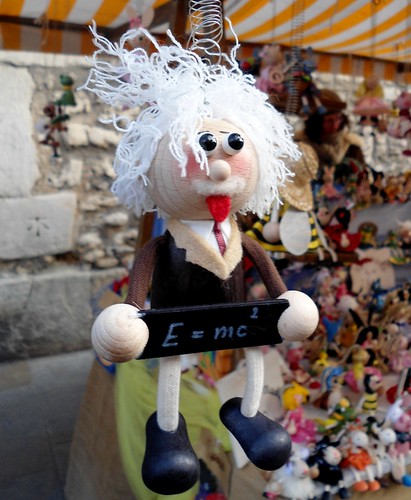
Maybe the smart pills could magically convert me into this guy:

einstein

Sunday, April 03, 2011

chemistry landmark

I just spotted this weekend that the Inorganic Chemistry Laboratory in South Parks Road has acquired a second plaque. The first one honoured the work of crystallographer Dorothy Hodgkin, and the new one some discovery that led to today's lithium batteries:


The date on the plaque is when it was handed over to the department (see a short news release here, but I'm quite sure it hasn't been mounted on that wall for longer than two weeks when I spotted it this weekend. I love the hexagonal design of the new plaques. Places that get several of these will be able to create interesting polycyclic compounds from them ...

Now if somebody could find out why the lithium battery in my camera, only two years old, only lasts one day (80 photos), that would be very helpful.

Wednesday, September 30, 2009

things I like

Having drowned this blog in text, I need to offer some visual entertainment now, so I decided to start an occasional series of things I like the look / design of. Let's start with that eternal classic, the periodic table taxis -- here is one I caught from the front side, just before it ran me over (just kidding, the driver popped out for a chat with a colleague):

Monday, September 28, 2009

news from the nanoworld

in last week's Angewandte Chemie Early view release there is a paper by Achim Müller and colleagues, using his trademark inorganic molybdate capsules to assemble a well-defined hydrophobic aggregate (24 butyrate molecules) on the inside of the capsule, such that its interactions can be studied by NMR, trapped in a molecular test tube, so to speak. Achim Müller says: "I believe that the present paper really refers to new options for future basic research. The reason is that one can systematically study in the capsule hydrophobic effects in general, (different) chain-chain contacts under confined conditions as well as investigations in hydrophobic cavities, especially with the influence of included water."

A Spherical 24 Butyrate Aggregate with a Hydrophobic Cavity in a Capsule with Flexible Pores: Confinement Effects and Uptake-Release Equilibria at Elevated Temperatures (p NA)
Christian Schäffer, Hartmut Bögge, Alice Merca, Ira A. Weinstock, Dieter Rehder, Erhard T. K. Haupt, Achim Müller
Published Online: Sep 22 2009 2:46AM
DOI: 10.1002/anie.200903910


There was also a paper about assembling nanowires just one atom thick within carbon nanotubes, which looked very interesting:

High-Yield Synthesis of Ultrathin Metal Nanowires in Carbon Nanotubes (p NA)
R. Kitaura, R. Nakanishi, T. Saito, H. Yoshikawa, K. Awaga, H. Shinohara
Published Online: Sep 22 2009 1:32PM
DOI: 10.1002/anie.200902615

Monday, May 25, 2009

periodic bus service

One does expect buses to run periodically and to timetable, but only very few of them display a periodic table. So, after a long wait for the bus, and following up on the more frequently seen periodic taxi, here comes at last the periodic bus:


Friday, April 24, 2009

Haber-Bosch revisited

My most recent book review to appear in Chemistry & Industry (No 7, 13.4., page 30)is about another book about Fritz Haber:

The Alchemy of Air: A Jewish Genius, a Doomed Tycoon, and the Scientific Discovery That Fed the World but Fueled the Rise of Hitler
by Thomas Hager
Harmony books, New York, 2008
ISBN: 978-0307351784


Here's a snippet (including a paragraph that was omitted from the printed version):

It is difficult for writers to find the right way to approach this monumental complex of tragic lives, science and technology of the highest possible impact, and politics gone off the rails. Apart from the epic biography of Haber, I have on my shelves a few slimmer studies of smaller aspects. There is a biography of Haber’s first wife, Clara Immerwahr, for instance, and a master’s thesis on Haber’s quest to mine gold from the oceans. Plus a 1950s account of the history of IG Farben dressed up as a novel, and a volume with short biographies of Jewish scientists in Germany 1900-33.

Now a fresh generation of American writers seems to have discovered this topic for themselves, and they approach it fearlessly. A few years ago, there was a new, shorter biography of Haber by Daniel Charles, who delivered a straight and very readable narrative of Haber’s ambivalent character and his rise and fall.

Thomas Hager has taken a step back to glance at an even bigger picture, including the history of nitrogen fertiliser before it could be made synthetically, and the further development of Bosch’s ambitions after the success with nitrogen. Essentially, he follows the intertwined stories of three protagonists: Haber, Bosch, and nitrogen.

PS checking up on the C&I website (still being rebuilt), I found out that the recently deceased author JG Ballard was a former assistant editor of the magazine:

J G Ballard, author
Former assistant editor of Chemistry & Industry, J G Ballard died on 19 April 2009 aged 78. Best known as a writer of what he described as apocalyptic, rather than science, fiction, his first novel, The Drowned World, published in 1962, recorded the psychological breakdown of a group of scientists examining a London waterlogged by the melting of the polar icecaps. Later books, including The Wind from Nowhere and The Drought, also dealt with ecological disaster. He is probably best remembered for his semi-autobiographical novel of his childhood as a Japanese internee in Shangai, China, Empire of the Sun, which was made into a blockbuster film by Steven Spielberg.


PPS Oh, and my short review of Daniel Charles's Haber biography is here (open access, I believe).

Sunday, March 22, 2009

OX1 3QT

From 1993 to 2001 I used to work at the New Chemistry Laboratory, South Parks Road, OX1 3QT, so I'm just a little bit irritated to see that the place has turned into a big muddy hole in the ground, which last week looked like this:


I understand that this hole will eventually be filled with a new building for Earth Sciences. I took this picture from the windows of the Inorganic Chemistry Laboratory, while I was there interviewing people for a feature about their work. The red brick building behind the hole is the Dyson Perrins Laboratory which used to house organic chemistry research until the new research building opened across the road.

Thursday, March 19, 2009

open up wide

In porous inorganic materials such as zeolites, the pore width normally determines what goes in and what stays out. Now, however, chemists have demonstrated that hollow capsules made of molybdate complexes can import molecules that are larger than the pores through which they enter, pointing to a surprising degree of flexibility for an inorganic structure.

Read my news story in Chemistry World.

Monday, February 16, 2009

ride the elements

As Oxford is known as the seat of learning, you can sit down and take a ride on (or wrapped in) the periodic table:


PS It's not an education initiative, though. It's advertising the Oxford Science Park.

Tuesday, December 30, 2008

nickel in nature

I have a short book review in the last edition of Chemistry and Industry of 2008:

Gross M:
Chemistry & Industry No 24 (22.12.), 29
review of "Nickel and its surprising impact in Nature" by A. Sigel, H. Sigel, and R.K.O. Sigel, eds.

Here's a snippet:
"The biological role of nickel isn’t one of the boxes that science gets filed into; I suppose there aren’t any departments dedicated to nickel biochemistry. All the more interesting then, to use this metal to slice across the established classifications and think outside the box for a while. "

Wednesday, December 10, 2008

Haber reviewed

as I'm currently reading another book about Fritz Haber (whose name is basically written on half the nitrogen atoms in your body), and also organising my old book reviews to make sure they don't get lost, I've dug out my previous effort on Haber, published in Chemistry World, Dec. 2005:


Book review

Between genius and genocide
Daniel Charles
London, UK: Jonathan Cape 2005 313pp £20 (HB) ISBN 0224064444


Nitrogen from the air can enter the chemical cycles of the living world via two processes that globally turn over similar amounts. One is bacterial nitrogen fixation; the other is the synthesis of ammonia from the elements under high pressure, invented by Fritz Haber.

Apart from the process that literally feeds today's world, Haber is also known for his enthusiastic services to the Reich of Kaiser Wilhelm during the first world war, particularly in the development of chemical warfare. With the arrival of the Third Reich, however, Haber found that his Jewish origins outweighed his achievements and services. Soon he found himself exiled, and he died before he could find a new home.

The moral complexity and tragic conclusion of his life make Haber a tricky subject. His former assistant Johannes Jaenicke spent decades collecting materials for a biography, but never got it written. His collection is the archive from which biographers feed, including Dietrich Stoltzenberg (whose epic effort recently appeared in a shortened translation, reviewed in Chemistry World, February 2005, p55) and now Daniel Charles.

Charles' advantage is that he sees Haber with the fresh eyes of an outsider, who admits that he once visited the Haber institute without knowing who it was named after. Since then, he has certainly done his homework at the Jaenicke archive, and manages to tell the story in a compelling and fascinating, yet compact and accessible form. His strength is the witty summary that often introduces a new section of his story (eg 'Haber didn't immediately volunteer for this epic quest. He had to be goaded into it with offers of money and insults to his pride.'). The only blemish is the title of the book, which demonises the creator of one of the most important inventions of the 20th century.

Thursday, October 02, 2008

microbial mining

There's an intriguing piece in Nature's journal club column today, on microbes drilling (or more likely, etching?) microscopic mining shafts into basalt rocks in Hawaii. Apparently, the preference for one component mineral over the other suggests they are after the metals, rather than just creating a cave for protection.

Original paper: A. W. Walton, Geobiology, Volume 6 Issue 4, Pages 351 - 364

Monday, September 15, 2008

periodic table of videos

I only found out yesterday that there is a "periodic table of videos", where each of the currently known 117 elements has its own little clip. You just click on the relevant square in the periodic table and you get the 3-minute introduction to the element. Genius. The structure of the clips I've seen is quite elementary as well, though. Basically they cut back and forth between Professor Martyn Poliakoff sitting behind his desk with a periodic-table themed tie (and matching mug), waving his hands and explaining the more academic side of the topic, and a younger scientist in the lab doing something with the element in question and giving additional explanations.

So maybe I wouldn't want to sacrifice five hours to sit through all 117 elements, but it's well worth checking out a few.

PS People in the UK may recognise the name Poliakoff -- his brother Stephen has written lots of stuff for stage and TV.

Thursday, September 04, 2008

magnetic liquids

In Angewandte Chem. early view, there is a nice little paper reporting the first ionic liquid that is both magnetic and fluorescent. So one could have a drop of it in tube, with another, immiscible liquid, and move it around with magnetic field, and watch it glow. And once that becomes boring, I am almost sure there is a brilliant application for this just waiting to be discovered. Just need to find my thinking hat and put it on ...

Hm, how about some new display technology. A new kind of lava lamp. Or for spooky floating aquarium lighting? Still looking for that hat!

Dysprosium Room-Temperature Ionic Liquids with Strong Luminescence and Response to Magnetic Fields
Bert Mallick, Benjamin Balke, Claudia Felser, Anja-Verena Mudring
Published Online: Aug 29 2008 6:45AM
DOI: 10.1002/anie.200802390

Thursday, May 15, 2008

happy birthday atomium

One of the perks of being a chemist, of course, is that you're allowed to play with toys like the ball-and-sticks models used to recreate molecular structures. Now one architect took this occupation to a larger scale and the result was the Atomium which was created for the Brussels Expo in 1958 and thus turns 50 this year.

It represents a unit cell (cubic space-centred) of the crystal structure of alpha iron. Rather than letting the cube rest on one of its faces, as you would find it illustrated in textbooks, the architect emphasized the 3-fold symmetry axis (i.e. the space diagonal) by arranging it vertically. (Now if we could get the thing to rotate around this axis, that would be truly spectacular.)

The Atomium has been recently refurbished -- now it's so shiny that I even spotted it from the train, though I didn't know when or where to look! Celebrations of its 50th birthday will be running all summer.

atomium by night

Thursday, January 17, 2008

trapping uranium

Researchers in Edinburgh have found an elegant way to catch the highly inert uranyl cation and make it react. Read my story here:

Chemists tame the uranyl ion

Monday, May 22, 2006

Platinum photographs

My most recent news story on photographs printed in platinum is now online at:

http://www.rsc.org/chemistryworld/News/2006/May/18050601.asp

enjoy ...