Showing posts with label namibia. Show all posts

Tuesday, July 26, 2022

colonial crimes

some thoughts on

Morenga

Uwe Timm

published 1983, new edition: dtv, 2020

In 1904, my adventurous great-grandfather Julius (born in May 1883) signed up to serve in the colonial war against the Herero and Nama in the area now known as Namibia, but soon caught a tropical disease and was sent home, arriving back in March 1905. He was rumoured to have witnessed terrible things there but as far as I know didn’t tell anybody any details.

In recent years, the operations under the command of general Lothar von Trotha have been increasingly described as genocide and discussed as foreboding of the Holocaust (eg by David Olusoga), although earlier accounts saw no more than the ruthless suppression of a rebellion against colonial rule.

Uwe Timm’s account of the events is half fictional, half documentary and dates from the time when the war was described in more forgiving terms. It contrasts the perspective of a (fictional) naïve and relatively innocent veterinarian serving the German troops, with lengthy extracts from contemporary documents.

Reading the sources with their original racist language and all the rest of it is disturbing at times and could lead the reader to condemning colonialist attitudes. Then again, I suspect any reader thinking that colonialism was a good thing could take those sources as the good side and the veterinarian as the crazy outlier. I suspect the fact that the book has now been re-issued (with a new afterword by Green politician Robert Habeck, no less) after the views have shifted shows that the format allows it to move with the times and allows readers to pick and choose.

Considering that Jacob Morenga, an important leader of guerrilla warfare after the Nama joined the rebellion in 1904, lends his name to the book title, we don’t learn all that much about him. I suppose the idea behind the title is that he is essentially the phantom that haunts the German troops, but a book that is actually about him, showing the other side of the front lines, might also be interesting.

See also my twitter thread listing books I read in 2022.

PS: I'll collect some other materials relevant to this here:

  • Just after finishing reading Morenga, I discovered the Bradt travel guidebook Namibia in a charity shop. Would have been handy if only for the map. In this edition, dating from 2011, the word genocide doesn't occur.

Thursday, April 21, 2022

lost illusions

Every picture tells a story No. 34

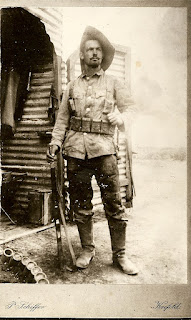
Staying on the unpleasant subject of wars, shopkeeper Julius Düsselmann had an adventurous streak in his younger days. Reportedly he wanted to fly zeppelins, which didn't quite work out. In 1904, aged 18, he signed up for the Schutztruppe, the small colonial force serving to uphold German rule in the small number of colonies the Reich had acquired belatedly. Here's Julius, looking wild and barely recognisable, in his Schutztruppe uniform. He signed up as a Reiter (rider) which was the equivalent of a common soldier there - definitely not cavalry, as I have seen photos of Reiter troops riding camels and donkeys.

A colour image of a Reiter's uniform and outfit can be seen here.

He was sent to Deutsch-Südwest Afrika, today's Namibia, as part of the reinforcement troops for the now notorious war against the Herero, which in recent years has been described as a genocide. Essentially, the very small Schutztruppe had been struggling to cope with the Herero uprising, until the government sent out the cruel and ruthless general Lothar von Trotha, who had no qualms about forcing a large part of the tribe into the desert and letting people die there.

I heard that Julius didn't talk about the war, but admitted having witnessed terrible things in his short stay in Africa. He caught a tropical disease, probably typhoid fever, and was sent home in poor health, arriving in Hamburg on 18.3.1905. He needed regular spa treatments at Bad Nauheim until 1914 (which is also the place where he settled after 1945 and lived for the rest of his life).

Apart from this photo, the only other souvenir of Africa is a small ruby he found there (or maybe two), which he had set in gold together with a bit of the surrounding rock. There are two of these, not sure if they are cut from the same rock or separate finds. I have one of the two and it is marked "Abbabis, S.W.Afrika, 22.Januar 1905". Must have felt he had a lucky day in an otherwise rather grim time that surely didn't live up to his hopes of an adventure.

Abbabis was a railway station and the place of a reconvalescence home for members of the Schutztruppe. If Julius was there to reconvalesce from his disease, that means he can't have spent much time in active service. Typhoid fever was reported to affect the Schutztruppe specifically from October 1904 onwards, which would broadly fit with this timing.

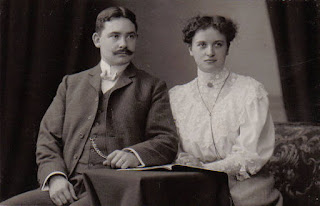
Two and a half years after his return he married his cousin Helene Kauer (youngest of the five daughters of the stationmaster of Adamsweiler):

Reportedly she talked him out of plans to emigrate to the USA, so he channelled his spirit of adventure into business instead.

Their shared ancestry is the Imig clan, as both their mothers were from the Imig family in Simmern. Julius's paternal side is the Krefeld clan.

To get a better impression of Julius's war experience, I bought a copy of the novel Morenga by Uwe Timm, which I hear steers very close to the historical documents. (The English translation appears to be out of print. Heck, it's even been made into a film, I just found out.) Am planning to read that soon, watch this space.

UPDATE 12.1.2024: My review of Morenga is now here. I just read in Der Spiegel that a critical historical edition of Gen. v. Trotha's diaries from the Herero war are due to be published (with photos) this month (details). As the official documents covering the war have all been lost, this will be about the only chance to find out more about what happened there.

This photo is also on flickr.

Every picture tells a story series so far:

  1. string quartet Wuppertal Elberfeld 1927
  2. greetings from Adamsweiler
  3. Gastwirthschaft Ferd. Weirich
  4. quartet times three
  5. Neumühl 1923
  6. Tangermünde railway station 1889
  7. a singing lesson
  8. bei Wilhelm Geppert
  9. a bakery at Lorsch 1900
  10. Consumgeschäft von Julius Düsselmann
  11. Hanna and Ruth
  12. a young chemist
  13. school's out at Reichenstein, 1886
  14. a patchwork family in East Prussia
  15. the case of the missing grandmother
  16. checkpoint Glaner Brücke 1929(ish)
  17. finding Mimi
  18. five sisters, five decades
  19. happy at home
  20. gone milking
  21. steel workers
  22. field work
  23. what to wear at Porta Westfalica
  24. a classic convertible
  25. at the bottom of the steps
  26. a forester's family
  27. the Kaiser visits Allenburg
  28. teaching the 'deaf-mute'
  29. a guard dog called Schluck
  30. party like it's 1956
  31. the case of the mysterious uncle
  32. three Hedwigs and a baby
  33. a lost generation
  34. lost illusions

Alternatively, you can use this twitter thread as an illustrated table of contents.

In a somewhat roundabout way, this series relates to my research for the family history music memoir I have now completed in a first version.

Tuesday, September 14, 2021

wonderful Welwitschia

The desert plant Welwitschia mirabilis has accompanied my writing for a while. It featured in my book Exzentriker des Lebens / Life on the Edge. The info in the books is mostly 1990s plant physiology. Now however, researchers have published a high quality genome structure of Welwitschia in comparison with its closest relative - which isn't very close. I've used the opportunity to also have a look at other plant life in deserts on other continents - in the context that the climate disaster will produce more extreme conditions for life to cope with, so we'd better understand how it does.

The resulting feature is out now:

How to survive in the desert

Current Biology Volume 31, Issue 17, 14 September 2021, Pages R1017-R1019

FREE access to full text and PDF download

See also my twitter thread with all 2021 features that are now in the open archives.

Welwitschia_mirabilis, Plate 5369 from vol89 (1863) Curtis's Botanical Magazine (source: wikipedia)

bonus illustration not included in my feature, as images in portrait format are awkward with the column format we use.