Showing posts with label livres en français. Show all posts

Sunday, October 09, 2022

from Alsace to Morocco

Leïla Slimani

Le parfum des fleurs la nuit

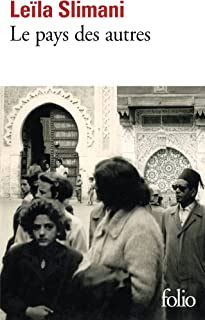
Le pays des autres

This June was the first time in too many years that I got to spend some time in France, so I had some catching up to do. In a bookshop at Nimes, I spotted a pair of paperbacks by Leila Slimani lying around on a table where they didn't belong, and as I loved her first novel, Dans le jardin de l'ogre (published in English as Adele), and generally have a soft spot for her, I read this as a sign and bought the pair unseen.

I read the slimmer one first, and it turned out to be an autobiographical sketch about an occasion when she agreed to spend a night locked into a museum in Venice and write about it. I mainly learned from this that she smokes too much, doesn't care much about visual arts, and had a grandmother from Alsace. As I had two grandparents from Alsace/Lorraine, I was intrigued and wanted to know more.

Luckily, the other book told me all about the Alsatian grandmother, albeit in fictionalised form. In the novel she's called Matilde and married a Moroccan soldier stationed near her home during the second world war, and followed him to his native country then still under French rule, but with calls for independence getting louder. Very much the type of book I want to read right now, making sense of our recent past and migration stories in an appealing format.

Ooh, and I hear there is a sequel too, called Regardez-nous danser. will have to get my hands on that (as soon as it comes out in paperback).

See also my twitter thread listing books I read in 2022.

PS Wikipedia names the real-life grandmother as Anne Ruetsch. My Alsatian grandparents were the son of Heinrich and Maria who fell in love in Stasbourg but then were forced to move to Dieuze (Lorraine), and the granddaughter of the stationmaster of Adamsweiler. Both lineages only came to the region after 1871, but Maria also had a much earlier Alsatian ancestor from Sainte-Marie-aux-Mines, unfortunately called Paul Simon, which must be the most useless name for online searches one can imagine. Considering all of this, I'm now creating a tag for all things Alsatian.

Sunday, December 26, 2021

new from Simone de Beauvoir

I read all of Simone de Beauvoir's novels and some of her autobiographical writing at a young and impressionable age when sitting in a Paris cafe writing books was my idea of a sensible career path. (Now, of course, after the rather strict lockdowns they had in France, I realise that writing from where I'm sitting right now is much more sensible.)

Seriously, though, having been imprinted on Beauvoir as an intellectual role model, I was thrilled to see she's got a new book out, at the age of 110 plus. I only found out this year, when the English translation was published, but the original came out in 2020.

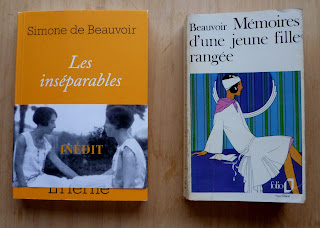
Les inséparables is a fictionalised account of her childhood friendship with and crush on school friend Elisabeth Lacoin, called Zaza, who died in 1929 aged 21. The account written in 1954 was deemed to be too emotionally sensitive to be published in her lifetime. A more distanced version was include four years later in Mémoires d'une jeune fille rangée.

In a detailed preface to this belated publication, Beauvoir's adopted daughter Sylvie Le Bon de Beauvoir explains the complex relations between the real life story, the short novel, and the memoir, which I found really helpful. It also comes with 18 pages of photos and copies of letters between Simone and Zaza.

I may be biased for imprinting reasons cited above, but I found the novel very moving and relatable (as we've only started saying long after it was written), and I'm very grateful that it came out at last. At 150 pages, the text is much more accessible than the memoir (which I bought 38 years ago but I'm not sure if I actually read it!), and I guess it might help to introduce new generations to the emotional and sensitive side of the great philosopher and feminist.

My editions of both books, own photo. I was too impatient to wait for a folio paperback to match my collection of Beauvoir's other works.

PS: My grandmother Ruth, shown here with a friend in her student days, was born the same year as Simone de Beauvoir, which makes the story even more relatable.

Tuesday, November 16, 2021

elusive memories

Impressions of

Dans le café de la jeunesse perdue
Patrick Modiano

Rummaging around the library I inherited I discovered a few books by the 2014 Nobel laureate for literature Patrick Modiano, including this one both in the French original and in a German translation:

I loved the French title and the German cover art, so went on to read the original. It is very short, with chapters from different perspectives describing the comings and goings of people who remain enchantingly mysterious, plus, it’s Paris shrouded in darkness and a haze of nostalgia, so what’s not to like. I disapproved of the ending though. And I'm wondering if, by not saying much at all about the characters, the author lets me do all the work. I mean I do love his elusive protagonist, Jacqueline, but I realise that I may be projecting my own expectations onto a blank canvas here.

After enjoying the misty mysteries of this one, I also read Du plus loin de l’oubli, which turns out to be very much the same, with some of the characters possibly overlapping (hello again, Jacqueline!), except that now part of the story (?) is moved to London, which somehow put me off a bit. So I guess I know the pattern now, and I don’t have to read the third one I found, which is called Pour que tu ne te perdes pas dans le quartier.

Tuesday, March 16, 2021

father and son

some thoughts on

Pierre-Auguste Renoir, mon père
by Jean Renoir
Hachette 1962 / Gallimard 1981
an English translation from 2001 is also available

Back in 2013, the film Renoir was one of the few French movies that still made it to our local independent cinema, and I was lucky to catch it there, and then watched it again when it came out on DVD. It is about the last years in the life of the painter, after the death of his wife, Aline Charigot, in 1915. Auguste Renoir (1841-1919) is stuck in a wheelchair and barely able to move his hands, two of his sons get injured in the war, but he creates some of his most vibrant and life-affirming art.

By the time I started looking at paintings, the impressionists had become mainstream to the point of commercial overload, so I’ve never been a huge fan these works although I don’t mind seeing them every once in a while. The film, however, made me appreciate Renoir a bit more and as a result I picked up a few books about him at various charity shops and antiques fairs, including the memoir by his middle son, the film director Jean Renoir (1894-1979). The idea of the changing of the guard in visual arts, one of the first great film makers writing about one of the last impressionists to remain active in the 20th century, intrigued me so I actually read the book, assisted by the other volumes to look up paintings mentioned and consult timelines.

The biography is based on conversations Jean Renoir had with his father in the last year of his life, as well as with his long-serving model Gabrielle Renard (1878-1959) and other surviving witnesses. As the age gap between father and son is more than half a century, his own recollections only become useful towards the end of the story.

It is organised broadly chronologically, although the author tends to digress on thematic excursions, and covers a staggering range of historical change. From his childhood in the 1840s, Renoir remembered an old man who visited his parents regularly and happily shared memories of how he helped operating the guillotines in the French Revolution. Renoir’s family moved to Paris before it was completely reshaped by Haussmann in the 1850s, he experienced the restored monarchy and as he lived in the Tuileries, he played under the windows of the actual queen. Like some of the other impressionists, he lived and worked in Montmartre when it was still a village with wooden shacks, long before Sacré Coeur was built.

The complete rejection of the impressionists by critics, public and art officialdom in the 1870s is a well-trodden story but always fun to read. Apart from having fun with quoting from the hilarious reviews of the first exhibitions (one of which gave us the word “impressionists” for the artists who had called themselves “les intransigeants” initially), he highlights the occasions when French institutions like the Louvre wouldn’t even take the paintings for free, resulting in many of them winding up in North America. For instance, the painter and collector Gustave Caillebotte died in 1894 leaving his vast collection to the state and installing Renoir to execute his will. Initially the Louvre (as the official repository of the state’s art collection) didn’t want to be bothered with any of it. Three years later, they saw sense and accepted a part of the collection. Not sure if anybody has calculated what the Caillebotte collection would be worth today – I suspect you’d have to be very good in calculating with trillions and such like.

Renoir, who famously identified as a craftsman rather than an artist and considered the word intellectual an insult, comes across as an interestingly complex mixture of old-fashioned and revolutionary, which is part of the force field that keeps this book interesting, even though it isn’t the most organised biography ever written. That and the chance to meet the people you already know from those famous paintings. In another very famous French movie, Amélie, there’s the painter who copies Renoir’s Déjeuner des canotiers (1881) over and over again. Jean Renoir describes the setting and can identify most of the participants, mostly faithful friends of the painter. The woman at the front left, playing with a little dog, is Aline, the author’s mother. When we see these pictures in museums or on countless wall calendars, they are just paintings – but for Jean Renoir and the rest of the family they were life.

Oh, and I'll just have to watch the movie a third time, now I know the family so much better.

Saturday, November 21, 2020

learning from Balzac

Balzac et la petite tailleuse chinoise

Dai Sijie

First published in 2000 and hugely successful, this is a short novel about two teenage boys caught up in Mao’s Cultural Revolution and sent to the remote countryside for re-education by the hardworking villagers. Instead, they find intellectual solace in an illicit stash of French novels by Balzac, Dumas, Flaubert et al. and also use them to re-educate themselves as well as the little seamstress of the title. Lives are changed, although perhaps not quite in the way they may have hoped.

(Cover of the 2001 folio edition I have, too. Later editions typically have images from the film.)

I managed to miss this when it came out and was swiftly made into a movie as well, I only vaguely remember seeing the title some time and wondering what it was about. Catching up with it now, I enjoyed the novel and I was amazed at how well it connected with my own experience of growing up around the same time. I was also stuck in the sticks, maybe not as remote and spectacular as the phoenix of the sky mountain villages with their dangerous paths, but still, as a vastly exaggerated fairytale metaphor for my youth, the novel works surprisingly well. And I found solace in the very same 19th century French novels. Today, I wouldn’t find time for Balzac, but I might revisit Flaubert one day.

It does make me think. Maybe there was a bit of Cultural Revolution going on in Europe as well? Between 1900 and 1960, everybody from whom I inherited DNA lived in towns and cities (eg Heinrich the cellist did all his life). Then, in the 1960s, People got cars, moved to the sticks, commuted to work. A slippery slope. I still get an allergic reaction when, ahead of the TV news, I see trailers for shows pretending that moving to the countryside is a good thing. The Cultural Revolution caused between 200,000 and 20 million deaths, depending on who you choose to believe, and traumatised millions like the author, Dai Sijie. We should heed that warning.

Saturday, February 08, 2020

bed bug

review of

bed bug

Katherine Pancol
Albin Michel 2019

A few years ago I discovered Pancol’s novel Les yeux jaunes des crocodiles (2006), which featured a scholar of mediaeval romances struggling with her own 21st century romantic life. I really enjoyed that one, although it appears that I forgot to review it.

So I was thrilled to see that her latest work seems to be doing something similar to biosciences. A biochemist studying insects and knowing all about their weird and wonderful love life, but finding her own more weird than wonderful.

Rose studies the firefly Lamprohiza splendidula in Paris and discovers that it produces a molecule that is very efficient at killing tumour cells. Her molecule may also be of interest to the cosmetics industry, which could lead to much faster profits for the start-up she’s planning to launch. Decisions, decisions. Meanwhile her mental health also needs attention due to traumatic events that are being dug up in the course of the novel. All being made more global by professional transplantation to New York.

I found the novel interesting as an example of science in fiction (with a few references to actual research papers listed at the end), although I’m slightly spooked when it travels too close to our dystopian present. We are clearly in the present day with Drumpf and all the rest of it.

The science remains a bit superficial, and one of Pancol’s contacts should have told her that there is no such thing as a Nobel prize for biology. Also, the dilution series that Rose performed to prove the miraculous effect of her compound reminded me of homeopathy and the “memory of water” claimed by some real-life Parisian researchers more than of any real science.

Scientists in the book have only two possible motivations – get rich quick by launching a start-up (allegedly the driver of all the researchers at the lab in New York), or curing disease. The actual quest for knowledge and understanding – so important for Rose in her private life as she struggles with her past trauma – doesn’t get a mention as motivator of scientific ambition.

Pancol is hugely successful in the French market, but as far as I can make out her work hasn’t been translated into English. Even the English title and the setting in New York didn’t help. Of course, the same book written in English by an author based in New York, with the converse excursion to Paris, would be translated into 30 languages within a year.

So catch the bed bug en français if you can.


Saturday, September 08, 2018

Madame Robinson

Leïla Slimani
Dans le jardin de l’ogre


When Leïla Slimani won the Prix Goncourt in 2016 for Chanson douce (English title: Lullaby), I really wanted to read her book but shied away from it because of the subject matter (as a parent, I am a bit squeamish about children being murdered). Then on my recent travel I stumbled across some kind of literary programme on TV5 Monde, where Slimani spoke about her most recent book (Sexe et mensonges : La vie sexuelle au Maroc), discussing the sex lives of Moroccan women with a panel of three blokes and looking as relaxed as if that was the most ordinary thing in the world to do.

So, looking up her oeuvre, I discovered her first novel, Dans le jardin de l’ogre, which looked less scary than the prize-winning one, so I read that. It’s in a way a Madame Bovary for the post-Catherine M. times. Which means, we have our medical doctor and his bored wife, but things get rather more out of hand than what I remember from Flaubert’s novel, and the move to rural Normandy (also the setting of Madame Bovary) comes as an attempt to fix things.

Slimani applies a cold psychiatric eye to report a case study of sex addiction – a condition only recognised as a mental health problem by the WHO last month, i.e. several years after her novel was published. She doesn’t spend much time on describing the external settings (Paris, Normandy, Boulogne sur Mer), and I kind of filled in from own memories what I missed there. But the internal landscapes are quite impressive and match the places. Hers, a city bustling with anonymous figures and existential angst, his, the yawning countryside and longing for steady normality, her parents’ the provincial small town of Boulogne (at some point, Napoleon planned to invade England from there, but I think he got side-tracked or something).

All of which reveals Slimani as a sharp and fearless writer, and one day I’ll even drum up the courage to read her other books.

An English translation of this book is scheduled to appear in February 2019 under the title of Adèle.


Available as a very lovely Collection Folio paperback, although I am not happy with the font they are now using for the author's name, which is the main difference between the current design and my collection of folios from the last century.

Tuesday, May 29, 2018

the science of Angélique

Trying to organise my book reviews, I came across this text I wrote in March 2016 after re-reading Angélique, which for some reason I didn't post then. As my recent reviews masterpost has a dramatic shortage of French novels, I'm now adding this as an almost review:

reasons to read Angélique

Each time my random path through life intersects with a copy of the historic novel Angélique by Anne and Serge Golon, I get asked why I would read that kind of nonsense. As it happens, I can think of a few good reasons, so here goes:

For the science – the first volume of the franchise revolves around a trial for sorcery, the pretext for which is the mining operation of the accused, which involves extraction of gold from minerals using lead as a solvent (cupellation). The argument why this is just chemistry and not the “transmutation” the mediaeval alchemists were after is a difficult one and handled competently. Serge Golon (1903-1972), who was probably more of a technical advisor than a co-author, was an engineer and geologist, so he would have known this sort of stuff.

For the social history – I don’t care what the courtiers were wearing for the wedding of Louis XIV, but the whole mining story also involves skilled miners immigrating from Germany. Plus there is the backdrop of the Huguenot persecution. Both issue figure prominently in my family history. Also fun to explore 17th century Paris – much of which disappeared when Napoleon III and Haussmann set to their grand-scale building project that created the city we know today.

For the literary merit – I wouldn’t vouch for the translations, but the original doesn’t quite deserve the trashy reputation it appears to have. One can certainly make out the author’s ambition to write a Dumas novel with a female lead, and I’m guessing that much of the stick she’s been getting over the year was simply sexism – a historic novel by a woman about a woman can’t be any good. Of note, for a book written in the 1950s, it is remarkably fearless in dealing with issues that were unmentionable back then, such as rape.

Incidentally, I only found out recently that Anne Golon has re-published the series to correct some mutilations that the original publishers made without her knowledge. Think I might just invest in a copy of that version.

-----

Update 2018

Checking the facts for this post, I just found out that Anne Golon died on Bastille Day last year, aged 95. I was travelling at that time and must have missed the news.

It looks like those "restored" versions of at least four of the Angélique novels have been published as "version augmentée", swiftly followed by a new edition billed as "version originale" to confuse readers completely. So the restored / augmented version looks like this, but sadly volume 1 doesn't seem to be available right now, although the following ones are:


Oh and from today, the tag for French books is livres en français


Sunday, May 27, 2018

book reviews reviewed

I'm trying to find some way of organising my literary book reviews published here, which are currently in the same tag (bookreview) as non-fiction and indeed as the reviews of science books that I write for Chemistry & Industry magazine. Plus, in the early days I also had some entries just pointing to other people's reviews of books I hadn't read. With 147 entries, that tag is getting a bit unwieldy.

So let's start with a master post sorting reviews by language (and maybe I'll introduce a new tag for each language, as I have already done for Galician), starting with the Romance languages which I am more interested in than in the Germanic ones:


Galician
(tagged biblioteca galega)

María Reimóndez: O club de calceta

Anxos Sumai: Así nacen as baleas, Galaxia 2007

Santiago Lopo: Hora Zulu, Galaxia 2012

Santiago Lopo: A arte de trobar, Xerais 2017


Spanish
(libros en español)

Isabel Allende: Más allá del invierno

Gioconda Belli: El país de las mujeres (2010)

Almudena Grandes: Castillos de cartón

Mario Vargas Llosa: El sueño del Celta

Elvira Valgañón: Luna cornata Sobrelamesa Ediciones 2007

Gioconda Belli: La mujer habitada

Gioconda Belli: El pergamino de la seduccion

Alicia Yanez Cossio: El Cristo feo


French
(livres en français)

Dai Sijie: Balzac et la petite tailleuse chinoise (2000)

Katherine Pancol: Bed bug (2019)

Leila Slimani: Dans le jardin de l'ogre

Anne Golon: Angélique, Marquise des Anges

Jean-Yves Ferri, Didier Conrad: Asterix - Le papyrus de César (2015)

Anna Gavalda: Ensemble, c'est tout

Alain Mabanckou: Verre Cassé


English

Ursula Le Guin: Lavinia

Laila Lalami: The Moor’s account

Esther Freud: Lucky break

Sefi Atta: Swallow Interlink 2010

Jennifer L. Rohn: The Honest Look Cold Spring Harbor Laboratory Press 2010

Weam Namou: The feminine art Hermiz Publishing 2004

Jennifer L. Rohn: Experimental heart Cold Spring Harbor Laboratory Press 2009

Esther Freud: Love Falls 2007

Salman Rushdie: The enchantress of Florence Jonathan Cape 2008

Belle de Jour: The intimate adventures of a London call girl Weidenfeld & Nicolson 2005

Megan Clark: Seduce me Kensington Books 2008


German

Daniel Kehlmann: Die Vermessung der Welt


Translations from other languages

Hong Ying: K - the art of love


Oh well that is an eclectic old list. And I should definitely review more French novels ...


In the meantime, here's my little Galician library:


PS I'm still adding a couple of links to more recent reviews but will at some point (end 2020?) leave it alone, lest it grows to become unmanageable. After that I might try and do a reviews master post at the end of every calendar year. Watch this space.

Tuesday, October 27, 2015

writing history

Asterix: Le papyrus de César

The 36th Asterix album – the second from the new team, Jean-Yves Ferri and Didier Conrad – addresses a question of utmost importance for the historical consistency of the whole oeuvre: Why on earth did Caesar not mention the indomitable Gauls and their numerous victories against his legions in his famous De Bello Gallico? Did he falsify the historical record by omission? Are all the zillions of schoolchildren who start their Latin reading with “Gallia est omnis divisa …” fed a pack of lies?

The issue is addressed with a very satisfying story, resulting in an album worthy to be read alongside the Golden Era ones written in the years before Goscinny died. On the basis of this story, there are deep discussions to be had about how history is written, the contribution of reportage, the value of oral tradition, and the philosophy of truth. Oh, and the vanity of writers and the publishing industry. And Assurancetourix the bard (Cacofonix / Troubadix) plays an early example of a Stroh cello, so what’s not to love?

Intriguingly, this arrived on my doorstep just after I started reading another recently published book featuring the origins of Caesar’s famous opus. In the third volume of his fictionalised biography of Cicero, Robert Harris imagines Cicero’s secretary Tiro visiting Caesar in Gaul and reading the beginning of his 12th chapter: “Flumen est Arar quod per fines Haeduorum et Sequanorum in Rhodanum influit, incredibili lenitate ita ut oculis in utram partem fluat iudicari non possit.” Seeing that Tiro is believed to have written a biography of Cicero which is lost, while Caesar’s book is so ubiquitous that it would survive the apocalypse, this encounter between two authors is also an interesting reflection on the vagaries of history writing.

looks like a fragment of the lost scroll survived in the font of the word "papyrus" - maybe the authors should reveal that in full ...

PS: here's an interview with the creators, from the Guardian.

Monday, March 08, 2010

ensemble, c'est tout

Ensemble, c’est tout
(Hunting and gathering)
Anna Gavalda


I am having trouble reviewing this book with anything like the necessary critical distance, as I loved it so much I wanted to live inside this fiction. Not just for the 300 sqm flat in central Paris furnished with random antiques, but for the whole feel-good package, suggesting that there is such a thing as society, and people can help each other out in spite of all differences that may seem to separate them. The characters who find surprising ways of helping each other include: a twenty-something failed painter (f) with an eating disorder working as a cleaner; a young chef (m) with a stressful life involving lots of work and disposable girlfriends; the chef’s granny who needs looking after; and the only son of an ancient tribe of aristocrats, a walking talking history book with a stutter.

So, trying hard for a moment to view the book as literature, not as a lifestyle, I can think of a few points that may make it attractive even to those who aren’t Parisian BoBos at heart. First of all, as we know from her previous, shorter works, Gavalda is a people watcher more than a writer, so all her dialogues sound real and her characters are so alive that it doesn’t require much imagination to feel one could move in with them.

Then she also does clever things such as manipulating the reader by withholding crucial information, and reporting the “unheld speeches” which the characters wanted to deliver but didn’t. As we do, of course, all the time. I would feel uncomfortable, though, if someone put my unuttered thoughts on a page like this. Maybe her characters should have a word …

Culturally, the novel contains references not just to the art which is part of our heroine’s life, but also to the francophone cartoons including Tintin and Asterix, and I had the impression that the work of Hergé had some influence on the grandiose locations and description of the characters as well. This brings us back to the feel-good factor, as I grew up with these bandes dessinées rather than their American counterparts, so appreciated these reminders.

The book has been enormously successful in France: it made a shortlist for the best novel of the decade (it came second, behind Les Bienveillantes by Jonathan Littell) and was filmed with Audrey Tautou (not surprisingly, as Amélie is another obvious cultural influence), but practically didn’t make any appearance this side of the English Channel, which seems to be widening all the time.

PS after watching the film on DVD, I feel like I've seen the ladybird edition of the story: simplified, nicely illustrated, and much too short (90 mins). Casting is great, but I got no sense of place, and only 1% of the human complexity. It might work the other way round though, watching the movie first, as a trailer advertising the book.

Thursday, September 10, 2009

broken glass

Seeing the funny side of failure

Review of Verre Cassé by Alain Mabanckou

Although officially labelled a novel, Verre Cassé is essentially an amalgam of the life stories of the people washed up in the bar “Le Crédit a voyagé”, somewhere in Congo (Brazzaville) as told by the most faithful customer, nick-named Verre Cassé (Broken Glass). Mimicking the unbridled speech flow of someone who had a few glasses and frustrations too many, Mabanckou writes without using a single full stop. Each chapter is a single rambling sentence, starting with a lower case and ending without any punctuation mark. This makes it a tad difficult to follow initially (as it would be difficult to follow the life story of a drunkard as told by himself down the pub past midnight), but I got used to it over time. I just had to adjust my attention span to the length of these uninterrupted rambles. (Note that I heroically resisted the temptation to write this review in the same style!)

While the book has its sad and depressing moments, on account of all the miscellaneous failures that led the characters to end up in this dump (and which they, to the last man, blame on the women in their lives), it can also be very funny a lot of the time. Early on, the scene where a committee of government officials searches for a catch-phrase for their boss, going through a whole dictionary of (unsuitable) citations, is quite hilarious, as are some of the events in and around the bar.

Citations occur not only in that scene, but throughout the book as a hallmark of our narrator. They come so thick and fast that I am wondering how on earth the translator of the English edition (which appeared a few months ago) got out of this problem. There are allusions to francophone literature en masse, both from France and from French-speaking Africa, but also to French chanson, from Brassens to modern times. You don’t have to have an education in French literature and culture to enjoy this book, but it would help enormously. Failing that, one can always read it for the drunken antics including a pissing contest.