Showing posts with label life-on-the-edge. Show all posts

Friday, June 20, 2025

deep down

As an armchair explorer of life under extreme conditions, I always enjoy reading the accounts of people who dare to go to these dangerous places themselves. One of them is Susan Casey, whose book on deep sea dives is informed by her own participation in some of the exploration as well as by immersing herself in the weird and wonderful world of those people who are prepared to go to the bottom of the oceans. While I had covered the 20th century explorations in my books, it was enlightening to read about the recent multi-record breaking exploits of Victor Vescovo who visited the deepest points of all five oceans in solo dives (the Five Deeps project completed in 2019).

The book is called

The underworld: Journeys to the depths of the oceans
Susan Casey
Penguin 2024
and my review is out now:

Oceanic exploration

Chemistry & Industry Volume 89, Issue 6, June 2025, Page 30

access via:

Wiley Online Library (paywalled PDF of the whole review section)

SCI (premium content, ie members only)

Monday, January 06, 2025

tiny survivors

Tardigrades (water bears) have often appeared in my writing as an example of remarkable resilience under extreme conditions. Our shared history goes back to the German edition of Life on the Edge, which came out in 1997, and from there they spread into the pages of Astrobiology. I just noticed I even created a tag for them back in the 00s when they took up space travel. Since then, they even landed on the Moon.

Surprisingly, however, I haven't had a full feature dedicated to them. As there have been several new developments in the field of tardigrade evolution, ecology and resilience accumulating in the last few months, and as I often use the first feature of the new year to describe "fantastic species", I felt the time had come to put the spotlight on tardigrades. In the process, I learned that apart from individual specimens surviving the most horrendous physical conditions one can imagine, their lineage has also survived the last three of the five big mass extinctions. Hence it isn't even a an exaggeration to call the feature:

Ultimate survivors

Current Biology Volume 35, Issue 1, 6 January 2025, Pages R1-R3

FREE access to full text and PDF download
(will become open access one year after publication)

See also my Mastodon thread where I highlighted all CB features of 2025.

The thread for 2024 is here .

Much about the distribution, ecology and physiology of tardigrades remains to be explored. (Photo: Frank Fox/Wikimedia Commons (CC BY-SA 3.0 DE).)

Update 7.4.2025: A tardigrade has just been voted Invertebrate of the Year!

Tuesday, June 06, 2023

diatoms and extremophiles revisited

The roundup of German pieces Febuary to June 2023 reveals some returns to familiar themes:

Malaria und Coviderkenntnisse
Nachrichten aus der Chemie Volume 71, Issue 5, May 2023, Pages 63-65
free to read via Wiley Online Library
related content in English: New beginnings for malaria research

Ausgeforscht: Wer hat an der Uhr gedreht?
Nachrichten aus der Chemie Volume 71, Issue 5, May 2023, Page 114
restricted access via Wiley Online Library

Die Spitzenmuster der Kieselalgen
Nachrichten aus der Chemie Volume 71, Issue 3, March 2023, Pages 72-74
restricted access via Wiley Online Library
related content in English: Proteins behind diatoms' intricate nano-scale shells revealed (news story in Chemistry World, which I forgot to blog about, open access if you haven't accessed anything else in CW this month. I think it's a quota of two free articles per month.)

Ausgeforscht: Ketchup ausgequetscht
Nachrichten aus der Chemie Volume 71, Issue 3, March 2023, Page 106
restricted access via Wiley Online Library

At the beginning of the year I also revisited the ecology and potential applications of extremophiles (as covered in Life on the Edge and in the eponymous chapter of Astrobiology) at the request of an industry magazine called tomorrow. They published my German text here, and their own translation here.

In the course of the diatom story I also learned that there is a new book out about them which looks fascinating:

although sadly in the rush to produce a news story I didn't get round to actually reading it.

Monday, April 04, 2022

eccentric penguins

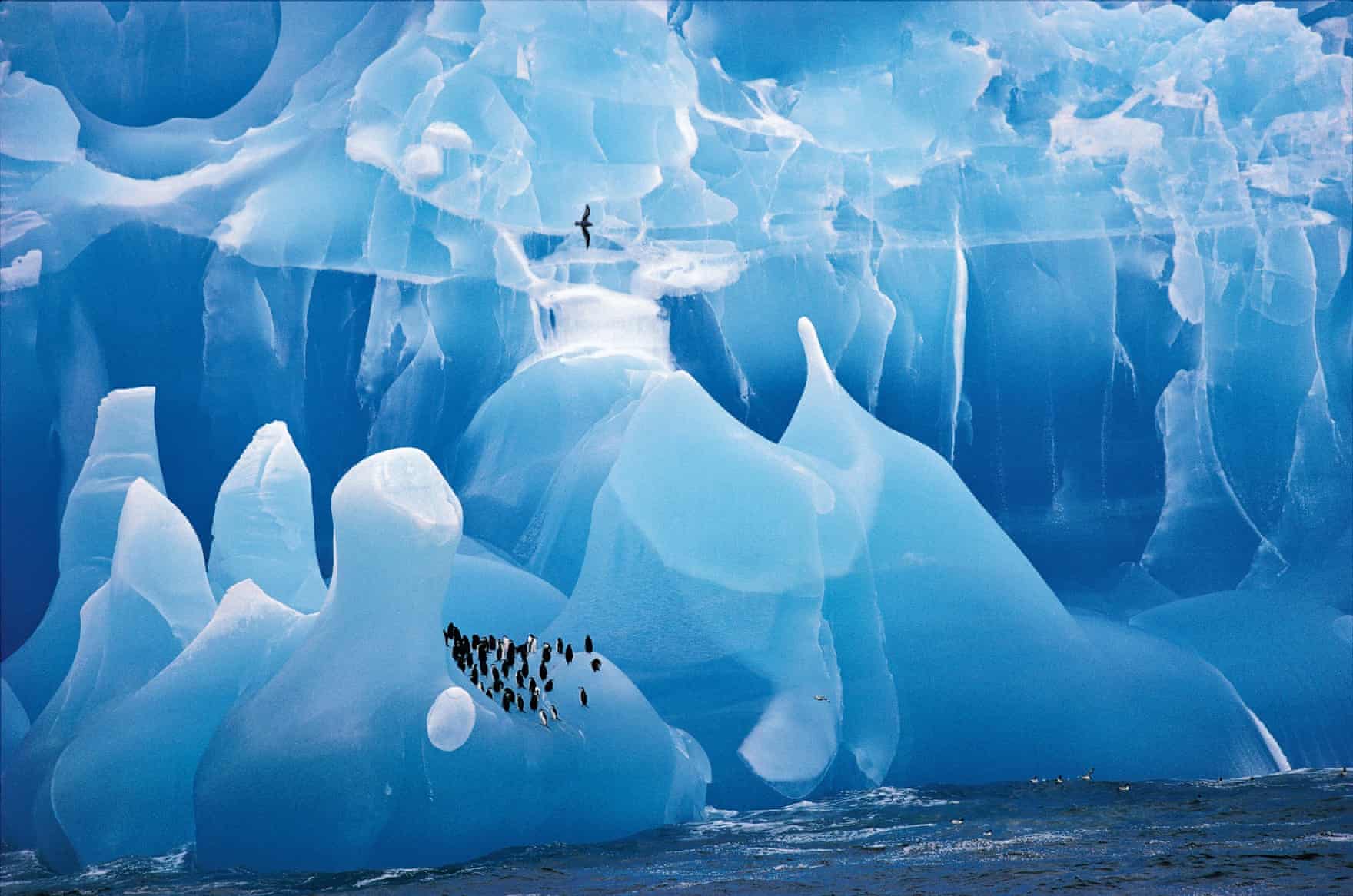
The French edition of my book Life on the Edge, La vie excentrique, was published with a lovely picture of penguins in an Antarctic landscape of blue ice on the cover:

Every once in a while I come across the original photo and then I forget again where I saw it, so this time I am bookmarking it for future reference.

The original is by Cherry Alexander and won the Wildlife Photographer of the Year award in 1995 according to this report.

I'll just hotlink it here:

For the book cover it was flipped such that the penguins can be on the front of the book and the penguin-less right half of the original photo wraps around the back of the book.

NB I also have a new feature out about Antarctica.

Tuesday, September 14, 2021

wonderful Welwitschia

The desert plant Welwitschia mirabilis has accompanied my writing for a while. It featured in my book Exzentriker des Lebens / Life on the Edge. The info in the books is mostly 1990s plant physiology. Now however, researchers have published a high quality genome structure of Welwitschia in comparison with its closest relative - which isn't very close. I've used the opportunity to also have a look at other plant life in deserts on other continents - in the context that the climate disaster will produce more extreme conditions for life to cope with, so we'd better understand how it does.

The resulting feature is out now:

How to survive in the desert

Current Biology Volume 31, Issue 17, 14 September 2021, Pages R1017-R1019

FREE access to full text and PDF download

See also my twitter thread with all 2021 features that are now in the open archives.

Welwitschia_mirabilis, Plate 5369 from vol89 (1863) Curtis's Botanical Magazine (source: wikipedia)

bonus illustration not included in my feature, as images in portrait format are awkward with the column format we use.

Monday, January 21, 2019

out of the freezer

Following a helpful suggestion from one of the scientific editors at Current Biology, I looked at the scary things that can come out of the Arctic permafrost soils as they continue to thaw due to climate change. The defrosted threats include pathogens like anthrax, poisons like methyl mercury, and, as is already widely known, lots of methane, which could further accelerate global warming in a positive feedback loop.

The scary but fascinating finds out of the Earths freezer compartment are collected in today's feature which is out now:


Permafrost thaw releases problems

Current Biology Volume 29, issue 2, pages R39-R41, January 21, 2019

FREE access to full text and PDF download


The photo shows researchers from several US institutions investigating the impact of vegetation on permafrost soils (Environ. Res. Lett. (2018) 13, 105006). (Photo: Los Alamos National Laboratory.)

Monday, April 23, 2018

weird membranes

Today's issue of Current Biology contains a special section on membranes, and my contribution to that is a feature investigating why the membranes of archaea are so weird (sorry, different from all other membranes). Back in the 90s, I did my PhD work next door to Karl Otto Stetter's Archaea Centre at Regensburg, so it was a bit of a nostalgia trip, but I also learned lots of new things about their evolution.


Archaea cloaked in mystery


Current Biology Volume 28, pages R372-R374, April 23, 2018


FREE access to full text and PDF download


Archaea represent a unique life form whose complexities science is only beginning to understand. Researchers in Regensburg and Munich, Germany, are studying the functions of cellular appendages such as the flagella-like archaella of Methanocaldococcus villosus. (Image: Gerhard Wanner, Ludwig-Maximilian University Munich.)

Wednesday, December 03, 2014

seasonal offerings

My German pieces published in December are embarrassingly seasonal - there is ice and snow aplenty in a feature about the subglacial biosphere of Antarctica, and the target of my regular fun-poking is Poinsettia (Euphorbia pulcherrima), which is known in Germany as Weihnachtsstern (christmas star). That's quite enough xmas for me, I don't want to hear it mentioned again until next year ...

Mikrobielle Artenvielfalt unter dem Eis der Antarktis
Nachrichten aus der Chemie 62, 1186-1187, 2014
[related content in English]

Die Wissenschaft vom Weihnachtsstern
Nachrichten aus der Chemie 62, 1251, 2014

Monday, October 06, 2014

science in antarctica

I had a feature on the shrinking arctic sea ice a couple of years ago, so here comes the southern counterpart. Apart from the concerns over climate change and loss of continental ice, I'm also looking at the recent investigation of biotopes in the subglacial lakes and their importance for astrobiology.

Shrinking ice caps in the spotlight

Current Biology Volume 24, Issue 19, 6 October 2014, Pages R941–R944
DOI: 10.1016/j.cub.2014.09.040

abstract and limited access to full text and PDF file
(should become free access one year after publication)

A mosaic of satellite images of Antarctica taken by RADARSAT-2.

Credit: RADARSAT-2 Data and Products © MacDonald, Dettwiler and Associates Ltd. (2008) All Rights Reserved. RADARSAT is an official mark of the Canadian Space Agency. (PR)

Thursday, February 20, 2014

deep sea dilemmas

While I've never actually visited the Deep Sea, I'm kind of attached to that vast part of our planetary biosphere, as my PhD thesis was about biological functions under high hydrostatic pressures of the kind that you would find in the deeper parts of the oceans. Knowing how inaccessible and remote from us surface dweller the deep sea is, I might have hoped that it is better protected from the collateral damage of human activities than most places. Recent developments suggest, however, that even the deep biosphere may feel the effects of climate change, and it could also experience large scale devastation from industrial mining operations very soon.

All this is discussed in my latest feature in Current Biology which is out now:

The deep sea under siege

Current Biology, Volume 24, Issue 4, R137-R139, 17 February 2014 doi:10.1016/j.cub.2014.01.062

Free access to full text and PDF link

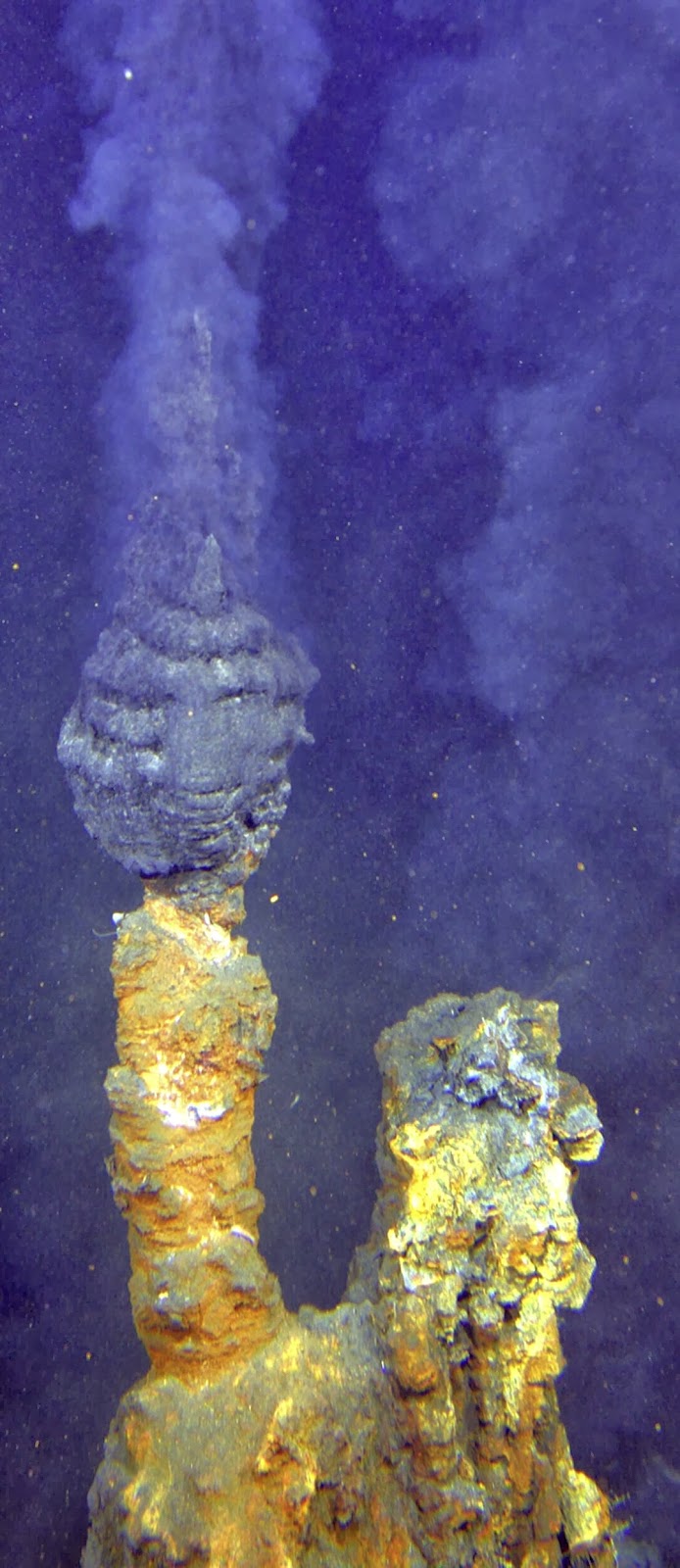
A black smoker known as The Brothers, off the coast of New Zealand. (Photo: National Oceanic and Atmospheric Administration/Wikimedia Commons.)

Wednesday, March 20, 2013

digging deep

The Deep Carbon Observatory is an international interdisciplinary project studying the hidden carbon fluxes deep within the earth, along with implications for life in the subsurface and on planet formation and development.

I've written a feature about this work which is out in Chemistry & Industry:

Carbon deep

Chemistry & Industry March 2013, pp 32-35

The full text is freely accessible here.

The article is also featured on the cover of the issue:

In the same issue, I also have a review of the book "Synthetic biology: a primer", which appears on page 50.

Wednesday, October 17, 2012

ants, arsenates, and asteroids

This month's roundup of German publications is covering the letter a, with a feature on ant orientation (which I also covered in Current Biology recently), a report on evidence showing the arsenate-resistant bacteria have not managed to replace phosphates in their metabolism, and a humorous take on asteroid mining. Next month, we'll get to bees, black holes and bedbugs. See you then.

Arsenat-Stoffwechsel widerlegt Chemie in unserer Zeit Volume 46, Issue 5, page 276 (published online: 2 OCT 2012) DOI: 10.1002/ciuz.201290051 Restricted access

Wie sich Ameisen in der Wüste orientieren Nachrichten aus der Chemie Volume 60, Issue 10, pages 1007–1009 (published online: 4 OCT 2012) DOI: 10.1002/nadc.201290351 Restricted access

Asteroiden-Recycling Nachrichten aus der Chemie Volume 60, Issue 10, page 978 (published online: 4 OCT 2012) DOI: 10.1002/nadc.201290380 Restricted access

PS: the journal home page of Chemie in unserer Zeit currently displays a news item concerning the current exhibition of the industry painter Alexander Calvelli, with a reference to my article about him.

Tuesday, July 24, 2012

losing our ice caps

I've recently read "The goldilocks planet" for review (watch this space) and learned to appreciate the variability of Earth's climate on geological time scales. 3 million years ago (just a moment, for a geologist), we didn't have a permanent ice cap on the Arctic, and just over 30 million years ago, we didn't have one on the Antarctic either.

The way the carbon dioxide concentrations in the atmosphere are developing right now suggests that we may be heading back to those warmer days, and man-made climate change is happening faster than any previous geological climate change.

How are ecosystems in the Arctic and Antarctic responding to the loss of polar ice that is happening already? And which of their responses may lead to dangerous positive feedback loops? I've looked into these problems for my latest feature which is out in Current Biology today:

Life changes as polar regions thaw

Current Biology, Volume 22, Issue 14, R547-R550, 24 July 2012 doi:10.1016/j.cub.2012.07.009

Read the story in HTML and PDF format.

Actress Lucy Lawless (Xena the warrior princess) took part in the Greenpeace campaign "Save the Arctic" (see this lovely interview in the Guardian. Maybe the scariest feedback loop of them all: that the disappearance of the Arctic ice will give us access to more fossil fuels to burn ...

PS More ice-melting news

Wednesday, January 25, 2012

eight years on Mars

Eight Earth-years ago today, NASA’s exploration rover Opportunity bounced down onto the surface of Mars, and I find it completely mindboggling that it is still operating there today. I don’t think I’ve known a CD player that has lasted as long in the relatively clement conditions here on Earth. As one rover team member told me, Oppy and the now defunct sister craft Spirit have outlasted several of the computers that were bought to steer them on their mission, which was originally scheduled to last three months.

Happy landing anniversary to Opportunity and to all who have made this amazing achievement possible. In celebration, here’s a snippet from my book Astrobiology: a brief introduction, describing Opportunity’s first (of many) day at work:

In early 2004, abiding by its Mars creed “follow the water,” NASA landed solar-powered rovers at two seemingly water-modified landscapes in Mars’s northern hemisphere. The first, called Spirit, touched down (bounced to a stop, actually, on airbags) on January 4 in the Guseve Crater. Located at the end of the 900-kilometer-long, 10-kilometer-wide Ma’adim Vallis (valley), Guseve appeared from orbit to have once been a lake. After extensive exploration, however, Spirit found little but the most indirect evidence that the crater was ever filled with water. Some three weeks later, Spirit’s sister craft, Opportunity, bounced to a stop on Meridiani Planum, a smooth, flat plain the size of the state of Colorado that had been selected because spectroscopic investigations from orbit indicated it was decorated with the mineral hematite. Hematite, an iron mineral, can be formed by several mechanisms, but on Earth it is most commonly deposited in aqueous environments. Cushioned by its airbags, Opportunity bounced a dozen times on the Martian surface before finally coming to rest in a small crater. When the rover shook off its landing and turned on its cameras, it found itself staring at thick, layered beds. The Opportunity rover, the fifth successful Mars lander, was the first to find bedrock.

On Earth, the majority of layered rock is sedimentary, laid down over successive seasons or successive floods by liquid water. But successive volcanic eruptions (either as lava flows or as successive layers of ash) can also form layered rock, as can shifting patterns of wind-blown dust. So which was it at Meridiani? The bedrock in Opportunity’s crater showed clear evidence of cross-bedding, layers formed at angles, as often formed in stream beds on Earth due to turbulent flow. Some of the rock surfaces also showed clear signs of polygonal cracks, reminiscent of the hexagons that sometimes form in drying mud. The layers were also filled with the type of small, round rocks that littered the ground at Meridiani. Termed “blueberries” after the fruit they seemed to resemble in shape and size, if not color (somehow “grayberries” just sounds wrong), the small spheres littering the crater are composed of hematite--again, most likely formed in situ in the rocks by the action of water.
Perhaps even more revealing than the gross structures of the strata are their chemical compositions. The rover’s α-particle and x-ray spectrometer (APXS), which can identify the elemental composition of rocks, indicated that the rocks at Meridiani contain large amounts of magnesium, calcium, and iron sulfates, along with traces of chlorine and bromine. On Earth such salts form preferentially by aqueous deposition, and on Mars are a near certain sign that liquid water was once present. Similarly, Opportunity’s Mossbauer spectrometer found evidence that some of the iron at Meridiani is tied up in the mineral jarosite, a hydrated form of potassium iron sulfate that, on Earth, is invariably formed by the aqueous leaching of iron minerals under acidic conditions. So it looks as if we have very firm evidence that at least parts of Mars were wet sometime in the distant past (albeit with rather acidic brine), but that Mars then took a very different environmental turn.


Opportunity looking back at its landing site (NASA).

Thursday, November 10, 2011

water world

My review of

Sex, drugs and seaslime: the oceans’ oddest creatures and why they matter
by Ellen Prager
University of Chicago Press 2011


has appeared in Chemistry & Industry, issue 21, page 27 (restricted access)

Here's a snippet:

[...] as a taster of the overwhelming biological diversity that is out there in the oceans, the book is certainly a stimulating read. Given the amount of slimy, shapeshifting, limb-regenerating, and deadly poisonous weirdness found in its pages, it is intriguing to think about what we may still be missing in those 91 % of marine species that remain to be discovered.

Tuesday, October 25, 2011

illuminating brain function

As I have followed the story of bacteriorhodopsin - the biological computer that never happened - for many years now, I was very pleased to learn that somebody found something very clever to do with this and similar microbial opsins. Specifically, the recently developed methodology of "optogenetics" involves expressing microbial light-responsive ion channels or pumps in neurons, meaning that one can activate or inactivate these neurons by shining light of a certain wavelength onto them.

Stanford researcher and practicing psychiatrist Karl Deisseroth, who invented the method and pioneered its use, is keen to apply it directly to psychiatric questions. Others think a few fundamental things need to be sorted out first. Read more about all this in my feature, which is out in today's issue of Current Biology:

Shining new light on the brain
Current Biology, Volume 21, Issue 20, R831-R833, 25 October 2011
doi:10.1016/j.cub.2011.10.007
Summary and free access to PDF file

Monday, June 27, 2011

astrobiology - second edition

Back in 2006, Johns Hopkins University Press published Astrobiology: a brief introduction, which I had co-authored with Kevin Plaxco. Since then, the field has become quite popular. (I would love to take credit for it, but maybe it’s just dumb luck.) The quest for life or at least habitable planets in the rest of the Universe is now a universally supported endeavour to the extent that NASA now justifies much of its research and exploration work with that goal.

The discovery of extremophiles in the most unlikely locations here on Earth has played a large part in propping up our hopes that life may also exist elsewhere. Add to that the discovery of more than 500 extrasolar planets in just 16 years since the first one was reported, and you get a proper scientific gold rush.

Thus, our 2006 book was beginning to look out of date and there was a strong case for a new, revised and expanded edition, which we prepared over the last year or so. We have revised the entire text, added a glossary and lots of new illustrations. New discoveries are included up to and including last December’s arsenic eating bacteria. With all this, the book will be around 90 pages thicker than the first edition, but hopefully just as readable.

The cover design, which we all love, has been kept. Only the colour of the title will now be green instead of orange, so you can easily tell the second from the first edition. The new version should be available by September in the US, maybe a few weeks later in the rest of the world.


In preparation for the release, I’m also updating the astrobiology web pages, but that’s work in progress still. (At the moment the ISBN numbers and the cover are there, but the exact page number and amazon links are still missing.)

Friday, February 11, 2011

Valentine's chemistry

In the round-up of German pieces published this month, we have Maya art works, arsenate eaters, disordered proteins and some seasonal musings on the chemistry of Valentine's day:

Nanopartikel zur Rettung von Maya-Kulturschätzen
Chemie in unserer Zeit
Volume 45, Issue 1, page 6, Februar 2011
DOI: 10.1002/ciuz.201190013
abstract and restricted access to PDF file

Arsenat-Verwerter: anders oder nur angepasst?
Chemie in unserer Zeit
Volume 45, Issue 1, page 9, Februar 2011
DOI: 10.1002/ciuz.201190018
abstract and restricted access to PDF file

Unordentliche Proteine
Nachrichten aus der Chemie 59, 133-4
(feature on intrinsically disordered proteins, some thoughts on this available in English here)

Valentins-Chemie
Nachrichten aus der Chemie 59, 111
(an eternal favourite, also see Cupid's chemistry)


A nicely ordered folding pattern I saw at Barcelona, while attending the conference on intrinsically disordered proteins. (Passeig de Gracia No 83, the Suites Avenue hotel, designed by architect Toyo Ito.)

Tuesday, February 08, 2011

Alvin reborn

I was very pleased to hear, last December, that Alvin, the world's oldest active deep sea research vessel, is getting an upgrade rather than being sent into retirement. So I submerged myself in the field of deep sea research once more and had a good look at what's available now, half a century after the bathyscaphe Trieste reached the bottom of the Mariana Trench, and wrote a news feature about it, which is out in today's issue of Current Biology:

Seabed search boost
Current Biology, Volume 21, Issue 3, R94-R95, 8 February 2011
doi:10.1016/j.cub.2011.01.021
summary and restricted access to pdf file


Photo: National Oceanic and Atmospheric Administration
source

Monday, December 13, 2010

bioremediation of oil spills

Funnily enough, the microbial communities that can digest oil spills (given the right set of conditions) attract a lot of attention after each major disaster, but suffer from neglect soon after. I covered this issue briefly in my book Life on the Edge (1998) and have now revisited it on the occasion of the Deepwater Horizon spill.

Turns out the research hasn't made as much progress as one might have wished, it's still mainly guesswork if you want to predict whether a given spill will or will not be efficiently degraded by microbes.

I wrote a news feature about all this for Chemistry & Industry, which is out today:

Digesting a sticky problem
Chemistry & Industry No. 23, page 14-15.

Full text (open access)