Showing posts with label imig. Show all posts

Thursday, May 15, 2025

robbed by Schinderhannes

I recently looked into the family history of the infamous robber Schinderhannes after a report that his skeleton was identified. Since then, I've retrieved a few books about the robbers from the library of our "family museum" and read most of

Schinderhannes und seine Bande
by Uwe Anhäuser
Rhein-Mosel-Verlag 2003

which throws around a lot of information in terms of names and quotes from the judicial procedures, but isn't very clearly structured. Although I haven't spotted any obvious connection with the names of the robbers (listed eg here), it occurred to me that a few of the victims and witnesses mentioned in the book could potentially be connected to my ancestry in the Hunsrück area (the ancestors of the Imig and the Kauer clans), so I went through the CV and the list of the crimes at the back of the book and wrote out the names (with place of residence) I could find. There's not much point in having a chronological order, as the whole crime spree was limited to just a few years, so I'll list victims and witnesses in alphabetical order here. NB the list of crimes is often missing first names, whereas the CV is only covering selected victims, and the spelling of names may differ between the two sources. I skipped a few where the information was too thin to be useful or victims were not from the area of interest.

André, NN, brigadier from Sobernheim (we have Andrae people as well, hailing from Gebroth, but our last male Andrae ancestor died 1765)

Andres, Franz, butcher at Kirn (must be related to the butchers family from which the founders of the local brewery emerged)

Bär, Jakob, Merxheim

Benedikt, Salomon, in Erbes-Büdesheim

Bernhard, Valentin, Waldgrehweiler

Frei, Anne Marie, hosted the robbers in Hahnenbach (where my relatives only arrived after Schinderhannes's death)

Frenger, NN, widow, Offenbach (Glan)

Geschwind, NN, Hundsbach

Gottschlick, Herz, Nahbollenbach

Horbach, NN, miller at ... Kanton Grumbach

Joel, Elias, Obermoschel

Köhler, Johann, Niederwörresbach

Kunz, Friedrich, Merxheim (we have Kunz / Kuntz people in that area too, eg Sargenroth, but much earlier, and this is a very common name, witness the idiomatic expression Hinz und Kunz, meaning just about everybody)

Levy, Samuel, Steinhardter Hof, robbed, then died of his injuries

Loeb, Mendel, murdered in 1801

Löb, Seckel, Staudernheim

Mathias, Wilhelm, butcher

Meyer, Herz, Ulmet (Glan)

Mohr, Christian, Schörner Hof (we do have lots of Mohr people in the area, but earlier, see here)

Moses, Isaak, Laufersweiler

Müller, Friedrich Gerhard, Raumbach

Nagel, NN, Bärenbach (the Schinder with whom Hannes served as apprentice and got his nickname)

Philippi, Heinrich (we have some Philippi ancestors from Heinzenbach in the Kirchberg area, the last in the line, Regina Chatherina Philippi was born in Simmern in 1782 and died there in 1851, so would have known of Schinderhannes as a contemporary)

Rauschenberger, Niklas, vagrant

Riegel, Peter, murdered in 1800 by Peter Stibitz, whose name is immortalised in the verb stibitzen, for "to steal"

Scherer, Johann Georg, Kirn, allegedly tried to get Schinderhannes poisoned

Schmitt, Johann, Spall

Sender, Isac, Weierbach

Schowalter, Jakob, Montforter Hof

Schweig, Niklas, Hirschstein

Schweizer, NN, Rehborn

Seligmann, Simon, murdered in 1798

Stumm cloth manufacturer at Birkenfeld

Stumm, Friedrich Philipp, Asbacherhütte (steel works on the river Fischbach)

Wiener, Wolf, Hottenbach

Zerfass, Johann Adam

Zerfas, Anne Marie, widow at Heinzenberg

Zürcher, Heinrich, Lettweiler

Update 25.1.2026: I created a new portal to navigate family history blog entries in the shape of a permanent Who Is Who page. This is because the old webpage at michaelgross.info will go offline on February 2nd.

Update 18.2.2026: I've now also read a novel about the robber:
Schinderhannes by Gerd Fuchs, 1986
which didn't reveal much new, apart from placing the robber story in the context of the French Revolution, which brought in some interesting angles. Other titles I have now piled up at Oxford:

200 Jahre Schinderhannes "Unrecht und Recht" - Der Wahrheit etwas näher? by Joachim Füllmann, 2003

Schinderhannes - Mythos und Wirklichkeit by Helmut Weiler, 1993

Thursday, April 10, 2025

a robber's family

A recent research paper reported the identification of the skeleton of the infamous robber Johannes Bückler (1778?-1803), aka Schinderhannes, who committed dozens of crimes in the Hunsrück area where 3/16 of my ancestry is from. In a nutshell, his skeleton had been involved in a mix-up and has now been correctly identified based on a known bone fracture, and confirmed by comparing a DNA sample with one donated by a descendant of his sister. (See this news story in Archaeology News for more details.)

Which reminded me that there is quite a bit known about the family links around the young outlaw, and that I really should check again for possible connections. Note that there were quite a few vicars and teachers among my Hunsrück ancestors (the Kauer and Imig clans), who would have been horrified to see their names associated with a criminal - even one whose life has been romanticised extensively. But you never know - maybe there once was a connection that was swept under the rug?

A family portrait dated 1803

So I need to find out. Here is the ancestry of the robber as a Kekule list (which is the only way I understand these things), data from GedBas, and I marked any places that also occur in my family tree as bold (no overlap with family names, apart from Schmidt which is so common as to be meaningless):

1. Johann Wilhelm BÜCKLER, aka Schinderhannes

2. Johann BÜCKLER born 1758-02-28 Merzweiler
3. Anna Maria SCHMIDT born 1755-03-18 Miehlen

4. Otto Philipp BICKLER born 1709-04-29 Hilscheid
5. Maria Margarethe RIEMENSCHNEIDER born 1713 Merzweiler
6. Johann Dietrich SCHMIDT born 1706-04-11 Hamm-Sieg died 1781-04 Miehlen
7. unknown

8. Johann Nicolaus BICKLER born 1673 Wallenbrück Death: 1757
9. Maria Barbara ROTH born 1675 Kastellaun
10. Johann Lorenz RIEMENSCHNEIDER born 1690-04-16 Herren-Sulzbach Death: 1750 Merzweiler
11.Anna Margaretha SCHIELER born Merxheim
12. Johann Christoffel SCHMIDT born estimated 1674 Miehlen bei Nastätten Death: 1740-01-27 Miehlen bei Nastätten
13. Anna Thimothea SCHMIDT born calculated 1687 Daaden

16. Hans Adam BICKLER born 1649 Wallenbrück Death: 1720-06-27 Wallenbrück
17. Margaretha KOLLER born 1648-09-03 Bernkastel Death: before 1694
18. Johannes ROTH born about 1640 Death: 1719-12-28 Kastellaun
19. Barbara RACH born about 1652 Oberwesel Death: before 1683 Kastellaun
20. Johann Wilhelm RIEMENSCHNEIDER born 1665-11-07 Meisenheim
21. Juliana Catharina HESSLER born about 1665 Diez
22. Philipp SCHIELER born Merxheim
23. NN
24. Johann Conrad SCHMIDT born 1645 aus Miehlen bei Nastätten
25. Anna Margaretha XX Death: 1713-01-10 Miehlen
26. Weiland Johannes SCHMIDT

32.Sebastian BICKLER born 1624 Kirchberg Death: 1668 Wallenbrück
33. Elisabeth CLAUSS born 1625 Uhler Death: before 1672
34. Philipps KOLLER born 1620 Bernkastel Death: 1694-01-09 Bernkastel
35. Anna HEIL born 1622-10-10 Bernkastel Death: 1696-06-14 Bernkastel
38.Nicolaus RACH
39. Anna Elisabeth XX Death: 1776-03-17 Oberwesel
48. Jacob SCHMIDT born 1610 Limburg
49. Carita Liebmuth WENTZEN born 1615 Limburg

64. (Bickler)
66. Johann CLAUSS born 1585 Trarbach, Mosel Death: 1636-08-30 Trarbach, Mosel
67 Catharina HAUSMANN born 1589-10-22 Trarbach, Mosel Death: 1670-11-10 Trarbach

There is also some information on Schinderhannes's girlfriend,

1. Maria Juliana (Julchen) Blasius, born in Weierbach 22. March 1781, whose occupation is given as Bänkelspielerin, ie a musician and street performer. Her parents are:

2. Johann Nicolaus BLASIUS born 1751-03-11 Weierbach
3. Maria Catharina Louisa CATHARIUS born 1754 Becherbach

While Schinderhannes was executed, Julchen only went to jail for a couple of years.

Their descendants are:

1. Johanna BÜCKLER 1801-1801

2. Franz Wilhelm BÜCKLER 1802-1834
2.1.Johann Friedrich Wilhelm BÜCKLER 1831-1874
2.2. Philipp Wilhelm BÜCKLER 1831-1886
2.3. Eduard BÜCKLER 1834-1838

Julchen later married a cousin also called Blasius, settled in Weierbach, and produced lots of children by that name.

Weierbach is on the river Nahe, downstream from Idar-Oberstein and just next to Fischbach, where my migrating miners passed through and where I revisited the ancient copper mine ten years ago.

The Wikipedia entry notes that Schinderhannes often visited the village of Hahnenbach, but that was a generation before my family showed up there. My many-times great aunt Maria Margaretha Weiss (1809-1885) married the innkeeper Johann Peter Schmidt in 1842. Her daughter married Ferdinand Weirich, whose name appears on the inn in this old photo.

Further reading:

  • A google search for led me to the book Unter dem Freiheitsbaum by Clara Viebig (full text at Projekt Gutenberg). I hadn't heard of her before, but apparently she was famous in the early 20th century, and this book has been praised for elevating the Schinderhannes sujet to the literary level.

    Update 25.1.2026: I created a new portal to navigate family history blog entries in the shape of a permanent Who Is Who page. This is because the old webpage at michaelgross.info will go offline on February 2nd.

  • Thursday, September 07, 2023

    five priests in a row

    Looking up W. O. von Horn, the author of the very romantic book that constitutes the earliest documented connection between Heinrich the cellist and Maria his future wife, I noticed the weird coincidence that the author is from a very similar background as two thirds of the ancestry of Heinrich and Maria’s future daughter in law. (As Ruth’s parents were first cousins, she only had three sets of great-grandparents, and the normal genealogy maths doesn’t apply.)

    Porträt: W. O. v. Horn. In: W. O. v. Horn’s gesammelte Erzählungen. Neue Volks-Ausgabe. Vollständig in 12 Bänden. J. D. Sauerländer, Frankfurt am Main 1. Band, 1861
    Source: Wikipedia

    W.O. von Horn, real name Friedrich Wilhelm Philipp Oertel, was the middle one in a lineage of five consecutive protestant priests in the male line, rooted in the village of Horn near Simmern (plus his brother). Info from Wikipedia plus additional details from this genealogy dataset:

    1. Johann Paul Oertel * 17.5.1708 Simmern, + 19.2.1780 Horn) parish priest of Horn since 1746, previously at Nieder-Hilbersheim
    oo before 1747 Anna Christina (Christine) Faber

    1.1. Friedrich Peter Paul Oertel (1748–1819) priest in Horn, 1804 President of the Lokalkonsistorium (whatever that means) in Bacharach, 1812 parish priest of Manubach, Kreis St. Goar, Superintendent in Koblenz
    oo 22.3.1782 Juliana Carolina Wilhelmina Maria (Juliane) Wolff

    1.1.1.Friedrich Franz Heinrich Jakob Oertel * 20.12.1784 Horn 1863 Bingen) parish priest at Oberdiebach and from 1832-1857 in Kirn
    1.1.2. Friedrich Wilhelm Philipp Oertel = W. O. von Horn (* 15. August 1798 in Horn; † 14. Oktober 1867 in Wiesbaden)
    oo 1822 Antonie Henriette von Saint George (1798-1870) from Weilburg (Lahn)

    1.1.2.1. Pauline Christiane Oertel * 1823
    oo Reichard Gerber (1823 – 1852)
    1.1.2.2.Georg Friedrich Hugo Oertel (1827–1909) parish priest in Horn (1854-64), Ottweiler and Simmern; superintendent at Simmern (1883-1907)
    oo Jakobina Philippina (Jakobine) Caesar (1827 – 1908)
    1.1.2.2.1.Christina Julia Anna Oertel (1858 – vor 1889) oo 1883 Gustav Adolf Eybisch
    1.1.2.2.2.Richard Oertel (1860–1932) parish priest in Neuerkirch; member of the Reichstag. oo 5. November 1886 Elise Cauer (1865–1919; daughter of Robert Cauer the Elder (1831–1893), sculptor)
    1.1.2.2.3. Jakobina Mathilda (Mathilde) Oertel * 1862 Horn oo 1889 Simmern: Gustav Adolf Eybisch (widower of her older sister, also a parish priest in Heiligenwald, Neunkirchen und Bingerbrück, their son also became a priest)
    1.1.2.2.4. Emilie Julie Maria Oertel (1863 – 1949) oo 1892 Simmern: Paul Julius Lembeck
    1.1.2.3. Mathilda Oertel * 1829 oo Heinrich Wilhelm Eduard Fuchs, Oberförster, * ca. 1825

    I note that the author’s background as the son of the parish priest of Horn born in 1798 was very similar to that of some of Ruth’s ancestors in the Kauer clan and in the Imig clan. (Sadly the Cauer clan which the fifth generation Oertel priest married into is unrelated to our Kauers, this prominent family of sculptors and artists came from Berlin and settled in Kreuznach for some reason.) So if only I had a more extended family tree for W.O. von Horn, I am quite sure it would touch mine somewhere.

    A quick search for the place name of Horn in my family history file revealed that four marriages of my direct ancestors happened in Horn. They are all from the ancestry of Ruth’s grandmothers, the sisters Elisabeth and Margaretha Imig, and the most recent one is:

    Christoph Philippi, a tanner from Ohlweiler near Simmern, married Charlotte Kuhn from Simmern on 25.7.1775. At this point, I assume that the serving priest at Horn must have been either Johann Paul or Friedrich Peter Paul Oertel.

    Sadly the other three marriages that happened at Horn were too early even for Johann Paul. One was in 1701 (Joh. Nicolaus Kurtz oo Elisabeth Margaretha Wagner), and then we have Elisabeth’s parents in 1671, and another pair of Imig ancestors in 1659, namely Michel Augustin from Riegenroth and Elisabeth Christ. (NB I’m giving GedBas links for each spouse separately, because each of these has incomplete info on the families attached to their other half.)

    Still a generation deeper down, we have Hans Caspars, a “welsch” (meaning foreign, eg French, but probably not Welsh) carpenter was active at Horn. No dates for him but his son Johann Caspers was born 1644 in Argenthal. (The son of Michel Augustin married the daughter of Johann Caspers in 1706 at location unknown.)

    Whereas Ruth’s Imig ancestors are most closely associated with the village of Horn (as well as a bunch of other villages near Simmern), those of her grandfather Christoph Gottlieb Kauer are more similar to the Oertel families in that they also included village priests and teachers in the same area (but a bit more mobile). For instance, we have Johannes Weiß (1704-72), the parish priest of Eckweiler, next door to Sobernheim where WO von Horn became parish priest in 1835 and a contemporary of his grandfather born in 1708. Johannes Weiß’s father-in-law, Martin Philipp Nicolas Ebner was the parish priest of Alterkülz and a senior year teacher at the Latin school of Trarbach (as was his father). Further protestant priests include Nikolaus Andreae in Gebroth from 1632, as well as Peter Siegel during the time of the Reformation. Oh, and the Kauer side of the family also features a connection to the earlier story writer Johann Peter Hebel (1760-1826), who was also a priest before he found fame as a writer. I think it is fair to assume that W.O. von Horn knew the stories of Johann Peter Hebel.

    Seeing that the first Oertel in line was born in Simmern, there should be further generations listed in Zwiebelberg's book of Simmern residents, which I don't have at hand right now, but can look up when I travel to Germany.

    Thursday, April 21, 2022

    lost illusions

    Every picture tells a story No. 34

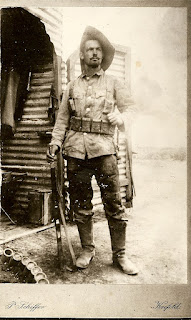
    Staying on the unpleasant subject of wars, shopkeeper Julius Düsselmann had an adventurous streak in his younger days. Reportedly he wanted to fly zeppelins, which didn't quite work out. In 1904, aged 18, he signed up for the Schutztruppe, the small colonial force serving to uphold German rule in the small number of colonies the Reich had acquired belatedly. Here's Julius, looking wild and barely recognisable, in his Schutztruppe uniform. He signed up as a Reiter (rider) which was the equivalent of a common soldier there - definitely not cavalry, as I have seen photos of Reiter troops riding camels and donkeys.

    A colour image of a Reiter's uniform and outfit can be seen here.

    He was sent to Deutsch-Südwest Afrika, today's Namibia, as part of the reinforcement troops for the now notorious war against the Herero, which in recent years has been described as a genocide. Essentially, the very small Schutztruppe had been struggling to cope with the Herero uprising, until the government sent out the cruel and ruthless general Lothar von Trotha, who had no qualms about forcing a large part of the tribe into the desert and letting people die there.

    I heard that Julius didn't talk about the war, but admitted having witnessed terrible things in his short stay in Africa. He caught a tropical disease, probably typhoid fever, and was sent home in poor health, arriving in Hamburg on 18.3.1905. He needed regular spa treatments at Bad Nauheim until 1914 (which is also the place where he settled after 1945 and lived for the rest of his life).

    Apart from this photo, the only other souvenir of Africa is a small ruby he found there (or maybe two), which he had set in gold together with a bit of the surrounding rock. There are two of these, not sure if they are cut from the same rock or separate finds. I have one of the two and it is marked "Abbabis, S.W.Afrika, 22.Januar 1905". Must have felt he had a lucky day in an otherwise rather grim time that surely didn't live up to his hopes of an adventure.

    Abbabis was a railway station and the place of a reconvalescence home for members of the Schutztruppe. If Julius was there to reconvalesce from his disease, that means he can't have spent much time in active service. Typhoid fever was reported to affect the Schutztruppe specifically from October 1904 onwards, which would broadly fit with this timing.

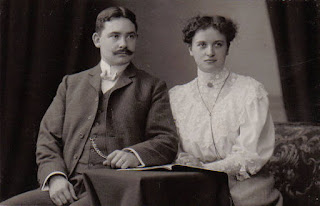
    Two and a half years after his return he married his cousin Helene Kauer (youngest of the five daughters of the stationmaster of Adamsweiler):

    Reportedly she talked him out of plans to emigrate to the USA, so he channelled his spirit of adventure into business instead.

    Their shared ancestry is the Imig clan, as both their mothers were from the Imig family in Simmern. Julius's paternal side is the Krefeld clan.

    To get a better impression of Julius's war experience, I bought a copy of the novel Morenga by Uwe Timm, which I hear steers very close to the historical documents. (The English translation appears to be out of print. Heck, it's even been made into a film, I just found out.) Am planning to read that soon, watch this space.

    UPDATE 12.1.2024: My review of Morenga is now here. I just read in Der Spiegel that a critical historical edition of Gen. v. Trotha's diaries from the Herero war are due to be published (with photos) this month (details). As the official documents covering the war have all been lost, this will be about the only chance to find out more about what happened there.

    This photo is also on flickr.

    Every picture tells a story series so far:

    1. string quartet Wuppertal Elberfeld 1927
    2. greetings from Adamsweiler
    3. Gastwirthschaft Ferd. Weirich
    4. quartet times three
    5. Neumühl 1923
    6. Tangermünde railway station 1889
    7. a singing lesson
    8. bei Wilhelm Geppert
    9. a bakery at Lorsch 1900
    10. Consumgeschäft von Julius Düsselmann
    11. Hanna and Ruth
    12. a young chemist
    13. school's out at Reichenstein, 1886
    14. a patchwork family in East Prussia
    15. the case of the missing grandmother
    16. checkpoint Glaner Brücke 1929(ish)
    17. finding Mimi
    18. five sisters, five decades
    19. happy at home
    20. gone milking
    21. steel workers
    22. field work
    23. what to wear at Porta Westfalica
    24. a classic convertible
    25. at the bottom of the steps
    26. a forester's family
    27. the Kaiser visits Allenburg
    28. teaching the 'deaf-mute'
    29. a guard dog called Schluck
    30. party like it's 1956
    31. the case of the mysterious uncle
    32. three Hedwigs and a baby
    33. a lost generation
    34. lost illusions

    Alternatively, you can use this twitter thread as an illustrated table of contents.

    In a somewhat roundabout way, this series relates to my research for the family history music memoir I have now completed in a first version.

    Thursday, January 06, 2022

    happy at home

    Every picture tells a story, No. 19

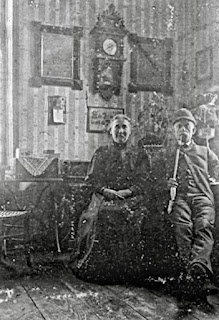
    This photo of Karl Düsselmann (1841-1927) and his wife Elisabeth Imig (1851-1924) strikes me as unusual as it appears to have been taken informally at their home, almost as a snapshot, without the slightest worry about the cluttered background. Did they perhaps know an early amateur photographer?

    (this version now improved with a little magic from a helpful twitter friend
    compare and contrast versions in my tweet and the replies to it)

    Funnily enough, we still have a couple of frames looking a lot like those two on either side of the clock. At the time of Karl's death, his peripatetic son Julius happened to be geographically close, so he may well have inherited those and passed them down to us. It's a shame we can't see who or what's in those frames and the images below, with better quality, this might have been a chance to glimpse at earlier generations of whom we have no photos at all.

    Karl Düsselmann (sometimes also appearing as Carl and/or Düselmann) came from the Krefeld clan, which had prospered in the textile industry of that town. He was one of the 13 children that were divided into teams by confession: all six boys grew up protestants (like their dad) and all seven girls became catholics (like their mum). This confessional split even applied to Karl and his twin sister, Maria (1841-1932). Maria married a Heinrich Wilhelm Schürenberg and had five children - about whom we know nothing because they were on the other side of the divide.

    After his military service (likely to have been 1861-64, followed by three years as a reservist) and likely involvement in several wars (see below), Karl was a Werkmeister (foreman).

    Elisabeth came from the Imig clan in Simmern. Several of her brothers had moved to the lower Rhine area (earlier generations of Imigs had been involved in a failed attempt to emigrate to the New World which ended up in a new settlement on the lower Rhine, not sure if these two moves have a causal connection). Some of the brothers were quite successful there, so I am guessing Elisabeth may have used them to move to the area and find herself a husband there.

    Their descendants are listed here. Briefly, Karl had one son (also called Karl) from an earlier marriage, who emigrated to the US in 1892 and had two sons there who were both born in New York. Karl and Elisabeth then had six children, but we have no photos of them with any of their children. Five of them got married and we do have photos of each one with their spouse. The oldest daughter married a Dutchman and ended up in the Netherlands, and one of the sons emigrated to the US with his family in 1924. Overall, our happy couple had 15 grandchildren.

    Here's a later (and clearer) portrait of the couple:

    It looks like Karl got some military medals to show off. As he was born in 1841, he could have been involved in Prussia's short wars against Denmark (1864) and Austria (1866), which both fell into his three year period as a reservist, and possibly also in the one against France in 1870/71. Don't have the resolution to get any more info from the medals, they appear to be 5 of them, from left to right: big round, small round, cross, big round, flat/wavy.

    Thinking of those 5 medals and forgotten military exploits in the wider context of the Krefeld clan, I'm getting the impression that the Düsselmann Y chromosome appears to be linked to a taste for risk taking (slightly surprising in a town and family thriving on spinning and weaving), see also: Julius's rollercoaster of a career; Karl's brother August was the founding director of the Krefeld fire brigade on it becoming a professional force in 1890; August's son Walter smuggled arms for Ireland's Easter Uprising, survived the sinking of the Volturno and disappeared during WW2; and August's son Wilhelm was also a seafarer and died in a road accident. Might explain that, inspite of numerous male offspring over several generations, there aren't all that many carriers of the name around today. Then again, who knows what descendents in the US have done to the name to make it pronouncable in American English.

    This photo is also on flickr.

    Every picture tells a story series so far:

    1. string quartet Wuppertal Elberfeld 1927
    2. greetings from Adamsweiler
    3. Gastwirthschaft Ferd. Weirich
    4. quartet times three
    5. Neumühl 1923
    6. Tangermünde railway station 1889
    7. a singing lesson
    8. bei Wilhelm Geppert
    9. a bakery at Lorsch 1900
    10. Consumgeschäft von Julius Düsselmann
    11. Hanna and Ruth
    12. a young chemist
    13. school's out at Reichenstein, 1886
    14. a patchwork family in East Prussia
    15. the case of the missing grandmother
    16. checkpoint Glaner Brücke 1929(ish)
    17. finding Mimi
    18. five sisters, five decades
    19. happy at home

    Alternatively, you can use this twitter thread as an illustrated table of contents.

    In a somewhat roundabout way, this series relates to my research for the family history music memoir I've now completed..

    Thursday, October 14, 2021

    railway families

    Four separate lines of my family tree involved a family kept alive by a railway job in the late 19th and early 20th century. The four railway employees were from wildly different geographic areas and never met each other, but they all benefited hugely from the opportunities provided by the railways and there are intriguing parallels in their lives.

    I've made separate blog posts about each of them already, but here comes the masterpost bundling the key information for the complete quartet, so I can draw comparisons and have all the links in one place. Arranged chronologically by date of birth we have:

    1. Johann Anton Lütkemeyer 1843-1887 from Schwaney
    job: railway worker in 1872 / railway guard in 1877, Gütersloh, presumably active from 1860s until he became ill with tuberculosis of which he died aged 44.
    family: married Johanna Catharina Charlotte Kosfeld, born 1854 in Gütersloh. Five daughters and two sons born within 12 years of marriage, five children survived him. First son died within three months of his birth, not sure which child was the second to die early, as data are missing on several siblings.
    blog entries: the Gütersloh connection; a village becomes a city

    [ No family portrait known. ]

    2. Christoph Gottlieb Kauer 1845-1909 from Simmern
    job: severely injured in the war of 1870/71, joined new Alsace railways as compensation, moving frequently (children born in Mulhouse, Morhange, Fontoy). Final stop and career step: station master in Adamsweiler from mid 1890s to his death aged 64.
    family: married Margaretha Imig, born 1847 Simmern Five daughters and two sons. Both sons died in early childhood, all five daughters lived to ages ranging from 73 to 87.
    blog entries: greetings from Adamsweiler; finally, the Kauer clan; Gastwirthschaft Ferd. Weirich

    The station master's family outside the station at Adamsweiler, around 1900. The daughters, left to right: Helene, Kätha, Johanna, Auguste, Anna.

    3. Richard Groß 1852-1913 from Breslau (today: Wrocław, Poland)
    job: railway (office) assistant active in Neurode (Silesia) 1880. Zella St. Blasii (Thuringia) 1882, Stendal-Tangermünde 1886 until his death aged 60.
    family: married Maria Louise Mentzel, born 1844, twice widowed; one daughter, one son. Wife also had a son from a previous marriage.
    blog entries: Tangermünde railway station 1889; a railway man; once there were emperors

    Railway parents seated in the middle, the young folks around them are left to right: their son, Max Heinrich Groß, his fiancee Maria Pfersching, his step-brother Arthur Reim, and his sister Gertrud Groß. Presumably taken on the occasion of Heinrich and Maria's engagement in 1904 (they married in 1908).

    4. Heinrich Nagel 1879-1952 from Neesen, today part of Porta Westfalica
    job: joined Minden district railways as an assistant around 1900, rising through the ranks to become station master at Minden Stadt by 1914, serving until retirement in 1944. Housed in railway company courtesy flats near that station from 1914 to his death at age 73.
    family: married Catharine Luise Lütkemeyer, born 1880, one daughter. Wife was the daughter of 1., but her father was long dead at the point when she found herself a new railway man.
    blog entries: railway memories; finding Minden

    Heinrich Nagel with his first wife Luise Lütkemeyer and their daughter Frieda.

    Patterns and similarities

    The first two families both had five girls and two boys each, each lost two children in the early years, at least three of the four casualties were boys. Not sure about the fate of the fourth boy, but there's a real possibility that all four boys died in early childhood and all ten girls survived, which would be a bit spooky.

    In contrast, the other two couples only had two children and one child respectively. Each produced a professional musician (Heinrich and Frieda), which is the connection that motivated me to dig deeper into the railway families.

    Number 2 and 4 became station masters with very modest stations under their command, but this would still have involved a number of workers to boss around. The status of that job is reflected in the fact that both families bought a massive 17 volume encyclopaedia (Pierer and Brockhaus, respectively). If you're wondering how to become a station master on the Prussian / German Empire railways, Google Books has a scan of the book: "Die Prüfung zum Stationsvorsteher und Güterexpedienten, sowie zum Stationsassistenten im Deutschen und insbesondere Preußischen Staats-Eisenbahndienste."

    With an average lifespan of 60 years, I guess they fared about normally for their times, but not better. Note that only number 4 got to enjoy a period of retirement and significant overlap with grandchildren (one great-grandchild even).

    All of them had an opportunity boost that has to count as social mobility, compared with their backgrounds. All except number 4, who only moved from his village to the nearest town, also achieved significant geographic mobility, with 2 and 3 ending up hundreds of kilometres away from their respective birthplace.

    The wives of 1 and 2 also had railway employees among their brothers and nephews who were perhaps inspired by the precedents. As these two had very modest jobs, I don't think they had any real power in providing jobs for the extended family.

    Bottom line, as one of my four grandparents and three of my eight great-grandparents were children of railway families, that makes me a 1/4 + 3/8 = 5/8 railway descendant.

    Friday, January 12, 2018

    reformation remembered

    Coming slightly late to the 500th anniversary party - I hear that my likely ancestor Peter Siegel (1485-1560), the first protestant vicar in the town of Kirn, was duly celebrated there on Reformation Day (31.10.).

    A well-known actor, Rainer Furch, was engaged to impersonate Peter Siegel during a short piece about the reformation in Kirn, which he wrote and performed.

    Incidentally, I was born in Kirn and baptised in Peter Siegel's church, although until very recently, we didn't know about him and I believed I was the first in the family to be born there. Although 3/16 of my ancestors hail from the general area, there was no specific link to the town, until we discovered Elisabeth Dammy, who was born there in 1654, and her ancestry of butchers, bakers etc. all working at Kirn.


    Peter Siegel (right), as played by Rainer Furch, together with his current successor, Volker Dressel.

    image source

    Thursday, December 29, 2016

    landschreiber Mohr

    Mohr is an interesting German family name, as it is also an ancient word for dark-skinned people (related to Maure, as in Mauretania), much older than the 19th century import “Neger” related to Spanish / English negro. Both of which, of course, are today considered rude. Mohr may thus in some cases be pointing to a distant migration background, to a darker looking person arriving in the village and being called names which stuck. However, there are also two alternative explanations, one relating to moors (swamplands), the other to pig breeding, so you can’t be sure which of the three applies.

    Our Mohr ancestors can be traced back to the small town of Gemünden in the Hunsrück mountains. There we find a Hans Mohr in the 16th century, to whom all of the Mohr families in the Hunsrück area seem to be connected. One significant lineage leads to Nikolaus Mohr of Kellenbach near Kirn, which is well-documented in GedBas.

    Our lineage, however, involves Johann Conrad Mohr, who became a Landschreiber for the Duke of Simmern – today a very inconspicuous town of 7000 inhabitants, but it was a state capital until Louis XIV’s troops burned it down in 1689 in the Palatinate succession wars (part of the Nine Year Wars), when they also created that very romantic ruin still overlooking Heidelberg today. The Landschreiber was a leading position in the regional administration, second only to the Amtmann. (I have no idea how these job titles might be translated into English but I’m open for suggestions.)

    Considering the importance of his position, it appears likely that Johann Conrad Mohr will have studied law in Heidelberg. What we know for sure is that he married Katharina Bilger at Heidelberg on 25.6.1611 and at least one of their nine children (Juliane Elisa) was born there in 1613.

    His tenure as Landschreiber lasted from 1615 to his death (from the plague) on 25.6.1635, interrupted by six years of Spanish occupation, 1626-1632. His boss, the Count-Palatine of Simmern-Kaiserslautern, Louis Philip (1602-1655) reigned 1610-1655, so no change there. Louis-Philip was the younger brother of the “winter king” Frederick V, whose misfortune led to the 30-Years War.

    Among the Landschreiber’s children, Johann Ludwig, born 1617, is well represented in GedBas. Intriguingly, he married one Angelique de Madra, who allegedly came to the court at Simmern at 15 as a religious refugee and was then brought up there.

    We’re after the older son, Andreas Mohr, however, who was born either in 1612 or in 1615, possibly still in Heidelberg, before his parents moved to Simmern. He married Walburgis, and became a forester, in which role he is documented at Rheinböllen in 1672. Two generations followed in this profession – the son Hans Peter, recorded first at Rheinböllen, then 1670-80 at Argenthal, and the grandson Mathias Mohr at Mengerschied. His daughter Juliane Mohr, born 1717 married an innkeeper at Simmern called Johann Kuhn, which is where we leave the Mohrs and the forests.

    Simmern in 1648 by Matthäus Merian, source.

    PSJuliane Mohr's female line descendency leads to Regina Catherina Strack who was the founding mother of the Imig clan, so find her descendents there.

    Wednesday, December 24, 2014

    a valiant vicar

    In the course of our investigations into the ancestors who were tradesmen in the small town of Kirn from the 15th through to the 17th century, we also came across a likely ancestor who was the town’s first Lutheran vicar. (I was actually baptised in his church, where his bones are probably still underfoot, which is kind of spooky.) He had an unusual life, so here’s a draft version of his biography:

    NB: I've added a German version of his biography to Wikipedia.de.

    Peter Siegel was a student of Martin Luther at Wittenberg and went on to introduce Luther’s ideas to his home town of Kirn long before the area officially became protestant.

    Peter Siegel was born in 1485 as the son of the baker Nikolaus Siegel and his wife, who was a daughter of Hen Thielmann. He started out learning his father’s trade and then probably became a monk. In October 1518, at the unusually advanced age of 33, he went to Wittenberg to study theology with the reformer Martin Luther, whose ideas had inspired him.

    After three years of study, in 1521, the rulers of his home territory suggested he should become vicar of Münster am Stein, which is also on the river Nahe, downstream of Kirn. It is unclear whether he actually obtained this job, but he soon married a woman from his home town named Gertrud (not quite in accord with catholic dogma).

    He then moved back to Kirn, where, according to his tombstone, he was a vicar from 1528 to his death in 1560 (although the first mentions in the town archives only date to the 1530s). Specifically his epitaph said that he “preached the gospel of Christ at this church for 32 years – no matter how much his adversaries raged – in its pure and unadulterated form, after elimination of all man-made additions.” In Latin that reads:

    qui cum duos et triginta annos, huic Ecclesiae, quantumvis frementibus adversariis, Evangelium Christi pure sincereque, neglectis hominum figmentis, tradisset

    Those raging opponents will mainly have been the members of the local Collegiate church, who made several complaints to the archbishop at Mainz about their vicar. Disputes over the true faith raged on into the 1540s, such that one cannot pin down a date for the introduction of the reformation at Kirn. The territorial overlords clearly protected their renitent protestant vicar from prosecution by the archbishop, but only “came out” as protestants after the 1555 Augsburg Settlement, which allowed each ruler complete freedom to choose the faith for their domain (cuius regio, eius religio).

    The citizens of the small town (which, despite its strong tradition in trades and crafts, only officially became a town in 1857) were already very supportive of their protestant vicar by that time. A significant date in this context is 1544, which is when the records of the wool weavers' guild stop mentioning the Corpus Christi (Fronleichnam) holiday, which is a highly significant day for catholics only. Kirn remained purely protestant until 1681 when French troops took over the town and the castle next door to it, the Kyrburg.

    Peter Siegel died on October 15th, 1560 and was buried in his church, which had to be partially rebuilt in later centuries, but still is a protestant church in the same location to this day. From 1684, the French occupation forced the town to simultaneously use the church for catholic as well as protestant services, and the new catholic altar came to cover up Siegel’s tomb. Later on, the tombstone, whose inscription survives in transcripts (although the date had to be corrected), was removed and remains lost.

    Sources:

    Own photo of the Lutheran church at Kirn.

    Monday, November 10, 2014

    the butcher, the baker ...

    ... I'm actually short of a candlestickmaker in this story, but I have a few other interesting trades, so bear with me:

    Until around a decade ago, I believed I was the first person in the family to be born in the small town of Kirn, by the river Nahe. While 3/16 of my ancestors hail from the surrounding hills of the Hunsrück, they seem to have studiously avoided the river valley with the towns Oberstein, Kirn, Sobernheim, and Kreuznach.

    Then we discovered one ancestor who was born at Kirn more than 300 years before me (in 1654, to be precise), and she turned out to be related to the Andres family, who went on to found the local brewery (Kirner Pils), which is still thriving today, bucking the trend that has seen much larger companies dominating the beer market. They do make very good beer, as well, so I’m glad they’re still there (and still in the hands of the Andres family).

    After pulling various threads attached to that family we have now got a whole network of ancestors who were crafts and tradesmen in Kirn, going back to the mid-15th century. There were butchers, bakers, tanners, weavers, plus the extinct profession of Schleifmüller, which I’ll explain below. For two centuries they had a thriving small town economy there – even though Kirn only officially became a town much later (1857) and the inhabitants had to pay to get their freedom in 1600. Then, however, the plague arrived in 1606, closely followed by the 30-years war (1618-1648), devastating the whole community. During the war, the number of households in Kirn fell to one tenth of what it had been before (230 to 22). Just after the war, as some refugees returned, there were 74 households, and the population would take until 1800 to recover, by which time my ancestors were long gone.

    Here are, in chronological order, some of the things we think we know about our ancestors in this little community in its heyday until darkness fell.

    ~~~~~~~~~~~

    In generation 17, born between 1440 and 1470, we have three households. Henn (Henrich, Hen) Kub (Koben) married Katharina Hensels around 1465. Not sure what they did for a living, but from the next generation onwards the Kubs are bakers, so let’s assume that. From 1481 to 1488 Hen Koben was mayor (Schultheiß) of Kirn. He lived in a house in the Adelsgasse that will later be home to the Creutzer family, below. Today this street is called the Nahegasse, and it's the tangent on the West side of the market square, so it's at the very heart of the historic centre of the town.

    Second, a tanner called Steffen, which in some sources is given as his last name and in others as his first name, with Lauer, an old-fashioned word for tanner, as the last name. At this time, the use of family names was still fluid, and we have several examples of people switching between their father’s first name, their profession, and a nickname, as a family name. Steffen’s daughters called themselves Lauer, so let’s stick with the name under which you’ll find him in GIB, i.e. Stephan Lauer. His wife is Katharina (Ketter) Wöllenstein (Wolfstein, Wellstein), they married around 1495. (Strictly speaking, we don't know where this family lived - research is ongoing.)

    Third, a “Schleifmüller” called Contz Schmidt, meaning he had a water mill and used the power to sharpen tools and possibly swords as well. People working at a Schleifmühle were also referred to as smiths, so his last name may reflect this. He obtained a heritable leasehold for his mill in 1468 – this is the earliest firmly established date in all of our family history. While there is nothing left of the mill, the millstream is still there, so one can guess the location.

    ~~~~~~~~~~~

    One generation down the line (born 1470-1490), we have the descendants of the above plus a few newbies. New kids on the block in generation 16 are the tanner Hen(rich) Culmann and his wife Catharina Treger.

    Henrich Kub’s son was a baker called Hans Kub, but he seems to have kept a low profile, as that is all that we know about him.

    The tanner Stephan Lauer had two daughters whose first names we don’t know. The one we care about married another tanner called Lauer, Simon Lauer, who came from Gemünden, some 20 km north of Kirn in the Soonwald, and by the Simmerbach which joins the Nahe just downstream of Kirn.

    The other Lauer daughter married a man called Wöllstein (note the similarity to her mother’s name, Wöllenstein, but no link established yet), and went off to Becherbach, just a few kilometres south of Kirn, where she had a daughter, who would later marry her first cousin, the son of the older Lauer girl and Simon Lauer, called Johannes Simon – where, again, the father’s first name became the family name for a lineage that remained present in Kirn through to the 20th century.

    Contz Schmidt had three sons, one of whom called himself Theiß, which became the family name of his descendants, and which is now quite a widespread name in the area. Of interest to us, however, is the first-born called Conrad Schmidt, who expanded his father’s business. In 1524 he is recorded as the owner of two mills and a house in the Steinweg, the northern extension of the Adelsgasse.

    ~~~~~~~~~~~

    In Generation 15 (born 1500-1520) we have three households, and as we are following the daughters of the smiths and the tanners, we are saying good-bye to these professions and focus on food production.

    Around 1525, Eulalia, the daughter of the tanner Hen(rich) Culmann and Catharina Treger married the earliest known male ancestor of the Andres lineage (of brewery fame) to show up in Kirn, a butcher who is variously also known as Endres Metzler (referring to his profession). Eulalia was the oldest of five children, who all went on to have their own families. Two of the sons became butchers under the family name of Pass, which was their father’s nickname. Of the at least 16 grandchildren of Culmann/Treger, one marries Hans Theiß, grandson of Contz Schmidt, another Johannes Simon, grandson of Simon Lauer. Both marriages are not part of our relevant lineages, showing that there are multiple cross-links between these families.

    The Kub kept their passion for baking, as Adam Kub was a baker like his father, and he married Anna Simon, daughter of Simon Lauer and the nameless older Lauer girl.

    Finally, the nameless Schmidt girl married another baker called Ulrich Emich. Now that is an interesting name, because the former lords of the Kyrburg, the castle overlooking the town, came from a family whose firstborn sons were called Emich throughout the 11th and 12th century. I need to investigate what exactly it means when this name turns up as the family name of an ordinary citizen two hundred years later. Confusingly, another Ulrich Emich worked at the castle around the same time, and there have been earlier Emichs in the services of the counts of the Kyrburg, specifically Wilhelm Emich was Sekretarius there 1568-1577, and as a reward for his faithful service, he received a house in the Steinweg, close to where the Kub and the Schmidt people mentioned above lived as well, which could count as circumstantial evidence that he is in fact linked to these townspeople.

    Ulrich Emich later (around 1570) married a second woman, who is called Wellstein in one source and Anna Wolfstein in another (AIS). The latter source claims that she was the mother of the Emich daughter we’re interested in, but if the marriage date is correct, this would appear implausible, so we’re sticking with the Schmidt girl. (Although the Wellstein ancestors reach one generation further than the Schmidt ones and yield another person resident in the Adelsgasse.)

    ~~~~~~~~~~~

    In generation 14 (born 1525-1560 ), we have three households again, featuring a wool weaver and two butchers.

    The woolweaver is a new arrival called Jean (Johann) van Dham (later: Dammi) from Malmedy, a town near Liege, in today’s Belgium (then it was a small church territory), or possibly from St. Vith, in the district of Malmedy. Von Dhams lived in St. Vith over many generations, but are believed to have come from Fels (Larochette) in Luxembourg originally. Intriguingly, there is an earlier von Dann family of wool weavers recorded in Kirn from 1530 onwards, and I have a suspicion they come from the same source.

    The butcher Uli Andres, son of Eulalia Culmann and Andres Metzler, married Sabine Kub, the baker’s daughter.

    The nameless daughter of the other baker, Ulrich Emich, married the butcher Jakob Creutzer ,who lived in Hen Kub's house in the Adelsgasse. They had three children in 1580-1585, but she must have died then, as he married again and had another three children with his second wife.

    ~~~~~~~~~~~

    Generation 13 (born 1550-1590), the field is narrowing, and we can begin to see where all this is leading …

    The immigrant wool weaver brought along a son called Hans Dammi, who worked as a cotton weaver. He married Elisabeth, the widow of Urban Welsch, who was also a wool weaver, but we don’t know her background. The name Welsch also points to a migration background, it essentially meant “foreign”, and one online genealogy claims that he is also from Malmedy, so at first I thought he may have received the moniker on arrival at Kirn. However, as the Malmedy area was also German speaking, and there are Welsch families in that area to this day, I now think that the name is due to an earlier migration event and he already lived in Malmedy under that name, which would be helpful in tracing down his family connections there. After Hans Dammi’s demise Elisabeth married a third time in 1614, this time the lucky man was another wool weaver called Matthes Wilhelm.

    Merten Andres, still following in the butcher tradition, marries the competitor’s daughter, Katharina Creutzer. Her brother Georg Matthias Creutzer keeps the butcher shop going and becomes mayor in 1635, as does Katharina’s son Jakob Andres ten years later.

    ~~~~~~~~~~~

    In generation 12 we have the winning couple (born 1614/1619):

    While the Andres sons march on to butcher shop, inn-keeping, and finally beer brewing glory, we follow daughter Anna Margareta Andres who marries the weaver Johann Dammy, son of Hans.

    They seem to have been of the robust sort – having lived through the thirty-years war and a return of the plague, he reached the age of 78, and she was 80 or 81 years old when she died in 1700.

    Johann Dammy was mayor in 1676 (it was obviously the thing to do, in those circles). A local historian also mentions that after the war ended in 1648, and there were no funds to restore the public bath houses by the river, Johann Dammy rented the huge copper kettle that had become redundant and used it to dye his fabrics.

    The couple only married in 1651, when they were both well over 30, but given the hardship the town suffered in the thirty-years war, they probably waited to make sure that it was really safe to do so. They had five children born in 1652 and 1666. The second of them, Elisabeth, was the last of my direct ancestors to be born in Kirn. In 1682, she married Matthes Wilhelm Schüler, an innkeeper in Kirchberg, and moved there. Although her brother Johann Jakob Damme had several sons, the name disappeared from Kirn, no person with this name appears to have been born there after 1700.

    One hundred years later, Johann Jakob Andres began brewing beer for other inns as well as his own. Two hundred years later, his grandsons Philipp and Carl Andres launched the brewery as large scale business.

    The tanners, including the Simon family, also went on to do well, and in the 19th century, leather factories became one of the key industries of the town.

    Sources:

    Own photo.

    Monday, October 26, 2009

    Imig-Clan

    (last update: 18.4.2021)

    Another batch of family history, this time the descendants of the Imig family (Wilhelm Imig and Regina Catharina Strack) from the Hunsrück area. His paternal lineage can be traced back to Peter Imig who was born in Fronhofen in 1620, and some other lineages go back even further (see below).

    The Imigs are linked to a group of would-be migrants that left the palatinate in the 18th century but never made it to the New World. Some of them, including my ancestors, got stuck in the Simmern area, others at the lower rhine, where in 1820 a whole new village (Louisendorf) was founded as a new home for these migrants. The name Imig is still common in that area, though rare elsewhere. In spite of the failure of the 18th century emigration attempt, there are now also descendants of Peter Imig in the US.

    Two of the seven children of Wilhelm Imig are my great-great-grandmothers (2. and 4.). Regarding the descendants of 3. Regina I know some details from an old letter where the family members are listed. Some descendants of 1. Julius Imig are found online. Of the descendants of the others I know only what my grandmother could remember, so if anybody can enlighten me on these, I’d grateful for hints.

    I picked the couple of Wilhelm Imig and Regina Catharina Strack as a starting point, as they are the same generation as Wilhelm Düsselmann and Elisabetha de la Strada (see the Krefeld Clan), and for this generation we still have a reasonable chance to get all descendants together (as my grandmother knew most of her second cousins at least by name). Also, I think it is revealing to focus on this early 19th century generation which enjoyed a relatively stable life (mostly they stayed in one place and within the same profession for several generations around this time). The branches protruding both forward, and backward from these typically spread out both geographically (surprising amount of mobility in the 17th and 16th century!) and socially.

    Regina Catharina Strack’s ancestry is linked to the Andres family, who were butchers, then innkeepers at Kirn, and in 1862 founded the family business that brews Kirner Pils to this day. Our ancestors shared with the brewers are documented at Kirn back to the 15th century. Ironically, the longest reasonably well-documented line in my family tree, after (or before) an absence of more than three hundred years spent trundling about in various parts of Germany (in the widest sense), leads back to my birthplace.

    But now for the descendants:

    ------------------------------------

    Wilhelm Imig * 28. 7.1820 Simmern + 31. 6.1877 Simmern

    } oo 12. 3.1844 Simmern

    Regina Catharina Strack * 21. 1.1817 Simmern + 8. 5.1877 Simmern

    ------------------------------------

    had 7 children und ca. 40 grandchildren
    (Details left in German are those my grandmother told me, so I didn't want them to get lost in translation. results of my later research are in English.):

    1. Michael Julius Imig * 17.1.1845 Simmern + 15.2.1888 Viersen, Bauunternehmer
    oo Anna Katharina Enders * 19.11.1850 Monzingen, + 1.1.1916 Mettmann
    1.1. Katharina oo Steffan
    1.2. Heinrich, Ingenieur bei Bayer Leverkusen
    1.3. Regina Karolina (Lina) * 5.9.1876 Viersen + 27.1.1951 Mettmann oo Ernst Gustav Meyer (1863-1930) in Mettmann
    1.3.1. Karl
    1.3.2. Alfred
    1.3.x. Ernst Meyer * 5.12.1902 Mettmann + 2.1987 Lahnstein oo Anna Helene Martin * 1902 Winterbach +1996 Lahnstein Tochter(Ancestry.com)
    1.4. Julius (1879-1959), headteacher at Wülfrath, founder of the local history museum there , see his CV here. The town also has a street named after him.

    2. Margarethe (1847-1930) oo Christoph Kauer (1845-1909)
    2.1. Christoph Gottlieb Matthias *12.10.1875, + 11.11.1875
    2.2. Johanna Sofia * 9.11.1876 Mühlhausen, + 26.11.1953 Hahnenbach
    2.3. Auguste (1879-1952) oo (1900) Wilhelm Fuchs (1872-1963) Postinspektor Münster a.St.
    2.3.1. Helene (1901-1965) oo Petz
    2.3.2. Natalie “Nelly” (1906-1984) oo (1931) Christian Paust
    2.4. Anna Katharina (1880-1965) oo Heinrich Thiebold (1877-1948) aus Brebach (Saar), Oberlehrer
    2.4.1. Erwin * 1902, an Krupp gestorben
    2.4.2. Martha (1907- ) oo Willi Helmer, Saarbrücken +1986
    2.4.3. Robert * 1910 oo Aenne Schmidt
    2.4.4. Herta * 1917
    2.5. Louise Regina gen. Kätha (1883-1960)
    2.6. Helene oo Julius Düsselmann
    4.4.1. Ruth (1908-1993)
    4.4.2. Werner (1911-1941)
    4.4.3. Esther (1918-1983)
    2.7. Karl (1888-1891) an den Masern gestorben

    3. Regina Imig (1849-1900) oo Heinrich Herrmann (-1900), Gefängnisaufseher in Simmern, Koblenz
    3.1. Gustav (1876-1917), Lehrer in Winningen
    3.1.1. Reinhold
    3.1.2. Walth
    3.2. Heinrich (1878-), Polsterer, nach USA ausgewandert, dort oo
    3.3. Luise (1879- ) Lippstadt
    3.3.1. Luise
    3.3.2. Auguste
    3.3.3. Heini-Karl
    3.4. Auguste (1880-1903)
    3.5. Karl (1886- ) Köln-Nippes
    3.5.1. Irene

    4. Elisabeth = Nr. 37. (1851-1924) oo Karl Düsselmann (1841-1927)
    4.1. Elise (1876-1944) oo Otto Finkensieper, Alkmaar, NL
    4.1.1. Otto (1906-), Theologe
    4.1.2. Kurt (1907-), Kaufmann in Scheveningen
    4.1.3. Benjamin (1910-) Kaufmann in Scheveningen
    4.2. Wilhelm (1878-) oo Hedwig (*1883) aus Wuppertaler Gegend. Wohnten zunächst in Neuß, 1924 nach USA emigriert
    4.1. Willi *1909), Arzt in USA, kinderlos (laut Überlieferung) (=William 1909-1996, Collier, FL? oo Daisy Ethel ?) MD 1934, Univ. Rochester.
    4.3. Auguste (1880-1968) oo Max Finke (1879-1914), Graveur
    4.3.1. Martha (1907-) oo Friedrich Ernst Winkelmann (1905-1975) 4.3.2. Alfred (1908-1989) oo Gerda Reichenbach
    4.3.3. Hilde (1910-1989) oo Christian Goetze (1908-1995)
    4.3.4. Rudolf (1911-1982) oo Käthe
    4.4. Julius (1883-1950) oo Helene Kauer (2.6. above)
    4.4.1. Ruth (1908-1993)
    4.4.2. Werner (1911-1941)
    4.4.3. Esther (1918-1983)
    4.5. Alwine oo Willi Esser, Sattlermeister, Neukirchen-Vluyn
    4.5.1. Wilhelm (1911-) oo Gretchen
    4.5.2. Juliane (1913-1925)
    4.5.3. Otto
    4.5.4. Margarete (1917-1964)
    4.6. Hedwig oo ...
    keine Kinder

    5. Wilhelm Imig (1853-1901) Mörchingen, Bahnbeamter in Köln
    oo Brigitte Meyer aus Metz
    5.1. Rudolf (+1914)
    4 Kinder
    5.2. Karl (+1952)
    5.2.1. Karl (1911-WW2) Gärtner in Essen
    5.2.2. Elisabeth DDR
    5.2.3. Helmut
    5.2.4. Ilse DDR

    6. Gottfried Imig (1856-1924) Anstreicher in Mörchingen 11 Kinder: Margarete, Auguste, Katharina, Karl, Josephine, Dina, Rudolf

    7. Karl Imig (1860-1921) Bauunternehmer
    oo Minna Hoch
    His name is mentioned in the documents of two listed buildings at Viersen, one from 1905, the other from 1906 (same source but the link isn't recognised).
    7.1. Karl (1890-1954) Studienrat Altphil. oo Aloisia Dietl * 1887 Oberndorf, Austria
    7.1.1. Karl-Richard (1917-44) Kapitänleutnant (died on U173)
    7.1.2. Renate, Ärztin in Mönchengladbach
    7.1.3. Dieter, Kaufmann
    7.2. Else
    7.3. Johanna
    7.4. Emilie oo Gillessen, Rheydt
    1 Tochter, oo Oberschulrat P ..., Mainz
    7.5. Martha Postbeamtin, Viersen

    A note (2021) on the migration story here - given the colonies of Imig relatives in Pfalzdorf in the lower Rhine it strikes me that 5 of the 7 siblings migrated in that direction too, but not to the actual settlements. I'm assuming the oldest went to Viersen first, and may have helped the others to follow. Note that Julius died quite young in 1888, but his youngest brother followed him in the building sector, so they may have worked together at Viersen at one point. The buildings that have Carl's name attached were built long after Julius died.

    ----------------------------------------------------------------------------------

    key words: family history, genealogy, Genealogie, Ahnenforschung, Familienforschung, Vorfahren, Abstammung, Kirn, Nahe, Simmern, Hunsrück, Rheinland-Pfalz,