Showing posts with label CB archives. Show all posts

Monday, December 20, 2021

make antibiotics evolution-proof

My first article about the dangers of antibiotics resistance came out in September 1994, so I am getting a little bit frustrated that this problem hasn't been fixed in the last 27 years. We are now reaching a point where a post-antibiotic age, meaning widespread incurable bacterial infections wiping years off our life expectancy, is a very real possibility. While I was writing this feature, I needed a course of antibiotics myself, which very nicely focused my mind on what a post-antibiotic world might be like.

The only thing that cheered me up was finding that all the recent work I discussed is based on the premise that we need to find a fundamental new way out of the race we've been running against the evolution and spread of resistance genes. Basically, bacteria have been dealing with fungal antibiotics for hundreds of millions of years. Thus, thinking that we might overcome them with slightly different antibiotics was always naive. So if we want to win this, we need to find evolution-proof recipes.

My feature on the latest advances in this quest is out now:

How to avoid a post-antibiotic age

Current Biology Volume 31, Issue 24, 20 December 2021, Pages R1549-R1552

FREE access to full text and PDF download
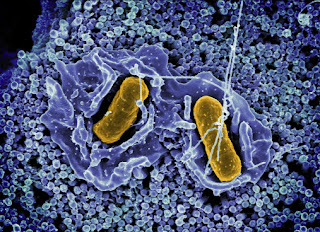
Drugs specifically suppressing virulence factors instead of eradicating the bacteria have been tried on Salmonella enterica serovar Typhimurium, among other pathogens. Here, Salmonella cells (yellow) invade a human gut epithelial cell (blue). (Photo: NIAID/Flickr (CC BY 2.0).)

Monday, November 08, 2021

citizen science then and now

Back in the happy days before Brexit and Trump became a thing, I regularly attended Earthwatch events and wrote stories about their exciting research projects around the world which are made possible by recruitment of volunteers who pay for the privilege of taking part. That activity faded away as the relevant contacts at the organisation kept being replaced by new people, and I lost touch at some point. Towards the end of the phase, I suggested writing a book to be released on the 50th anniversary of the organisation, splashing out on all the wonderful work they are doing around the world. Strangely I never got anywhere with this idea. Emphasis at the organisation shifted away from the volunteer-paid research expeditions and towards partnerships with corporate sponsors as well as more affordable activities closer to home, so that may have been one reason why I didn't get much response re the history book.

The 50th anniversary happens to be now, and as there have been a couple of new developments in citizen science, I have taken the opportunity to wrap up the 50-year history of Earthwatch in a feature on new trends in citizen science more widely. Ironically, one of the trends is to get rid of the citizen scientist altogether and just use their social media posts to algorithmically identify species observations.

The resulting feature is out now:

New avenues for citizen science

Current Biology Volume 31, Issue 21, 08 November 2021, Pages R1403-R1406

FREE access to full text and PDF download

Earthwatch Institute started out organising international research expeditions with volunteer helpers, but now also offers science projects closer to home. (Photo: John Hunt, Earthwatch.)

Monday, October 25, 2021

keeping cool

Six days to go until the start of COP26 at Glasgow, so today's feature has a climate focus. I looked into the spread of air conditioning as a way of "adapting" to rising temperatures, which is, of course, one of many feedback loops making things worse, and at other good or bad ways of adapting to climate change, partially inspired by the book Great Adaptations, which I read for review recently.

So here are some things we can and some we shouldn't do as the climate catastrophe accelerates:

Keeping cool in a warming climate

Current Biology Volume 31, Issue 20, 25 October 2021, Pages R1363-R1365

FREE access to full text and PDF download

See also my twitter thread listing all the 2021 features in Current Biology as they move to the open archives.

If the response to rising temperatures is the installation of more air-conditioning units, this will add to carbon emissions and thus accelerate the climate catastrophe. (Photo: Kars Alfrink/Flickr (CC BY 2.0).)

Tuesday, October 12, 2021

brief history of conservation

This week's issue of Current Biology is a biodiversity special issue, see cover below, and I was asked to cover the history of biodiversity conservation. I haven't read anybody else's history of this field, so my selection of highlights may be eclectic, but it struck me as an enlightening thread that the introduction of agriculture was all about reducing biodiversity in our habitat, and that it took humans a long time to realise that biodiversity is actually good for us too. Hence the title:

Learning to value biodiversity

Current Biology Volume 31, Issue 19, 11 October 2021, Pages R1146-R1148

FREE access to full text and PDF download

See also my twitter thread listing all the 2021 features in Current Biology as they move to the open archives.

Cover of issue 19.
Table of contents.

Wednesday, September 29, 2021

biotech against extinction

One of the many things I learned in recent years while playing wrong notes in Oxford pubs is that there is a research group at Oxford studying rhinoceros reproduction biology with a view to bringing back the northern white rhino. This subspecies is functionally extinct as only two females survive.

Inspired by this I have looked at the wider field of using reproductive biotechnology in the service of conservation efforts and found out fascinating things about species including lions, black-footed ferrets and pandas. The resulting feature is out this week:

In vitro conservation

Current Biology Volume 31, Issue 18, 27 September 2021, Pages R1065-R1068

FREE access to full text and PDF download

See also my twitter thread listing all the 2021 features in Current Biology as they move to the open archives.

Black-footed ferrets have been saved from extinction with biotechnological methods. The cloning effort that recently marked its first live birth aims to introduce genetic diversity into an inbred population. (Photo: Kimberly Fraser/USFWS (CC BY 2.0).)

PS: If I've got my numbers crunched correctly, this is the 250th feature I've done in this format, which started in February 2011. At an average length of roughly 2000 words, that's half a million words. All articles older than 12 months, that's more than 90% of those 250, are in the open archive, so free access for all. Each one has an entry tagged currentbiology on this blog.

Tuesday, September 14, 2021

wonderful Welwitschia

The desert plant Welwitschia mirabilis has accompanied my writing for a while. It featured in my book Exzentriker des Lebens / Life on the Edge. The info in the books is mostly 1990s plant physiology. Now however, researchers have published a high quality genome structure of Welwitschia in comparison with its closest relative - which isn't very close. I've used the opportunity to also have a look at other plant life in deserts on other continents - in the context that the climate disaster will produce more extreme conditions for life to cope with, so we'd better understand how it does.

The resulting feature is out now:

How to survive in the desert

Current Biology Volume 31, Issue 17, 14 September 2021, Pages R1017-R1019

FREE access to full text and PDF download

See also my twitter thread with all 2021 features that are now in the open archives.

Welwitschia_mirabilis, Plate 5369 from vol89 (1863) Curtis's Botanical Magazine (source: wikipedia)

bonus illustration not included in my feature, as images in portrait format are awkward with the column format we use.

Monday, November 23, 2020

bats revisited

Open Archive Day

A year ago, I wrote a feature about bats and why we should care about them and understand them better. I'm glad I included a section about viral loads, discussing the remarkable ability of bats to harbour viruses without getting noticeably sick. (In a rather interesting and complex way, this connects to their ability to fly.) Back then, the bat virus that served as an example was Ebola. Now it would obviously be the coronavirus that is causing COVID-19 and changing all our lives.

Which means that my feature is still topical in a way, and it is now freely accessible:

Why we should care about bats

Powered flight has enabled bats to expand into a wide variety of ecological niches from nectar feeding to insect hunting, making them one of the largest groups of mammals. The image shows a grey-headed flying fox (Choeronycteris mexicana) observed in Costa Rica. (Photo: Zdeneˇk Machácˇek/Unsplash.)

Monday, November 09, 2020

crispr crowned

Open Archive Day

Slightly belated echo to this year's Nobel prize in chemistry for Jennifer Doudna and Emmanuelle Charpentier. When the prize was announced, I checked and found that I had already recycled my most recent feature on crispr (applications in agriculture, here), but I didn't think of the previous one, from the early days after the discovery of Crispr, and the nascent discussions on implications for bioethics.

In all of this, I had the advantage that I already knew Jennifer Doudna was brilliant. Nobel laureate Tom Cech told us so back in 1994(ish), when he gave a seminar at Oxford and implored us to remember his postdoc's name because she will go on and do great things. I've often remembered his words and reflected on his remarkable foresight.

Anyhow, my 2015 feature on Crispr, complete with a lovely photo of this year's laureates, is here:

Bacterial scissors to edit human embryos?

Jennifer Doudna and Emmanuelle Charpentier identified the nuclease Cas9 as a key part of the bacterial immune response to phages and adapted it for use as a universally applicable genome editing tool. (Photo: Justin Bishop/Breakthrough Prize http://www.breakthroughprize.org.)

Monday, October 26, 2020

open cities

More than half of humankind is now living in cities, and urbanisation continues to grow. So in my contribution to last year's special issue on the anthropocene, I gazed into my crystal ball to work out how cities can be more sustainable in the future.

The resulting feature is now in the open archives:

The future is urbanised

Making cities resilient to climate interactions requires tailored solutions. Heat build-up is a problem for many cities, and the traditional approach of painting surfaces in reflective colours can help to keep the environment cool. (Photo: SofiaPapageorge/Pixabay.)

Monday, September 14, 2020

sharks in the open

Open Archive Day

There has been some exciting shark news in recent week at the biology front (eg about angel sharks or about giant sharks from the Cretaceous), but not so much in conservation issues, as the global slaughter carries on, so the hard work of raising awareness of shark conservation continues. My most recent feature about sharks and how they may end up on your dinner plate appeared a year ago, so it is now in the open archives:

Stop the global slaughter of sharks


The scalloped hammerhead (Sphyrna lewini) is one of the shark species whose fins were identified in a barcoding study of fish products in the UK. It also appears on the EDGE of Existence list of unique and endangered rays and sharks. (Photo: © Simon Rogerson.)

Monday, August 24, 2020

wake-up call

Open Archive Day


If you missed my feature on the science of sleep last summer, here's your wake-up call: It is now in the open archives absolutely free to all. As I remember it, I learned many surprising things about how birds sleep with one half of the brain and even in flight, ducks lined up in a row with the terminal duck keeping one eye open for predators, and such like.

I also came away with the surprising impression that scientists are discovering complex sleep regulation in ever less complex animals, which re-ignites the debate what use it is and what advantage over a simple rest period regulated by the circadian clock. (A crucial difference: The circadian clock wouldn't care how much you slept the previous night, while sleep is budgeted and sleep deprivation can accumulate.)

Anyhow, everything you always wanted to know about the science of sleep is here:

The reasons of sleep


Birds display neural sleep signatures very similar to those of mammals, but also a whole range of behavioural adaptations to accommodate the need for sleep in challenging conditions. (Photo: sipa/Pixabay.)

Monday, August 10, 2020

planting trees

Open Archive Day

Planting some trees is (almost) always a good idea, but if we want them to help us out with stopping the climate catastrophe, we should do a bit of thinking before reaching for the shovel.

In my feature last August I rounded up some good and bad examples of reforestation, to give an impression of the complexities involved. The feature is in the open archives now:

How to bring back our planet's forests


If humans weren’t interfering, around two thirds of the ice-free land surface would be covered by trees. Restoring a fraction of the missing natural forests would sequester enough carbon to keep climate change within the limit of the Paris accord. (Photo: jarmoluk/Pixabay.


Monday, July 27, 2020

sniff it out

Open Archive Day

I am currently reading a book about smell, which I'll need to review when I'm through, so it may be useful for me to reread my smelly feature from last year, which was all about odour space, and is now on open access, so sniff it out:

Odour space - the final frontier


Beetroot is becoming popular thanks to a trend towards more vegetarian and vegan options, but one of its odorants can spoil the pleasure for many. (Photo: © Marco Verch/Flickr (CC BY 2.0).)


Monday, July 13, 2020

sloths set free

Open Archive Day

Last year I wrote a feature about the very fascinating (if slightly slow) lifestyle of sloths, and then I spent a year doing nothing, hanging around and waiting for it to come to the open archives, and here we are, the sloths have now been set free and you can read them for free (in your own time):


How sloths got their sloth


A young two-fingered sloth feeding on leaves. (Photo: Proyecto Asis/Flickr (CC BY-SA 2.0).)

Monday, June 29, 2020

stop the killing

Open Archive Day


We are already causing a mass extinction by taking up more space than any other species, but some people aren't content with that and feel the primeval urge to go out and kill some animals to speed the extinctiona along. I have had a couple of features on how humans are messing up biodiversity by killing the wrong kinds of animals (eg top predators like sharks and tunas) and how the industrialisation of the oceans is threatening the megafauna that survives there.

Last year's hunting feature was mainly an appeal to stop the killing, and to that purpose I rounded up examples of species threatened by hunting on land, in water and in the air. The feature is now in the open archives:

Hunting wildlife to extinction


Hunting of large animals continues to diminish the natural biodiversity with knock-on effects going far beyond the species targeted. (Photo: Save-Elephants/Wikimedia Commons (CC BY-SA 4.0).)

Monday, June 15, 2020

roots of religion

Open Archive Day

Last June's special issue of Current Biology was about cooperation and conflict - always a lot of that going on on this planet! - and my contribution was about the origins of religion, seeing that it has been the cause of both cooperation and conflict. Although right now, with so many other things to worry about, we hardly remember religious conflicts.

Anyways, my feature, along with the rest of this very interesting special issue is now in the open archives, which means free access for everybody, forever. Enjoy!

Uncovering the roots of religion


The Pancaraksa (five protections) is a Buddhist text written in Sanskrit. This copy in Ranjana script dates from 1653 CE. (Image: Wellcome Collection (CC BY 4.0).)


PS I was hoping to highlight a feature relevant to the recent historic events surrounding the Black Lives Matter movement, but both features that spring to mind have already had their spotlight in this series:


Why do people riot
? (2011)

Can we change our biased minds? (2017)

Will write a new one as soon as I can think of a new angle ...

Monday, June 01, 2020

bird watching

Open Archive Day


Birds are all over the place at this time of the year, even in the latest feature to emerge from behind the great paywall, so if you want to read up about the evolution of the weirdness and wonderfulness of our feathered dinosaur friends, you can do so for free:

How birds evolved to be different


As the birds surviving the mass extinction at the end of the Cretaceous were small animals with fragile skeletons, very few fossils of this important phase in their evolution are known. This is an unidentified bird species from the Fossil Butte Member in southwestern Wyoming, USA. (Photo: Mira Mechtley (CC BY-SA 2.0).)

Monday, May 11, 2020

keep calm

Open Archive Day


I'm not particularly stressed right now, but I still get a feeling that it may be a good time to revisit my 2014 feature on how the blue mind (the relaxed state of mind we cultivate eg when we're enjoy doing nothing next to a body of water) relates to the red mind (the high-adrenaline state of mind we need to respond to danger).

So adapting the message to today's situation in the UK: Keep calm, stay home, ignore the Prime Minister.

Anyhow here's the feature:

Chronic stress means we’re always on the hunt


It was published with one of my own photos:


which I still like so I'll use it again. It's also at the top of my twitter profile page. The view is of Frankfurt seen from the banks of the river Main.

Monday, April 27, 2020

a crisis of touch

Open Archive Day

One of the collateral problems arising from the covid-19 pandemic is the fact that the distancing dramatically reduces opportunities to experience touch with other humans, as for instance, V (the artist formerly known as Eve Ensler) has pointed out in the Guardian recently (I really liked her suggestion that all the mad female grooming culture is just serving as an excuse to get a regular dosis of gentle touching).

See also this feature in Wired magazine on skin hunger.

Even before this pandemic, some have argued that western societies were becoming more touch averse and that this was having a negative impact on our mental health, as I reported in my feature from last April, which is now in the open archives. With distancing measures likely to remain necessary for months if not years, one can imagine that these problems will become even more serious.

Are we losing touch with our world?


The human sense of touch is important for well-being, but current trends in society tend to discourage touching behaviours. (Photo: andreas160578/Pixabay.)


Monday, April 13, 2020

even harder times for orangutans

Open Archive Day

I am reasonably hopeful that the current coronavirus crisis might scare humanity into doing something about climate change, so it may still turn out saving more lives in the long run than it is costing right now.

However, there may also be collateral damage to the natural world. I heard that the absence of wildlife tourists and rangers has led to an increase in illegal hunting of engangered animals such as rhinos. And there is the risk that the coronavirus, after we have spread it globally, will find some new animals to infect, such as the tiger in the New York zoo. Great apes, for being most similar to ourselves, may be at risk from the disease, and it could even tip some of the endangered species over the brink.

So time to revisit last year's feature about the orangutan, which is now in the open archives:

Hard times for orangutans


still from the banned TV ad "there's a rang-tan in my bedroom" which I mentioned in the feature.