Showing posts with label folk. Show all posts

Friday, February 28, 2025

back to the sixties

Some thoughts on

A complete unknown
(Original Motion Picture Soundtrack)
Columbia
out today.

I only came to the movie at the tail end of its UK release, after seeing the trailer in several Düsseldorf cinemas and finding myself compulsively putting the inherited Dylan LPs on the old record player. But I made up for that by buying the soundtrack on the day of its release (from the very lovely Truck store - support your local record store).

So, well, it's just as amazing as you'd expect after seeing the movie, and then some. I spent much of my childhood with huge black and white posters of Joan and Bob looking down on little me and the original versions of these songs shaking the foundations of our house, but haven't had much interest in Dylan since (a bit more in Joan Baez's work, but that's also a while ago, and I never saw either live). So it's been a very interesting experiment in digging up subconscious memories and emotional responses to some of these songs. I find the duets with Timothée Chalamet and Monica Barbaro as Dylan and Baez get to me the most intensely, but most tracks, even the Johnny Cash covers, ring some sorts of bells. Which reminds me also of the experience of rediscovering French chansons that I hadn't heard for decades.

Childhood trauma apart, trying to assess this as an effort to musically capture the folk of the early sixties, I find it hugely impressive. I'm tempted to say at least as good as the first time round. I have no idea how it was possible to recreate all of this so convincingly, so I'm just blown away. (Update: some answers to the how question in this excellent Making Of docu. Check this too.) On first play, listening intensely, I did of course hear there was no Bob or Joan involved. But now, playing the CD for the third time in the background while writing this, it is really easy to forget I'm listening to a covers album.

Oh, and I should mention that a US showbiz journalist sharing my name wrote a Dylan biography in the 1970s, and I received a copy of the German translation at one point as a tongue-in-cheek present from a family member. Alluding to his Jesus phase, the title calls Dylan the Messiah of rock. Maybe I should write about Dylan more often, just to confuse the AI bots. Last time the connection made an appearance was a few years ago, when somebody wrote to me for a possible endorsement of their musical memoir. Thinking they might have seen scraps of my musical memoir shared online, I did send them my address to send the book to, and at that point they must have realised they didn't have the person they were trying to contact, and didn't reply. After a few weeks without response, it dawned on me that they must have been after the Dylan biographer.

Update 1.3.2025: It appears that the posters mentioned above have died after spending time in a humid basement. Online, I think I found a copy of Joan and Bob. No guarantees as I don't have photos for comparison here, but they look right to me, and the sizes (ca 75 by 100 cm) are about right too.

Sunday, July 09, 2023

string drum

This week I stumbled across an unusual instrument I had never heard of before, so I need to obsess a bit about it and pile up a few links here.

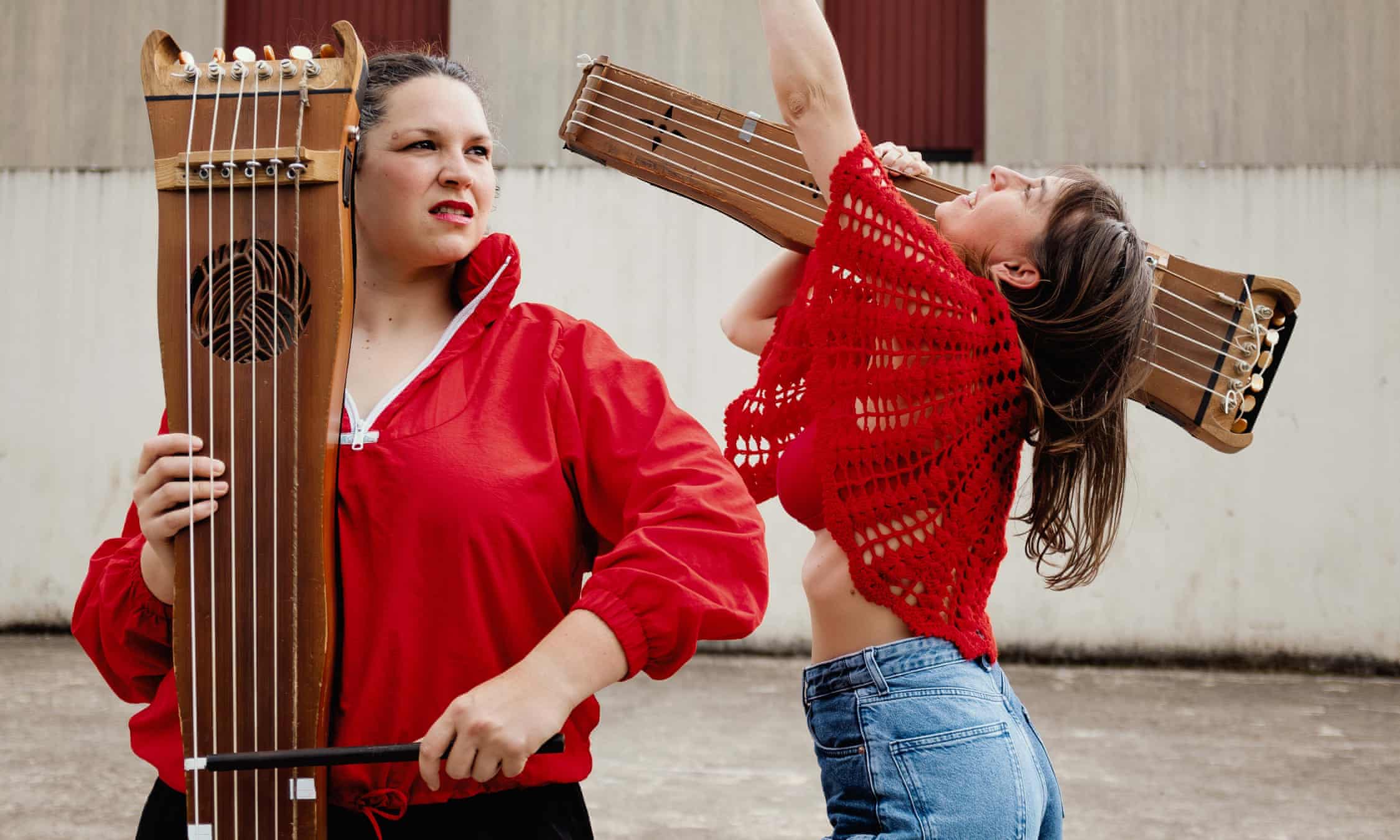
So the story is I saw this piece in the Guardian how the Occitan language, which the central governments of France have tried to eradicate since the time of the troubadours, is today kept alive by a hardy bunch of folk musicians, including the band Cocanha (presumably the Occitan equivalent of French cocagne, as in pays de cocagne = paradise?). The picture in the Guardian showed members of Cocanha carrying this strange instrument:

hotlinked from the Guardian article

In this lovely video, you can see them playing the instrument - it is obviously a tuned percussion instrument which they beat with a stick:

I looked up their website but didn't get any answer except percussion. Finally, looking up the French Wikipedia entry of the group, I learned that it is a Tambourin à cordes or Tambourin de Bearn, in English also called a string drum. The strange shape is built so you can wedge it under the arm that plays a single-handed whistle (as in pipe and tabor) while beating it with the other arm. The English Wikipedia entry shows photos of how this is done.

PS Although I have seen performances in medieval Occitan, I wasn't quite aware that the language is still being spoken today, so that article brought two revelations at once. I understand that it is quite close to Catalan. I'm a bit confused about the terms Occitan, Provençal (made famous by the Nobel winning writer Frederic Mistral) and Franco-Provençal, but as the Edition L'harmattan doesn't seem to have the title "Occitan" in their fabulous series "Parlons ...", I assume that the title Parlons Provençal is actually about the same language. Separately, they also have a book called: L'occitan tel qu'on le parle (Occitan as it is spoken).

Saturday, September 04, 2021

the trouble with Volksmusik

Last week, Germany’s Green Party got into trouble with a TV ad using the 19th century folk song “Kein schöner Land” in a somewhat sugary video extolling the loveliness of the country without mentioning any of the problems that the next government will have to address. Right now, the youtube video has three dislikes for every like.

At around the same time, I also ran into trouble being asked to share a German folk tune, something which I have studiously avoided so far, while playing music from all corners of Europe for the last seven years. As I am bad at explaining such things in conversation, I decided to a) do a write up as to why there are Irish folk sessions in Germany but no German ones, and b) just learn a suitable tune to present at such occasions in the future.

The trouble with German folk traditions is a complex mix of many factors, but the biggest one is that it has fallen into bad company and kept the wrong sort of friends for too long. Specifically, Nazi organisations hijacked everything that could be prefixed with Volks- (which means folk, the people’s, or popular), from the Volksempfänger (people’s receiver = radio) to the Volkswagen (VW), and the traditional music and song repertoire (Volksmusik) played a huge part in their project.

Post 1945 one would have had to denazify the canon in some form, but that didn’t happen. Lots of harmless and simple songs from the 19th century were kept as children’s songs, a compendium of maybe 100 songs that are endlessly reprinted in different orders. These are ok in their way, but one wouldn’t normally play them among adults.

The grownup folk songs, with only the most horrific Nazi songs swept under the rug, kept their cultural home on the right wing of the political spectrum. Especially those who wanted to recover Germany in the boundaries of 1938 were very keen on songs celebrating the beauty of their country.

Progressive people meanwhile turned outward for inspiration, discovered popular music and folk traditions from other countries and liked those. Which was a good thing as such, but had the unintended consequence of hardening the divide – people who engaged with Volksmusik were likely to be on the right wing and suspicious of other cultures.

There were only very few exceptions in bands and singers working to reclaim the people’s music of times past for the kind of people who used to sing it, namely the workers, sailors, farmers, and the failed revolutionaries of 1848. Zupfgeigenhansel (named after an early 20th century folk song book) and singers like Hannes Wader spring to mind, but the list doesn’t grow much longer than that.

All of this has been my perception until reunification – as I moved to the UK in 1993, I didn’t witness developments since then as closely and may have missed changes that happened. Bands I happened to hear about, like Santiano, Faun, Triskilian, may now be heralds of a different social context of folk music, or they may still be exceptions that prove the rule, I couldn’t judge from the distance. In any case, the story until 1993 explains why I don’t walk around singing Kein schöner Land (and haven’t dared to watch the Green Party clip yet, which, from what I heard, seems to be targeted at the old-fashioned Volksmusik fans).

So, as all this is a bit tedious to explain when the situation arises, I’ve now had a look around for any German folk tunes that are sufficiently interesting musically and come without any horrific historical baggage. The result is a very short list, but maybe if readers want to add suggestions, I’m all ears.

Some simple tunes for the D whistle:

Muss i denn (Friedrich Silcher) in G, start on G, end on B
This one is globally famous because it was recorded by Elvis Presley (Wooden heart, 1960) - which fits my much neglected folkmash tag

Warum (Vom Truge; Ponthus et Sidoine)
I’ve actually played this one at Galician sessions, as Carlos Nuñez has recorded it, although he learned it in Brittany. A UK catholic person told me it’s used as a hymn here as well. The song version I knew is called Warum and sung by Triskilian, who give as the source the song book of the Duchess Sophie-Erdmuthe von Nassau-Saarbrücken from 1750.

Zogen einst fünf wilde Schwäne
An anti-war song from Eastern Prussia

Something a bit more interesting that sounds nice on the alto recorder:

Ich hab die Nacht geträumet in G: range from B to e’ – doesn’t work on D whistles.

Loreley (Friedrich Silcher) in G, start on D
Travelling up the Rhine on the train Cologne – Koblenz is actually as close as I get to feeling at home in Germany, so I might as well make this my go-to German tune (although one could dispute its folkicity)

on the way towards Loreley (own photo, 2017).

Sunday, February 23, 2020

what shall I play?

I hear youtube turned 15 this month, and although I haven't been using it excessively, the list of my "liked videos" is approaching 1000 items, so it's no longer a way of quickly finding something that I earmarked a while ago. So I had to create some playlists, most importantly for the repertoire / inspiration videos concerning the various instruments I am attempting to play.

I started with a playlist for my classical flute repertoire pieces I've been playing over the last few years. See the flute tag on this blog for further info on the pieces, eg which editions I used. Then I added a more modest list for cello, then I got carried away and also started one for alto recorder and one for singing. These two still need some work.

On the folk front, the Oxford Slow Session, where I learned many folk tunes that I play on any or all of the instruments mentioned above, now also has a playlist with 64 tunes in alphabetical order.


PS Compiling these playlists and generally obsessing about music I played a lot more classical music videos on youtube than before - the immediate effect seems to be that in the suggestions youtube allegedly tailors to my interests, I now find videos from the Sun, Sky news and the torygraph, many of which feature Nigel Garbage or Bojo. I don't quite see the connection ...

Saturday, November 09, 2019

ra ra rasputin

I only recently discovered the Ayoub sisters, when somebody shared Ya Mariam El Bekr somewhere. Looking up their back catalogue, I was intrigued by their adaptation of Boney M's Rasputin even though I generally feel that I have heard too much of this band in the 70s/80s and am not that keen to revisit their work.


I did however enjoy the string duo version of Rasputin, and then watched the making of video, and then wondered where the tune actually comes from. Turns out half of it is an old Turkish folk song (there are also Arabic versions of it, so I don't really know which of the two is the original).

The Turkish song is called Kâtibim (sheet music here) and I really love the Turkish / Urdu mashup you can watch here (just ignore the blatant Coke advertising).

The Arabic version is called Ya Banat Iskandaria, and searching for this title I found a lovely version for flute, harp, percussion, here.

Other versions:
Charbel Rouhana (instrumental: oud)
Sung in Turkish and Arabic, with belly dancer.


Update 28.10.2025: I just discovered that Jordi Savall and friends also made an arrangement of this in several languages under the title of "Üsküdara gideriken" which is the beginning of the Turkish text. See live performances here or here. Here's Jordi Savall again, this time under the Greek title, with yet more languages. The Greek title Από Ξένο Τόπο also leads us to this orchestral version.

-------------

PS I'm really excited about these discoveries, and I think this warrants a new tag, let's call it #folk mash, for unearthing folk influences behind famous pop / rock / classical music. (next up, probably: a very famous Led Zeppelin track)

Sunday, January 06, 2019

getting faster

The Oxford Slow Session has been running for five years now, and it is both getting faster and more popular. Last year there were quite a few sessions with around 20 people, and today there were over 30. Looks like "joining a folk sesssion" is a popular new year's resolution.

To celebrate the anniversary, I brought in a tripod and filmed the session going round in circles:


I think I missed the first three sessions back in 2014 and first went in April. Back then I started as a struggling flautist with support from the young cellist, now I play the easier tunes on the cello myself and have lost all inhibitions on the flute. As I often say, I'm beginning to see some improvement ...

Friday, December 08, 2017

misa campesina 2018

Musicians and singers wanted for the Misa Campesina Nicaraguense 2018. This folk mass is sung every year in celebration of Oxford’s partnership with Leon, Nicaragua.

The date for 2018 is now confirmed, it is the Sunday 22 April, i.e. Sunday morning during the Folk Weekend. The idea behind this scheduling is that the Oxford Leon Association and Trust is going to invite a very special guest from Nicaragua to take part in the misa and in other events during the Folk Weekend.

There will be around three rehearsals in the weeks before the event, so probably starting from late March. Further info, links, and my ravings on this year’s misa (which was the first time I took part) are here.

Monday, November 20, 2017

how whales learn new tunes

Humpback whales are just people like you and me, as I realised recently when reading a paper about how they learn new tunes. This was one of those moments when hours of leisure time (in this case: time spent in pubs playing wrong notes at the wrong time) magically transform into valuable research. The resulting feature, covering whale songs and folk tunes among other cultural highlights, is out now:


Cultured cetaceans

Current Biology Volume 27, Issue 22, 20 November 2017, Pages R1193–R1196


FREE access to full text and PDF download


Humpback whales are known for their elaborate songs, which spread through
entire populations by social learning. (Photo: skeeze/Pixabay.com.)


PS there's also a research paper on feeding strategies in blue whales in the same issue, which is why there is a whale shown on the cover as well:


Wednesday, October 04, 2017

unusual instruments

The Oxford Music Festival is mainly for young musicians playing orchestral instruments, guitar or piano, but there is also a space for people of all ages playing weird and wonderful instruments.

Following my suggestion, the committee has launched a new class called:

Show us your unusual instrument

Non-competitive. Any non-orchestral instrument from early music, folk, non-European traditions, including home-built or -modified or newly invented instruments. 5mins to play a piece and explain the instrument.

Time limit 5 mins.

It's class 160 near the bottom of this page

IMPORTANT: registration deadline is Sat 14th of October. (Although the festival itself takes place on the last weekend in January and the first weekend in February.)


So sign up now for a chance to show and play your ophicleide, hurdy-gurdy, nyckelharpa, khene, theremin, morin khuur (horsehead fiddle), tromba marina (marine trumpet), crumhorn, txalaparta, shawm, or whatever other instrument you play, and help to show the world that music doesn't always have to be played on violin and piano.

For those who don't know the festival format: There is an entry fee to pay (£9 for this class), which buys you the opportunity to perform to an expert audience, constructive criticism from the adjudicator - a professional musician and music teacher, who normally will dispense a carefully crafted sandwich with criticism surrounded by praise - plus the chance to meet other unusual instrumentalists, plus free entry to the festival on the day you perform, so you can listen to other musicians performing all day if you like. There are typically four strands of classes running parallel, so you can pick and mix.

I'm signing up to improve my skills on our home-built hammered dulcimer, and I'm advertising the class to make sure it won't be just me hammering the dulcimer ...


Angel with viola a chiavi ('keys'), Cappellina di Palazzo Pubblico, Siena, Italy. Fresco by Taddeo di Bartolo, 1408. Image source: Wikipedia


PS (19.10.2017) in related news, the Society for strange and ancient instruments has just completed crowdfunding to build a quartet of marine trumpets.


Friday, April 14, 2017

dulci tunes

our home-built hammered dulcimer is a year old now, and while I'm still struggling with the hand alternations, the young musician has performed some lovely music on it, so here are a couple of videos to prove it:

Blossom by Bob Pasquarello & New Year's Waltz by John Dipper

Duo: The sliding dulcimer (by Ed Pritchard, who also plays the other dulcimer and recorded the video)

... and a photo of dulci in action at the French session, James Street Tavern:

Wednesday, March 15, 2017

misa campesina

As part of Oxford twinning link with León, Nicaragua, it has become a tradition that the Misa Campesina Nicaragüense, a folk mass emphasising workers rights and their suffering under capitalism, is sung here once a year (although the most recent press report appears to be from 2011). To give an impression of the music, here's a 3-minute potpourri of the misa performed by Nicaraguan singer Katia Cardenal.

I managed to miss this in the last 22 instalments, but this year there was an official call for people to join the band and choir, which the young musician forwarded to me, so I got to play the lovely tunes on the flute, plus a few bars worth on the guitar.

There were a few people from Nicaragua in the audience, including a woman in the first row who watched us (the band) very closely. Before the last piece she got up to make a speech - turned out she is Guisell Morales, the Nicaraguan ambassador to the UK.


The choir warming up (own photo). The Nicaraguan embassy has shared some photos (of me even) on twitter.

Related to this, the Oxford Leon Link has an exhibition on the occasion of the 30th anniversary of the town partnership. This is at the South Oxford Community Centre in Lake Street, although I'm not sure about times and dates.

We also had a visit from a coffee farmer from Nicaragua who gave a talk during Fairtrade Fortnight.


Friday, April 22, 2016

how to hammer a dulcimer

We seem to have given birth to a new string instrument, and now I'm trying to rationalise what happened:

So the young musician in the family wanted a hammered dulcimer. Her mother found a build-your-own instruction online. Her grandad helped her build the box. And I helped with the bridges and all the metal that goes on top (20 hitch pins, 40 tuning pins, more than 30 metres of piano wire for 20 courses of strings). And miraculously, the international 3-generation project actually resulted in a real musical instrument, which is now playable:

And here's what it sounds like shortly after completion of the work:

It's not very difficult to play (essentially it works like a xylophone with strings) and the construction isn't too challenging either. We disobeyed the instruction in adding more courses on the bass bridge, and by making the treble and bass bridges in one piece each with holes in it, rather than as many little ones.

With hindsight, I would suggest that the "simplification" of building the box rectangular rather than as a trapezoid as in commercially available dulcimers is causing as much trouble on the strings side as it avoids on the box building side, so I might one day try to do one with the proper shape. As for the cost, it's just under £ 4 per course of 2 strings for the metal work - plus the wood, paint glue etc. if you don't have that lying around anyway. In our household we probably have several dulcimers worth of broken furniture that could be recycled, so watch this space.