Showing posts with label belgium. Show all posts

Friday, October 02, 2015

more films we're not allowed to see

UPDATE 16.6.2024 - the new list for films from 2021 onwards is here: films not shown - part 3

Back in 2010 I started a blog entry listing interesting (mostly European) movies that did not get a cinematic release in the UK. Many updates later, this entry has become just a little bit unwieldy, with two lists running in opposite directions, so I suspect I’m the only one who still finds anything in that entry (although it has been viewed more than 2500 times and is among the five most-viewed entries of all time).

Thus, I decided to start from scratch with a clean slate and just one list of films running chronologically forward, so starting with the earliest ones. I’ll start with films produced in 2012, because that’s where the old review/appreciation list fizzles out (unlike the watch list, which also included films that were more recent and those that I hadn’t seen yet). Within each year, the films that I actually managed to see are listed first. Oh, and female directors are now also highlighted in bold font (work in progress).


So, without further ado, off we go:

Camille redouble (Camille rewinds) - France 2012, Noémie Lvovsky - Charming if slightly illogical time travel story featuring the director in the lead role. It was - released in around a dozen countries but no UK date in sight.

La fille de nulle part - France 2012, Jean-Claude Brisseau - this low-budget ghost story looks like poor old Brisseau is now reduced to filming in his own flat and playing the lead himself, but it is still interesting.

Mapa para conversar (A map for love) - Chile 2012, Constanza Fernandez, starring Andrea Moro, Mariana Prat, Francisca Bernardi - three women in a cute little chamber piece mostly set on a small boat. Restrictions clear the mind, as one of the characters says. Available on DVD from the lovely peccadillo pictures.

Des morceaux de moi (Pieces of me) - France 2012, Nolwenn Lemesle, starring Adele Exarchopoulos (before she became famous in that other role) - growing up in a dysfunctional family in the middle of nowhere (in this case Picardie, northern France) can be hell, as the contrast between Adele Exarchopoulos' character, Erell, and everything around her demonstrates. Erell tries to cope by recording a video diary of her daily life, thus locking up her teenage trauma in a little box which she can eventually leave behind.

La vie d'une autre (Another woman's life) - France 2012, Sylvie Testud, starring Juliette Binoche, see my review here.

El amigo aleman (The German friend) - Germany, Argentina 2012, Jeanine Meerapfel, starring Celeste Cid - a slightly confused story of confused identities as the the daughter of Jewish refugees from Nazi Germany gets entangled with the son of Nazi refugees from postwar Germany, with both protagonists moving back and forth between Argentina and Germany.The fact that in both families the parents talk German to their children who answer back in Spanish reflects the mix-up. I do have a soft spot for Sulamith though, played by Celeste Cid.

Una pistola en cada mano - Spain 2012, Cesc Gay - Shown in Germany (Ein Freitag in Barcelona), and at the London Spanish Film Festival 2013.
Die Vermessung der Welt (Measuring the world) Germany 2012, Detlev Buck. Adaptation of Daniel Kehlmann's bestselling novel.
Klip (Clip) - Serbia 2012, Maja Milos
Weil ich schöner bin - Germany 2012, Frieder Schlaich
3 - Uruguay, Argentina, Germany 2012 - Pablo Stoll - oops, there are too many movies called 3, I was looking for this one and first found the one below, and got all confused.
Tres - Ecuador, Argentina, Germany 2012
3 Zimmer/Küche/Bad (Move) - Germany 2012
Baad el Mawkeaa (After the Battle) - France / Egypt 2012
Después de Lucía - Mexico / France 2012
A perdre la raison - Belgium 2012, Joachim Lafosse, starring Emilie Dequenne
Buscando a Eimish - Spain 2012, Ana Rodríguez Rosell, starring Manuela Vellés, Emma Suárez - shown at the London Spanish Film Festival 2012
Joven y alocada - Chile 2012, Marialy Rivas
Goltzius and the Pelican Pelican Company - UK 2012, Peter Greenaway


Angélique (I) - France 2013, Ariel Zeitoun - A fresh-looking new adaptation of the bestselling history romances by Anne and Serge Golon. I admit I watched part of it during travels in a hotel room and kind of liked it, so I ordered the DVD. Review to follow.

Landes - France 2013, François-Xavier Vives, starring Marie Gillain - gloomy reflections on life, boredom and social problems in the vast pine forests near Bordeaux set in the early 20th century. Compare and contrast with Therese Desqueyroux, starring Audrey Tautou, which did get a UK release.

Jack et la mécanique du coeur (Jack and the Cuckoo-Clock Heart) - France 2013, Stéphane Berla, Mathias Malzieu - interesting CGI-fairy tale in a surreal steampunk-style setting. One could spend hours unpicking cultural references from Jules Verne through to modern ones.

Las brujas de Zugarramurdi (Witching and bitching) - Spain 2013, Alex de la Iglesia, starring Carolina Bang, Carmen Maura. Shown at various festivals in the US and UK. Too much horror and buddy movie for my tastes, so I won't even attempt to review it, but here's the New York Times' take on it.

Arrêtez-moi - France 2013, Jean-Paul Lilienfeld, starring Sophie Marceau, Miou-Miou. Powerful and disturbing chamber drama about lives destroyed by domestic violence.

Chez nous, c'est trois! - France 2013, Claude Duty, starring Noémie Lvovsky. Very cute little film with a funny sideplot relating to the age-old question of how many kisses people in France exchange for greetings, hence the title. The main plot is about a struggling film director played by Noémie Lvovsky, who in real life directed the equally charming Camille redouble just the year before (listed above) so it could also be read as a reflection on the lack of global success of that work.

Flores raras (Reaching for the Moon) - Brazil 2013, Bruno Barreto
Ayer no termina nunca (Yesterday never ends) - Spain 2013, Isabel Coixet - shown at the Berlin International Film Festival 2013, and at the London Spanish Film Festival 2013
La marche - France 2013, Nabil Ben Yadir, starring Hafsia Herzi - I only know about this film because the trailer is on a DVD I own, probably one I bought in France.


Todos estan muertos - Spain/Germany/Mexico 2014, Beatriz Sanchis, starring Elena Anaya - the first full-length feature from Sanchis is a nice little film on a former pop singer traumatised by the accidental death of her brother and bandmate. Mecano may have been a musical inspiration. Only released in Spain and Mexico, and shown at a few festivals.

Les yeux jaunes des crocodiles - France 2014, Cécile Telerman, starring Emmanuelle Béart - a spirited defense of authors' rights, in a way. Based on the best-selling novel by Katherine Pancol.

Die geliebten Schwestern (Beloved sisters) - Germany 2014, Dominik Graf, starring Hannah Herzsprung. Young poet Friedrich Schiller's love life - it's complicated.

On a faillie être amies (Almost friends) - France 2014, Anne Le Ny, starring Karin Viard, Emmanuelle Devos, Roschdy Zem. Some nice scheming going on in this female-led comedy where the male chef serves as a trophy husband.

Arrête ou je continue (If you don't, I will) - France 2014, Sophie Fillières, starring Emmanuelle Devos, who gets lost in the woods and finds herself. Otherwise somewhat depressing relationship breakdown.

Respire (Breathe) - France 2014, Mélanie Laurent - shown at lots of festivals around the world, released in half a dozen countries. Managed to catch it on TV5 at some point but memories are evaporating fast. Felt kind of ethereal.

Ocho apellidos vascos (Spanish affair) - Spain 2014, Emilio Martínez Lázaro - only shown at the London Film Festival 2014.
Sous les jupes des filles - France 2014, Audrey Dana
Marie Heurtin (Marie's story) - France 2014, Jean-Pierre Améris, starring Isabelle Carré
Week-ends - France 2014, Anne Villacèque - released in Germany as "Wochenenden in der Normandie"
Au fil d'Ariane (Ariane's thread) - France 2014, Robert Guédiguian - released in Germany in Dec 2014 as "Café Olympique - Ein Geburtstag in Marseille"
Las insoladas (Sunstrokes) - Argentina 2014, Gustavo Taretto - released in Germany in August 2015.
Qui vive (Insecure) - France 2014, Marianne Tardieu, starring Adele Exarchopoulos
Une rencontre (A chance encounter) - France 2014, Lisa Azuelos, starring Sophie Marceau.
Tu veux ... ou tu veux pas? (Sex love and therapy) - France 2014, Tonie Marshall, starring Sophie Marceau (I'm on a roll adding all of Sophie Marceau's movies since 2012, as none of them have been shown in the UK.)


Jamais contente - France 2015, Emilie Deleuze - starring nobody I've ever seen before, this is a 21st century version of La Boum where the girl gets to sing in a band rather than going to a party. I wanted her band to be more punk though.

Qui c'est les plus forts? (You'll never walk alone) - France 2015, Charlotte de Turckheim, starring Alice Pol, Audrey Lamy. Charming comedy ticking off all the social issues of our time, maybe too obvious in its box ticking, but extra kudos to the director for casting herself in an unlikable role.

Je suis a vous tout de suite (I'm all yours) France 2015, Baya Kasmi, starring Vimala Pons. Billed as a comedy about a woman who can't say no, it has some rather dark undertones too, but overall manages to keep a warm tone and feelgood vibe. I didn't know Vimala Pons before, will have to watch out for other work. Intriguingly, she did an earlier short film with Baya Kasmi, called "J'aurais pu être une pute" which could almost be connected to this film.

Journal d'une femme de chambre (Diary of a chambermaid) - France 2015, starring Léa Seydoux, shown at the Berlinale, all of which is sadly no guarantee that we will get to see it here (except in the French Film Festival UK showing in a small number of cities.)
Mi gran noche (My great night) - Spain 2015, Alex de la Iglesia, starring Carolina Bang.
Le gout des merveilles - France 2015, Eric Besnard.
Go home - France 2015, Jihane Chouaib
Je suis un soldat - France 2015, Laurent Larivière
La taularde (Jailbirds) - France 2015, Audrey Estrougo, starring Sophie Marceau.


Corps étranger (Foreign body) - France/Tunisia 2016, Raja Amari, starring Sarra Hannachi. Very intimate portrait of one refugee's story.

À tous les vents du ciel (Twisting fate) - France 2016, starring Noémie Merlant. Yes, she may be a bit of a manic pixie dream girl stereotype, but the film is amazing in the extent to which it focuses on her and lets all male characters drop by the wayside. (Update April 2022: just spotted the name of Noémie Merlant here, who later shot to fame with portrait d'une jeune femme en feu, I hadn't made the connection at all, and she plays a character much younger than her real age here)

Rupture pour tous (Love is dead) - France/Belgium 2016. Charming and timely little comedy involving nobody I've ever heard of before.

Fleur de tonnerre (Poisoning angel) - France 2016, Stéphanie Pillonca, starring Déborah François - brilliant and quite a bit scary, see my review. IMDB lists no foreign releases at all - not the image of Brittany and of French women that people want to project ...

Maman a tort (Trainee day) - France 2016, starring Emilie Dequenne - bookended by fleeting party scenes reminiscent of La boum, a 14-year-old girl has her moral compass comprehensively crushed by a week-long work-experience at her mum's insurance company. Bottom line: yes capitalism is evil but just play along and find somebody weaker who can suffer so you don't have to. I might have to channel that anger into a separate blog entry.

O Perfume da Memória - Brazil 2016, Oswaldo Montenegro - amazingly stylish chamber piece in the spirit of Room in Rome and En la cama. Montenegro appears to have made it with his own resources and released it free on YouTube. See my review here.

Sex cowboys - Italy 2016, Adriano Giotti. Mildly interesting little no-budget movie made with people who don't even have a profile picture on IMDB. Selling out your sex life on only fans or whatever the 2016 precursor was comes with unintended consequences. Note that the girl gets a complex character, while the boy is mainly there as the love interest.

Egon Schiele: Tod und Mädchen (Death and the maiden) - Austria / Luxembourg 2016
Paula - Germany 2016, Christian Schwochow. A biopic of painter Paula Modersohn-Becker.
Marie Curie - France 2016, Marie Noelle.
Vor der Morgenröte - Stefan Zweig in Amerika (Stefan Zweig: Farewell to Europe) - Germany 2016
Orpheline - France 2016 - starring Adele Exarchopoulos, Adele Haenel, Gemma Arterton.


Luna - France 2017, Elsa Diringer, starring Laëtitia Clément - A male victim of a gang assault and a female member of the assaulting gang meet again, a love story as an almost-thriller due to the dark secret lurking in the past. Impressive work from unknown young actors.

Aus dem Nichts (In the fade) - Germany 2017, Fatih Akin - UK release June 2018!!! - on time for the end of the court case against the neo-nazi terror group NSU, the real-life inspiration behind the story.

Plonger (Diving) - France 2017, Mélanie Laurent, starring Maria Valverde. Ignore the trailer, the film is much more interesting than the trailer suggests.

La belle et la meute (Beauty and the dogs)- France 2017, Kaouther Ben Hania, starring Mariam Al Ferjani. Haunting depiction of the aftermath of a rape not shown - it's all to be read from the face of Mariam Al Ferjani.

Prendre le large (Catch the wind) - France 2017, Gaël Morel, starring Sandrine Bonnaire and Lubna Azabal. A textile company moves production from France to Morocco - one of the workers takes up the insincere offer to keep the job and move along. I'm sure I've seen another French film with a small group of workers moving after their jobs ... ah, found it, it's actually from the same year but I had forgotten to include it in this list after I watched it, so adding it now below:

Crash Test Aglaé - France 2017, Eric Gravel, starring India Hair, Yolande Moreau, Julie Depardieu. In this case it's a car factory relocating to India, and the heroines take a car to follow their jobs in easterly direction.

Djam - France 2017, Toni Gatlif, starring Daphne Patakia. Kind of a road movie without transport, and the title character trying to get from Lesbos to Istambul and back. A lot of spontaneous and informal music making happens on the journey otherwise marked by troubles and tribulations. Also dealing with the issue that many refugees have been risking their lives in the attempt to get from Turkey to Lesbos. Some similarities with Tony Gatlif's 2004 movie Exils, which is also set on the EU's southern border, namely between Spain and Morocco.

La mélodie - France 2017, Rachid Hami. This one is based on an earlier Brazilian movie called The violin teacher. Said teacher leads a bunch of kids in a disadvantaged suburb of Paris from zero to a performance at the Phiharmonie. Unlike the treatment such stories get in Hollywood, we don't have a love story thrown in and get only the bare bones of biographical background on the protagonists, which I think is a deliberate choice to show that once they caught the music bug, the project became the most important thing to them, so everything else has to fade into the background.

La lengua del sol (the tongue of the Sun) - Mexico 2017, José Luis Gutiérrez Arias. Lovely little film about the end of the world, so very topical in this day and age, also a nice chamber play in the style of Room in Rome and En la cama. See my review here.

Rodin - France 2017, Jacques Doillon, starring Vincent Lindon and Izïa Higelin
Le Semeur (The sower) - France 2017, Marine Francen - a 19th century man-sharing plot in a village where only women survived the war.


El arbol de la sangre
- Spain 2018, Julio Medem. See my review here. Medem returns to his Basque roots, which are probably too obscure for UK distributors.

Madame Mills, une voisine si parfaite - France 2018, starring and directed by Sophie Marceau. Wouldn't normally consider watching a comedy with Pierre Richard, but loved this one, see my review here.

Ma mère est folle (My mother is crazy) - France 2018, Diane Kurys, starring Fanny Ardant. Charming and stylish, even though maybe a bit too close to home ...

Joueurs (Treat me like fire) - France 2018, Marie Monge, starring Stacy Martin. Dark stuff from the world of underground gambling, with a compelling lead.

La belle et la belle (When Margaux meets Margaux) - France 2018, Sophie Fillières, starring Sandrine Kiberlain. The 20 and the 45-year-old version of Margaux cross paths and the older tries to be helpful. It is never revealed which rip in the space-time continuum supposedly made this possible, but the encounter is fun to watch.

Sofia - France/Morocco 2018, Meryem Benm'Barek-Aloïsi. Life is complicated for an unmarried woman giving birth in Casablanca, Morocco. There is no good solution, but the female family members stick together and muddle through somehow, which is more disturbing than uplifting, but I found the grumpy young mother in denial (Maha Alemi) very watchable.

Victor et Célia - France 2018, Pierre Jolivet, starring Arthur Dupont, Alice Belaïdi. Given that I have no interest in hair and beauty salons, there is an amazing number of French films set in this environment that I actually like, and this one joins the ranks of Venus Beaute and Caramel. Alice Belaïdi is a revelation, she also had a smaller role in Les tribulations d'une caissière, 2011.

La dernière folie de Claire Darling - France 2018, Julie Bertuccelli, starring Catherine Deneuve and her daughter, Chiara Mastroianni. Charming and surreal drama about letting go, kind of fits my age now.

Normandie nue (Naked Normandie) - France 2018, Philippe Le Guay
Amoureux de ma femme - France 2018, Daniel Auteuil, starring Adriana Ugarte. Released in Germany in October 2018.
Sin rodeos (Empowered) - Spain 2018. Shown at the London Spanish Film Festival in September 2018, but no release date scheduled at that time.
Un homme pressé - France 2018, starring Fabrice Luchini, Leïla Bekhti.
L'amour est une fête - France 2018, Cédric Anger
LikeMeBack - Italy/Croatia 2018, Leonardo Guerra Seràgnoli


Damien veut changer le monde - France 2019, Xavier de Choudens. Charming comedy on illegal ways to help migrant kids stay. Outside France it has been released only in Turkey, Lebanon, Morocco.

Tambour battant - Switzerland 2019, François-Christophe Marzal - with a bunch of unknown actors, this is a musical fable about the incursion of modernity into a Swiss mountain village. Women get the vote (it's 1970!) and the rebel faction of the village band uses modern contraptions like saxophones and tambourines.

Une fille facile - France 2019, Rebecca Zlotowski. Coming of age story set in the obscene wealth of Cannes marina. Not quite sure what to make of this.

Poissonsexe - France 2019, Olivier Babinet, starring India Hair. I got the impression that this was a very strange film, set in a near future where marine life faces extinction and humans may also struggle keeping reproduction going? I only gave it half my attention while doing something else though, so I may have missed some of the subtle clues.

Fabuleuses (Fabulous) - Canada 2019, Mélanie Charbonneau. Fabulous film about three young women, one is a successful influencer, one wants to be her, and one wants to be a professional cellist and objects to the whole influencer nonsense. I was very grateful that the young cellist plays the prelude of the fourth suite, not the one of the first which you'll hear in every other movie that has ever included a cello. I only understood 10% of the dialogues in français québécois (some characters were more understandable than others), so may have to watch it again to see if I can decipher a bit more. I think part of the problem is that it is both heavily coloured by English and invaded by English vocab, but as both the English and the French part of the speech sound the same to me I struggle to keep up with the switches.

Le mystère Henri Pick - France 2019, Rémi Bezançon, starring Fabrice Luchini, Camille Cottin, Alice Isaaz. Lovely and very bookish film, see my review here.

J'irai où tu iras - France 2019, Géraldine Nakache, starring Leila Bekhti. I'd watch Leila Bekhti in anything, and she does a good job here as the alien recently landed on her sister's planet of Celine Dion superfans (the title is from a Dion song too). I resented the talking cars and the attempts at comedy on the back of disability.

Curiosa - France 2019, Lou Jeunet, starring Noemi Merlant. Interesting reflections on the early adoption of photography as a medium torn between poetry and pornography. For that alone I would not mind watching it several times. People more interested in the human stories may find the characters a bit cold and aloof perhaps.

Tu mérites un amour (You deserve a lover) - France 2019, starring, written and directed by Hafsia Herzi


In corpore - Australia 2020, Sarah Jayne and Ivan Malekin, starring Clara Francesca. Available on Youtube. Four couples around the globe (Melbourne, Malta, Berlin, New York) are having very loving physical intimacy, but trouble elsewhere in their relationships. Just stay in bed, I would say. Also, possibly the first time I have been exposed to spoken Maltese, which is a very intriguing language as it is a mixture of Romance and Arabic heritage.

Jumbo - France 2020, Zoé Wittock, starring Noémie Merlant, shown at Sundance 2021.


last updated 19.11.2025


One of our lovely independent cinemas here, not their fault that they're not getting all these films. (Own photo)

Wednesday, January 21, 2015

reading the world

I was very impressed when I read that the author Ann Morgan had managed to read one book from each of the 196 countries represented at the 2012 Olympics in London. Her list of books read and others that were recommended to her is here, and the book she wrote about the experience is reviewed here.

Thinking about how embarrassingly far I would fall short of that figure I estimated I would be lucky to make it to 50 countries (in my life so far, not in a year) and started my own list to prove it. If and when I've reviewed a book on this list, I've included a link to the review. If I can't remember whether I've actually read it (even though it's on my shelf), I've marked it with CR. NFY means not finished yet. Still struggling to get to 50 though.

  1. Algeria – Mehdi Charef: Thé au harem d’Archi Ahmed (CR - saw the movie though)
  2. Argentina – Federico Andahazi: El anatomista (The anatomist)
  3. Austria – Daniel Kehlmann: Die Vermessung der Welt (Measuring the world)
  4. Belgium – Amélie Nothomb – L’hygiène de l’assassin
  5. Brazil – Paulo Coelho: Der Alchemist (The alchemist)
  6. Canada - L. M. Montgomery: Anne of Green Gables
  7. Chile – Isabel Allende: La casa de los espiritus (The house of the spirits)
  8. China – Hong Ying: K – the art of love
  9. Colombia – Gabriel Garcia Marquez: Cien años de soledad
  10. Congo, Republic of the – Alain Mabanckou: Verre Cassé (Broken Glass)
  11. Cote d'Ivoire – Fatou Keita: La rebelle
  12. Cuba – Zoe Valdes: La nada cotidiana
  13. Ecuador – Alicia Yanez Cossio: El cristo feo
  14. Equatorial Guinea – Guillermina Mekuy: El llanto del perro
  15. France – Anna Gavalda: Ensemble, c’est tout (Hunting and gathering)
  16. Germany – Charlotte Roche: Feuchtgebiete (Wetlands)
  17. Guatemala – Miguel Angel Asturias: Leyendas de Guatemala (CR)
  18. India – Ruth Prawer Jhabvala: Heat and dust
  19. Iraq - Weam Namou: The feminine art
  20. Israel – Ephraim Kishon: Oh, oh, Juliet
  21. Italy – Umberto Eco: Der Name der Rose (The name of the rose)
  22. Kyrgyzstan – Chinghiz Aitmatov: Jamila
  23. Lebanon - Vénus Khoury-Ghata: Les fiancés du Cap-Ténès (CR)
  24. Madagascar – Michele Rakotoson: Dadabé
  25. Mexico – Laura Esquivel: Como agua para chocolate
  26. Mongolia – Galsan Tschinag: Die Karawane (NFY)
  27. Morocco – Tahar Ben Jelloun: Harrouda (CR)
  28. Netherlands – Anne Frank: Das Tagebuch der Anne Frank (Diary of a young girl)
  29. New Zealand - Katherine Mansfield: Stories
  30. Nicaragua – Gioconda Belli: El pergamino de la seduccion (The scroll of seduction)
  31. Nigeria – Sefi Atta: Swallow
  32. Peru – Mario Vargas Llosa: El sueño del Celta (The dream of the Celt)
  33. Poland – Stanislaw Lem: Stories
  34. Russia – Mikhail Bulgakov: Master and Margerita
  35. Senegal – Ousmane Sembene: Guelwaar
  36. Sierra Leone - Aminatta Forna: The memory of love (NFY)
  37. Spain – Almudena Grandes: Castillos de carton
  38. Sweden – Astrid Lindgren: Pippi Longstocking
  39. Switzerland – Max Frisch: Homo faber
  40. Syria - Rafik Schami: Die dunkle Seite der Liebe (NFY)
  41. United Kingdom – Esther Freud: Lucky break
  42. United States – Megan Clark: Seduce me
  43. Vietnam - Kim Thuy: ru (NFY)

Own photo of my reading pile some time in early 2014.

PS: I'll keep updating this with any further reading adventures, hoping that one day I can travel around the world in 80 books ... So this post will also serve as a directory to my reviews of world fiction.

Monday, January 19, 2015

evolution of allergy

In December, I attended the Cell Symposium on type 2 immunity (i.e. our adaptive immune system as opposed to innate defence mechanims) and learned a lot about the big two questions in the field of allergy, namely why did allergies evolve, and why are they becoming more prevalent in industrialised societies?

It's been a steep learning curve not helped by immunologists' habit of speaking in acronyms, but I believe I discovered some meaningful connections to evolution and ecology - it's really all about snakes and parasitic worms. So I wrote a feature summarising what I think I understood, which is out today:

Why did evolution give us allergies?
Current Biology Volume 25, Issue 2, pR53–R55, 19 January 2015

Open access

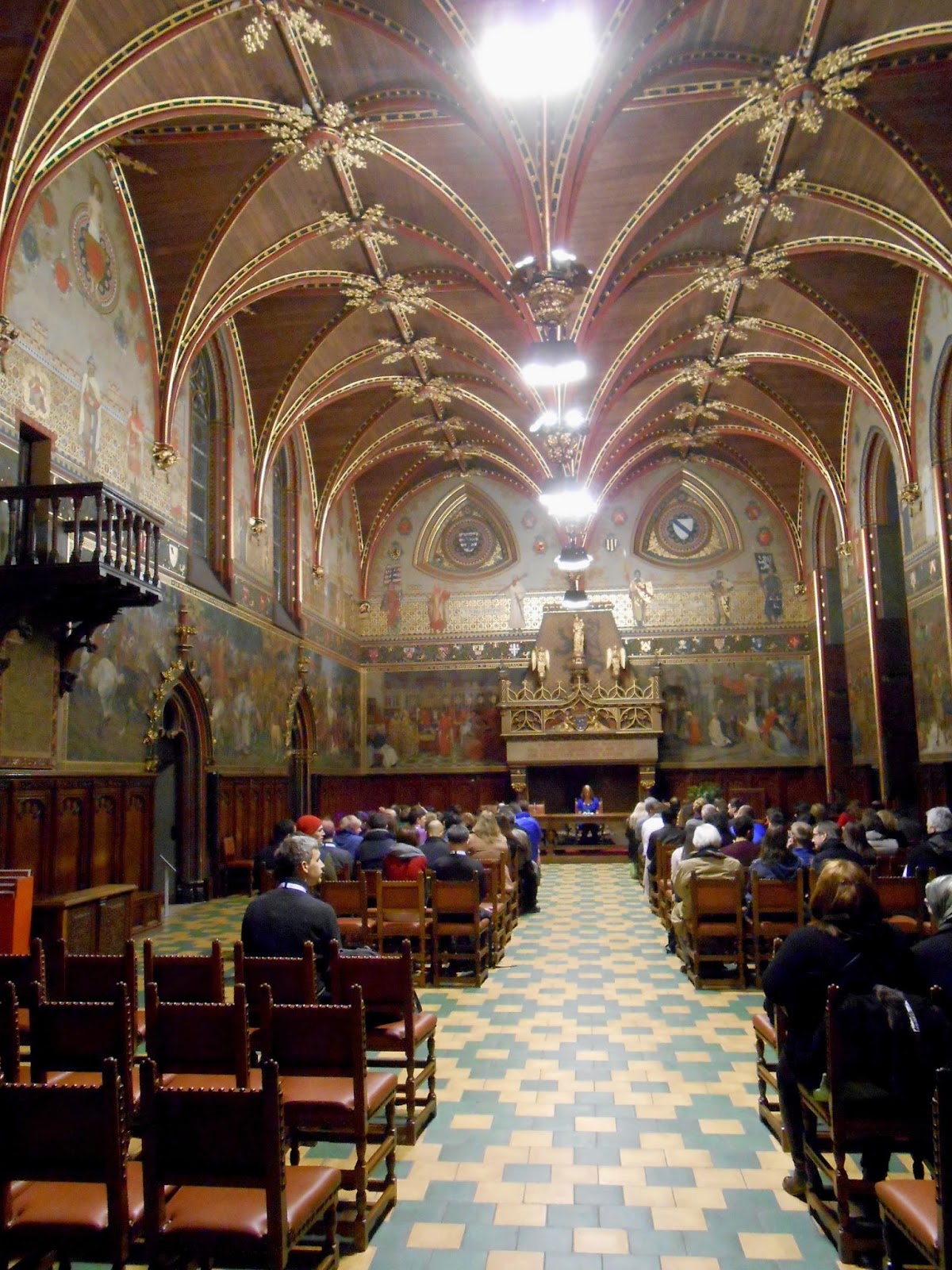
The Cell Symposium in session (this was a reception in the town hall though, not part of the scientific programme). Own photo.

Tuesday, September 30, 2014

Guillaume Paque

Continuing the theme of obscure composers, the young cellist recently played Souvenir de Curis, a piece for four cellos by the Belgian cellist and composer Guillaume Paque.

Here are four blokes playing it (but if you prefer to see four girls playing it give me a shout and I'll send the private link):

The information I could find about him reads, in its entirety (and the years / ages don't add up):

"GUILLAUME PAQUE must be mentioned, born at Brussels on July 24, 1825. At ten years of age he became a pupil of the Conservatoire, where, during a course of six years, he received his entire artistic training. Dismissed from the institution with the first prize, he entered the orchestra of the Royal Theatre in his native town. After he had belonged to it for some years, he took up his abode in Paris, with the intention of permanently settling there. But an offer which he received in 1840, of entering, as solo cellist, the Italian Opera at Barcelona, induced him to leave the French capital. Scarcely had he arrived at Barcelona, when the Professorship of the Musical School was committed to him. In 1849 he played before the Queen of Spain in Madrid, and in 1850 he travelled in the South of France giving concerts. In the same year he fixed his residence in London, where he gained popularity as a chamber music player. He found his particular sphere of work as solo cellist at the Royal Italian Opera, as well as teacher at the London Academy of Music, until his death on March 3, 1876. Amongst his compositions he published several "Fantasias," Variations, and Drawing- room pieces."

source

Wednesday, June 12, 2013

control freakery

Each time I’m taking the Eurostar to continental Europe I am left wondering, why is a single passport check ok to travel out, but two or three are done on the way back?

Coming back from Germany via Brussels last Sunday (on the Eurostar departing Brussels at 19:52) we had our passports checked three times (by Belgian and UK authorities in Brussels, and then by UK people again in St. Pancras). The ticket was also checked three times, by the machine at checkin, by the UK passport control in Brussels and by a train manager on the train.

I don’t really see the need for any passport controls within the EU. If I can fly from Madrid to Helsinki or Athens under the Schengen agreement without border control, what’s so special about the UK and Ireland that they can’t join? I’m really not buying the argument that these countries are so attractive they need extra protection.

Then, if you do need passport controls, why not do them once in the right place, and be done with it? If I’m a legal traveller on the first contol, I’ll surely still be legal on the third one. To me, the third passport control on the same leg of the journey really is where security measures end and harassment begins. It didn’t improve my mood that a steward, as I was stepping up to the counter with my son who has autism and needs constant supervision and assistance, shouted at us “one at a time”. If he had actually looked at us before, he could have figured out why we went ahead together.

My personal gripes apart, surely, it can’t be good for the UK economy if people who may be travelling to London on business get harassed this way?

New art work suspended from the roof of St. Pancras station.

Thursday, June 07, 2012

a Belgian in the family

As I’ve mentioned before, my ancestors, who appeared to be German through and through in the 19th and 18th century, suddenly turned out to be a load of immigrants when we reached the 17th century. So far, we have found one move from Hungary, one from Italy, several from France and seven from Switzerland. I've now discovered the 16th immigration event in my family tree, which is the first one from today’s Belgium.

Linard Jacque, who later called himself Leonhard Jacob in Germany, arrived in Fachbach on the river Lahn in the 1670s. (This is very close to where the Lahn meets the river Rhine, and just a little bit upstream of Koblenz, where the Mosel joins the Rhine from the other side.) New ironworks were built there from 1671 onwards by the Mariotte family from Liege, Wallonia. That area was leading the world in metal processing technology at the time and had developed blast furnaces long before the industrial revolution came along with its steam engines. Expanding into other European countries, the Walloons brought skilled workers to the site, maybe from places in Wallonia where they had other ironworks. This also happened in Fachbach, where there is a marked influx of people with French names including also Jacquemot, Grisar, Permantier (from France, though), and others.

Historic painting of the Nieverner Hütte, from Wikipedia.

One family that seems to have been closely linked with my ancestors, judging by the mutual services as godparents and marriage witnesses, is the Grisar (Grisard, Grysar, Krisar) lineage, coming from Yvoir near Namur, and in previous generations from Sauheid near Liege. One might speculate that the Jacque family came from the same place and the families knew each other before they arrived in Germany, but I also found a source saying that recruiters working for the Mariotte family came to the town of Theux near Liege, so they may have just scoured the region for skilled workers in which case it would be quite hopeless to try and find the departure region of my Belgian ancestor.

Under the name of Jacob, his descendents did reasonably well in Fachbach, to the extent that in the mid 18th century there are two males called Johann Jacob who are the same generation but I’m not sure which belongs to my branch of the family (Leonhard Jacob junior) and which to Leonhard’s brother Wericus Jacob.

In any case, my lineage only stayed there for four generations, as Leonhard junior’s grandson, Philipp de la Strada, moved to Krefeld to work in the textile industry there and left lots of descendants.

Additional sources:

L'évolution des sciences et des techniques en Wallonie - (1995) by Robert Halleux et al. (Intriguingly, this source mentions that Ottavio Strada was involved in the Wallonian ironworks industries, he was granted a patent in Liege.)

genealogy of the Grisar family by Gerhard Hufnagel

Patrimoine - Les industries sidérurgiques de la basse ourthe (about ironworks in Sauheid near Liege)

Wednesday, October 26, 2011

tintin revisited

Dear Mr Spielberg,

many thanks for offering your 3D, motion captured, animatronic, and everything else take on the Tintin stories, but I'm afraid I've decided to stick with the original:


This edition of "Le secret de la licorne" (the secret of the Unicorn) is even older than me, not dated, but from the list of other Tintin adventures on the back, it must have been printed between 1960 and 1963.

For some deeper insights into the Tintin oeuvre, see the brilliant book Tintin and the secret of literature by Tom McCarthy, which I reviewed here.

PS: Further reasons not to watch the film:

why the CGI doesn't work and only produces zombie impressions (interesting in that it tells us how our brains process people images differently from everything else!)

Tom McCarthy on how Spielberg missed all the interesting bits in Tintin

Peter Bradshaw's review of the film

Nicholas Lezard trying to cope with the trauma the film inflicted on him

PPS Art critic Jonathan Jones tries to mediate between Tintin fans and those who appear to like the movie.

Wednesday, April 20, 2011

solidarity poster

love this solidarity poster I saw in Brussels this weekend, at the Centre International


It's from the Belgian Labour Party - more on their thoughts re Libya and the Arab revolutions here (in French).

Sunday, September 19, 2010

movies we're not allowed to see

-- last updated 25.06.2015 --

NB: for more recent updates see my new blog post on this issue.

I've been catching up on some European movies from the last years that for some reason or another didn't get a cinema release in the UK (criteria: no release date listed on IMDB and film didn't show up here). There is a growing collection of recent films that I really liked and that didn't get shown in this country, so I'm compiling a commented list here:

Mädchen Mädchen (Girls on top) - Germany 2001, Dennis Gansel.

Juana la loca - Spain 2001, Vicente Aranda - it's just a straightforward period drama based on the same events as Gioconda Belli's more ambitious novel El pergamino de la seducción (which I reviewed here) but I love the story so it doesn't harm to have a second view on it. It's nicely done and should interest people outside Spain too. (It has in fact been released in the US as "Mad Love", but not here.)

800 balas (800 bullets) - Spain 2002, Alex de la Iglesia - surprisingly brilliant film, see my review.

El otro lado de la cama (The other side of the bed) - Spain 2002, Emilio Martínez Lázaro - starring Paz Vega, Natalia Verbeke.

Suite Habana (Havana Suite) - Cuba 2003, Fernando Pérez - not European, but still interesting.

L'esquive (Games of love and chance) - France 2003, Abdellatif Kechiche - only shown at the London film festival.

Dot the i - UK 2003, Matthew Parkhill - this one puzzles me, actually, it's made in Britain, with funding from UK film council, in English (though with stars better known in Spanish speaking countries), all nipples carefully covered up, and it still went straight to DVD (more here).

Tout le plaisir est pour moi (The pleasure is all mine) - France 2004, Isabelle Broué, starring Marie Gillain - comedy around libido lost and found, a bit painting by numbers and too americanised for my taste, but apparently not enough to get a UK release.

En la cama - Germany / Chile 2005, Matías Bize starring Blanca Lewin, Gonzalo Valenzuela - the film that inspired Julio Medem's "Room in Rome" (2010, see below). See my review.

Melissa P - Italy / Spain 2005, Luca Guadagnino - a difficult topic handled tactfully, see my review.

Ensemble c'est tout - France 2007, Claude Berri - ok, I wasn't really overwhelmed by this one, see my review of the book (by Anna Gavalda) with post-script on the film here. The film was only shown at a festival here and hasn't even seen a DVD release (my DVD is from Germany).

Caótica Ana - Spain 2007, Julio Medem - maybe not his best work but still worth watching, see my review here.

Les anges exterminateurs - France 2006, Jean-Claude Brisseau - although part one of the trilogy, Les choses secretes, was shown in UK cinemas, this second part and the final one, A l'aventure, weren't.

Tangerine - Germany 2008, Irene von Alberti - German musicians try and fail to connect with the culture of Morocco ...

A l'aventure - France 2008, Jean-Claude Brisseau - third part of the trilogy, of which only the beginning, Les choses secretes made it to UK cinemas.

LOL (Laughing out Loud) - France 2008, Lisa Azuelos - a teenage comedy with a twist, as Sophie Marceau, who shot to fame with La Boum in the 80s, plays the mother of the lead girl this time round. Looking this up on IMDB, I found out that a US remake starring Miley Cyrus and Demi Moore is due to be released on 1.6.2012. Oh, and there hasn't even been a DVD release in the UK, another movie I had to import from Germany.

Française -France 2008, Souad El-Bouhati - shortish film about being a foreigner and choosing your country, starring Hafsia Herzi from Couscous (La graine et le mulet), review to follow.

Soul kitchen - Germany 2009, Fatih Akin - review to follow.

Castillos de cartón - Spain 2009, Salvador García Ruiz - charming film based on novel by Almudena Grandes, about three art students in 1980s Madrid who find their ways in art, love, and life. See my review of the UK DVD edition trying to mis-sell it as porn.

Je te mangerais - France 2009, - girl-on-girl obsession complete with harrassment and a background of classical music. Love the setting (in Lyon) and the views, but there are some disturbing things going on that aren't really addressed. Also, the link between emotions and their musical expression wasn't easy to catch for mere mortal non-pianists like me. Went straight to DVD in the UK in 2010 (title: Highly Strung, cert. 15).

Now & later - USA 2009, Philippe Diaz - free love vs. the power of military and financial oppression, heart-warming stuff, read my review here.

Mentiras y gordas (Sex, party & lies) - Spain 2009, Alfonso Albacete - superficially, this is sex and drugs and techno all the way through, so don't be surprised at the knee-jerk reaction from some quarters and the 18 certificate on the DVD. If you can look beyond that, however, there are interesting subtleties (the lies are in the title for a reason), characters likeable with all their flaws, and a cautionary tale about the dangers of drugs and falling in love.
UPDATE December 2023: rewatched this after realising that it features a young Ana de Armas (who since then moved on to Hollywood and played Marilyn Monroe). Hadn't remembered much after 14 years, so I had great pleasure in rediscovering it.

Happy Few - France 2010, Antony Cordier - starring Elodie Bouchez - I missed La vie rêvée des anges when it came out, and generally hadn't seen a movie with Bouchez since Les roseaux sauvages (1994), so I made a note regarding this one when I heard about it in France. Needless to say, it didn't get a UK release (not even as DVD) so I imported the DVD from Germany. One might question whether the news that two couples have merged into a foursome is material enough to fill two hours, but I really liked the general feel and atmosphere of it.

L'âge de raison - France 2010, Yann Samuell - starring Sophie Marceau - what happens if the letters a clever 7-year-old girl writes to her future, 40-year-old self actually get delivered? Good question, slightly muddled in the answer but still interesting and moving to a degree. Further proof that de-frenching French films by bringing in a bit of English dialogue and leaving out all nipples doesn't guarantee cinematic release in the English-speaking world. Neither does the presence of a huge star like Marceau ... It was shown in cinemas in Germany, where a DVD is available under the title Vergissmichnicht.

Balada triste de trompeta - Spain 2010, Alex de la Iglesia - shown at Edinburgh Film Festival only.
A complex and difficult movie on the trauma caused by the Spanish civil war, read my review here

Vénus noire - France 2010, Abdellatif Kechiche - epic and profound biopic of an African woman shown around as "Hottentot Venus" in European cities in the 19th century. See my review here

Mes chères études - France 2010, Emmanuelle Bercot - now this alternative approach to student finance might have caused scandal around here, so better not show it.

678 / Les femmes du bus 678 - Egypt 2010, Mohamed Diab, starring Nahed El Sebai, Boushra, Nelly Karim - very timely and relevant film on the everyday harassment of women, see my review here.


still from "Habitación en Roma": official site.

Habitación en Roma (Room in Rome) - Spain 2010, Julio Medem - read my review here.

I love Périgord - France 2011, Charles Nemes – it’s a cliché-laden comedy about an Anglo-French culture clash and I wouldn’t normally make a fuss about it, but given the topic, a no-show in UK cinemas might of course be read as censoring the opinion of the other side in this age-old cultural conflict.

Q - France 2011, Laurent Bouhnik – What if relationships between people were driven by rampant female desire, what might this alternative to the testosterone-soaked world we live in look like? The (male) writer/director seems to think that it would be a better world, as the desire of the female protagonist, although a bit disconcerting at first, ends up being a force for good, fixing troubled relationships and strengthening the community. Sadly, censors and marketing people are unable to ignore the bare chests for long enough to work out what a film is actually about, so we have another interesting film that didn’t get a UK release and went straight to DVD with a blurb that essentially tries to sell it as posh porn. When will they ever learn?

Memoria de mis putas tristes - Mexico/Denmark 2011, Henning Carlsen - lovely adaptation of Gabriel Garcia Marquez' eponymous short novel from 2004. Review to follow.

Camille redouble (Camille rewinds) - France 2012, Noémie Lvovsky - Charming if slightly illogical time travel story featuring the director in the lead role. It was - released in around a dozen countries but no UK date in sight.

La fille de nulle part - France 2012, Jean-Claude Brisseau - this low-budget ghost story looks like poor old Brisseau is now reduced to filming in his own flat and playing the lead himself, but it is still interesting.

Mapa para conversar (A map for love) - Chile 2012, Constanza Fernandez, starring Andrea Moro, Mariana Prat, Francisca Bernardi - three women in a cute little chamber piece mostly set on a small boat. Restrictions clear the mind, as one of the characters says. Available on DVD from the lovely peccadillo pictures.


PS: I am, of course, a bit biased in favour of Spanish and French cinema, but I'm sure there are similarly neglected films from other European countries, and indeed from around the world as well. I'll also acknowledge bias towards vaguely intelligent films, which excludes some German comedies that were extremely successful on the domestic market but didn't get exported.


"Endangered List" of films that may or may not end up on the list above (as I haven't seen them yet, and/or they may still turn up):


Flores raras (Reaching for the Moon) - Brazil 2013, Bruno Barreto
Landes - France 2013, François-Xavier Vives, starring Marie Gillain
Ayer no termina nunca (Yesterday never ends) - Spain 2013, Isabel Coixet - shown at the Berlin International Film Festival 2013, and at the London Spanish Film Festival 2013

Una pistola en cada mano - Spain 2012, Cesc Gay - Shown in Germany (Ein Freitag in Barcelona), and at the London Spanish Film Festival 2013.

Die Vermessung der Welt (Measuring the world) Germany 2012, Detlev Buck.
Klip (Clip) - Serbia 2012, Maja Milos
Weil ich schöner bin - Germany 2012, Frieder Schlaich
El amigo aleman (The German friend) - Germany, Argentina 2012, Jeanine Meerapfel
3 - Uruguay, Argentina, Germany 2012 - Pablo Stoll - oops, there are too many movies called 3, I was looking for this one and first found the one below, and got all confused.
Tres - Ecuador, Argentina, Germany 2012
3 Zimmer/Küche/Bad (Move) - Germany 2012
Baad el Mawkeaa (After the Battle) - France / Egypt 2012
Después de Lucía - Mexico / France 2012
A perdre la raison - Belgium 2012, Joachim Lafosse, starring Emilie Dequenne
Buscando a Eimish - Spain 2012, Ana Rodríguez Rosell, starring Manuela Vellés, Emma Suárez - shown at the London Spanish Film Festival 2012
Joven y alocada - Chile 2012, Marialy Rivas

Lo mejor de Eva - Spain 2011, Mariano Barroso - starring Leonor Watling, Adriana Ugarte
Un été brûlant - France 2011, Philippe Garrel - starring Monica Bellucci
Violeta se fue a los cielos (Violeta went to heaven) - Chile 2011, Andrés Wood - a biopic of the Chilean folk singer, song writer Violeta Parra
Graba - Argentina 2011
Lo contrario al amor - Spain 2011 - shown at the London Spanish Film Festival 2012
Verbo - Spain 2011 - shown at the London Spanish Film Festival 2012
Karen llora en un bus - Colombia 2011
Abrir puertas y ventanas (Back to stay) - Argentina 2011, Milagros Mumenthaler
La chispa de la vida (As luck would have it) - Spain 2011, Alex de la Iglesia
Poulet aux prunes (Chicken with plums) - France 2011, Marjane Satrapi
3 - Germany 2011, Tom Tykwer
I phone you - Germany 2011, Dan Tang
Almanya - Willkommen in Deutschland - Germany 2011, Nesrin Samdereli, Yasemin Samdereli

Amador - Spain 2010, Fernando Leon Aranoa, starring Magaly Solier
Le sentiment de la chair - France 2010 - (slightly scared of this, plot summary sounds like it may be taking "anatomical detail" a little bit too literally?)
Marieke, Marieke - Belgium 2010, Sophie Schoukens
Die Fremde (When we leave) - Germany 2010, Feo Aladag - starring Sibel Kekilli
Le nom des gens - France 2010, Michel Leclerc
Flamenco, flamenco - Spain 2010, Carlos Saura -
Un homme qui crie - France/Belgium/Chad 2010, Mahamat-Saleh Haroun -
Joseph et la fille - France 2010, Xavier de Choudens - starring Hafsia Herzi, Jacques Dutronc


La fille du RER (The girl on the train) - France 2009, André Téchiné, starring Emilie Dequenne
Eloise - Spain 2009, Jesús Garay
Io, Don Giovanni - Spain / Italy 2009, Carlos Saura
Anonymes (Buried secrets) - France 2009, Raja Amari - starring Hafsia Herzi
El último verano de la Boyita - Argentina 2009, Julia Solomonoff - shown at the Viva Festival, Manchester only.
La Yuma - Nicaragua 2009, Florence Jaugey -

El juego del ahorcado - Spain 2008, Manuel Gómez Pereira - starring Adriana Ugarte
La journeé de la jupe (Skirt day) - France 2008, Jean-Paul Lilienfeld - starring Isabelle Adjani, who won a César for this role
L'aube du monde (Dawn of the world) - Iraq, France, Germany 2008, Abbas Fahdel - starring Hafsia Herzi
Le premier venu (Just anybody) - France 2008, Jacques Doillon -
Arráncame la vida (Tear this heart out) - Mexico 2008, Roberto Sneider - Adaptation of Angeles Mastretta's novel, shown at the Viva Festival, Manchester only.

Les filles du botaniste - France / Canada (2006) but dialogue in Mandarin
Short order (Life is a buffet) - Ireland, Germany, UK 2005 - starring Emma de Caunes

Perder es cuestión de método - Colombia 2004, Sergio Cabrera - an adaptation of Santiago Gamboa's eponymous novel

Petite Lili - France 2003 - starring Ludivine Sagnier; an adaptation of Chekhov's The Seagull, apparently

Solino Germany 2002, Fatih Akin


Finally, films from the watch list that did get a UK release after all, hooray:

Alceste a bicyclette (Bicycling with Moliere) - France 2013, Philippe Le Guay - Note the predictable replacement of the name of Alceste (the lead character in Le misanthrope) with the author's name in the international title. UK release on July 6th, 2014.
El artista y la modelo - Spain 2012, Fernando Trueba, starring Claudia Cardinale - one-off showing at the London Spanish Film Festival's Spring Weekend, April 2013, then release of around a dozen copies in September 2013, details here
La vie d'Adèle (Blue is the warmest colour) - France 2013, Abdellatif Kechiche - winner of the Palme d'Or at Cannes 2013, and I was still worried it might not get a release here. That's how bad things have become. It was released in November 2013.

Paris-Manhattan - France 2012, Sophie Lellouche - French reflections on Woodie Allen - UK release 5.7.2013, apparently, although it hasn't shown up in our local cinemas. Got DVD via Germany and really liked it.
Les femmes du 6ème étage (The women on the 6th floor) - France 2010 - UK release in July 2012
Elle s'appellait Sarah - France 2010, Gilles Paquet-Brenner - starring Kristin Scott-Thomas
UK release 5.8.2011 as "Sarah's Key"


Further reading:

  1. An interesting piece from a movie professional who had a few fights with the UK censors appeared in the Guardian film section on 1.10.2010.
  2. 100 years of film censorship (slash classification): Kira Cochrane in the Guardian on the BBFC's anniversary, 27.7.2012.
  3. BFI statistical yearbook 2013: According to the country of origin stats on page 17, 151 (23%) of the movies released in the UK in 2012 came from other European countries. Also see the chapter 5, "Specialised Films", which includes stats on foreign language films. Apparently, 230 films in 32 foreign languages were released in 2012, accounting for 35.5% of all releases but taking only 2% of the box-office. I'll prepare a separate blog entry on these stats.

Wednesday, May 12, 2010

Within Temptation, partially unplugged

Within Temptation at the Koningin-Elisabeth Saal, Antwerpen 28.4.2010

I just about caught the tail end of the second run of Within Temptation’s “theatre tour,” so by this time I already had the resulting CD “An acoustic night at the theatre” and was kind of expecting a live rendition of the CD. Although the programme started much like this CD (Towards the end, stand my ground, somewhere), it turned out to be much more. In fact, the acoustic set was interspersed with an equal number of pieces in full-on inferno mode, so we got two full hours of music (and thankfully, no support act!).

While the acoustic equipment included two guitars, piano, cello, and violin, the acoustic set wasn’t completely unplugged either, as the bass was still electric. One could feel immediately that some of the musicians and large parts of the audience weren’t quite comfortable with the low-voltage part of the programme. I saw one of the guitarists was fidgeting so much I had the impression he wanted to jump up and start headbanging. I, for one, think the music of the band would work well in an even more drastically unplugged version, eg in an MTV unplugged programme, with a few more interesting instruments.

Everybody’s attempts to stay in their seats faltered just before the half-time break, when the electric guitars came out, and the hard-core fans streamed to the edge of the stage. The second half alternated between acoustic and electric parts, with fans flooding forwards and being shooed back to their seats accordingly.

One of the bonus features of the event was to observe the violinist and the cellist during the louder parts of the concert. At one time they put on helmets (builders’, not motorcyclists’) as if they feared the building would collapse. At another time, one of the other musicians appeared to be instructing them in the high art of playing an instrument while jumping up and down. I certainly haven’t seen any cellist trying that before.

The background video projection was apparently shown on some sort of semi-transparent gaze, making it hard to distinguish between things that were real but behind the screen and those in the videos. Duet partner Anneke van Giersbergen appeared to walk in at the back of the stage but turned out to be a projection, while the cellist, violinist, and second drummer working behind the gaze initially looked a bit two-dimensional but turned out to be real.

For anybody who missed this experience, I recommend the live package “Black Symphony,” a recording of a one-off concert with the Metropol Orchestra and a large choir – the best and most generous live CD/DVD pack I own. I’m still hitting myself because I missed that concert when it happened.


PS didn’t get very good pictures from row 8, but here’s the stage before the concert (no idea where they hid the amps and everything, the big sound just came out of nowhere):


And here’s singer Sharon den Adel:

Tuesday, May 04, 2010

liege guillemins in passing

Last stop of my April travels -- admiring Liege Guillemins station by Santiago Calatrava (see previous raving here) from within the train, on our way back to Brussels. It's also interesting to notice how the structure stimulates conversation among passengers who didn't know about it, look out of the window, and notice there's something rather special going on outside.

So here's the view from the windows of an ICE train (running 100 mins late, and being overcrowded due to the ash crisis):


Thursday, April 29, 2010

the reality hidden behind Tintin

Review of:

Tintin and the secret of literature
Tom McCarthy
Granta 2006

Many years ago, I started my writing career at the school magazine with a series of articles about comics (mostly of the French variety), covering Asterix and Lucky Luke in the first two instalments, before moving on to a German cartoonist. I meant to write an article about Tintin as well, but never got round to doing it, partly because I felt there were hidden layers of meaning that I didn’t really understand, and at the time I didn’t have access to secondary literature about Tintin (and the world-wide web hadn’t been invented yet).

Now, thirty years later, thanks to Tom McCarthy’s book, I finally gained admission to the hidden parts of the Tintin universe, which (not surprisingly) is in large parts inspired by the family history of its creator, Hergé. Characters like the Dupond/t (Thom(p)son) twins and Tchang are modelled on real life – Hergé’s father and uncle were twins and wore bowler hats, and the real life Tchang became Hergé’s lifelong friend. Prof. Tournesol (Calculus) is widely recognised as a caricature of the scientist/explorer Auguste Piccard.

But beyond the fairly trivial level of copying caricatures of real people into his fiction, deeper issues of Hergé’s life story provide recurring themes for his work, including authenticity versus fakeness, coded and decoded messages, denial of inherited status, stowaways and intruders, and being caught out by rapid regime change, as McCarthy competently explains.

Hergé started his career with a dangerous level of political naïveté, simply mirroring prevailing rightwing prejudice in his early works. Racism allegations against Tintin au Congo are provoking debate and calls for censorship to this day. His lucky break came in 1934 when he met the Chinese student Tchang Tchong Jen, who helped him with details for the fifth Tintin book, Le lotus bleu. From that point onwards, his world view became much more sophisticated and balanced, and he went on to create some of the undisputed masterworks of the French “ligne claire” tradition of comic books.

Some of the Tintin books, like Le lotus bleu, are instantly recognisable as perfect works of comic art. With others, like Les bijoux de la Castafiore, I initially had the impression that they were “fillers” produced at times when Hergé ran out of inspiration. Surprisingly, the Castafiore volume is among those about which McCarthy finds the most interesting things to say, harking back to an obscure novella by Balzac that I was completely unaware of, and unravelling multiple layers of philosophy hidden underneath a seemingly trivial and uneventful story. I’ll definitely have to read that one again, or ideally, the whole set of 24 books (I left most of them behind when I left home).

The Tintin universe is a mixture of (caricatured) real world places and events on one hand, and some completely imaginary material on the other. McCarthy draws on previous research from other authors uncovering the real underlying the imaginary, and then tries to construct an argument in favour of Tintin as literature, based on this and the big philosophical questions it addresses. As the ever growing book series “… and philosophy” shows, there seems to be a readership for the philosophical analysis of popular culture.

Personally, I think the reality check is more important than the philosophy link. As almost anybody can dream up imaginary characters in imaginary worlds and let them muse about philosophical questions, I feel that the work owes its depth to its roots in the real world, many of which are so artfully concealed that it takes an expert guide like McCarthy to point them out to us lay readers. Reading the books all those years ago, I could only intuitively sense that there was a complex reality hidden behind the simple line drawings.

PS I prepared this review earlier this week, but now seems a good time to post it as I've just come back from Belgium. Saw Within Temptation in Antwerp (review of this to follow) and of course lots of Tintin merchandise in Brussels, below an example of a modest shopwindow display:


And this is part of a mural that most Eurostar passengers will have seen, it's on the wall you walk towards when you come out of the Eurostar arrivals area and go towards the main station concourse:


PS The book is due to come out as paperback edition in March 2011:

Monday, January 11, 2010

51 years of Asterix & Obelix

Brussels is not only the capital of the European Union, but also the capital of the European comic strip, as I found out last week when trying to find a book shop that also sells normal books without drawings. So I felt obliged to bring back a copy of the Asterix & Obelix "Livre d'or" (Golden Book) published on the occasion of their 50th anniversary last year (which I missed completely, living on an island that's very well insulated from European culture).

Although I started my writing career with a lengthy piece about Asterix volumes 1-24 in my school magazine 30 years ago, I'm not going to review this one in detail. It's great fun, but it also struck me that dear old Uderzo is about as subtle as Obelix (which, I believe, is not a coincidence). All the graphic jokes which might have served a deeper meaning if Goscinny were alive, are just thrown around for the heck of it. But what can we do. It's the best we can get without René so we might as well enjoy, as my 12-year-old clearly does.

Sunday, September 20, 2009

Calatrava's new wave

I hear that the new railway station at Liege-Guillemins, which I saw under construction this April, see here, has been officially opened yesterday.

Here's the Guardian's Jonathan Glancey getting all lyrical about it. Quote from his concluding paragraph:

Britain aside, this is the age of the high-speed train in Europe – and Calatrava has provided one of the era's finest monuments, a station that is a destination in itself. It is worth taking the trip from St Pancras to Liège–Guillemins just to experience this building, which makes our own mess of a railway seem all the more maddening.


I agree with all of that -- will have to go back and see how it looks finished. Even though we may soon get direct high-speed trains from London to Cologne, it will still be worth stopping over to admire Santiago Calatrava's new wave. Will also have to check out his other buildings. I was about to say I haven't seen any of them, but looking them up on wikipedia I realised that I had seen the bridge he built at Sevilla for the 1992 world exposition.

PS: another Calatrava building I have seen in statu nascendi (without knowing) is the new footbridge linking Venice's railway station to the bus station, Ponte della Costituzione


here are some of my photos from April:


Tuesday, April 21, 2009

liege

On my recent trip to Germany, I stopped over in Liege, which isn't all that pretty, but gets a lot better after dark:


and it has a spectacular new railway station by Santiago Calatrava under construction:


which looks even more stunning from the inside, with whe white scaffold viewed against a blue sky. I've uploaded a few photos of that to VIEW and to my MySpace photo album.