Showing posts with label wine. Show all posts

Thursday, June 12, 2025

the Trimbach connection

Ten years ago, I looked into the story of the miners migrating from Fischbach (Nahe) to Markirch (Sainte Marie Aux Mines) and mentioned several interesting leads connected to the Trimbach family which stayed in Markirch for several generations. (NB I'm using the German name for Sainte Marie aux Mines because it's a lot shorter. As I explained in the migrating miners entry, the town was split between territories, languages and confessions for several centuries.) There is a likely Huguenot connection, as well as a link to a wine-growing business still active today. All safely buried in a great big materials file I compiled at the time.

I was reminded of the Trimbachs now because I became interested in family names that are also place names and go back far enough to support the hypothesis that the first in the name line took the name of the place where he came from, for instance after being displaced and on arrival at a new place becoming known as the person from the previous place.

So Trimbach is such a case, and intriguingly one place with this name is half way on the well trodden path of the migrating miners between Fischbach and Markirch. Another is in Switzerland. But which could it be? Let's introduce some Trimbach people first:

We're starting from the supremely unsearchable Paul Simon, born 1740 in Markirch, who migrated to Böchingen, Palatinate, where his descendants became entangled with the Klundt Clan.

His mother was Maria Susanna Trimbach * 1713 + 1752 Markirch. Her male line ancestry goes:

Paul Trimbach * 1682/83 (calc.) Echery (now part of Sainte-Marie-aux-Mines) ~ 1682 Markirch oo Maria Salome Klein five children + 1760 Markirch aged 77

Johann Georg Trimbach ~ 1635 Markirch oo (II.) 1667 Elisabeth Saass + 1693 Echery (the same person, identified by baptism and death dates and names of parents and first wife, is known as Paul Trimbach in the Gaudel genealogy)

Jakob Trimbach oo 1623 Ermelind Monschat (Irmel Besuchet) from Lapoutroie + 1669 Markirch

Jean Jacques Trimbach * around 1570 oo Susanne Marchand at least three children including a Jean Trimbach who on 15.9.1625 married Marguerite Reisser in Riquewihr. I'm assuming he is the same Jean Trimbach who in 1626 established himself as a wine grower in that very town, according to the Trimbach website. The business moved a couple of times while staying in the Trimbach family and is now located in Ribeauvillé. (Incidentally both Ribeauvillé and Riquewihr are today tourist destinations for all things Alsatian.) If I've got my maths right, the founder must be my 9xgreat grand uncle.

Laurent Trimbach * around 1540 Markirch oo 1570/71 Marie Anne Sturm in Riquewihr

the name line ends here, but six generations of Trimbachs in one spot isn't too shabby.

Now one village with the name of Trimbach is in the northeast corner of Alsace region, around 100 km north-northeast of Markirch. It has always had just a few hundred residents (435 in 1793). I was keen to connect the name to this one, as it is on the route from Fischbach, but others seem to have other information:

The history page of the Trimbach winery, however, says the family came to Markirch from Switzerland in the 16th century to work in the silver mines. There is a Trimbach town in the Canton Solothurn in the north of Switzerland, not all too far from Alsace (also just over 100 km from Markirch), so that would make sense too.

Trimbach is one of three names in my family tree that appear on wine labels to this day. The others are Klundt and Minges. All three are in the ancestry of Barbara Klundt (1847-1886).

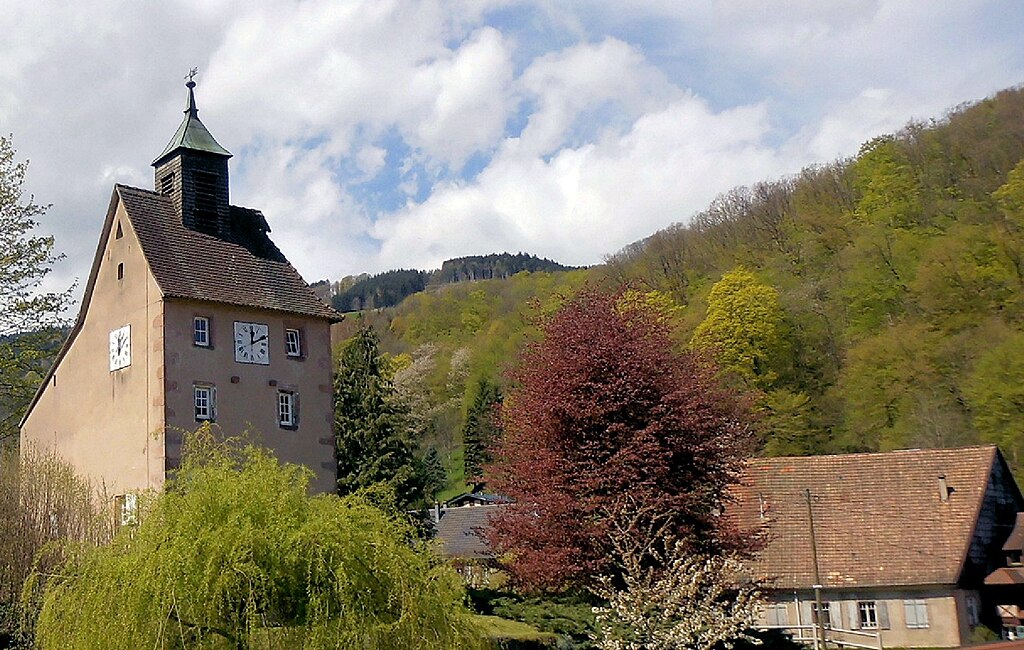
The miners' tower at Echery.
Image source: Wikipedia / Von Rauenstein - Selbst fotografiert, CC BY-SA 3.0

In the hope that this will grow into a series, here's my nucleus list of blog entries exploring name/place connections:

  1. Wolff (named after the Wolffskotten farm in Styrum);
  2. Zeuzheim; further details re. the Zeuzheim family
  3. Trimbach

Update 25.1.2026: I created a new portal to navigate family history blog entries in the shape of a permanent Who Is Who page. This is because the old webpage at michaelgross.info will go offline on February 2nd.

Monday, December 23, 2024

in vino veritas

If you've ever drunkenly looked at the label on a wine bottle and wondered why it doesn't list the ingredients, you'll find the sober answer in the first half of this book:

Understanding wine chemistry
Andrew Waterhouse, Gavin Sacks, David Jeffery
Wiley 2024

which systematically discusses all the molecules you may find in the bottle, from H2O and ethanol to the more complex ones. And then their reactions. The second half is about how wine is made, so essentially first part is chemistry for winemakers (and -lovers) and the second is winemaking for chemists.

All in all 560 pages, but for a more concise coverage read all about it in my latest essay review:

Wine science

Chemistry & Industry Volume 88, Issue 12, December 2024, Page 35

access via:

Wiley Online Library (paywalled PDF of the whole review section)

SCI (premium content, ie members only)

As always, I'm happy to send a PDF on request.

Monday, April 10, 2023

wandering wine

As the climate gets hotter, wine cultivars will have to move polewards to remain in favourable conditions (as I discussed previously in C&I). A recent massive genome study unravels the past moves of grapevines since their domestication so that's been a good excuse to write about wine and climate again, and also throw in a bit of family history (of which the longer version is here).

The resulting feature is out now:

Wine on the move

Current Biology Volume 33, Issue 7, 10. April 2023, Pages R239-R241

FREE access to full text and PDF download

See also my Mastodon thread where I highlighted all CB features of 2023.

I'm not on Instagram myself, but I believe if you follow CurrentBiology there, you'll find my features highlighted there as well.

Climate change has shifted the growth regions of traditional grapevine varieties, to the extent that merlot grapes can now be grown in Canada, as shown here in the Okanagan Valley, British Columbia. (Photo: laughingmango/Getty images.)

Friday, April 01, 2022

liquid history

Some thoughts on

A history of the world in six glasses

by Tom Standage

Atlantic Books 2007

While I don’t read about food if I can avoid it, I make exceptions for drink, especially wine. Still not my top priority, so it took me a while to get round to Tom Standage’s excellent liquid history of the world covering beer, wine, rum, coffee, tea and coca-cola.

I was mainly hoping to compare notes on things that I have also covered and may cover again, including the origins of agriculture and the socio-ecology of wine and coffee. Still, the other chapters were fascinating too, and maybe I should find an excuse to write about rum, or even tea. I’ll draw the line at coca cola.

The six drinks capture much of world history in a surprisingly neat series, with the three alcoholic ones leading the way and the three caffeinated ones catering for our more sober times. Water, the essential liquid of life and thus not a choice as such, only gets the epilogue.

The perspective is somewhat anglocentric, so manages to jump directly from the Roman Empire and its wine to the British colonies and their rum. I’m sure there must be a causal connection via French wine and cognac, but those “foreign” drinks only get a very fleeting mention as competition that the rum distillers had to overcome. So maybe not quite a complete history of the world, but an interesting read nonetheless.

Looking up the cover, I found out that the author has followed this up with an "edible history" - I'm sure it's fascinating, but I guess I'll stick with the liquids.

Wednesday, November 29, 2017

wine moves

Around harvest time this year, I wrote a feature on how climate change affects wine production (good news for English wines, not so good for French ones), which is out in the latest issue of Chemistry & Industry, and also on the cover (I objected to the grape/great puns but to no avail):


Grape expectations

Chemistry & Industry Volume 81, Issue 09, pages 22-25
DOI: 10.1002/cind.819_6.x

open access to full (HTML) text via SCI website

restricted access to PDF file via Wiley Online Library


Friday, March 13, 2015

migrating miners

When I investigated the possible Huguenot origins of my Bondame ancestors in the Palatinate region, I looked at a map of Huguenot settlements in German-speaking areas, which also showed one in Markirch / Sainte-Marie-aux-Mines in Alsace. As one of my ancestors in the Palatinate came from that little town, I was intrigued and wondered whether some of his folks may have also been Huguenots or other refugees for religious reasons.

The guy who left Markirch to settle at Böchingen in the Palatinate was Paul Simon (1740-1813). The name Simon is completely useless for internet searches as it is a very common family name and also a widely used Christian name, and both these things across several European languages (never mind the famous namesake). Moreover, the male line only spent a few decades at Markirch. Before that, the Simons came from the Hunsrück area (where in a separate Simon lineage we have seen the name become a family name based on the Christian name of the founding father).

Thus, I really needed to look at Paul Simon’s mother and grandmothers. His mother was called Maria Susanna Trimbach (1713-1752). So I did a search on “Trimbach Markirch” and on the first page of ten results there were three separate items of interest. First I learned that there is a Trimbach winery in that area to this day. This is the third name in that small part of my family tree that is being printed on wine labels as we speak, along with Klundt and Minges, but I’ll rave about this another day. Second, a gravestone still exists of a Jacob Trimbach who died in September 1649. I still need to work out how he relates to my Trimbachs.

And third, there was a whole research paper on migration of miners across Europe, with Fischbach and Markirch being the focal points, and migration routes leading onwards to France. Paul’s father Johann Christoph Simon was among the miners who migrated from Fischbach to Markirch, and as his marriage to Maria Susanna Trimbach is mentioned in the text, this document turned up in my search. I would never have been able to find it based on his name.

So that migration of the miners, broadly westbound, is in addition to the eastbound flight of the Huguenots who also settled at Markirch, as the map suggested. The town, which allegedly was the third-largest in upper Alsace (today’s department Haut-Rhin) until the 19th century, must have been an interesting place to be at the time. Here’s the potted history of the town, adapted from the French Wikipedia article:

From the 14th century through to the French revolution, the town was split in two parts, with the small river Lièpvre representing the frontier between separate territories, and after the reformation, between confessions. The right bank of the river was part of Alsace, German speaking, and under the rule of the lords of Rappolstein (Ribeaupierre). On the left bank it was ruled by the dukes of Lorraine, French speaking, and would remain catholic after the reformation.

The mining which gave the town its post-reunification name of Sainte-Marie-aux-Mines has been an important activity since the 10th century, but it was the rise of silver mining in the 16th century that brought affluence to the town, with its peak activity from around 1545 to 1580. However, mining ceased during the 30-years war (1618-1648) and was only revived in 1710-1711.

At that time, the counts of Rappolstein, who owned the German side of the town, had close links to the Hunsrück area through marriages with the house of the Wild and Rheingrafen who ruled there. As a result, there were close political connections between the areas from 1673 to 1776, which may explain the very lively migration of miners from the Hunsrück to Markirch, including my ancestor Johann Christoph Simon (1707-1756) and his brother Johann Jakob Simon (1703-1761).

This was part of a larger pattern of westwards migration of skilled workers often originating in the eastern German regions like Harz and Erzgebirge, and leading as far west as southwest France. The historians Hans-Eugen Bühler und H. Peter Brandt have analysed this phenomenon in a detailed study published in 2003: “Muster europäischer Migration im Bergbau des frühen 18. Jahrhunderts: Fischbach/Nahe und Markirch/Elsaß als Drehscheiben des Austauschs” which also features the Simon family, who must have arrived at Markirch before 1732 (the date of Johann Christoph’s first marriage there).

Those typically Lutheran miners arriving from Fischbach will have found an interesting multicultural scene at Markirch where there were five different religious affiliations to choose from, including Anabaptist, Lutheran, German Reformed (Calvinist), French Reformed (Huguenot), and Catholic (NB that’s only on the German side of town, there was a separate Catholic parish on the French side). I understand the Amish also have their roots at Markirch, resulting from a schism in the local Anabaptist community that occurred in 1693.

The origins of this diversity go back to 1566, when the count of Rappolstein, Eguenolf III, introduced the Lutheran creed (although he was officially subject of the catholic Habsburg empire). Soon after, the 1572 St. Bartholomew’s Day massacre in France brought a wave of Huguenot refugees, joined by Calvinists expelled from Lorraine by the duke Charles III in 1585, and the complete parish of Badonviller in Alsace, fleeing the count of Salm in 1625. It was a lively little refugee camp there, where worshippers were mainly divided by language. German services were held at a little chapel “in the fields” (Mattenkirch) and attended by refugees and miners alike, while the French-speaking protestants used Saint-Pierre-sur-l'Hâte.

The field chapel succumbed to arson in 1757 but was rebuilt three years later and served until 1867. It was there that a tombstone was discovered with the name of Jacob Trimbach, who died on September 3rd 1649.

In 1768, Paul married Anna Christine Jungbluth in Böchingen in the Palatinate and settled there. By that time, there wasn’t much opportunity left in mining at Markirch. The new game in town was textiles, which were to become the dominant industry in the 19th century.

Bühler and Brandt note in their paper the surprising mobility of skilled miners in the 18th century. Not only did they migrate half-way across Europe to find opportunities in new or reviving mining regions. They often stayed mobile over several generations, with Fischbach and Markirch serving as relais stations for onward migrations that led second and third generations of mobile families as far afield as western France.

In the case of my ancestors, however, onward migration led Paul out of the whole mining business and into a wine growing area (not sure what he did for a living, but almost everybody in Böchingen has some connection to wine making!) – maybe this has something to do with the fact that his mother was a Trimbach? That’s the Alsatian wine connection which I need to unravel some other time. (Oh, and there still is the possibility that some of Paul's non-Simon ancestors in Markirch actually were Huguenots. Stay tuned.)

Sainte-Marie-aux-Mines. Photo: Bernard Chenal / Wikipedia.

Monday, October 13, 2014

Klundt Clan

Migration in my family tree normally works like this – direct ancestors coming in (eg from Wallonia), and aunts/uncles going out (eg to Brazil). There is one married couple of direct ancestors, however, who emigrated to Russia and stayed there for the rest of their lives (to make matters worse, many of their great-grandchildren later emigrated to the US). Fortunately, their firstborn son and his family stayed in Germany, otherwise I wouldn’t be here now and you might be staring at an empty screen. So here comes a story of fearless migrants and wine makers:

Johannes Klundt was born November 2nd 1759 in Wollmesheim, a village near Landau in the Southern Palatinate, a traditional wine growing region, the second of five children of Konrad Klundt and Maria Johanna Bodang (this name appears to be a palatinate distortion of the French name Bonnedame). His parents had a very small vineyard there (just half a hectare), and some 3.5 ha other agricultural land. Splitting this between him and his older brother would have left too little for either party to survive.

Johannes married Eva Hust (1762-1837) in 1781 – she may also have a migration background, as the name Hust is almost non-existent in Germany, but there are lots of them in France and Belgium. They had five sons and a daughter, born between 1782 and 1805.

Moving out

At the beginning of the 19th century, the Russian Tsars actively encouraged settlers from southwest Germany to move to the Odessa area at north coast of the Black Sea, which was then a new addition to the Russian empire and is today part of Ukraine. A village called Rohrbach (today: Новосвітлівка - Novosvitlivka), some 120 km north-northeast of Odessa, was built in 1805 and the first German settlers arrived there in 1806. My ancestors Johannes Klundt and Eva Hust got there in 1809, after a journey of 80 days, most of which was done by ship (specifically, in improvised wooden boxes that were used one-way only) down the Danube.

Source

So who came along and who stayed behind? When Johannes Klundt left, his parents were no longer alive. We know that of his five sons, the first one, Johann Jacob (1782-1853; my four-times-great-grandfather), stayed behind. He had already set up his own family in nearby Godramstein, with his wife Katharina Barbara Müller (1781-1813) from that village and his son Georg Nicolas (1805-1851) who was to become a farmer and wine maker.

The second, Wilhelm (* 1785) was still unmarried and came along. Their only daughter Eva Catharina (* 1792) and two younger sons, Heinrich (1797-1851) and Johann Michael (1801-1876) were still children when the Klundts emigrated, so they came along by default and lived their lives in the German colony near the Black Sea. We don’t know what happened to the other son.

Johannes’s older brother Johann Jacob (1756-XXX) presumably inherited the modest house and land of Konrad Klundt and worked as a cooper and farmer. (There are two family vineyards called Klundt in neighbouring Mörzheim today (led by Sven Klundt and Walter Klundt), but we’re not sure exactly how they are related to this family.)

Intriguingly, one of the many Klundt descendants in Rohrbach, Heinrich’s granddaughter Katherina Klundt (1857-1949) later married a man called Johann Hust, who was also born in Rohrbach, which makes me think that a brother or cousin of our Eva Hust may have emigrated together with the Klundt family. We don't really know much about Eva Hust's family at all, except the names of her parents, so we don't know whom she left behind or may have taken along for the ride.

The four children who came along to Rohrbach between them provided Johannes and Eva with 26 grandchildren, who all (except one) appear to have stayed in the Odessa area all their lives. (Intriguingly the three sons contributed 13 grandsons carrying the name onwards). When Johannes died in 1833, and Eva in 1837, they left behind a healthy and thriving clan that seemed to have established itself in its now environment.

The village economy in general seemed to be doing well in those times, according to this report. Villagers grew large amounts of wheat, but also held sheep and produced some wine. The population of the village grew from 602 in 1816 to 1581 in 1859.

Moving on

From 1871 onwards (with a ten-year transition period), the colonists lost the privileges that they had enjoyed for two generations, and life on the Black Sea suddenly looked a lot less attractive. Apart from the loss of financial incentives, the young men were also facing the obligation of six years service in the Russian army. Thousands of German settlers emigrated again. The population of Rohrbach peaked in 1894, then dropped by a third, mainly as a consequence of migration to the US. Of the more than 60 great-grandchildren of our founding couple, at least 12 emigrated to the US, where they kept the reproduction rate up, so there must be hundreds of descendants of the Klundt families from Rohrbach in the US and also in some other parts of the world. They are listed here by a descendant of Heinrich and here by a descendant of Eva, but I haven't counted.

In 1884, Jacob Klundt (1855-1939), the eldest of Johannes's great-grandchildren, and his wife Maria Lutz (1854-1939) with their children (three were born in Russia, but not sure if all three survived) took the lead and emigrated to Mitchell County, South Dakota. Then they moved to the city of Alexander, South Dakota. Jacob’s mother, Juliana Kulatus (1835-1925), five brothers and one sister, Katherina (the one who married Johann Hust) joined them there in 1889. As the remaining three siblings and their father Heinrich Klundt had died before the emigration, this means the entire surviving clan moved to the US, where Juliana became a proud grandmother of 50. A bunch of Johann Michael’s grandchildren also emigrated to the US between 1893 and 1907, as did a few scattered individuals and families across the board. They had a lucky escape, because the 20th century held disaster in store for those settler families who stayed in Russia.

In 1889, the combined Klundt families moved to Dakem, North Dakota, on three covered wagons. During the years in South and North Dakota, Jacob Klundt and Maria Lutz had another eight children. They tried to establish a farming business there, but found the climate too different from what they were used to on the shores of the Black Sea.

Thus, in 1902, Jacob’s family (with ten children) migrated further west to Franklin County, Washington, where they bought land near the Snake River, north of the town of Walla Walla, from a Mr Page – after whom the location was named in 1903. Conrad’s family followed them, while Katherina and the other brothers stayed in North Dakota.

Until 1919, the Klundts ran a ferry across the river as well as their farm. Jacob’s son Charles Klundt became the first postmaster of Page when a post office was installed in 1903, later to be followed by two of his brothers.

The Klundts also set up a shop, a church, and fisheries. They also established a modest vineyard of two acres and actually produced wine. This makes me think that they probably handed down their wine-making traditions over the generations since they left the palatinate, and also grew vines in Rohrbach. For a more detailed account of their lives in the US, see the historical sketch provided on this page. The village of Page no longer exists, sadly, as it disappeared under water in 1961, when a dam was built on the Snake River. But there are a lot of vines growing on the slopes near the Snake river nowadays, and maybe the Klundts have something to do with that.

So the bottom line is I have every excuse to obsess about wine, it runs in or veins …

Note: Alternative spellings of the name in old records include Clund, Klund, Chlundt.
Thursday, February 16, 2012

miscellaneous musings

rounding up the last two months worth of German pieces, I have the miraculous interconversion of spider glue and barnacle cement, the wine diet, barcodes and autism. Here goes:

Chemie in unserer Zeit 46, Nr 1, 6
Naturstoffe: Seide aus Beton
Abstract and FREE access to PDF file

Nachrichten aus der Chemie 59, Nr 2, 111
Ausgeforscht: Na denn, prost!

Nachrichten aus der Chemie 59, Nr 2, 137-8
Blickpunkt Biowissenschaften: Barcodes für Tiere und Pflanzen

Spektrum der Wissenschaft Nr 1, 24-26
Autismus: neue genetische Fährten

plus a late arrival from last December:

Trillium Report 9 Nr 4, 211-212
Astrobiologie: Lebenszeichen aus dem All


writer's fuel

Astrobiology diffracted through a glass of Cotes du Rhone ...

Tuesday, December 20, 2011

the right diet for me

review of:

The wine diet
Roger Corder
Sphere, 2007


I may be a bit biased, as I am very partial for a glass of Côtes du Rhone and a bit of dark (>70%) chocolate, so any book that tells me these two are good for me already has one bonus point. On the other hand, I’m not much of a foodie and wouldn’t normally dream of buying a book that has “diet” in the title, so I guess that cancels out.

My lifestyle choices and agreement with the author’s opinion apart, this is an interesting blend of popular science writing and nutrition advice including recipes, all informed by the author’s own research into the effects that one group of chemicals found in red wine and fruit has on the lining of our blood vessels and hence on the health of our heart and circulation.

The short message is that oligomeric procyanidins (and not the more widely known resveratrol) are the likely cause of the “French” paradox, namely the unusually long life expectancy of people in Southern France and other places where a Mediterranean lifestyle is cultivated (Sardinia is the place to be, apparently, if you want to live to 100!). These polyphenols are present in certain red wines (especially in those produced following more traditional procedures), as well as in fruit and berries including cranberries, pomegranate, and raspberries. As these molecules have an adstringent effect as well, modern food processing methods tend to do what they can to remove or destroy them.

The author is very eloquent at explaining what - according to recent research from his lab and others - is good for us, and manages to debunk some “voodoo science” along the way, including the excessive cult of antioxidants. Very interesting read – obviously even more satisfactory if you happen to like the kind of food he recommends.

Friday, April 01, 2011

oddbins run dry

the Guardian reports it's the end of the road for mildly eccentric wine merchants chain OddBins, which happens to be my age. I loved their crazy catalogue graphics and used to buy my Havana Club (Cuban rum) from there, but I have to say that at least in the last three years, when I did some exploratory wine shopping, they never had any Cotes du Rhone bottles that might have tempted me. I mostly ended up importing them from the continent or buying them at M&S.

Just recently, I picked up brochure called "Oddyssey" from one of the branches (we have three within easy cycling distance), which relates the intriguing history of the chain, now looking certain to be coming to an end.

Here is a photo of the branch on Oxford's High Street,taken just a few days ago:


PS Possibly one of the last bottles they sold before going into administration arrived at my house just yesterday, it was the prize for spotting the odd book title that won the Diagram Prize.

Thursday, January 20, 2011

chocolate and wine

review of:

Chocolate unwrapped, by Sarah Jane Evans
Pavilion, Oct. 2010


As someone who likes to match up red wine (Cotes du Rhone) with dark chocolate (70% cocoa solids or more) I was intrigued to see that the wine critic of BBC Good Food magazine has published a book about chocolate. I should warn you that the word “chocolate” is used in the narrow sense here – if you like your “dairy milk” bars containing vegetable oil instead of cocoa butter, you’ve probably dialled the wrong number.

The book opens with a 50-page introduction into the history and production of chocolate, complete with a how-to guide to tasting. This is followed by an alphabetical compendium of some 80 brands of chocolate from around the world, from Akesson’s to Zotter. Each gets two pages, and from each brand one bar, 70% or nearest offer, is marked up with flavour notes where the author’s main job as a wine critic shines through.

The first part is well written and contains lots of interesting facts, both from food science and history. Chocolate feels smooth, for instance, only if the particle size is 30 micrometres or less. I also learned that more than half the world production of cocoa beans comes from just two countries, namely Ghana and Cote d’Ivoire. And that the UK insisted on EU rules permitting up to 5% vegetable fat in “chocolate.” Remember to read the list of ingredients before you buy any. The good news, though, is that the appreciation of real chocolate, made from fairly traded ingredients of well-defined origin, seems to be a growing trend even in Cadbury-infested places like the UK.

The list of chocolate brands is also surprisingly readable, thanks in part to the interesting mix of people who at some point of their life decide that their vocation is to produce chocolate. (Having read the first part of the book describing the difficulties involved, you know that they have to be a bit mad to choose this as a career!) While there are of course those who have inherited a family business or come from a background of patisserie or other fine food, there is the odd scientist, lawyer, and management consultant sprinkled in who discovers in mid-life that the quest for the perfect chocolate bar might be more satisfying than whatever they were doing in their previous career.

On top of that, the book is mouthwateringly illustrated with colour photos of lots of chocolate bars, details of the production process, and the plants. And it is beautifully produced, inside and out. Considering this, the book is very good value. Quite a few of the chocolates introduced here will probably cost more per weight.


PS I’ve bought Divine for a while, which is included in the list, but my current, very affordable favourite is the cooperative’s own brand “truly irresistible Fairtrade dark chocolate” with 85% cocoa solids, which sadly isn’t included in the list.

Tuesday, October 12, 2010

wine, games, and geometry

Articles out in German this month include circled squares, quiz chemistry, the science of wine, and the computer game that folds proteins:

Die Quadratur des Kohlenstoffs, Chemie in unserer Zeit 44, 317, DOI: 10.1002/ciuz.201090063
abstract and access to pdf
(my blog entry on this story in English)

Ausgeforscht: Quizfragen für Computer, Nachrichten aus der Chemie 58, 1002.

Biowissenschaften: In vino Wissenschaft, Nachrichten aus der Chemie 58, 1028.

Proteinfaltung als Computerspiel, Spektrum der Wissenschaft Nr 10, 16.
full text
(my blog entry on this story in English)

Oh, and talking about protein folding, here's a swan folding back its flexible domain onto the compact core domain:

Wednesday, May 19, 2010

cotes du rhone villages

I only found out in my late 20s that I really like the red wines of the Cotes du Rhone area (apologies for the bad spelling, does anybody know how to produce an accent circonflexe in HTML???), and have in recent years managed to pin my preferences down more precisely and learned to distinguish the various "Appellation Controlée" labels of the region (AOC). By sheer coincidence, some of my French relatives moved to the area that produces my favourite wines, so if I recognise a place name that I remember from driving through on my way to visit them, that usually means I will like the wine.


Among the many villages that produce Cotes du Rhone, only around 90 are allowed to put Cotes du Rhone Villages AOC on the label. Even more selective is the AOC Cotes du Rhone Villages followed by the name of a village - only 18 villages have the right to append their name, and here in the UK it is mighty difficult to find these wines. I have found such wines from Rasteau, Plan de Dieu and Saint Maurice at Marks and Spencers, and Valréas at the co-op. Still looking for sources for the other 14.

Two of the villages in the area have gained the right to their own AOC, namely Gigondas and Vacqueyras. Gigondas is typically outside of the range I am prepared to pay (as is the Chateauneuf du Pape), but Vacqueyras is usually affordable and very good. Just to make sure people don't overlook it, both villages put their name not only on the label but also emblazon it in the actual glass of the bottle:


PS. Wikipedia tells me that 2009 is an exceptionally good vintage, so be prepared for further ravings when that wine arrives ...

Wednesday, February 13, 2008

biodiversity in the vineyard

As I mentioned earlier, Earthwatch has a new project in this year's expedition guide, which looks at biodiversity in the vineyard and at ways in which increased biodiversity can be used to protect the crop.

I've now done a short feature in Current Biology about this project. Sadly I haven't had time to investigate the matter in situ.

Thursday, February 07, 2008

Wein, Weib und Gesang

As the old saying goes, men need "Wein, Weib und Gesang", i. e. wine, women and singing, to keep themselves amused. In the round-up of my German publications for February, there's wine and singing all right. Shame that the long-haired creatures that complete the triplet turn out to be bacteria ...

Groß M:
Chemie in unserer Zeit 42, Nr 1, 6
Pflanzenzüchtung: Ein Prosit dem Wein-Genom

Groß M:
Nachrichten aus der Chemie 56, Nr 2, 120
Ausgeforscht: Wo man singt ...

Groß M:
Nachrichten aus der Chemie 56, Nr 2, 148
Blickpunkt Biowissenschaften: Bakterien am Schopf gepackt

Wednesday, February 06, 2008

cupid's chemistry

As Valentine's day is approaching fast, I have updated my Cupid's chemistry pages, which contain details of the book "Lust and Love -- is it more than chemistry?" by Gabi and Rolf Froböse. I translated and edited this book based on the German original.

So if you're still looking for a V day present for that loved (and/or lusted) person in your life, check it out.

I also did a feature article called Cupid's chemistry a couple of years ago. One day, I'll write a book of my own on this topic, just need to do some more field research ...

Tuesday, August 28, 2007

heard it on the grapevine

As you slurp your well-deserved bordeaux or beaujolais, spare a thought for the complex genetics giving your wine that rich taste. A consortium of genome researchers from France and Italy has now presented a draft version of the genome of the grapevine. Among interesting insights into the evolution of flowering plants, they also discovered that the genes responsible for health-beneficial compounds such as resveratrol, and those responsible for flavours, are massively overrepresented in comparison with the genomes of other plants.

Read my story here.