Showing posts with label hamborn. Show all posts

Sunday, December 07, 2025

what happened in Hamborn

I'm trying to figure out what happened to the ca. 15 children of the East Prussian patchwork family we met in the Every picture series, so let's tag the three patches. There are the litters Faust 1 and Faust 2 sharing Franz Faust (1857-1938) as a father, and the Wittke family from Wilhelmine Domscheit's (1863-1942) first marriage.

Of the (at least) four children of Faust 2, we know that the sisters Auguste and Hanna moved west to the short-lived industrial city of Hamborn in the 1920s, wheras Luise landed in Lippstadt via a refugee camp in Denmark so presumably stayed in East Prussia until January 1945. We know that their brother Otto Faust (born 1895 as the first child of Faust 2) died in January 1945 in the attempt to defend East Prussia.

Browsing lots of address books of Duisburg, I now discovered that the semi-mysterious aunt Therese Vietz (who could be from any of the patches) also lived in Hamborn for several decades, actually two doors down from her sister Hanna. So from 1950 to 1980 we have three patchwork sisters living on a geographically very limited patch in the former city of Hamborn, now part of Duisburg, less than a mile apart.

The iconic town hall of Hamborn, which reminds me of the one at Elberfeld, built only a few years earlier.
Own photo. More photos from my recent visit to Hamborn in this flickr album.

So to gain some clarity I need to spell this out as a timeline. Dates before 1950 are from documents and addresses on envelopes; from 1950 onwards from the excellent collection of addressbooks of Duisburg) in the city archives.

Timeline: 100 years in Hamborn

1922 13.10. Auguste registers at Weseler Str. 95 as a lodger with a resident called Hirsch. At the time, Weseler Str. and especially its intersection with Kaiser Wilhelm Str. were becoming the big shopping destination in the new city, with the Arnold Pollmann department store completed in 1929, after which the area is now named Pollmannkreuz.

1923 2.2. Auguste moves to Wittfelderstr. 189a (still in Hamborn but on the southern edge of the city).

1923 23.3. Auguste marries Ernst.

1924 2.8.; 21.11. They live at Kampstr. 140a, which is the northern edge of the Dichterviertel (poets'/writers' quarter) , a major development of workers' accommodation built by the Thyssen company (mines and steelworks).

By 1927 they move one block further east to Knappenstraße 43 which may have been new then, as this northeastern part of the Dichterviertel was developed later than the bit around Goethestraße.

1930s Auguste's sister Hanna and her husband Fritz Krieger also live in Knappenstr., at number 51 (based on a list of residents compiled by Auguste's son born 1926 who refers to the residents listed as the "Ureinwohner", ie original or indigenous residents). Other neighbours include the Kuhwald family.

section of a map from 1936. Schachtstraße is on the left under the red number 15, Knappenstraße runs diagonally into the top right corner. Hamborn town hall, post office, and the protestant church where Auguste and Ernst married are all on the large through road Duisburger Straße just southwest of the centre of this map. Although chronically overrun by cars now, it is essentially a 15 minute city, as everything is within walking distance and there are trams too.

1943 Hanna and Fritz now live Schachtstr. 27.

1945 Ernst dies, Auguste continues to live in Knappenstraße 43 with her sons.

1950 Therese now lives in Schachtstraße 23, two doors down from Hanna and Fritz. Therese is recorded as a widow in the address book of 1950, but we don't now what happened to Mr Vietz (or even what his first name was). We also don't know whether Therese arrived at Hamborn before the war like Hanna and Auguste or whether she had to flee from East Prussia like Luise.

1973 last addressbook entry for Auguste and her son Erwin in Knappenstraße.

Around 1975 Auguste has to leave her home of five decades in Knappenstraße as the site is cleared for a new development. She moves to Obere Holtener Str. 87. This is on the northeastern edge of Hamborn, the street leading towards Holten which is now part of Oberhausen. She was in a way unlucky to be in the newer and less coherent part of the Dichterviertel, as the older part around Goethestrasse has largely survived to this day (see my photos from Goethestraße on flickr). As do the Schachtstrasse houses where Hanna and Therese lived for several decades.

1977 First addressbook entry for Auguste and Erwin in Obere Holtener Str. In Knappenstraße, the odd numbers from 29 to 59 are now missing from the address book.

1979 Auguste dies. Two of her sons still live in Hamborn. Therese and the Kriegers are still living in Schachtstraße. The town of Walsum, which in 1975 also became part of Duisburg, also has a street called Schachtstraße. Therefore:

by 1981 the former Schachtstraße has become Dr-Heinrich-Laakmann-Straße, named after a catholic priest who taught at the nearby Abteischule and died in Hamborn. Therese is still there in the address book of 1981, but the Kriegers no more.

1982 Last entry for Therese Vietz in the address books.

1984 Therese Vietz no longer appears in the address book.

2015 The last survivor of Auguste's sons dies in Hamborn.

2025 A new development of 80 homes goes up on the north side of Knappenstrasse. where the lower odd house numbers must have been. Google Street View shows vegetation on that side of the road right now, and then the 1970s four-storey apartment blocks from around number 47 onwards. So maybe the development in the 70s never extended to this area of the new project? Meanwhile the relevant houses in the former Schachtstrasse are looking really lovely on Street View.

Resources

  • Lovely website from Duisburg city about the district Hamborn.
  • History of the Dichterviertel (in German), the area of which Knappenstrasse is a part.
  • Havenburn, Hamborn, Duisburg-Hamborn: Geschichte und Geschichten. Walter Braun Verlag Duisburg 1979. I found a copy of this at a book exchange when I visited.

PS some of the patchwork grandchildren emigrated to Australia in the 1950s, so if anybody down there sees this and has ancestors in East Prussia named Faust, Domscheit, Wittke or Witt, do let me know.

Update 25.1.2026: I created a new portal to navigate family history blog entries in the shape of a permanent Who Is Who page. This is because the old webpage at michaelgross.info will go offline on February 2nd.

Thursday, January 18, 2024

streets of Hamborn

Every picture tells a story, season 3, picture 14:

Auguste from the East Prussian patchwork family lived at Hamborn (now Duisburg) most of her life, spending more than 40 years at Knappenstraße 43 from the late 1920s to around 1970. We have seen the front door of that building here and here. To get a better sense of the place, here is Auguste looking out of her window (street side I think):

and here is a view of her garden with her son Erwin:

Before moving to Knappenstraße, she and her family briefly lived in Kampstraße, where we see her looking out of the window (marked with a pen):

Should anybody have any answers to some of the many questions I am raising in this series, please leave a comment here (I'll need to vet it, so it may take a few days before it goes public) or contact me at michaelgrr [at] yahoo [dot] co [dot] uk

Navigation tools:

Season 3 so far:

  1. family holiday
  2. play time
  3. fashion show
  4. bakery to butcher's shop
  5. the Hamborn brotherhood
  6. all grown up
  7. sisters in the snow
  8. the last holiday
  9. village life
  10. family reshuffle
  11. push bike
  12. mystery trio
  13. confirmands at Hamborn
  14. streets of Hamborn

The Mastodon thread for season 3 is here.

You can find Season 2 entries in this thread on Mastodon (complete now!) or via the list at the bottom of the last entry of the season (and also at the bottom of the first entry of this season).

The twitter thread for season 1 is still here. Alternatively, visit the last instalment and find the numbered list of entries at the bottom.

Thursday, January 11, 2024

confirmands at Hamborn

Every picture tells a story, season 3, picture 13:

Let's have a game of "Where is Wally?" Below is Werner, the youngest of the Hamborn brotherhood, on the day of his confirmation, which happened at the Lutherkirche, Obermarxloh (which was part of the city of Hamborn while it existed - even if today the church stands in Röttgersbach) in 1951. Funnily enough, everybody else is there too. Catholics tend to get individual portrait of each kid with a candle (eg young Willy here) - protestants get the group photo. Wonder if that's just protestant penny-pinching? Or an emphasis on being admitted to the faith community, versus an emphasis on personal enlightenment? In any case, I shouldn't moan because I love this group photo with the low light and the crumbling classicistic church (built 1913, restored in the 1950s, listed monument since 2012) as the background:

To make it easier, I offer you another group photo, this one is from Werner's school a couple of years earlier, and he is marked with a pen.

This one has a rubber stamp on the back saying:
Foto-Kempken
Duisburg-Hamborn
Alleestra&szllig;e 93
18. Mai 1949

NB I have now created a Hamborn tag.

Should anybody have any answers to some of the many questions I am raising in this series, please leave a comment here (I'll need to vet it, so it may take a few days before it goes public) or contact me at michaelgrr [at] yahoo [dot] co [dot] uk

Navigation tools:

Season 3 so far:

  1. family holiday
  2. play time
  3. fashion show
  4. bakery to butcher's shop
  5. the Hamborn brotherhood
  6. all grown up
  7. sisters in the snow
  8. the last holiday
  9. village life
  10. family reshuffle
  11. push bike
  12. mystery trio
  13. confirmation at Hamborn

The Mastodon thread for season 3 is here.

You can find Season 2 entries in this thread on Mastodon (complete now!) or via the list at the bottom of the last entry of the season (and also at the bottom of the first entry of this season).

The twitter thread for season 1 is still here. Alternatively, visit the last instalment and find the numbered list of entries at the bottom.

Thursday, November 16, 2023

all grown up

Every picture tells a story, season 3, picture 6:

We saw the Hamborn brothers growing up last time, so here they are all grown up now.

The oldest working in the postal service (then still Deutsche Bundespost, with virtually all employees enjoying the benefits of being civil servants, Beamte), still at Hamborn:

whereas the other two went to work in the steel industry in Duisburg. Here's the middle one on holiday (don't have any pics of him at work I'm afraid, otherwise I would have called this entry men at work). I have absolutely no idea where this is, most likely southern Germany or possibly Austria:

and the youngest at his workplace (fourth from left), hopefully after the end of the shift:

Photos are all undated, but the first two should all be from the 1950s, the last one more likely 60s to possibly early 70s

Should anybody have any answers to some of the many questions I am raising in this series, please leave a comment here (I'll need to vet it, so it may take a few days before it goes public) or contact me at michaelgrr [at] yahoo [dot] co [dot] uk

Navigation tools:

Season 3 so far:

  1. family holiday
  2. play time
  3. fashion show
  4. bakery to butcher's shop
  5. the Hamborn brotherhood
  6. all grown up

The Mastodon thread for season 3 starts here.

You can find Season 2 entries in this thread on Mastodon (complete now!) or via the list at the bottom of the last entry of the season (and also at the bottom of the first entry of this season).

The twitter thread for season 1 is still here. Alternatively, visit the last instalment and find the numbered list of entries at the bottom.

Thursday, November 02, 2023

the Hamborn brotherhood

Every picture tells a story, season 3, picture 5:

Earlier in the series we have met Ernst Leopold Kosmowsky the steel worker, his wife Luise Auguste Faust, and his mother Auguste Adschuck. Here they are united in one lovely family portrait from the 1930s, with the couple's three surviving children (the firstborn son had died in infancy).

And here are the brothers a few years later:

The family lived in the industrial city of Hamborn on the river Rhine, which became a part of Duisburg in 1929.

We have seen the Faust family earlier (the East Prussian patchwork family), but we still don't have a photo of Ernst Leopold's father, Friedrich Kosmowsky, born Gerdauen, East Prussia 1862, died there before 1923,

Should anybody have any answers to some of the many questions I am raising in this series, please leave a comment here (I'll need to vet it, so it may take a few days before it goes public) or contact me at michaelgrr [at] yahoo [dot] co [dot] uk

Navigation tools:

Season 3 so far:

  1. family holiday
  2. play time
  3. fashion show
  4. bakery to butcher's shop
  5. the brotherhood of Hamborn

The Mastodon thread for season 3 starts here.

You can find Season 2 entries in this thread on Mastodon (complete now!) or via the list at the bottom of the last entry of the season (and also at the bottom of the first entry of this season).

The twitter thread for season 1 is still here. Alternatively, visit the last instalment and find the numbered list of entries at the bottom.

Thursday, June 01, 2023

neighbours at Hamborn

Every picture tells a story, season 2, picture 37:

Ernst Leopold the steel worker and Auguste from the East Prussian patchwork family settled in Hamborn (now part of Duisburg) and brought up their three sons there. Another son had died less than two months old. The Kosmowsky family lived in Knappenstraße 43 from 1927 (at least, possibly as early as 1925) until the late 1960s or early 70s, when the building was cleared to be demolished (strangely, we haven't been able to find a date for that).

The street harboured a tight-knit community – at the age of 77 the oldest surviving son was still able to compile a name of the “indigenous” residents with hundreds of names.

From this we learn that neighbours in the same house included Heinz, Karin and Christel Kuhwald, who appear to have been the same age as youngest son Werner. I believe we saw young Karin sitting on the steps in the entry about Tante Therese, although back then I didn’t know who she was.

Judging by the photos, young Werner got on well with the girls and they even appear to have gone on holidays together.

In vaguely chronological order, here's young Werner in ca. 1943 with all the Kuhwald kids and their mother, Anni:

I love this undated photo of Werner with Karin - note the photo on the wall which appears to show Anni with all three children, so this was probably taken in the Kuhwald flat:

Here he is with Christel, undated (the photo has this tilt, it's not my fault!):

and apparently on holiday in the mountains with both of them.

Other parties in Number 43 were Ursula and Erika Hölscher, Günter and Marianne Gruczka, and somebody called Herzog. Note that the list is from the perspective of the boys, so any first names are more likely to be those of the children of the respective households, rather than the parents.

On the list of indigenous residents we also find Auguste’s sister Johanna and her husband Fritz Krieger in number 51. I might type out the whole list at one point, but want to keep it separate from this post about the residents of number 43.

Should anybody have any answers to some of the many questions I am raising in this series, please leave a comment here (I'll need to vet it, so it may take a few days before it goes public) or contact me at michaelgrr [at] yahoo [dot] co [dot] uk

Navigation tools:

Season 2 so far:

  1. could be a cousin
  2. two weddings in Silesia
  3. off to Canada
  4. off to Australia
  5. a very romantic poet
  6. fireman August
  7. 50 hundredweight of coffee
  8. mysterious Minden people
  9. horses for Hedwig
  10. guessing the great-grandmothers
  11. cousin Charlotte
  12. three sisters from East Prussia
  13. travelling saleswoman
  14. family portrait
  15. dancing chemist
  16. games time
  17. desperately searching Wilhelm
  18. the third Hedwig
  19. patchwork portraits
  20. missing brothers
  21. the oberlehrer's family
  22. a double wedding
  23. mystery solved
  24. young Frieda
  25. old aunts and young children
  26. a semi-mysterious aunt
  27. a gathering at Gellrichs
  28. farm work at Bad Landeck
  29. meet the Weitze family
  30. a post-war wedding
  31. the joy of chemistry
  32. the joy of botany
  33. becoming Frieda
  34. becoming Peter
  35. bakery kids united
  36. the four from the farm
  37. neighbours at Hamborn

I started a twitter thread for season 2 here. However, as the bird site seems to be turning into an evil empire, I have now switched to logging the entries in a similar thread on Mastodon.

The twitter thread for season 1 is still here. It only loads 30 tweets at first, so you have to click "show more" a couple of times to get all 40 entries. Alternatively, visit the last instalment and find the numbered list of entries at the bottom.

I'm also adding all photos from this series to my family history album on flickr.

Thursday, March 09, 2023

a semi-mysterious aunt

Every picture tells a story, season 2, picture 26.

Aunt Therese, who appears in the photos below, is semi-mysterious because we know whose aunt she is, but not whose sister she is. She could be a sister of Ernst Leopold the steelworker or of his wife Auguste, or indeed one of Auguste's half siblings from the earlier patches of the East Prussian patchwork family. Thus, Therese's maiden name can have been any of these three: Kosmowsky, Faust, Wittke.

Ernst and Auguste's son Fritz labelled the photos below quite carefully, saying that the lady on the right is called Therese Vietz and is his aunt. However, in a list of allegedly all the siblings of his father he didn't include her. In a list of the siblings of Auguste, he didn't include her either, but at least he didn't claim the list to be complete and he admitted to being a bit hazy about the earlier patches of the patchwork. Hence my guess that she might fit in there but we don't really know. We don't know either what became of the Mr Vietz she appears to have married.

So, well, here comes the semi-mysterious aunt first in 1950 outside Auguste's home in Knappenstraße 43, Duisburg-Hamborn (we've seen Auguste entering that very same door here). The other woman is a neighbour called Frau Majer, who lived in number 51, where Auguste's sister Johanna also lived with her husband Fritz Krieger (both appeared here). The girl is Karin and the dog Molly. No idea who these two belong to.

I love the light in this photo.

And then with Fritz's wife Mathilde in their flat in 1953:

Looking for Vietz people on GedBas, I found this family which was active in Kreis Wehlau, like Auguste's paternal line, and featured a marriage with a Witt woman (one of the daughters of the Wittke patch in East Prussia also married a Witt), so it appears entirely possible that Therese found her husband in East Prussia. The most recent Vietz in that database is Johann Friedrich Wilhelm Vietz 1872-1915.

Should anybody have any answers to some of the many questions I am raising in this series, please leave a comment here (I'll need to vet it, so it may take a few days before it goes public) or contact me at michaelgrr [at] yahoo [dot] co [dot] uk

Navigation tools:

Season 2 so far:

  1. could be a cousin
  2. two weddings in Silesia
  3. off to Canada
  4. off to Australia
  5. a very romantic poet
  6. fireman August
  7. 50 hundredweight of coffee
  8. mysterious Minden people
  9. horses for Hedwig
  10. guessing the great-grandmothers
  11. cousin Charlotte
  12. three sisters
  13. travelling saleswoman
  14. family portrait
  15. dancing chemist
  16. games time
  17. desperately searching Wilhelm
  18. the third Hedwig
  19. patchwork portraits
  20. missing brothers
  21. the oberlehrer's family
  22. a double wedding
  23. mystery solved
  24. young Frieda
  25. old aunts and young children
  26. a semi-mysterious aunt

I started a twitter thread for season 2 here. However, as the bird site seems to be turning into an evil empire, I have now switched to logging the entries in a similar thread on Mastodon.

The twitter thread for season 1 is still here. It only loads 30 tweets at first, so you have to click "show more" a couple of times to get all 40 entries. Alternatively, visit the last instalment and find the numbered list of entries at the bottom.

I'm also adding all photos from this series to my family history album on flickr.

Thursday, June 16, 2022

open doors

Every picture tells a story No. 40

Season finale - as the list of entries gets a bit unwieldy, I am going to close this door and open another one in a few weeks time.

Auguste from the East Prussian patchwork family, who worked in Allenburg at the bottom of the steps moved to Hamborn on the river Rhine (now part of Duisburg) in October 1922, aged 24. The following year she married fellow East Prussian Ernst Leopold and stayed at Hamborn the rest of her life.

She lived there at four different addresses over the years, here she is entering the house in Knappenstraße 43, where she lived with her family from the 1920s through to the mid 1960s, in a photo dating from the 1950s:

Knappe in this context refers to a skilled miner working below ground. Although it's emphatically not named after a poet or writer, the Knappenstraße is part of the poets' quarter (see also this link), a large housing development built between 1905 and 1924 for workers of the rapidly growing steel and mining industries. A photo of the street appears in this document on page 22.

This photo is also on flickr.

Every picture tells a story series - season 1 now complete:

  1. string quartet Wuppertal Elberfeld 1927
  2. greetings from Adamsweiler
  3. Gastwirthschaft Ferd. Weirich
  4. quartet times three
  5. Neumühl 1923
  6. Tangermünde railway station 1889
  7. a singing lesson
  8. bei Wilhelm Geppert
  9. a bakery at Lorsch 1900
  10. Consumgeschäft von Julius Düsselmann
  11. Hanna and Ruth
  12. a young chemist
  13. school's out at Reichenstein, 1886
  14. a patchwork family in East Prussia
  15. the case of the missing grandmother
  16. checkpoint Glaner Brücke 1929(ish)
  17. finding Mimi
  18. five sisters, five decades
  19. happy at home
  20. gone milking
  21. steel workers
  22. field work
  23. what to wear at Porta Westfalica
  24. a classic convertible
  25. at the bottom of the steps
  26. a forester's family
  27. the Kaiser visits Allenburg
  28. teaching the 'deaf-mute'
  29. a guard dog called Schluck
  30. party like it's 1956
  31. the case of the mysterious uncle
  32. three Hedwigs and a baby
  33. a lost generation
  34. lost illusions
  35. pursued by a bear
  36. three daughters
  37. happy 240th birthday
  38. three sisters
  39. wedding styles
  40. open doors

Alternatively, you can use this twitter thread as an illustrated table of contents.

In a somewhat roundabout way, this series relates to my research for the family history music memoir I have now completed in a first version.

Thursday, January 20, 2022

steel workers

Every picture tells a story No. 21

Ernst Leopold Kosmowsky from East Prussia (son of Auguste the missing granny, brother of Friedrich with the fiddle) moved to the rapidly growing industrial city of Hamborn in October 1922 to find work there. He worked in mining at first, but from August 1938 he was employed as a Brenner (burner?) at the steelcast factory Friedrich-Wilhelms-Hütte at nearby Mülheim.

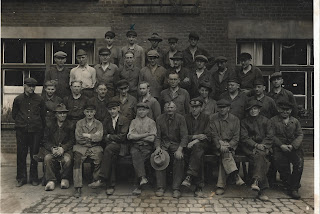
The photo shows him (top row, marked with a cross) with his colleagues around 1941. It strikes me that he and some of the others are looking quite cheerful - suppose at that point being an essential worker in the steel industry was preferable to being cannon fodder at the front.

Ernst Leopold and Auguste from the East Prussian patchwork family moved to Hamborn in the same month and got married the following year, so we assume that this was a coordinated project, but we don't have any explicit information on that. Their shared migration background was wiped from the collective memory fairly swiftly.

This photo is also on flickr.

Every picture tells a story series so far:

  1. string quartet Wuppertal Elberfeld 1927
  2. greetings from Adamsweiler
  3. Gastwirthschaft Ferd. Weirich
  4. quartet times three
  5. Neumühl 1923
  6. Tangermünde railway station 1889
  7. a singing lesson
  8. bei Wilhelm Geppert
  9. a bakery at Lorsch 1900
  10. Consumgeschäft von Julius Düsselmann
  11. Hanna and Ruth
  12. a young chemist
  13. school's out at Reichenstein, 1886
  14. a patchwork family in East Prussia
  15. the case of the missing grandmother
  16. checkpoint Glaner Brücke 1929(ish)
  17. finding Mimi
  18. five sisters, five decades
  19. happy at home
  20. gone milking
  21. steel workers

Alternatively, you can use this twitter thread as an illustrated table of contents.

In a somewhat roundabout way, this series relates to my research for the family history music memoir I have now completed in a first version.

Thursday, December 09, 2021

the case of the missing grandmother

Every picture tells a story, No. 15

Staying in East Prussia, here's another mystery that needs solving. Auguste Adschuck, born around 1865, died in January 1945 in the turbulences at the end of World War II, somewhere between East Prussia and the river Oder, so in today's Poland. The first version I heard was that after visiting family in the West she was trying to get back home to East Prussia. Written notes from one of her grandchildren now suggest she was fleeing from East Prussia to the West, which makes more sense. At a push, both versions could be true if she was attempting to return East and then had to turn around and flee westwards.

From a family portrait dated 1930.

We have no documentation of her birth, marriage or death, so even the name could be spelled differently. It sounds to me like it may have been a Polish name originally (maybe a longer one like Solodczuk) and there are multiple versions to be found in East Prussia including Odzuk, Odczuk, Otsick, Atschuk, etc. Her husband (Friedrich Kosmowsky) was born in Gerdauen, so for lack of a better clue it makes sense to look there. This website with church records from Kreis Gerdauen has some Adschuck entries, as well as Adschack and other variants, but nothing that could immediately be linked to her.

She had three daughter and five sons. The only two for whom we have birth details were born in 1899 and 1904 in Ernstwalde, Kr. Wehlau (just north of Kr. Gerdauen), so that's another clue. The sons include Friedrich on the fiddle photo (No. 5), as well as Ernst Leopold whose family appears in the photo from which I clipped her portrait. Descendants of her three daughters go by the surnames of Kalippke, Cichy, and Popp. All three surnames turn up in the Gerdauen database, although not necessarily with the specific people we're looking for.

This photo is also on flickr.

Every picture tells a story series so far:

  1. string quartet Wuppertal Elberfeld 1927
  2. greetings from Adamsweiler
  3. Gastwirthschaft Ferd. Weirich
  4. quartet times three
  5. Neumühl 1923
  6. Tangermünde railway station 1889
  7. a singing lesson
  8. bei Wilhelm Geppert
  9. a bakery at Lorsch 1900
  10. Consumgeschäft von Julius Düsselmann
  11. Hanna and Ruth
  12. a young chemist
  13. school's out at Reichenstein, 1886
  14. a patchwork family in East Prussia
  15. the case of the missing grandmother

Twitter thread

Friday, April 09, 2021

a short-lived city

#lostcities bonus episode: Hamborn

When I was rounding up 10 cities which my ancestors inhabited between 1900 and 1970, it struck me that my in-laws were attached to one city during that time, but with a duration of stay that is unrivalled on my side. A young couple arrived in the industrial city of Hamborn (now part of Duisburg) from rural East Prussia in October 1922. She registered at the new residence on the 13th, he started work at the coal mine Gewerkschaft Friedrich Thyssen, Schacht 1/6 on the 23rd (and yes, I have the documents for both these dates). They married five months later and stayed at Hamborn the rest of their lives, which in her case meant more than 56 years. The last of their children died there in 2015, so that makes 92 years of family presence.

That’s real commitment to a place. The lifetime of Hamborn as a city was much shorter, however. After a decade of dramatic population growth, the village, which had only started to run a market in 1898, became a city in 1911. In 1929, its 132,000 inhabitants lost the fight against the all powerful neighbour and became part of Duisburg, initially as a conglomerate called Duisburg-Hamborn, but from 1935 simply as one of many districts of the city of Duisburg. Although many never accepted that state of things. Postcards were still printed with the line “Industriestadt Hamborn” (the example below dates from 1961, would you believe). Another city lost to the efficiency drive, like Rheydt on the other side of the river Rhine.

I borrowed the photo from the usual source, but we do in fact own a specimen of this postcard, and around 20 more. I've visited the attractions in the two frames at the top, but need to go back to see the old town hall and water tower in the one at the bottom left.

Update 25.6.2021: Der Spiegel reports that 20 railway lines are set to be revived, including (number 11 in the list) the one from Oberhausen to Wesel that serves the station at Hamborn. (The main line goes via Sterkrade and passes to the east of Hamborn).

#lostcities series:

  1. Elberfeld / Wuppertal 1919 - 1961
  2. Strasbourg 1901 - 1908
  3. Minden 1903 - 1952
  4. Tangermünde 1888 - 1916
  5. Rheydt 1923 - 1935
  6. Königsberg 1935 - 1945
  7. Aachen 1936 - 1940
  8. Idar-Oberstein 1940 - 1962
  9. Bad Nauheim 1945 - 1972
  10. Würzburg 1961 - 1968