Showing posts with label düsseldorf. Show all posts

Thursday, August 07, 2025

29 street libraries

Two years ago, I wrote a blog entry about the 23 street libraries set up within the city limits of Düsseldorf. I embarked on a quest to visit them all, but didn't quite make it to Knittkuhl, which is not only remote but gloriously unconnected to the tram system. So that's 22 visited (marked in bold below).

This month, I checked the official website and discovered a whole bunch of new ones, including some in faraway parts of the city, so that will be another struggle.

If I have got my ducks in a row, there are new ones in Flingern, Garath, Heerdt, Lohausen, Oberbilk, and Rath, so that should make 29 overall. I did a small cycle trip to the new ones in Oberbilk and Flingern (Dorotheenplatz) already, bringing me to 24/29), but the others will need some strategic planning. This way, I will get to know all parts of the city, eventually!

    City Centre:

  • Mannesmannufer, next to KIT (Kunst im Tunnel), photo below
  • Kö-Bogen

    Angermund (way out north, behind the airport!):

  • Kreuzung Angermunder Straße, In den Blamüsen und Kirchweg

    Benrath:

  • Marktplatz

    Bilk:

  • Friedensplätzchen - this one is my local and the one that got me hooked. Both the range of offerings and the turnover rate are amazing. Without exaggeration, it's worth visiting every day.

    Derendorf and Pempelfort (north of the city centre) - these five are lined up very neatly:

  • Frankenplatz
  • Roßstraße, intersection with Klever Straße/Jülicher Straße
  • Maria-und-Josef-Otten-Platz (Marschallstraße/Blücherstraße) - photo
  • Rochusmarkt
  • Berty-Albrecht-Park (near the centre of this lovely park which stretches a long way, more than 1 km)

    Flingern:

  • Hermannsplatz near S-Bahn Flingern
  • Dorotheenplatz (not far from Hermmansplatz, actually, but I'm not complaining. I'm sure the posh neighbourhoods of Flingern have lots of nice books to give away)

    Friedrichstadt:

  • Fürstenplatz

    Garath (a suburb newly built in the 1960s, deep in the south, beyond Benrath even):

  • Matthias-Erzberger-Straße/Carl-Severin-Straße

    Gerresheim:

  • Apostelplatz
  • Gerricusplatz (historic centre of the town, worth visiting)
  • „Roter Platz“ on the corner Hatzfeld- and Heyestraße, near S-Bahn station

    Grafenberg:

  • Staufenplatz near eponymous tram station

    Heerdt (out west, on the wrong side of the river, beyond Oberkassel):

  • Nikolaus-Knopp-Platz

    Kaiserswerth:

  • Markt

    Knittkuhl (way out east, not served by the otherwise perfect tram system!):

  • In der Flieth

    Lohausen:

  • Alte Flughafenstraße/Niederrheinstraße (between the airport and the river, so not on the side from which one would normally approach the airport with the S11 or regional express trains)

    Oberbilk:

  • Oberbilker Markt (I knew the address as a horrid intersection of two major roads, but now discovered there is also a nice little square in one of the corners, which is where the street library is).

    Oberkassel:

  • Werner-Pfingst-Platz

    Rath:

  • Rather Kirchplatz (not on my map, but must be near one of the two churches at Rath, both of which are near the S Bahn station)

    Volmerswerth:

  • Volmerswerther Straße (next to the loop where the tram turns around)

    Wersten:

  • Liebfrauenstraße
  • Ickerswarder Straße Ecke Kölner Landstraße

    Zooviertel:

  • Brehmplatz

Update 6.5.2026: While I wasn't paying attention, six new ones have popped up, so the total now stands at 35. There's an additional one at Derendorf, and the other additions serve districts that didn't have one so far, namely: Eller (2), Golzheim, Hellerhof, and Lierenfeld. I'll try to visit at least some of these before revising the list.

Here is a recent photo I took of oldest of them all, on the river promenade near KIT (Kunst im Tunnel), showing that these are really popular. There are shelves on three sides, and it can happen that all three are occupied by people browsing:

dus1931

Note that you can find books in all sorts of languages as well. On my first visit to the one at Oberbilk, I spotted at least five books in a language I really struggled to identify. After a while I spotted in one the section which gave the original title and the equivalent of translated to "language in question" and it said Shqip, so based on the "Skipetaren" in the title of a novel I read as a child, I guessed Albanian.

PS The things I discovered in these street libraries include:

Street libraries elsewhere:

Sunday, November 24, 2024

art to take part in

Some thoughts on
Yoko Ono: Music of the mind
Kunstsammlung NRW: K20
Düsseldorf
(until 16.3.2025)
(in collaboration with the Tate Modern)

I came to this exhibition a bit by accident and without knowing much about Yoko Ono beyond the bits that everybody knows, so it was an interesting learning experience. I found out that much of her work is based on the concept of making the audience create the art, eg by just displaying an object and an instruction what to do with it. Such as lots of white walls to draw or write on. or a blanket to create interesting shapes with. Some of the creations were naturally ephemeral, like the game of chess with two sets of white pieces, to be played until you lose track of which ones are yours (professional chess players probably wouldn't have much of a problem?), whereas the ones drawn on the walls presumably last (and evolve) as long as the exhibition.

The artist compared her work to that of a composer who only creates the score as an instruction, from which musicians then produce the work of art - with potentially different outcomes depending on how much effort and skill goes into the execution, the acoustic of the venue, the support of the audience, etc. I'm guessing that this is also the thought that inspired the title of the exhibition: the artist creates the art in the mind of the participating audience, much like the composer creates it in the mind of performing musicians.

In the last 10 years I have come to realise that (to me at least) trying to play music is much more enlightening and enjoyable than only listening to it, so this participatory approach to art made a lot of sense to me on that level. Even though in the event I didn't leave any permanent traces in the exhibition, as I was too busy watching other people responding to the instructions. In that sense it was a similar experience to the recent Tony Cragg exhibition (Please touch, Kunstpalast Düsseldorf), where the best thing was watching people interact with the sculptures, although the touching as such was fun too.

The room in the photo below, for instance, had lots of white walls to draw on and a white rowing boat in the middle, to leave messages on the theme of migration and refugees, with blue sharpies provided. Thankfully, the people willing to pay for a Yoko Ono exhibition appear to be a very sensible lot, so the quality of the contributions was a lot better than what you might find on other blank spaces. I also loved the multiple trophic layers of interactions: the artist, the participant, the participant's friend taking a photo, then me taking a photo of both:

own photo

More photos on my flickr.

Tuesday, November 19, 2024

blue riders on film

Some thoughts on

Münter & Kandinsky
Marcus O. Rosenmüller
Germany 2024

I didn't quite get my act together to catch the Münter & Kandinsky exhibition at the Tate Modern this summer, but I made up for it by watching the movie at Dusseldorf, and I also visited the Macke Haus at Bonn and revisited some of the Blue Rider works at the K20 at Dusseldorf this month. Earlier this year, I saw the Kandinsky and af Klint exhibition and read the book about the women of the Blue Rider, so all in all I feel I have my blue riders lined up reasonably well this year.

So, the film - a bit like the one about Hilde Coppi I saw a day earlier - is pegged to the female protagonist being troubled by Nazi officials, and then reflecting on the twists and turns of her life that brought her to this point. Unlike Coppi, Münter manages to outwit the Nazis in that her stash of Kandinsky paintings remains undiscovered when they raid her house. Looking back from that point, it's a pretty straight telling of the story of Münter's life from the time she signed up for Kandinsky's art course in Munich to the time he ghosted her as we would say now.

I've seen critics moaning that there is too much soap opera in this film and not enough art, but I was reasonably happy with the coverage of the art. The artsy angles of the locations, from the light-flooded landscapes to the hand-painted staircases, come out well, and I felt I did get to relate to Münter's creative process sufficiently. I was also excited to see that she appears to have taken lots of photos as well - will look out for those. Maybe the title is a bit of a misnomer, as Kandinsky spends much of the time withdrawing himself from her attentions, and accordingly we see less of him and also get less than perfect insight into his creative work (ironically, IMDB lists a Russian title for the movie which translates as "Kandinsky and his muse" managing to be both offensive and a misrepresentation of the film). Also, the other artists of the group, Marc, Macke, Klee, Jawlensky, Werefkin only drift by rather fleetingly. So to fix that, one could have reduced the time frame to the time when all of them were alive (until 1914) and the title characters were together. Or have separate biopics for the others. I would be really keen on one covering Macke and Klee's trip to Tunis - but that's obviously another story for another movie. But as a Münter biopic, and in terms of flying the flag for female artists wronged by the arts world, this film does the job.

IMDB

PS 25.11. Upon my return I read the review in epd-film - they object that the film does too much telling as opposed to showing, and that it is a lot more conventional than the work of the artists concerned. Which is of course true, but in a biopic, we just want the story of the relevant life or lives to be told. A piece of film art as revolutionary as the Blue Rider paintings were would be interesting but would not serve this purpose. I would also watch it though.

Saturday, August 17, 2024

a river landscape

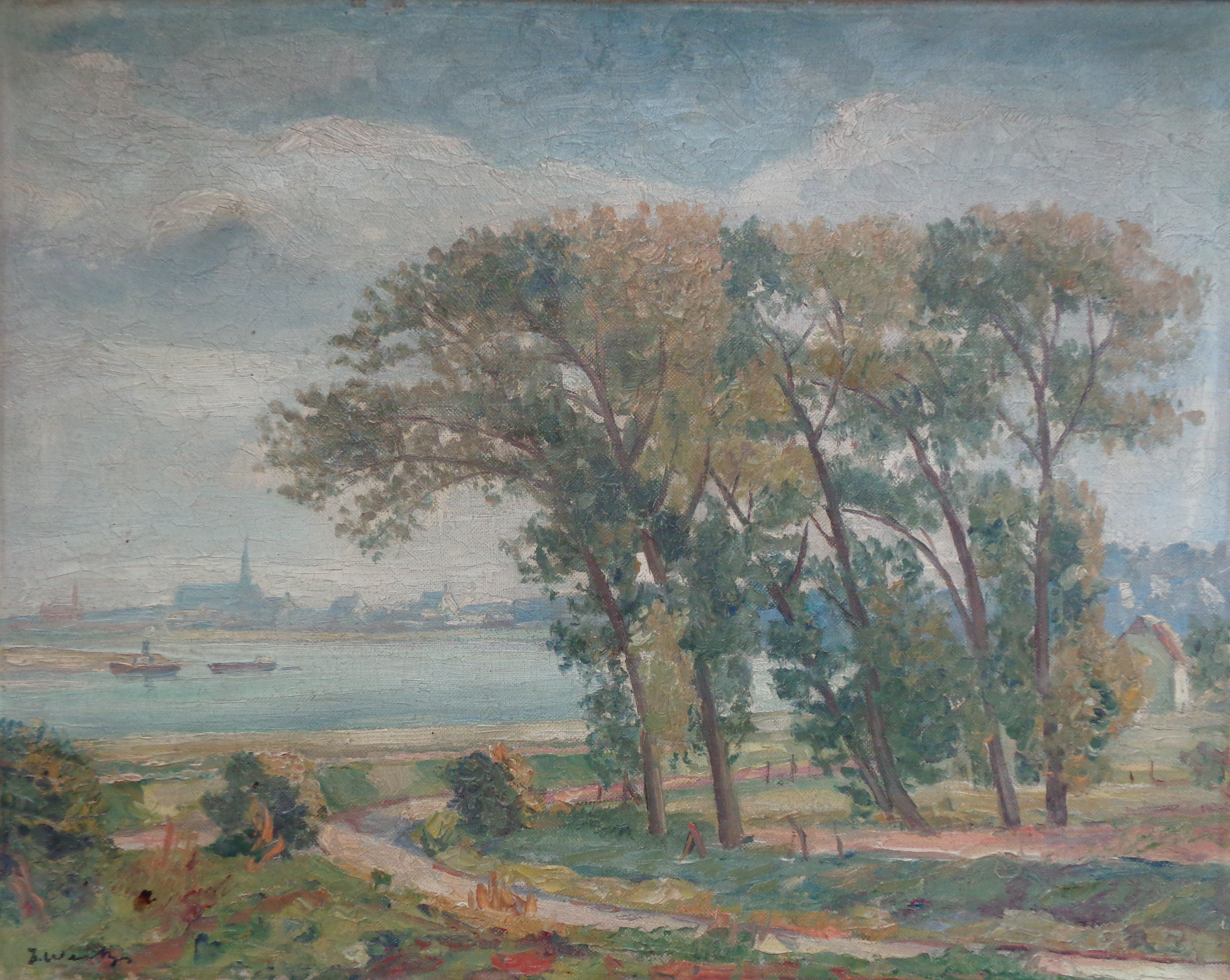
Somebody in Düsseldorf put an actual oil painting out with their bins this week and I liked the look of it when I cycled past it, so I am now the proud owner of a landscape by Jakob Weitz (1888-1971) which looks like this:

It measures 40cm x 50cm and came with a bulky frame which isn't quite to my taste so I took that off to hang it just as the canvas (with the light wood frame underneath on which it was painted). The canvas has two bumps, a big one in the clouds which is interesting as it makes the clouds look more real, and a smaller more inconspicuous one in the landscape which also involves a little bit of tear. I'm wondering if it may become a bit more luminous if I try to wash the surface. Then again the paint is cracking in places so humidity may get in?

When I saw it by the roadside I thought the riverside landscape looked like it might be near here and my first thought was Volmerswerth, on the southern edge of the city. However, a bit of DuckDuckGo research (Google had fewer relevant results) revealed a similar painting by the same artist, which is captioned as Kaiserswerth, so that is still on the edge of Düsseldorf but on the opposite end, downstream from the city centre.

Hotlinking here to contrast and compare:

A few other paintings by this artist are shown on this auction site. Nothing to raise a gasp from the Antiques Roadshow audience, but some of them come with estimates of a few hundred euros.

Tuesday, May 28, 2024

abstract comparisons

I saw two amazing exhibitions on my recent visit to Düsseldorf, will rave about both in separate entries, starting with the one that is still running in case anybody out there gets the idea to go and see it:

Hilma af Klint und Wassily Kandinsky Träume von der Zukunft 16.3. — 11.8.2024

The exhibition at the Kunstsammlung NRW (K20) compares and contrasts the abstract paintings of Wassily Kandinsky (1866-1944) and Hilma af Klint (1862-1944), who were near contemporaries and developed similar kinds of abstraction at around the same time - but independently of each other. There are all the obvious conclusions to draw from the fact that the male artist was successful in his lifetime whereas the female pendant was discovered long after they both died.

To me personally, the intriguing thing though was the contrast of the very familiar and the unknown. Kandinsky is very much the kind of art I grew up with, seeing the Folkwang Museum and the Kunstsammlung NRW were within daytrip distance. I don't have a record of my childhood exposure, but a lot of his work just looks like home to me. The most recent exhibition of his work I have seen before this one was at the Von der Heydt Museum in Wuppertal in 2004: "Wassily Kandinsky: Der Klang der Farbe 1920-1921".

By contrast, I remembered Hilma af Klint's name only because it featured in a recent novel I read, namely Bed bug by Katherine Pancol. This French novel is set mainly in New York and it mentions the 2018/2019 retrospective at the Guggenheim Museum which made Hilma af Klint postumously famous. The author couldn't really have known that the show would be such a success, as the novel appeared in the same year when it was on.

Her work very much feels like a foreign country - the colours and shapes are all different from what I'm used to in abstract art, but still it is all very interesting and intriguing. I am wondering how she arrived at all those shapes that are eerily reminiscent of molecular orbitals, long before quantum theory suggested those shapes for the clouds of electrons holding molecules together. There were some very impressive huge format paintings as well, and we overheard a helpful tour guide explaining how she painted those after placing her canvas flat on the floor. Long before Jackson Pollock, as the guide pointed out.

I'm loving the irony that a museum in Stockholm declined to accept her work as a gift in 1970, citing the parallels with Kandinsky as a reason for the rejection. So, well, see for yourself.

Sunday, March 17, 2024

vintage postcards

I got a bit obsessed with vintage postcards when I researched my lost cities series, and word got out, so a generous Santa helped me build a collection of beautiful books with such postcards, covering some of the lost cities and some others too:

The books typically date from the late 1970s, but those of the two cities that are no longer part of Germany (Breslau and Königsberg) date from the 1990s. Hence they all qualify for my much-neglected antiquarian tag. I still haven't quite figured out the rules predicting which places got into the series and which didn't. Regensburg, for instance, didn't make it. There may be an element of luck in that too.

Thursday, August 17, 2023

a colourful collection

In the 1950s and 60s, my grandparents bought and read loads of paperbacks including the iconic rororo ones with the cloth strip round the spine - easy to spot on any shelf. Their collection of several hundred volumes of this series still resides in the house where they lived in the 1960s through to the 1980s, but in the last few years I was worried it might go awol and therefore started building a collection of my own with the rororo paperbacks I found at street libraries in Düsseldorf and further afield. I just love the cover designs.

My grandparents left a typescript list of their collection (up to number 5,000 which must have been in the 70s and a while after they stopped using the cloth backs), and my collection is now reaching the point where I have to produce a list too, such as not to lose the overview. I'll note the date when it was first published, and also if my copy is a first edition. Where my collection overlaps with that of my grandparents, I put the number in bold (there's not that much overlap).

So here's the family portrait (in numerical order):

(compare and contrast with the photos of my grandparents' collection below)

... and here's the list:
__4 Kurt Tucholsky: Schloss Gripsholm (first published May 1950)
_11 Graham Greene: Orientexpress (9/1950)
_18 Jacques Roumain: Herr über den Tau (first ed. 12/1950)
_25 Betty McDonald: Das Ei und ich (first ed. 3/1951)
_29 Honore de Balzac: Die Frau von dreissig Jahren (first ed. 5/1951)
_31 Thyde Monnier: Die kurze Strasse (first ed. 6/1951)
_36 Winston S. Churchill: Weltabenteuer im Dienst (8/1951) Second printing Sept. 1952, so Churchill was still alive when this translation of his memoir was printed, sold and possibly read. Signed illegibly, could be U. or W. Mertens.
_37-38 Theodore Dreiser: Eine amerikanische Tragödie (first ed. 10/1951)
_39/40 AJ Cronin: Die Zitadelle (first ed. 11/1951)
_41 Pearl S. Buck: Ostwind-Westwind (9/1951)
_42 R.G. Waldeck: Venus am Abendhimmel (12/1951)
_50 rororoTucholsky (3/1952) - a selection of Tucholsky's writings obviously in celebration of the 50th volume, in just two years.
_53 Gabor von Vaszary: Sie (5/1952)
_62 Frank Thiess: Stürmischer Frühling (9/1952)
_65 Allen Roy Evans: Der Zug der Renntiere (10/1952)
_70 Bruno Frank: Cervantes (12/1952)
_75 Graham Greene: Ein Sohn Englands (first ed. 2/1953)
_89 Gabor von Vaszary: Wenn man Freunde hat, Pariser Geschichten (8/1953)
_92 Nancy Mitford: Liebe eisgekühlt (first ed. 9/1953)

117 Sinclair Lewis: Benzinstation (Free air) (first ed. 7/1954)
120 Colette: Die Fessel (8/1954)
127 AJ Cronin: Der spanische Gärtner (10/1954)
133 Tania Blixen: Afrika, dunkel lockende Welt (12/1954)
136 Hans Fallada: Damals bei uns daheim (1/1955)
145 Richard Mason: Denn der Wind kann nicht lesen (4/1955)
147 Arthur Miller: Brennpunkt (first ed. 5/1955)
151 Jean Duché: Drei unter einem Dach (6/1955)
170 Wolfgang Borchert: Draußen vor der Tür (1/1956)
175 Mascha Kaléko: Das lyrische Stenogrammheft (first ed. 2/1956)
176 Richard Gordon: Aber Herr Doktor! (3/1956) BR>179/180 Daphne du Maurier: Rebecca (first ed. 4/1956)
186/187 Pearl S. Buck: Söhne (6/1956)
192 Alain Fournier: Der große Kamerad (first ed. 8/1956) - Le grand Meaulnes
195 Pierre Boulle: Die Brücke am Kwai (9/1956)
197 Damon Runyon: Schwere Jungen, leichte Mädchen (first ed. 9/1956)

201 Friedrich Sieburg: Blick durchs Fenster (11/1956)
212 Jean Hougron: Das Mädchen von Saigon (first ed. 2/1957)
215 G. Guareschi: Don Camillo und Peppone (3/1957)
225 Heinrich Spoerl: wenn wir alle Engel wären (6/1957)
231 G. Guareschi: Don Camillo und seine Herde (8/1957)
233 Richard Gordon: Hilfe! Der Doktor kommt (9/1957)
234 Aubrey Menen: Eine unmoderne Frau (first ed. 9/1957)
235 L. Bemelmans: Incognito durch Frankreich und Paris (first ed. 10/1957) This is from the author of the Madeline books for children - as I'm a great fan of these, I am tempted to go and find the English original: How to travel incognito.
248 Peter Fleming: Brasilianisches Abenteuer (first ed. 1/1958)
250 Tania Blixen: Kamingeschichten (first ed. 2/1958)
251 Allen Roy Evans: Wind über weißen Wegen (first ed. 2/1958)
285/286 Jules Romain: Der Gott des Fleisches (first ed. 11/1958
290 Allen Roy Evans: Ein glückliches Paar (first ed. 12/1958)
295 Richard Gordon: Käpt'n Ebbs, Seebär und Salonlöwe (first ed. 1/1959)

305 Pierre Boulle: Die Kehrseite der Medaille (first ed. 4/1959)
306 Erich Kuby: das ist des Deutschen Vaterland (first ed. 4/1959)
325-326 Richard Mason: Suzie Wong (9/1959)
330 Leo Slezak: Der Wortbruch (first ed. 10/1959)
337 Richard Mason: Schatten über den Blauen Bergen (12/1959)
339 Marcel Ayme: Der Mann, der durch die Wand gehen konnte (first ed. 12/1959)
359 J. Mario Simmel: Affäre Nina B. (first ed. 5/1960) Simmel's rather works were popular in the 20th century but considered too low-brow in my family, but my grandparents had this one too, so maybe it was one of the very few by this author that were considered acceptable.
373 Colette: Duett (first ed. 6/1960)
376 AJ Cronin: Das Licht (first ed. 9/1960) 359, 373 and this one include an ad for cigarettes at the front!

448 Friedrich Dürrenmatt: Der Verdacht (first ed. 10/1961)


UPDATE 24.9. Added three titles found on my latest visit, numbers 39/40, 50 and 197. The first two also present in my grandparents' collection I never liked the way they designed the double volume to look like two books.

UPDATE 25.2.2024 Added four titles: 41, 65, 285/286, 339

UPDATE 23.5.2024 Only found two this time, numbers 117 and 195

UPDATE 26.8.2024 I'm beginning to worry that these books may be dying out - only found two this time, namely number 41, which I already had, and 325-326.

UPDATE 9.5.2025 After slim pickings in November and February, May is looking better, so I've now added the whole lot accumulated since last August.

UPDATE 10.8.2025 Another 6 titles added - naturally, the overlap with my grandparents' collection is increasing over time. Also, some of these books are falling apart, I need to investigate how best to restore them.

UPDATE 13.8.2025 Added five new titles (six numbers as there is a double issue 37/38 among them) discovered this week and it turns out all of them are first editions. What a lucky streak. Later editions likely explain the thinning out of my list from the first hundred (17 titles) to the fourth (9 titles). Assuming they stopped using the cloth backs shortly after 448, the higher numbers have had less time to be re-issued in the same outfit than the earlier ones. (And I'm ignoring reissues of early numbers if they don't have the cloth.)

UPDATE 11.2.2026 Added four new titles including two very early first editions, numbers 18 and 31. Oh, and I discovered among my mother's books a rororo book from 1954 which they handed out for free in celebration of reaching their number 100. It presents the authors of the first 100 books (not quite as there were some double issues) with a one-page biography and photo for each. Very depressing that there are only 6 women among the 76 authors. The lucky few are Pearl S. Buck, Joan Lowell, Betty Macdonald, Nancy Mitford, Thyde Monnier, R. G. Waldeck. I have one from each within the first 100, except for Joan Lowell (number 23), which is in my grandparents' collection though.

---

Here are some from my grandparents' collection:

Thursday, August 10, 2023

23 street libraries

Arriving in Dusseldorf this month, I visited the nearest three street libraries (offener Bücherschrank, I used to be unsure of the translation but now I think I'll go for street libraries!) and wondered whether there were any others that I wasn't aware of, beyond the six I had visited so far. The official website told me that they just opened the 23rd within the city boundaries. Looks like I have some work to do. Here is the list, and I'll mark in bold the ones I've visited. While I was writing up this entry, I managed to increase the count to 13, with tram excursions to Wersten and Benrath, Pempelfort and Derendorf.

    City Centre:

  • Mannesmannufer, next to KIT (Kunst im Tunnel)
  • Kö-Bogen

    Angermund (way out north, behind the airport!):

  • Kreuzung Angermunder Straße, In den Blamüsen und Kirchweg

    Benrath:

  • Marktplatz

    Bilk:

  • Friedensplätzchen (photo below) - this one is my local and the one that got me hooked. Both the range of offerings and the turnover rate are amazing. Without exaggeration, it's worth visiting every day.

    Derendorf and Pempelfort (north of the city centre) - these five are lined up very neatly:

  • Frankenplatz
  • Roßstraße, intersection with Klever Straße/Jülicher Straße
  • Maria-und-Josef-Otten-Platz (Marschallstraße/Blücherstraße)
  • Rochusmarkt
  • Berty-Albrecht-Park (near the centre of this lovely park which stretches a long way, more than 1 km)

    Flingern:

  • Hermannsplatz near S-Bahn Flingern

    Friedrichstadt:

  • Fürstenplatz

    Gerresheim:

  • Apostelplatz
  • Gerricusplatz (historic centre of the town, worth visiting)
  • „Roter Platz“ on the corner Hatzfeld- and Heyestraße, near S-Bahn station

    Grafenberg:

  • Staufenplatz near eponymous tram station

    Kaiserswerth:

  • Markt

    Knittkuhl (way out east, not served by the otherwise perfect tram system!):

  • In der Flieth

    Oberkassel:

  • Werner-Pfingst-Platz

    Volmerswerth:

  • Volmerswerther Straße (next to the loop where the tram turns around)

    Wersten:

  • Liebfrauenstraße
  • Ickerswarder Straße Ecke Kölner Landstraße

    Zooviertel:

  • Brehmplatz

Here is a historic photo I took of the one in Bilk back in 2014:

Might add a few fresh ones when I get home and process all my photos.

Note also that this is an actual gas light behind the book shelf. Obviously problematic in this day and age, but also very quaint and historic. On my quest for more libraries, I am discovering some lovely parks and squares, and also a lot more gas lights. Around the market square of Benrath I saw more than 20 of them.

PS Here's a book I took home from one of them during the August exploration (not sure which one, actually) and very much enjoyed reading. Typical for the random stuff I discover there in that I would never have thought to look for let alone pay for it but am very glad I found it.

UPDATE 24.9.2023 took the tram to Gerresheim today (and S-Bahn back) to explore another five libraries. They have 3 in Gerresheim, an adorable little town that became part of the city in 1909, but preserved its character, and anothr two were on my path there and back. So that should bring up my total to 18 (after correcting the previous total to 13). Five to go.

UPDATE 24.2.2024 Made the expedition to Angermund on the S1, and took in the library at Brehmplatz on the way there, three to go. Also starting a list with links to other cities below.

UPDATE 23.5.2024 Went to the Kunstpalast for an exhibition and realised that Oberkassel isn't all that far from there, just across the bridge. So I ticked that one off too. Two to go.

UPDATE 26.8.2024 Did another tram journey to Benrath and visited the library at Ickerswerder Strasse on the way which I overlooked on the previous trip. Now there's only the Knittkuhl one left - getting there is a bit of a challenge, will have to find something else in that direction to make it worth the journey.

UPDATE 6.5.2023 There also is a map for these - spotted this on Mastodon, then kept the tab open for months, now putting the link here so I can finally close that tab.

UPDATE 3.8.2025 checking up on the official website, I spotted several new ones, so now there are 29! The one in Oberbilk is easy for me to reach, but Garath, a new suburb in the far south, is a bit of a challenge. New ones are also in Flingern, Hassels and Lohausen (near the airport). The new blog entry with the revised list is now here.

Street libraries elsewhere:

Monday, August 15, 2022

the great 9-euro adventure

From June through to August 2022, Germany offered a "flat rate" ticket for local and regional public transport for 9 Euros per calendar month. I used one in June, but was only there for a couple of days, so it didn't make much difference, although it did inspire me to revisit Wuppertal and travel the entire length of the Schwebebahn (suspension railway) up and down the valley. I think the Schwebebahn day pass alone would have cost something like 9 euros in normal times.

At the beginning of August, I was there for ten days and used the ticket to explore a few cities. There were three I hadn't seen before, namely Rheydt (featured in my lostcities series), Krefeld, and Rothenburg ob der Tauber. The latter I wouldn't have dared normally, as it is a globally famous tourist destination and I was kind of expecting it to be overrun, but on the day it turned out just fine, with fewer tourists than you'd see in Oxford on a normal summer day, and it was quite lovely. I also spent time in Aachen, Cologne, Düsseldorf, Frankfurt, Würzburg, and Xanten. That's 9 cities for 9 euros.

It did take me some time to get my head round the fact that this thing really works, that I was really allowed to go anywhere. It does change the geography of a country significantly if you can just hop on a train without worrying whether it will be worth the expense. And after many years of routinely using the intercity and high-speed network, it was nice to rediscover some of the little train stations that the ICE doesn't serve. The Regional Express (RE) trains that you are allowed to use with the ticket cover considerable distances though, including one of the first long-distance rail lines in Germany, Cologne to Minden, or a 200km stretch of the river Rhine from Koblenz to Wesel. With air-conditioned electric double-decker trains, they often offer a level of comfort that compares favourably with what Great Western would call an intercity train. (There was also a heat wave going on, so the AC came in handy.)

Some trains were crowded (but mask discipline was good, so no covid worries), some were late or cancelled, but hey, if it's basically free, you can't complain, right? It's all part of the big 9-euro adventure. I read that 31 million tickets were sold for June, so it's kind of a one off nation-wide summer experience you just have to enjoy. Designed in haste as a counterweight to the very non-green fuel subsidy (Tankrabatt), it may not have moved the dial on car usage, but it certainly helped many who would otherwise have struggled to pay for travel by any means.

I took a zillion photos, some of which are slowly turning up in this new flickr album.

The regional railway station Düsseldorf-Bilk, where all my adventures started. It used to be an S-Bahn station with only the platform on the left, but has been expanded and upgraded to serve regional express trains of four separate lines. Basically every RE that crosses the river Rhine at Düsseldorf now stops at Bilk (plus three lines of the local S-Bahn trains). That's more trains and destinations than you get from Oxford main station, and they are electric.

Media coverage of the 9-euro ticket:

  • a recent Guardian leader
  • impact on air pollution: paper by Niklas Gohl, Philipp Schrauth, University of Potsdam
  • Tourismus zieht Bilanz zum 9-Euro-Ticket (photo story, Deutsche Welle 30.8.2022)
  • As of 12.10.2022, negotiations re a follow-up flatrate ticket, likely to be priced at 49 euros, are still ongoing, reports Der Spiegel.
  • 26.12.2022: FAQs for the new Deutschland ticket are now here. For one-off visits, the important point is that getting out of the subscription in the first year costs €30, so if you just want it for one calendar month, it will be €79. Still a good price for a whole month, but if I travel for ten days, it may not be worth it. - ooops. according to this source, the bit about the €30 fee is wrong. In any case, no start date yet, so watch this space.
  • 28.4.2023: Deutschlandticket is available now and valid from 1.5. The cancellation fee mentioned above has been scrapped so it is 49 euros per month regardless of how many months you take. More details from Deutsche Welle (in German).

Sunday, March 08, 2020

Angelica Kauffman

There is a brilliant exhibition of the 18th century portrait and history painter Angelica Kauffman (German spelling: Angelika Kauffmann) on at the Kunstpalast Düsseldorf. I must have seen several of her works before, including a portrait of Goethe, and must have walked under four of her painting on the ceiling of the Royal Academy at Burlington House, but somehow never joined the dots and explored her life which was quite remarkable. So after seeing the exhibition earlier this week, I am now reading her biography to catch up.

In her time, she was famous as a portraitist, honing her skills first in Italy, where she allegedly painted "all the Englishmen" passing through on their Grand Tour, as well as other celebrities. Thanks to the contacts with the travelling Englishmen she was then able to move to London, establish herself as a history painter and became a founding member of the Royal Academy of Arts.

The portraits are amazing, but what really makes her relevant to our times is the depiction of gender in her history paintings - she shows the heroes of Homer's epics as soft and feminine figures torn by hard decisions, and women like Penelope as strong forces for peace in a world shaped by male views of heroism and conflict. So she really did manage to impose her own viewpoint, in spite of some critics (like Schlegel) grumbling about her "inability" to paint proper male heroes.

This pioneering feminist perspective apparently helped her rediscovery and appraisal in the late 20th century (the biography I'm reading, written by Waltraud Maierhofer, dates from 1997), but I completely missed the memo back then. Partly explained by the fact that many of her works are in private collections still or in obscure museums, and exhibitions are few and far between. So go and see her work either now at the Kunstpalast Düsseldorf (until 24.5.2020) or later this year at the Royal Academy London (28.6.-20.9.2020).


The artist torn between music and art - I can relate to that ...
[image source]


Check this thread of women painted by women ...


Friday, September 20, 2019

stupid useless vain

as today's global wave of climate demos were held, I happened to be in Düsseldorf. Starting point for the local demo was Corneliusplatz, and I didn't know the way there all that well, so I was really glad that this cyclist overtook me as I was cycling into town:


and I only had to follow her. The demo here was huge - this is what I saw on arrival at Corneliusplatz, clearly more than 10k people:


I've posted these and a few other quick picks from today on flickr, more to follow at a later date.

Sunday, May 05, 2019

moonlight sonata

All our instruments series, episode 10

Sorry there has been a slight delay in the continuation of this series. This has to do with the instrument I am going to present this week, which has ended up in my care just now, but has been in the family for longer than any other, a bit more than a century.

It is my grandmother's piano, built by August Förster in Leipzig in 1912. My grandmother (Frieda Eberle, née Nagel) was born in 1902, studied at the Conservatoire in Bückeburg, but then married in 1924 and had three daughters. Widowed in 1945, she gave piano and singing lessons at Idar Oberstein until her early death in 1962.

The piano was in storage from 1962 to 1968, but then moved in with us and stayed with my mother until her death. Although she had a somewhat conflicted relationship with the instrument, I think it is safe to say that it has been played at least occasionally for most of its 107-year life time so far.


Among my mother's belongings I discovered a 90 min recording of her mother playing piano pieces (and singing an opera duo). As I don't know much about piano sonatas, I'll copy the complete set list in here and would be grateful for any thoughts on the choice of pieces.

Oh, and I put all of it on YouTube as well, so here's a video that doesn't feature my playing for once:


-----------------


Here's the complete list of pieces recorded in January 1958

Beethoven:
Piano Sonata No. 17 in D minor, Op. 31, No. 2, "The Tempest" (audio)
Piano Sonata No. 14 in C♯ minor "Quasi una fantasia", Op. 27, No. 2, popularly known as the Moonlight Sonata (audio)
Piano Sonata No. 8 in C minor, Op. 13, commonly known as Sonata Pathétique (audio)


Mendelssohn
Spinnrocken ???
Frühlingslied

Schubert op 90
Impromptu Nr 2, Nr 3, Nr 4

Mendelssohn
Rondo cappricioso

Brahms
Rhapsodie op 78 (audio from the tail end of the Beethoven sonatas until around here)

Chopin
Rev. Etude
Etude Op 25 Nr 11 (audio of the rest of the piano pieces)

Mozart
duet: Reich mir die Hand mein Leben, from Don Giovanni (audio)

Monday, April 26, 2010

Düsseldorf

... some snaps from Düsseldorf. First the mythical water creatures known as Flossies, which apparently emerge from the river Rhine and climb up otherwise unremarkable buildings:


A building by the waterside in the former harbour area, obviously inspired by the former use of the area:


... and going inland, a 3D work of art on a wall near the station of D-Bilk: