Thursday, February 05, 2015

light reading

In the round-up of German pieces published in January/February it's mostly about light, so we have photosynthesis, seasonal affective disorder, UNESCO's year of light. Along with that a bit of chemistry bang in the shape of Knallgas bacteria and a new synthesis approach:

Ein neuer Molekülbaukasten
Chemie in unserer Zeit Volume 49, Issue 1, page 12, Februar 2015
abstract and limited access to full text/pdf
related content in English

Jahr der Erleuchtung
Nachrichten aus der Chemie 63, Nr 1, pages 133–135
free access

Die Brennstoffzelle der Knallgasbakterien
Nachrichten aus der Chemie 63, Nr 2, pp 133–135 DOI: 10.1002/nadc.201590047

Chemische Heiterkeit
Nachrichten aus der Chemie 63, Nr 2, p 215

Fotosynthese mit Turbolader
Spektrum der Wissenschaft Nr 2, pp 17-19

Mehr Licht - die saisonale Depression
Trillium Diagnostik 2014, 12, Nr 4, pp 188-189

Monday, February 02, 2015

drowning in plastic waste

I covered the problem of plastic waste in the oceans two years ago, but as research on the interactions between the plastic materials and the affected biosphere is beginning to emerge, I wrote a new feature, now more focused on microplastics and their biological impact. This has just appeared in Current Biology:

Oceans of plastic waste
Current Biology Volume 25, Issue 3, pages R93–R96, February 02, 2015

Open access

(Photo: © Karumbé-Uruguay.)

Sunday, January 25, 2015

organs on chips

The slightly delayed January issue of Chemistry & Industry includes my feature on chip-sized microfluidic models of human organs, mainly based on the amazing work that's been done at the Wyss Institute at Harvard in recent years. This may well revolutionise medicine and make animal testing redundant.

Chips with everything
Chemistry & Industry January 2015, pp 28-31
Free access to full text

Image: Harvard's Wyss Institute

In the same issue, there is also my review of the book

The burning answer: a user’s guide to the solar revolution
by Keith Barnham (Weidenfeld & Nicolson 2014)

The solar revolution
Chemistry & Industry January 2015, pp 48-49
Restricted access

Here's a snippet from my (long essay) review:

"In fact, Barnham delivers three books for the price of one: a popular science book on the historic developments that led to our current energy technologies, then the “user’s guide” of the subtitle, an analysis of the present day situation in the renewable energy vs. climate change field complete with a manifesto for the revolution, and finally a look at what should and might happen in those crucial 15 years ahead of us, which may well decide the long-term success of our civilisation."

Wednesday, January 21, 2015

reading the world

I was very impressed when I read that the author Ann Morgan had managed to read one book from each of the 196 countries represented at the 2012 Olympics in London. Her list of books read and others that were recommended to her is here, and the book she wrote about the experience is reviewed here.

Thinking about how embarrassingly far I would fall short of that figure I estimated I would be lucky to make it to 50 countries (in my life so far, not in a year) and started my own list to prove it. If and when I've reviewed a book on this list, I've included a link to the review. If I can't remember whether I've actually read it (even though it's on my shelf), I've marked it with CR. NFY means not finished yet. Still struggling to get to 50 though.

  1. Algeria – Mehdi Charef: Thé au harem d’Archi Ahmed (CR - saw the movie though)
  2. Argentina – Federico Andahazi: El anatomista (The anatomist)
  3. Austria – Daniel Kehlmann: Die Vermessung der Welt (Measuring the world)
  4. Belgium – Amélie Nothomb – L’hygiène de l’assassin
  5. Brazil – Paulo Coelho: Der Alchemist (The alchemist)
  6. Canada - L. M. Montgomery: Anne of Green Gables
  7. Chile – Isabel Allende: La casa de los espiritus (The house of the spirits)
  8. China – Hong Ying: K – the art of love
  9. Colombia – Gabriel Garcia Marquez: Cien años de soledad
  10. Congo, Republic of the – Alain Mabanckou: Verre Cassé (Broken Glass)
  11. Cote d'Ivoire – Fatou Keita: La rebelle
  12. Cuba – Zoe Valdes: La nada cotidiana
  13. Ecuador – Alicia Yanez Cossio: El cristo feo
  14. Equatorial Guinea – Guillermina Mekuy: El llanto del perro
  15. France – Anna Gavalda: Ensemble, c’est tout (Hunting and gathering)
  16. Germany – Charlotte Roche: Feuchtgebiete (Wetlands)
  17. Guatemala – Miguel Angel Asturias: Leyendas de Guatemala (CR)
  18. India – Ruth Prawer Jhabvala: Heat and dust
  19. Iraq - Weam Namou: The feminine art
  20. Israel – Ephraim Kishon: Oh, oh, Juliet
  21. Italy – Umberto Eco: Der Name der Rose (The name of the rose)
  22. Kyrgyzstan – Chinghiz Aitmatov: Jamila
  23. Lebanon - Vénus Khoury-Ghata: Les fiancés du Cap-Ténès (CR)
  24. Madagascar – Michele Rakotoson: Dadabé
  25. Mexico – Laura Esquivel: Como agua para chocolate
  26. Mongolia – Galsan Tschinag: Die Karawane (NFY)
  27. Morocco – Tahar Ben Jelloun: Harrouda (CR)
  28. Netherlands – Anne Frank: Das Tagebuch der Anne Frank (Diary of a young girl)
  29. New Zealand - Katherine Mansfield: Stories
  30. Nicaragua – Gioconda Belli: El pergamino de la seduccion (The scroll of seduction)
  31. Nigeria – Sefi Atta: Swallow
  32. Peru – Mario Vargas Llosa: El sueño del Celta (The dream of the Celt)
  33. Poland – Stanislaw Lem: Stories
  34. Russia – Mikhail Bulgakov: Master and Margerita
  35. Senegal – Ousmane Sembene: Guelwaar
  36. Sierra Leone - Aminatta Forna: The memory of love (NFY)
  37. Spain – Almudena Grandes: Castillos de carton
  38. Sweden – Astrid Lindgren: Pippi Longstocking
  39. Switzerland – Max Frisch: Homo faber
  40. Syria - Rafik Schami: Die dunkle Seite der Liebe (NFY)
  41. United Kingdom – Esther Freud: Lucky break
  42. United States – Megan Clark: Seduce me
  43. Vietnam - Kim Thuy: ru (NFY)

Own photo of my reading pile some time in early 2014.

PS: I'll keep updating this with any further reading adventures, hoping that one day I can travel around the world in 80 books ... So this post will also serve as a directory to my reviews of world fiction.

Monday, January 19, 2015

evolution of allergy

In December, I attended the Cell Symposium on type 2 immunity (i.e. our adaptive immune system as opposed to innate defence mechanims) and learned a lot about the big two questions in the field of allergy, namely why did allergies evolve, and why are they becoming more prevalent in industrialised societies?

It's been a steep learning curve not helped by immunologists' habit of speaking in acronyms, but I believe I discovered some meaningful connections to evolution and ecology - it's really all about snakes and parasitic worms. So I wrote a feature summarising what I think I understood, which is out today:

Why did evolution give us allergies?
Current Biology Volume 25, Issue 2, pR53–R55, 19 January 2015

Open access

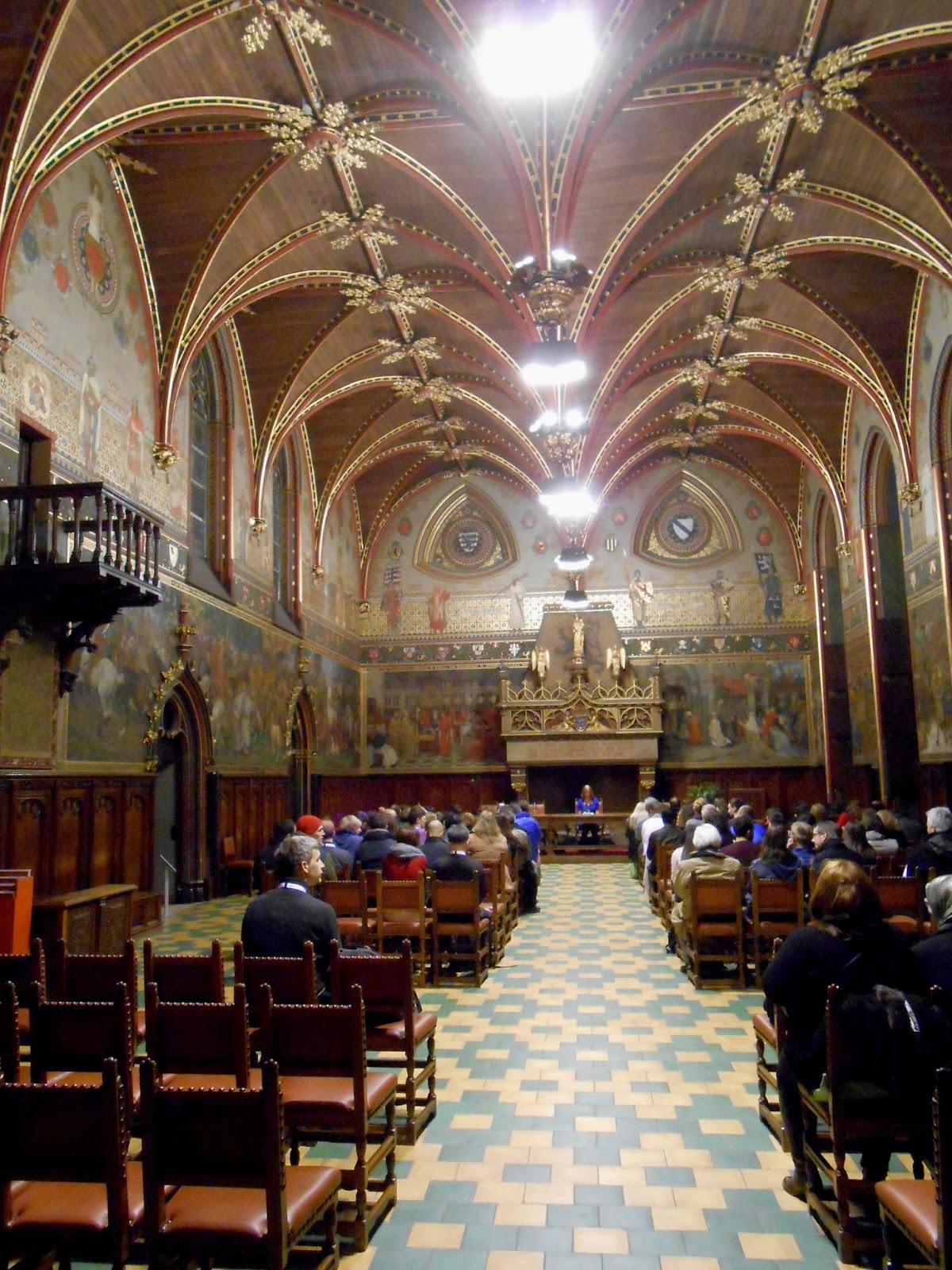
The Cell Symposium in session (this was a reception in the town hall though, not part of the scientific programme). Own photo.

Wednesday, January 07, 2015

reinventing Paris

review of:

Paris reborn
Stephane Kirkland
St. Martin’s Press, New York, 2013

The city landscape of Paris is instantly recognisable in many photos that don’t contain any landmarks or specific clues. You see the slate-covered mansard roofs, the well-aligned balconies, the wide boulevards, the trees, the street furniture, and you just know it must be Paris.

One important reason why it is so recognisable is that much of it was built within two decades (1852-1870) and to strict design standards keeping the extravagance of architects and developers in check. More than 100,000 houses were built in this time, and half a dozen entirely new transects cut in straight lines across the city. The name most widely associated with this remarkable act of urban development is that of the prefect of the Seine département, Georges-Eugène Haussmann. We like to talk about Haussmannian boulevards, and there is even a boulevard named after him.

Kirkland argues that, while Haussmann was the right person in the right place at the right time to ruthlessly implement the vision of what we now appreciate as the Parisian city landscape, it wasn’t his vision at all. President Louis-Napoléon Bonaparte, who then became emperor Napoléon III by a coup d’état followed by a plebiscite, had drawn the colourful lines on his master plan when Haussmann was still a provincial bureaucrat in Bordeaux, and even before him there had been similar ideas and concepts floating around. It was no secret that Paris at the beginning of the 19th century was in urgent need of renovation. It was the combination of the emperor’s vision and the prefect’s efficiency at getting things done that made this project a reality.

In his very readable account of the origins of one of today’s leading tourist magnets, Kirkland aims to distribute the blame and credit fairly, spelling out the specific contributions of Napoléon III and Haussmann, as well as those of the architects and financiers involved. He also acknowledges the dark sides of the “grands travaux”, from the wholesale destruction of medieval Paris (apart from Notre Dame cathedral, which was lovingly restored) through to the questionable finance deals and the banishment of the working class to the suburbs.

It was partly due the republican critics of these faults that Haussmann, the rather boring bureaucrat, came out of this story with the biggest slice of posthumous fame. Under the empire, the critics couldn’t attack the emperor directly, so they pinned all the blame on Haussmann. He didn’t mind too much, and he added to his immortal fame by publishing three volumes of memoirs when he was underemployed under the third republic. The republic, for all its criticism of the empire, essentially carried on with the project of modernising Paris in the same style, culminating in the world exhibition of 1900, which gave the city the metro and the Eiffel tower.

Cover of the hardback edition. I hear it is now out in paperback.

Monday, January 05, 2015

fun with science

Current Biology starts its 25th year today and, in celebration, issue 1 of vol 25 is dedicated to the biology of fun and all things fun in biology (there's also a press release for this).

My contribution to this has been a look back at my own work in science communication (not quite 25 yet but soon) and to reflect on how having fun with and occasionally even making fun of science can help the worthy cause of disseminating the insights of science to a wider public.

The joy of science communication

Current Biology Volume 25, Issue 1, pR27–R30, 5 January 2015

Free access to full text and PDF download.

Own photo of young people having fun with science at the Oxford Museum of Natural History.

Wednesday, December 24, 2014

a valiant vicar

In the course of our investigations into the ancestors who were tradesmen in the small town of Kirn from the 15th through to the 17th century, we also came across a likely ancestor who was the town’s first Lutheran vicar. (I was actually baptised in his church, where his bones are probably still underfoot, which is kind of spooky.) He had an unusual life, so here’s a draft version of his biography:

NB: I've added a German version of his biography to Wikipedia.de.

Peter Siegel was a student of Martin Luther at Wittenberg and went on to introduce Luther’s ideas to his home town of Kirn long before the area officially became protestant.

Peter Siegel was born in 1485 as the son of the baker Nikolaus Siegel and his wife, who was a daughter of Hen Thielmann. He started out learning his father’s trade and then probably became a monk. In October 1518, at the unusually advanced age of 33, he went to Wittenberg to study theology with the reformer Martin Luther, whose ideas had inspired him.

After three years of study, in 1521, the rulers of his home territory suggested he should become vicar of Münster am Stein, which is also on the river Nahe, downstream of Kirn. It is unclear whether he actually obtained this job, but he soon married a woman from his home town named Gertrud (not quite in accord with catholic dogma).

He then moved back to Kirn, where, according to his tombstone, he was a vicar from 1528 to his death in 1560 (although the first mentions in the town archives only date to the 1530s). Specifically his epitaph said that he “preached the gospel of Christ at this church for 32 years – no matter how much his adversaries raged – in its pure and unadulterated form, after elimination of all man-made additions.” In Latin that reads:

qui cum duos et triginta annos, huic Ecclesiae, quantumvis frementibus adversariis, Evangelium Christi pure sincereque, neglectis hominum figmentis, tradisset

Those raging opponents will mainly have been the members of the local Collegiate church, who made several complaints to the archbishop at Mainz about their vicar. Disputes over the true faith raged on into the 1540s, such that one cannot pin down a date for the introduction of the reformation at Kirn. The territorial overlords clearly protected their renitent protestant vicar from prosecution by the archbishop, but only “came out” as protestants after the 1555 Augsburg Settlement, which allowed each ruler complete freedom to choose the faith for their domain (cuius regio, eius religio).

The citizens of the small town (which, despite its strong tradition in trades and crafts, only officially became a town in 1857) were already very supportive of their protestant vicar by that time. A significant date in this context is 1544, which is when the records of the wool weavers' guild stop mentioning the Corpus Christi (Fronleichnam) holiday, which is a highly significant day for catholics only. Kirn remained purely protestant until 1681 when French troops took over the town and the castle next door to it, the Kyrburg.

Peter Siegel died on October 15th, 1560 and was buried in his church, which had to be partially rebuilt in later centuries, but still is a protestant church in the same location to this day. From 1684, the French occupation forced the town to simultaneously use the church for catholic as well as protestant services, and the new catholic altar came to cover up Siegel’s tomb. Later on, the tombstone, whose inscription survives in transcripts (although the date had to be corrected), was removed and remains lost.

Sources:

Own photo of the Lutheran church at Kirn.

Wednesday, December 17, 2014

stripped back cellulose

Cellulose as made by plants is a complex material that mankind has used for all kinds of applications for millennia. Only in the 20th century synthetic materials increasingly replaced it, mainly because the plastics can be tailored to any material property required. Now, however, as plastic waste is becoming a global problem and sustainable solutions are in high demand, researchers are rediscovering cellulose and stripping down its complexity, resulting in so-called nanocellulose. With these structural building blocks of natural cellulose, they can then construct composite materials to rival the synthetic ones.

I've written a feature about nanocellulose which is out in the December issue of Chemistry & Industry:

Nature's building blocks
Chemistry & Industry December 2014, pp 18-21
(premium content, but I can send PDF "reprints" on request)

On page 51 of the same issue you'll find my review of the book The economic competitiveness of renewable energy - pathways to 100% global coverage, by Winfried Hoffmann.

Tuesday, December 16, 2014

the trouble with animals

It's all very well having animals around as food or for company, but the trouble is that we pick up diseases from them, and those can be deadly, especially in the initial phase after jumping across to our species. At the end of the year in which Ebola hit the headlines for months, I've discussed the wider problem of zoonotic disease and the lessons to be learned from the failure to tackle Ebola in time to stop it running out of control.

Our shared burden of diseases

Current Biology Volume 24, Issue 24, pages R1139–R1141, 15 December 2014 Open access

(I can send PDF "reprints" on request, and the article should become freely accessible one year after publication)

Wednesday, December 03, 2014

seasonal offerings

My German pieces published in December are embarrassingly seasonal - there is ice and snow aplenty in a feature about the subglacial biosphere of Antarctica, and the target of my regular fun-poking is Poinsettia (Euphorbia pulcherrima), which is known in Germany as Weihnachtsstern (christmas star). That's quite enough xmas for me, I don't want to hear it mentioned again until next year ...

Mikrobielle Artenvielfalt unter dem Eis der Antarktis
Nachrichten aus der Chemie 62, 1186-1187, 2014
[related content in English]

Die Wissenschaft vom Weihnachtsstern
Nachrichten aus der Chemie 62, 1251, 2014

Monday, December 01, 2014

how to feed the world

The world population keeps growing, more people want better diets, and climate change puts food production at risk. All these global trends mean we as a civilisation will have to act now to make sure we will still have enough food in the next few decades.

Plant science can offer crucial support for this quest in a number of ways. Improvements in crop yield through genetic engineering are a controversial route, but even by tracking down wild relatives of crop plants and feeding their desirable traits into the gene pool by conventional breeding, plant scientists can help to improve global food security. Importantly, bridges must be built between fundamental research in plant science and the applied research in agriculture.

These issues are covered in some detail in my latest feature which is out today:

Plant science called up to provide food security

Current Biology
Volume 24, Issue 23, pR1105–R1108, 1 December 2014
Open access

The feature was inspired by this special issue of the American Journal of Botany (October 2014):