Thursday, February 20, 2014

deep sea dilemmas

While I've never actually visited the Deep Sea, I'm kind of attached to that vast part of our planetary biosphere, as my PhD thesis was about biological functions under high hydrostatic pressures of the kind that you would find in the deeper parts of the oceans. Knowing how inaccessible and remote from us surface dweller the deep sea is, I might have hoped that it is better protected from the collateral damage of human activities than most places. Recent developments suggest, however, that even the deep biosphere may feel the effects of climate change, and it could also experience large scale devastation from industrial mining operations very soon.

All this is discussed in my latest feature in Current Biology which is out now:

The deep sea under siege

Current Biology, Volume 24, Issue 4, R137-R139, 17 February 2014 doi:10.1016/j.cub.2014.01.062

Free access to full text and PDF link

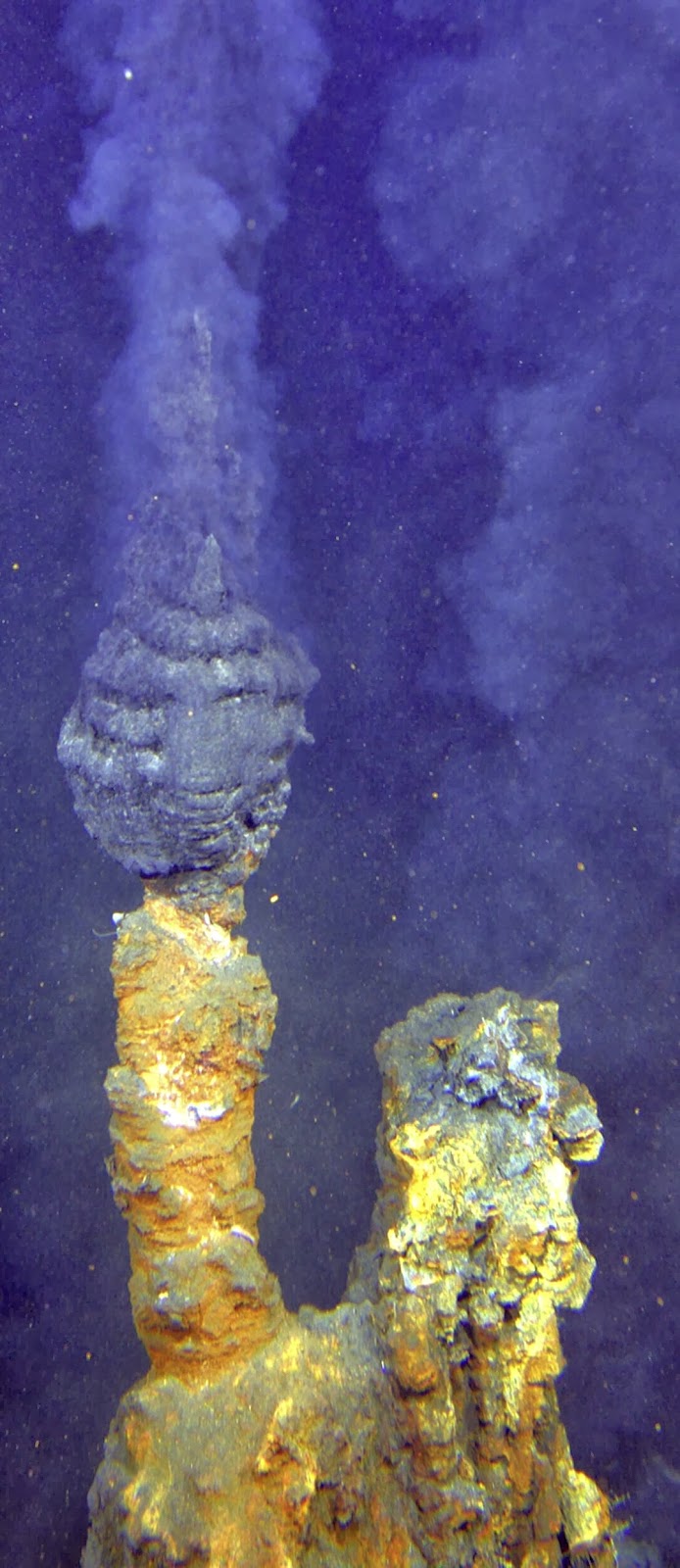
A black smoker known as The Brothers, off the coast of New Zealand. (Photo: National Oceanic and Atmospheric Administration/Wikimedia Commons.)

Wednesday, February 05, 2014

my way into science journalism

in the February round-up of German pieces there is a special piece in the popular chemistry magazine Chemie in unserer Zeit. The editor invited me to reminisce on my career as a science writer (an earlier attempt at describing my career path, in English, is here). This is kind of related to the fact that I’m being awarded the prize for journalists and writers from the German Chemical Society (GDCh) this year. Previously, the only prize I won was a bottle of Bordeaux for spotting the book title that went on to win the Diagram Prize, so this is definitely a step up.

The other pieces published in January and February cover crystallography without crystallising the substance of interest, lab-grown meat, natural ingredients, and cell-free biotechnology.

Mein Weg zum Wissenschaftsjournalismus
Chemie in unserer Zeit 2014,48, 68-71
DOI: 10.1002/ciuz.201400659 [FREE access]

Ausgeforscht: Vorsicht, die Fleischfälscher
Nachrichten aus der Chemie 2014, 62, 107

Ausgeforscht: Echt natürlich - natürlich echt?
Nachrichten aus der Chemie 2014, 62, 207

Blickpunkt Biowissenschaften: Zellfreie Biotechnik
Nachrichten aus der Chemie 2014, 62, 147-148

Kristallstrukturen von nicht kristallisierbaren Substanzen Spektrum der Wissenschaft 2014, Nr. 1, 14-16

memories ...

Monday, February 03, 2014

demographic challenges

My latest feature in Current Biology looks into the recent changes to China's one-child policy, which has been in force for 34 years now. Changes announced recently allow parents a second child if they are single children themselves, avoiding the one-child-rule from becoming effectively a one-grandchild (per set of four grandparents) rule.

Where next for China's population policy?

Current Biology Volume 24, Issue 3, 3 February 2014, Pages R97–R100

Restricted access to full text and PDF download (free access after one year)

Shopping street in Shanghai. Photo: Wikimedia Commons / Agnieszka Bojczuk

Friday, January 24, 2014

latest spin on carbohydrates

Even though I did much of my PhD thesis with the characteristic whining of two ancient, wardrobe-sized Beckman model E analytical ultracentrifuges in the background, I didn't really expect to get a chance to write something about this technique any time soon. It was widely used to study molecular weight and assembly of proteins back in the 1970s but for a time it became so unfashionable that there was no company left making or servicing the instruments, and only hardcore fans like my PhD supervisor, Rainer Jaenicke, kept the last of these dinosaurs alive.

By now, the technique has been rediscovered, new centrifuges have been developed and built, and various groups are using the technique. In an intriguing development, the groups of Steve Harding and Thomas Heinze have shown that certain carbohydrates can assemble reversibly just like oligomeric proteins. Read all about it in my news story which is out now in Chemistry World online, free access:

Self-assembling carbohydrates behave like proteins

Searching for an illustration for this article, I discovered this video of a simulation showing what happens to protein molecules in the cell of an ultracentrifuge. Simulation is of lysozyme in water, so nothing to do with carbohydrates, but I thought it's a lovely visualisation of the technique:

Source: Díez A, Ortega A, Garcia de la Tore J (2011). "Brownian dynamics simulation of analytical ultracentrifugation experiments". BMC Biophysics. DOI:10.1186/2046-1682-4-6.

via wikimedia commons.

Tuesday, January 21, 2014

coastal protection

With sea levels rising and many coastal cities sinking, protection from floods is becoming an ever more urgent problem. Which doesn't seem to stop people from the ongoing destruction of natural defences like mangrove forests.

My latest feature, describing how conservation and flood defence can help each other, is now out:

Protect the coasts so they can protect us

Current Biology, Volume 24, Issue 2, R51-R53, 20 January 2014
doi:10.1016/j.cub.2014.01.001

FREE access to full text and PDF download

Mangrove wetlands lining many coasts in the tropics provide effective natural protection against storm surges. They also have the ability to build up in line with sea-level rise. Large-scale loss of mangroves in countries like Myanmar exposes many millions of people to increased flood risks. (Image: Challiyan at ml.wikipedia.)

Thursday, January 16, 2014

food speculation update

Back in October 2011, I published a feature on food speculation (i.e. the gambling with vital commodities on international financial markets, which can leave real people unable to buy the food they need to survive), so I was pleased to hear yesterday that the EU is now taking action, as it sealed a deal on the reform of the Markets in Financial Instruments Directive (MiFID), which sets new regulation for financial markets.

As always when the EU does a good thing, the UK government is fighting hard to stop it, but I understand it only succeeded in watering it down a bit, and campaigners from the World Development Movement are claiming the EU decision as a win for their fight against food speculation.

Here are the reactions from:

WDM: EU takes historic step to stop banks betting on hunger

Oxfam: EU deal on curbing food speculation comes none too soon

Friends of the Earth: New finance directive lays out improvements, but loopholes remain

See also this report from the Guardian: EU moves to curb food price bets by traders

Photo: WDM.

Monday, January 06, 2014

forest fears

An interactive global map of deforestation, the trouble with the diseases of trees, the floristic temperature in the undergrowth, and the Grimm brothers all appear in my latest feature in Current Biology, which is now online:

Fears for the woods and the trees

Current Biology, Volume 24, Issue 1, R1-R4, 6 January 2014
doi:10.1016/j.cub.2013.12.024

FREE access to full text and PDF download

The interactive global map of forest changes produced by researchers at the University of Maryland shows that deforestation in Indonesia has accelerated dramatically between 2000 and 2012. Colours indicate changes in forest cover between 2000 and 2012. Red, forest loss; blue, forest gain; purple, losses and gains; green, persisting forest cover. Screenshot of the interactive map produced by M.C. Hansen et al. (Science (2013) 342, 850–853; http://earthenginepartners.appspot.com/science-2013-global-forest).

Monday, December 16, 2013

antibiotics in crisis

When I started out writing about science, 20 years ago, I tended to end my articles on an optimistic note, along the lines of: now the molecular structure of this problem is known, surely a solution will soon materialise. How little did I know.

One of the solvable problems I wrote about nearly 20 years ago – and I have an article published in September 1994 to prove it – is the spread of antibiotics resistance. Now the existence of antibiotics resistance traits is natural and there isn’t much we can do about it, but their spread is greatly facilitated by two human activities, namely the reckless use of antibiotics in agriculture, where they are essentially used to speed up growth, and their misguided use in human patients, including pointless prescriptions by doctors, and inappropriate application by patients.

All that was very well known and recognised in the 1990s, so it was deeply distressing for me to find out from a recent report into the problem that antibiotics are still misused in agriculture in the US, and from own experience I know that some doctors still prescribe antibiotics when they very clearly shouldn’t, e.g. for a common cold.

So, well, the problem we’re facing today is that there are hardly any new antibiotics in the development pipeline, and the old ones we have are being squandered through systematic and long-running misuse which should have stopped 20 years ago but for some strange reason hasn’t.

In the US alone, 23,000 people per year are dying from antibiotic-resistant bugs, and the bottom line is most of these deaths could have been avoided if antibiotics misuse had been stopped in time. And this will get worse. Infectious diseases which we’ve almost forgotten are returning because of this.

It’s a very very depressing subject, but if you can bear to read more about it, there is a new feature out in Current Biology today:

Antibiotics in crisis

Current Biology, Volume 23, Issue 24, R1063-R1065, 16 December 2013 doi:10.1016/j.cub.2013.11.057

full text and free access to PDF download

Extended spectrum beta-lactamase-producing strains of Enterobacteriaceae, including Klebsiella species and E. coli, are responsible for around 1,700 deaths per year in the US. (Photo: courtesy of CDC http://www.cdc.gov)

Monday, December 09, 2013

dances with diatoms

German publications in November and December cover foaming proteins, dance your PhD, chemical elements you can by from Holland & Barrett, boron-boron triple bonds, and diatoms. Phew. I won't even try to conjure up a connection between these, apart from the byline. So here goes:

Tierischer Eischnee und andere Schäume
Nachrichten aus der Chemie 2013, 61, 1227-1229
(a feature in English covering the same ground is here)

Ausgeforscht: Elemente für den Hausgebrauch
Nachrichten aus der Chemie 2013, 61, 1307

Ausgeforscht: Tanze deine Diss
Nachrichten aus der Chemie 2013, 61, 1191

Kieselalgen: Weder Tier noch Pflanze, aber klimarelevant
Chemie in unserer Zeit 47, 368-374, DOI: 10.1002/ciuz.201300621
abstract and restricted access to PDF download

Dreifachbindungen: Bor-Chemie im Aufwind
Chemie in unserer Zeit 47, 340
abstract and restricted access to PDF download

Monday, December 02, 2013

collapse ahead

Highly sophisticated societies have collapsed (i.e. lost a lot of of their complexity very quickly) in the past, and there is no reason why this couldn't happen to ours. In fact there are a few very good reasons to believe it will happen well within the 21st century, i.e. within the life-expectancy of everybody born in the richer countries from now on. (I do hope Mumsnet are reading this and can still turn things around!)

We're still wrecking the environment we depend on, and the financial crisis has shown how blindly we can run into a disaster, so, well, there may be interesting times ahead.

I've discussed all this in some detail in a feature that has appeared today:

Will our civilisation survive this century?

Current Biology, Volume 23, Issue 23, R1017-R1020, 2 December 2013 doi:10.1016/j.cub.2013.11.028

Free access to full text and pdf download

After writing this feature, I was left with the feeling that we're standing at the edge of a cliff (no pushing at the back!). Since then, however, I've read a book for review that made me think maybe we're already one step further. Like those cartoon characters that stay suspended in mid-air until they realise that they are bound to fall. So I guess it's fine as long as we don't look down. More about that soon, when my review comes out. Now that's what I call a cliffhanger.

Extensive ruins such as those of the Roman colony of Thamugadi (Timgad) in modern-day Algeria remind us that civilisations can and do collapse. (Photo: Wikimedia Commons/PhR61.) I actually visited Timgad many years ago. It does make a big impression.

PS Jan 2017: Oooops, I never did resolve that cliffhanger, did I? The book I was reviewing at the time was "The energy of nations" (review is in C&I Feb 2014, p51, but I forgot to blog about it), in which Jeremy Leggett argues that risk-blindness could lead the energy sector into a crash worse than the financial crisis, and big enough to lead to a collapse of civilisation. Now, as an irascible twitter troll takes over the White House and brings along his fossil fuel cronies, this prospect appears closer than ever.

Saturday, November 23, 2013

the male-only prize for science books

The shortlisted titles for the Royal Society Winton Prize for Science Books this year are:

Bird Sense by Tim Birkhead
The Particle at the End of the Universe by Sean Carroll
Cells to Civilizations: The Principles of Change That Shape Life by Enrico Coen
Pieces of Light: The New Science of Memory by Charles Fernyhough
The Book of Barely Imagined Beings by Caspar Henderson
Ocean of Life by Callum Roberts

Notice anything strange? Hint: look at the first names of the authors. All six of them are men. Surely some coincidence? Well, I went through the list of winners for the last 26 years and the shortlists for the last 14 years. The prize – with its many renamings and reincarnations – has never been won by a woman, which becomes less surprising when you consider that out of the last 14 shortlists, only 5 contained a woman (and none had more than one). That’s 5 / 84 or 6%. (Funnily enough, I seem to remember the fellows of the Royal Society have about the same gender ratio?) In other words: since the year 2000, nine years have produced all-male shortlists.

Taking a quick look at my popular science shelves, I acknowledge that the majority of authors are male, but not an embarrassingly large majority. Some of my all-time favourite popular science books are written by women, including Woman, by Natalie Angier, and Deadly companions, by Dorothy Crawford. The latter title was published in 2007, so could have been shortlisted for 2008. As it happens, 2008 was one of the years without a woman on the shortlist. Plastic Fantastic, a very important book about how science is done these days (using a famous recent case of misconduct), by Eugenie Samuel Reich was published in 2009 – again there was no woman on the 2010 shortlist.

I suppose this is due to an accumulation of bias over the many selective steps involved, from an author drumming up the confidence to make a book proposal, via a publisher accepting the proposal, a publisher suggesting the book to be considered for a prize, through to the longlisting, shortlisting, and prize-giving process.

In any case, it’s clear to me that the prize has consistently failed to reflect the contribution that women make to writing about science, so it should either be scrapped or fixed. Fixing would require positive discrimination – from my experience with “zipper” style gender alternation rules in Germany’s Green Party in the 1980s and 90s I can confirm that very simple measures can work miracles not just for the representation but also for the way things are done – if every committee has at least 50% female participation, the management style is improved dramatically.

Similarly, positive discrimination at the top of the science book prize, making sure that women are visible in the shortlist (e.g. by widening the shortlist), could feed back to the previous selection levels, such that more women are inspired to write about science, more publishers commission them, and more publishers put them forwards for prizes. It shouldn’t be difficult.

The winner of this year's prize will be announced on Monday 25th. We already know the winning author will be a man. Maybe they should rename it the male-only prize for science books.

wrong gender?
Wednesday, November 20, 2013

foaming proteins

If you work with proteins in a lab, one thing is for sure: you do not want your protein solution to foam. When it does foam, you can probably throw it away. Unless, that is, it is one of the rare proteins that are meant to act as detergents. So far, they have only been discovered in tropical frogs and in the sweat of horses, so that's why my latest feature is called:

Only frogs and horses

Chemistry & Industry November 2013, pp 24 - 27

restricted access to full text

I'll be happy to send pdf reprints if you want one, email me at

m i c h a e l g r r aaaaatttt y a h o o ddoooottt co dddddooottt uk
(chew that, spammmmbots!)