Monday, March 31, 2014

losing our mobility

With the general resurgence of various nationalist and rightwing movements across Europe, which will probably have a significant impact on the European elections in May, there is the risk that we may lose mobility, which will also cause problems for science. My latest feature, written after the Swiss referendum on "mass immigration" takes a closer look at what's at stake.

New barriers to mobility in Europe?

Current Biology Volume 24, Issue 7, pR257–R259, 31 March 2014

DOI: http://dx.doi.org/10.1016/j.cub.2014.03.019

Free access to full text and PDF download

... and now also with buttons for easy tweeting and sharing !

Friday, March 28, 2014

buskers in Oxford

I've come to realise in recent years that we have an amazing busking scene here in Oxford. There are quite a few artists and bands whose music I really love and whom I discovered in the streets of Oxford, and from quite a few I also bought CDs:

So as a new series on this blog, I will start introducing some of my favourite buskers. Starting with flamenco fusion band Fernando’s kitchen, who I saw a few years ago. They aren’t regulars on the Oxford scene, as they are based in London and Cambridge, so I’ve been extremely lucky to bump into them.

Since then, they have brought out a couple of new CDs which I ordered off their website. In fact, I also bought the cajón (which is the background for the CDs photo above) because of them. Percussionist and singer Heidi Joubert teaches cajón lessons on YouTube and in real life and by now also sells her own brand cajóns.

As I understand it, FK are consciously remaining independent of music labels and selling and promoting their own music, so the best way to get it is through their website (unless, of course, you're lucky enough to find them playing in the streets of London or Cambridge).

NB: Anybody wanting to join the vibrant Oxford busking scene needs a busking pass from the Oxford City Council, application details here. See also the code of practice and the map of the nine official busking spots here.

Tuesday, March 25, 2014

shakira - the eponymous album

It's a gift for anybody who loves the word "eponymous" as much as I do :) Seriously though, as I'm playing the album for the 5th time, here are my first impressions:

Having followed Shakira's output for nearly 15 years now, I expect nothing less than brilliance from her releases in Spanish but anticipate the English ones with some trepidation. Conflicts between the artist's vision and the label's views on commercial viability have obviously damaged past English releases. Considering this, the self-titled album is surprisingly good. All the eccentricities we've come to expect from her are firmly in place. The only obvious input from the sales guys is the duet with Rihanna, but as I like both the collaborator and the track, I'm fine with that. (I'm even ok with the football anthem.) Prick up your ears for the slower, more sensitive numbers, including cut me deep, 23, and broken record.

Thursday, March 20, 2014

colombian gold

I have fond memories of the gold museum (museo del oro) in Bogota, Colombia, which I visited back in 2000, so I was pleased to see that the Colombian gold came for a return visit to the UK, for the exhibition Beyond El Dorado at the British Museum which runs until March 23rd, i.e. Sunday.

I saw the exhibition in combination with the recent panel discussion on Colombia's resources, and took this opportunity to write a feature on Latin America's resources more generally, also covering Ecuador's oil:

Latin America’s resources: Blessing or curse?

Current Biology, Volume 24, Issue 6, R209-R211, 17 March 2014 doi:10.1016/j.cub.2014.02.054

free access to full text and PDF download

This pendant, made in pre-Columbian times from the gold alloy tumbaga, is one of the objects displayed at the British Museum during the exhibition of Colombian gold artefacts, which runs until March 23rd. (© Museo del Oro – Banco de la República, Colombia.)

Thursday, March 06, 2014

fertiliser challenges

oooops, looks like I forgot to announce the publication of my feature on the challenges surrounding the fertiliser elements phosphorus and nitrogen:

Fertile Ground?

Chemistry & Industry January 2014, pp 24-27

Full text - free access

In the same issue of C&I I also have a review of the book:

The bet: Paul Ehrlich, Julian Simon and our gamble over Earth's future, by Paul Sabin

which appears on pp 50-51 (restricted access)

Monday, March 03, 2014

life on Mars

Planet Mars is in the focus of planetary research like never before. The rovers Opportunity and Curiosity as well as three separate orbiters are providing us with clues to the present and past condition for life of the red planet, while people at the non-profit company Mars-One are preparing for the future of life on Mars in the shape of human colonies.

To me the most mindboggling aspect of the whole story is the fact that Opportunity is still operating after 10 Earth years on Mars, while the computers used to guide its trip there must by now be all dead and buried.

Anyhow, read all about it in today's issue of Current Biology:

The past and future habitability of planet Mars

Current Biology, Volume 24, Issue 5, R175-R178, 3 March 2014 doi:10.1016/j.cub.2014.02.029

Free access to full text and PDF download

A selfie of the rover Curiosity produced shortly after landing. By combining several takes, the editing removed the camera arm from the final mosaic image. (Photo: NASA/JPL-Caltech/Malin Space Science Systems.)

For background info, see Astrobiology - a brief introduction, 2nd ed., which describes the state of the field just before Curiosity landed.

Thursday, February 20, 2014

deep sea dilemmas

While I've never actually visited the Deep Sea, I'm kind of attached to that vast part of our planetary biosphere, as my PhD thesis was about biological functions under high hydrostatic pressures of the kind that you would find in the deeper parts of the oceans. Knowing how inaccessible and remote from us surface dweller the deep sea is, I might have hoped that it is better protected from the collateral damage of human activities than most places. Recent developments suggest, however, that even the deep biosphere may feel the effects of climate change, and it could also experience large scale devastation from industrial mining operations very soon.

All this is discussed in my latest feature in Current Biology which is out now:

The deep sea under siege

Current Biology, Volume 24, Issue 4, R137-R139, 17 February 2014 doi:10.1016/j.cub.2014.01.062

Free access to full text and PDF link

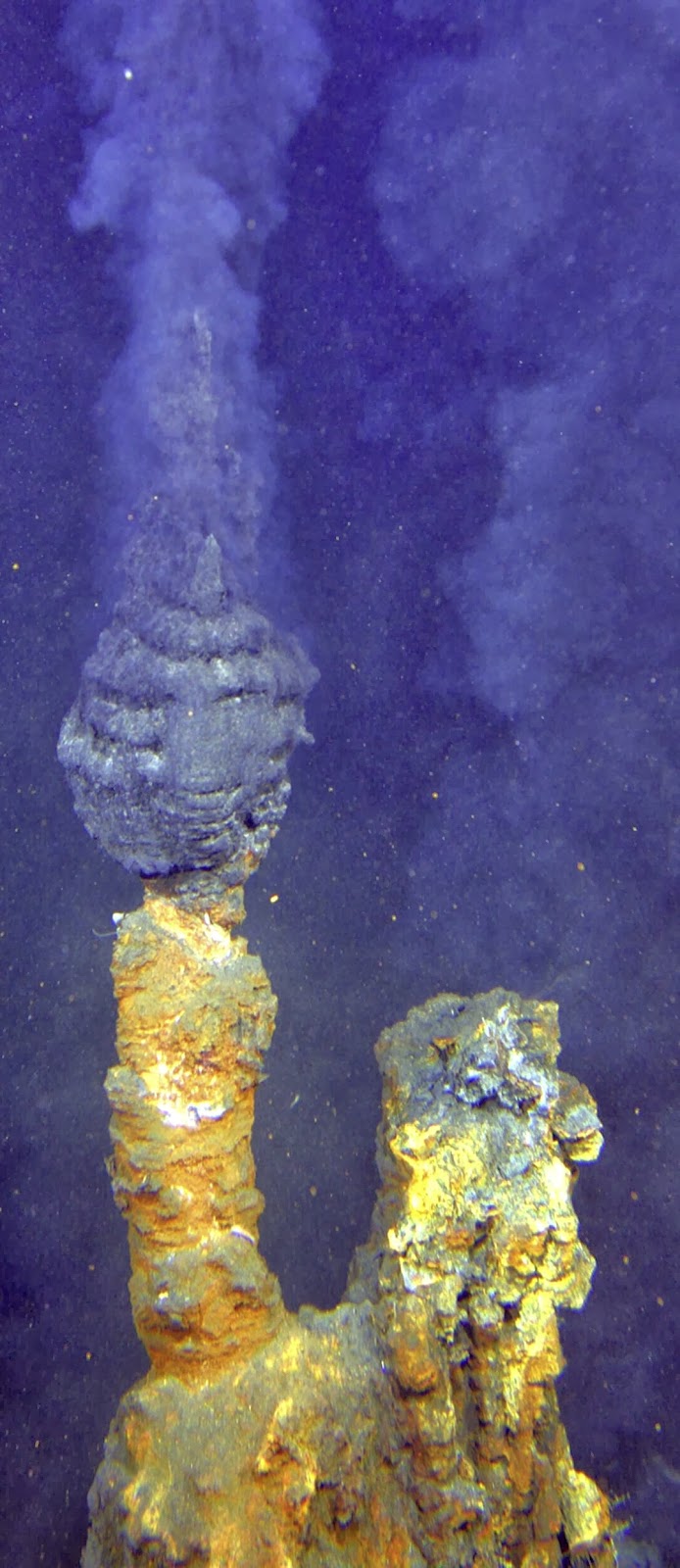
A black smoker known as The Brothers, off the coast of New Zealand. (Photo: National Oceanic and Atmospheric Administration/Wikimedia Commons.)

Wednesday, February 05, 2014

my way into science journalism

in the February round-up of German pieces there is a special piece in the popular chemistry magazine Chemie in unserer Zeit. The editor invited me to reminisce on my career as a science writer (an earlier attempt at describing my career path, in English, is here). This is kind of related to the fact that I’m being awarded the prize for journalists and writers from the German Chemical Society (GDCh) this year. Previously, the only prize I won was a bottle of Bordeaux for spotting the book title that went on to win the Diagram Prize, so this is definitely a step up.

The other pieces published in January and February cover crystallography without crystallising the substance of interest, lab-grown meat, natural ingredients, and cell-free biotechnology.

Mein Weg zum Wissenschaftsjournalismus
Chemie in unserer Zeit 2014,48, 68-71
DOI: 10.1002/ciuz.201400659 [FREE access]

Ausgeforscht: Vorsicht, die Fleischfälscher
Nachrichten aus der Chemie 2014, 62, 107

Ausgeforscht: Echt natürlich - natürlich echt?
Nachrichten aus der Chemie 2014, 62, 207

Blickpunkt Biowissenschaften: Zellfreie Biotechnik
Nachrichten aus der Chemie 2014, 62, 147-148

Kristallstrukturen von nicht kristallisierbaren Substanzen Spektrum der Wissenschaft 2014, Nr. 1, 14-16

memories ...

Monday, February 03, 2014

demographic challenges

My latest feature in Current Biology looks into the recent changes to China's one-child policy, which has been in force for 34 years now. Changes announced recently allow parents a second child if they are single children themselves, avoiding the one-child-rule from becoming effectively a one-grandchild (per set of four grandparents) rule.

Where next for China's population policy?

Current Biology Volume 24, Issue 3, 3 February 2014, Pages R97–R100

Restricted access to full text and PDF download (free access after one year)

Shopping street in Shanghai. Photo: Wikimedia Commons / Agnieszka Bojczuk

Friday, January 24, 2014

latest spin on carbohydrates

Even though I did much of my PhD thesis with the characteristic whining of two ancient, wardrobe-sized Beckman model E analytical ultracentrifuges in the background, I didn't really expect to get a chance to write something about this technique any time soon. It was widely used to study molecular weight and assembly of proteins back in the 1970s but for a time it became so unfashionable that there was no company left making or servicing the instruments, and only hardcore fans like my PhD supervisor, Rainer Jaenicke, kept the last of these dinosaurs alive.

By now, the technique has been rediscovered, new centrifuges have been developed and built, and various groups are using the technique. In an intriguing development, the groups of Steve Harding and Thomas Heinze have shown that certain carbohydrates can assemble reversibly just like oligomeric proteins. Read all about it in my news story which is out now in Chemistry World online, free access:

Self-assembling carbohydrates behave like proteins

Searching for an illustration for this article, I discovered this video of a simulation showing what happens to protein molecules in the cell of an ultracentrifuge. Simulation is of lysozyme in water, so nothing to do with carbohydrates, but I thought it's a lovely visualisation of the technique:

Source: Díez A, Ortega A, Garcia de la Tore J (2011). "Brownian dynamics simulation of analytical ultracentrifugation experiments". BMC Biophysics. DOI:10.1186/2046-1682-4-6.

via wikimedia commons.

Tuesday, January 21, 2014

coastal protection

With sea levels rising and many coastal cities sinking, protection from floods is becoming an ever more urgent problem. Which doesn't seem to stop people from the ongoing destruction of natural defences like mangrove forests.

My latest feature, describing how conservation and flood defence can help each other, is now out:

Protect the coasts so they can protect us

Current Biology, Volume 24, Issue 2, R51-R53, 20 January 2014
doi:10.1016/j.cub.2014.01.001

FREE access to full text and PDF download

Mangrove wetlands lining many coasts in the tropics provide effective natural protection against storm surges. They also have the ability to build up in line with sea-level rise. Large-scale loss of mangroves in countries like Myanmar exposes many millions of people to increased flood risks. (Image: Challiyan at ml.wikipedia.)

Thursday, January 16, 2014

food speculation update

Back in October 2011, I published a feature on food speculation (i.e. the gambling with vital commodities on international financial markets, which can leave real people unable to buy the food they need to survive), so I was pleased to hear yesterday that the EU is now taking action, as it sealed a deal on the reform of the Markets in Financial Instruments Directive (MiFID), which sets new regulation for financial markets.

As always when the EU does a good thing, the UK government is fighting hard to stop it, but I understand it only succeeded in watering it down a bit, and campaigners from the World Development Movement are claiming the EU decision as a win for their fight against food speculation.

Here are the reactions from:

WDM: EU takes historic step to stop banks betting on hunger

Oxfam: EU deal on curbing food speculation comes none too soon

Friends of the Earth: New finance directive lays out improvements, but loopholes remain

See also this report from the Guardian: EU moves to curb food price bets by traders

Photo: WDM.