Open Archive Day
The project to build a ginormous canal across Nicaragua has divided opinion. It is likely to spell ecological disaster in a number of ways, but then again, it is hard to deny one of the poorest countries in the Americas the opportunity to capitalise on its geographic location.
I reported on the project in November 2014 in a feature which is now in the open archives:
Will the Nicaragua Canal connect or divide?
Now it looks like it is definitely going to be built, even though not all Nicaraguans are happy with it. Recent press reports suggest that conflicts with protestors may be escalating, answering my title question by reminding us that the canal not only connects two oceans but also divides the country, although these letters suggest the majority is still behind the project.
Tuesday, August 29, 2017


Wednesday, August 23, 2017
life and her children

Life and her children:
Glimpses of animal life - From the amoeba to the insects.
By Arabella B. Buckley.
With upwards of 100 illustrations
This is a popular science book from 1885. As the author states in the preface: "Its main object is to acquaint young people with the structures and habits of the lower forms of life; and to do this in a more systematic way than is usual in ordinary works on Natural History, and more simply than in text-books on Zoology."
I bought this one from an Oxfam shop - more expensive than what I usually buy, but still under £10. I could almost claim I need it for my work. The writing and the animals are embossed and gilded, which doesn't show very well in my photos but looks lovely in real life. Also, the lower parts of the letters have a horizontal stripe pattern, presumably suggesting they emerge from the water, as life did.
It turns out Arabella Buckley (1840-1929) was Charles Lyell’s secretary and started writing and lecturing about science after Lyell’s death (1875), see her short Wikipedia entry. And it seems to have worked out well for her, considering this impressive list of titles published:
A short history of natural science and of the progress of discovery from the time of the Greeks to the present day. For the use of schools and young persons (1876)
Botanical Tables for the use of Junior Students (1877)
The Fairy-Land of Science (1879)
Life and Her Children (1880) with illustrations by John James Wild
Winners in Life's Race or the Great Backboned Family (1883)
History of England for Beginners (1887)
Through magic glasses and other lectures : a sequel to The fairyland of science (1890)
High School History of England (1891) co-authored by W.J. Robertson.
Moral Teachings of Science (1892)
Insect Life (1901)
Birds of the Air (1901)
By Pond and River (1901)
Wild Life in Woods and Field (1901)
Trees and Shrubs (1901)
Plant Life in Field and Garden (1901)
Eyes and No Eyes (1903)
additional photos are in my tumblr post about the book.
Monday, August 21, 2017
plastic planet
I have covered the catastrophic accumulation of plastic waste in the oceans a couple of times before, but a recent analysis of all the plastic ever produced suggested that this is only the beginning of the problem. Production keeps growing exponentially and faster than the global economy, and the waste produced will follow that curve with only a short delay.
So, time for another feature on the horrible things we're inflicting on our home planet:
Our planet wrapped in plastic
Current Biology Volume 27, Issue 16, 21 August 2017, Pages R785–R788
Free access to full text and PDF download

Beaches even on remote and uninhabited islands can accumulate large quantities of plastic waste delivered by the ocean gyres. This picture was taken on Laysan Island in the Hawaiian Islands National Wildlife Refuge. (Photo: Susan White/USFWS.)
PS other recent news on plastic waste:
Fish mistaking plastic particles for food (16.8.2017)
David Attenborough on plastic pollution (25.9.2017
So, time for another feature on the horrible things we're inflicting on our home planet:
Our planet wrapped in plastic
Current Biology Volume 27, Issue 16, 21 August 2017, Pages R785–R788
Free access to full text and PDF download

Beaches even on remote and uninhabited islands can accumulate large quantities of plastic waste delivered by the ocean gyres. This picture was taken on Laysan Island in the Hawaiian Islands National Wildlife Refuge. (Photo: Susan White/USFWS.)
PS other recent news on plastic waste:
Fish mistaking plastic particles for food (16.8.2017)
David Attenborough on plastic pollution (25.9.2017
Monday, August 14, 2017
vanishing wilderness
Open Archive Day
A year ago I wrote about the threats to one of the last true wilderness areas in Europe, the Białowieża forest, on the border of Poland and Belarus. It appears that the risks we worried about then are now becoming a harsh reality, as the Guardian has reported earlier this year:
'My worst nightmares are coming true': last major primeval forest in Europe on 'brink of collapse'
(The Guardian, 23.5.2017)
My feature is now on open access:
Europe’s last wilderness threatened
A year ago I wrote about the threats to one of the last true wilderness areas in Europe, the Białowieża forest, on the border of Poland and Belarus. It appears that the risks we worried about then are now becoming a harsh reality, as the Guardian has reported earlier this year:
'My worst nightmares are coming true': last major primeval forest in Europe on 'brink of collapse'
(The Guardian, 23.5.2017)
My feature is now on open access:
Europe’s last wilderness threatened
Friday, August 11, 2017
very hungry caterpillars
the roundup of German pieces published in July and August includes my take on the plastic-degrading caterpillars, along with the surprising regulatory role of ribosomal proteins, the quest for better fertilisers, and musings on a ban of concentrated hydrogen peroxide.
Raupen zerlegen PE
Chemie in unserer Zeit Volume 51, Issue 4, August 2017, Page 223
Access via Wiley Online Library
Netzwerk Leben: Die Proteinfabrik reguliert sich selbst
Chemie in unserer Zeit Volume 51, Issue 4, August 2017, Pages 282-283
Access via Wiley Online Library
Besser düngen
Nachrichten aus der Chemie Volume 65, Issue 7-8, Juli - August 2017, Pages 764-765
Access via Wiley Online Library
Jäger und Sammler
Nachrichten aus der Chemie Volume 65, Issue 7-8, Juli - August 2017, Page 859
Access via Wiley Online Library
Raupen zerlegen PE
Chemie in unserer Zeit Volume 51, Issue 4, August 2017, Page 223
Access via Wiley Online Library
Netzwerk Leben: Die Proteinfabrik reguliert sich selbst
Chemie in unserer Zeit Volume 51, Issue 4, August 2017, Pages 282-283
Access via Wiley Online Library
Besser düngen
Nachrichten aus der Chemie Volume 65, Issue 7-8, Juli - August 2017, Pages 764-765
Access via Wiley Online Library
Jäger und Sammler
Nachrichten aus der Chemie Volume 65, Issue 7-8, Juli - August 2017, Page 859
Access via Wiley Online Library
Monday, August 07, 2017
seafood genes
long chain omega 3 fatty acids, as found in fatty fish, are important for our health - this much is clear. But from this, one cannot conclude that everybody should eat more fish.
In fact they are so important that human evolution has adapted our metabolism to the availability or lack of the fish oil compounds. Thus people from a fish-eating genetic heritage may need the fish oils, while others from a long vegetarian tradition have evolved their own ways of producing the compounds in their body.
Thus, the answer is complicated, as I have explained in my latest feature which is out now in Current Biology:
How our diet changed our evolution
Current Biology Volume 27, Issue 15, 7 August 2017, Pages R731–R733
FREE access to full text and PDF download

In Inuit and other populations traditionally relying on seafood, researchers have found gene variants that weaken the endogenous synthesis of the fatty acids that these people take up with their regular doses of fish. (Photo: Louise Murray/Science Photo Library.)
In fact they are so important that human evolution has adapted our metabolism to the availability or lack of the fish oil compounds. Thus people from a fish-eating genetic heritage may need the fish oils, while others from a long vegetarian tradition have evolved their own ways of producing the compounds in their body.
Thus, the answer is complicated, as I have explained in my latest feature which is out now in Current Biology:
How our diet changed our evolution
Current Biology Volume 27, Issue 15, 7 August 2017, Pages R731–R733
FREE access to full text and PDF download

In Inuit and other populations traditionally relying on seafood, researchers have found gene variants that weaken the endogenous synthesis of the fatty acids that these people take up with their regular doses of fish. (Photo: Louise Murray/Science Photo Library.)
Friday, August 04, 2017
old tunes
reviving the series of antiquarian books from my shelves, here are some musical titles I bought from the book stall at the Oxford Music Festival this year:

Giesbert, F.J. (Hrsg.):
Deutsche Volkstänze. Eine Sammlung der schönsten Volkstänze und Reigenlieder für 1 oder 2 Blockflöten oder andere beliebige Melodieinstrumente nach Belieben mit einer Laute. Hefte 1 und 2.
My edition is undated but the internet ventures all sorts of guesses ranging from 1910s to 1940s. The serial numbers 2361 and 2362 are not that far away from the Rohr-Lehn recorder book for schools (2661) which is ancient, but was still in use in the 1970s. In fact, you can still get these from Schott Music today, apparently, but they don't reveal the publication date either. The editor, Franz Julius Giesbert, lived 1896-1972, so that narrows it down a bit ...

Der Flötenmusikant - Volkslieder und Tänze für 1 oder 2 Blockflöten gleicher Stimmung edition Schott, Band I-III.
These are also from Schott, and a different version under the same title is still available today, presumably the three booklets merged into one. My three little books have numbers on the back cover and month of printing, reading:
158 XII.61 on the first two volumes, and then 158 VII.63 on the third.
Funnily enough, Giesbert No 1 also has 158 in the same place (but no date) and No. 2 has the number 33 - I think these numbers specify the lists of other works available, but the dates are still likely to be close to the date of printing, right?

Giesbert, F.J. (Hrsg.):
Deutsche Volkstänze. Eine Sammlung der schönsten Volkstänze und Reigenlieder für 1 oder 2 Blockflöten oder andere beliebige Melodieinstrumente nach Belieben mit einer Laute. Hefte 1 und 2.
My edition is undated but the internet ventures all sorts of guesses ranging from 1910s to 1940s. The serial numbers 2361 and 2362 are not that far away from the Rohr-Lehn recorder book for schools (2661) which is ancient, but was still in use in the 1970s. In fact, you can still get these from Schott Music today, apparently, but they don't reveal the publication date either. The editor, Franz Julius Giesbert, lived 1896-1972, so that narrows it down a bit ...
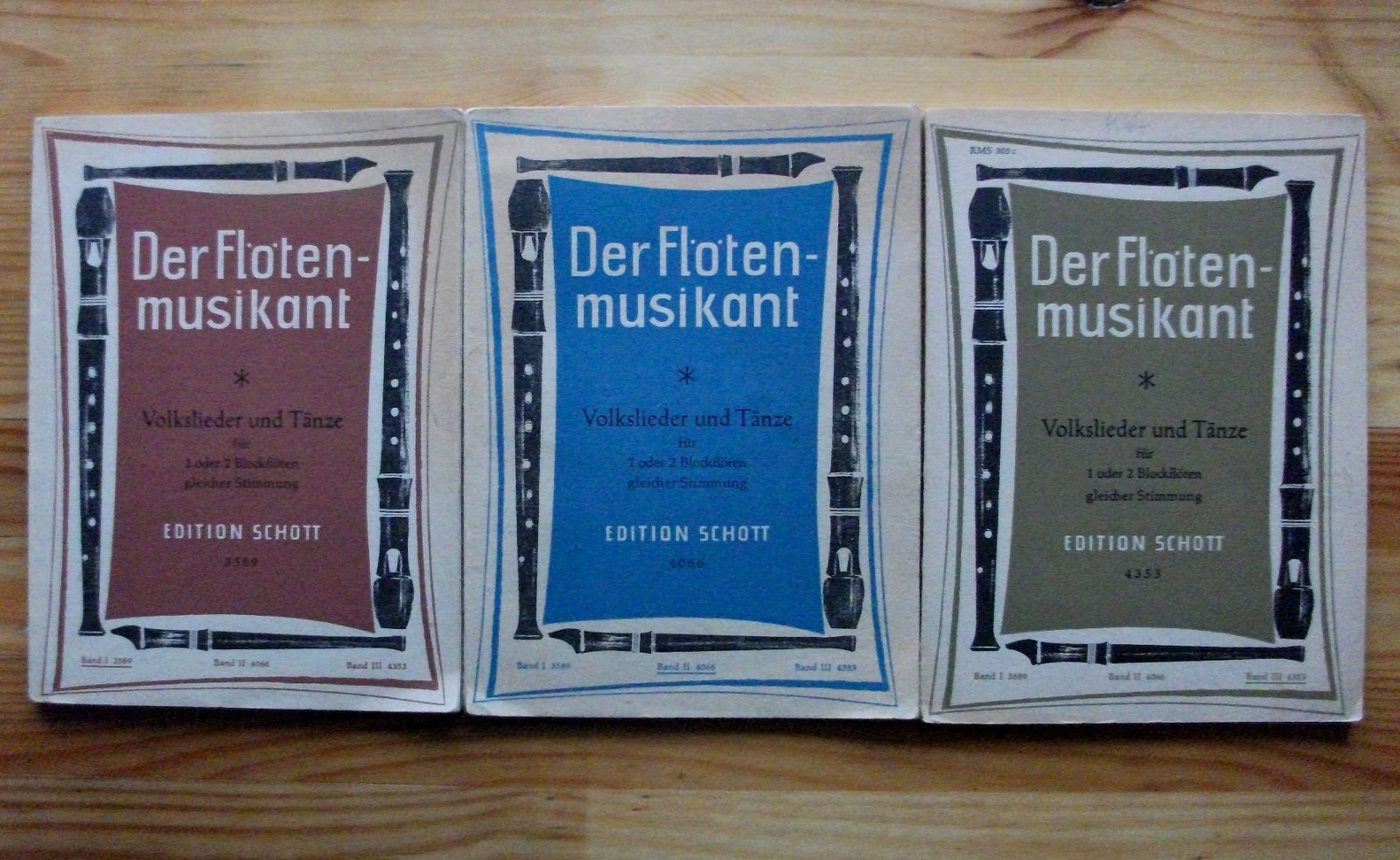
Der Flötenmusikant - Volkslieder und Tänze für 1 oder 2 Blockflöten gleicher Stimmung edition Schott, Band I-III.
These are also from Schott, and a different version under the same title is still available today, presumably the three booklets merged into one. My three little books have numbers on the back cover and month of printing, reading:
158 XII.61 on the first two volumes, and then 158 VII.63 on the third.
Funnily enough, Giesbert No 1 also has 158 in the same place (but no date) and No. 2 has the number 33 - I think these numbers specify the lists of other works available, but the dates are still likely to be close to the date of printing, right?
Monday, July 31, 2017
nature on fire
Open Archive Day
It's wildfire season in the Northern hemisphere, so a good time to re-consider my feature from two years ago on how nature can live with fire, but humans have managed to turn it into a problem - partly by stopping it from happening.
My feature is on open access here:
Learning to live with landscape fires

A forest fire near Sydney, Australia, dwarfs a fire truck sent to contain it. (Photo: Stefan Doerr, Swansea University.)
It's wildfire season in the Northern hemisphere, so a good time to re-consider my feature from two years ago on how nature can live with fire, but humans have managed to turn it into a problem - partly by stopping it from happening.
My feature is on open access here:
Learning to live with landscape fires

A forest fire near Sydney, Australia, dwarfs a fire truck sent to contain it. (Photo: Stefan Doerr, Swansea University.)
Wednesday, July 26, 2017
what is life
the latest issue of C&I contains my review of a book called "What is life?" - sadly not Schrödinger's take on the matter though.
Free access.

Free access.

Tuesday, July 25, 2017
fragmented forests
Brazil hosts a pioneering experiment designed to study the ecological damage done by forest fragmentation. After making some real progress in slowing down deforestation, however, the country is now once again speeding up the destruction of the Amazon rainforest. The lessons learned in decades of research in the Amazon clearly haven't made much of an impact on the people now in power.
Read all about it in my latest feature, which is now out:
Brazil's fragmented forests
Current Biology volume 27, Issue 14, 24 July 2017, Pages R681–R684
FREE access to full text and PDF download
Oh, and I think this must be the 150th contribution in the series of features started in February 2011.

Research at the BDFFP has shown that forest fragmentation and edge effects significantly alter the abundance of bats. (Photo: Oriol Massana and Adrià López-Baucells.)
Read all about it in my latest feature, which is now out:
Brazil's fragmented forests
Current Biology volume 27, Issue 14, 24 July 2017, Pages R681–R684
FREE access to full text and PDF download
Oh, and I think this must be the 150th contribution in the series of features started in February 2011.

Research at the BDFFP has shown that forest fragmentation and edge effects significantly alter the abundance of bats. (Photo: Oriol Massana and Adrià López-Baucells.)
Monday, July 10, 2017
climate canaries
So I came across a story about albatrosses and how they are affected by ocean warming, and I wanted to do effects of warming more widely (other than corals), but all roads led to birds. Ocean warmings leads to more frequent extreme climate events, and it turns out that birds with their complex life cycles including migration, nest-building and parental care routines, are often quite vulnerable to these events. So they are our modern day coalmine canaries in a way.
All will be explained in my latest feature out now:
Volatile climate stirs bird life cycle
Current Biology Volume 27, Issue 13, pR623–R625, 10 July 2017
Restricted access to full text and PDF download
(will become open access one year after publication)
Magic link for free access
(first seven weeks only)

Sea birds like albatrosses are sensitive to changes in ocean temperatures. In one recent study, a well-studied population was shown to suffer from the increasing temperature variations but to benefit from recent warming bringing it closer to its temperature optimum. (Photo: Lieutenant Elizabeth Crapo/NOAA Corps. (CC BY 2.0).)
All will be explained in my latest feature out now:
Volatile climate stirs bird life cycle
Current Biology Volume 27, Issue 13, pR623–R625, 10 July 2017
Restricted access to full text and PDF download
(will become open access one year after publication)
Magic link for free access
(first seven weeks only)

Sea birds like albatrosses are sensitive to changes in ocean temperatures. In one recent study, a well-studied population was shown to suffer from the increasing temperature variations but to benefit from recent warming bringing it closer to its temperature optimum. (Photo: Lieutenant Elizabeth Crapo/NOAA Corps. (CC BY 2.0).)
Tuesday, July 04, 2017
dvořák sonatina
I've just finished off the Dvořák sonatina op 100, having played all four movements over the last few months. I love it mainly for its echoes of the other "American" works, including the cello concerto and the New World symphony, which Dvořák wrote around the same time.
I started this adventure by buying a flute arrangement by James Galway, but soon realised he needlessly transposed the entire work as high up as physically possible, which in my ears doesn't sound very nice even if it is played competently, never mind when I try it. So I went back to the violin version (which is free online) and started from that, made it a bit more flutey with my teacher's help, looking at Galway's version for inspiration only where changes were necessary.
You can find a version that follows similar lines and uses the richer colours of the lower register here, played by Julien Beaudiment.
Next up: Albert Einstein's favourite Mozart sonata.

I started this adventure by buying a flute arrangement by James Galway, but soon realised he needlessly transposed the entire work as high up as physically possible, which in my ears doesn't sound very nice even if it is played competently, never mind when I try it. So I went back to the violin version (which is free online) and started from that, made it a bit more flutey with my teacher's help, looking at Galway's version for inspiration only where changes were necessary.
You can find a version that follows similar lines and uses the richer colours of the lower register here, played by Julien Beaudiment.
Next up: Albert Einstein's favourite Mozart sonata.

Subscribe to:
Posts (Atom)


