Monday, October 07, 2024

a whale of a tale

The rise of cetaceans (whales and dolphins) to become the dominating megafauna of the oceans happened remarkably quickly, within only 50 million years since some sort of hippopotamus-like species took the plunge to go fully aquatic. Their demise, which very nearly might have led to the extinction of a number of species, happened even more rapidly, within less than a century.

A couple of recent studies have enlightened us on the rise of whales, and ongoing news regarding whaling remind us of their entirely human-made fall, so I combined these two to the feature called:

The rise and fall of whales

Current Biology Volume 34, Issue 19, 7 October 2024, Pages R877-R879

FREE access to full text and PDF download

See also my Mastodon thread where I highlighted all CB features of 2024.

The thread for 2023 is here .

Baleen whales like this humpback typically feed on krill. (Photo: Admitter/Flickr (CC BY-ND 2.0).)

Saturday, October 05, 2024

when the cat's away ...

Cowley Orchestra runs on a no-commitment policy which we take seriously, so everybody including our part-time conductors can be absent any time. These last two weeks it so happened that we had no serving conductors, so the task of picking music out of our library of 400 pieces fell to me. I went through the database and put some effort into my selections (which I also documented on Mastodon and Facebook), so here comes the summary after two weeks (normal service should resume on Wed). Title links lead to youtube videos of other people's performances, which I have also added to a new playlist:

25.9.

  1. Just one cornetto - although it says "O sole mio" on the sheet music which is probably a lot older than the Cornetto ad.
  2. Albert Ketelbey, In a monastery garden. I actually discovered Ketelbey through playing another piece of his at Cowley (have that one lined up for next week):
  3. Cosi fan tutte Ouverture (Mozart). Based on our no-commitment policy, we have a lot of experience in playing orchestral pieces with whatever instruments turn up on the night, even if it's only 7 and no violin. So it's good to see professionals also like to play (and even record) these pieces with smaller ensembles, in this case just 5 wind players.
  4. Handel Suite No. 1. No this is not the famous water music, it is Handel's keyboard suite arranged for orchestra by the founder of our ensemble and collector of much of its music library, Henry Gosling. I tend to moan when I see the handwritten dots but the flip side is that this arrangement is a unique piece of music that probably doesn't exist anywhere else.
  5. As we have a few lovers of #musicals in the ensemble, we return to this selection of tunes from Oklahoma! fairly regularly, maybe once a term.
  6. Alexander Borodin: Polovtsian Dances (Prince Igor). Borodin was obviously very important because he was both a chemist and a composer. We had a go at the Prince Igor dances before running out of time - may help to study the dance video to get a feeling for the spirit of the piece.

2.10.

  1. 'Souvenir de France' by Ronald Hanmer - a medley of traditional French songs, some very widely known even in the UK ... Strangely youtube had two different recordings of this by different ensembles but in the same bandstand. I've picked the one which looked a bit sunnier.
  2. As promised, here comes the other Ketelbey piece, the one that first introduced me to this composer, In a Persian Market. In this video I love the fact that the English orientalism is diffracted through the prism of a Taiwan orchestra with traditional Chinese instruments and a conductor from Turkmenistan.
  3. This week's musical was Showboat by Jerome Kern - also a favourite we play around once per term. There are five selections left which we didn't get round to this week. Next week the conductors are back in charge but maybe they'll take on one of my leftovers in which case I'll highlight thoses as well.

Some other pieces we played on a previous occasion.

Monday, September 23, 2024

dodo and company

Here in Oxford we feel a special cultural connection to the dodo (Raphus cucullatus) - seeing that an important specimen of the extinct species is housed in the University Museum, where it inspired Lewis Carroll to assign it a small role in Alice's adventures in wonderland, which ironically secured its immortality. Witness the pub down the road from me which is run by the Dodo Pub Co. At this year's Alice Day (the Saturday closest to July 4, the day when the story was first told), there was an excellent talk about the museum's specimen, and soon after a paper came out evaluating the entirety of the scientific literature on the dodo and on its relative the equally extinct Rodrigues solitaire (Pezophaps solitaria).

All of which clearly indicated that I needed to write a dodo-themed feature. The more general question I have tried to address is what the study of extinct species can teach us for the conservation of those that are endangered but still alive. The feature is out now:

The way of the dodo

Current Biology Volume 34, Issue 18, 23 September 2024, Pages R837-R839

FREE access to full text and PDF download

See also my Mastodon thread where I highlighted all CB features of 2024.

The thread for 2023 is here .

A life-sized dodo sculpture by palaeoartist Karen Fawcett, created on the basis of the most recent scientific investigations into its anatomy. (Photo and sculpture © Karen Fawcett.)

Monday, September 09, 2024

a silent summer

This summer, I was quite spooked by the total absence of wasps around here, and after I read that they have also been missing elsewhere in the UK, that was a good enough excuse to write up a feature on their ecological importance. And start it in my own garden.

The wonderful world of wasps

Current Biology Volume 34, Issue 17, 9 September 2024, Pages R795-R797

FREE access to full text and PDF download

See also my Mastodon thread where I highlighted all CB features of 2024.

The thread for 2023 is here .

The common wasp (Vespula vulgaris) is widely seen as a nuisance, especially in the late summer, when its workers are desperate for sugary food. (Photo: © Roman Eisele (CC BY-SA 4.0).)

Friday, September 06, 2024

a supersized violin

Pirate luthier adventures continued:

violin number 17)

In June I gave away six violins via freegle bringing the resident population down from 10 to 4. After that I had a bit of a hiatus in terms of offers. Now however, a freegler kindly offered a neglected violin that had been tucked away in the attic for too long. I had to put the soundpost and bridge back in place but otherwise it was in good shape. Although it groaned a bit when I first tuned it up last Saturday, it has now settled down nicely and I have played it a bit this week, including for two hours in the slow session of September 1.

So it looks fairly normal (on my new old musical cushion which I found by the roadside on my way home from orchestra):

It has a very beautiful backside:

and a lovely flower intarsia in the tailpiece (there's also a round dot inlayed closer to the tail end):

Another thing that is special about it is harder to spot and only visible when you compare it to another violin:

... or if you get out the measuring tape. Compared to a standard violin like my number 5) (top), number 17) is 1 cm longer overall, with the body length of 363 mm compared to standard length of 356 mm. By contrast, the width and thickness of the instrument are normal, so it's basically a stretched version. Looking into it I understood there have been makers in France, for instance, embracing this "long strad" shape hoping to gain a more powerful sound. Others object to the fact that the larger instruments don't necessarily fit into standard cases, see for instance this forum discussion. It came in a 1960s style hardcase which is loose-fitting anyway, so no problem but also not much protection. Luckily I had a modern case ready which I saved from landfill and which happened to have the extra centimetre to accommodate the longer instrument.

Having played it for nearly a week now, I appreciate that the sound is very strong and clear, which was particularly useful for hearing myself in the session playing with 20 others. Playing on my own at home, however, I tend to find the sound a bit too piercing. As a result, I am now developing my technique to play more quietly, but at this point I still prefer playing number 5) when I'm on my own.

Another special feature is the chin rest which is unusually high, as you can see in the last photo (it still had the price sticker on the underside, it was bought from Newingtons the Music Centre at Tunbridge Wells for £5.50, not to be confused with Newingon Strings who supplied the very lovely bridge). The higher chin rest has the advantage that I can play it comfortably without a shoulder rest (it came with a shoulder cushion), so don't have to mess around with that when I switch between instruments. Which in this case works well, as the setups seem to be similar enough.

Previously in the pirate luthier series:

violin 1) is the one my late aunt had since the 1930s, which got me started. After restoring it in November 2022, I played it almost every day for 14 months, until number 5) showed up.

violin 2) is a Stentor student 1 (a very widely used brand of cheap fiddles available everywhere and still being produced). It has a fault that is probably not worth repairing, see the blog entry on number 3) below. After stripping it of some accessories and spares, I am now inclined to keep it in a semi-functional state to try out experimental repairs, i.e. use it as a wooden guinea pig of sorts.

violin 3) came from a folkie friend who moved away. I put the soundpost back in its place and it has now found a new home.

violin 4) is a modern Chinese one which I bought from one musical friend and sold to another, no work needed.

violin 5) (donated by a friendly freegler) is my new favourite and the one I currently play in folk sessions.

violin 6) is the half-sized Lark which was one of the six violins I gave away on freegle in the first week of June.

violin 7) is a skylark from 1991 which I bought on gumtree for £ 10 and fitted with a new bridge. Good enough for folk I would say. It was one of the six violins I gave away on freegle in the first week of June.

violin 8) is the "ladies violin", a 7/8 skylark. It was one of the six violins I gave away on freegle in the first week of June.

violin 9) is the one which needed a new bridge and a tailgut and turned out to sound quite lovely on the E string. It was one of the six violins I gave away on freegle in the first week of June.

violin 10) is the broken one with traces of multiple repair attempts. I'm still gathering courage to try and fix that one.

violin 11) is the 3/4 sold by JP Guivier & Co Ltd. in the 1950s but may actually be older than that. It was one of the six violins I gave away on freegle in the first week of June.

violin 12) is a full-size Lark which a freegle user kindly donated and delivered after seeing my offer. It was one of the six violins I gave away on freegle in the first week of June.

violins 13) through to 15) I bought locally through gumtree or facebook, nothing special to report.

violin 16) is branded Sebastian Klotz, but sadly not by the Mittenwald Luthier, but by Yamaha Malaysia, who appear to have trademarked his name. This one needs a serious repair, may write more about it when I've done it and found out whether it was worth it.

violin 17) is the supersized violin described above.

Sunday, August 25, 2024

the generation game

Some thoughts on

I couldn't love you more
by Esther Freud
Bloomsbury 2021

I've been following the work of Esther Freud since the time when we both turned 30, and as we both turned 60 last year, that's half our lifetimes, scary thought. The mix of dysfunctional families and artsy / intellectual people populating her novels always speaks to my own views and experiences to a certain extent, even if my family doesn't have quite as famous people in it as hers. Thanks to this I always find something in her books to relate to, although more of it in some books and a bit less in others.

My favourite so far has been Summer at Gaglow (read before I had a regular blog so I may not have reviewed it, will have to re-read and review!), which reflects her mixed German/British heritage to great effect. This, her ninth novel, is at least as rich and rewarding as I remember Gaglow to be, so it may well be my new favourite (until I re-read Gaglow).

Whereas many of the other novels feature on young(ish) people's experience (eg Love Falls, Lucky break), this one skilfully interweaves three generations (plus a young girl in a smaller role) of women, who have suffered from various degrees of male awfulness and society prejudice in their different lifetimes. The connecting thread is that the middle generation woman becomes pregnant and is forced to deliver her daughter in a convent in Ireland where children born "in sin" are routinely offered for adoption. Freud has written about the real life background that informed this side of her novel in the Guardian. In real life, her mother shared many of the experiences of the middle protagonist but narrowly escaped the fate of giving birth in the convent.

It is both helpful and scary that Kate, the younger protagonist born in the convent, is my age (as many of Freud's protagonists happen to be, because it also happens to be her age). So it is easy to imagine the other generations in the novel, as they neatly align with generations in my family. And of course I am also taking notes re how to turn one's family history into fiction.

All in all, highly recommended to readers of all ages and generations.

I'm loving the photo by Willy Ronis used for the cover of my edition. It shows Gaston Berlemont's pub, The French House, in Soho, in 1955.

PSA: As I now have separate tags for literature written in French, Spanish, Galician, I should reserve the literature tag for books written in English - this will need some tidying up as I appear to have used it randomly over the last 15 years.

Thursday, August 22, 2024

a book is born

The publishers told me this week that first copies of my new book have arrived at their offices, and on checking up I see it can now be pre-ordered from their website as well. So here are the full details now:

Intertwined
From Insects to Icebergs
by Michael Gross
Johns Hopkins University Press
15. October 2024
424 pages
ISBN 9781421449975
Hardcover $32.95

Also available as an e-book for the same price, ISBN: 9781421449982

Cover of the book Intertwined: From Insects to Icebergs

watch this space for excerpts and further horn-tooting ...

Wednesday, August 21, 2024

travelling pathogens

When humans travel, they tend to bring their infectious diseases along. With Covid and air travel we have seen that an outbreak can become a global pandemic within weeks. With historic, slower mode of travels, the situation is more complex. Consider a sailship going half way round the world - by the time it reaches the destination, the pathogen may have run out of hosts to infect and thus the disease may have died out without any intervention. I spotted a paper applying the tools of ecological theory to the intercontinental transfer of pathogens in the times of sail and steam and found that topic really fascinating, so I mixed in a bit of Covid and air travel and some pre-historic travellers to widen the scope and made it my latest feature which is out now.

Travelling pathogens

Current Biology Volume 34, Issue 16, 19 August 2024, Pages R747-R749

FREE access to full text and PDF download

See also my Mastodon thread where I highlighted all CB features of 2024.

The thread for 2023 is here .

This painting by Jacob Knijff (1639–1681) purportedly shows “Ships, Galleys and Other Vessels off an Italian Port”, although the location could not be identified and the scene is not thought to depict a specific event. (Image: Jacob Knijff/Wikimedia Commons.)

Saturday, August 17, 2024

a river landscape

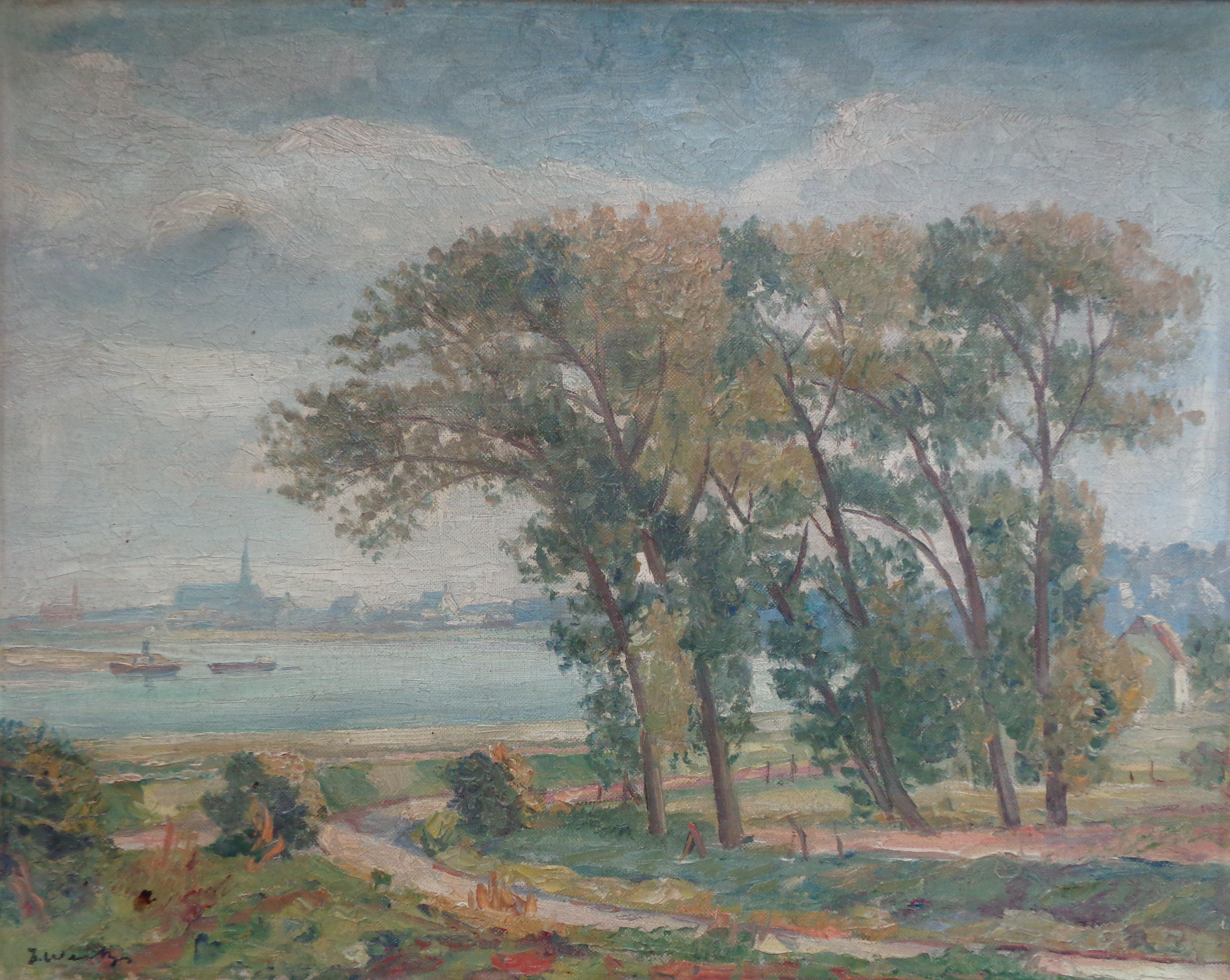
Somebody in Düsseldorf put an actual oil painting out with their bins this week and I liked the look of it when I cycled past it, so I am now the proud owner of a landscape by Jakob Weitz (1888-1971) which looks like this:

It measures 40cm x 50cm and came with a bulky frame which isn't quite to my taste so I took that off to hang it just as the canvas (with the light wood frame underneath on which it was painted). The canvas has two bumps, a big one in the clouds which is interesting as it makes the clouds look more real, and a smaller more inconspicuous one in the landscape which also involves a little bit of tear. I'm wondering if it may become a bit more luminous if I try to wash the surface. Then again the paint is cracking in places so humidity may get in?

When I saw it by the roadside I thought the riverside landscape looked like it might be near here and my first thought was Volmerswerth, on the southern edge of the city. However, a bit of DuckDuckGo research (Google had fewer relevant results) revealed a similar painting by the same artist, which is captioned as Kaiserswerth, so that is still on the edge of Düsseldorf but on the opposite end, downstream from the city centre.

Hotlinking here to contrast and compare:

A few other paintings by this artist are shown on this auction site. Nothing to raise a gasp from the Antiques Roadshow audience, but some of them come with estimates of a few hundred euros.

Saturday, August 10, 2024

women and the blue rider

Some thoughts on

Malerinnen und Musen des »Blauen Reiters«
by Hildegard Möller
Piper Verlag 2007

I am definitely going to see the current exhibition on German expressionists of the "Blue Rider" group at the Tate Modern (Expressionists: Kandinsky, Münter and the Blue Rider, until October 20), but as I haven't quite made it yet, I read this book in preparation, which is a joint biography of five women associated with the group, namely the painters Gabriele Münter, Marianne von Werefkin, and Maria Marc, and the muses and wives Lisbeth Macke and Lily Klee. We have had the book since it came out in 2007 but I hadn't read it yet. Partially, I presume, due to the misguided feeling that there wasn't much left to discover in it, as the four core members of the group (Marc, Kandinsky, Macke, Klee) represent the art I grew up with. (Funnily enough, these are also the ones that are represented in the compact art books series from Taschen.) Jawlensky is the one rider I am less familiar with - strangely the one work I associate his name with appeared on a postage stamp in the 1970s. Of the women I was aware of Gabriele Münter as a painter but not so much of the other two.

So, well, although I was familiar with the art of the Blue Rider, I did learn a lot about the lives behind it, and it was an interesting experience to follow these lives from the perspectives of the women involved. Ironically, although I perceive many of the very colourful paintings of the group as joyful, the lives weren't all that much fun, seeing that Marc and Macke died young in WW1, while Münter and Werefkin had rather troubled relations with their more famous painter boys, and Klee only lived to age 60 and a half. So in significant parts this is the story of three widows and two women abandoned by the artist partners they supported to the point of self-sacrifice. Although the roots of the Blue Rider are in the Schwabing district of Munich, there is a lot about moving out of the city to remote farm houses, eg at Murnau, which I find a bit scary. The painters in the story shared the dubious honour of being branded "entartete Kunst" (degenerate art) by the Nazis, which obviously has become a badge of honour since but didn't help the careers of those who were still alive when it happened.

Considering all the very exciting (to me at least) and brightly coloured art that is being created in this story, I find the author's writing style a bit subdued and grey. I realise she's obviously striving to stay neutral, not to make any feminist statements in support of the women wronged one way or another, but still I find this neutrality clashes with the revolutionary nature of the art in question and of some of the lives being lived as well.

It was interesting too to meet some of the marginal figures of the Blauer Reiter, including August Macke's less famous cousin Helmuth Macke, who hailed from Krefeld, so I will have a look at his art the next time I'm there, and will also have a look at his family history in case his maternal ancestry throws up anything connected to my Krefeld clan.

It was also interesting to learn that the one and only almanac "Der Blaue Reiter", which gave the group its name and identity, was published in 1912 by a young man called Reinhard Piper - whose publishing house survives to this day and has indeed published this very book as well. A paperback edition came out on the centenary of the almanac's publication. I'm surprised it hasn't been translated ahead of the Tate Modern exhibition - could have sold well there.

PS I'll take the opportunity to list here the relevant exhibitions I (may) have seen (the childhood ones still need research:
22.8.-12.9.1969 Museum Folkwang, Essen
Paul Klee, Aquarelle und Zeichnungen. No memory of this whatsoever but I found the catalogue of the exhibition among my possessions so assume I will have seen it as a 5-year-old.
1970s: Pretty sure I saw a generic Blauer Reiter exhibition at the Museum Folkwang as a child. Definitely sure I saw one about Karl Schmidt Rottluff a bit later (maybe ca. 1980). May have seen exhibitions featuring Campendonk and/or the trip to Tunisia undertaken by Macke and Klee.
1980s: Visited Lenbachhaus in Munich with the Jaenicke research group in 1989/90?
1.8.-19.9.2004 Von-der-Heydt-Museum Wuppertal,
Wassily Kandinsky: Der Klang der Farbe 1920-1921
2.11.2013 Tate Modern
Paul Klee
2014 (ab 25.9.) Bundeskunsthalle Bonn
August Macke und Franz Marc: Eine Künstlerfreundschaft
25.2.2024 Kunstmuseum Pablo Picasso Münster
Brücke zur geistigen Welt: Meisterwerke des Expressionismus
17.5.2024 K20 Düsseldorf
Hilma af Klint und Wassily Kandinsky: Träume von der Zukunft

Updates and additions:

8.2.2026 Mackehaus Bonn
Macke and friends
11.2.2026 Stadtmuseum Mülheim (Sammlung Ziegler)
Marc, Macke, Heckel, Jawlensky
exhibition coming up
23 Okt 26 — 21 Feb 27 Museum Wiesbaden
Die Blauen Reiterinnen,

Wednesday, August 07, 2024

finding Rita Strohl

After bringing up a young cellist and spending quite some time obsessing with cello music myself, it was a bit of a shock to discover a couple of truly amazing cello pieces from a composer I never heard of before.

The composer is Rita Strohl (1865-1941)

source

As was the case with many other female composers, her music was played during her lifetime, but forgotten after her death as there was nobody willing to champion it. Some of her works have been rediscovered, published and recorded in recent years.

The pieces are

Grande Sonate Dramatique "Titus et Bérénice" (1898) played by Hermine Horiot & Hélène Fouquart, Youtube

It does have a story to tell, based on the eponymous tragedy by Racine, but on the first couple of hearings I was so blown away by the music I didn't pay any attention to texts between the movements. By the day I first watched this, the video had only around 5860 which is just scandalous.

Solitude for cello (or violin) and piano played by Hermine Horiot, cello & Hélène Fouquart, piano, Youtube

Sheet music for this one is available on IMSLP and it does sound as if it might be playable for mere mortals (unlike the sonata which is pushing the limits of cello technique). On closer inspection, the cello part reaches a couple of quite high notes that I don't use very often (up to the F just over 2/3 up the A string), but the violin version of the solo part fits the instrument range more easily, and it is also very handy for the flute without any alterations. Actually great fun to play on the flute alongside with the cello video.

Here's cellist Sandra Lied Haga raving about Strohl's work in Strad magazine, April 2023. She has released a recording of Titus et Bérénice together with César Franck's sonata in A.

Oh and I've added the two videos to my youtube playlist with female composers.

Thanks to lesser-known-composers on tumblr.

Monday, August 05, 2024

the AI tipping point is nigh

I am slightly allergic to the whole AI hype and the tendency to use it for everything regardless of risks and side effects (a hundred years ago it was radium). So I successfully avoided writing about it, but recently the news about new data centres for AI and their exorbitant carbon footprint piled up and that at least is an angle worth reporting, I thought.

So here goes, entirely written by my own two hands, no AI involved:

The artificial intelligence tipping point

Current Biology Volume 34, Issue 15, 5 August 2024, Pages R709-R711

FREE access to full text and PDF download

See also my Mastodon thread where I highlighted all CB features of 2024.

The thread for 2023 is here .

The rapid expansion of data centre facilities built to serve the demand of AI applications is at risk of endangering energy supplies and climate policies. (Photo: Rawpixel.com.)

other recent (anti) AI news published after I submitted my feature: