As politicians blatantly fail to find ways of limiting climate change to a warming of no more than two degrees C, scientists are beginning to think about what will happen if and when the average temperature rises by four degrees or more, which may in fact happen as early as the 2060s.
Not all effects are likely to just double from a two-degrees world. Some, including the predicted displacement of people, may take on a very different (meaning catastrophic) quality.
Read my news feature in the latest issue of Current Biology:
Researchers ponder a 4C temperature rise
Current Biology, Volume 20, Issue 24, R1052-R1053, 21 December 2010
summary and free access to pdf file
Monday, December 27, 2010


Wednesday, December 22, 2010
christmas tandem
This year's christmas lights in Oxford's High Street feature a few bicycles, very fitting for one of the UK's biggest bike hotspots, also including a tandem:

Wondering whether they picked up abandoned bikes from the street and painted them ...
Oh, and I have to admit I haven't written a single xmas card this year - if you were expecting one, I'm afraid this seasonal blog post is all you're going to get.
happy holidays!
PS (2011): the tandem is there again this year, and somebody else took a much better photo of it, which you can see on flickr

Wondering whether they picked up abandoned bikes from the street and painted them ...
Oh, and I have to admit I haven't written a single xmas card this year - if you were expecting one, I'm afraid this seasonal blog post is all you're going to get.
happy holidays!
PS (2011): the tandem is there again this year, and somebody else took a much better photo of it, which you can see on flickr
Friday, December 17, 2010
wytham woods
A couple of years ago I wrote a feature for Oxford Today about the climate change research that Earthwatch carries out in Wytham Woods, just outside Oxford. Wytham Woods is actually a reasonably large (by today's standards) patch of wood, with an intriguing history and an amazing track record in ecological research, to the extent that there is now an entire book about it:
Peter Savill, Christopher Perrins, Keith Kirby, and Nigel Fisher:
Wytham Woods: Oxford's Ecological Laboratory
Oxford University Press 2010
Publisher's page with link to pdf of first chapter

When I visited the Earthwatch project in Wytham Woods, it was run as a corporate partnership, recruiting volunteers only among the employees of the relevant company. From next year, however, the project appears in the generall Earthwatch programme, so everybody can join the fun, jug the trees and weigh the voles:
Full details of the Earthwatch project.
Tweet
Peter Savill, Christopher Perrins, Keith Kirby, and Nigel Fisher:
Wytham Woods: Oxford's Ecological Laboratory
Oxford University Press 2010
Publisher's page with link to pdf of first chapter

When I visited the Earthwatch project in Wytham Woods, it was run as a corporate partnership, recruiting volunteers only among the employees of the relevant company. From next year, however, the project appears in the generall Earthwatch programme, so everybody can join the fun, jug the trees and weigh the voles:
Full details of the Earthwatch project.
Tweet
Thursday, December 16, 2010
silk and prizes
The roundup of German pieces for December includes a polymer science perspective on spider silk, a detailed look at this year's Nobel prize for chemistry (Heck reaction and similar couplings using palladium catalysts) and a look back over 20 years of the coveted IgNobel prizes in chemistry. The spiders even made it to the cover of Nachrichten:

Blickpunkt Biowissenschaften: Spinnenseide aus Sicht der Polymerforschung. Nachrichten aus der Chemie 59, 1250
Ausgeforscht: Was ist eigentlich Chemie? Nachrichten aus der Chemie 59, 1225
Verknüpfung von Kohlenstoffatomen mittels Palladium Spektrum der Wissenschaft Nr 12, 18 [free access]
Tweet

Blickpunkt Biowissenschaften: Spinnenseide aus Sicht der Polymerforschung. Nachrichten aus der Chemie 59, 1250
Ausgeforscht: Was ist eigentlich Chemie? Nachrichten aus der Chemie 59, 1225
Verknüpfung von Kohlenstoffatomen mittels Palladium Spektrum der Wissenschaft Nr 12, 18 [free access]
Tweet
Wednesday, December 15, 2010
Shakira at Paris
Shakira live at the Bercy, Paris, 6.12.2010
concert report / review
As I take every conceivable excuse to travel to Paris, and as I can’t do the London gig of the current tour because it falls in the school hols and I have kids to look after, I went down to the Bercy to see the Sale El Sol Tour for the second time (first time was Lyon, see here).
The queuing was slightly less mad than in Lyon (which was the first concert in Europe and has therefore surely attracted a few hundred hardcore front row people from across the continent), but still quite crazy. I joined the end of a very long and winding queue at 6pm, when the doors opened, and it was 7 before I got in.
This time I heeded my own advice which I gave out after the last concert, and went for a place close to the “end of the pier”, with just four or five rows between me and the synapse of the stage axon (I like this neurological terminology for the stage layout, will stick with it!). It’s not just that much of the show is actually happening there, it’s also that you don’t have to crane your neck back and forth when the action moves from the main stage to the synapse and back. And the view of the main stage is still good from this distance, plus one gets an impression of the whole light show as it is intended to be seen. So, best standing place in the house, really.
Just after “Bonsoir Paris” I noticed she actually addressed the criticism I expressed after the Lyon concert, switching her “tonight I’m all yours” introduction into French. Later on she also spoke more French during the bellydance course with four girls from the audience. Sweet. My other criticism after Lyon was that the DJ was a bit rubbish and blatantly only there to artificially pump up the adrenaline, and wouldn’t it be better to give a new act the chance to play to a big audience. As the announcement in Lyon said the DJ was booked for the entire European tour (and he was still there in Paris), I am now officially spooked to hear that at the Manchester Gig (14.12.) he has been replaced with a girl group called Parade. Damn I should have gone to Manchester as well.
So, next on my wishlist is a full-length recording of the Arabic song A'tini al-Nay. Oh, and another MTV unplugged concert.
Where were we? Oh yes, Paris. So, from my vantage point at the end of the axon the whole show made a lot more sense, and I really loved the little unplugged session at the synapse.
Some random observations that I hadn’t noticed or recorded last time:
The Sale El Sol announcement already confused me at Lyon. She started with something along the lines of “over the last few months I’ve been feeling a bit different” which seemed to lead very clearly towards something involving eggs and sperms, except that it didn’t. Identical text in Paris, but still no baby at the end of it.
I really loved the violin intro for Ojos Asi. I think the violinist who also plays a range of other instruments is a great addition to the band. Still have to find out her name. I think she was introduced as British in Lyon but as Irish in Paris. Never mind.
I’m not a huge fan of Gipsy but loved the dance intro and the acoustic version of that, and the throwaway line at the end: “soy gitana de ciudad”.
Two days after Paris I was due to see the show again at Frankfurt, but come 9pm (and after the DJ had already played 30 mins too long and in a suspiciously calm mood) it was announced that due to the inclement weather conditions her plane couldn’t land at Frankfurt, so the show had to be postponed. Oh well. Next time take the train – I really enjoyed my train rides through the snow from Paris to Frankfurt and back. Now I hope that the replacement show in Frankfurt will be Monday –Wednesday during term time, hope that can be arranged … Oh, and don’t forget A'tini al-Nay.

concert report / review
As I take every conceivable excuse to travel to Paris, and as I can’t do the London gig of the current tour because it falls in the school hols and I have kids to look after, I went down to the Bercy to see the Sale El Sol Tour for the second time (first time was Lyon, see here).
The queuing was slightly less mad than in Lyon (which was the first concert in Europe and has therefore surely attracted a few hundred hardcore front row people from across the continent), but still quite crazy. I joined the end of a very long and winding queue at 6pm, when the doors opened, and it was 7 before I got in.
This time I heeded my own advice which I gave out after the last concert, and went for a place close to the “end of the pier”, with just four or five rows between me and the synapse of the stage axon (I like this neurological terminology for the stage layout, will stick with it!). It’s not just that much of the show is actually happening there, it’s also that you don’t have to crane your neck back and forth when the action moves from the main stage to the synapse and back. And the view of the main stage is still good from this distance, plus one gets an impression of the whole light show as it is intended to be seen. So, best standing place in the house, really.
Just after “Bonsoir Paris” I noticed she actually addressed the criticism I expressed after the Lyon concert, switching her “tonight I’m all yours” introduction into French. Later on she also spoke more French during the bellydance course with four girls from the audience. Sweet. My other criticism after Lyon was that the DJ was a bit rubbish and blatantly only there to artificially pump up the adrenaline, and wouldn’t it be better to give a new act the chance to play to a big audience. As the announcement in Lyon said the DJ was booked for the entire European tour (and he was still there in Paris), I am now officially spooked to hear that at the Manchester Gig (14.12.) he has been replaced with a girl group called Parade. Damn I should have gone to Manchester as well.
So, next on my wishlist is a full-length recording of the Arabic song A'tini al-Nay. Oh, and another MTV unplugged concert.
Where were we? Oh yes, Paris. So, from my vantage point at the end of the axon the whole show made a lot more sense, and I really loved the little unplugged session at the synapse.
Some random observations that I hadn’t noticed or recorded last time:
The Sale El Sol announcement already confused me at Lyon. She started with something along the lines of “over the last few months I’ve been feeling a bit different” which seemed to lead very clearly towards something involving eggs and sperms, except that it didn’t. Identical text in Paris, but still no baby at the end of it.
I really loved the violin intro for Ojos Asi. I think the violinist who also plays a range of other instruments is a great addition to the band. Still have to find out her name. I think she was introduced as British in Lyon but as Irish in Paris. Never mind.
I’m not a huge fan of Gipsy but loved the dance intro and the acoustic version of that, and the throwaway line at the end: “soy gitana de ciudad”.
Two days after Paris I was due to see the show again at Frankfurt, but come 9pm (and after the DJ had already played 30 mins too long and in a suspiciously calm mood) it was announced that due to the inclement weather conditions her plane couldn’t land at Frankfurt, so the show had to be postponed. Oh well. Next time take the train – I really enjoyed my train rides through the snow from Paris to Frankfurt and back. Now I hope that the replacement show in Frankfurt will be Monday –Wednesday during term time, hope that can be arranged … Oh, and don’t forget A'tini al-Nay.

Monday, December 13, 2010
bioremediation of oil spills
Funnily enough, the microbial communities that can digest oil spills (given the right set of conditions) attract a lot of attention after each major disaster, but suffer from neglect soon after. I covered this issue briefly in my book Life on the Edge (1998) and have now revisited it on the occasion of the Deepwater Horizon spill.
Turns out the research hasn't made as much progress as one might have wished, it's still mainly guesswork if you want to predict whether a given spill will or will not be efficiently degraded by microbes.
I wrote a news feature about all this for Chemistry & Industry, which is out today:
Digesting a sticky problem
Chemistry & Industry No. 23, page 14-15.
Full text (open access)
Tweet
Turns out the research hasn't made as much progress as one might have wished, it's still mainly guesswork if you want to predict whether a given spill will or will not be efficiently degraded by microbes.
I wrote a news feature about all this for Chemistry & Industry, which is out today:
Digesting a sticky problem
Chemistry & Industry No. 23, page 14-15.
Full text (open access)
Tweet
Friday, December 10, 2010
ICE and snow
My ICE train from Frankfurt to Paris had just left Saarbrücken and entered the snowy landscapes of Lorraine, when the announcement came: Due to the difficult weather conditions, the train manager told us in very apologetic tones (I was half expecting we had to stop the train and walk the rest of the distance), they were obliged to limit the travel speed to 230 km/h (144 mph). Whizzing through the winter wonderland at only 230 km/h (at one point the train seemed to outpace a plane that came in to land at Charles de Gaulle airport) I had time to reflect on the wonders of modern technology which we in the UK can only dream of. It also helped that there was an audio socket where I could plug in my headphones to listen to Bryan Adams’ bare bones acoustic live CD, which I really enjoyed and hadn’t known before, rather than having to listen to the two very talkative blokes on the other side of the aisle. Oh, and the general comfort and space available was comparable to first class carriages in the UK. So I didn’t mind at all that the marginally slower high-speed train would take half an hour longer to get to Paris Est (in the event, it turned out to be only a delay of 25 minutes, of which 8 minutes were already picked up between Frankfurt and Mannheim).
A week earlier I had travelled from London Paddington to Oxford in similar weather conditions. Never mind that the Diesel-guzzling trains on this route would probably disintegrate if they tried to run faster than 120 km/h, but my train spent a full hour sitting on the same spot outside Reading station, where the points had packed up due to the mild frost. Trains from Surrey into London had stopped working altogether the day before my travel, and I had read reports about passengers who had to spend the night on stranded trains.
And I’m not waving the German flag here or advertising the services of Deutsche Bahn and Siemens (who build the ICE trains). In fact, on the way out (Paris to Frankfurt) I had a TGV (run by SNCF and built by Alstom) which catapulted me through the snowy landscapes just as comfortably and without speed limit (Alstom hold the world record for rail engines, as they very helpfully explain in German (!) on the sides of at least some of their TGV engines, so that their competitors in Munich get the message). And on the whole I think the TGVs have a better record on reliability than the ICEs which have had some technical troubles in recent years. (But, of course, TGV and snow wouldn’t have worked as a title.) I’m just wondering why the UK has taken such a spectacularly wrong turn, wrecking its railways at the time when other countries invested in the future of theirs. Here in Oxford, half way between the capital and the second largest city, we’re still waiting for the railway line to be electrified. And not content with being one of the worst rail systems in Europe, ours is also among the most expensive ones (and is set to get more expensive under the pretext of having to finance improvements). Oh, and after yesterday’s political events, we can look forward to higher education following the tracks of the UK’s railways. Comfort and joy, indeed.

Tweet
A week earlier I had travelled from London Paddington to Oxford in similar weather conditions. Never mind that the Diesel-guzzling trains on this route would probably disintegrate if they tried to run faster than 120 km/h, but my train spent a full hour sitting on the same spot outside Reading station, where the points had packed up due to the mild frost. Trains from Surrey into London had stopped working altogether the day before my travel, and I had read reports about passengers who had to spend the night on stranded trains.
And I’m not waving the German flag here or advertising the services of Deutsche Bahn and Siemens (who build the ICE trains). In fact, on the way out (Paris to Frankfurt) I had a TGV (run by SNCF and built by Alstom) which catapulted me through the snowy landscapes just as comfortably and without speed limit (Alstom hold the world record for rail engines, as they very helpfully explain in German (!) on the sides of at least some of their TGV engines, so that their competitors in Munich get the message). And on the whole I think the TGVs have a better record on reliability than the ICEs which have had some technical troubles in recent years. (But, of course, TGV and snow wouldn’t have worked as a title.) I’m just wondering why the UK has taken such a spectacularly wrong turn, wrecking its railways at the time when other countries invested in the future of theirs. Here in Oxford, half way between the capital and the second largest city, we’re still waiting for the railway line to be electrified. And not content with being one of the worst rail systems in Europe, ours is also among the most expensive ones (and is set to get more expensive under the pretext of having to finance improvements). Oh, and after yesterday’s political events, we can look forward to higher education following the tracks of the UK’s railways. Comfort and joy, indeed.

Tweet
Wednesday, December 08, 2010
fighting education cuts
My news feature about the UK protests against the savage cuts to higher education funding suggested by the government is out in this week's issue of Current Biology:
Fees hike leads to UK student riot pR999
Current Biology, Volume 20, Issue 23, R999-R1000, 7 December 2010
doi:10.1016/j.cub.2010.11.043
summary and restricted access to pdf file
Tweet
Fees hike leads to UK student riot pR999
Current Biology, Volume 20, Issue 23, R999-R1000, 7 December 2010
doi:10.1016/j.cub.2010.11.043
summary and restricted access to pdf file
Tweet
spider silk
Research into the amazing material properties and potential uses of spider silk is a field I have followed for many years. My latest piece on this features the use of methods from polymer science (including rheology and theoretical models) for a better understanding of what makes spider silk special and why it isn't so easy to recreate the material even given the protein sequences. The piece also reports recent progress in structural biology of silk and attempts to reconstitute it.
It appears in the December issue of Chemistry World:
The spider's apprentices
[restricted access]
There is also a German article about this in the December issue of Nachrichten aus der Chemie - details to follow when I do my roundup of German pieces for this month.
Tweet
It appears in the December issue of Chemistry World:
The spider's apprentices
[restricted access]
There is also a German article about this in the December issue of Nachrichten aus der Chemie - details to follow when I do my roundup of German pieces for this month.
Tweet
Monday, November 29, 2010
who should demonstrate tomorrow?
Vice-chancellors, profs, lecturers, schoolkids, parents, … that’s who.
I don’t really read the right-wing papers, but have heard rumours that they are trying to dismiss the current wave of student protests against education cuts and tuition fees as “self-serving.” Which is of course a blatant lie, as the current students of year 2 and higher will not be affected by the changes, and those who have just started will only be affected in their final year.
The student protest is very much based on the principle that higher education is a public good that serves society as a whole and should therefore be funded by the state and free to those who have a sufficiently large brain to soak it up. The students’ side of the deal, of course, is that they are investing three years of their lives into the improvements of their minds, when they could just go after the money (the schoolgirl with the placard “Fine – I’ll be a stripper” comes to mind here).
Seeing that the government is trying to demolish this fundamental principle of higher education, the professors and lecturers should be first in line to man the barricades. The message the government has for them is that their work is really not in the public interest but only helping the individual customer. Now if I were a vice-chancellor of a UK university, I would have a word or two to say about this presumption. (And I am sure that if the Oxbridge VCs had spoken out on this issue, the world would have taken notice.)
Then, if we have to think materialistic thoughts, the school-children now under 16 will be hit hardest. If they are from below-average earning households, they stand to lose the Education Maintenance Allowance (EMA), and on top of that have to face the prospect of up to £27k tuition fees (plus the student loan they will need to cover living costs. Those who will be hit hardest may not have started following political events yet, so it’s their parents who should demonstrate on their behalf.
As the old Manics tune said so fittingly: “If you tolerate this, then your children will be next” (and yes I know where the slogan comes from, but that’s how bad the situation is).
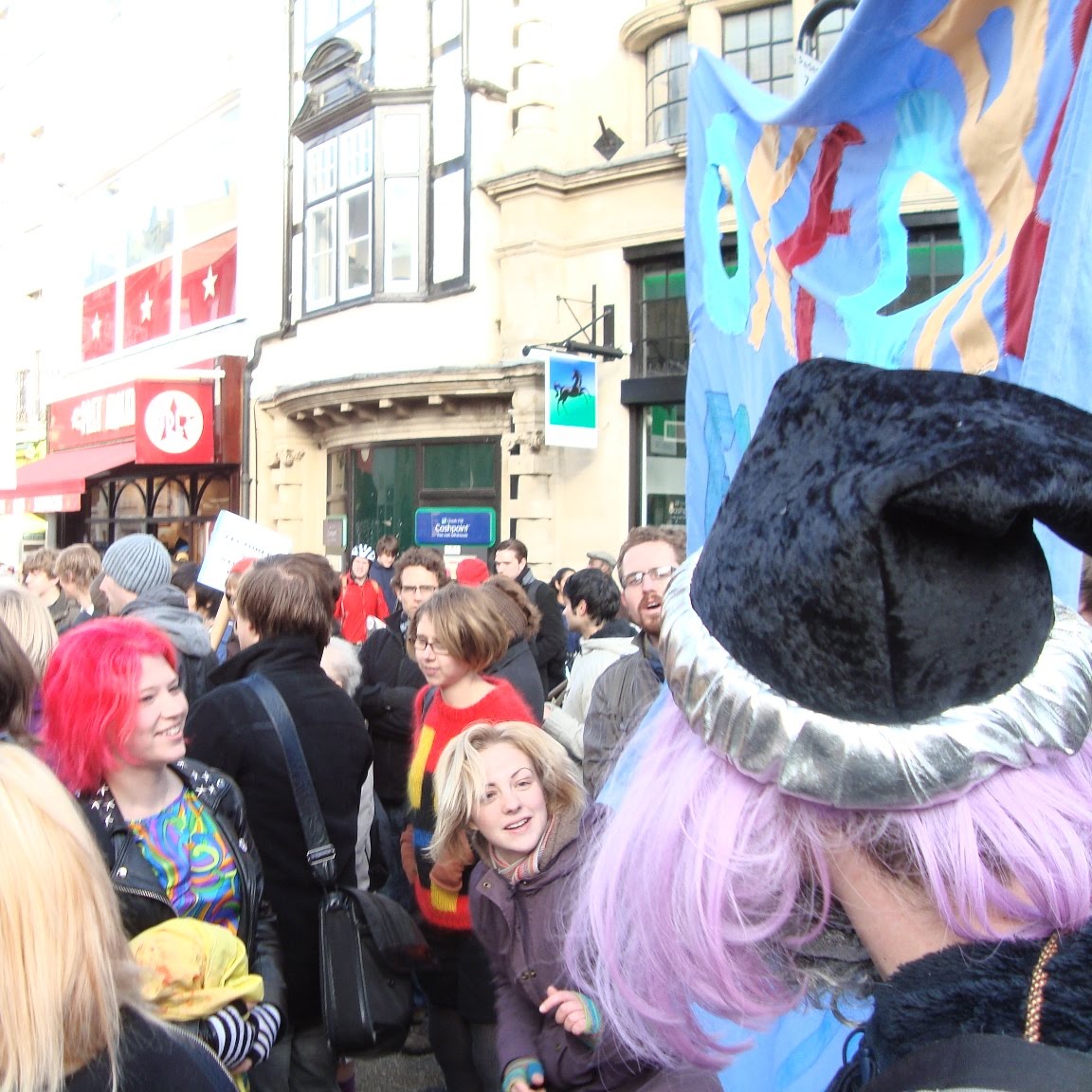
So, if people think this through, the students may have some company during tomorrow’s demos.

Tweet
I don’t really read the right-wing papers, but have heard rumours that they are trying to dismiss the current wave of student protests against education cuts and tuition fees as “self-serving.” Which is of course a blatant lie, as the current students of year 2 and higher will not be affected by the changes, and those who have just started will only be affected in their final year.
The student protest is very much based on the principle that higher education is a public good that serves society as a whole and should therefore be funded by the state and free to those who have a sufficiently large brain to soak it up. The students’ side of the deal, of course, is that they are investing three years of their lives into the improvements of their minds, when they could just go after the money (the schoolgirl with the placard “Fine – I’ll be a stripper” comes to mind here).
Seeing that the government is trying to demolish this fundamental principle of higher education, the professors and lecturers should be first in line to man the barricades. The message the government has for them is that their work is really not in the public interest but only helping the individual customer. Now if I were a vice-chancellor of a UK university, I would have a word or two to say about this presumption. (And I am sure that if the Oxbridge VCs had spoken out on this issue, the world would have taken notice.)
Then, if we have to think materialistic thoughts, the school-children now under 16 will be hit hardest. If they are from below-average earning households, they stand to lose the Education Maintenance Allowance (EMA), and on top of that have to face the prospect of up to £27k tuition fees (plus the student loan they will need to cover living costs. Those who will be hit hardest may not have started following political events yet, so it’s their parents who should demonstrate on their behalf.
As the old Manics tune said so fittingly: “If you tolerate this, then your children will be next” (and yes I know where the slogan comes from, but that’s how bad the situation is).
So, if people think this through, the students may have some company during tomorrow’s demos.
Tweet
Friday, November 26, 2010
A´tini al-Nay...فيروز_-_اعطني_الناي
On the Oral Fixation tour, Shakira started the show singing a couple of lines in Arabic. This snippet is only listed as "intro" in the DVD, and to my eternal shame I must admit I never investigated what these lines were.
On the new tour, the same lines emerged in the middle of the show and a setlist I found on the web names the song as A'tini al-Nay.
Which, it turns out, is a poem by Gibran Khalil Gibran, sung by Fairuz:
And in this interview, Shakira explains how A´tini al-Nay was one of the first songs she performed as a young child, and that people called her the "little Fairuz," and she sings the first two lines again but then says she can't remember the rest of the lyrics.
And here's the version at the beginning of the Oral Fixation concerts, which then blends into Estoy aqui.
I'd love to see her doing a complete cover version of the song, actually. Can we have that on the next album, please?
Update 13.11.2021: still waiting, but I replaced the embedded video above which had stopped working, and found two new ones to add:
Oh, hang on, maybe I like this version even better. Can't make up my mind:
And I've just found a free score too. Don't have a ney (yet) but have enjoyed playing the bits I remembered on the flute and recorders over the last few years.
Thursday, November 25, 2010
Oxford occupied
I visited the Radcliffe Camera today, the historic library building occupied by student protesters since yesterday's demo. Situation looked rather grim, as police aren't letting anyone in, and a represeantative of the university read a statement threatening consequences to the education prospects of the occupants. As if their education wasn't threatened enough already by the government. Also not clear why Oxford University students shouldn't be allowed in their own library (at least during opening hours).
Here are some photos I took today:

A rather fierce looking police cordon sealing off the building.

Communicating with balloons.

A don discussing with students in front of the occupied building.
See protesters' blog with links to other occupation events around the country, and their twitter feed.
According to BBC Radio Oxford the students were evicted from the library around 5pm today, after police managed to get in.
Tweet
Here are some photos I took today:

A rather fierce looking police cordon sealing off the building.

Communicating with balloons.

A don discussing with students in front of the occupied building.
See protesters' blog with links to other occupation events around the country, and their twitter feed.
According to BBC Radio Oxford the students were evicted from the library around 5pm today, after police managed to get in.
Tweet
Subscribe to:
Posts (Atom)


