Friday, April 18, 2025

a neck re-attached

Pirate luthier adventures continued:

After nearly a year I gathered up enough courage to try repairing the broken neck of violin 10, which sports a whole crime scene with traces of multiple repair attempts. I had cleaned out the place where it needs gluing early on, but then hesitated to proceed because I was afraid the connection wouldn't hold the tension of the strings. So it stayed on the back burner for many months, while I kept picking the lower hanging fruit.

Two weeks ago, however, I just cooked up some hide glue and fitted the two parts together again, and they hold like a charm. I first tested the connection with a mock setup using random old strings, and when that held together I ordered some really cheap strings from ebay (ten times cheaper than what I normally buy) and put those on, together with an upcycled old bridge. With that setup, the violin is now playable, stays in tune, and still hasn't fallen apart. It doesn't sound very nice, so if somebody wanted to play it I'd recommend a more expensive set of strings and maybe a new bridge. It is a 3/4 sized violin so I have no use for it myself. (And I also don't have a 3/4 bow to go with it, nor a case that offers reasonable protection.) It came with a label suggesting that it may date from the 1920s.

Here are a few photos in its post-repair state. First the re-attached neck.

Then the front

and back (with another repair patch unrelated to the neck crisis):
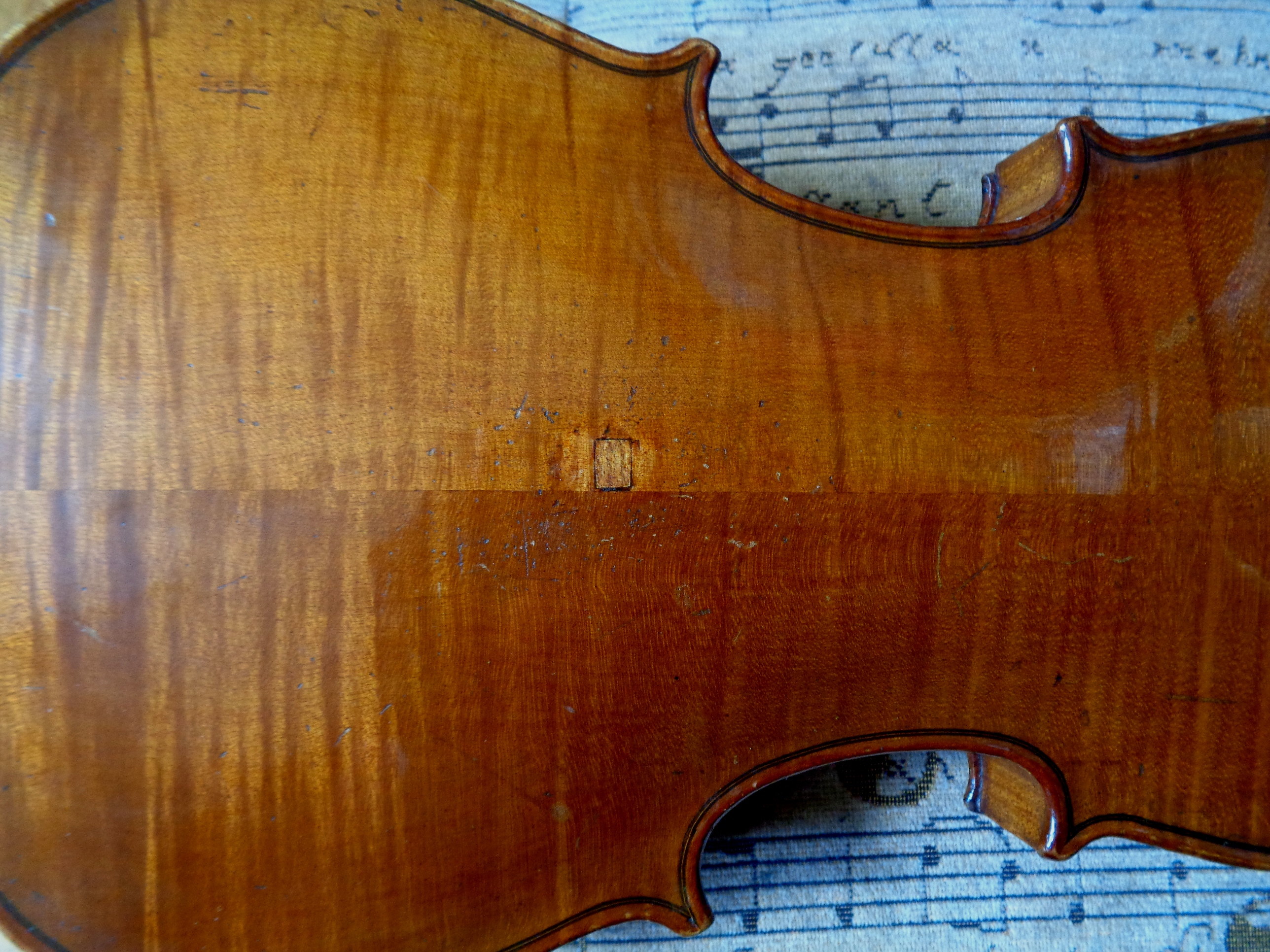
Update 24.6.2025 The neck is staying in place very nicely, so last week I donated this violoin along with a half-sized Lark to an organisation that offers introductory lessons to children at music festivals. So all going well, my violins may be getting played at Glastonbury later this week.


List of violins in the pirate luthier series:

violin 1) is the one my late aunt had since the 1930s, which got me started. After restoring it in November 2022, I played it almost every day for 14 months, until number 5) showed up.

violin 2) is a Stentor student 1 (a very widely used brand of cheap fiddles available everywhere and still being produced). I bought it very cheap on gumtree, mainly because I needed a case for number 1). It has a fault that is probably not worth repairing, see the blog entry on number 3) below. After stripping it of some accessories and spares, I am now inclined to keep it in a semi-functional state to try out experimental repairs, i.e. use it as a wooden guinea pig of sorts.

violin 3) came from a folkie friend who moved away. I put the soundpost back in its place and it has now found a new home.

violin 4) is a modern Chinese one which I bought from one musical friend and sold to another, no work needed.

violin 5) (donated by a friendly freegler) was my second favourite and the one I played in folk sessions for roughly a year until number 22) showed up.

violin 6) is the half-sized Lark which was one of the six violins I gave away on freegle in the first week of June.

violin 7) is a skylark from 1991 which I bought on gumtree for £ 10 and fitted with a new bridge. Good enough for folk I would say. It was one of the six violins I gave away on freegle in the first week of June.

violin 8) is the "ladies violin", a 7/8 skylark. It was one of the six violins I gave away on freegle in the first week of June.

violin 9) is the one which needed a new bridge and a tailgut and turned out to sound quite lovely on the E string. It was one of the six violins I gave away on freegle in the first week of June.

violin 10) is the broken one with traces of multiple repair attempts, which I've now repaired, as reported above.

violin 11) is the 3/4 sold by JP Guivier & Co Ltd. in the 1950s but may actually be older than that. It was one of the six violins I gave away on freegle in the first week of June.

violin 12) is a full-size Lark which a freegle user kindly donated and delivered after seeing my offer. It was one of the six violins I gave away on freegle in the first week of June.

violins 13) through to 15) I bought locally through gumtree or facebook, nothing special to report.

violin 16) is the Sebastian Klotz branded one, sadly not made by the Mittenwald luthier, but by Yamaha Malaysia, who appear to have trademarked his name.

violin 17) is the supersized violin with a very strong sound.

violin 18) is the slightly drunken but nice sounding violin from Poland, which I restored and returned to its family.

violin 19) is a Stentor student 1 violin which only needed a little TLC, and within less than a week I had it brushed up and ready to move to our local school. The most intriguing problem it had was that somebody had put in the bridge the wrong way round, with the lower slope under the G string.

violin 20) is a Stentor student 1 violin I bought via GumTree. It sounds really nice for what it is, thanks in part to a good set-up with Dominant strings. My current plan is to make this one an official Cowley Orchestra instrument.

violin 21) is a nameless student violin I bought via facebook, not quite sure what to think of it. The fingerboard is horizontal, which is all wrong and may mean there is not enough pressure on the bridge to produce a good sound.

violin 22) is the 19th century Guarneri copy, still my favourite (although I'll have to fix that crack at some point).

violin 23) is a nameless student violin I bought from a charity shop. It looks unused but had no strings, so I set it up with a set of spare strings that came with another violin. It turned out to be no trouble at all and sounds ok for an instrument that looks really cheap (with the purfling painted on).

violin 24) is the densely cratered one I found lying on a chair at Oxfam. I'm now playing this one at sessions, and number 22 at home.

Balance 18.4.2025: Of the 24 violins listed above, 7 received via freegle, 3 from friends and family, 13 bought (gumtree, facebook, charity shops, cost ranging £ 10 to £45), 1 taken in for repair only and returned to its family.
Of the 23 acquired, 6 given away via freegle, 2 given to a local school, 2 sold to musical friends, 1 moved to Germany for holiday practice, 9 currently in house and ready to play, 3 in house and still broken.

List of non-violins in the pirate luthier series:

An old Irish banjo

guitar 1) is the 100 year-old one from Valencia which I set up with frets and strings and handed back to its owner.

and finally a shout-out to our family-built hammered dulcimer, which dates from 2016, long before I got any ideas about violins.

Thursday, April 10, 2025

a robber's family

A recent research paper reported the identification of the skeleton of the infamous robber Johannes Bückler (1778?-1803), aka Schinderhannes, who committed dozens of crimes in the Hunsrück area where 3/16 of my ancestry is from. In a nutshell, his skeleton had been involved in a mix-up and has now been correctly identified based on a known bone fracture, and confirmed by comparing a DNA sample with one donated by a descendant of his sister. (See this news story in Archaeology News for more details.)

Which reminded me that there is quite a bit known about the family links around the young outlaw, and that I really should check again for possible connections. Note that there were quite a few vicars and teachers among my Hunsrück ancestors (the Kauer and Imig clans), who would have been horrified to see their names associated with a criminal - even one whose life has been romanticised extensively. But you never know - maybe there once was a connection that was swept under the rug?

A family portrait dated 1803

So I need to find out. Here is the ancestry of the robber as a Kekule list (which is the only way I understand these things), data from GedBas, and I marked any places that also occur in my family tree as bold (no overlap with family names, apart from Schmidt which is so common as to be meaningless):

1. Johann Wilhelm BÜCKLER, aka Schinderhannes

2. Johann BÜCKLER born 1758-02-28 Merzweiler
3. Anna Maria SCHMIDT born 1755-03-18 Miehlen

4. Otto Philipp BICKLER born 1709-04-29 Hilscheid
5. Maria Margarethe RIEMENSCHNEIDER born 1713 Merzweiler
6. Johann Dietrich SCHMIDT born 1706-04-11 Hamm-Sieg died 1781-04 Miehlen
7. unknown

8. Johann Nicolaus BICKLER born 1673 Wallenbrück Death: 1757
9. Maria Barbara ROTH born 1675 Kastellaun
10. Johann Lorenz RIEMENSCHNEIDER born 1690-04-16 Herren-Sulzbach Death: 1750 Merzweiler
11.Anna Margaretha SCHIELER born Merxheim
12. Johann Christoffel SCHMIDT born estimated 1674 Miehlen bei Nastätten Death: 1740-01-27 Miehlen bei Nastätten
13. Anna Thimothea SCHMIDT born calculated 1687 Daaden

16. Hans Adam BICKLER born 1649 Wallenbrück Death: 1720-06-27 Wallenbrück
17. Margaretha KOLLER born 1648-09-03 Bernkastel Death: before 1694
18. Johannes ROTH born about 1640 Death: 1719-12-28 Kastellaun
19. Barbara RACH born about 1652 Oberwesel Death: before 1683 Kastellaun
20. Johann Wilhelm RIEMENSCHNEIDER born 1665-11-07 Meisenheim
21. Juliana Catharina HESSLER born about 1665 Diez
22. Philipp SCHIELER born Merxheim
23. NN
24. Johann Conrad SCHMIDT born 1645 aus Miehlen bei Nastätten
25. Anna Margaretha XX Death: 1713-01-10 Miehlen
26. Weiland Johannes SCHMIDT

32.Sebastian BICKLER born 1624 Kirchberg Death: 1668 Wallenbrück
33. Elisabeth CLAUSS born 1625 Uhler Death: before 1672
34. Philipps KOLLER born 1620 Bernkastel Death: 1694-01-09 Bernkastel
35. Anna HEIL born 1622-10-10 Bernkastel Death: 1696-06-14 Bernkastel
38.Nicolaus RACH
39. Anna Elisabeth XX Death: 1776-03-17 Oberwesel
48. Jacob SCHMIDT born 1610 Limburg
49. Carita Liebmuth WENTZEN born 1615 Limburg

64. (Bickler)
66. Johann CLAUSS born 1585 Trarbach, Mosel Death: 1636-08-30 Trarbach, Mosel
67 Catharina HAUSMANN born 1589-10-22 Trarbach, Mosel Death: 1670-11-10 Trarbach

There is also some information on Schinderhannes's girlfriend,

1. Maria Juliana (Julchen) Blasius, born in Weierbach 22. March 1781, whose occupation is given as Bänkelspielerin, ie a musician and street performer. Her parents are:

2. Johann Nicolaus BLASIUS born 1751-03-11 Weierbach
3. Maria Catharina Louisa CATHARIUS born 1754 Becherbach

While Schinderhannes was executed, Julchen only went to jail for a couple of years.

Their descendants are:

1. Johanna BÜCKLER 1801-1801

2. Franz Wilhelm BÜCKLER 1802-1834
2.1.Johann Friedrich Wilhelm BÜCKLER 1831-1874
2.2. Philipp Wilhelm BÜCKLER 1831-1886
2.3. Eduard BÜCKLER 1834-1838

Julchen later married a cousin also called Blasius, settled in Weierbach, and produced lots of children by that name.

Weierbach is on the river Nahe, downstream from Idar-Oberstein and just next to Fischbach, where my migrating miners passed through and where I revisited the ancient copper mine ten years ago.

The Wikipedia entry notes that Schinderhannes often visited the village of Hahnenbach, but that was a generation before my family showed up there. My many-times great aunt Maria Margaretha Weiss (1809-1885) married the innkeeper Johann Peter Schmidt in 1842. Her daughter married Ferdinand Weirich, whose name appears on the inn in this old photo.

Further reading:

  • A google search for led me to the book Unter dem Freiheitsbaum by Clara Viebig (full text at Projekt Gutenberg). I hadn't heard of her before, but apparently she was famous in the early 20th century, and this book has been praised for elevating the Schinderhannes sujet to the literary level.

    Update 25.1.2026: I created a new portal to navigate family history blog entries in the shape of a permanent Who Is Who page. This is because the old webpage at michaelgross.info will go offline on February 2nd.

  • Monday, April 07, 2025

    culturally connected oases

    After 333 features in the format started in 2011, it is getting harder to find an issue / field that I haven't covered yet, but oases in the desert were one, until now. (I think I did something on the island biogeography of sea floor "oases" at one point.) A new paper attempting to compile a global atlas of oases provided the inspiration to plug this gap.

    My own experience of desert oases is limited to a visit to Algeria back in the last century, including a stay at El Oued, an oasis town in the Sahara. Thus I learned a lot about the amazing cultural history of oases around the globe, which have supported all kinds of travel routes including the Silk Road.

    So here comes my very first feature on desert oases:

    Islands of life

    Current Biology Volume 35, Issue 7, 7 April 2025, Pages R237-R239

    Restricted access to full text and PDF download
    (contact me if you would like a PDF)

    See also my Mastodon thread where I highlighted all CB features of 2025.

    The thread for 2024 is here .

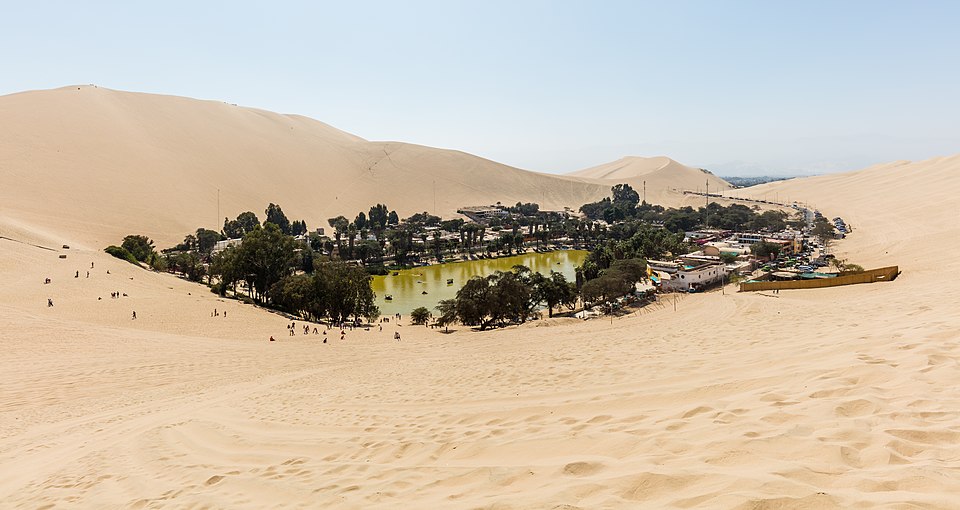
    There are more than 1300 oases scattered across the world’s arid regions. The photo shows the oasis of Huacachina, in Peru. Image Source: Wikimedia Commons.

    Sunday, April 06, 2025

    the evolution of early music

    I visited the Bate Collection on the last day before they closed for the move from St. Aldates to the new building in Jericho (named after one of the billionaires who co-funded the ongoing trumpocalypse, so I won't name it here). As they were desperate to clear out stuff from their shop, I helped by taking on the last 20 issues they had of the journal Early Music, which look like this:

    The random issues span the years 1974 (the journal started in 1973) to 2004. The journal published four issues per year until recently - I am a bit worried that the most recent issue online dates from May 2024, so they may either be in trouble or just running late with their publication schedule?

    I browsed through all 20 issue going backwards in time and it is amazing to observe how the field has moved in those three decades - starting with "what is a hurdy-gurdy?" and ending up discussing really subtle differences between medieval bows, or details of Renaissance notation on ten pages.

    A few things I learned or noticed:

    Small violins were a thing long before they were inflicted on children. As Margaret Downie Banks explained in November 1990 (vol 18, pp 588-596), violino piccolo is specified in early baroque compositions (including some by Bach even) in ways that suggest the violins were used like recorder consorts, with smaller instruments to reach the higher notes. This was useful because at the time the normal technique used by violinists didn't include higher positions. The chin rest hadn't been invented yet, and the ways of holding the instrument were all over the place, meaning that when you move up to higher positions you would have trouble coming back down (moving the hand away from the chin) without dropping the instrument. So people played first position only, plus a few extra notes that can be reached by stretching while the thumb stays in place. Like today's folk fiddlers. There isn't much explicit info on this from the time, because people who only knew this way of playing didn't know what they were missing. A key source is the violin instruction book published by Leopold Mozart (father of Wolfgang Amadeus), who noted in 1756 (just after what we now regard as the official end of the Baroque period) that small violins are no longer necessary, because players can now play higher notes by shifting their hand. He also mentions that the small instruments no longer needed by grown-ups could be useful in music education for children, although he doesn't whole-heartedly support this use.

    Another article in August 1984 addresses the issue of early violinists not using higher positions from the point of view of fingerings marked in the scores. This article notes that the chin rest was invented by the composer Louis Spohr (1784-1859).

    I am left wondering now if cellists / viola da gamba players discovered higher positions earlier than violinists, because they can move their left hand freely anyways. Will have to investigate.

    An ad that appeared in October 1980 notes that "In 1522 the Croydon Waits were beheaded for performing crumhorn consorts on comb and paper while waiting for their instruments to be delivered." The ad goes on to reassure readers that in the 20th century this couldn't happen any more, as the waiting time for their crumhorns "has been reduced to a reasonable length."

    I noticed that across the whole 20 issues with all the luscious illustrations, there isn't a single picture of a nyckelharpa (keyed fiddle) even though these instruments are present in medieval iconography. Doing a word search on the online archive, there appears to be only one mention of the word nyckelharpa in the entire corpus of the journal, and that was in the review of a recording where the instrument was used. Given the popularity of the instrument in Scandinavian folk today, I am puzzled as to why the Early Music crowd chose to completely ignore it. By contrast, hurdy-gurdies are well represented. Obviously, it is difficult to do stats based on the issues I have, as they are a negative selection, left behind by earlier visitors to the collection. Somebody may have picked all issues that had a viola da gamba on the cover. But the absence of nyckelharpas is a real thing.

    In November 2003, we find the late Jeremy Montagu (1927-2020) reminding us that "trump" is another name for the Jew's harp. He wrote "it is a term of historical usage ... and today safe from any potentially offensive connotation, which many of us have adopted as a result." Those were the days.

    In the same issue, there is an interesting article on Quantz's flute quartets which had been rediscovered recently.

    Oh and I also learned that the early music festival Tage Alter Musik Herne is still going strong and happening each year in November. Back in the last century when we were spoilt rotten by the Tage Alter Musik Regensburg (held in magnificent historic venues matching the age of the music) we were a bit snobbish about the competition from the less lovely city of Herne, but now that I have a base in Dusseldorf, I could easily attend some of the concerts at Herne.

    May add further discoveries as they turn up ...

    Monday, March 31, 2025

    intertwined audiobook is out

    I just discovered that my latest book, Intertwined is already available as an audiobook, from Tantor Media. Last I heard was that the audio rights were sold last summer.

    Glad to hear from the sample clip they found a British narrator for this (Mike Cooper) and an actual human, just before AI gobbles up everything. Sounds good to me, even though I'm not sure I would want to have 12 hours worth of my own words read back at me.

    Anyways, if you would like to listen to Intertwined, now you can!

    There is also an ebook version as expensive as the hardback, but no news yet on a paperback.

    Monday, March 24, 2025

    a global meltdown

    In case you didn't realise, 2025 is the International Year of Glaciers’ Preservation and March 21 was the annual World Day for Glaciers. The frozen freshwater stocks of our planet urgently need all the awareness and support they can get. At 1.5 degrees warming and rising, they are disappearing fast and that will affect the water supplies of two billion people, contribute to sea level rise, and accelerate further warming through the loss of albedo.

    So, plenty of reasons to care about glaciers, and high time to dedicate a feature to them, which I hadn't done before.

    a world in meltdown

    Current Biology Volume 35, Issue 6, 24 March 2025, Pages R199-R201

    restricted access to full text and PDF download
    (contact me if you would like a PDF)

    See also my Mastodon thread where I highlighted all CB features of 2025.

    The thread for 2024 is here .

    Glaciers around the world offer imposing, landscape-defining sights, but many are shrinking and doomed to disappear. The photo shows the Perito Moreno Glacier, Patagonia, Argentina. (Photo: pclvv/Flickr (CC BY 2.0).)

    Sunday, March 23, 2025

    vintage roadworks

    Corrected version 8.7.2025: After I scanned and shared the photos from a little album from Dörndorf, Kreis Frankenstein, Silesia, and mentioned that many of the photos are showing a major road building project which appears to have happened near that village, I thought I could actually identify the road that is in statu nascendi in the pictures.

    It was based on the little church appearing in some of the road building pictures looking exactly like the one in Dörndorf, so I wrote a whole blog entry about how the photos matched up to the course of one specific road. As that entry went live on March 23, I idly returned to the tab where I had google street view open, which I had used to stroll through the village virtually, and decided to follow the road out of the village and find the spot from where that key photo was taken. It turned out that spot didn't exist and the landscape didn't match, so the church in the photo must have been a different one. I had to very quickly take that blog entry offline again. I now think it is the very similar church of Byczeń (German: Baitzen), in which case the road would be today's DW382. Note that the photo at the top of the previous blog entry on the Dörndorf album does in fact show the Dörndorf church, as we can read the name of the village on the road sign marking the entrance to the village.

    Just for the historical record (and to preserve all those links I had included), here are the photos and comments from my original entry - bear in mind that all geographic assignments below are probably wrong and I'm still trying to find out where the other photos were taken. .

    First, check this photo (no. 42) - in the background you can see the little church of Dörndorf:

    Then we have another one with an overlapping view, as the white house on the hill on the right of the photo above appears on the left in the photo below:

    See also photos No. 39, offering a similar view, and 11, extending the view to the left.

    So we get a reasonably clear impression that this road is bypassing the village of Dörndorf. The online entry of Mayers Gazeteer includes a map, which at first glance seems to be straightforward google maps, but if you click on it, it shows a historic interactive map with the German placenames. Zoom in further, and at some point it switches to a modern map, showing that the road bypassing the village (now called Plonica) is labelled as number 390, i.e. droga wojewódzka 390, a regional road of 28 km length. Confusingly, the smaller, older road going straigth through the village also has the same number. The newer version of the road 390 is a pretty straight north-south axis. Southwards, it leads to the nearby town of Reichenstein (Zloty Stok). Northwards, it crosses the river Neisse before it reaches Kamenz (Camenz in the old map, now Kamieniec Ząbkowicki).

    Incidentally, I only just discovered that from 1900 to 1997 there was also a local railway line linking these three places, but it appears neither in the photos we have nor on the old map. Will have to rave about that separately.

    The river is significant, because we have another pair of photos showing a similar view, once of the road under construction, and once of the same landscape being flooded (check the conspicuous pattern of the trees on the horizon), so we can safely assume that this is near the Neisse (because the southern reach of the road leads towards more mountainous areas near the Czech border):

    There are also a couple of photos of buildings by the riverside, which could be in or near Kamenz: No. 33, No. 34, as well as further photos of flooded landscapes.

    The album also includes views of the road builders in the hillier landscapes further south, such as:

    which were in the earlier parts of the album, so we're getting the impression that the road was built south to north.

    As mentioned in the first blog entry, photo 21 identifies the road building company Hugo Jaensch, from Jauer:

    I think there may be further revelations to be drawn from these photos, so this may well become a series ...

    Update 25.1.2026: I created a new portal to navigate family history blog entries in the shape of a permanent Who Is Who page. This is because the old webpage at michaelgross.info will go offline on February 2nd.

    Friday, March 21, 2025

    four cellos and their humans

    Some thoughts on

    Cello: A journey through silence to sound
    by Kate Kennedy
    Head of Zeus 2024

    Kate Kennedy had her fledgling career as a professional cellist thrown off track by injury, as she explained in this extract from the book, leading her to reflect on what happens when the symbiotic relation between a musician and their instrument is broken by unfortunate events. Now she explores four examples of cellists who were separated from their cellos in more dramatic circumstances, dragging her own cello around Europe to find the places and soundscapes that these earlier cellos and their humans had inhabited.

    The instruments in question are, in chronological order:

    • The Cristiani Stradivari, and its eponymous owner, Lise Cristiani (1827-1853), who died on an epic concert tour through the Russian Empire, covering remote locations that possibly hadn't seen a cello before. The cello currently resides in a museum in Cremona.
    • A Gadigliano cello played by Hungarian composer Pál Hermann, who was murdered in the Holocaust. The cello was saved by relatives after his arrest, but the family sold it later and the author has been unable to find out what happened to it after 1952.
    • A Ventapane cello played by Anita Lasker when she was growing up in Breslau. She survived the Holocaust playing a different cello in the women's orchestra at Auschwitz concentration camp. Anita Lasker-Wallfisch, who turns 100 this year, has also written a memoir about this. The fate of her Ventapane is unknown.
    • The Mara Stradivari cello, which ended up floating in the Rio de la Plata when a ferry carrying its owner Amadeo Baldovino and his quartet sank in July 1963. (I don't understand how Baldovino could abandon the cello in search of some float to cling to - surely a cello in a wooden case floats well enough to keep the cellist above water?) It was rebuilt from fragments by W.E. Hill & Sons in London. Since then, it has served Heinrich Schiff and is now played by his alumnus Christian Poltera. It is thus the only one of the four instruments which is known to be still in active service.

    The book fits my obsessions with cellos, sense of place, soundscapes really well - the main difference to what I am trying to do with my musical memoir project is that the instruments in my family - and the ones I am currently rescuing / restoring - are in a more modest price range, there are absolutely no Stradivariuses involved in my instrumental adventures (even if some of the labels pretend otherwise). As numerous examples demonstrate, the exorbitant market value and cultural significance of the famous instruments isn't doing them a good service, in that many of them are now silently sitting in museums or safe vaults, instead of playing music. On the other hand, the shipwrecked instrument certainly wouldn't have been pieced together again if it hadn't been a Stradivarius.

    On a related note regarding the relation between insanely famous and common or garden instruments, the author discovered a hilarious entry in the logbooks of W.E. Hill luthiers regarding a visit by Albert Einstein and his violin in October 1933 (note 17 on page 433). The luthiers were quite disparaging about the quality of Einstein's violin and suggested that the only possible reason he might like its sound was that he had gotten used to it. In a blatantly unfair comparison, they showed him the Messiah Stradivarius (now residing in a glass case in the Ashmolean Museum) and let him bow a note on it. Still, Einstein left a happy message in their books, and didn't swap his beloved "Line" for an expensive model (although he had several through his lifetime, and the one auctioned here was probably the successor to the one the Hills saw).

    Related to the Cristiani and the Messiah in their museum displays, the author shares an interesting suggestion, namely that the displays should include recorded music from the same or a similar instrument, such that they could resonate with an appropriate sound. I would sign that petition immediately. In a more understanding future, we will regard it as cruelty to keep museum instruments in permanently silent environments.

    Useful things I learned from the book include the concept of whakapapa, a Maori term for genealogy including objects and locations, which reminds me of what I'm trying to do with my cello memoir and other family history endeavours. It was interesting to read about historic Breslau, as the parents of our old cellist came from there, but had left following railways job opportunities nearly half a century before Anita was born. Also handy to learn about the traditional luthiers quarter in Paris (rue de Rome, near gare St. Lazare) and the museum in Cremona (where the Cristiani cello now resides), places to visit some time, but preferably travelling without a cello.

    I was pleased to see that I already have many of the cello books the author cited, but one blatant gap in my collection is the autobiography of Beatrice Harrison, who famously duetted with a nightingale (or possibly with a nightingale imitator) on live radio in the early days of the BBC. Another is Cellistinnen by Katharina Deserno (2019). Watch this space.

    The cover shows the Cristiani cello (the other side of it is on the back).

    Update 17.10.2025: Cellist Sol Gabetta is releasing an album of pieces linked to Lise Cristiani this month and is also going on tour with these. Can't find anything about which cello she's using for these, so I'm assuming it's not Lise Cristiani's Stradivarius.

    PS here's my little library of cello-related memoirs and biographies (listed alphabetically by the last name of the relevant cellist - and for this one the author who is also a cellist):

    Sunday, March 16, 2025

    counting craters

    Pirate luthier adventures continued:

    Violin number 24 has arrived! After 14 years of writing 24 features per calendar year for Current Biology, I've come to associate this number with happiness and a sense of achievement, so this is a milestone I am celebrating - and also an old violin worth blogging about.

    I found it lying on a chair in an Oxfam shop (in the Oxfam shop, actually, the first one ever), looking as battered as the surface of the Moon and a bit dishevelled but fundamentally sound. No case, no chinrest, but three strings and an interesting looking old bow. Some of its many impact craters:

    I'm wondering if somebody repeatedly dug the tip of their bow in there. Also not sure what happened on the other side of the fingerboard:

    It's a bit frustrating to have an old instrument with absolutely no info on its provenance (no label or mark whatsoever), but based on the number of scratches I would guess it must be more than 50 years old. It also looks and sounds like an early 20th century European violin to my very limited experience. It also makes the name finding harder. Might have to start a series with eg female composers' names.

    It came with three Dominant strings (GDA), so I fitted it out with a random E string I had and tuned it up to Baroque pitch to start playing gently. So here it is with my provisional set-up:

    Within a week I coaxed it up to concert pitch (A=440) so it is now ready to play as normal. Will take it to the next session that comes up (which is actually today as it happens).

    Update 17.3. Putting it in a case for the first time to take it to the session, I realised the body is a couple of millimetres longer than a standard violin. It only just fits into a standard (Stentor) case, squeezing the polystyrene a bit.


    List of violins in the pirate luthier series:

    violin 1) is the one my late aunt had since the 1930s, which got me started. After restoring it in November 2022, I played it almost every day for 14 months, until number 5) showed up.

    violin 2) is a Stentor student 1 (a very widely used brand of cheap fiddles available everywhere and still being produced). I bought it very cheap on gumtree, mainly because I needed a case for number 1). It has a fault that is probably not worth repairing, see the blog entry on number 3) below. After stripping it of some accessories and spares, I am now inclined to keep it in a semi-functional state to try out experimental repairs, i.e. use it as a wooden guinea pig of sorts.

    violin 3) came from a folkie friend who moved away. I put the soundpost back in its place and it has now found a new home.

    violin 4) is a modern Chinese one which I bought from one musical friend and sold to another, no work needed.

    violin 5) (donated by a friendly freegler) was my second favourite and the one I played in folk sessions for roughly a year until number 22) showed up.

    violin 6) is the half-sized Lark which was one of the six violins I gave away on freegle in the first week of June.

    violin 7) is a skylark from 1991 which I bought on gumtree for £ 10 and fitted with a new bridge. Good enough for folk I would say. It was one of the six violins I gave away on freegle in the first week of June.

    violin 8) is the "ladies violin", a 7/8 skylark. It was one of the six violins I gave away on freegle in the first week of June.

    violin 9) is the one which needed a new bridge and a tailgut and turned out to sound quite lovely on the E string. It was one of the six violins I gave away on freegle in the first week of June.

    violin 10) is the broken one with traces of multiple repair attempts. I'm still gathering courage to try and fix that one.

    violin 11) is the 3/4 sold by JP Guivier & Co Ltd. in the 1950s but may actually be older than that. It was one of the six violins I gave away on freegle in the first week of June.

    violin 12) is a full-size Lark which a freegle user kindly donated and delivered after seeing my offer. It was one of the six violins I gave away on freegle in the first week of June.

    violins 13) through to 15) I bought locally through gumtree or facebook, nothing special to report.

    violin 16) is the Sebastian Klotz branded one, sadly not made by the Mittenwald luthier, but by Yamaha Malaysia, who appear to have trademarked his name.

    violin 17) is the supersized violin with a very strong sound.

    violin 18) is the slightly drunken but nice sounding violin from Poland, which I restored and returned to its family.

    violin 19) is a Stentor student 1 violin which only needed a little TLC, and within less than a week I had it brushed up and ready to move to our local school. The most intriguing problem it had was that somebody had put in the bridge the wrong way round, with the lower slope under the G string.

    violin 20) is a Stentor student 1 violin I bought via GumTree. It sounds really nice for what it is, thanks in part to a good set-up with Dominant strings. My current plan is to make this one an official Cowley Orchestra instrument.

    violin 21) is a nameless student violin I bought via facebook, not quite sure what to think of it. The fingerboard is horizontal, which is all wrong and may mean there is not enough pressure on the bridge to produce a good sound.

    violin 22) is the 19th century Guarneri copy, still my favourite (although I'll have to fix that crack at some point).

    violin 23) is a nameless student violin I bought from a charity shop. It looks unused but had no strings, so I set it up with a set of spare strings that came with another violin. It turned out to be no trouble at all and sounds ok for an instrument that looks really cheap (with the purfling painted on).

    violin 24) is the densely cratered one described above.

    Balance 10.3.2025: Of the 24 violins listed above, 7 received via freegle, 3 from friends and family, 13 bought (gumtree, facebook, charity shops, cost ranging £ 10 to £45), 1 taken in for repair only and returned to its family.
    Of the 23 acquired, 6 given away via freegle, 2 given to a local school, 2 sold to musical friends, 1 moved to Germany for holiday practice, 8 currently in house and ready to play, 4 in house and still broken.

    List of non-violins in the pirate luthier series:

    An old Irish banjo

    guitar 1) is the 100 year-old one from Valencia which I set up with frets and strings and handed back to its owner.

    and finally a shout-out to our family-built hammered dulcimer, which dates from 2016, long before I got any ideas about violins.

    Monday, March 10, 2025

    moving backwards and breaking things

    I've been trying to distil the events unfolding in the US since January 20 into a reasonable narrative that remains valid during the 2.5 week production period and beyond, so I focused on the public health implications of dismantling both international cooperation and federal agencies meant to protect people. Whereas there is no telling which changes will remain and which ones won't, one thing is for sure that many people will suffer and die as a result of certain oligarchs moving backwards and breaking things, and the climate catastrophe will accelerate further, which, again, will cause more suffering and death among humans and wildlife alike.

    In retrospect, why didn't the assaults on global public health and on the survival of a habitable biosphere in the early weeks of the Deatheaters takeover get a similarly energetic response from Europe to what we're now witnessing in the context of Ukraine policy? I happen to think that on a dead planet, there won't be a free Ukraine either, so protecting the planet should have been be a bit more important.

    Anyhow, my trumpocalypse 2 feature is out now:

    Rolling back public health

    Current Biology Volume 35, Issue 5, 10 March 2025, Pages R159-R161

    FREE access to full text and PDF download

    See also my Mastodon thread where I highlighted all CB features of 2025.

    The thread for 2024 is here .

    Healthcare for women is particularly threatened after the US administration announced the departure from the WHO. The photo shows a Shakila midwife listening to the heartbeat of a pregnant woman at the mobile clinic organised by the WHO at the Garm Abak of Waras district in Bamiyan, Afghanistan. (Photo: © World Health Organization/Rada Akbar, 2015.)

    Sunday, March 09, 2025

    a guitar from Valencia

    Pirate luthier adventures continued with a detour into guitar territory:

    I try to bat away most instruments that aren't from the violin family, but accepted to restore this guitar which looked really cute and was in need of frets, inlays, and a nut when it came to me. I managed to fit in all of these vaguely in the right places, so now it looks like a guitar and sounds like a guitar, although I wouldn't guarantee that all notes will be 100% in tune.

    It has a maker's label, but unfortunately, a Swiss company importing the instrument from Spain insisted on sticking its own label right across the more interesting one telling us who made the instrument.

    Update: Scratch my guesswork - a helpful Mastodon user from Valencia cracked the secret. The guitar maker was Jose Cortes, and you can see examples of his labels here (ignore the first image which is an unrelated label). The label reads then:

    Manufactura de Guitarras /
    E Instrumentos Similares /
    J. Cortés /
    Continuacion de Jorje Juan, D.N. /
    Valencia /
    (Espana)

    Jose Cortes was active from around 1910 till 1930, and from 1925 the street appears under its new name as calle Joaquin Costa on his labels, so we can now confidently say the guitar is at least 100 years old. More info about him here.

    I'm loving the rich decoration around the sound hole and around the edges, which looks a little bit irregular and home-made, but very charmingly so.

    The instrument has now returned to its owner who has had it for more than half a century.

    Update: While attempting to track down the maker in Valencia, I looked up the trader, Hug & Co, and it turns out they have an interesting history too, spanning more than 200 years, and they're still in business today. A quick look seems to suggest they traded as Hug & Co from 1905 until 1973.

    Normal service obsessing about violins will resume soon, as violin number 24 has arrived on the premises this week.

    Thursday, March 06, 2025

    a little photo album from Dörndorf

    A curious little photo album emerged from the belongings of my late inlaws, with photos from Dörndorf, Kreis Frankenstein, Silesia (where the kids form the bakery grew up), but the owner's stamp is a name we don't recognise, and the only two photos of people we know have probably been added to it later. Kreis Frankenstein is now Ząbkowice County in the south of Poland.

    The album is roughly half the size of a paperback book, and designed to hold around 50 photos of format 6.5 x 9 cm, which can be slotted into the pages. The rubber stamp at the front says:

    Fritz Grötzner
    Dörndorf
    Kreis Frankenstein

    At a push, the name could be Grützner, which would be a name that gives you more search results in Silesia than Grötzner. As the ink of the stamp has filled in the middle of the letter I read as an o, I can't tell whether it is open or closed, but it doesn't have a leg on the right, as the letter u should probably have.

    What we get in the album is a lovely portrait of the little church of Dörndorf, where Hedwig Geppert and Paul Gellrich got married (more about the church, which was built in 1777, here):

    as well as a view of a house that has Fritz's name above the door, but sadly I can't read the line below so don't know what he's selling.

    The only person to have as many as three individual portraits in the album is the one shown below, so I'll guess that this is Fritz G. His portraits appear near the beginning of the album, and he may or may not be included in some of the later group photos.

    Obviously, I had to pick the one with a musical instrument. Elsewhere in the album, there is also a big bass drum dangling from the back of a car that has landed in a ditch. (That accident is the most dramatic thing documented in the album.)

    Most of the photos appear to be related to a road building project, and one of these has the little church of Dörndorf on the horizon, so I'll assume that the entire project was a road that led into the village and it all happened reasonably close to it. A couple of photos show a flooded landscape, but even those are related to the road building, as a pair of matching photos with and without floodwater reveals. The lorries used in the road building have number plates starting with I K, which is as it should be for private vehicles registered in Silesia. The Roman numeral I applies across Prussia (as opposed to II for Bavaria), and the letter K specifies Silesia.

    In picture 21 we can read on the side of the lorry the name of a road building company involved in the works:
    Hugo Jaensch Stra[ssenbau]
    Jauer Fernruf 5

    I have added most of the photos to a new flickr album created for this, just leaving out a couple that have too many nazi uniforms for my taste, and the three that are almost certainly later additions. The genuine ones have only the brand of the photographic paper on the back (Agfa Lupex), whereas the cuckoos come with the stamps of different shops that processed the prints.

    On flickr I also have a postcard of the village, with views of both the church and the bakery.

    I'm tagging this "every picture" even though there may not have been a family member in the album originally, but there must have been some sort of connection otherwise it wouldn't be here. Make this an every picture special issue.

    And as always, all hints and clues appreciated.