Monday, November 20, 2023

mission not accomplished

Not so very long ago, the end of 2023 was the target date by which wild polio strains would have been eradicated and the vaccine-derived variants been brought under control. It is now clear that these goals will not be accomplished this year or any time soon. Like meaningful climate saving measures and action against antibiotic resistance, the planned second-ever eradication of a human disease remains a movable feast.

I've taken the approaching target date as an opportunity to have a closer look at what went wrong, what still needs to be done, and how we can overcome diseases more generally. The resulting feature is out now:

Can we wipe out diseases?

Current Biology Volume 33, Issue 22, 20. November 2023, Pages R1163-R1165

FREE access to full text and PDF download
(open archives)

See also my Mastodon thread where I highlighted all CB features of 2023.

I'm not on Instagram myself, but I believe if you follow CurrentBiology there, you'll find my features highlighted there as well.

The new generation of polio vaccines features stabilising manipulations to the RNA, designed to stop the attenuated virus from mutating back to the more virulent form. (image: National Institutes of Health.)

Saturday, November 18, 2023

in praise of old technology

I was keen to read and review this book

Reimagining Alternative Technology for Design in the 21st Century
by Brook S. Kennedy

as I'm really interested in the idea of using and modernising the sustainable technologies that we have had for a long time, rather than inventing new ones that turn out to be unsustainable. It was an interesting read but also a bit frustrating as written purely from an American perspective and thus telling the reader about allegedly extinct alternatives that many of us in Europe still have been using all the time, such as bikes, trams and clotheslines, shutters on windows, etc. Anyhow, a slim volume and thus a quick read with some interesting insights into the history of technology and how it took wrong turns in the 20th century, as well as some smart ideas on how to do better in this one. (Incidentally, this week's crop of EurekAlert press releases included one called: Sticking with old technology can be a strategic move).

More about it in my long essay review now out:

Back to the future

Chemistry & Industry Volume 87, Issue 11, November 2023, Page 38

access via:

Wiley Online Library (paywalled PDF of the whole review section)

SCI (premium content, ie members only)

As always, I'm happy to send a PDF on request.

Blackwells

Thursday, November 16, 2023

all grown up

Every picture tells a story, season 3, picture 6:

We saw the Hamborn brothers growing up last time, so here they are all grown up now.

The oldest working in the postal service (then still Deutsche Bundespost, with virtually all employees enjoying the benefits of being civil servants, Beamte), still at Hamborn:

whereas the other two went to work in the steel industry in Duisburg. Here's the middle one on holiday (don't have any pics of him at work I'm afraid, otherwise I would have called this entry men at work). I have absolutely no idea where this is, most likely southern Germany or possibly Austria:

and the youngest at his workplace (fourth from left), hopefully after the end of the shift:

Photos are all undated, but the first two should all be from the 1950s, the last one more likely 60s to possibly early 70s

Should anybody have any answers to some of the many questions I am raising in this series, please leave a comment here (I'll need to vet it, so it may take a few days before it goes public) or contact me at michaelgrr [at] yahoo [dot] co [dot] uk

Navigation tools:

Season 3 so far:

  1. family holiday
  2. play time
  3. fashion show
  4. bakery to butcher's shop
  5. the Hamborn brotherhood
  6. all grown up

The Mastodon thread for season 3 starts here.

You can find Season 2 entries in this thread on Mastodon (complete now!) or via the list at the bottom of the last entry of the season (and also at the bottom of the first entry of this season).

The twitter thread for season 1 is still here. Alternatively, visit the last instalment and find the numbered list of entries at the bottom.

Friday, November 10, 2023

the year of the fiddle

In the zodiac of my life, there are instrument obsessions that define certain time spans, so since last November this has definitely been the year of the fiddle. Which surprised me because I never had much interest in violins until I accidentally succeeded in repairing the old one that my aunt had (and didn't enjoy much) as a little girl back in the 1930s.

After playing it rather too enthusiastically at the folk weekend (in April) I've begun to notice some joint pains in the fingers of the left hand, so I'm not putting in massive amounts of practice but I do make sure to play a few folk tunes and a bit of Mozart (K525 or K304) every day, progressing very slowly.

For the anniversary, I've recorded the Äppelbo Gånglåt again (only to realise later that I already shared a version of that at the six-month milestone. Comparison of both videos shows that I play it a bit faster now (by around 10%) and a bit less out of tune. So all indicators going in the right direction.

Family reunion: All three instruments have been in the family for more than half a century: Heinrich the cello, Blue the guitar and Christa the violin.

PS Previous instruments on the zodiac were:

  • tenor sax 8/21-10/22 (the ergonomically designed instrument that works even with a frozen shoulder, also suited to keep people at a distance during plague times)
  • cello 3/20 - 9/22 (Plague Year Bach Project brought to a halt by shoulder problems)
  • alto recorder 1/19 - 2/20 (both my altos appear in this year review, the black Triebert is the one I play regularly)

Thursday, November 09, 2023

vestische Musikschule

On Flickr I came across a postcard of the Vestische Musikschule at Gelsenkirchen-Buer, which is where from 1969 to 1971 my mother took piano lessons (for herself rather than offering any kind of musical education to her children). Her teacher was the then head of the school, Kurt Kayser. So I was intrigued to read on the back of the flickr postcard the name Eusebius Kayser.

The chronicles of the city of Gelsenkirchen name Eusebius as the headteacher when the school reopened in 1946, but Kurt as the founder (in 1920) as well as the headteacher in the early 1970s, until his death in 1972. Which is all a bit confusing, but I assume they were related and the music school was more of a family business rather than a public institution? Eusebius also played cello, like Kurt, and in 1946-47 played recitals together with his mother, Ida Kayser-Insinger, playing piano. Search "Eusebius" in the city chronicles for 1946 and 1947.

The name Vestische, by the way, looks kind of official but isn't, as the Vest Recklinghousen was a judiciary district in the Middle Ages, but hasn't had any official significance since. When I was growing up in the Vest, the name was everywhere, but it was never clear to me where the Vest was exactly.

It bothers me that there is virtually no info about the Vestische Musikschule to be found online, apart from the snippets I already mentioned, so if anybody knows more, I'd be grateful for any hints. The city's public Musikschule has been in operation since 1978, so I'm thinking the Vestische may just have been merged into that, or it may have died out with the Kayser family?

NB In the budget for 1974, funding for the foundation of a music school was rejected, the city chronicles note. There is no mention of the word Musikschule in the volume for the previous year.

The building at Pfefferackerstraß 11 looks really lovely on the old postcards. As the one on flickr has been scribbled on, here's a clean copy I found in a forum online:

Source

The building is now the home of a ballet school called Swoboda - when you search for that you'll also get a google streetview image.

More generally, in the research for my musical family memoir project, I am getting the impression that music schools and conservatoires don't often have a Wikipedia entry or any kind of written history online - in contrast to eg schools and universities. Making music look like some sort of clandestine society?

Monday, November 06, 2023

power to the peatlands

In September I attended the conference Power to the Peatlands in Antwerp and learned lots of things about the ongoing efforts to save or restore peatlands, not just as ecosystems but also as carbon storage that has a major impact on climate change. What I love most about this topic is how our idea what progress means has turned by 180 degrees in just a few decades - until around 1970 draining the swamps was considered a good idea (which today mainly survives in political metaphor), whereas now progress is all about rewetting the landscapes we once drained.

Now I've rounded up everything from the cultural history to current climate efforts in my latest feature which is out now:

Powerful peatlands

Current Biology Volume 33, Issue 21, 6. November 2023, Pages R1127-R1129

FREE access to full text and PDF download
(open archives)

See also my Mastodon thread where I highlighted all CB features of 2023.

I'm not on Instagram myself, but I believe if you follow CurrentBiology there, you'll find my features highlighted there as well.

Population pressure and generous investments made the Netherlands a pioneer in draining wetlands to create new land for agriculture. The iconic windmills now admired by tourists often served as pumps to remove water from low-lying areas. (Photo: R Boed/Flickr (CC BY 2.0 DEED).)

PS back in the noughties, I read various sources about wetlands drainage programmes in 17th century France for family history reasons, because Octavio Strada Junior, grand-son of Jacopo Strada, was involved with them and made quite a success of it. His well-documented descendants include French president Valery Giscard d'Estaing. A firm connection to my Strada ancestors remains to be found though.

Thursday, November 02, 2023

the Hamborn brotherhood

Every picture tells a story, season 3, picture 5:

Earlier in the series we have met Ernst Leopold Kosmowsky the steel worker, his wife Luise Auguste Faust, and his mother Auguste Adschuck. Here they are united in one lovely family portrait from the 1930s, with the couple's three surviving children (the firstborn son had died in infancy).

And here are the brothers a few years later:

The family lived in the industrial city of Hamborn on the river Rhine, which became a part of Duisburg in 1929.

We have seen the Faust family earlier (the East Prussian patchwork family), but we still don't have a photo of Ernst Leopold's father, Friedrich Kosmowsky, born Gerdauen, East Prussia 1862, died there before 1923,

Should anybody have any answers to some of the many questions I am raising in this series, please leave a comment here (I'll need to vet it, so it may take a few days before it goes public) or contact me at michaelgrr [at] yahoo [dot] co [dot] uk

Navigation tools:

Season 3 so far:

  1. family holiday
  2. play time
  3. fashion show
  4. bakery to butcher's shop
  5. the brotherhood of Hamborn

The Mastodon thread for season 3 starts here.

You can find Season 2 entries in this thread on Mastodon (complete now!) or via the list at the bottom of the last entry of the season (and also at the bottom of the first entry of this season).

The twitter thread for season 1 is still here. Alternatively, visit the last instalment and find the numbered list of entries at the bottom.

Friday, October 27, 2023

more carbon rings

I reported the discovery of a new allotrope of carbon, the C18 cyclocarbon, back in 2019. It took a while, but the groups involved in that paper have now presented another new ring molecule made only of carbon, C16. This time the extra challenge is in the fact that it is anti-aromatic (hosting 4n rather than 4n+2 atoms in the ring). A group in China has also produced several such rings in different sizes with a similar method. Their papers aren't officially published yet but available as preprints.

My news story in Chemistry World is out now (open access if you haven't used up your monthly quota of free stories):

Carbon's anti-aromatic allotrope is ringing the changes

The paper is out in Nature online (but not in this week's issue) and is on open access. UPDATE The paper is now in the issue of 29.11.2023, page 977, together with one of the papers from the Wei Xu's group, on page 972

And here is the recipe:

Source: © Yueze Gao et al 2023

The precursor 4 is deposited on a NaCl surface and the carbon monoxide and halogen masking groups are then eliminated to give the cyclocarbon C16

Thursday, October 26, 2023

bakery to butcher's shop

Every picture tells a story, season 3, picture 4:

The little boy we saw in the picture of the three children from the bakery at Dörndorf (Kreis Frankenstein, Silesia), Willi Geppert, chose not to follow in his fathers trade (reasons unknown) but did an apprenticeship as a butcher instead. Which strikes me as odd as he comes across as a smiley and gentle person in his photos, so I don't really visualise him chopping large mammals to pieces, but here we are.

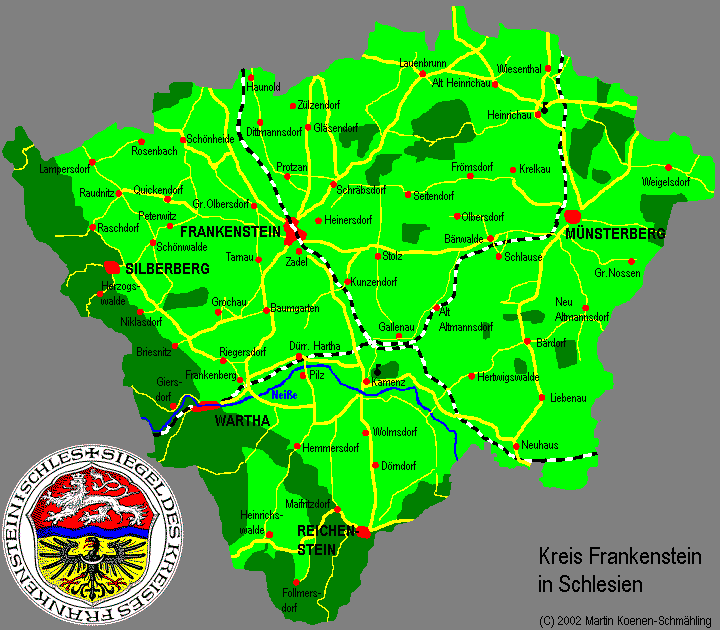
He did his apprenticeship from 1.4.1931 to 30.9.1934 with Paul Loge in Heinersdorf (today: Dziewiętlice). Specific mentions for slaughter and sausage making. His behaviour was "good". He passed his exam on 25.9.1934 at the district capital Frankenstein. He then continued to work with Loge until the end of March 1935, then half a year with Georg Noglitz in Frankenstein. Then there is an 18-month gap in his record which I assume must have been his time in military service. In 1937/38 he worked with M. Gottwald in Hertwigswalde (Doboszowice), Paul Drechsler in Kamenz, and Gustav Welz in Münsterberg. The last one had a nice rubber stamp revealing the address: Pusillusstr. 6. All places appear on this map of the Kreis Frankenstein, so the Wanderschaft didn't take him very far. Listing those names as I'm guessing any of them could be in the photos below.

Here are some photos which came without any explanations, but which to me look like they could be related to his budding career as a butcher (Willi is on the left in the first two pics, have fun spotting him in the others!):

Not at all sure what to make of this one but throwing it in anyway:

Should anybody have any answers to some of the many questions I am raising in this series, please leave a comment here (I'll need to vet it, so it may take a few days before it goes public) or contact me at michaelgrr [at] yahoo [dot] co [dot] uk

Navigation tools:

Season 3 so far:

  1. family holiday
  2. play time
  3. fashion show
  4. bakery to butcher's shop

The Mastodon thread for season 3 starts here.

You can find Season 2 entries in this thread on Mastodon (complete now!) or via the list at the bottom of the last entry of the season (and also at the bottom of the first entry of this season).

The twitter thread for season 1 is still here. Alternatively, visit the last instalment and find the numbered list of entries at the bottom.

Monday, October 23, 2023

all about cephalopods

Today's issue of Current Biology is a special on cephalopods (octopuses, squids, cuttlefish, and nautiluses) with lots of contributions on various aspects of these amazing species, with a focus on their neurobiology and behaviour. My contribution looks at the way we treat octopuses and other cephalopods and asks whether, given what we are now beginning to realise about their intelligence, it is still acceptable to farm them for slaughter, as a company in Spain is planning to do.

Octopus etiquette

Current Biology Volume 33, Issue 20, 23. October 2023, Pages R987-R990

FREE access to full text and PDF download
(open archives).

See also my Mastodon thread where I highlighted all CB features of 2023.

I'm not on Instagram myself, but I believe if you follow CurrentBiology there, you'll find my features highlighted there as well.

Cover of the special issue. Image: broadclub cuttlefish (Sepia latimanus) (photo © Kimberly Tripp Randal; instagram @KimberlyLTripp).

Saturday, October 21, 2023

three horsemen of distrust

One of the many worrying developments of our time is the growing lack of trust in objective rationally testable (and falsifiable) facts of science. I am on the lookout for explanations what went wrong with our science-based civilisation and how we can fix it, so was happy to review

Gary Smitn
Distrust: big data. data torturing and the assault on science
OUP 2023

Smith is an economist and maybe a bit more interested in the idiocies of bitcoin than I am, but otherwise he is very convincing in his analysis of three leading horsemen of the distrust apocalypse, namely disinformation, data torturing, and data mining. Ironically, all three are riding on the advances of the technological revolution that were supposed to make us smarter. Read all about it in the October issue of C & I:

What went wrong?

Chemistry & Industry Volume 87, Issue 10, October 2023, Page 34

access via:

Wiley Online Library (paywalled PDF of the whole review section)

SCI (premium content, ie members only)

As always, I'm happy to send a PDF on request.

OUP

I have no idea what the cover image is showing, but I like it.

Thursday, October 19, 2023

fashion show

Every picture tells a story, season 3, picture 3:

The middle child of the three from the bakery at Dörndorf (Kreis Frankenstein, Silesia), Emma Geppert, later gained a bit of a reputation as somebody who wanted to live the good life at the expense of others and sniffed at Hedwig's employment on farms and the associated smells. Accordingly, photos of her were buried deep and not exactly celebrated in the family. Once we identified her in the sibling photos, however, I discovered quite a few more photos of her. In these, she expresses her being different from the hardworking family in the relatively conspicuous clothes she wears - even in difficult times.

A set of three photos all dated 1.6.1941 shows her in three different outfits:

Here's one she wore earlier, dated Breslau 1938 with the remark on the back that the photo didn't turn out well.

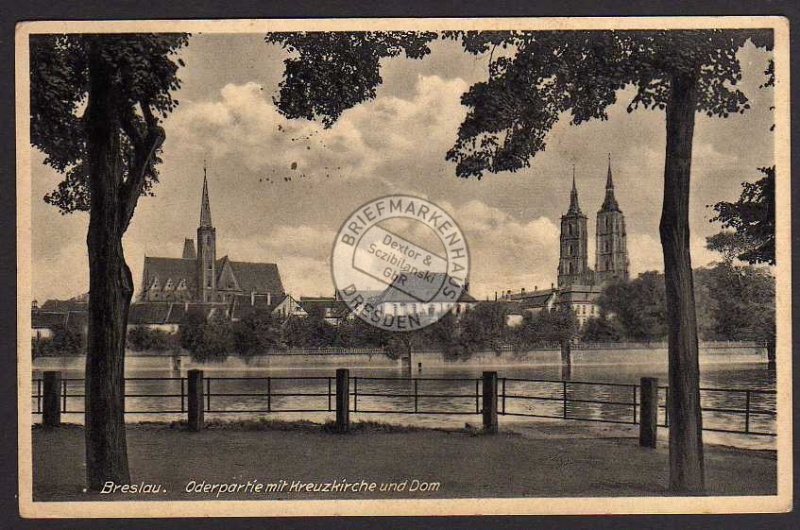
Another one from Breslau with no inscription, but the city's Kreuzkirche is recognisable on the left (in all the zillions of pre-1950 photos we have this is an extremely rare example of a recognisable cityscape showing up in the background).

Here is a postcard from 1941 of the same perspective minus Emma (hotlinked from the site that sells the postcard). Emma's photo fits in roughly between the tree on the left and the right hand side of the watermark in the middle.

Some serious dressing up went into this one, but again she wasn't quite happy with the result:

And I think this may be her as well, although less flamboyantly clothed and less round-faced, but I setting looks like the cabbage garden where they also took the sibling photos. Part of the problem with identification is that there may have been any number of cousins that may had some resemblance with the bakery kids, but other than the recently discovered portrait of Lotti Geppert we don't know anything about any of them.

Should anybody have any answers to some of the many questions I am raising in this series, please leave a comment here (I'll need to vet it, so it may take a few days before it goes public) or contact me at michaelgrr [at] yahoo [dot] co [dot] uk

Navigation tools:

Season 3 so far:

  1. family holiday
  2. play time
  3. fashion show

The Mastodon thread for season 3 starts here.

You can find Season 2 entries in this thread on Mastodon (complete now!) or via the list at the bottom of the last entry of the season (and also at the bottom of the first entry of this season).

The twitter thread for season 1 is still here. Alternatively, visit the last instalment and find the numbered list of entries at the bottom.