Friday, July 28, 2023

how the monkey got stuck

Stuck monkey is an adorable metaphor for our civilisation's dilemma - said monkey has his hand trapped in a glass jar trying to pull out a banana, and gets stuck simply by not letting go the fruit. I read and reviewed the book mainly on the merit of the title, but it does have some interesting facts too.

Stuck monkey: The deadly planetary cost of the things we love
James Hamilton-Paterson
Head of Zeus 2023

My long essay review with some thoughts on how the monkey got stuck is out now:

Stuck monkey syndrome

Chemistry & Industry Volume 87, Issue 5, May 2023, Page 35

access via:

Wiley Online Library (paywalled PDF of the whole review section)

SCI (premium content, ie members only)

As always, I'm happy to send a PDF on request.

Here's a snippet of my review:

The author goes through the environmental costs of a wide variety of things that people like to do and don’t want to give up even if it kills the planet, from keeping carnivores as pets to getting internet shopping delivered the next day. He can be devastating in deconstructing some of the more outrageous examples of planet-destroying wealth issues, such as golf courses. There are 26 of them in Phoenix, Arizona, he claims, in a location which is fast becoming uninhabitable to humans.

Wednesday, July 26, 2023

an asynchronous quartet

some thoughts on

Quartet: How four women changed the musical world

Leah Broad

Faber & Faber 2023

I’ve been a huge fan of Rebecca Clarke’s sonata for viola ever since I first heard a student playing part of it at the Oxford Music Festival quite a few years ago. Which is why I pounced at the opportunity to hear this and more music by her at the Jacqueline DuPre Music building on International Women’s Day this year, performed by Rosalind Ventris (viola), Laura van der Heijden (cello) and Libby Burgess (piano).

There was a pre-concert talk held by Leah Broad, who was there to promote her brand-new book, a group biography of four female English composers, including Clarke. It was all really lovely and inspiring so I bought a copy of her book on the spot and started looking for further female composers to add to Cowley Orchestra's music library. When I got the chance, I started reading Quartet at chapter 3, where Rebecca Clarke comes into the story. The four composers are different generations, and Clarke is the second to make her appearance. One could object to the title giving the misleading impression of four musicians performing simultaneously.

To give a brief overview, we’re talking about

  • Ethel Smyth (1858-1944): known for her operas in her lifetime
  • Rebecca Clarke (1886-1979): best known for her chamber music
  • Dorothy Howell (1898-1982): piano and sacred music
  • Doreen Carwithen (1922-2003): prolific film composer

I was a bit sceptical of the whole concept of a group biography where the lives concerned span very different times, but I came around to acknowledging that it kind of works in this case, seeing that as rare “woman composers” in the fairly limited scene of English classical music, they were all handled as curiosities, and their works were sometimes billed together in concerts or radio broadcasts. And they faced similar dangers of being forgotten as soon as they were no longer able or willing to fight for their music to get airtime. So in the end, I returned to reading the bits I missed at the beginning, and learned a lot about the other composers too, of whose work I had been entirely unaware.

In a way, it was interesting to see Rebecca Clarke’s life woven into the lives of other women who have faced similar challenges before and after her, and I’m a sucker for everything about the Bloomsbury set, to which Ethel Smyth was connected through Virginia Woolf, and I was pleased to learn that Doreen Carwithen played a cello called Perky. However, at the end of the day, I’m sticking with the Rebecca fandom and would like to see her autobiography published (and/or a full-scale biography). I should really learn some of her cello work, and perhaps also the viola sonata (of which the composer also prepared a cello adaptation).

Blackwells

Update 8.3.2025: There are another eight woman composers in the book "Sounds and sweet airs" by Anna Beer (2016), which I discovered recently and haven't read yet. Watch this space.

Monday, July 24, 2023

where there's smoke

Due to climate disruption, the world has seen a vast number of devastating wildfires in recent years, and there are some of those happening right now, even in some of Europe's favourite holiday destinations. These have received a fair bit of coverage in terms of immediate loss of property and danger to life. However, the slow-acting danger of exposure to the smoke produced has seen less attention.

In context of the recent spate of wildfires in Canada, which produced air pollution choking major US cities, the issue was raised, however. Therefore, I've looked into the science of the health risks associated with exposure, both to humans and to wildlife. The resulting feature is out now:

Breathing wildfire smoke

Current Biology Volume 33, Issue 14, 24. July 2023, Pages R743-R745

FREE access to full text and PDF download

See also my Mastodon thread where I highlighted all CB features of 2023.

I'm not on Instagram myself, but I believe if you follow CurrentBiology there, you'll find my features highlighted there as well.

Due to climate change and anthropogenic disturbances, extreme wildfires are becoming more frequent and are likely to affect human health and animal survival. (Photo: Robert Lang Photography.)

Saturday, July 15, 2023

fiddling with fiddles

After the surprising success in restoring my aunt's ancient violin last November, I started to think I'd like to do a little light lutherie more often, so I'm now doing my own repairs and looking out for instruments that need saving. Last week I had a tiny little repair job when the tailgut broke on the old violin. It broke near one end, so I just tied up the new end with the old string, did a bit of flame melting and that was it. When I shared this on facebook, a musical friend commented approvingly on "piracy in lutherie", so here I have my new tag for these endeavours, pirate luthier.

This week I rehaired Heinrich's old cello bow. It had been done professionally in 2009, when the young cellist started playing the full-sized instrument. As they always used a different bow, the 2/3 of hair missing now from Heinrich's bow are all my work (playing almost daily for the last six years, and up to an hour per day during the Plague Year Bach Project). The rehairing went ok - it's not looking quite as neat as a bow set up professionally, but it works perfectly fine and will serve me a few years I'm sure.

This week I also picked up a stray violin in need of repair from a folkie friend who is leaving the country. Its soundpost had come off and it was missing the E-string. Fortunately, the soundpost had a wedge-shaped hole on the side facing the F-hole, so rather than fiddling with the gripping mechanism I concocted the last time, I could wedge the sharp end of my bent wire into that hole and just pull it out once the post was in place. That worked better and quicker than the last time. Within 20 minutes I had the soundpost where I wanted it.

Here's a photo of the setup showing the helpful hole:

Looking at that photo now, I may want to experiment with moving the bridge a little bit closer to the soundpost. Easier than moving the soundpost closer to the bridge. Buchanan's book says it should be closer for "well-arched models" and further away for flatter fiddles, but I'm not sure where this one stands in terms of archedness.

It is a cheap violin that doesn't sound very good (Paragon, made in China, I believe), but to my ear it is a bit better than the Stentor "Andreas Zeller" we had since 2015 (and actually paid money for, at the antiques fair in Gloucester Green), although not as good as the old family fiddle which I am now playing regularly. So here's the trio of them in ranking order:

All three are now ready to play, so I might do a comparison video one day.

I also have another Stentor fiddle (a Student I found ridiculously cheap on gumtree), which I'm plundering for accessories and spares. On that one, the peg of the A-string is slipping and I have so far failed to make it stick. - Update: looking at it again after writing this, I realised that the reason is a crack in the scroll going all the way from the peghole to the top of the scroll, on the side of the peg handle. Silly and trivial, but maybe not worth fixing? Especially as the sound (tested just now with the A string attached to the E peg) is clearly the worst of all four fiddles. I guess I'll just continue using this one as a quarry for whatever parts I may need ...

Monday, July 10, 2023

prime time for primates

It's always handy when a whole bunch of papers on a suitable topic arrives in a package - saves me the trouble of having to look for them in different places. So when Science magazine published a special issue on a major release of primate genomes and additional research based on these, I grabbed the opportunity to do a feature about them, which is out now:

A tree full of primate genomes

Current Biology Volume 33, Issue 13, 10. July 2023, Pages R699-R702

FREE access to full text and PDF download

See also my Mastodon thread where I highlighted all CB features of 2023.

I'm not on Instagram myself, but I believe if you follow CurrentBiology there, you'll find my features highlighted there as well.

The phylogenetic history of macaques in Asia has also been complicated by hybridisation and admixture. The image shows long-tailed macaques (Macaca fascicularis). (Photo: Martin Harvey/Getty.)

Sunday, July 09, 2023

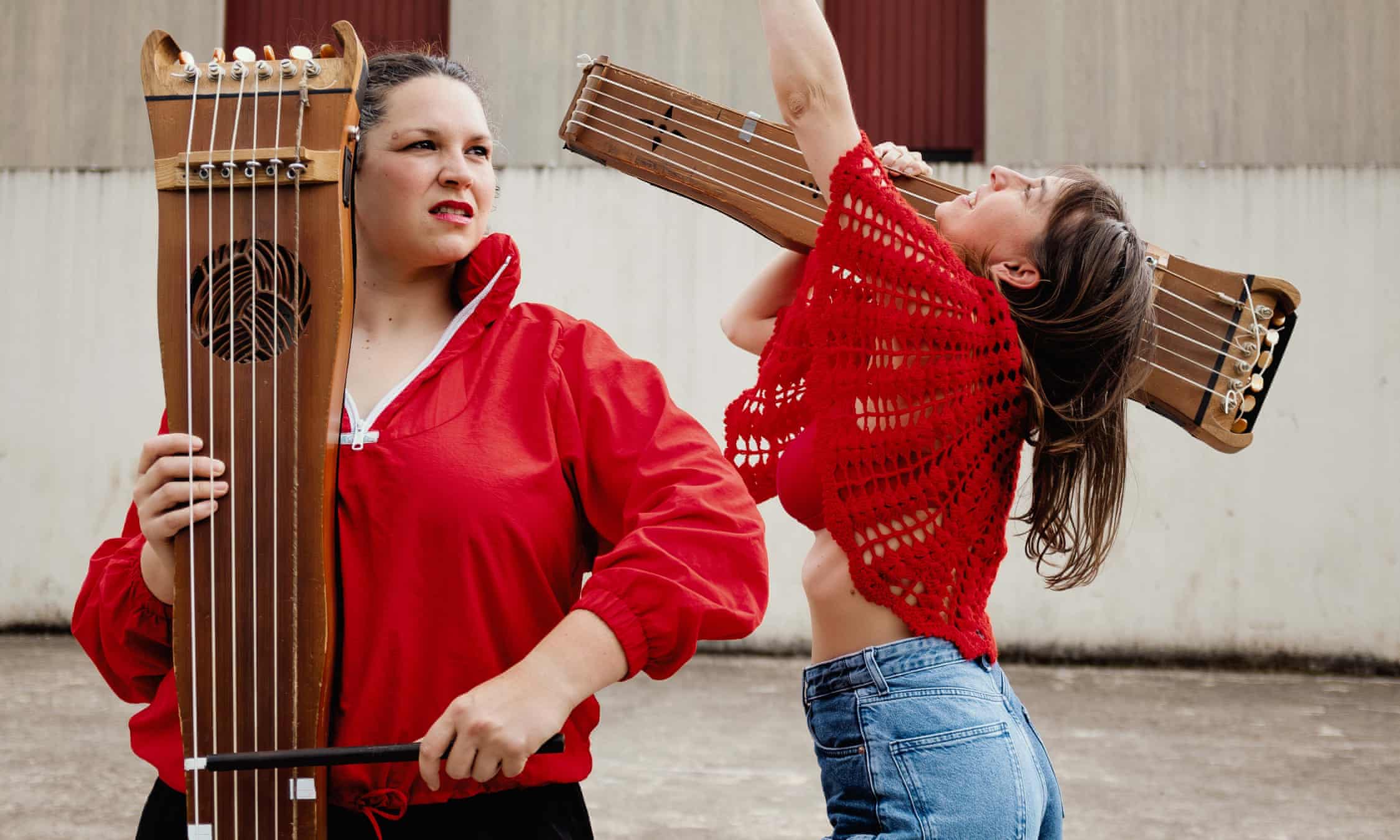
string drum

This week I stumbled across an unusual instrument I had never heard of before, so I need to obsess a bit about it and pile up a few links here.

So the story is I saw this piece in the Guardian how the Occitan language, which the central governments of France have tried to eradicate since the time of the troubadours, is today kept alive by a hardy bunch of folk musicians, including the band Cocanha (presumably the Occitan equivalent of French cocagne, as in pays de cocagne = paradise?). The picture in the Guardian showed members of Cocanha carrying this strange instrument:

hotlinked from the Guardian article

In this lovely video, you can see them playing the instrument - it is obviously a tuned percussion instrument which they beat with a stick:

I looked up their website but didn't get any answer except percussion. Finally, looking up the French Wikipedia entry of the group, I learned that it is a Tambourin à cordes or Tambourin de Bearn, in English also called a string drum. The strange shape is built so you can wedge it under the arm that plays a single-handed whistle (as in pipe and tabor) while beating it with the other arm. The English Wikipedia entry shows photos of how this is done.

PS Although I have seen performances in medieval Occitan, I wasn't quite aware that the language is still being spoken today, so that article brought two revelations at once. I understand that it is quite close to Catalan. I'm a bit confused about the terms Occitan, Provençal (made famous by the Nobel winning writer Frederic Mistral) and Franco-Provençal, but as the Edition L'harmattan doesn't seem to have the title "Occitan" in their fabulous series "Parlons ...", I assume that the title Parlons Provençal is actually about the same language. Separately, they also have a book called: L'occitan tel qu'on le parle (Occitan as it is spoken).

Saturday, July 01, 2023

how to fiddle

I’ve been playing wrong notes on our old family cello with Cowley Orchestra since 2017, and have always been intrigued by the history of this ensemble, which is basically built on a cupboard full of sheet music. Some of our sets have labels from the early 20th century saying “Oberon Symphony Orchestra” and some carry the address stamp of Henry F. Gosling in Ilford, Essex.

It was in fact Gosling who re-founded the orchestra in Oxford when he moved here in 1948. Before that, he had been running the Oberon Orchestra in Ilford, as well as the Ilford Civil Military Band and Orchestra, and teaching violin there.

Last November, when I started playing my aunt’s ancient violin, I remembered that in earlier snoopings into the history of our orchestra I had come across a book that Gosling wrote about violin playing, published ca. 1935. Now I had a good excuse to actually order a copy, so I did. (The copy I got was rebound for a library in 1941, so nothing to show in terms of cover art, just a plain black hardback.)

The title of the book is worth admiring in full:

The Violinist's Manual
A Treatise on the Construction, Choice, Care, Adjustment, Study and Technique of the Violin
Containing much Useful and Practical Advice regarding the Violin and the Bow

I read bits and pieces of it, skipping the things that have been made obsolete by more recent research, like the description of the origins of string instruments. At the very end, the book includes a couple of pages about orchestra playing, which are hilarious in that they contain advice we still follow today, such as not to play every note if the music is too difficult. He really does endorse the spirit of amateur music making for the benefit of learning about the music rather than for a perfect rendition of it.

By contrast, the parts of the book about violin technique and practice are sometimes a bit stricter – in line with the prevailing opinion of his time, I am sure – in that he sniffes at light music and jazz, and is uncompromising on the practice of scales and challenging pieces of good music. Every now and then, however, he remembers that not everybody is destined to be the next Paganini, so we have an appreciation of the easy playability of the third position as the “amateur’s paradise” to cheer us up. In the repertoire recommendations, he includes some of his own compositions,such as Melodie, Oberon Minuet and Furioso, all allegedly published by Siena, but sadly I can't find them in IMSLP.

Until reading the book I used a very folk-like posture in the left hand, supporting the neck of the instrument with my palm. I find this relaxing in the wrist, but tense for the third finger, which has to bend quite tightly. As Gosling insists that the tip of the thumb, rather than the hand should support the neck of the violin, I tried his position and ended up with a more comfortable feel in the fingers, but some pain in the wrist. So I’m still looking for a way that keeps all my joints happy. (Back in April I may have played too many hours at the Folk Weekend sessions, after that my joints have been limiting practice time.) Using the lower joint of the thumb as a contact point may be a viable compromise.

The book comes with photos of a man demonstrating posture and hand technique. There is no credit for photographer or model, so I am left wondering whether the fiddler is Mr Gosling himself or maybe one of his adult students …

Previously, he appears to have published an essay called "Music and its aspects", which I have yet to track down. Also, if anybody out there knows biographical data for Henry F. Gosling, I’d be keen to hear and maybe prepare a Wikipedia entry for him. The only personal information in the book is the poetically shaped dedication at the front:

To my Wife,
Gladys Marion,
this Work is Dedicated.

One of the photos demonstrating the hold of the instrument. To me the left arm looks uncomfortable. I remember adjudicators in string classes at the Oxford Music Festival telling pupils to hold the instrument more to the side, to have a more relaxed left arm, and this certainly works for me. I could find no credits for photographer or model in the book, so these may well be selfies of the author?

PS in other violin news, this week the tailgut broke overnight, leaving the instrument in a rather scary looking mess with the bridge fallen down and the strings all over the place. It appears to be the original, "organic" gut (real gut, I suppose?), and looking at the intact end I figured out it appears to have been molten with a flame and then secured with a bit of string. Which is what I did with the broken end, and it worked like a charm. Only later it occurred to me to look it up in Buchanan's book, and it turns out that this is the official method for these old style tailguts. All tuned up and back in playing order now.

Tuesday, June 27, 2023

playing cello saves lives

Some thoughts on

Inherit the truth / Die Wahrheit erben

by Anita Lasker-Wallfisch

Giles de la Mare 1996 / Weidle Verlag 1997

I had been aware of Anita Lasker’s biography – the cellist who survived both Auschwitz and Bergen Belsen – for many years, and I actually saw her son Raphael Wallfisch performing the Dvorak concerto at the Sheldonian Theatre some time in the noughties, so I felt kind of acquainted with her family already. However, a copy of her actual memoir only crossed my path now,* and I read it immediately.

She wrote the book in English for her children and grandchildren, but prepared the German version herself, which is the one I read. The book is very short considering the weight of events covered and focuses on the anecdotal events that added up to her and her sister’s survival against the odds. Like Hadley Freeman in her family memoir House of Glass, she is very good in highlighting the absurd coincidences that can decide your life and death in the context of the Nazi system setting out to kill you.

In short, her parents were born in an area that became part of Poland after 1918, which meant that in the US system of refugee quotas they were counted as Polish Jews, and had no chance at all to find asylum that way, even though her uncle, the chess master Edward Lasker, was a US citizen by then. When called up to be deported, her parents obeyed and soon disappeared without a trace.

With no parental supervision, Anita and her sister Renate got involved in forging documents to help people escape, which earned them jail terms and probably saved their lives when they arrived at Auschwitz, because convicted criminals were registered in case they were needed for further testimony in court cases.

Once in Auschwitz, Anita’s cello playing saved her life in the longer term, as she was admitted to playing in the girls orchestra. As the only cello in the small ensemble, she was clearly indispensable. Indirectly, it saved Renate too, with the reconnection made via an unlikely chain of events carried by Anita’s unusual shoes.

Compared to the privileged position at Auschwitz, the last winter of the war at Bergen Belsen turned out to be much worse, with prisoners being left to starve and rot in situ rather than being murdered and disposed of efficiently, but with further luck and resilience both sisters made it through.

After liberation of the camp, the focus returns from bare survival to the second most important thing, namely finding a cello and music to play with it (the Bach suites get a mention in this context). Oh, and getting out of Germany. All of which proves challenging but doable. So, in summary, playing cello saves lives.

I do love the photo of her they used for the cover of the English edition. My edition has a badly drawn cello on the cover, but this photo (among others) is reproduced inside the book and I was tempted to scan it for the blog. It is captioned Berlin 1938. (She went to study cello in Berlin but soon had to return to her family home at Breslau.) I will look out for the English edition too. Blackwells

UPDATE 7.8.2023 In a book exchange, I just discovered a German paperback edition (rororo) using the photo as well (and without the red hue).

Some related links:


* Note: I found a signed copy of the book in my late father's extensive collection of Holocaust-related books. One of the things he forgot to mention to me, otherwise I would have read it a lot earlier. It's also too late to find out whether he (or if not who else) met the author to get the autograph.

Thursday, June 22, 2023

the house Johanna built

Every picture tells a story, season 2, picture 40:

Johanna Kauer, the oldest of the five daughters of the station master of Adamsweiler, worked as a secretary at the Berufsschule (vocational college) Bad Kreuznach and then took early retirement on (slightly dubious) health reasons. In 1934, she built herself a house in the village of Hahnenbach, where her cousin Ferdinand Giloy ran the pub and owed her money. She got the land from him in lieu of repayment. She shared the house with various family members including her niece Ruth and her children (1943-1945) who had used Johanna's health as an excuse to get out of Königsberg in good time; her sister Kätha (1943-1953), and her cousin Ferdinand Weirich (1945-1952).

Here she is contemplating her home in 1943:

An even earlier photo shows the house with its bare walls:

Not sure who is standing outside the door on the right, could be Ruth on the right and Johanna peeping round the corner, but this is just a guess.

And here is one from the early 1960s, when Johanna's niece Ruth and her husband Richard moved in.

After their children had finished school, they gave up their flat in Idar-Oberstein to move to the sticks (not my idea of fun), which meant they had to buy the car shown in the picture (an Opel Kapitän I believe) so Richard could commute to his school. Before the move their home was literally just across the road from the school.

Johanna kept quite a few things from her parental household including an encyclopedia from the 1870s and various pieces of 19th century furniture and kitchen equipment. Since then, the possessions of various households have also washed up there when people had to flee (eg from Königsberg) or died. Thus, the house remains a treasure trove for family history, and one of the main sources of the photos I am sharing in this series. Most recently, I looked through the cookery books (which I'm not really interested in) and discovered the hand-written recipe book of Maria Pfersching, wife of Heinrich the cellist).

Johanna also made a key contribution to our family history by manually copying the Weis chronicles from 1891. Her copy survives, while the original has gone missing. She also kept letters from lots of relatives, which are now a precious resource.

In the spirit of its history of housing refugees, it is now home to two displaced persons from Ukraine. If and when that war ends without triggering the nuclear apocalypse, we will have to find a new usage model for the house, as currently there is nobody who wants to live there and look after the house. It really is quite remote, 5 km from the nearest town.

UPDATE 27.8.2023: I just added a few recent photos of old things found in the house to my flickr and tagged them Hahnenbach. I also went through earlier uploads to apply this tag more systematically.

Should anybody have any answers to some of the many questions I am raising in this series, please leave a comment here (I'll need to vet it, so it may take a few days before it goes public) or contact me at michaelgrr [at] yahoo [dot] co [dot] uk

Navigation tools:

With this post I'm closing season 2 (there are still plenty of photos left for a third season). So this is the table of contents of the entire season:

  1. could be a cousin
  2. two weddings in Silesia
  3. off to Canada
  4. off to Australia
  5. a very romantic poet
  6. fireman August
  7. 50 hundredweight of coffee
  8. mysterious Minden people
  9. horses for Hedwig
  10. guessing the great-grandmothers
  11. cousin Charlotte
  12. three sisters from East Prussia
  13. travelling saleswoman
  14. family portrait
  15. dancing chemist
  16. games time
  17. desperately searching Wilhelm
  18. the third Hedwig
  19. patchwork portraits
  20. missing brothers
  21. the oberlehrer's family
  22. a double wedding
  23. mystery solved
  24. young Frieda
  25. old aunts and young children
  26. a semi-mysterious aunt
  27. a gathering at Gellrichs
  28. farm work at Bad Landeck
  29. meet the Weitze family
  30. a post-war wedding
  31. the joy of chemistry
  32. the joy of botany
  33. becoming Frieda
  34. becoming Peter
  35. bakery kids united
  36. the four from the farm
  37. neighbours at Hamborn
  38. family with fowl
  39. the elusive Nagel clan
  40. the house Johanna built

I started a twitter thread for season 2 here. However, as the bird site seems to be turning into an evil empire, I have now switched to logging the entries in a similar thread on Mastodon.

The twitter thread for season 1 is still here. It only loads 30 tweets at first, so you have to click "show more" a couple of times to get all 40 entries. Alternatively, visit the last instalment and find the numbered list of entries at the bottom.

I'm also adding all photos from this series to my family history album on flickr.

I also should mention from time to time that this whole thing with old photos has been influenced by all the orphaned photos I see on flea markets, and by this little book I found at Oxfam 14 years ago.

Monday, June 19, 2023

bird flu takes off

Bird flu only gets media attention very briefly each time it either affects industrial poultry farming or poses a danger to establish itself in humans as a new virus strain. It usually stays limited to the flu season, too.

The current outbreak is different in a number of important ways, however. It has left the seasonality behind, has spread around the globe, and killed large numbers of other animals too, especially marine and coastal mammals. It is thus a lot more worrying than recent outbreaks, and could have implications ranging from species extinctions through to another human health crisis. Which is why I had a closer look at it in my latest feature which is out now:

A flying pandemic

Current Biology Volume 33, Issue 12, 19. June 2023, Pages R659-R662

FREE access to full text and PDF download
(will become open access one year after publication)

See also my Mastodon thread where I highlighted all CB features of 2023.

I'm not on Instagram myself, but I believe if you follow CurrentBiology there, you'll find my features highlighted there as well.

Sandwich terns (Thalasseus sandvicensis) along the coasts of northern Europe have been suffering mass mortality in the current outbreak of H5N1 avian influenza. (Photo: Trish Hartmann/Flickr (CC BY 2.0).)

Thursday, June 15, 2023

the elusive Nagel clan

Every picture tells a story, season 2, picture 39:

In season 1 we met Luise Schilling, mother of Heinrich Nagel, the station master of Minden Stadt, wearing the elaborate festive costume of the rural surroundings of Minden. Running a farm while trying to feed 11 children born 1863-1887, the family got into financial difficulties and in 1900 had to sell the farm. So, understandably, there aren't many photos of the family with the kids growing up at a time when photography was still very much a luxury. I fact, this is the only one I know of, showing Luise with her husband, Christian Nagel, called Giesselmann, and their youngest child Sophie:

Sophie later married Heinrich Brunschier and had a daughter also called Sophie, who was the younger cousin of Frieda the pianist and may have been the girl in the picture we saw a few weeks earlier. Here I think we may have Sophie mother and daughter but I'm not entirely sure about that as the source where I pinched the photo failed to identify the younger woman.

Should anybody have any answers to some of the many questions I am raising in this series, please leave a comment here (I'll need to vet it, so it may take a few days before it goes public) or contact me at michaelgrr [at] yahoo [dot] co [dot] uk

Navigation tools:

Season 2 so far:

  1. could be a cousin
  2. two weddings in Silesia
  3. off to Canada
  4. off to Australia
  5. a very romantic poet
  6. fireman August
  7. 50 hundredweight of coffee
  8. mysterious Minden people
  9. horses for Hedwig
  10. guessing the great-grandmothers
  11. cousin Charlotte
  12. three sisters from East Prussia
  13. travelling saleswoman
  14. family portrait
  15. dancing chemist
  16. games time
  17. desperately searching Wilhelm
  18. the third Hedwig
  19. patchwork portraits
  20. missing brothers
  21. the oberlehrer's family
  22. a double wedding
  23. mystery solved
  24. young Frieda
  25. old aunts and young children
  26. a semi-mysterious aunt
  27. a gathering at Gellrichs
  28. farm work at Bad Landeck
  29. meet the Weitze family
  30. a post-war wedding
  31. the joy of chemistry
  32. the joy of botany
  33. becoming Frieda
  34. becoming Peter
  35. bakery kids united
  36. the four from the farm
  37. neighbours at Hamborn
  38. family with fowl
  39. the elusive Nagel clan

I started a twitter thread for season 2 here. However, as the bird site seems to be turning into an evil empire, I have now switched to logging the entries in a similar thread on Mastodon.

The twitter thread for season 1 is still here. It only loads 30 tweets at first, so you have to click "show more" a couple of times to get all 40 entries. Alternatively, visit the last instalment and find the numbered list of entries at the bottom.

I'm also adding all photos from this series to my family history album on flickr.

Thursday, June 08, 2023

family with fowl

Every picture tells a story, season 2, picture 38:

I'm loving this family portrait dating between 1913 and 1916:

The lady sitting down with the chicken on her lap is Maria Mentzel, the mother of our old cellist Heinrich. She died in April 1916 so that sets the upper limit for the date of the photo. Her husband, railways clerk Richard Groß, had died in July 1913, which sets the lower limit.

Standing from right to to left we have Heinrich's older sister Gertrud, then his even older half-brother Arthur Reim (who also appeared in this family portrait, but otherwise I don't think I have any other photos of him), then Arthur's wife Liesel (Elisabeth) Güde, and finally an unidentified woman.

Arthur and Liesel had one daughter, Maria. She married Erich Tübel, who took over a dance school his parents had founded in Pulsnitz (near Dresden), so this family business shaped their lives through several generations. Last time I checked the dance school was still in business run by one of Maria's grandsons, but in a different city.

Anyhow, here is Maria with a growing number of children:

I think the granny in this one is Liesel Güde again, right?

Should anybody have any answers to some of the many questions I am raising in this series, please leave a comment here (I'll need to vet it, so it may take a few days before it goes public) or contact me at michaelgrr [at] yahoo [dot] co [dot] uk

Navigation tools:

Season 2 so far:

  1. could be a cousin
  2. two weddings in Silesia
  3. off to Canada
  4. off to Australia
  5. a very romantic poet
  6. fireman August
  7. 50 hundredweight of coffee
  8. mysterious Minden people
  9. horses for Hedwig
  10. guessing the great-grandmothers
  11. cousin Charlotte
  12. three sisters from East Prussia
  13. travelling saleswoman
  14. family portrait
  15. dancing chemist
  16. games time
  17. desperately searching Wilhelm
  18. the third Hedwig
  19. patchwork portraits
  20. missing brothers
  21. the oberlehrer's family
  22. a double wedding
  23. mystery solved
  24. young Frieda
  25. old aunts and young children
  26. a semi-mysterious aunt
  27. a gathering at Gellrichs
  28. farm work at Bad Landeck
  29. meet the Weitze family
  30. a post-war wedding
  31. the joy of chemistry
  32. the joy of botany
  33. becoming Frieda
  34. becoming Peter
  35. bakery kids united
  36. the four from the farm
  37. neighbours at Hamborn
  38. family with fowl

I started a twitter thread for season 2 here. However, as the bird site seems to be turning into an evil empire, I have now switched to logging the entries in a similar thread on Mastodon.

The twitter thread for season 1 is still here. It only loads 30 tweets at first, so you have to click "show more" a couple of times to get all 40 entries. Alternatively, visit the last instalment and find the numbered list of entries at the bottom.

I'm also adding all photos from this series to my family history album on flickr.